It’s Getting Closer! The Next Article

Anyone looking at my publication record is soon going to be mightily confused. The article about Sir John Macgregor Murray concerns a Highlander who lived from 1745-1822. I wrote it at a time when I was still researching Scottish music collecting and publishing in the late eighteenth- and early nineteenth-centuries.

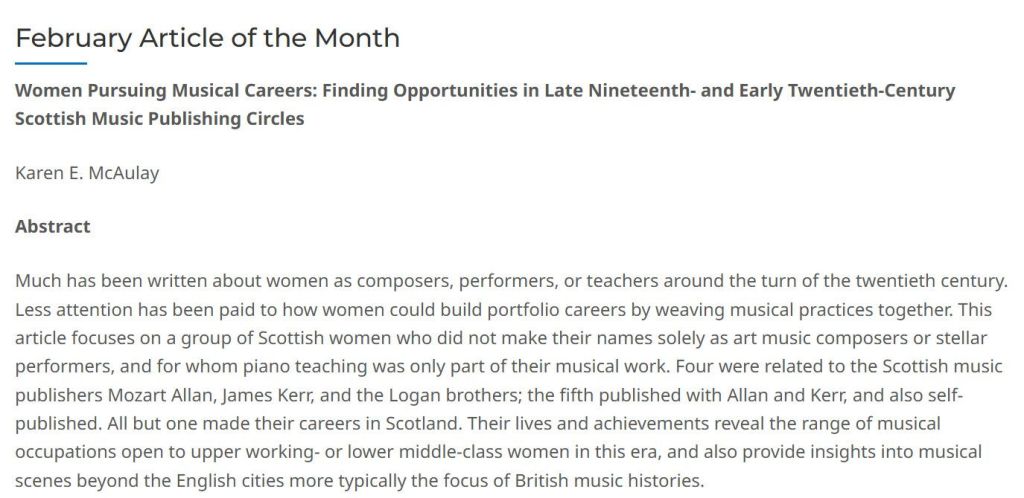
Today, I received the final proofs for the next extensive article. This time, it’s about Scotswomen with portfolio music careers in the late nineteenth- and early twentieth-centuries. (Two of them were of English parentage, but let’s not quibble!) A spin-off from my latest book, in the sense that I turned my focus onto a number of individuals who had hung around in the shadows of the book, this article extends over some 22 pages, and luckily there wasn’t a great deal needing changing in the proofs.  But the instructions for using the proofing system extended over 49 pages, and there was also a ten-step quick tour of the process. I nearly had a fit at the sight of the former, but the latter told me nearly all I needed to know. Job done.

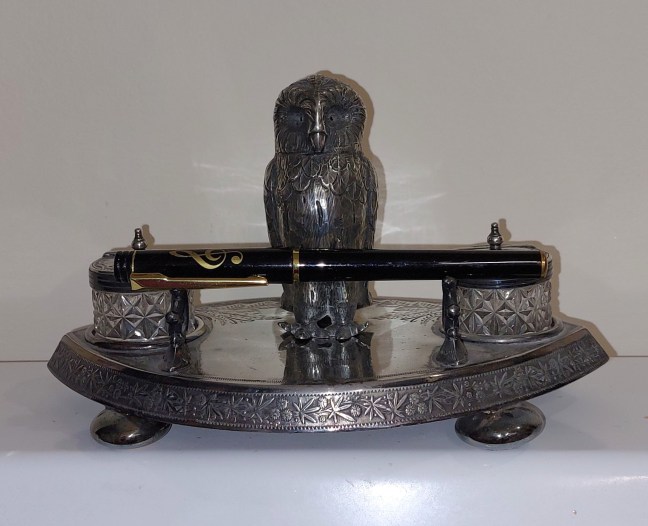
There are still more articles in the pipeline; I’ll flag them up as they come along! Meanwhile, there’s the small matter of Christmas requiring my attention during the semi-retired part of my existence, not to mention the continued tidying up of our poor scarred, rewired residence! But first, I need stamps …

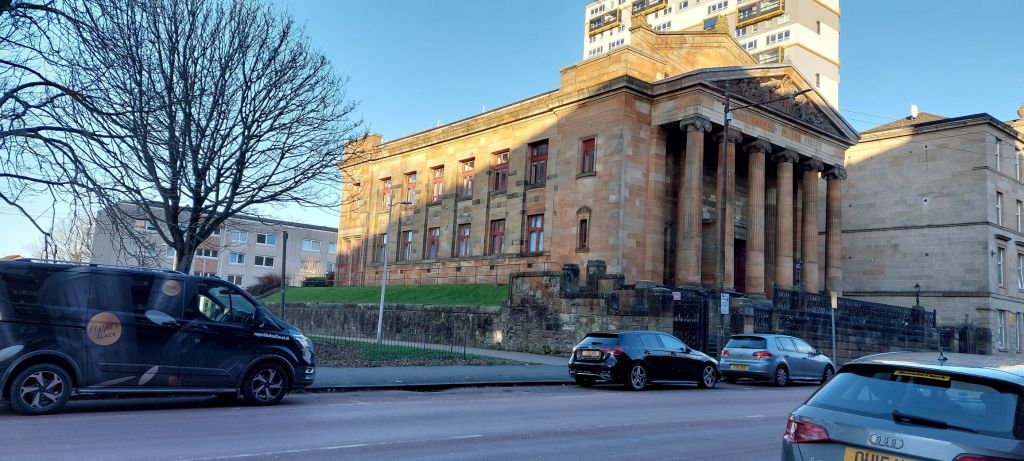
Image: Glasgow Athenaeum, forerunner of the Royal Conservatoire of Scotland (Wikimedia Commons) – where two of ‘my’ musical ladies received their advanced musical training.

Mystifying Timewarp Challenge

It’s not as though I’m unaccustomed to what I’ve been doing in odd moments for the past few days.  Over the years, I’ve opened dozens, indeed hundreds of old song books and other music publications, trying to read their prefaces, annotations and harmonic arrangements as though I were a contemporary musician rather than a 21st century musicologist.  Looking at music educational materials is likewise not new to me.

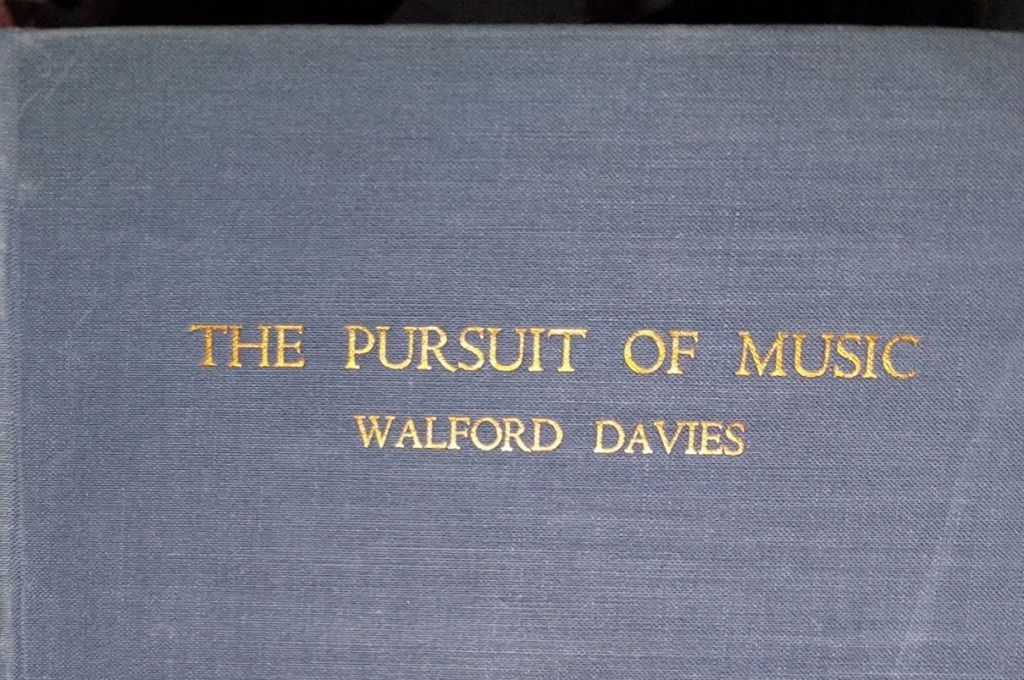
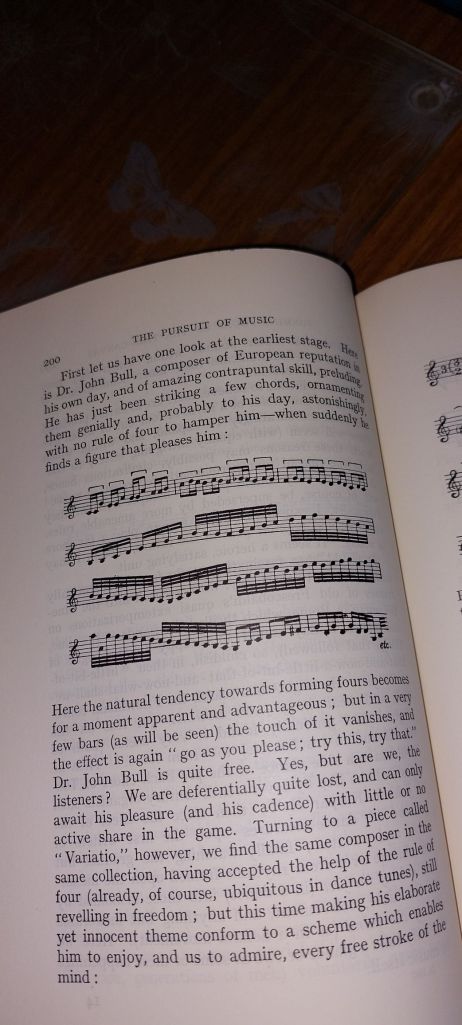
Enter Dr Walford Davies and his The Pursuit of Music

He was the first music professor at the University of Aberystwyth, but he was also hugely popular in the 1920s-30s through his broadcasting work – fully exploiting the new technology of wireless and gramophone for educational purposes, and to share his love of music with the ordinary layman wishing to know more about all they could now listen to. This book was written after he’d mostly, but not entirely retired.

It wasn’t exactly what I expected! If I thought he would write about what made the Pastoral Symphony pastoral, or Die Moldau describe a river’s journey, I rapidly had to change my expectations. 

His audience was apparently not just the average layperson, but also young people in their late teens, not long out of school. If the reader didn’t play the piano, they were urged to get a friend to play the examples for them.  (Considering the book is over 400 pages, you can imagine how long they’d be – erm – captive!)

Dedication

And this was aesthetics, 90 years ago. I struggled to get into the mindset of a layperson wanting to know what music (classical, in the main) was ‘about’, without knowing what a chord was, or realising that music occupies time more than space. Would I have benefited from that knowledge? Would being told in general terms what the harmonic series was, have helped me appreciate the movements of a string quartet? Or Holst’s The Planets?

It wasn’t about musical styles over the years. I didn’t read it cover to cover, but neither did it appear to explain musical form and structure as I would have expected.

Davies’ biographer, H. C. Colles, did comment that it was a mystifying book, and suffered from the fact that the authorโ€™s strengths were in friendly and persuasive spoken, not written communication.

I’ve only heard snatches of his spoken commentary, so I can’t really say.ย  Apart from which, Colles made an observation about Davies’ written style. Colles was a contemporary authority who knew Davies personally – and he may have been picking his own words carefully, so as not to cause offence. My own disquiet is more a matter of content:ย  was it what his avowed audience needed, to start ‘understanding music’?

I think I have been mystified enough.

I wonder what the Nelson editors made of this book by one of the great names of their age? They published it, and I think regarded him as a catch, but what did they actually think?!

And did the layperson, assuming they got through the 400+ pages, lay it down with a contented sigh, feeling that now they understood music?

Don’t Give Up Too Soon

I have a tiny cutting on my pinboard, which reminds me that,

Many of life’s failures are people who did not realise how close to success they were when they gave up. – Thomas Edison

It’s painfully true in life, but it’s also particularly pertinent in archival research!

Yesterday, I was trawling the most random of files. To be fair, a couple were even labelled ‘Miscellaneous’ in the handlist. However, they date from an era I need to know more about, so I was going to look at them!  I entered a rabbit warren of curiosities.

  • Rejections, marked ‘Refused’, or ‘Returned’
  • Objections:- ‘You interviewed my son and sent him for a medical before deciding he was too old for an apprenticeship. Why?’ [My precis, not a quote]
  • Union matters. ‘If you don’t join the union, you put yourself and us in a difficult position  because we can’t work alongside you’ [again, my summary]
  • Sob stories, like the widow whose friends said her story ought to be made into a film, or a book. Apparently, she was robbed and then incarcerated in a lunatic asylum in America, and now she wanted Nelson’s to publish her story of those calamities … (‘Refused‘)
  • Inks
  • Plant (machinery)
  • An Indian paper mill under the mistaken impression that Nelson’s were interested in a collaboration  …

By 4 pm, I had a splitting headache, and was quickly flicking through pages as fast as I dared – the paper was fragile, and I still  didn’t want to miss something important.

Why not admit defeat and give up on this box file?, I mused. There was nothing relevant in it. Interesting, but irrelevant.


Note signed by composer Peter Warlock
Note from Warlock to a song book compiler

Then I saw it. A beautiful little note from no less than British composer Peter Warlock! In the grand scheme of things, it’s not of huge significance – it’s just an apology for his delayed response,  and a request to correct a small detail before publication  – but it does confirm the editor’s identity (something I hadn’t yet managed to do, apart from finding a footnote in someone else’s biography), and it reminds me  that I should index the Nelson collection that contains Warlock’s unison choral song. 

This handwritten note from March 1929 was written less than two years before  Warlock died on 17 December 1930, aged only 36.  He is thought to have committed suicide over a perceived loss of his creativity.  I believe he was something of a tortured soul, though I’m not familiar with his detailed biography.

I so very nearly didn’t find this note! Yet again, that maxim has proved true. Dogged persistence wins every time.ย  The tragedy is that Warlock (Peter Heseltine) was too tormented to be able to keep going at all. What else might he have achieved? How much more might he have written?

Fame! Flora Woodman and Robert Wilson under the Spotlight

I’m giving a paper at a forthcoming conference at the University of Surrey: Actors, Singers and Celebrity Cultures across the Centuries.

It takes place from tomorrow, Thursday 12 to Saturday 14 June 2025, and is organised under the aegis of the University’s Theatrical Voice Research Centre.

My talk’s entitled, ‘Comparing the Career Trajectories of Two Scottish Singers: Flora Woodman and Robert Wilson‘.ย 

The Gowns! The Kilts!

I could write plenty about their concert attire alone (think lace, diamonds and fluted frocks, or smart kilts and jackets) – but obviously, I can only just brush past that particular clothes rail, considering the more significant observations that I’m also making.

Booseyโ€™s Ballads

Today, I’d like to share some audio that won’t be making it into my talk. Let’s call it ‘extra content’.  I’ve recorded some of the Boosey-published ballads that Flora performed at their Royal Albert Hall concerts.  Since I’m not a trained singer, I’ve done my best to convey an impression solely on the piano.  (I’m not going to start singing here!)  I also highlight some of the themes in these songs – captured hearts, broken hearts, the joys of spring and of youth.  It’s surprising what you find, if you really look.

Here goes:-

New Technology! From Early Plastic Recorders to Tape Recorders and Long-Playing Records

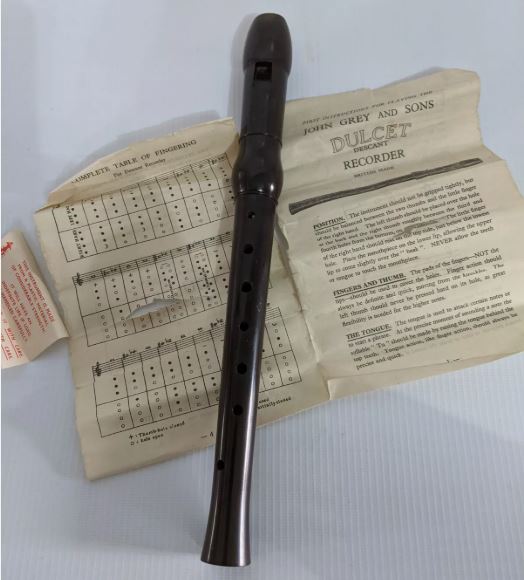
Dulcet plastic recorder by John Grey and Sons

They wondered where I was in the Uni Library this morning  – I was off looking at old magazines in the National Library of Scotland!

Queuing for 10 am!

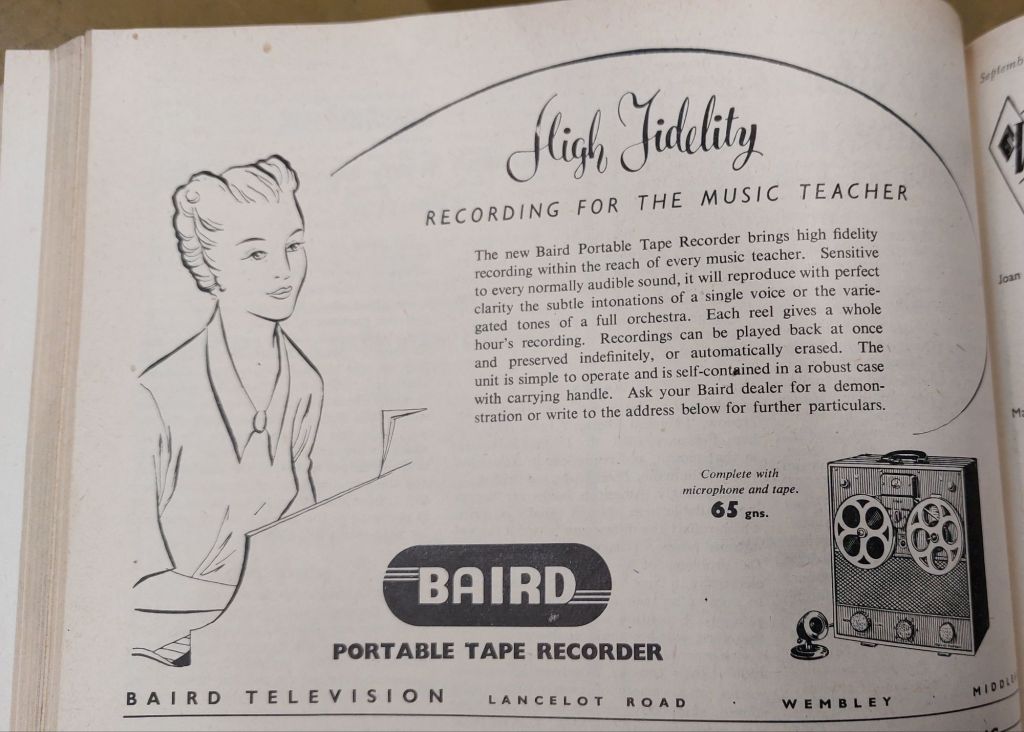
High Fidelity

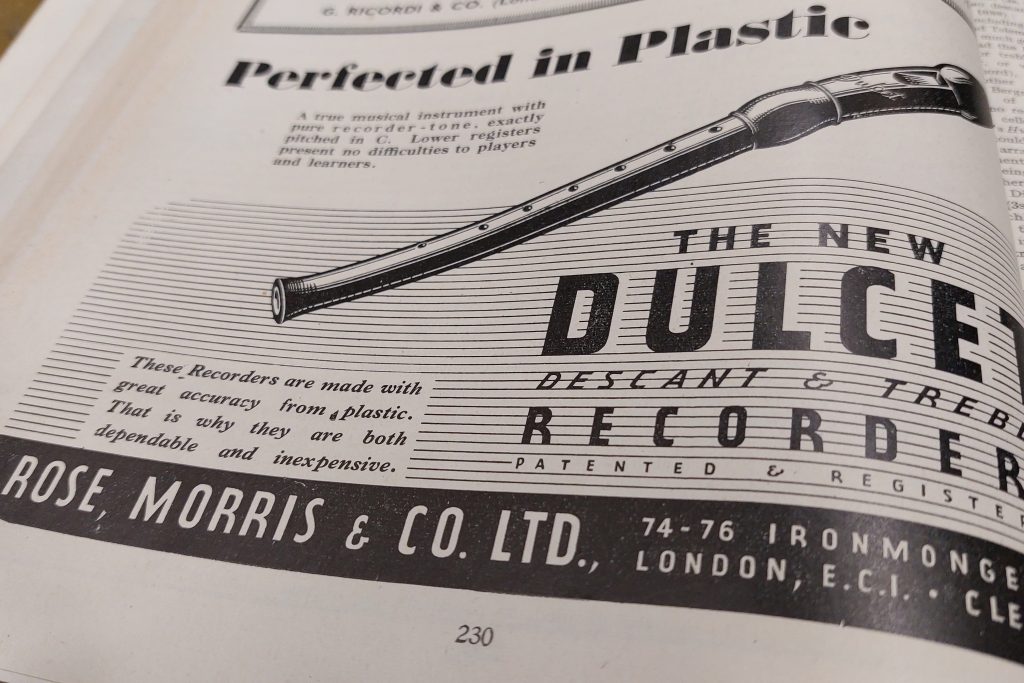
I did find a couple of book reviews and an advert, which is what I was looking for. But I was also drawn to other adverts for long-playing records, tape recorders and plastic recorders! Here we are today, with our phones, mics, streaming services and laptops, whilst a wooden recorder is much more eco-friendly, not to mention authentic. But in post-war Britain, all this shiny new stuff was the last word in modernity! 

As for a record that held four times as much music as a 78? Who wouldn’t want such an innovation?! 

Oh, and I spotted another ‘innovation’: folk songs with guitar chords. The times they certainly were a-changing. (And this was a decade before Bob Dylan’s song!)

Anyway, I filled in a couple of gaps in my knowledge by ploughing through eight years‘ worth of bound, unindexed magazines (we forget how amazing digitised journals are!), and answered another question with a microfilmed reel (urgh, old technology!) of another journal.  To think that microfilms were comparatively modern when I was a postgrad the first time round.  Today, I used a shiny new microfilm reader – very techie – but it’s still a linear way of storing data. Luckily, I found what I was looking for towards the end of the first reel.

And had a thoroughly modern iced latte before heading back to the Uni Library!

The Multi-Tasking Music Teacher – 88 Years ago!

Engraving of child singing. Probably late 1920s or early 1930s.

Here’s a little curiosity that I came across last autumn. It’s published by Thomas Nelson, yes, but I’m not entirely sure why I bought it. I certainly didn’t know what I was getting!

The title should have given me a clue, but it wasn’t enough to tell the whole story:-

A RURAL SIGHT READER

Being an Amalgamation of “Eyes Right!”

and “Look Ahead!”

Okay, you might say, so there were clearly two earlier books. Correct, there were. But the amalgamation was performed by having “Eyes Right!” (the simpler sight-reading book) on all the left-hand pages, and “Look Ahead!” on all the right-hand pages, until just past halfway through the book. The rest is all ‘Look Ahead” material.

You might ask why? The answer is quite simple. A teacher in a small rural school in those days might have a wide age-range in one class, so they could hand out one set of books (are you with me?) and have two age-groups use it at the same time. The idea was that the older children would follow along when the young ones were sight-reading, and vice versa.

The one thing they could not do, was sing together simultaneously. That absolutely would not work. (Opposite pages might have different time signatures, and or different keys – they were completely unrelated.) Ah well, it was a nice idea. The publishers went on printing it from 1937 until 1948, when His Majesty’s Inspector for Music pleaded with them to reprint it, suggesting that a different title might make it more saleable. There was still a need for it, he insisted.  (I have since discovered that he was the unnamed author of this miserable little book!)

It was not reprinted. The publisher’s sales reps reported adverse comments and little customer interest. Looking inside, I’m not surprised. Apart from the first page of ‘Look Ahead’, which patriotically contains the National Anthem with the right rhythm followed by various odd permutations, they aren’t even recogniseable tunes, just abstract little melodies to familiarise the pupils with the ups-and-downs and simple rhythms of notated music. Functional to a fault.

showing two opposite pages of this frankly rather dull music sight-reading book!
[Discreetly yawning …]

And my copy – look closely at the image at the top – was a publishers’ sample copy. It may never even have been used. But the little singing child image was used again on the front and title pages of two other titles – E Fosbrooke Allen’s A First Song Book, and a much more popular book – Desmond MacMahon’s New National and Folk Song Book vols. 1 and 2. (Possibly elsewhere too – I haven’t seen enough titles to be able to say.)

Whilst I admire the laudable desire to have every child leaving school musically as well as functionally literate, the Rural Sight-Reader is a truly dull and uninspiring little offering. I imagine the children wriggling and kicking under the desk until it was playtime, or time for something more appealing!

Blue marbles - more appealing to the average child!
Anyone for marbles?!

Wonderful! Look! A Gift of a Book

A couple of days ago, I wrote,

I would dearly love to trace a child, or children, who sang from these books. I think these books were aimed at children probably between eight to twelve years old, so the oldest children were born circa 1936-1946.

Well, I have! Five people have reached out to me already – one of them a prize-winning singer.ย  However, it appears I underestimated this title’s longevity.ย  I guessed,

I donโ€™t know how long the books would have remained in use, but my guess is that theyโ€™d probably have fallen to bits by the late 1950s. In that case, the youngest users would have been born round about 1950. And that would make them baby-boomers, but several years older than me

I got that wrong! Two (as I predicted) are a bit older than me. Two a little younger. And the very youngest tells me they were at school in the 1980s – still singing from Nelson’s Scots Song Book.

Four are Scots. But the other (one of those a little bit younger than me) was in …

South Wales! (Now I’m curious to know – any more distant sightings, anyone?)

I’ve also, tonight, been gifted a copy of Book 4.  I got home and sat down at the piano straight away! What an exciting present. And I can play away to my heart’s content, since it’s all in the name of research.

Wednesday 26 March, 1 pm

But I won’t pre-empt my Work in Progress talk at IASH next week. Would you like to hear it? It’s online as well as in person. Click here.

Scots Songs: a Question for your Elderly Scottish Relatives!

Front cover of Nelson's Scots Song Book Pupil's Edition Book 2

I would dearly love to trace a child, or children, who sang from these books. I think these books were aimed at children probably between eight to twelve years old, so the oldest children were born circa 1936-1946.

I don’t know how long the books would have remained in use, but my guess is that they’d probably have fallen to bits by the late 1950s. In that case, the youngest users would have been born round about 1950. And that would make them baby-boomers, but several years older than me.

So, if you have elderly Scottish relatives aged between 74 and 90, please do show them these images. Can they remember singing from these books at school?

And does Granny remember her teacher playing the piano for class singing lessons? There were bigger, more substantial teachers’ books to go with these little booklets. The teachers’ books had the piano accompaniments as well as the words and tune melodies. Only a few libraries still have them. I consider myself lucky to have tracked down my Pupil’s Edition Book 2!

Library copies of teachers’ books on an archival cushion

Musicology, and a Nerdy but Meaningful Spreadsheet

Musical notes cut out of old sheet music

How to Assess whether a Song Book was Aligned with Contemporary Tastes

There were once four books of Scottish songs in a mini-series: just under 100 songs, all told. They weren’t much advertised, and few copies are now extant.ย  If they were intended mainly for school use, then I need to know to what extent their contents were standard Scottish song repertoire for their day. (Each generation has its favourites, noticeably different from the previous ones.)

Now then, I spent a very long time indexing song books as a librarian; that library catalogue is now a reference resource in its own right.  Last night, I listed the contents of those four books, and next, I shall look each song up in our RCS library catalogue.  I’ll end up with two figures for each song:-

  1. How many times the song is listed altogether: a high figure means popularity over a long period.
  2. How many times the song is listed between 1930-1970: this will be a shorter range of numbers. If it’s as high as, say, five hits, then it was popular amongst quite a few compilers over that 40 years.  If it’s not in any other books between 1930-1970, then it’s either old-fashioned, or a more obscure ‘rarity’ from less well-known or very old collections. 

And THEN, I can look up the rare ones in the National Library of Scotland’s Digital Gallery. 

This is the only accurate way of ascertaining whether the contents themselves might have been off-putting to the very audiences that they were meant to attract. I hope that’s not the case, because the compilers were well-placed, indeed ideally-placed to know exactly what went down well with school children. Nonetheless, I want hard evidence, and comparing the repertoire with two significant sets of data – the RCS more standard books, and NLS rare books – seems to me a pretty good way of doing it.

Blogging Helps Clarify the Question

I enjoy writing this blog, because it helps me clarify in my mind what the big issues are that I am addressing. Writing for a wide audience, which may or may not have exactly the same scholarly interest in the topic as I do, is a good way of reminding myself to write accessibly, and hopefully interestingly, about the things which occupy my thoughts as I pursue my research. Do I succeed? You tell me!

Now published in History Scotland, Spring 2025: The ‘Scottish Soprano’ and the ‘Voice of Scotland’

The Scottish Clans Association of London badge, on background of Mackinnon tartan

Sadly, this is the last issue of History Scotland, but I’m very pleased to have an article published there. I have really enjoyed writing this, and I think my idea of comparing two very different Scottish singers has actually come together rather well.  I wanted to write about Robert Wilson, but I didn’t want to go over the same ground that has already been covered.  I also wanted to write about Flora Woodman – but would anyone remember her? Then came the inspiration: what if I wrote about them both, two almost contemporary but very different celebrities, and then I could compare them.  This hadn’t been done before! And it worked  – the piece almost wrote itself.

Karen E McAulay, ‘The โ€˜Scottish Sopranoโ€™ and the โ€˜Voiceย ofย Scotlandโ€™: the Importance of Nationality to Flora Woodman and Robert Wilson’, History Scotland Vol.25 no.1 (Spring 2025), 74-81

If your public library has e-magazines, you’ll be able to read it online. Glasgow Life certainly has it!

Flora Woodman – photo and compliments, 25th October 1924