Dr Karen McAulay explores the history of Scottish music collecting, publishing and national identity from the 18th to 20th centuries. Research Fellow at Royal Conservatoire of Scotland, author of two Routledge monographs.
Dutifully, I booked a morning off because we were anticipating the advent of a roofer at home, and I didn’t want to be torn between roofing conversations and research work. The afternoon was my own, apart from a couple of rescheduled meetings at the end of the day. (There wouldn’t be anyone on the roof by then, surely.)
‘Anticipating’ was the word I just used, and it was just that. The storms a few weeks ago played havoc with more roofs than our own. Anyway, here I sat, two laptops in front of me, nothing happening on our roof, and Scholarly Satan started tugging at my conscience.
“You could sort out your timesheets, you know.”
“You can reschedule that tutorial. Do It Now.”
“You’ve got to update your CV, haven’t you? You LOVE formatting documents and getting the bullet-points and punctuation just right.”
“Oooh, look, you can action that email straight away – wouldn’t it feel good to be so on-the-ball?”
And then came his masterstroke.
“This is Scholarly Stuff, you know. There’s nothing sinful about Scholarly Stuff.” Which is true, of course, apart from the fact that I wasn’t meant to be working! Anyway, it’s now 4 pm, and I propose to walk away from the laptops for half an hour, until the last and only official duties of the day. I fear I’m too old to mend my ways now.
I read some advice the other day (you’ll have seen it often enough):-
If you aren’t happy where you are working, then leave.
There’s another adage, which is similar on the face of it, which goes like this:-
If you keep on doing what you’ve always done, you’ll get what you’ve always got.
I know there’s value in the first suggestion, but it isn’t always possible, is it? You may be well aware that you’ve probably been in the same job too long, but personal circumstances mean you simply can’t leave. Or your role is so specialised that you would have to relocate, which might not be an option.
This is why I prefer the second adage. Sometimes you have to take a long view, and your Plan B might involve changing direction whilst sitting tight. Get ready for a new role, adjust your mindset accordingly, but accept that it’ll be a while before you make the move.
Alt-Ac-tually
I feel for people at the start of an academic career, with the struggle to get one foot on the ladder. Do you actively want an Alt-Ac career, or do you feel you have no choice?
I wanted to be an academic music librarian. That became my career, but later I regretted not having finished my first PhD and given academia a fair shot.
My Plan B began with getting a PhD. Afterwards, I was very fortunate to get partial secondment as a researcher for more than a decade, whilst remaining in librarianship for the bulk of my week.
Adjust Mindset
It’s not just a question of having the right qualifications. You need to ensure that you believe in yourself as a scholar, and that others see you as a serious academic.
Write the articles;
Publish the book (if appropriate) or chapters,
Attend conferences (partial attendance isn’t ideal but it’s better than non-attendance, if cost or time are problematical);
Give talks, whether scholarly or as public engagement;
Seek opportunities for career development. (I did a part-time PGCert a couple of years after the part-time PhD).
DO NOT, repeat DO NOT, write yourself out of a career option because you believe yourself incapable of it. (Aged 21, I believed I would never be able to stand in front of a class of students. And on what did I base that assumption? I’d just taught English to assorted European students for about a month. I did it. I planned lessons, and stood there, and did it. So who said I couldn’t?! And it gets worse. There weren’t many women doing music PhDs when I was 21. Guys told me it was incredibly hard to break into academia – and I just took their word for it. How naive WAS I?!)
Look instead for opportunities to practise the areas you feel need improvement. You may need to think laterally. Music librarians seldom teach music history, but they do deliver research skills training. Lots of it.
Today
Fast-forward to now. I left Glasgow at 7 am today, in subzero temperatures. Edinburgh is bright, clear and breathtakingly … well, breathtakingly cold as well as beautiful! A freezing cold early start might not sound like a luxury to the average retired librarian. I’ve never wanted to be conventional, though.
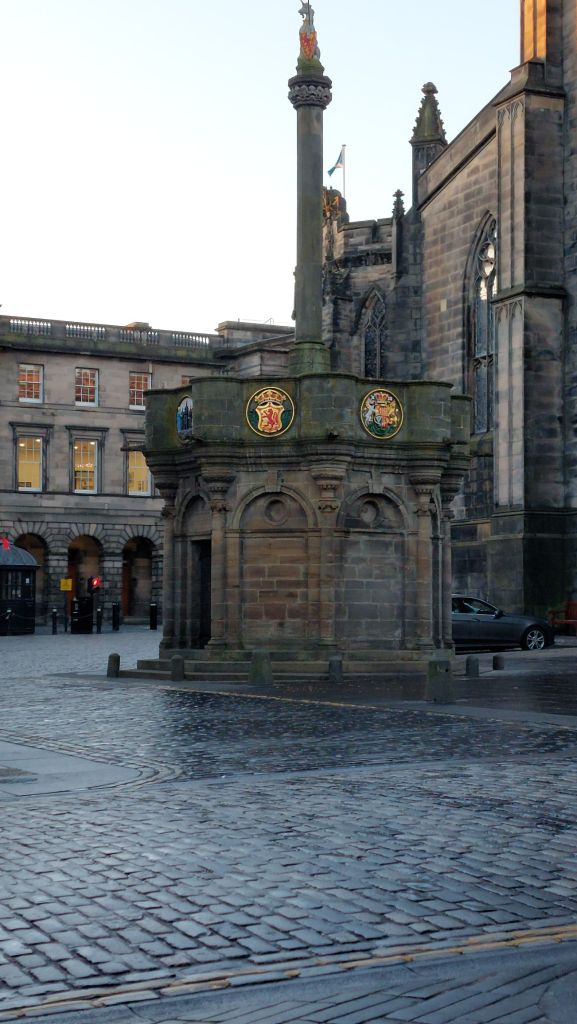
The Mercat Cross, Edinburgh
This is the first week in my IASH Heritage Collections fellowship. For the first time in my career, I’m NOT juggling librarianship and research. I’m part of a vibrant community of practice, and I have both the University Library and the National Library of Scotland just down the road. Thus, today, I saw a set of four Scottish song books that are remarkably hard to find as a set. (Three cheers for legal deposit!)
And last night, the year got off to an even better start, with an article being accepted. Just a few minor tweaks to do, which won’t be difficult.
It feels to me as though my long-term plan might be working out quite well!
Probably the most eventful year I’ve ever reported, 2024 saw plenty of action. However, I’d like to add a few words of explanation before I go any further. Firstly, everyone’s different and everyone’s circumstances are different. (You know the old saying about how you have to ‘walk a mile in someone’s shoes’ before you understand their experiences and challenges?) I’ve spent far too long on introspection, measuring myself unfavourably against high-achievers. It gets you nowhere, apart from feeling inadequate. You will know what is possible in your own situation; please don’t feel I’ve set myself up as an example. I’ve done it my way.
If you’re on the tenure track hamster wheel elsewhere in the world, you may read this and wonder at how little I’ve achieved. On the other hand, if you’re not employed as an academic, you might be surprised at how much. If you’re fully retired, you may think I’ve lost my marbles, but if you’re semi-retired, you might understand! Similarly, everyone’s personal circumstances at home are different too.
For full disclosure, my research career has been what you’d now call alt-ac (alternative academic); I have had 10½ paid hours a week on research for over a decade, but my main career has been in music librarianship. (I’ve never been a full-time academic, and my outputs were achieved in less than one third of my working week.) As you’ll see, I recently gave a keynote about being ‘alt-ac’, and I’d certainly be open to further bookings of this kind, if your institution or network was interested. (I’m in the UK.)
Highlights
I had successful eye surgery in February.
I retired from librarianship at the end of June.
I was promoted to part-time postdoctoral research fellow in July (10½ hours a week).
I’ve had the opportunity to do some teaching cover.
My second monograph was published. (It has a 2025 imprint, but actually came out in autumn 2024.)
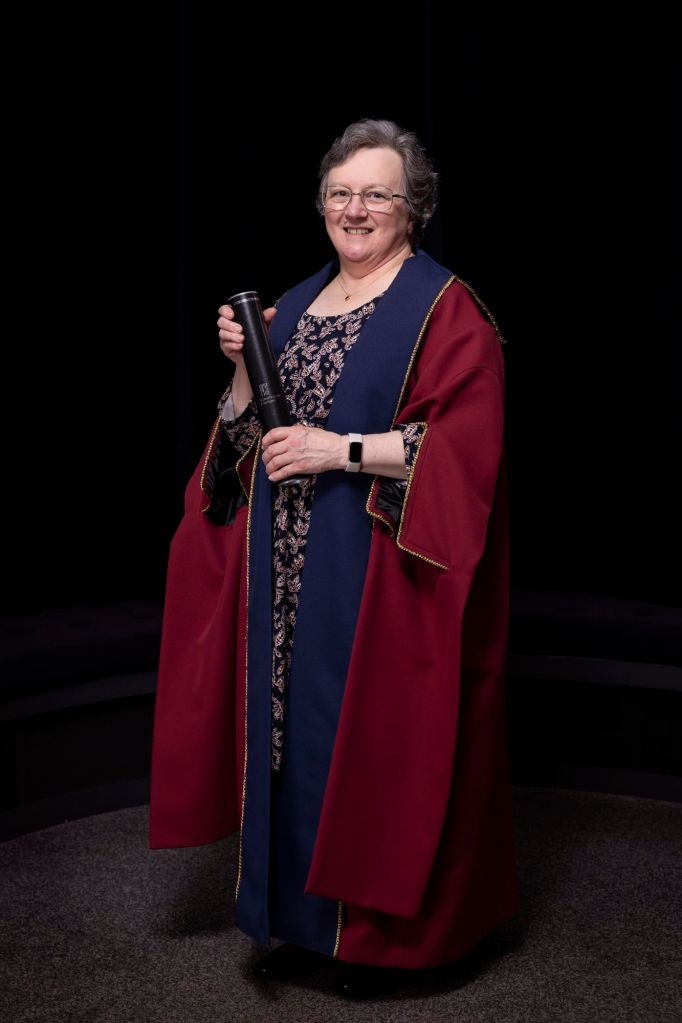
I was elected a Fellow of IAML (UK & Ireland) in the spring, and of the Royal Conservatoire of Scotland in November.
I was keynote speaker for the ECRN Alt-Ac Showcase at the University of Birmingham.
I successfully applied for a research fellowship at IASH (the Institute for Advanced Study in the Humanities) at the University of Edinburgh, which I shall be taking up between January and June 2025.
I received the Mervyn Heard Award from the Magic Lantern Society in December, for research into Bayley and Ferguson’s service of song publications.
Four fellowships of various kinds is quite an impressive number, however you look at it, so I must remind myself of this before I start beating myself up about my relatively modest upward progress!
Publications
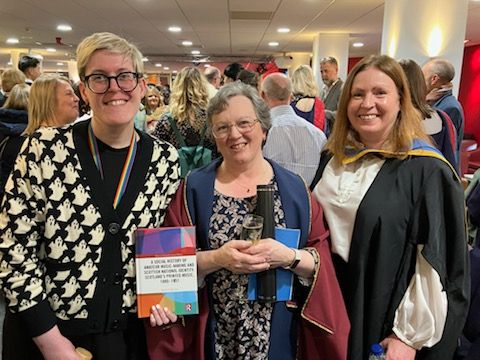
A Social History of Amateur Music-Making and Scottish National Identity: Scotland’s Printed Music, 1880-1951 (Routledge, 2025)
Book Review: Gun Sireadh, Gun Irraidh: The Tolmie Collection (Folk Music Journal Vol.12 no.5, pp.127-9; my review of a new edition of the Tolmie Collection, a significant Gaelic song anthology, here re-edited by Kenna Campbell and Ainsley Hamill)
[Article withdrawn due to pressures of time, but published on this blog: ‘The Exhilaration and Exasperation of Hybridity: Third-Space Professionalism in the Library’]
2 accepted chapters pending publication.
2 articles recently submitted, pending peer review. [February 2025 update: one got through peer review, has been revised, edited and I’ve approved the proofs. The other got through peer review and now awaits the revisions. Nonetheless, satisfactory progress!]
Speaker
Exchange Talk, Royal Conservatoire of Scotland, Jan 2024, ‘From Magic Lantern to Microphone: the Scottish Music Publishers & Pedagogues inspiring Hearts & Minds through Song’
NAG (National Acquisitions Group) Talk, April 2024, ‘Redressing the Balance: Getting Historically Under-Represented Composers and Contemporary Environmental Concerns into Library Stock’
Print Networks, conference held at University of Newcastle, July 2024, ‘‘Music for All’: the Rise and Fall of Scottish Music Publishing, 1880-1964’
Exchange Talk, Royal Conservatoire of Scotland, Nov 2024, ‘The Glory of Scotland’ (it’s the title of a Scottish song book published for the 1951 Festival of Britain)
Keynote for ECRN Alt-Ac Showcase at the University of Birmingham, Nov 2024, ‘My Alt-Ac Life’
Other Activities
BBC Scotland: ‘Good Morning Scotland’ interview
Book launch
Fellowships of IAML(UK) and RCS
Mervyn Peak Award, Magic Lantern Society
New job title: Post Doctoral Research Fellow
Peer reviews for AHRC and a scholarly journal
Providing teaching cover
Successful application: Heritage Collections Research Fellowship, IASH (Institute for Advanced Studies in the Humanities at the University of Edinburgh), for Jan-June 2025.
Edinburgh University Library from The Meadows (Wikipedia image)
Forward Planning
My IASH Fellowship will allow me the opportunity to explore the former Edinburgh publisher, Thomas Nelson’s archives, to find out more about their publishing in the music field. There wasn’t a great amount, but I aim to explore correspondence and find out how it fits into the wider range of their activities. I’ll be spending more of my time on research than I ever have since 1982!
Meanwhile, I’ve been working on an article for a history publication; I want to get that finished in the near future, so that I can turn my attention to another article on a different topic. What I do after that will probably depend on how the IASH Fellowship research goes, and what interesting possibilities reveal themselves to me. There’s bound to be enough for an article. But could I expand it to something book-length? I’ll have to wait and see!
I attended a meeting about grant applications, today. There was lots of good advice, including the development of a five-year career plan. A very sound suggestion. However, most early career researchers are really at the start of their research career, whilst I? I’ve done less research in my research career than a full-time researcher – obviously, as I got my PhD aged 51, and since then I’ve mostly been a 0.3 researcher – and my research development has thus been spread over a longer period. Similarly, I do have some teaching experience, but not an enormous amount. So …
In planning the next five years, young researchers have different parameters (making a good start, developing their strengths, possibly more able to relocate geographically, possibly without family responsibilities), whilst old ones are trusting they’ll still be fit and well in five years’ time; might not be able to relocate; and might well have family or caring responsibilities. (Should the plan also have the equivalent of a runaway truck ramp or escape lane, in case personal circumstances change unexpectedly?!)
Over the Hill? Which Hill?!
Maybe over one hill, but there are other hills to climb!
Five years at the start of a working life are different from five years somewhere nearer the end. I want to go on forever! Realistically, that’s impossible. (I might live another three decades, but who can say if I’ll still be researching at 96?!)
However, I read a posting the other day about the use of metaphors in health care, and I can see a parallel for scholars here; they talk about a journey with an illness, whilst we use metaphor to talk about our research journey.
To continue with the journeying, travelling metaphor: I climbed the librarianship hill as far as I could get. I didn’t reach the top, but I made reasonable progress. Looking around, I saw other hills I’d like to climb. You could say I’ve used the state retirement age as an opportunity to come down from the library hill, so I can spend more time climbing elsewhere.
I’d like to write another book. But I’ve only just published my second; I need at least three or four more years to do enough research into a new topic to merit a book. And I haven’t decided what exactly it will be about yet, though this might well become apparent in the next year or so.
Despite all this, a five-year research plan does seem desirable. I must apply myself to devising it!
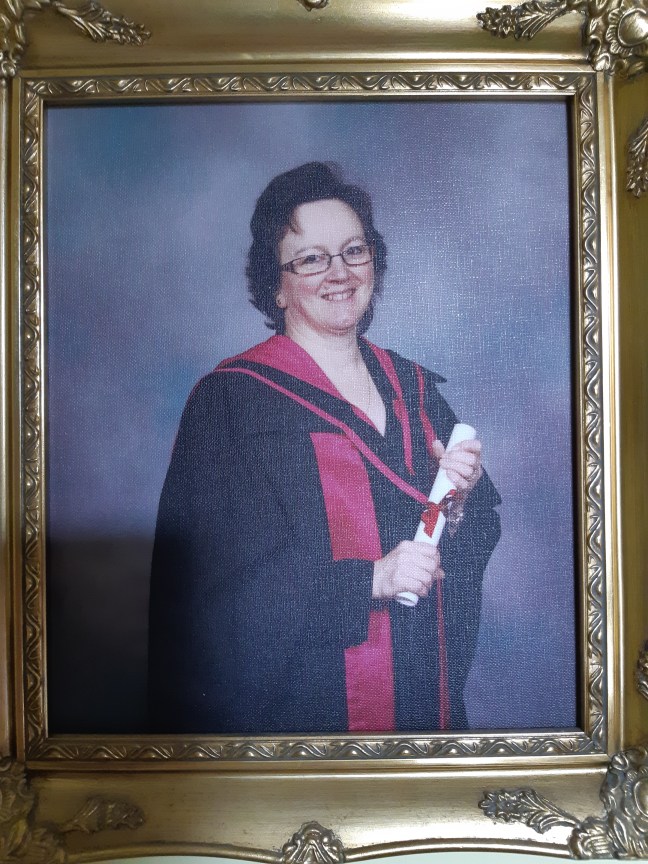
Facebook has just reminded me it’s 15 years since my doctoral graduation. Heavens, where did the time go?
Two Knees and a PhD
Summer 2009 was quite a summer! I submitted my thesis. He had two knee replacements, three months apart. He walked comfortably at my graduation ceremony.
Baking is not really one of my strengths!
Since then? Too much to enumerate. The thesis became a book. I contributed chapters to others’ essay collections. I published another book last month.
Why would a Librarian want a PhD?
Someone asked that, before I even started. I think I’ve demonstrated why.
Why would a Librarian want a PGCert?
Someone asked that, too. It seemed a good move at the time, and I have recently been doing a little teaching cover, proving that this wasn’t such a bad idea, either.
If one thing is certain, I wouldn’t now have a semi-retired existence as a postdoctoral research fellow, if I hadn’t found three old flute manuscripts in a cupboard that was being dismantled, a couple of years before I started the PhD.
I thought folk might be interested to see a quick summary – NOT the whole talk – of the keynote I gave at the University of Birmingham yesterday. ‘Alt-Ac’ is Alternative Academia, or Alternative Academic. You’ll see what I mean …
I’m very happy to have been honoured with an honorary Fellowship of the Royal Conservatoire of Scotland, the place where I’ve worked for 36 years. It was a memorable and touching evening.
We tell students that they should not make assertions without providing evidence. I was recently explaining that I had found a great website with a long article about the Shakespeare controversy. It criticised a couple of other authors for blithely ascribing half of Shakespeare’s plays to a woman, Emelia Bassano Lanier, without providing sufficient (any?) evidence.
Now, I’m not a Shakespeare scholar. (I did study some of his plays for A-level, a very long time ago – that doesn’t really count!) In recent years, I have become aware that some experts query whether he did write all the plays ascribed to him. That, in summary, is really all I can say about the controversy, because I simply don’t know enough to make further comment.
I was, however, quite taken with this website’s argument. The authors they were criticising had proposed Emilia Bassano Lanier as the author of a number of ‘Shakespeare’ plays. The justification for this assertion was apparently that Emilia hadn’t written much in her own name before middle-age, due to the fact (?) that she had been busily writing some of the plays that we now consider to be by Shakespeare, before that. It seemed a very shaky assertion!
You need to back up your statements with firm evidence, I insisted in my seminar. Well, I was right in that advice.
However, we also talked a bit about being accurate in our references, and checking where our information came from. Very important, as everyone will agree. And here, I’ve come unstuck. Because, if you wanted to cite the Oxfraud website, the first thing you find is that there’s no date of publication at the bottom of the page, and no obvious sign of who the authors are – or whether they have an institutional affiliation. (Don’t try googling, “Who is responsible for Oxfraud” – it thinks you’re asking about monetary fraud.) Indeed, there is also an Oxfraudfraud website and a ShakespeareAuthorship website, and I’ve no doubt I’ve only scratched the tip of the iceberg. But I shan’t be delving any deeper. I don’t need to cite it.
In the circumstances, it’s probably a good thing that, as a musicologist, I don’t actually need to know about the Shakespeare controversy!
Today was my first wee bit of teaching*, since retiring from the library and becoming solely a part-time research fellow. Sporting my new ID card (it now says I’m a member of the Research team), I got there in good time and strode up to the classroom door. I have never before been able to get through a classroom door without a student letting me in, so this was the moment of truth! I was in. Hooray! I eyed the digital whiteboard set-up with some suspicion, but I got the powerpoint working with no difficulty. All went well, and we had a good session. Hopefully, I’ve also navigated Moodle successfully – another new venture for me.
It’s not as though I hadn’t given lectures about my research specialism before. I’ve given research papers galore, but this was the first time of teaching, when I wasn’t speaking as a librarian. But, guess what? Despite my best intentions, it was unavoidable to mention the library, the songbooks on the shelves, the library donations … hardly surprising, because I wouldn’t have written my second monograph without being prompted by some of the old music in all those carrier bags and boxes we took in over the years. I even caught myself saying ‘we have ….’ and ‘we did …’. Old habits die hard.
I’ve achieved my ambition – I’m a research fellow – but I can’t pretend I don’t have a library background!
*For clarification, this was a guest lecture. I’ve a few more temporary teaching dates lined up. It’s nice to use my PGCert in this way.
To anyone starting out on their research journey, visiting an unfamiliar library can be intimidating. Here are some tips to help you prepare.
Know what you’re looking for. (1) Have you been able to check the catalogue online and get the shelf references?
Know what you’re looking for. (2) Have you got all the bibliographical details to hand? You might need them to look something up once you’re on site, in a card, microfiche or some other retro catalogue format. You also might need to ask someone to fetch items for you – reference libraries don’t have all their stock on open access, and special collections/archives never do – so it’s only reasonable to have as much info as possible to share with the staff who’re going to help you.
Know what you’re looking for. (3) Be clear in your own mind as to why you’re going to see these resources, what you’re intending to look out for, how much you can reasonably get through, and what it will take for you to feel you’ve had a successful day. This is crucial!
Practicalities (1) If you have to order things up in advance, be sure you’ve allowed enough time between your request and your visit.
Practicalities (2) Check travel arrangements and book in advance if necessary.
Practicalities (3) Have a pencil, rubber and ruler. Pens may not be permitted. Take your laptop cable. Find out about wifi access.
Practicalities (4) Ask if you can use your phone to take photos. There could be a form to fill in.
Be prepared for different rules and procedures. Answering your phone with a whisper might be okay in your usual library, but an absolute faux-pas somewhere else! Last week, I answered my phone in a public library, and had just started to explain that I couldn’t speak because I was in a lib …. (you’ve guessed the rest. Shhhhh! My own fault for answering it in the first place.)
Have an open mind. Be prepared for unexpected finds! If it looks useful, note it. AND note the page you found it on! Don’t scribble something so cryptic that you’ll never remember why you wrote it.
Get there early, if possible. Have a leisurely coffee before you start, because there’s always the chance you’ll be so engrossed or busy that you won’t want to waste precious time later on!
On your way home, try to go through your notes. Highlight anything you need to follow up.
I had a great trip to Edinburgh yesterday. The sun shone; I made it up the 122 News Steps to the Royal Mile without ending up completely out of breath; and I was so early that I was able to have a very leisurely coffee indeed in the sunshine, before heading to George IV Bridge. I had only ordered four actual items to look at, but I was looking at them quite intensively, so that was exactly right for the time I had available.
‘Lost Works’, meaning No Known Library Holdings at all
I took notes and photos, found a couple of extra unexpected features (evidence of ‘lost works’, no less – that’s a book history term meaning that we know the title did exist, but no copies are extant in libraries today), and on the way home, I was able to email another library with a question about their own edition of a piece of music I’d just been looking at.
Sadly, I can’t assure you that every research visit will be as sunny or as successful as mine was – but at least you’ll have given yourself the best chance!
Completely unrelated to my research – I just liked it!