Dr Karen McAulay explores the history of Scottish music collecting, publishing and national identity from the 18th to 20th centuries. Research Fellow at Royal Conservatoire of Scotland, author of two Routledge monographs.
When I am thinking about research directions, in my mind I have an image of a funnel. Getting further and further into an ever-narrowing topic can be enthralling, but I worry that such a narrow topic might not interest a wide enough audience.
Admittedly, there are circumstances when narrow specialism is exactly what you need. An eye surgeon who specialises in one particular part of the eye, is exactly what any prospective patient would hope for.
Three cheers for absolute specialists!
However, a broader field in my own kind of subject means I am likely to engage with an interdisciplinary audience. It offers more places to share my findings, and more people to interact with. At this stage in my career, I find this quite appealing. I wouldn’t want to end my career as the woman who was the expert in just one songbook, just one singer, or music in one closely defined location.
Estuary
So, the closest antonym (opposite) that I’ve found to a funnel, is an estuary. I like my research to fan out into different strands over a broader area. For me, I find I’m more likely to generate impact this way. But it’s an estuary, not a garden hosepipe spray! That would be altogether too messy. In other words, research might lead in various different directions, but I try to focus my ultimate writing on one particular aspect at a time. The book currently at the publisher’s has given rise to papers about post-war tourism, Scottish music in the diaspora, and the impact of technology on music publishing for an amateur customer base…
How do you visualise potential research topics? Does consideration of how narrow or broad something is, form part of your deliberations?
Edinburgh, Glasgow, Paisley?
I have various ideas to pursue, all starting somewhere in Scotland, but my most promising one is the one that extends beyond Scottish music, and beyond Scotland. Possibly even beyond the UK. Another idea isn’t quite as broad, in one sense, but might throw up some new comparisons. I’m still mulling over this one! The others would be interesting, but don’t offer the same breadth. One in particular is probably too niche to risk giving my full attention to.
Today, my research has been into the first of these ideas. Delving into unlisted source materials has meant a whole DAY not really finding much with any musical connection. On the other hand, the amount of context I’ve discovered is immense. I find it very helpful to know about what was going on beyond the publication of a few specific books. It IS relevant to collect data that tells me who the key protagonists were.
However, I’ll have to try to avoid following up intriguing stories that really DON’T concern me. The lovely old man who chased up the progress of his book in an admirably gentle, diplomatic way? It got to the editing stage, but didn’t seem to get published – no trace of it. But it wasn’t music-related, and has no place in my research. I really must not succumb to the temptation to explore the back story of every human interest story I encounter!
For a number of years, I’ve given an annual talk to RCS students, about how different generations looked upon, collated and collected and published Scottish songs and tunes. The snappy, official title is ‘Transformations’, but when I was revising it for this year’s presentation, I decided to compile a list of all the people (and a few extra titles) that I would be mentioning. Forty of them! So, I’ve added a new, unofficial subtitle: Speed-Dating 40 Scottish Music Collectors in an Hour. Okay, not exacty forty people, but forty lines in the list. I was quite surprised. I would imagine the individuals themselves might have raised an eyebrow, too.
It was the last time I’d give a lecture as a Performing Arts Librarian. Admittedly, not the last time I hope to give a lecture as a researcher, but certainly the final one with a library hat on! The librarian accordingly played a tiny bit of Beethoven’s Johnnie Cope from memory, along with a few chords from Marjory Kennedy-Fraser’s Sleeps the Noon in the Deep Blue Sky (score open), and blithely announced that she saw no need to inflict her rendition of Debussy’s La Cathedrale Engloutie upon her audience for comparison.
More than anything, the lecture epitomises me as a hybrid. I’m a librarian – I acquire and curate these resources. As a scholar, I contextualise them into cultural history. It wouldn’t be the same talk if I occupied only one of these roles.
The subject of my forthcoming monograph – amateur music making and Scottish national identity – only actually got a brief mention. But it was there. Maybe I’ll need to do a more extensive revision at some point!
Friday was a great day. Or should I say, Friday afternoon was a great afternoon?
A short research visit to the Mitchell Library was followed by discussion of my forthcoming RCS research contract – to enable me to continue researching part-time after I leave the library – followed by a trip to Glasgow Uni for the launch of the Books and Borrowing Database. It’s a fantastic resource, and I’ve watched the project with interest. (website: https://borrowing.stir.ac.uk/)
A bit of networking over a glass of wine and some cheese straws, then I headed home with a distinct lightness in my step. It wasn’t just the glass of wine! I felt as though I’m finally adjusting myself into who I’m meant to be.
I like to think I’ve been a good librarian. I do believe I have. But if I am honest, I chose librarianship because I couldn’t see myself as an academic. I am an object lesson in not writing oneself off at the age of twenty-four. If you’re like I was, or you know someone like I was, tell yourself/them to have more self-belief.
I’m giving my annual lecture on Scottish song books tomorrow. Just shows that I can lecture. Indeed, I’ve read countless papers over the past two decades.
Just think how many books I needn’t have catalogued, if I’d been braver and more determined at twenty-four. (I’m still cataloguing them – feeling a bit pressured, if I’m honest!)
On the other hand, how many intriguing enquiries I’d have missed, not to mention unexpected surprises amongst the book and music donations … there have been some advantages.
Image: Wikipedia picture of Hereford Cathedral Chained Library
How often are we told this? Starting with school exams, in fact ….
So I’m here to remind you of this basic advice. Even if you think you’ve got it right, read it again, and then re-read it. Sometimes things aren’t what they seem on first reading. (Said she, having carefully copied out the instructions, broken them down into separate sub-instructions, compiled a beautiful submission … only to discover that A included B and C, and my word-count would have to be reduced by 40% as a consequence. Computers can tell when your uploaded document is too long!)
I blame myself. I jumped to the wrong conclusion. However, I was pleasantly surprised to discover how easily I lost those surplus words. Anyone need a ruthless editor …?
Well, this has been an interesting weekend. It has encompassed both the sublime (filling in a Fellowship application) and the ridiculous. Completing an application turned out to have been exactly the right thing to have done, in the circumstances, because it put the unrelated storm-in-a-teacup properly into perspective. It even banished a migraine – quite remarkable! The expression, ‘Focus on the positive’ has a lot to be said for it.
Not, I hasten to add, that I have submitted the application yet – but at least I’ve written what needs writing. I am NOT planning on turning to daytime TV in my 66th year – I can’t think of anything worse. So, plainly I need engrossing things to do, once I’ve had the dreaded birthday.
When it comes to filling in online forms, the best thing is to print them out for easy reference, and then to draft answers to the various questions.
Headings
That way, you can write under headings reflecting the different parts of each question; ensure nothing gets omitted; AND keep count of how many words you have used. I’m getting quite good at condensing down sentences and simplifying wording where my first response would have been just too wordy.
So, I’ve made up a title for my proposed project (I did that when I woke at 5.40 am and couldn’t get back to sleep!);
Composed a 50-word summary (that fitted the time between getting ready for church and actually setting off);
and answered all the questions, in between cooking Sunday dinner, eating it, and supper-time.
However, there’s another question I must ask myself: as well as writing under all the headings that the form requires, I also need to ensure I’ve showcased anything that I feel relevant. That’s a task for Monday night!
I feel as though I’ve had a busy day, but I’m happy with what I’ve achieved.
MOT cancelled on April Fool’s Day; it really was …
I took myself off on a library visit, looking for a peaceful, fruitful day. (Yes, yes, I know – I’m a librarian, and I already work in a library 3.5 days a week. However, researching in a different library is an entirely different experience.)
It was peaceful, though I could have done without the six miles’ walking in the rain! But –
I found nothing related to my research question!
The trouble was, I had to read a lot of stuff, to eliminate it. Having researched music for so long, however, I was enchanted to read about paper pulp, factories, shipping and personnel in Nairobi, Cape Town, India, Toronto … yes, it was 1946-7, and the links were strong.
Then there were paper and bookbinding cloth shortages. Lots of allusions to both.
But was it a wasted journey? On the face of it, I made no progress, but – as you see – I gathered contextual information. From now on, I won’t be parroting those facts, but alluding to situations I’ve witnessed through perusal of correspondence. That does count for something. And I learned a handful of names that I might one day encounter in a musical context.
Oh, and apart from getting drookit (drenched) and walking six miles (thanks, Fitbit), I did get my peaceful day in a library.
Few people in Glasgow knew that I had an unfinished first PhD guiltily lurking in my past, when I announced I wanted to do a PhD. It would actually be my second attempt. I’m told that someone (an academic?) asked that memorable and somewhat hurtful question, ‘What does a librarian want with a PhD, anyway?’
Chained to the shelves – Wimborne Minster Chained Library (Wikipedia)
I realised with a jolt, yesterday morning, that I would be retiring from librarianship exactly fifteen years to the day, since I submitted my thesis to the University of Glasgow. I never managed to cease being a librarian in order to become a full-time academic, because I had family responsibilities in Glasgow, and the chances of a full career-change without relocation were limited, to say the least. However, if I entered librarianship with the unfulfilled expectation of soon having a PhD from Exeter, and the aspiration to become a scholar-librarian …. well, I did achieve the latter aspiration. After getting the Glasgow PhD, I became partially seconded to research three years later, and I’ll continue as a part-time researcher when I’m unshackled from the library shelves.
I don’t know who it was that queried whether a librarian actually needed a PhD, more than twenty years ago. It’s probably a good thing I don’t know! However, if I could show that individual how I’ve just spent my afternoon, then maybe they’d begin to understand.
The other day, an academic colleague said they were putting a student in touch with me, to advise them about resources for a project. This afternoon, I was working from home as a librarian, so I decided to spend the time finding suitable resources for my enquirer. I had in mind a lever-arch file from my own research activities, that I knew was in my study-alcove.
Subject Specialist
[Scottish] ResearchFish
The more I thought about the query, the more things I thought of suggesting. I looked at my own monograph, for a start, along with a couple of essay collections that I’ve contributed to. I compiled a list, mostly but not entirely from the library catalogue. (I tweaked a few catalogue entries whilst I was at it. What does an academic want with a library qualification?, one might ask!) I The family balefully eyed the dining-room table that they were hoping to eat off, as I moved aside the ancient and modern books that were gaily strewn across its surface. However, I’m fairly content that I’ve done my preparation to help with the query. I’ve also enjoyed an afternoon in the company of old friends – the compilers, authors and editors of all those books!
A Value-Added Librarian
Listen, I wouldn’t have known any of those resources if I hadn’t done that PhD. I wouldn’t have known what the arguments were. I wouldn’t have known how nineteenth and early twentieth century song-collectors viewed their collections, nor the metaphors they used to describe them, nor which collections might be of particular interest. I wouldn’t subsequently have collaborated on The Historical Music of Scotland database. And if I hadn’t gone on researching, I wouldn’t have known about some of the more recent materials, either.
I kennt his faither! (A Scot knows what that means)
There might have been times when others wondered who I thought I was, but I am absolutely certain that it has come in useful!
I’ve written quite a bit about women in musical history, so I’m adding something to the top of this post every couple of days during Women’s History Month – mostly flashbacks to women musicians I’ve researched, but some other discoveries too. (I’ve been shifting things around to a more chronological order, but I’ve always added the new bit first!) You’ll find more musicians than composers in this posting, just because of my own recent research.
Sometimes I look at the history of women musicians from the point of view of good library provision for our readers, whilst at other times my own research interests are foremost. It just depends on the day of the week, because I currently occupy two roles in the Royal Conservatoire of Scotland. For 3.5 days a week, I’m a librarian. For 1.5, a postdoctoral researcher.
15. The Ketelbey Fellowship
It’s a whole year since I learned that I had been awarded the first Ketelbey postdoctoral research fellowship at the University of St Andrews. Scholar Doris Ketelbey was a significant figure in the history of the department. I felt highly honoured to have been the first Ketelbey Fellow from September to December 2023.
14. Representation of Women Composers in the Library
I couldn’t resist adding the open access article I published about my EDI activity in our own Whittaker Library:-
It’s a privilege to shape a library collection, so I’m pleased to have just ordered and catalogued several relevant books this month.
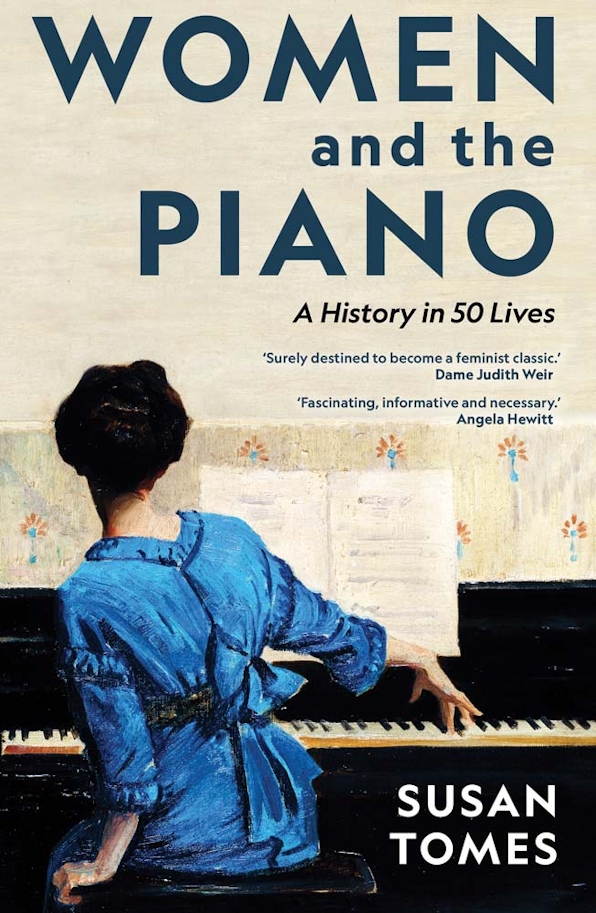
Susan Tomes, Women and the Piano: a History in 50 Lives (Yale University Press, 2024) Read more about it on the publisher’s website, here. In actual fact, it’s the fourth title by this author that we now have in stock. So if readers like this, they might like the earlier three, too!
Margaret C. Watson, Women in Academia : Achieving our Potential. (Market Harborough : Troubadour, 2024). Not a book about women in history, but very much for women in the present day!
Gillian Dooley, She played and sang: Jane Austen and Music (Manchester University Press, 2024). Back to history again.
Women and Music in Ireland / ed. Jennifer O’Connor-Madsen; Laura Watson & Ita Beausang (Boydell Press, 2022)
Moreover, there’s a new Routledge book coming out this summer – I have ordered it for the Whittaker Library. Of course, I may have retired from the Library by the time it arrives. This just means I won’t need to catalogue it! I’ll still be a part-time researcher, so I’ll be able to read it:-
It’s some years now, since a single-minded schoolgirl decided action was necessary. In 2015, Jessy McCabe noticed that Edexel had no women composers in the A-Level Music syllabus, and successfully petitioned to rectify this, via Change.org. I found out about her impressive initiative when I was beginning to start serious work on building up our library collection to include more music – contemporary and historical – by women and people of colour.
Jessy is now a Special Needs teacher. I’m sure she’ll go far.
11. Forgotten Women Composers
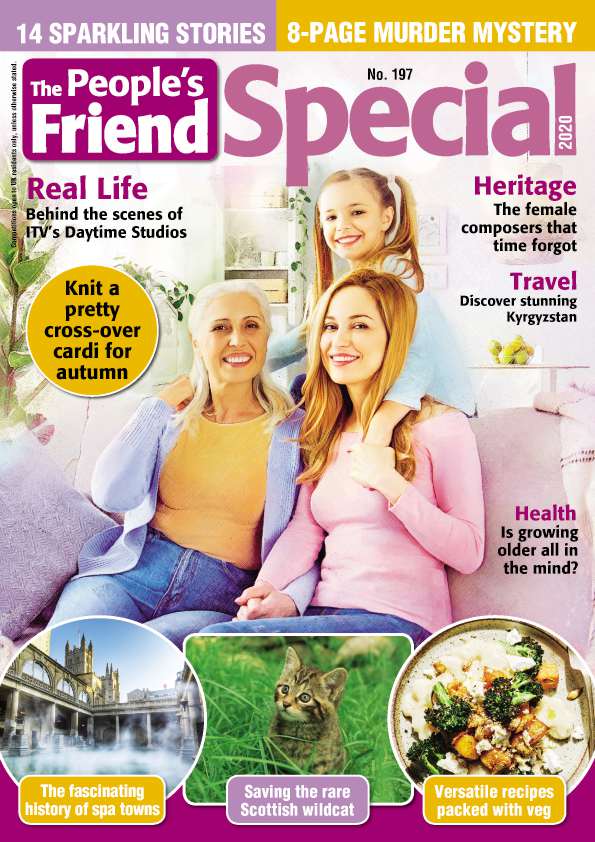
Part of academia entails sharing research outcomes beyond the ‘ivory walls’. It’s called public engagement, and that’s the opportunity I seized when my old friend The People’s Friend magazine commissioned me to write a feature back in 2020.
The sound of forgotten music: Karen McAulay uncovers some of the great female composers who have been lost from history’, in The People’s Friend, Special Edition, 11 Sep 2020, 2 p. (Dundee : D C Thomson). I blogged about it at the time (here).
10. Late Victorian Women Musicians
Since my more recent research has focused on the late Victorian era and the first part of the twentieth century, you’ll not be surprised to find that I found some interesting Scottish women musicians of that era! They are forgotten today – but I’ve done my bit to raise their profiles!
Newsletter article, ‘‘Our Heroine is Dead’: Miss Margaret Wallace Thomson, Paisley Organist (1853-1896)’, The Glasgow Diapason, March 2023, 10-15. (You can find this article in full on this blog)
‘An Extensive Musical Library’: Mrs Clarinda Webster, LRAM, Brio vol.59 no.1 (2022), 29-42 (a late Victorian head teacher who founded a music school in Aberdeen, and later did a national survey of music in public libraries – which she presented to the Library Association!)
In October 2023, I pondered about Mr *and Mrs* J. Spencer Curwen (amongst others) in another blog post, when I remarked upon early twentieth century attitudes to folk song.
9. In Praise of Music Cataloguers! Introducing Miss Elizabeth Lambert
Before I started the Claimed From Stationers’ Hall music copyright network, I had spent some months researching the wonderful late 18th and early 19th century music copyright collection at the University of St Andrews. A key resource was the handwritten catalogue in two notebooks, largely compiled by Miss Elizabeth Lambert (later to become Mrs Williams, when she married and moved to London.)
I just love the fact that this earnest young woman (I’m going out on a limb here, but I’m pretty sure she must have been earnest!) created a useful resource which would help everyone get maximum use out of the music repertoire that other libraries were less than impressed by. So we had Elizabeth cataloguing the collection, and numerous men and women, friends of the professors, making use of it. I blogged about her, and eventually wrote an article for the Edinburgh Bibliographical Society, mentioning her again.
‘A Music Library for St Andrews: use of the University’s Copyright Music Collections, 1801-1849’, in Journal of the Edinburgh Bibliographical Society no.15 (2020), 13-33.
The library’s copyright collection of music was a boon for middling class women like headmistress Mrs Bertram, her teacher daughters and their pupils. It does lead one to wonder if they had a harp at the school. I checked their borrowing records for more evidence. They certainly borrowed several volumes which included harp music.
7. Students but not at University? Educating Young Women
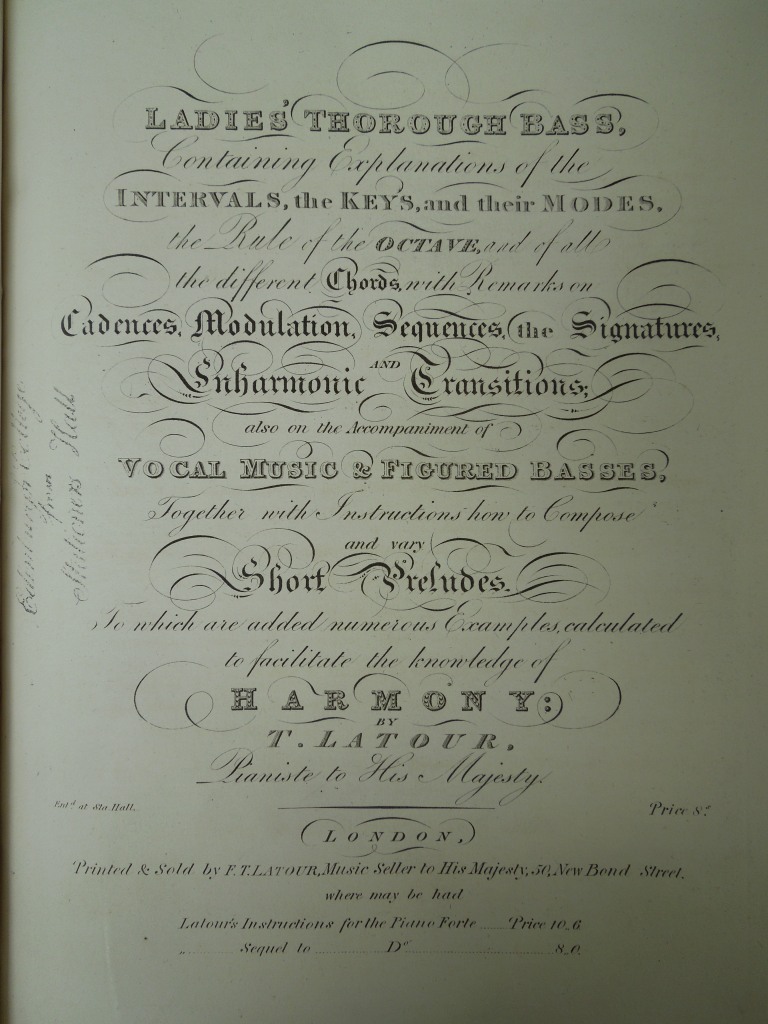
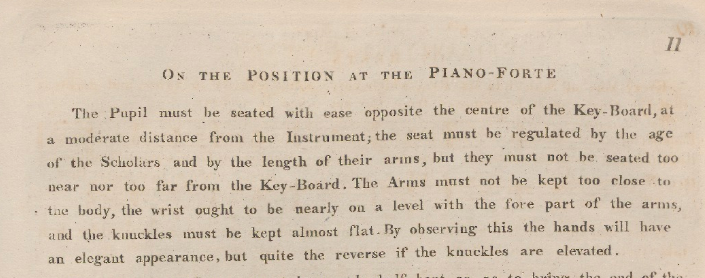
It’s time to turn to piano teacher Mr T. Latour. I’d like to refer you to my June 2018 blog post about women in St Andrews using pedagogical musical material in the early 19th century. Possibly the self-same young ladies attending, or having attended Mrs Bertram’s school?! The illustration features a young woman – probably just approaching or about marriagable age – at an upright piano. The abundant floral arrangement atop the piano (quite apart from sending shivers down the housekeeper’s spine every time the young pianist played too enthusiastically) suggests a well-to-do household. Following Latour’s instructions, the pianist has elegantly flat hands …..
T. Latour – Ladies’ Thorough Bass
Latour advises on the seating position, and how to hold ones hands elegantly
6. Not my work – but very timely for WHM 2024]
I’m not posting anything relating to my work today, but I saw mention of a great new article by Dominic Bridge the other day, so I thought I’d share details here. It’s a fascinating read. The Journal for Eighteenth-Century Studies is part of the Wiley Online Library:-
Back in 2018 when I was awarded the AHRC networking grant for the Claimed from Stationers Hall network, I drew up a list of women composers from the Georgian era. There were more than one might have expected – perhaps they only composed a handful of pieces, in many cases, but nonetheless – they composed. You can find the list on a separate page on this blog, here. And you can read more about it in the blogpost I wrote in July 2018,
This lady ran a girls’ school at St Leonard’s in St Andrews. This was NOT the famous and long-established private school that has long stood there, but an earlier enterprise. And Mrs Bertram and her daughters subsequently moved to Edinburgh, to the disappointment of parents of daughters in St Andrews!
The photo portrays a Mrs Bertram of Edinburgh. Chronologically, she could well be ‘our’ Mrs Bertram, and a scholarly bent is suggested by the pile of books at her hand.
2. The Accomplished Ladies of Torloisk
I almost forgot about the musical Maclean-Clephane ladies of Torloisk, which is a stately home on the island of Mull. But how could I forget about them, considering I published a lengthy article about them some years ago?! Luckily, a book of letters by Sir Walter Scott crossed my library desk, and even though it didn’t contain those particular letters, this did remind me of his musical friends in Torloisk!
Karen E. McAulay, ‘The Accomplished Ladies of Torloisk‘, International Review of the Aesthetics and Sociology of Music, Vol. 44, No. 1 (June 2013), 57-78
Today, I’d like to introduce a woman composer who predates most of the individuals I’ve encountered. Professor James Porter applies his considerable intellect to produce this in-depth article:-
‘An English Composer and Her Opera: Harriet Wainewright’s Comàla (1792)’, Journal of Musicological Research Feb, 2021. Published online: 16 Feb 2021.
I’m a Librarian and a Postdoctoral Researcher. (My secret skill is, basically, finding things!) I’ve just finished writing my second book – and I guess I’m lucky. I wasn’t dependent on the British Library. It’s too far away for me to visit more than infrequently.
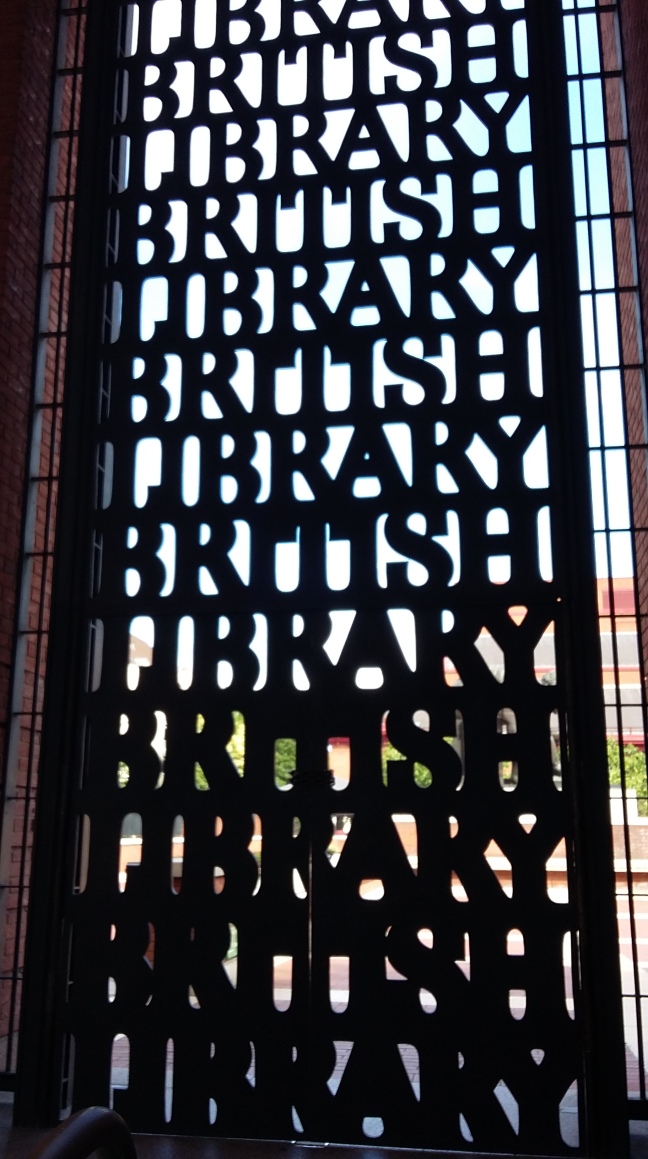
I keep coming across social media comments that “the British Library is doing nothing.” That they’re not taking the situation seriously. That “nobody knows what’s happening.” I don’t work at the British Library, but I do feel heartily sorry for anyone working there. They’ve been victims of a serious cyber crime, for heaven’s sake, and I’m sure that they’ve been taking the best advice about cyber security in light of the attack. It’s the kind of thing where they won’t want to divulge too much of what has been done, for fear of copycat crimes, but at the same time, we the public (especially scholars and academics) all know the end result. We can’t use their catalogue or their e-resources. Visitors have to wait whilst librarians look things up in paper and card catalogues, and with the best will in the world, the service isn’t quite what we’re used to. It’s devastating.
It’s not that the British Library hasn’t tried to keep us up to date:-
Rachel Cooke’s letter to the Observer, link retweeted by the Guardian
Chief Executive Sir Roly Keating has since released an update (11 January 2024) on Restoring our Services
Additionally, a recent Computer Weekly feature provides some of the technical information that many people have been waiting for: British Library cyber attack explained: What you need to know (By Alex Scroxton, Computer Weekly Security Editor, 9 January 2024)
I think what worries me is that people may not know about other ways of finding information. Certainly, if the British Library is the only holder of a particular document, then you’re up the creek without access to that document. If the only way you can access a database, or a digitised copy of a rare document, is via the British Library, then similarly, you really are in a bind at the moment. I know. As a researcher myself, I know.
We’re Here to Help
But are researchers and students asking their own institutional librarians? And conversely, are library organisations saying, often enough (on social media and elsewhere), that librarians are happy to help wherever they can? OK, ‘often enough’ is as long as a piece of string, but say, several times a week? Are we the librarians telling our own patrons in our own libraries?
And if you’re stuck looking for information, are you aware where else you can look?
Options and Alternatives
If you’re at an academic institution in the UK, there is SCONUL Access. That gets you into other libraries as well as your own.
Anyone can look at Jisc Library Hub Discover to find out whether there are copies of books elsewhere in the country. You can find books in the British Library, sure, but also in dozens of other academic libraries, and other big libraries. Yes, databases and other online resources like journals etc, are generally restricted by licence to people AT a particular institution, but you can still sign up to SCONUL Access and go to look at books and other hard copy material in other universities etc.
Have you tried your big city public library?
Are you aware that inter-library loans can be obtained from nearly all libraries except the ones that have a legal deposit responsibility? They don’t just come from the British Library. Your university or college library can organise this. Public libraries do inter library loans too.
Have you looked on Internet Archive or Hathi Trust for digitised copies of older material? Even Google Books?
Ask a Librarian!
Have you consulted your own specialist librarian to see if they can think of other ways you can get to see that crucial book or article?
Have you looked at ResearchGate and reached out to scholars directly, if there’s a particular article that even your librarian hasn’t been able to source?
Now, I’m just one small academic librarian/postdoctoral researcher in one small academic institution. I can’t help everybody! But please, please, do reach out to your librarians. We can’t replace the invaluable, much-loved and extraordinarily well-resourced British Library, but we can certainly help you make sure that you haven’t left other stones unturned, that might be able to provide at least some of what you need?
Well, folks, I have a preface, revised introduction, seven revised chapters and a revised conclusion … all in a zip file. I finished my revised book manuscript last night, ready to go off this morning. And it feels – Strange. I wondered if I’d feel triumphant when I clicked ‘Send’. But, at the moment, it’s cautious relief with a side of exhaustion. Let’s put the kettle on.
I did my PhD part-time, in my spare time, between 2004-09. Then there was more spare-time work turning it into a monograph, published in 2013.
From 2012-15, I was part-time RA to a major AHRC grant (but still 80% a librarian), and then – there’s a common thread here – I was awarded an AHRC networking grant (which I did part-time) on a different topic, before my hybridity changed to 85% librarian as I started research for this, my second monograph. The initial draft was submitted last summer, a decade after the first book was published.
It was with some envy that I read about an academic starting their research leave this year. I’m sure it’s well-deserved. I’m just wistful, because, apart from being allowed a month for writing up my PhD (yes, I know – we all know – it took much longer than that!), I’ve basically taken annual leave whenever I needed it. That’s what happens when you are more of a librarian than a researcher.
Apart from a brief visit home last summer, I didn’t take a proper break, because I was writing. I only took a week’s pause for Christmas, before jumping back into book revisions. It’s not surprising I’m knackered.
I can’t pretend I’m a full-time academic. I cannot, and should not, compare myself with people in a fully academic role. I’m mostly a librarian – admittedly, an academic librarian – but I’ve been a research fellow (part-time plus some annual leave), and I’ve just finished writing a second scholarly monograph (ditto). Given the time constraints, and the fact that I can’t be researching or writing when I’m being a librarian, I’m modestly proud of that.
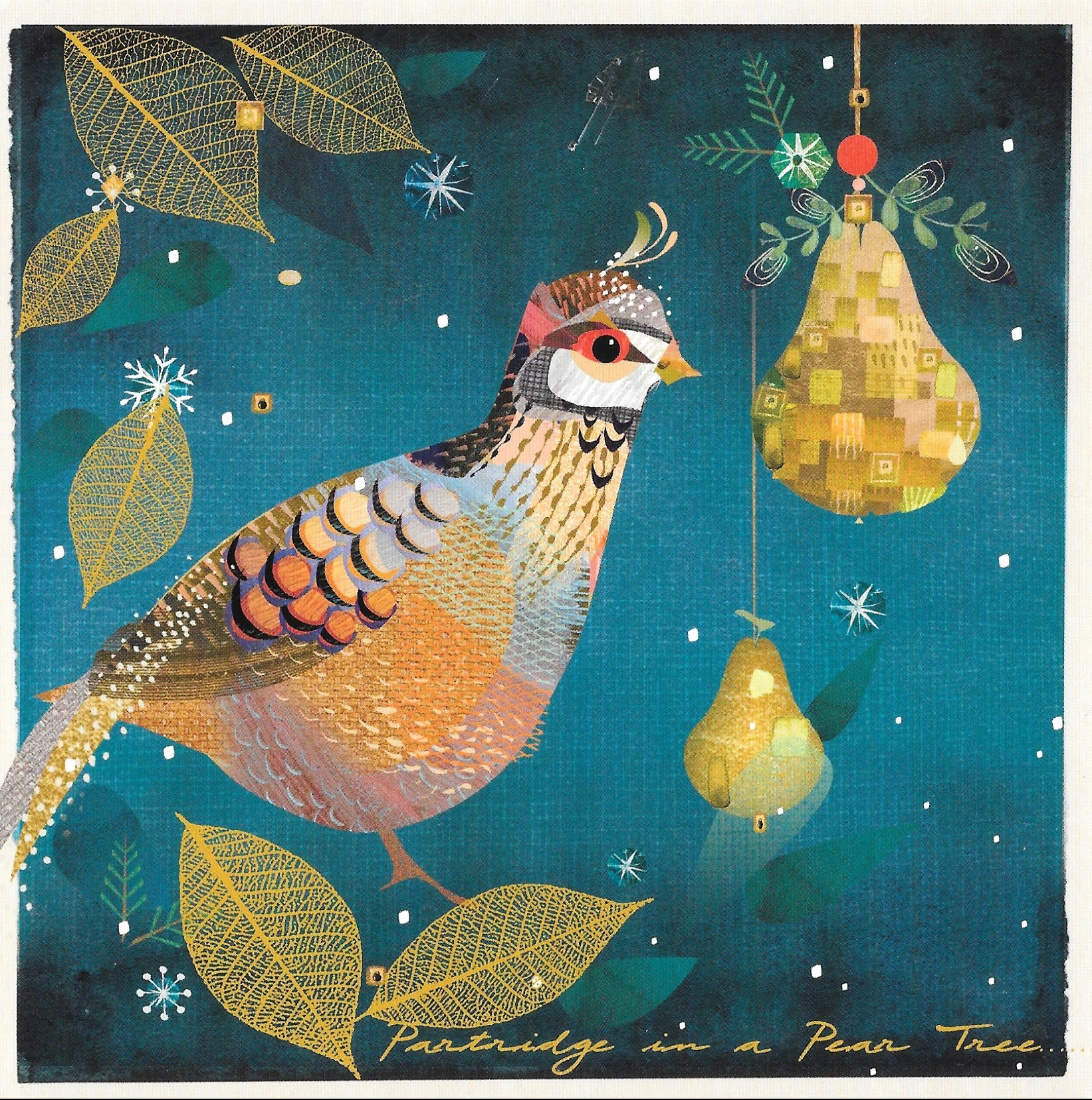
Never Mind the Partridge …
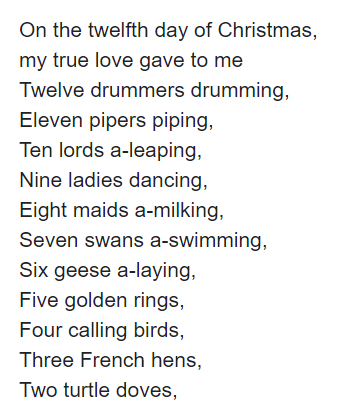
Exhausted but provisionally exhilarated … it’s the Twelfth Day of Christmas. After the obligatory drummers drumming, etc, etc, never mind the partridge!
Partridge in a Pear Tree (greetings card from Motor Neurone Association, image courtesy of Advocate Art)













 Karen McAulay, Musicologist