Need I say more? Could any author want more than to find their book was the chosen reading for someone’s sunny Saturday afternoon?
Image courtesy of Lovaig Music


Dr Karen McAulay explores the history of Scottish music collecting, publishing and national identity from the 18th to 20th centuries. Research Fellow at Royal Conservatoire of Scotland, author of two Routledge monographs.
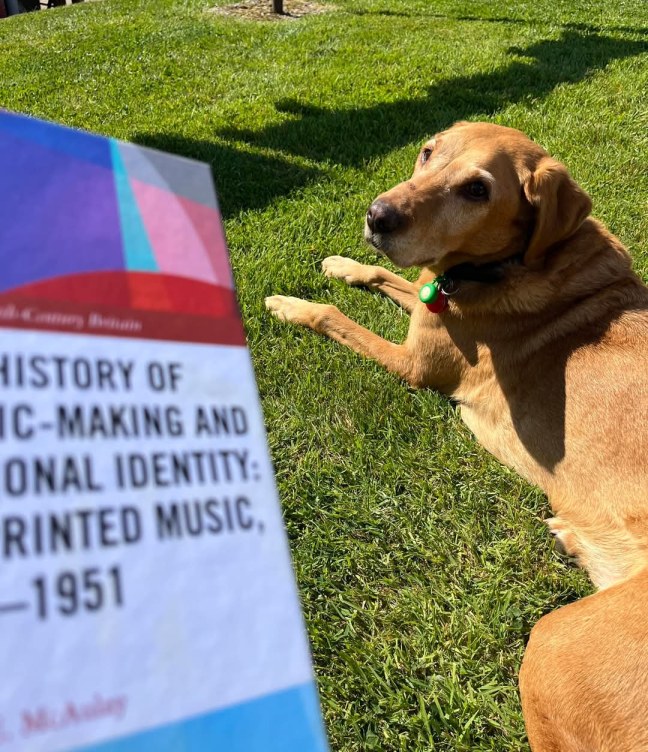
Need I say more? Could any author want more than to find their book was the chosen reading for someone’s sunny Saturday afternoon?
Image courtesy of Lovaig Music

On Friday afternoon, a tiny germ of a thought struck me. It was about a book to which I had previously given no thought whatsoever. It is unrelated to Scottish song, or even Scottish culture. It was published by a Scottish publisher.
(Forgive the little library codes! I haven’t forgotten where I came from.)
But I can’t see a title without wondering about the author, so I idly looked them up on my journey home from Edinburgh.
Well!
Here we have someone who …
Did I trace their birth and death dates, where they grew up, and where their parents married? Yes, I’m afraid I did!
(Another clue for my former colleagues!)
All this falls into the scholarly equivalent of ‘pretty but pointless’, on the face of it, since it has nothing to do with a Scottish song book series for schools. But the book itself might have a tangential link to my present research – more anon – and gives me food for thought in another direction.
I have just talked myself into another eBay purchase …
Image by OpenClipart-Vectors from Pixabay
From the 56 or so files I’ve examined up to now, the Thomas Nelson archives generally save copies of the letters that went out from the offices – but not the incoming replies. They reveal one side of a conversation.
So today, I was able to read letters to James Easson and Herbert Wiseman about the third and fourth Scots Song Books, but I couldn’t see how they reacted or responded. I need to look at the finished books again, but I may not necessarily be able to determine if they took on board the impeccably polite and respectful points raised about the texts they had used. I haven’t got the annotated proofs that were sent to Easson, or his reply.
As you will see from the enclosed, there are certain discrepancies, mostly small ones, between your text and the text as given in the various authorities.
I wonder if he had anticipated the lengths to which his new editor would go – visiting libraries and consulting authoritative editions – to ensure the texts were accurate?! Lengths, I might add, which are entirely consistent with what I’ve learned about the editor!
What is clear, though, is that these books were very carefully compiled, and just as painstakingly edited.
I am very anxious to get these points settled now before the MS goes for setting.
I still have a number of files to examine – and until I see them, I won’t know which departments they are from. I wonder when I’ll catch up with the meticulous editor again?!

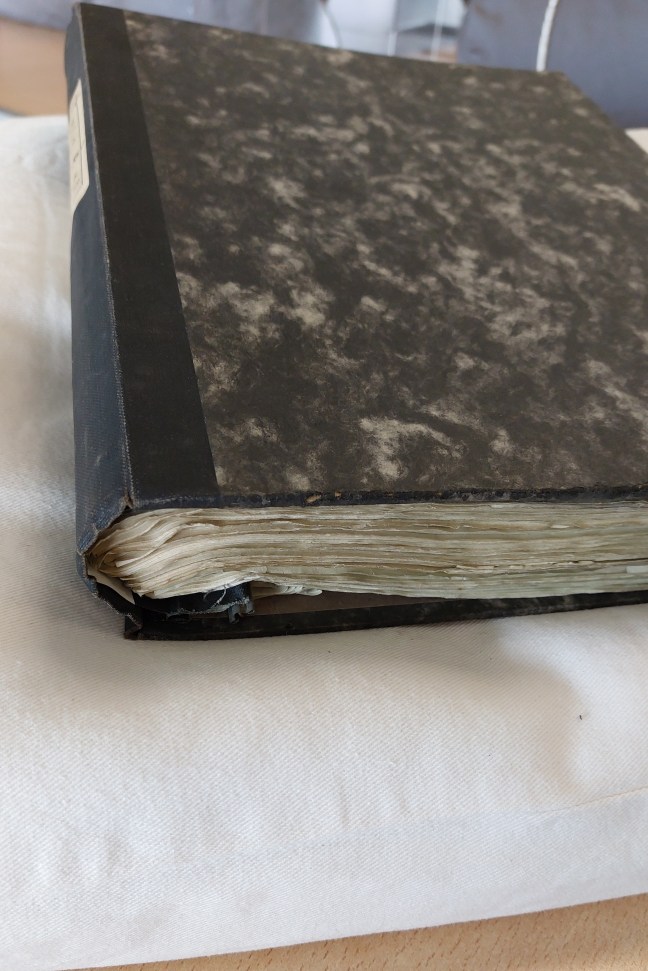
If this book could speak, it would just say something mysterious and enigmatic. It wouldn’t give everything away all at once.
So … as you know, I’ve been ploughing through archival records. On Friday afternoon, I’d just got to an interesting volume. But before I’d examined all the pertinent pages, I left (because the reading room was closing) – just wishing it was Tuesday morning!
I’d unearthed a change of personnel at the publisher’s. Over the weekend, I’ve learnt all sorts of interesting facts, most of which – truth to tell – have nothing related to Nelson’s Scots Song Books. (They can’t have – they’re subsequent to these books’ publication.) On the other hand, it significantly adds to the human interest, and gives a kind of forward-looking context. And I truly believe that the more context you can give, the more relatable the ultimate story is.
I look forward to Monday, because it’s a Glasgow-based research morning. But Tuesday? I want to get back to that volume in Edinburgh, and there are other sources I am keen to access. Roll on Tuesday.
A few weeks ago, I led a community ‘Scottish song’ event. I found myself singing a solo – well, to say ‘found myself ‘ is inaccurate, because I HAD planned and rehearsed it with a pianist.
But it seemed to go down well enough, so, emboldened by this, I sang a couple of examples from Nelson’s Scots Song Book at my Work in Progress talk on Wednesday. This time, I prerecorded my accompaniment myself. (Three cheers for the decent mic I had purchased during lockdown!)
I reminded myself that my esteemed audience were a mixture of musicians and non-musicians, and I was there as a researcher rather than a star turn, so hopefully they’d listen kindly rather than critically!
And it was fine. I suppose the more often you do something, the easier it gets. I have played in public, conducted in public, and sung in a choir numerous times, but singing solo? That’s something new.
I have another talk coming up in a few weeks. Of the two songs I sang this week, I much preferred one to the other – the range was more comfortable. So I looked through NSSB4 again last night, and hit upon a favourite – ‘I’ll aye ca’ in by yon toun.’ I took it to the piano for a first play through. Yes, I like Easson’s setting. It’s reasonably modern, and playable.
At this point – just as I’d finished the chorus – I was obliged to stop.
‘But, I was …’
You’d be alarmed at how routine governs my activities. No point causing upset by continuing to play, so the song will wait for another time. Supper couldn’t wait!
However, I thought I’d look for a YouTube rendition, to accompany my breakfast this morning, and what did I find, but a Topic recording of Jean Redpath performing it in the American Serge Hovey’s setting. I never heard Jean sing live, but she got an honorary DMus from the University of Glasgow (my Alma Mater), and her enthusiasm for Scottish song was influenced by her time at the University of Edinburgh – as I sit with a cuppa in the Library cafe, I’m literally looking out at the School of Scottish Studies building where she’d have talked with Hamish Henderson.
Having heard Redpath’s beautiful singing, I am less sure that my singing is a good idea, but there’s only one way I can share Easson’s setting, and that’s by playing it. Which, without a singer, wouldn’t work at all. I’d better get practising!

Thomas Nelson’s four-book set was for classroom use. Offering a mixture of history and theory (music-reading and tune-building), it even suggested pupils might plan a folk music concert.
In this exciting, modern world, children were reminded that their parents’ music lessons consisted only of singing, whereas now they might also learn instruments like the recorder, and perhaps collect interesting clippings from the Radio Times. (It sounds like another world, doesn’t it?)
Meanwhile, diving straight into the history, children were immediately introduced to the concept of folk music.

This is an English book, but I only recognised two of the three songs from my own school days. ‘The Carrion Crow’ wasn’t one I knew.
I’m delighted to find that kids were also introduced to the role of a song collector. Although I have to say that the child in the foreground on the right looks bored and unimpressed by the proceedings, in the illustration! Still, Nelson’s editors presumably commissioned the illustration rather than use a stock image, so they’re due some credit.

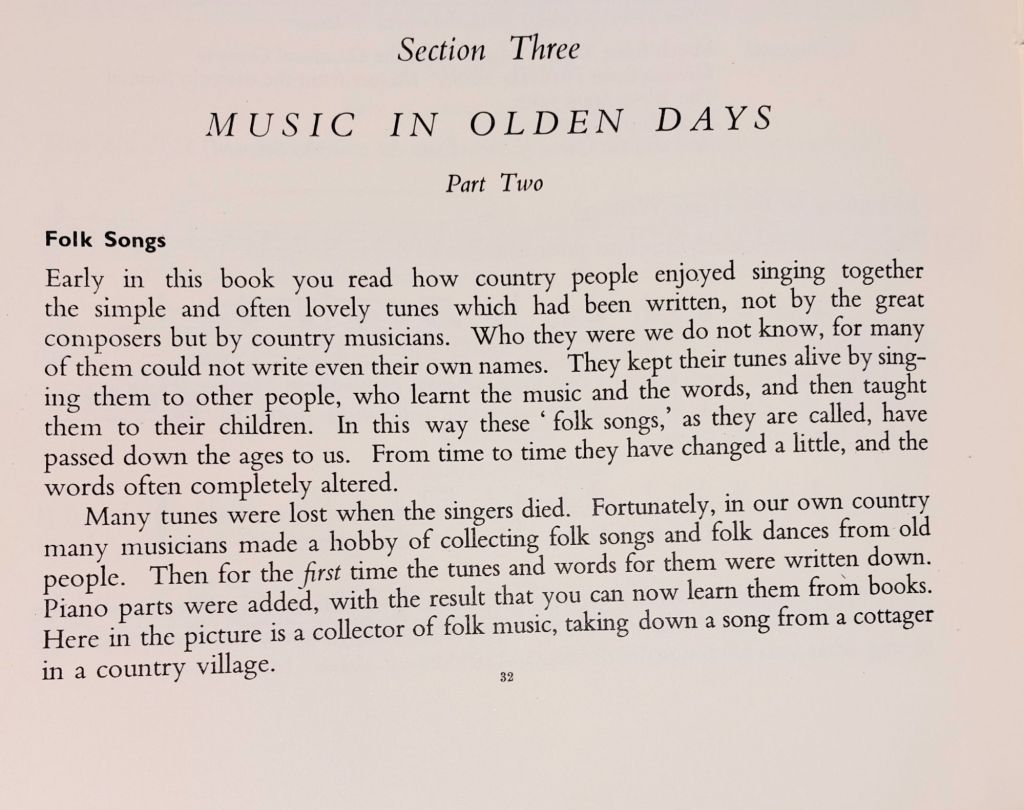
They’re still holding onto the idea that folk music came from country folk. I wonder if pupils ever asked what city folk sang?!
Of course, it wasn’t all folk music. Kids were also introduced to the likes of Brahms, Handel and Purcell. Today, I imagine only examination classes would have textbooks introducing the classical greats. On the other hand, more time is probably spent on world music, and efforts are made to consider music by women and people of underrepresented communities. Times have moved on!
Nonetheless, it’s interesting to see how much knowledge children would have acquired in general classroom music lessons, and to compare it with modern times.
Even the books are brighter and more appealing today, I must admit!

I have written a lot about diasporic enthusiasm for Scottish culture. Usually, I’m thinking about music, but today’s archival materials embrace almost every topic under the sun. If it can be taught, then educational materials can be published. And thus it is that I encounter an American author’s proposal to Thomas Nelson’s in Edinburgh, which bears out everything I’ve ever said about people’s affinity with the Auld Country. (Not to mention the annoying ‘Scotch’, a term unused by Scots!)
Thus I have a hankering, just for the romance of it, to have some of my verse published in Edinburgh, especially since I hope to be in that city in the not very far future […]
I can almost hear echoes of Brigadoon in the distance. But, the poet is practical. Recognising the paper shortages at the time (post-World War 2), the enthusiastic poet offers money to help defray initial costs, because …
Once out, I believe both of us will profit by its […] appearance.
There was only one problem. The editor replied,
We regret very much, however, that we are not publishing poetry at the present time.

As I’ve mentioned, I’m currently Heritage Collections Research Fellow at IASH, the Institute for Advanced Studies in the Humanities, at the University of Edinburgh. All guest fellows are invited to give a work-in-progress seminar, and it’s my turn on Wednesday 26 March at 1 pm. You can attend in person, or online – more details on the link below. The abstract tells you what my talk is about.
I’ll explain what I’m looking for, and introduce you to some of the individuals I’ve been finding out about. The one thing I can’t predict, is whether I shall by then have found the answer to my prime question!
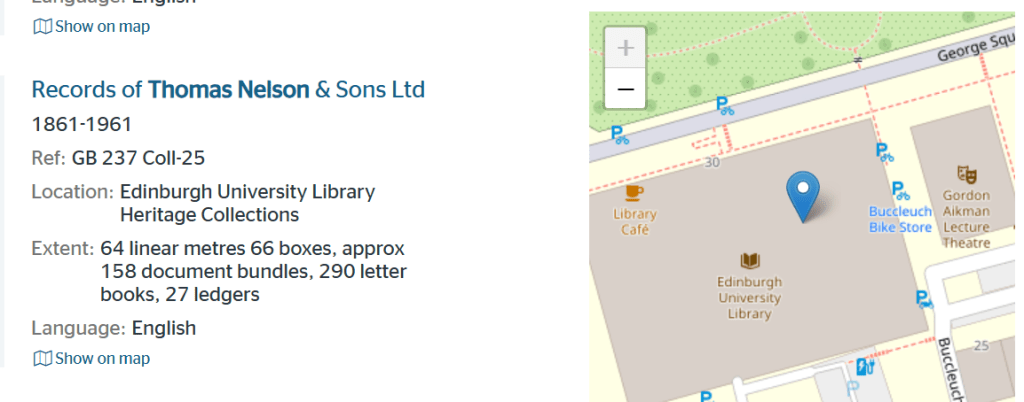

Last Friday, I submitted an article. Yesterday, I did the minor edits for an accepted article and dispatched that, too.
And today, I headed to Edinburgh and resumed my archival pursuits. The city was initially bathed in golden sunshine, though this didn’t even last until lunchtime. It is certainly a very beautiful city.


Unless you’ve experienced it, you can’t imagine how many brown folders of thin carbon copies will fit into an archival box. Carbon copies are as thin as airmail writing paper. The bulk of this particular box consists of NINETEEN folders of rejection letters just for one year, 1948.
You might think I didn’t need to concern myself about books they didn’t publish, but you never know what snippets about publishing policy or the economic climate – or anything else! – might turn up. (And you’d be surprised at the number of would-be authors who didn’t take a definite refusal AS a definite refusal, but kept writing to argue their case!)
That was an unexpected postscript, in one of the letters that wasn’t a rejection. The publisher and author had evidently gone to the swimming baths, and the author went home without his trunks! Irrelevant, but it’s undoubtedly evidence they were on friendly terms, isn’t it?
I did discover – unneccessarily, but amusingly – that in the late nineteenth century, the managing director of this publishing house used to go open-air swimming in Leith before work in the summer. Clearly the tradition had either continued, or been revived, with the opening of the Portobello open-air pool in 1936 …
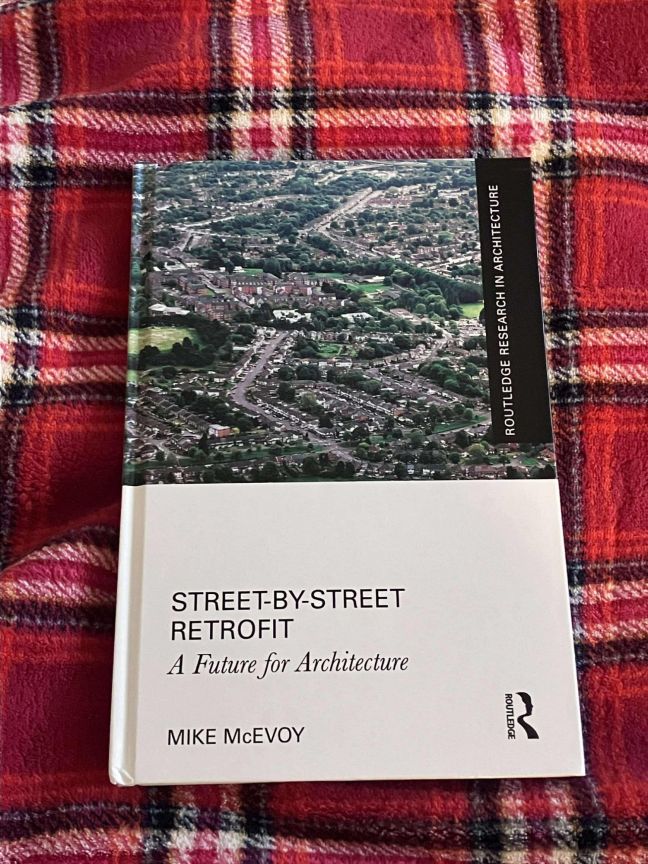
Our talented son, Scott McAulay, has just shared with us an image of his latest triumph – a foreword in another Routledge book. (He’s less than half my age, so who knows how much he’ll have published by the time he reaches my advanced years!)
So, this year, between us we’ve had a hand in three Routledge books, or four if you include the paperback edition of one I contributed to earlier:-
Scott McAulay (foreword), in Mike McEvoy, Street-by-Street Retrofit: A Future for Architecture (2024)
Karen E. McAulay, A Social History of Amateur Music-Making and Scottish National Identity: Scotland’s Printed Music, 1880-1951 (2024)
Scott McAulay (chapter and a co-authored chapter) in The Pedagogies of Re-Use: The International School of Re-Construction (2024), ed. Duncan Baker-Brown, Graeme Brooker
Karen E. McAulay (chapter) in new paperback edition of Music by Subscription: Composers and their Networks in the British Music-Publishing Trade, 1676–1820 (2024, hardback 2022)
 Karen McAulay, Musicologist