Officially, Post Doctoral Research Fellow

AI generated phoenix from Pixabay

Starting today, that’s my new official title. Prior to my retirement from the Whittaker Library at the Royal Conservatoire of Scotland, I was seconded part-time to Research and Knowledge Exchange. Today, after a brief break, I return as a post doctoral research fellow, since I plainly can’t be seconded from a role I no longer hold.

Reincarnated / ReinKarenated

It’s strange. Today, I sit at my working-from-home desk – same desk, same research work to do, same hours – outwardly, nothing has changed, and yet everything has changed, because I retired from Professional Services and returned to Academic Services. Research is now my sole role, not a small chunk cut out of my 9-5 library existence, and I’m a Research Fellow rather than a Researcher. It’s what I’ve always wanted.

Karen has been reinKarenated, you could say.

What’s in a Name?

‘That’s not how you say my name!’

If I explain the embarrassment of my name, the pun will make more sense. My family pronounces my name ‘Kar’ to rhyme with car, rather than the conventional ‘Kar’ to rhyme with carry. Don’t blame me!

I stopped trying to correct people a very long time ago – it’s not other folks’ fault that my parents decided to pronounce my name distinctively differently. If you’d spent several decades being thought prickly for insisting on an unusual pronunciation, you’d understand why I’ve given up on that!

Call me what you like – I’m a research fellow, and I’d better get on with indexing my monograph ….

A Brief (the Briefest!) Hiatus between Librarianship and Research

Freworks

After a memorable retiral from the Library last Friday, today (Monday) is a day’s annual leave, and tomorrow is my birthday. It goes without saying, nothing work-related will be happening until Wednesday! That’s when I am officially a Post Doctoral Research Fellow.

Meanwhile – please just imagine me indulging in fine dining and more cake than usual!

Image by Steve Raubenstine from Pixabay

Fellowship Announcements: not One, but Two

My final days as a librarian are characterised by a combination of exhaustion and adrenaline. This cough is determined to flatten me, but I’m equally determined to plan ahead for pastures new!

I woke, coughing, at 3.30 am yesterday.  In broad daylight, no less.  I reflected grimly that, whilst I didn’t deny believers their joy at the summer Solstice, I personally would have preferred to have greeted the sun a couple of hours later.  I coughed, made tea, and finally got up and read a book.

My decision came back and bit me in the heel later. I needed a wee power-nap at lunchtime. In the evening, I sat down to look at my new, 1951 catalogue (which came packaged in original 1966 wrapping, addressed to the last owner) in daylight … and woke to find myself sitting in the dark.  No disrespect to the original compilers; I was just exhausted.

It wasn’t just the Coughing

I wasn’t just tired out by coughing and sleeplessness. I’d had so much excitement that I think I was just suffering from an excess of adrenaline followed by the inevitable slump at the end of the day!

All my chickens metaphorically hatched yesterday.  I can now relate that, after a long time planning and waiting, I shall be starting my new, semi-retirement role with a new  job title, and I couldn’t be happier.  I have been promoted in semi-retirement!

Post Doctoral Research Fellow

As a Performing Arts Librarian, I was partially seconded as a postdoctoral researcher.  But you can’t be seconded if you don’t hold the original post any longer, so when I retire, I will have a new part-time contract with a new title and job description. This pleases me enormously.

And in 2025, a Heritage Collections Fellowship at IASH

I’m extremely proud to have just accepted a six-month fellowship at the University of Edinburgh, at the Institute of Advanced Studies in the Humanities. Between January and June next year, I’ll be researching the archival collection of papers from Thomas Nelson, the Edinburgh publisher.  There’s something singularly appropriate about a retired scholar librarian researching an archive in  another academic library, particularly such an eminent collection. I’m particularly pleased because one of my strengths is in placing what I’m researching into its wider cultural and historical context, and this massive collection of papers certainly offers plenty of scope for that. 

To begin with, there’s that new Audible book I bought the other day – nothing to do with Nelson, but hopefully giving me understanding about significant economic trends that would have impacted their trade.  (Just let me stop coughing enough to listen to it …!)

Comfort Zones were Stretched Today

Whilst I was going through archival materials today, looking for music-related documentation, I came across all sorts of non-musical correspondence. I wasn’t surprised. Sometimes, it’s rather nice to see what falls out of Pandora’s box, after all. All the ‘extra’ material vastly enriches the ultimate narrative. And other tidbits just raise a smile:-

  • I found one publisher offering to order whisky from an Inverness wine-dealer for another publisher holidaying in Raasay. Very fraternal!
  • I found someone looking forward to ‘frizzling in Paris’. (Considering Glasgow’s set to be 4 degrees Celsius tonight -in mid June – I can empathise!)
  • Then there was a job application letter. No clues as to the manager’s selection rationale – things were very different then – just, pencilled across the top – NO.
  • I found a terse letter from a professor who was distinctly unimpressed by the unavailability of a book (no, not a music book) that he wanted to purchase:-
Perturbed Professor

‘It’s damnable that such a valuable, well-written & cogent book should be off the market.’

But in 1947-1948, Britain was in economic crisis. There were restrictions on business activities, and if a publisher decided a reprint was non-viable then that, dear Professor, was that. Tough.  (I wanted to tell him that eBay and Alibris would have helped alleviate his evident distress.)

I found travelling salesmen being asked if they wanted any books from a particular series. Music-related ones, even? I sat up straight at that, until I realised that the subtext was probably, ‘these books aren’t selling terribly well, old chaps.’

It wasn’t until I got home that I got myself into deep water:-

I looked up what was happening to the British economy in 1947-1948. I knew there WAS a crisis. Britain was in recession.  I had never heard of ‘convertibility’ in the economic sense, and I find myself only slightly the wiser after a bit of Googling!  World War II had taken its  toll, and on top of this, the US had insisted on convertibility, it seems, and we very quickly descended into an almighty mess.  However, such a simplistic summary doesn’t sound exactly satisfactory.

I’m undecided whether I need an Oxford Short Introduction, or can I get by with a more basic understanding?  Oh well, plenty of time to ponder on that! (But if you’re a modern historian reading this, and you can think of something that would give me an intelligent layperson’s overview of post-war economics, then please do get in touch. Thank you!)

READING LIST?

  • Complete Idiot’s Guide to Economics
  • The Economics Book: Big Ideas Simply Explained 
  • Economics for Dummies
  • Rough Guide to Economics

Funnel or Estuary? Where’s your Research Going?

When I am thinking about research directions, in my mind I have an image of a funnel. Getting further and further into an ever-narrowing topic can be enthralling, but I worry that such a narrow topic might not interest a wide enough audience. 

Admittedly, there are circumstances when narrow specialism is exactly what you need. An eye surgeon who specialises in one particular part of the eye, is exactly what any prospective patient would hope for.

Three cheers for absolute specialists!

However, a broader field in my own kind of subject means I am likely to engage with an interdisciplinary audience. It offers more places to share my findings, and more people to interact with. At this stage in my career, I find this quite appealing. I wouldn’t want to end my career as the woman who was the expert in just one songbook, just one singer, or music in one closely defined location.

Estuary

So, the closest antonym (opposite) that I’ve found to a funnel, is an estuary. I like my research to fan out into different strands over a broader area.  For me, I find I’m more likely to generate impact this way.  But it’s an estuary, not a garden hosepipe spray! That would be altogether too messy. In other words, research might lead in various different directions, but I try to focus my ultimate writing on one particular aspect at a time.  The book currently at the publisher’s has given rise to papers about post-war tourism, Scottish music in the diaspora, and the impact of technology on music publishing for an amateur customer base…

How do you visualise potential research topics? Does consideration of how narrow or  broad something is, form part of your deliberations?

Edinburgh, Glasgow, Paisley?

I have various ideas to pursue, all starting somewhere in Scotland, but my most promising one is the one that extends beyond Scottish music, and beyond Scotland. Possibly even beyond the UK. Another idea isn’t quite as broad, in one sense, but might throw up some new comparisons. I’m still mulling over this one!  The others would be interesting, but don’t offer the same breadth. One in particular is probably too niche to risk giving my full attention to.

Today, my research has been into the first of these ideas.  Delving into unlisted source materials has meant a whole DAY not really finding much with any musical connection. On the other hand, the amount of context I’ve discovered is immense.  I find it very helpful to know about what was going on beyond the publication of a few specific books. It IS relevant to collect data that tells me who the key protagonists were.

However, I’ll have to try to avoid following up intriguing stories that really DON’T concern me. The lovely old man who chased up the progress of his book in an admirably gentle, diplomatic way? It got to the editing stage, but didn’t seem to get published – no trace of it. But it wasn’t music-related, and has no place in my research. I really must not succumb to the temptation to explore the back story of every human interest story I encounter!

Guilty as Charged

The river Kelvin, with the University of Glasgow in the background

It’s about work-life balance, but it’s also about adjusting to a changing situation. I have no problem turning off my 0.7  librarian self when I leave the office, but research has always been something that occupies more than the remaining 0.3 of my working life.  Last year’s summer annual leave was spent finishing writing a book. Last Christmas, revising it.  HOLIDAY? That’s what other folk do!

So, when I find I have more time, what happens? I’ll need to watch this, when I am semi-retired.

I said I was having a day off, a proper day off, didn’t I? So, how did that go? Did I do all I set out to do? Did I keep away from research? No, I did not.

Guilty as Charged.

I finished my audiobook in a leisurely way. (It was Cal Newport’s Slow Productivity – it had to be leisurely!) So far, so good. I even made a note of his three key points:- Do fewer things; Work at a natural pace; and Obsess over quality.

Knowing that I was expecting the postie to collect a parcel this morning, I decided I’d better not laze around in bed reading the book about ultra-processed foods, so instead I went down for breakfast – and there I came unstuck. I opened my phone, headed right for my favourite website (Jisc Library Hub Discover) and started what can only be described as a literature search, for publications by a particular organisation. Oh dear, oh dear. The breakfast disappeared, the piece of paper beside me filled up, and I sent a couple of queries about a publication and an archive. Finally, it was clear that I’d need not only to tweak a paragraph in the paper I’m working on, but also to type up my Jisc Library Hub findings …

Glasgow Tram model at Kelvingrove Art Gallery and Museum

By lunchtime, I was disgusted with myself. I hadn’t even managed half a morning away from research! This afternoon, therefore, I went on an outing. I not only got my favourite red shoes repaired (which was somewhat urgent), but – more importantly – I visited Kelvingrove Art Gallery and Museum, and saw the Glasgow City of Empire exhibition.

Having seen the groundbreaking work at the Hunterian Museum (‘Curating Discomfort‘) a couple of years ago, I had an idea what to expect, and I wasn’t disappointed. It’s thought-provoking. I found myself wondering where the donors of some of the exhibits had got their artefacts from, and whether they’d paid a fair price, or been given them … and under what circumstances?

I sat and watched Aqsa Arif’s film installation, ‘The Trophy Cupboard’ (Anam Ki Almari) in which a woman discovers items ‘collected from the Indian Pavilion at the 1888 Glasgow International Exhibition’. I need to go back and watch it again – I think there are deeper layers that I’d find, if I had seen it more than once. I make no pretence at being highly film-literate, as I’ve never studied the medium as an art-form.

There was also another exhibition about Scottish identity in art, but again, I need to go back another time. There’s just too much to take in on one visit.

On the journey home, thoughts of research returned to my head. There’s another sentence that needs modifying. (Will I do that tonight? Do I dare even open the document at this time of night?!) I cooked tea and started a dressmaking project to distract myself.

But before you ask – no, I didn’t get round to riding the bike today! I’m hopeless. So much for ‘practising for semi-retirement’!

Tomorrow’s another day.

In Training for a New Lifestyle

I had to decide what to do about my outstanding annual leave, prior to my retiral at the end of June. So, I decided to take a very long weekend off (Thursday to Tuesday – you could call it a short week), to use up a few days.

  • Today, Wednesday, was a research day – as usual. I finished drafting a research paper. With no deadlines today, I allowed the ‘intellectual’ work to merge into a bit of eBay searching at 5 pm, to find the perfect specimens for a couple of PowerPoint images. (It was a rather complicated operation, involving looking for recordings in a particular year, in the British Newspaper Archive, and then searching for those titles on eBay. Not as easy as you’d think!)
  • My Out-of-Office was set at 5 pm.
  • Now, here goes. Tomorrow is holiday. I should be researching tomorrow morning – and the new, semi-retired me will still be researching on Thursdays. In fact, I have a PowerPoint to prepare, but – tomorrow is holiday. I have to get used to not working even when it ISN’T the weekend.
  • Friday to Tuesday are, likewise, holiday.

HOW AM I GOING TO KEEP AWAY FROM MY RESEARCH UNTIL NEXT WEDNESDAY? A WHOLE WEEK?!

3 Challenges for the Nearly Semi-Retired Researcher

For my first challenge, I have to resist leaping out of bed early tomorrow morning. I have an audio book to finish – the Slow Productivity book – and a paperback about ultra-processed foods to continue reading, so I should manage this – providing I have enough tea to keep me going.

And my second challenge is to eat as little ultra-processed food as possible, so food prep might occupy me a bit more than usual. The trick will be to strike a balance between healthy eating and actually benefitting from more free time.

Lastly – might I dust off the bike? We’ll have to see about that.

LinkedIn Wrote about Changing Jobs

Changing Jobs? It’s emotional‘, says Jennifer Ryan, Segment Editor at LinkedIn. I settled down to read her posting, which collates what a number of people have said about the challenge of leaving a job you’ve held for a very long time. A lot of their comments made sense.

Retirees, This is Not About You

But then, just when I was thinking, ‘this is helpful’, Ryan threw a curveball:-

It’s one thing to retire after a decades-long career, relishing a chapter successfully concluded, say authors Dorie Clark and Natalie Nixon, PhD. However, leaving a job you’ve held for years in order to start your own venture or go to another company is “a different emotional and practical experience altogether”.

However, I AM retiring.  And rather than starting my own venture, I am just continuing part-time with the interesting research element of my job, that has hitherto been a partial secondment

Don’t Look Back

What I must do, I’ve decided, is STOP LOOKING BACK. Remember the Biblical story of Lot’s wife? She turned to look over her shoulder and turned to a pillar of salt.

Relishing a Chapter Successfully Concluded?

So, I need to make a concerted effort to stop kicking myself for opportunities I didn’t get, things I didn’t achieve, and disappointments I could do nothing about.

After all, I got a PhD whilst working full-time. I raised a family, ditto. I was a Fellow of CILIP, my professional association, until I decided to let the fellowship go, now that I’m ceasing to be a librarian. I’ve been an honorary Fellow at the University of St Andrews, and I’ve been elected an honorary Fellow of IAML (UK & Ireland) – my other professional association. And my second monograph is at the publisher’s.

Who cares if I’ve catalogued so many jazz CDs that my brain-cells have practically ossified? (They haven’t, or I wouldn’t be capable of writing books etc.) In five and a half weeks, it won’t matter how many of the things are still waiting to be catalogued, because I won’t be cataloguing them.

Maybe I should start repeating this mantra:-

Don’t Look Back (Boston)

(I was 20 when this song was written.  And I only stumbled across it tonight!)

Slow Productivity: my Latest Read

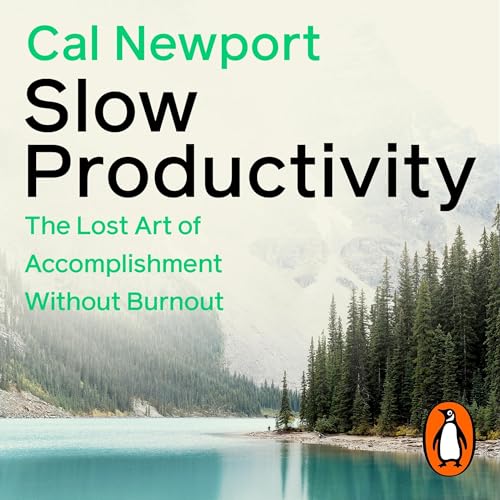
Cover of Cal Newport book, Slow Productivity

Slow Productivity: The Lost Art of Accomplishment Without Burnout
by Cal Newport and Penguin Audio (March 2024)

picture of headphones on a patchwork background.

I’ve been listening to Cal Newport’s book, Slow Productivity: the Lost Art of Accomplishment without Burnout, on Audible. I’ve taken my time over it – appropriately – and I’m approaching the end of it. Because I haven’t finished completely, what I’m writing here today can’t really be described as a review, so much as a first impression.

But why, you might ask, would anyone less than two months away from retirement age, decide to read a book about productivity at all? It’s a good question! I think I was both intrigued by the title, and fascinated by the different paces at which different people work. There are times when I achieve a lot – but not usually at a frenetic pace.   I don’t throw myself into tasks at fever-pitch, unless a deadline is creeping up on me. On the other hand, I do tend to have so many things on the go, that going slow feels impossible. (And I’m worryingly obsessed about accomplishment and achievements! That’s how I was raised.)

The main thrust of the book is that we ‘knowledge-workers’ should be more deliberate, allow ourselves time to do things well, factor in holidays, breaks and slower-moving spells, and not take on too much. That we’re not like factory workers on an assembly line, and aren’t generally required to produce so many units of whatever-it-might-be, per hour, day or week. Newport’s historical examples are inspiring, underlining his message, but some suggestions have no application to any role I’ve ever occupied. Pay someone to do some part of my work? If I was self-employed, possibly. However, the only time I’ve ever done that, was getting my first book indexed professionally. Librarians don’t outsource their work. (Neither do 0.3 of the week researchers!) Similarly, if you own a business or are freelance, you can deliberately decide to make a little less profit in exchange for a longer, more intentional route towards a high-quality product/performance act/whatever. People employed in any kind of academia can choose to seek a promoted position or not (depending on circumstances, of course), but it’s not about profitability directly affecting one’s own pocket.

Obsess over Quality

However, the suggestion to look at your role and focus on the ‘core activities’ that will have the most impact, is certainly sensible. As I’ve mentioned before, cataloguing barely-used jazz CDs is a soul-destroying task, mainly because it has such little impact. I hardly needed an Audible book to endorse that sentiment, but there it was.

Impactful Librarianship

As I did the ironing one night last week, listening to my book, I think that’s what prompted me to make sure my final weeks of librarianship would have a bit more impact than that! I’ve thrown myself back into tracking down music by BIPOC composers, and it certainly passes the time more quickly than other tasks I could mention!

My aim is simply to make it possible for students to find more diverse repertoire, should they feel so inclined.  My efforts won’t result in a massive listing – there are less than a thousand such items tagged in our catalogue, and our budget isn’t huge. It’s not just about getting the materials in – but I won’t be the one devising ways to get it known about and borrowed, after 28 June 2024.

Yesterday, a highlight was discovering one particular new acquisition was already on loan to a second borrower. Result!  That  in library terms, is impact.

And Impactful Research

As for slow productivity? I need to finish reading Newport’s book and then consider how to apply the best suggestions to a semi-retired existence. At the time I’m posting this, it’s a Wednesday, and I have my research hat on. I have a book review to do, and then I’ll look at my list of projects … because I’m not retiring from research! Far from it.

Becoming Unshackled from the Shelves

Friday was a great day. Or should I say, Friday afternoon was a great afternoon?

A short research visit to the Mitchell Library was followed by discussion of my forthcoming RCS research contract – to enable me to continue researching part-time after I leave the library – followed by a trip to Glasgow Uni for the launch of the Books and Borrowing Database.  It’s a fantastic resource, and I’ve watched the project with interest.  (website: https://borrowing.stir.ac.uk/)

A bit of networking over a glass of wine and some cheese straws, then I headed home with a distinct lightness in my step. It wasn’t just the glass of wine! I felt as though I’m finally adjusting myself into who I’m meant to be.

I like to think I’ve been a good librarian. I do believe I have.  But if I am honest, I chose librarianship because I couldn’t see myself as an academic.  I am an object lesson in not writing oneself off at the age of twenty-four.  If you’re like I was, or you know someone like I was, tell yourself/them to have more self-belief.

I’m giving my annual lecture on Scottish song books tomorrow.  Just shows that I can lecture.  Indeed, I’ve read countless papers over the past two decades. 

Just think how many books I needn’t have catalogued, if I’d been braver and more determined at twenty-four.   (I’m still cataloguing them – feeling a bit pressured, if I’m honest!)

On the other hand, how many intriguing enquiries I’d have missed, not to mention unexpected surprises amongst the book and music donations … there have been some advantages.

Image: Wikipedia picture of Hereford Cathedral Chained Library