Report of Conference: Reading and Book Circulation, 1600-1800

(Libraries, Lives and Legacies Festival of Research), University of Stirling, 17-18 April 2023

I wrote a report for the conference that I attended in April this year, thanks to an LIHG Bursary. This report has just been published in the latest LIHG Newsletter for Summer 2023 , Series 3, no. 53 (ISSN 1744-3180), pp.7-10.

I thought I’d share excerpts of the report here, too.

The conference resonated strongly with the research topic of my 2017-18 AHRC Networking Grant, Claimed from Stationers’ Hall, when we were investigating surviving music in the British Legal Deposit libraries of the Georgian era.  Although my network was interested in books rather than music, I had immersed myself in the Georgian borrowing records of St Andrews University Library, and had taken a particular interest in the music borrowing habits of women of that era, so the opportunity to hear more about what people borrowed apart from music was irresistible. 

On the subject of borrowing records, the opening introduction to the ‘Books and Borrowing 1750-1830 project’ and demonstration of the digital resource by Katie Halsey, Matthew Sangster, Kit Baston, and Maxine Branagh-Miscampbell was fascinating, offering so much data for investigation.

The following panel on Reading Practices in Non-Institutional Spaces was just as interesting, with Tim Pye’s ‘Had, Lent; Returned: Borrowing from the Country House Library’, along with Abigail Williams speaking about non-elite book use in rural settings, and Melanie Bigold’s paper about women’s book legacies. Whilst my own interest has been in formal library borrowing, ‘my’ borrowers took music away for their leisure-time enjoyment, and these papers served as a reminder that musicians were probably just as likely to have borrowed music outwith the more regulated library environment. Similarly, the concept of the Sammelband is very familiar to me – that was how libraries kept their legal deposit music. Sam Bailey invented a useful new verb, ‘Sammelbanding’, during the course of their talk on ‘The Reading and Circulation of Erotic Books in Coffee House Libraries’ – a topic far removed from my own research.

Kelsey Jackson Williams’ hands-on session with books from the Leighton Library, in an exhibition curated by Jacqueline Kennard, was the perfect after-lunch session, offering the chance both to stretch one’s legs on the way there, and to inspect some rare selections from the Leighton.

Parallel sessions meant tough choices, but I opted to hear Angela Esterhammer talk about John Galt’s various publishing ventures – an intriguing history – followed by Cleo O’Callaghan Yeoman’s ‘Still my ardent sensibility led me back to novels’.  (I reflected that St Andrews’ first music cataloguer, Miss Elizabeth Lambert, had read a wide variety of books, and whilst her reading included travel accounts, religious books, and books on botany and conchology, she certainly wasn’t averse to reading a good novel, too.)  Next came Amy Solomon talking about Anne Lister’s considerable book collection at Shibden Hall, and how she had made an inherited collection her own, as well as keeping commonplace books, diaries, and reading journals. I regret having missed seeing the films about her diaries, and the two more recent ‘Gentleman Jack’ series on the television.

The first keynote paper was given by Deidre Lynch, on ‘The Social Lives of Scraps: Shearing, Sharing, Scavenging, Gleaning’.  I am sure I was not the only delegate pondering as to whether any of my own ‘scraps’ would survive to intrigue future readers, but more importantly, Deidre’s paper reminded us that proper ‘books’ are only a small proportion of the vast amount of printed material still surviving, often against the odds and far from their original context. 

On the second day, the opening plenary roundtable chaired by Jill Dye addressed borrowers’ records across Scotland, and I heard from several people with whom I was already acquainted, three of them through my own AHRC Networking project. 

We heard about the library of Innerpeffray, the National Library of Scotland, and Edinburgh, Glasgow and St Andrews’ University Libraries. I was interested to hear about the bigger picture, so that I could place my own special interests into the wider context.

For the third panel, I opted for the panel on Readers, Libraries and Loss.  Jessica Purdy gave a fascinating talk on ‘Libraries of Lost Books?’, speaking about chained church libraries, and the fact that their tight security and still pristine condition suggest that the books might as well have been ‘lost’ as far as most of the local residents were concerned.  Elise Watson, too, made us reflect upon just how many publications of Catholic devotional material had been published, even if they were so ephemeral that there are now ‘”Black Holes” of Ephemeral Catholic Print.’

For the fourth panel, I attended the panel on ‘Education’, hearing Maxine Branagh-Miscampbell talking about the Grindlay bequest and ‘Childhood Reading Practices at the Royal High School, Edinburgh’.  The Grindlay bequest was valued sufficiently that it was all added to stock, even though some material was never going to interest young or teenage boys.  Mary Fairclough gave an interesting talk on ‘Barbauld’s An Address to the Deity and Reading Aloud’.  I have recently encountered Victorian publishers appropriating evangelical hymns for magic lantern shows, but had not considered that poetry might also be ‘trimmed down’ and repurposed.

Duncan Frost’s paper did have a musical subject: ‘Bird Books: Advertising, Consumption and Readers of Songbird Training Manuals’.  Who would have thought that so many books were written about catching and training songbirds to sing in captivity?!  The most intriguing aspect of this genre of books was in fact that, despite many pages dedicated to all aspects of caring for and training your bird, there was significantly little information about the kind of tunes that you might want to teach it.

The second and closing keynote lecture was delivered by Andrew Pettegree, on ‘The Universal Short Title Catalogue: Big Data and its Perils’.  Professor Pettegree was at pains to underline not only what the USTC had achieved, but also its shortcomings, or rather, what it was not.  We were also reminded of some aspects that I have encountered in my own work: that books in libraries were not the only copies of these titles; they would have existed plentifully outside libraries, and so might other books which we can now only trace by, for example, publisher’s catalogues and advertisements. Moreover, library catalogues can conceal different editions, or show duplicate entries, depending on minor differences in cataloguing approaches.

Since my own networking grant, I have had to reflect upon the benefits of the work, and the impact the research has had.  One of the outcomes that I identified then, was that library history research created effectively a ‘third space’ where librarians and academic scholars – and those like myself, straddling both library and research worlds – could meet and beneficially share our insights and learning.  I realise that at this recent conference I had experienced exactly the same kind of meeting of minds again. Similarities of approach and a common interest in library and book history meant that I felt I had an underlying understanding enabling me to benefit from their fresh insights.

I am grateful to the Library and Information History Group for enabling me to attend this wonderful and thought-provoking conference.  Besides having such a rich array of papers to listen to, I certainly did benefit from the opportunities to talk to other delegates.  It was a treat to be able to take two days out of normal routine in such a beautiful setting, giving plenty of food for thought for the future.

Image: Image by G.C. from Pixabay

Two Worlds Meet

News of a potentially interesting archival item triggers an attack of insatiable curiosity. I must confess that the musicologist is somewhat more triggered than the custodian!

So, I have a few questions that need answered. Where and when was the original owner born? When did they leave Scotland? What did their Scottish ancestry/identity mean to them?

And most importantly, was ‘Scottish’ music a significant part of their repertoire?

As I mentioned in earlier posts, my librarianship is amply qualified, and embodies four decades of expertise, but musicology and research came first. The musicologist is buried beneath the outer librarian, and can’t help bubbling to the surface when an intriguing possibility presents itself!

If I can answer these initial questions satisfactorily, then I’ll want to explore further. I think you can guess what I need to do this morning!

AND LATER …

Well, the original owner called themselves Scottish. But they were born in England of a Scottish mother. Should I order their birth certificate? It’s not cheap, and could arrive too late to be useful. But … !

58 Weeks to Go – How is This Meant to Feel?

Goalposts

The government moved the goalposts – when I started work, I imagined I’d have retired by now.  Instead, I’ve worked an extra five years, with one more to go. I shall hit 66 in summer 2024.  I don’t want to retire entirely, but I must confess I’m utterly bored with cataloguing music! (Except when it turns out to be a weird little thing in a donation, perhaps shining a light on music education in earlier times, or repertoire changes, or the organisation behind its publication – or making me wonder about the original owner and how they used it … but then, that’s my researcher mentality kicking in, isn’t it?!)

Status Quo: Stability and Stagnation

Everyone knows I’m somewhat tired of being a librarian.  Everyone knows that my heart has always been in research.  Librarianship seemed a good idea when I embarked upon it, and it enabled me to continue working in music, which has always been my driving force.  But the downside of stability – and I’d be the first to say that it has been welcome for me as a working mother – has been the feeling of stagnation.  No challenges, no career advancement, no extra responsibility.  Climbing the ladder?  There was no ladder to climb, not even a wee kickstep!  (I did the qualification, Chartership, Fellowship, Revalidation stuff. I even did a PhD and a PG Teaching Cert, but I never ascended a single rung of the ladder.)

In my research existence, I get a thrill out of writing an article or delivering a paper, of making a new discovery or sorting a whole load of facts into order so that they tell a story. I love putting words on a page, carefully rearranging them until they say exactly what I want them to say. I’m good at it. But as a librarian, I cannot say I’m thrilled to realise that I’ve now catalogued 1700 of a consignment of jazz CDs, mostly in the same half-dozen or so series of digital remasters.  (I’d like to think they’ll get used, but even Canute had to realise that he couldn’t keep back the tide.  CDs are old technology.)

The Paranoia of Age

But what really puzzles me is this: when it comes to the closing years of our careers, is it other people who perceive us as old? Is age something that other people observe in us?  Do people regard us as old and outdated because they know we’re close to retirement age? 

Cognitive Reframing (I learnt a psychology term!)

Cognitive reframing? It’s a term used by psychologists and counsellors to encourage someone to step outside their usual way of looking at a problem, and to ask themselves if there’s a different way of looking at it.

So – in the present context – what do other people actually think? Can we read their minds? Of course not. Additionally, do our own attitudes to our ageing affect the way other people perceive us?  Do I inadvertently give the impression that I’m less capable?  Do I merely fear that folk see me as old and outdated because I know I’m approaching retirement age? A fear in my own mind rather than a belief in theirs?

How many people of my age ask themselves questions like these, I wonder?

Shopping Trolley

Am I seen as heading downhill to retirement?  Increasingly irrelevant?  Worthy only to be sidelined, like the wonky shopping-trolley that’s only useful if there’s nothing else available?

Is my knowledge considered out-of-date, or is it paranoia on my part, afraid that I might be considered out of date, no longer the first port-of-call for a reliable answer?

When I queue up for a coffee, I imagine that people around me, in their teens and early twenties, must see me as “old” like their own grandparents.  And I shudder, because I probably look hopelessly old-fashioned and fuddy-duddy.  But is this my perception, or theirs?  Maybe they don’t see me at all.  Post-menopausal women are very conscious that in some people’s eyes, they’re simply past their sell-by date.  I could spend a fortune colouring my hair, and try to dress more fashionably, but I’d still have the figure of a sedentary sexagenarian who doesn’t take much exercise and enjoys the odd bar of chocolate!  (And have you noticed, every haircut leaves your hair seeming a little bit more grey than it was before?)

Similarly, I worry whether my hearing loss (and I’m only hard of hearing, not deaf) causes a problem to other people?  Does it make me unapproachable and difficult to deal with?  I’m fearful of that.  Is it annoying to tell me things, because I might mis-hear and have to ask for them to be repeated?  Or do I just not hear, meaning that I sometimes miss information through no fault but my own inadequate ears?  Friends, if you thought the menopause was frightening, then believe me impending old age is even more so. I don’t want to be considered a liability, merely a passenger. And I know that I’m not one. But I torment myself with thoughts that I won’t really be missed, that my contribution is less vital than it used to be.

Gazing into the Future

Crystal ball
Crystal Ball Gazing

I wonder if other people at this stage would agree with me that the pandemic has had the unfortunate effect of making us feel somewhat disconnected, like looking through a telescope from the wrong end and perceiving retirement not so much a long way off, as approaching all too quickly?  The months of working at home have been like a foretaste of retirement, obviously not in the 9-5 itself (because I’ve been working hard), but in the homely lunch-at-home, cuppa-in-front-of-the telly lunchbreaks, the dashing to put laundry in before the day starts, hang it out at coffee-time, or start a casserole in the last ten minutes of my lunchbreak.  All perfectly innocuous activities, and easily fitted into breaks.  But I look ahead just over a year, and realise that I’ll have to find a way of structuring my days so that I do have projects and challenges to get on with. 

Not for me the hours of daytime TV, endless detective stories and traffic cops programmes. No, thanks!  Being in receipt of a pension need not mean abandoning all ambition and aspiration. I want my (hopeful) semi-retirement to be the start of a brand-new beginning as a scholar, not the coda at the end of a not-exactly sparkling librarianship career.  If librarianship ever sparkles very much!

I’m fortunate that I do have my research – I’m finishing the first draft of my second book, and looking forward to a visiting fellowship in the Autumn.  As I wrote in my fellowship application, I want to pivot my career from this point, so that I can devote myself entirely to being a researcher, and stop being a librarian, as soon as I hit 66.  And I want to be an employed researcher.  I admire people who carve a career as unattached, independent scholars, but I’d prefer to be attached if at all possible!

Realistically, I will probably always be remembered as the librarian who wanted to be a scholar.  At least I have the consolation of knowing that – actually – I did manage to combine the two.

First Ketelbey Fellowship at University of St Andrews

Here’s the big news I’ve been bursting to share! During Autumn 2023, I’m to be the first holder of the honorary Ketelbey research Fellowship in Late Modern History, in the University of St Andrews’ School of History. I’ll be there on Wednesdays and Thursdays for one semester, continuing to research and think about Scottish music publishers and other related topics, and enjoying the experience of being a research fellow in a very highly-rated university history department. St Andrews was rated the top UK university in the Times and Sunday Times Good University Guide last September, and the School of History came top in both the Times and Sunday Times rating, and the Guardian University Guide 2023 – so I’m dead chuffed! I’m an academic librarian and musicologist – I guess this means I can call myself halfway to being a historian, too.

The Fellowship is named after Doris Ketelbey (1896-1990), who was the first female academic in the School of History; a respected author; and had a phenomenal career for a woman of her times. Aileen Fyfe has written a blog post about her, which you can read here:-

Doris Ketelbey, 1896-1990 (in the series, ‘Women Historians of St Andrews’) by Aileen Fyfe

Interestingly, Ketelbey taught at St Leonard’s School at one point. A few years ago, I wrote a blogpost for the EAERN Network about about the very first owner of a private school in the same premises, in the early 19th century: Mrs Bertram’s Music Borrowing. But the St Leonard’s that Ketelbey taught at would have been a more sophisticated institution than Mrs Bertram’s doubtlessly estimable establishment!

– and yes, she was the sister of composer Albert Ketelbey, who wrote an enormous quantity of lighter music and songs. I bet he was proud of his determined, high-achieving sister!

Saturday dawned, and a research question was bothering me …

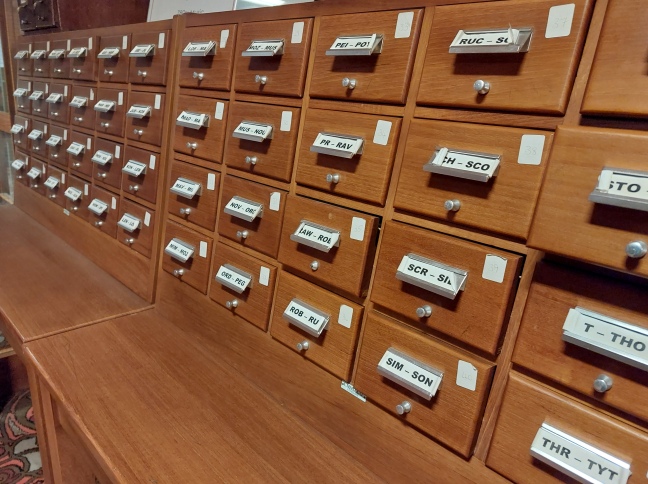
Old music card catalogue at Mitchell Library, Glasgow

So I decided to spend the afternoon at the Mitchell Library. Glasgow is so fortunate to have this wonderful collection!

I saw the two publications I had in mind. I took notes. I even had time to look at the card catalogue. (Catalogues are great research tools, even though I am personally sick of actually cataloguing.)

And then I went home. It was only when I went over my notes that I realised I had missed at least one item in the bibliography of one book, which I thought I had been looking out for. I spent the next 24 hours kicking myself, determined to go back to find that elusive reference if it killed me.

And then my librarian self remembered the advice I often give students. If you have copied out a useful snippet, put it into Google Books, in speech marks. Like this:-

“Reader, I married him”

(Try for yourself – it’s a quote from Charlotte Bronte.)

Often enough, Google Books will retrieve 2-3 lines including the words you copied, telling you the book where it found the text – and the page number.

I searched on the book abbreviation for the missing reference, and found I’d missed three! However, I have now traced them, and all is well. All for research into a publisher who only caught my interest two weeks ago.

Retrospective 2022

I still don’t know if this kind of post is helpful.  To anyone who hasn’t many/any visible outputs, reading someone else’s list of what they achieved is probably the very last thing they need to brighten their day – and I apologise.  You’ve probably achieved other, equally or even more important things, which didn’t take the form of words on a page!

From my vantage point, as a researcher who sentenced herself to a career in librarianship, not necessarily as a first choice but what seemed at the time to be a reasonable one, I look at other academics’ lists of achievements and struggle not to compare myself – although realistically I cannot achieve as much research in 1.5 designated days a week as the average full-time academic. My research line-manager is more than content, so maybe I should remind myself of that more often.

So, what have I achieved?

As a librarian, I have spoken at two conferences, a panel discussion and as staff training for another library, about EDI (Equality, Diversity and Inclusion) in our own library.  I have a paper being published in an academic journal next year, on the topic of women composers in libraries; but my proudest achievement was actually in sharing a song by a Victorian woman teacher in the junior department of the Athenaeum, that I had discovered in a research capacity, and which a singing student eagerly learned and presented as one of their competition entries in a recent singing competition at RCS.  Discovering something, having someone else declare it lovely, and hearing them perform it beautifully, is a very special privilege.

Still hatching

As a researcher, I have another paper forthcoming in an essay collection, though I can hardly list details here before it has even gone through the editorial process.  And another magazine article which has been accepted for 2024.  Can’t include that either.  Nor can I yet include the monograph I’m halfway through writing.  I’ve done a ton of work in that respect, but it doesn’t count in a retrospective list of successes!

I’ve also applied for a grant which I didn’t get, and a fellowship for which the deadline is just today, so no news on that front for a little while.

That leaves this little list, the last item of which appeared through my letterbox at the turn of last year, so I’ve cheekily included it here again.

Forthcoming

  • ‘Representation of Women Composers in the Whittaker Library’, Journal of Perspectives in Applied Academic Practice. Arises from a paper given at the International Women’s Day Conference hosted by the University of the Highlands and Islands, 2022.  Peer-reviewed and pending publication.

Arrived

  • ‘Alexander Campbell’s Song Collecting Tour: ‘The Classic Ground of our Celtic Homer’, in Thirsty Work and Other Heritages of Folk Song (Ballad Partners, 2022), 180-192
  • ‘An Extensive Musical Library’: Mrs Clarinda Webster, LRAM, Brio vol.59 no.1, 29-42
  • ‘Burns and Song: Four New Publications’, Eighteenth Century Scotland, no. 36 (June 2022),12-15.
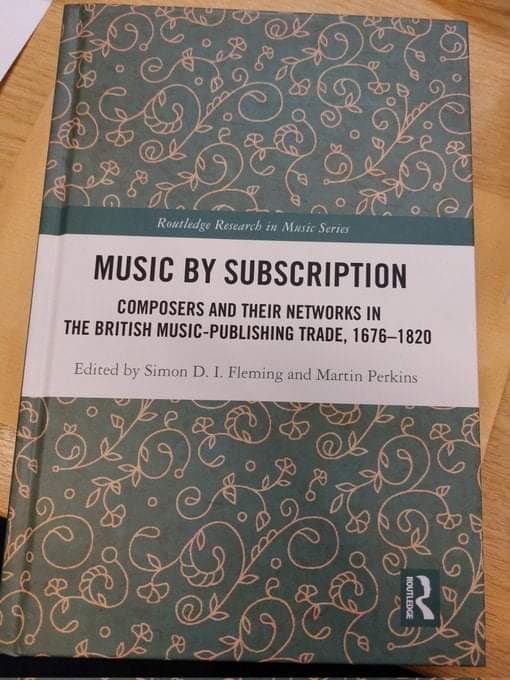
  • ‘Strathspeys, Reels and Instrumental Airs: a National Product’, in Music by Subscription: Composers and their Networks in the British Music Publishing Trade, 1676–1820, ed. Simon D. I Fleming & Martin Perkins. (Routledge, 2022), 177-197

Meanwhile, as an organist, I’ve completed my first year in Neilston Parish Church, which has been a very healing experience.  I love it there!  This Christmas has seen three of my own unpublished carols being performed, one in Neilston and two in Barrhead; and earlier in the autumn I contributed a local-history kind of article to the Glasgow Diapason, the newsletter published by the Glasgow Society of Organists.  Another publication! Might as well add it to the list:-

  • ‘Trains, Trossachs, Choirs and the Council: Neilston Parish Church’s First Organist’, in The Glasgow Diapason Newsletter

Confession time. Sewing is my relaxation of choice, often influenced by something I’m researching. This year’s project, a Festival of Britain canvas-printed linen piece, relates to the aforementioned chapter that I’ve contributed to someone’s book.

I know I would get more research writing done if I didn’t sew in my leisure time, but I need that for my mental health. Swings and roundabouts…

Interdisciplinary Research, Anyone?

When I graduated with my PhD in 2009, there was a flurry of interest in me as a ‘mature’ postgraduate, and my ‘portfolio career’. There’s only one problem – it isn’t a portfolio career! I work in one place, full-time, on a full-time salary. I’m not self-employed, nor do I do a little bit of this and that for different employers. It’s correct that I spend 0.7 of my time as an academic librarian, and 0.3 of my time as a researcher. If I had any aspirations at the start of my librarianship career, it was to be a scholar librarian of some kind, and as you see, that IS where I’ve ended up. I don’t claim that it exactly reflects who I am now – in my head, I’m more scholar than librarian.

So, if I don’t consider myself a good example of a portfolio career, then here’s another conundrum: do I do interdisciplinary research? If at some times I’m writing about librarianship, and at other times I’m writing about nineteenth to twentieth-century music publishing, does that make my research interdisciplinary? I guess it probably does, even if the librarianship and the music publishing seldom meet! I’m often contemplating the social context of whatever I’m researching. And just occasionally – like my recent article about Clarinda Webster – I manage to mention librarianship, music publishing AND social history in one fell swoop.

At other times, my research finds its way into the librarianship quite naturally. This week, the RCS Library is having a series of events throwing a Spotlight on Diversity. I’ve written a short blogpost about Scottish Women Composers as one of my contributions. The names I’ve suggested are just a start – and I haven’t attempted to include every Scottish woman who wrote a tune, because I’m assuming our students are basically looking for recital repertoire. My research has led me to several more women who made their own unique contribution, but they’ll get a mention in the book I’m currently writing. Their pieces aren’t necessarily recital repertoire, or even easily sourced today.

See my Scottish Women Composers in the Spotlight library blogpost.

Which half of me is winning?

Librarian. Time mainly spent cataloguing and working on the library equality and diversity project. In connection with this, I’m commited to giving a talk next month, and to submitting a librarianship-related journal article arising from a talk I gave earlier this year.

Musicologist. [2nd] book proposal submitted. Already committed to producing two book chapters for essay collections being edited by other folk.

Librarian meets Musicologist. Article straddling both worlds, due out in the next month or so. Also giving a talk in Edinburgh in June, in my capacity as Honorary Wighton Librarian.

If only I had a garden big enough for a secluded Writing Shed!

ResearchFish

There comes a time in every funded researcher’s year, when they have to upload evidence of writings and speakings and anything else that may have emanated from their funded research.

Research Fish – as imagined

I struggled this month. There didn’t seem to be much to report, given that I’ve been focused largely on my present writing project, which is not (currently/yet, depending on optimism) funded. Nonetheless, I did it. And cheerfully tweeted my relief that it was done. I shared my favourite image of a fish mosaic on social media to celebrate.

Today, imagine my surprise – ResearchFish actually SENT me a Research Fish! I shall treasure this gesture.

Outreach and engagement

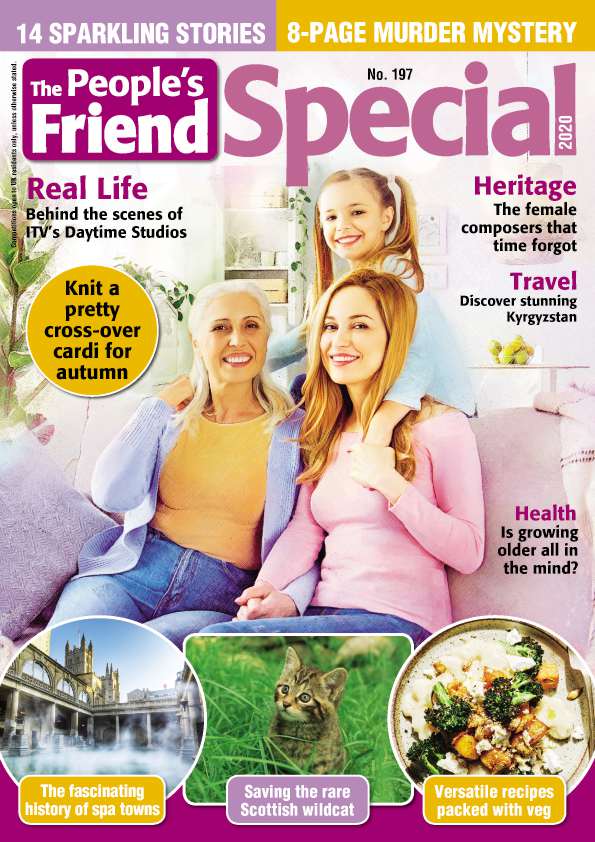
(On a slightly more serious note, this is possibly the first time an article in The People’s Friend has been cited as a research output – it counts as outreach!)

First publication of 2022 – a chapter

I have just catalogued a book containing my chapter on music subscribers to published strathspey and reel collections in the late 18th to early 19th centuries.  (Not every author gets to catalogue what they contributed to! Still, it means it’s now available in the library at RCS.

 Here it is:-

Chapter 10. ‘Strathspeys, Reels, and Instrumental Airs: A National Product’

And the book itself:

 Music by subscription : composers and their networks in the British music-publishing trade, 1676-1820 / edited by Simon D.I. Fleming, Martin Perkins.  (Routledge, 2022)