Dr Karen McAulay explores the history of Scottish music collecting, publishing and national identity from the 18th to 20th centuries. Research Fellow at Royal Conservatoire of Scotland, author of two Routledge monographs.
I really should have known better. I’m making a filial pilgrimage to Norfolk. I’d call it a flying visit, if it wasn’t for the fact you can no longer fly direct from Glasgow to Norwich.
I played the organ this morning, went home to homemade soup, then headed for Norwich by train. (It was a more appealing option than a long drive, mostly in the dark, and the prospect of icy roads later.)
So …
Glasgow to Edinburgh
Edinburgh to Peterborough (LNER buffet delivers tea and fruit cake to your seat! Kudos to LNER)
Peterborough to Ely
Ely to Norwich
22.22 reach hotel.
There was only one setback. You can’t get anything to eat or drink from Peterborough to Norwich, unless you pay a vending machine via Contactless. I took this to mean, ‘using your phone’ – which I’ve never done. (Only later did I wonder if card payment might also have worked…)
No buffet-car on the trains, and not really time to leave the platform in search of sustenance.
And so my Sunday dinner, at 22.22, was this:-
Better than nothing!
I had also apparently booked a hotel room with no breakfast. This has now been rectified!
I said this was a moral tale. It’s this: one should never, ever venture into East Anglia on a Sunday night without a sandwich in one’s handbag (and a drink in a flask)!
Paddington Bear and Queen Elizabeth could have told me that …
You know what it’s like, working from home. The Plus: surrounded by all your books and papers, and the kettle just ten feet away from your desk. The Negative: trying so hard not to get distracted by – well – STUFF! No-one has ever suggested I have ADHD. But maybe I have? Take this morning. All set to start on time, I set the washing machine going, and make a cup of tea.
I’ll need more teabags in the caddy, I muse. But I manage not to go and get them. I’m only working this morning, so I want to get on.
Mug in hand, I read my emails and start checking train times for a lecturing gig.
A family member drifts in. My home office is in an alcove off the dining room, on the way to the kitchen. Ah, well. (They’re going out this morning anyway!) I adopt a friendly, interested but BUSY demeanour: (let’s call it FIbB).
Continue what I’m doing. Train times sorted, email written, and on with the lengthy article. To be accurate, on with a wee literature search to back up an assertion in the lengthy article.
The washing machine beeps to say it has stopped. I ignore it, and work on.
Another family member drifts in. Only a couple of minutes … FIbB face again.
Progress is being made. Suddenly it’s time for elevenses, so I think I’ll just hang the laundry out …
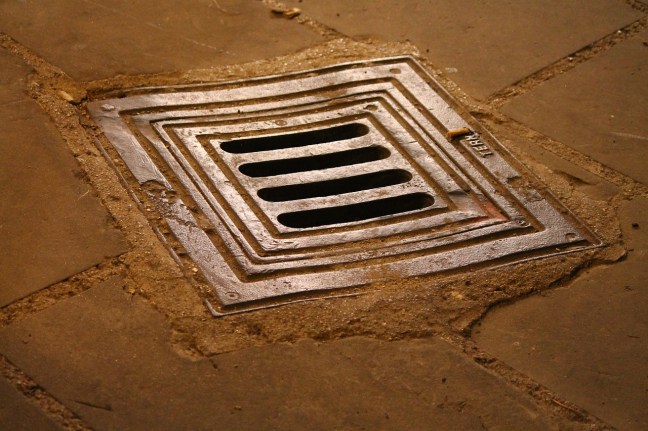
The blinking drain outside the kitchen has blocked! I am remarkably good at unblocking drains – it’s a dry day, and I’d better get it done – it barely takes ten minutes – otherwise there’ll be another overflow next time we use the washing machine OR the dishwasher!
As I stand out there, sleeves rolled up, the first family member reappears, seems in the mood for chatting. FIbB face doesn’t work so well out in the garden, apparently. I suppose I don’t look busy in the same way as when I’m at my desk.
In my own defence, I did spend another three extra hours working later, so my conscience is clear, and I’m happy with what I achieved. I remind myself that working on campus isn’t without its interruptions, either – just different ones. And had I been on campus, that drain would still be blocked – but I might not yet know about it …
Not all research materials are scholarly journals (obviously), and in the Arts and Humanities, not everything is online. Nonetheless, I needed to read a substantial magazine article, and the nearest copy was in our renowned Mitchell Library.
I woke this morning to grey skies and steady, insistent rain. My first thoughts were that the seedlings planted last night had had a good start to their grown-up garden life, and then (on a different train of thought), that I was going to get rather wet going through to Edinburgh’s Morningside this afternoon.
Then I remembered that article in the Mitchell.
Researching in the Rain
Did I feel like another soaking in one day? No matter. It’s a research morning, and this is research. Indeed, I found useful information that’s immediately relevant, so I’m glad I made the effort. I did get rather wet, but I got the feature copied, rewarded myself with a takeaway latte, and headed home. It’s a salutary reminder that not all research is high-flying or glamorous; that there’s worthwhile data in non-scholarly publications as well as historical old sources – and after all, there’s plenty of time to dry out before the next outing!
NB. Scotland isn’t kind to neat, efficient-looking collapsible umbrellas, but my large, pink golfing umbrella is going to have an airing later. Glamorous, me? No!
I returned my edited, copy-edited manuscript to the publisher today, and turned back to the small matter of my second index. One index wasn’t enough for Yours Truly – I needed to index all the historical publications that I’ve alluded to, which is not at all the same as a list of modern references – it includes lost works amongst those that are still extant.
I did make the list a couple of months ago, but I realised now that it wasn’t in the most useful order. Worse still, I had used tabs rather than a properly formated table, making it just a bit more fiddly to manipulate.
Hey-ho, time for a reorganisation exercise. So I got started … I do quite like bibliographical lists, but this one’s quite an undertaking.
I sat at that laptop so long today that my eyes are dry and scratchy (hello, eyedrops) whilst my neck twinges when I move my head. Owch. I tried a heated oat-pack, and eventually opted for Voltarol gel. Here’s hoping!
I haven’t remotely finished the task yet – it’ll have to wait now until I’ve been to Dundee tomorrow. The trip will probably be a welcome break.
Perhaps it’s not surprising to find more librarians and former librarians than usual at a research conference about book and print history and the book trade – but I was certainly in my element amongst the researchers at this week’s Print Networks conference in Newcastle. Indeed, I even found two more musicologists and a music practitioner amongst the kindred spirits, so I didn’t really need to try very hard to make my point that printed music history is indeed a branch of book history. Glasgow printers also got a look-in, so my talk about Glasgow music publishers wasn’t out on a limb geographically, either.
Then there were trade catalogues, book pirates, Stationers’ Hall, slave narratives, radical newspapers in Birmingham … just so many interesting papers!
Having spent the first part of the week in Newcastle, the last couple of days were ‘mine’, an agreeable blend of sociability, along with mundane catching-up at home, and (ahem!) more research.
A Lost Work, aka, a Ghost Publication
An old copy of a classical piece in a Mozart Allan edition raised some interesting questions – could I resist following them up? Indeed I could not. I’ve found another lost work – or as I prefer to call it, a ‘ghost’ publication. It would have been so very nice to have tracked this down. The advertisement absolutely reinforced a point I make in my forthcoming book. But it’s in neither Jisc Library Hub Discover, WorldCat, the British Newspaper Archive, Abe, Alibris, eBay, the Sheet Music Warehouse, Google Books nor Archive.org. There’s no mention of an editor or compiler for this collection, just a title. Oh, bother!
London suburbs
And a London Gent supplying Mozart Allan with Light Music?
It gets worse – another advert at the back of the same classical piano piece appears to suggest that a light-music composer who published almost exclusively with Ascherberg, Hopwood and Crew, also published a few early works with Mozart Allan – but using a different first name. Two of the works published by Mozart Allan also appear later with the first name he was mainly known by. This is interesting. I’ve spent several hours yesterday and today trawling eBay (and treating myself), whilst on the trail of this gent. Yes, I know the book is already in preparation. Anything I find won’t go in the book, but research doesn’t stop when a book is published, does it?!
Starting today, that’s my new official title. Prior to my retirement from the Whittaker Library at the Royal Conservatoire of Scotland, I was seconded part-time to Research and Knowledge Exchange. Today, after a brief break, I return as a post doctoral research fellow, since I plainly can’t be seconded from a role I no longer hold.
Reincarnated / ReinKarenated
It’s strange. Today, I sit at my working-from-home desk – same desk, same research work to do, same hours – outwardly, nothing has changed, and yet everything has changed, because I retired from Professional Services and returned to Academic Services. Research is now my sole role, not a small chunk cut out of my 9-5 library existence, and I’m a Research Fellow rather than a Researcher. It’s what I’ve always wanted.
Karen has been reinKarenated, you could say.
What’s in a Name?
‘That’s not how you say my name!’
If I explain the embarrassment of my name, the pun will make more sense. My family pronounces my name ‘Kar’ to rhyme with car, rather than the conventional ‘Kar’ to rhyme with carry. Don’t blame me!
I stopped trying to correct people a very long time ago – it’s not other folks’ fault that my parents decided to pronounce my name distinctively differently. If you’d spent several decades being thought prickly for insisting on an unusual pronunciation, you’d understand why I’ve given up on that!
Call me what you like – I’m a research fellow, and I’d better get on with indexing my monograph ….
I was all set to blog about the Librarian’s Last Tuesday, but my lunchtime discovery makes all that stuff about library owl mascots and jazz CDs seem rather trivial!
There I sat, half-heartedly eating my sushi, when it occurred to me that I hadn’t yet looked to see if my forthcoming book is advertised on the publisher’s website yet. I practically dropped the sushi in surprise (it wasn’t Boots’s best effort) when…
There was my book looking at me! It’s the first time I’ve seen the title on the cover that I chose a few weeks ago.
I haven’t even seen the proofs yet, and I’m still indexing it, but it’s really exciting to see its outward appearance.
Okay, it was the Performing Arts Librarian’s Last Tuesday. But it was also the last Tuesday before I cease to be a partially-seconded researcher. In eight days I’ll be a part-time Post Doctoral Research Fellow. Still indexing the forthcoming monograph!
Friday was a great day. Or should I say, Friday afternoon was a great afternoon?
A short research visit to the Mitchell Library was followed by discussion of my forthcoming RCS research contract – to enable me to continue researching part-time after I leave the library – followed by a trip to Glasgow Uni for the launch of the Books and Borrowing Database. It’s a fantastic resource, and I’ve watched the project with interest. (website: https://borrowing.stir.ac.uk/)
A bit of networking over a glass of wine and some cheese straws, then I headed home with a distinct lightness in my step. It wasn’t just the glass of wine! I felt as though I’m finally adjusting myself into who I’m meant to be.
I like to think I’ve been a good librarian. I do believe I have. But if I am honest, I chose librarianship because I couldn’t see myself as an academic. I am an object lesson in not writing oneself off at the age of twenty-four. If you’re like I was, or you know someone like I was, tell yourself/them to have more self-belief.
I’m giving my annual lecture on Scottish song books tomorrow. Just shows that I can lecture. Indeed, I’ve read countless papers over the past two decades.
Just think how many books I needn’t have catalogued, if I’d been braver and more determined at twenty-four. (I’m still cataloguing them – feeling a bit pressured, if I’m honest!)
On the other hand, how many intriguing enquiries I’d have missed, not to mention unexpected surprises amongst the book and music donations … there have been some advantages.
Image: Wikipedia picture of Hereford Cathedral Chained Library
Reaching the end of my recent cataloguing project – the gift of a number of books of old Scottish music – I must confess I left what looked like the most miscellaneous, worn, unbound pieces until last. Late on Friday afternoon, I had observed that one such piece had a pencil note at the head – ‘Music for The Gentle Shepherd, Foulis edition, 1788’. Now, this is a famous ballad opera by Allan Ramsay. It was so popular that my colleague Brianna Robertson-Kirkland writes that there were 86 editions of TheGentle Shepherd, 66 of them the ballad opera. Initially, the songs only indicated the name of the tune to use, and different editions have more or less songs. The 1788 edition contains a full vocal score of the songs, and that’s what we’ve got. My guess is that the last owner bought the 18 pages which someone had previously separated from the back of the larger original volume.
I haven’t made a study of it myself, but I do recognise the opera and its songs as very significant in the history of Scottish music – and this edition has particular importance. So, if this gathering of pages was so important, it would benefit from a decent catalogue entry.
The pages are numbered 1-18. With no title-page, still less a cover, to give me further clues, it wasn’t a task for 4.30 on a Friday afternoon, but it very definitely was one for a Monday morning.
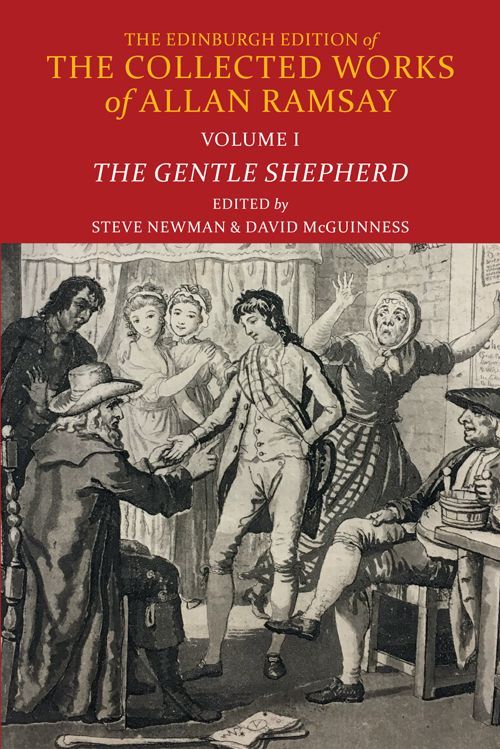
A bit of digging around soon found me another library’s catalogue record of Ramsay’s ballad opera in that very edition – a particularly significant edition, because it’s the most lavish, quite apart from having the complete vocal score section. RCS lecturer Brianna Robertson-Kirkland has researched the work in detail and written an article about it, which is on one of her class reading-lists. Dr David McGuinness, with whom I worked on the HMS.Scot AHRC-funded project a few years ago, has also recently published a book about it, with Steve Newman.
The new Edinburgh Edition of The Gentle Shepherd
But the catalogue record didn’t exactly fit my purpose, because what I had in my hand was the appendix at the end of the book, containing all the songs. We didn’t have the text of the ballad opera at all.
No problem – I downloaded the catalogue record and adapted it to reflect what we did have. I made sure the words ‘Scottish songs’ appeared in the catalogue record, and I indexed every one of those songs. The appendix is only eighteen pages long – it wasn’t that arduous a task. I’m really happy that we’ve been given this, because – even though it’s fragile and will have to be handled with extreme care – it means the students will now be able to see the music that Brianna has written about, and lectures about. (It still needs a nice stout card folder, and a secure storage space – but they’ll be sorted out soon.)
Informed Cataloguing
There’s one strange thing, though. It appears no other cataloguer has catalogued each song in The Gentle Shepherd – not in Jisc Library Hub, at any rate. Well, although we at RCS might not have the whole magnificent text, a title page or a cover, we HAVE now got a catalogue record which indexes all the songs. Hooray!
Contents:-
The wawking of the fauld (1st line: My Peggy is a young thing)
Fy gar rub her o’er wi’ strae (1st line: Dear Roger, if your Jenny geck)
Polwart on the Green (1st line: The dorty will repent)
O dear mother, what shall I do (1st line; O dear Peggy, love’s beguiling)
How can I be sad on my wedding day (1st line: How shall I be sad when a husband I hae?)
Nansy’s to the green-wood gane (1st line: I yield, dear lassie)
Cauld kail in Aberdeen (1st Line : Cauld be the rebels cast)
Mucking o’ Geordie’s byre (1st line: The laird, wha in riches)
Carle, an’ the king come (1st line: Peggy, now the king’s come)
The yellow-hair’d laddie (1st line: When first my dear ladie gade to the green hill)
Kirk wad let me be (1st line: Duty, and part of reason)
Woe’s my heart that we shou’d sunder (1st line: Speak on, speak thus)
Tweed Side (1st line: When hope was quite sunk in despair)
Bush aboon Traquair (1st line: At setting day and rising morn)
The bonny grey-ey’d morn
Corn-Riggs (1st line: My Patie is a lover gay)
I struggled to explain to my family just how gratifying I find this. But I think it’s really important not only that Brianna’s students can see which songs are in Foulis’s edition of The Gentle Shepherd, but also, anyone looking for one of those song titles will be able to see that it was one of the songs used in the famous ballad opera.
The Gentle Shepherd / Allan Ramsay ; edited by Steve Newman, David McGuinness.
As a matter of interest, we do also have some items going back to the era when Cedric Thorpe Davie put on a performance of the opera. Anyone checking our catalogue will spot those too!
The Gentle Shepherd: a pastoral comedy / by Allan Ramsay ; abridged and adapted for performance at Edinburgh International Festival by Robert Kemp [bound photocopy, 47 p.]
After diligently doing my organ practice this morning, I felt like an outing this afternoon. Only a librarian/musicologist would decide to go library-visiting! However, I knew that Paisley has a new, exciting public library building in the High Street, and I also wanted to find out about an old Paisley publication, so where else would I go? The image above is one I found on Renfrewshire Libraries’ website.
The new Paisley Central Library, wow. Was genuinely emotional to see what can be created when there is will and investment. A beautiful library at the heart of the High Street that will inspire generations to come. Inspiring, well done to the team there and @onerenculture 👏 pic.twitter.com/lAAb8Klwir
Sean McNamara’s enthusiastic tweet about the library, on 23 November 2023.
The library is bright and modern, on three floors. The ground floor has a large children’s section at the back of the floor, with places for parents and children to sit, and steps the children could go up and down – very cheerful and user-friendly.
There are also facilities for making a hot drink. Whatever next?! Very nice, but an unexpected surprise for an old-school librarian who last worked in a public library, erm, 36 years ago!
Plainly there wasn’t going to be anything of the kind I was looking for, on the ground floor. I headed up to the next floor, and the next. Places for computer use, an array of different seating arrangements, non-fiction …..
I asked, but I discovered that if I would find what I wanted anywhere in Paisley, then it was not here. I need to go the Heritage Centre (aka “the archives”), elsewhere in the city. That’s a trip for another day, since it’s not open at the weekend.
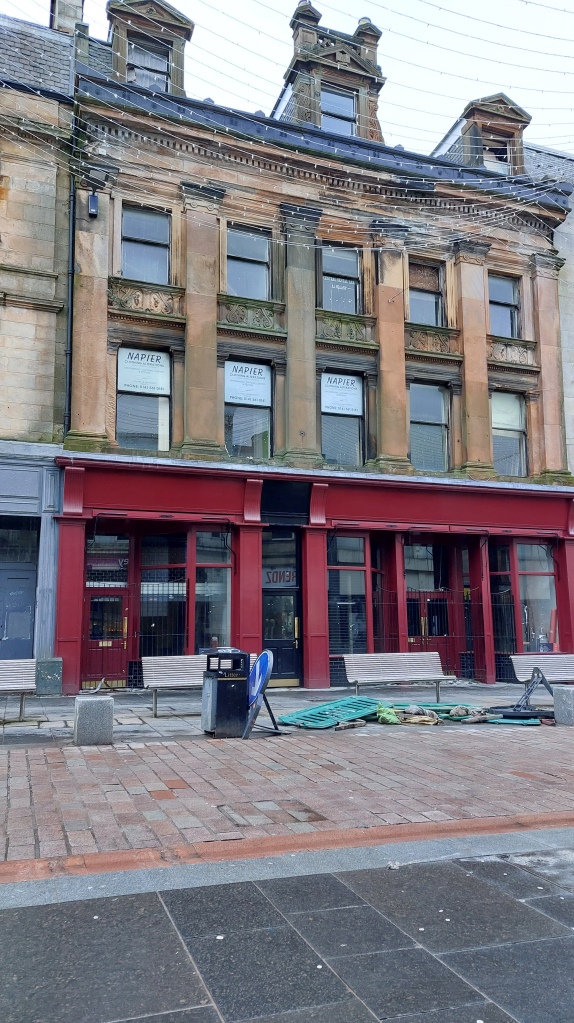
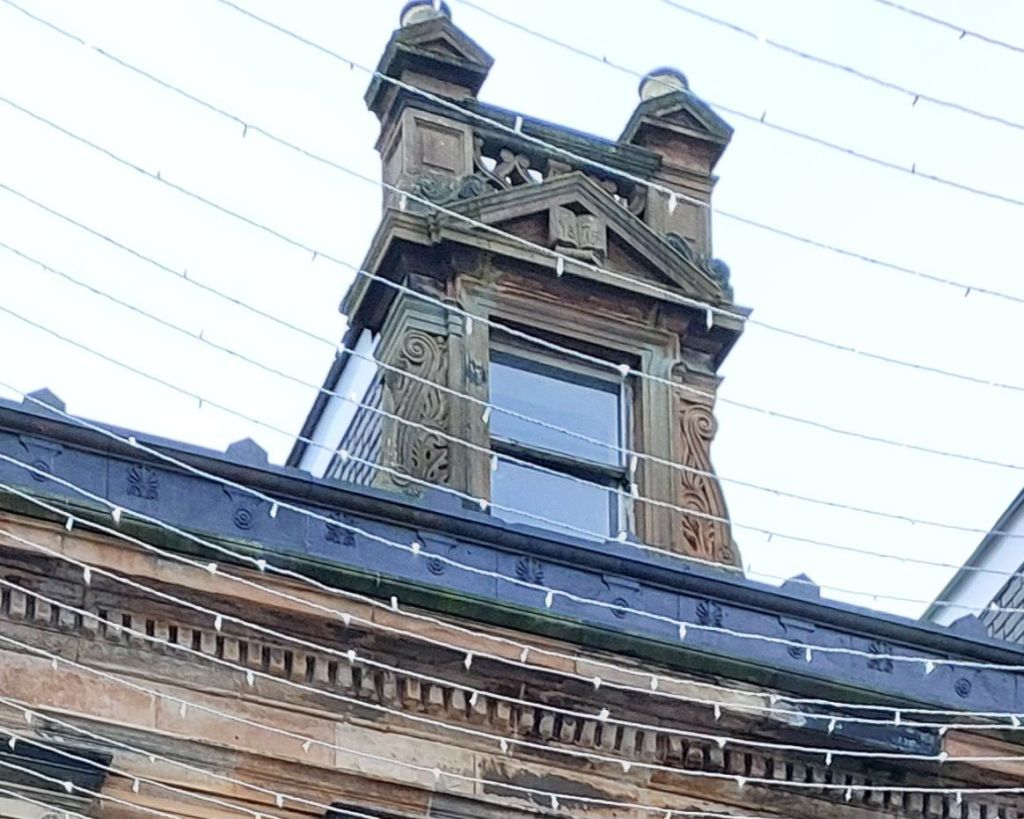
Parlane’s former offices in Paisley High Street. Book sculpture right above the top dormer window.
All was not lost. I also wanted to find out where Parlane’s offices had been. I knew that they, too, were in the High Street – and they were two doors away, in fact. They looked a bit sorry for themselves. I took a photo, but a string of twinkly lights (not illuminated by day) obscured a decent photo of the book sculpture at the top of the building.
Maybe I’ll find a better one online somewhere. Messrs Parlane might have been pleased to find a new library as their next-door-but-one neighbour, but I fear they would have been sad to see the High Street today. It wasn’t exactly bustling on a Saturday mid-afternoon.
Home I came, and spent several hours making lists of things I’d like to see at the Heritage Centre. (I hope they’re as welcoming as the website suggests, or they’ll find me a bit of a nuisance with my long list!!)