Dr Karen McAulay explores the history of Scottish music collecting, publishing and national identity from the 18th to 20th centuries. Research Fellow at Royal Conservatoire of Scotland, author of two Routledge monographs.
Dutifully, I booked a morning off because we were anticipating the advent of a roofer at home, and I didn’t want to be torn between roofing conversations and research work. The afternoon was my own, apart from a couple of rescheduled meetings at the end of the day. (There wouldn’t be anyone on the roof by then, surely.)
‘Anticipating’ was the word I just used, and it was just that. The storms a few weeks ago played havoc with more roofs than our own. Anyway, here I sat, two laptops in front of me, nothing happening on our roof, and Scholarly Satan started tugging at my conscience.
“You could sort out your timesheets, you know.”
“You can reschedule that tutorial. Do It Now.”
“You’ve got to update your CV, haven’t you? You LOVE formatting documents and getting the bullet-points and punctuation just right.”
“Oooh, look, you can action that email straight away – wouldn’t it feel good to be so on-the-ball?”
And then came his masterstroke.
“This is Scholarly Stuff, you know. There’s nothing sinful about Scholarly Stuff.” Which is true, of course, apart from the fact that I wasn’t meant to be working! Anyway, it’s now 4 pm, and I propose to walk away from the laptops for half an hour, until the last and only official duties of the day. I fear I’m too old to mend my ways now.
I wrote this post last year, but for some reason never actually posted. Not to worry – now is the time to share it!
You could say Robert Wilson had Scottish music publishing just about tied up in Glasgow. As his singing career began to wane, he bought up James S. Kerr’s and Frank Simpson’s, also co-founding Thistle Records from his premises in Berkeley Street. Not bad going, eh? Oh, and he also owned a travel company, which is less surprising considering his own worldwide travelling as a singer – he must have gained quite a bit of insight into the travel business. An informed, on-the-ground (or water, or airborne) interest, you could say.
After his death, the remaining shareholders of Kerr’s Corporation later acquired Mozart Allan’s AND Bayley & Ferguson’s backlists, too.
Wilson began a career as an apprentice draftsman, but after redundancy, started out as a singer. He sang with the Rothesay Entertainers, joined the D’Oyly Carte Opera Company Chorus between 1931-7 and then embarked upon his solo career, specialising in middle of the road Scottish song, but not limiting himself exclusively to this repertoire. Here he is, recorded by Pathe Films at the start of his solo career.
Annie Laurie (Maxwellton Braes are Bonnie)
If you’ve got a bit more time, here’s a ‘Voice of Scotland Short’ – a biopic lasting nearly an hour,with musical performances:-
Robert Wilson – Voice of Scotland Short
‘A Tribute to Robert Wilson’, with:-
Kenneth McKellar
Eliot Dobie
Jimmy Shand
Andy Stewart
Will Starr and Accordion
Cliff Hanley
Harry Carmichael
Sydney McEwan
Additional material by Bob Wright of Girvan
Header Image of ‘The Road Bridge to Bonnie Dundee’ from EBay
I have a forthcoming magazine article with more about Robert Wilson, of which I will give full details when it’s published in the near future.
You can read more about Scottish music in bygone days in my recent book:-
On LinkedIn, public-speaking coach Alex Merry recently posted these tips on making a great presentation. It occurs to me that some of these tips will be equally applicable to the Scottish song entertainment that I’m leading later this month.
Alex Merry’s Presentation Tips
In my case, it’s not a presentation at all – I just need to introduce the songs we’re singing. So it’s categorically not about me. But I do need to be lively and relatable. Start with a short sentence and a pause? I hadn’t thought of that, but it should be easy to factor in.
Fun? Oh, yes. I have a few ideas! đŸ’¡ Well, props, really. I’m going to need one of those big, reusable supermarket bags. And I have an abundance of stories, so that’s all right.
My only problem is this: I’m a bit embarrassed about my Englishness. I’ve lived in Scotland more than half my life. Scottish national music is my specialism, and I’m secure in my subject – but this is a fun entertainment, not a demonstration of knowledge, and my accent is all wrong. So … do I bring attention to it jokingly, or put it to the back of my mind? My personal view is that you should never draw attention to your weaknesses. What would you do? Stuart Chater on LinkedIn makes a good argument for NOT being ashamed of your accent.
And the song I’m going to sing? (It wasn’t my idea, someone asked me.) It’s short. It’s within my vocal range. But I can no more sound Scottish than fly!
Remember un-conferences? They were popular a few years ago.
Well, now I’m co-ordinating a Scottish song event, but it’s for entertainment, and not remotely connected with my research. Does that make it an ‘un-research’ event? Anything I might say about these songs will have been learned during my research career. (I grew up in England – it wasn’t my childhood repertoire.)
Community Singing
It’s interesting, all the same. For a start, I am interested in community singing in an early-twentieth-century sense, but my own practical experience of secular community singing is limited. The forthcoming gig may well trigger new trains of thought. (Let’s discount leading congregational singing from the organ, which I’ve done for decades.)
Repertoire
The preparation has been interesting, too. We have collectively chosen the repertoire: some old, some from the 1950s and 60s, and some that our children would have learnt at school. It bears out my findings that the repertoire of favourite Scottish songs does change with every generation.
We’re also channelling Sir Hugh Roberton and his Orpheus Singers for a couple of choral items, but an even earlier choral arrangement felt too dated. You have to know about the west of Scotland’s intimate acquaintance with Roberton’s repertoire to appreciate why those settings go down so well to this day. Somehow, his particular brand of close SATB singing has endured in a nostalgic kind of way, where earlier settings have fallen by the wayside.
Authenticity
It gets better. We’ve debated different versions of the lyrics, and odd discrepancies in tunes. In other words, we re-enacted all the chatter about authenticity and correct versions that has been rolling on for, shall we say, 250 years or more?
And the Squeezeboxes?
Accordion
I debated with myself whether to go all authentic with an accordion accompaniment in appropriate songs, but I don’t think I’m that brave. Singing a solo is brave. A couple of concertina tunes is positively reckless. But the accordion is probably getting left at home. (Although, if you listen carefully between now and then, you might catch me attempting a few strains of ‘The Song of the Clyde’ in private … Jimmy Shand I’m certainly not!)
Leisure and Pleasure – Everyday life in Second World War Scotland
I don’t often sign up to webinars, but something so closely aligned to my own current research was irresistible.
The History Scotland webinar series is promoted by the History Department at the University of Dundee. The guest speaker today was Dr Michelle Moffat of Manchester Metropolitan University.
And what did I learn? Leisure pursuits didn’t stop in wartime, especially going to the cinema. This is worth knowing. (However, I must be careful not to assume things were exactly the same everywhere. It makes me wonder about central London, for example, where people might have felt more threatened. )
There was also interesting detail about rationing and food shortages, and discussion about how much people in Scotland felt the war was ‘their’ war. (I suspect anyone who had relatives fighting overseas would very much have felt indirectly part of it.)
And a reminder about the Mass Observation Archive. I had forgotten about this, but it’s a crucial resource – I’m going to check it out with some questions that I hope it might help with!
Last Friday, I submitted an article. Yesterday, I did the minor edits for an accepted article and dispatched that, too.
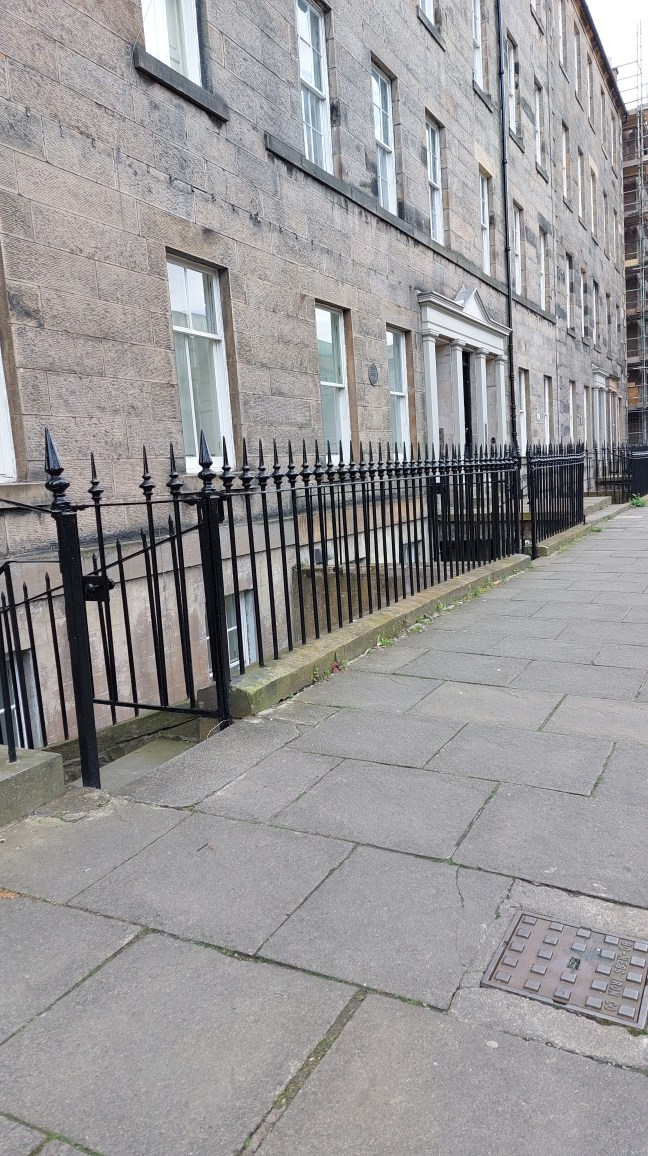
And today, I headed to Edinburgh and resumed my archival pursuits. The city was initially bathed in golden sunshine, though this didn’t even last until lunchtime. It is certainly a very beautiful city.
Nearly spring in Edinburgh?
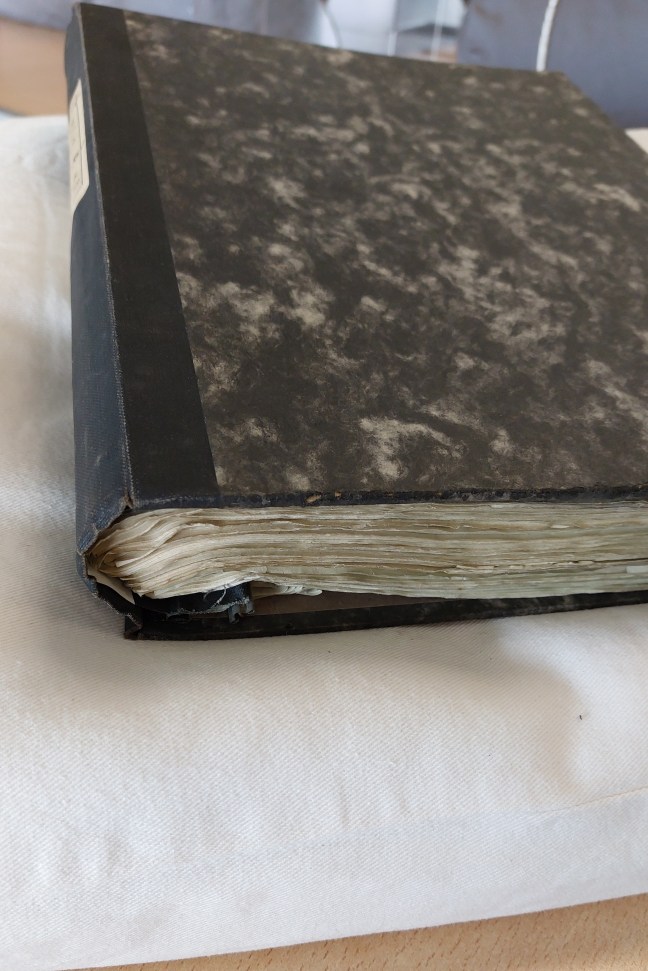
Unless you’ve experienced it, you can’t imagine how many brown folders of thin carbon copies will fit into an archival box. Carbon copies are as thin as airmail writing paper. The bulk of this particular box consists of NINETEEN folders of rejection letters just for one year, 1948.
You might think I didn’t need to concern myself about books they didn’t publish, but you never know what snippets about publishing policy or the economic climate – or anything else! – might turn up. (And you’d be surprised at the number of would-be authors who didn’t take a definite refusal AS a definite refusal, but kept writing to argue their case!)
‘Do Forward the Bathing Costume’
That was an unexpected postscript, in one of the letters that wasn’t a rejection. The publisher and author had evidently gone to the swimming baths, and the author went home without his trunks! Irrelevant, but it’s undoubtedly evidence they were on friendly terms, isn’t it?
I did discover – unneccessarily, but amusingly – that in the late nineteenth century, the managing director of this publishing house used to go open-air swimming in Leith before work in the summer. Clearly the tradition had either continued, or been revived, with the opening of the Portobello open-air pool in 1936 …
You can tell I’ve spent too long in the late nineteenth century – in the research sense, that is. Dizzy with excitement at the thought of seeing a silent movie – yes, it might actually come to pass, albeit not for a few months – I was almost deliriously pleased to discover that one of my research interests made British Pathe ‘shorts’ during the Second World War. My aim is to contrast two singing careers, started only a decade apart – and here’s the first contrast. One began their career during the First World War and the silent movie era. The other made British Pathe shorts during the Second.
We think we’re so advanced, with our internet and our AI, electric cars and digital sound … but anyone born in the late nineteenth or early twentieth century might have been amazed by their own advances in technology. A fin-de-siecle child treated to a magic lantern show, might have sung along to hymn or Scottish song texts projected on a magic lantern screen, the singing led by whichever grown-up had been co-opted in to help. When silent film came along, any music would be provided by a cinema pianist or a small ‘orchestra’ – possibly no more than a piano trio. What you heard would partly depend on who was playing and the bundle of music they’d brought with them.
But when the children became adults, they would would find themselves listening to the wireless or going out to ‘talking’ movies. Watching, in adulthood, a short film performance by a contemporary star vocalist would have been unimaginable a decade earlier.
However, I must still cool my heels as I wait to see if (and when) the silent movie that I need to see, can be converted into a modern format. Meanwhile, I’m trapped in the nineteenth century with the printed novel that gave rise to the movie. As I read, I wonder how they managed to condense the story into a couple of hours, and then convey the whole plot by wordless gestures.
‘LUCERNA is an online resource on the magic lantern, an early slide projector invented in the 17th century.
‘For more than 350 years the magic lantern has represented and fed into every aspect of human life and every part of the world. It is still used today, both in its original form and through direct descendants like the modern data projector.
‘LUCERNA includes details of slide sets, slide images, readings and other texts related to slide sets, lantern hardware, people and organisations involved in lantern history, and much more.’
My new schedule entails thinking about an Edinburgh publisher whilst I’m in Edinburgh, and writing about various other aspects of my research on my Glasgow days.
I have an article I’m actively gearing up to write; another requiring tweaking; a couple more requested; and lastly, a new avenue for which I’ve identified a journal, but not yet completed the research. Quite a bit of writing!
But first, in the first article, we have the soprano and her repertoire. And her ‘go-to’ encore. And if you thought I got excited about magic lanterns – new technology for late Victorians – well, you can imagine my excitement at the thought that I may need to watch a silent film soon.
Why? A musicologist watching something in silence? What does silence have to do with music (apart from John Cage’s 4’33”, of course)?
You see, I think this film may have influenced her choice of encore. So, firstly, I’m awaiting an eBay copy of the novel on which the movie was based. And then, I’m waiting to find out if I can watch the movie without leaving Scotland.
She wasn’t a film actress herself, so my whole quest is a bit tangential – I’m not thinking about nipping down to London unless it’s absolutely unavoidable. But I could …
Meanwhile, I reflect that watching silent moving pictures must have been enormously exciting if you had grown up with the occasional magic lantern show. And when, in due course, talkies came in … it’s hard to imagine how amazing that must have been. Small wonder that printed music took a bit of a nosedive in the late 1920s – the options for entertainment outside the house were expanding all the time.
I’m eagerly awaiting news of my chances to watch this intriguing spectacle!
I read some advice the other day (you’ll have seen it often enough):-
If you aren’t happy where you are working, then leave.
There’s another adage, which is similar on the face of it, which goes like this:-
If you keep on doing what you’ve always done, you’ll get what you’ve always got.
I know there’s value in the first suggestion, but it isn’t always possible, is it? You may be well aware that you’ve probably been in the same job too long, but personal circumstances mean you simply can’t leave. Or your role is so specialised that you would have to relocate, which might not be an option.
This is why I prefer the second adage. Sometimes you have to take a long view, and your Plan B might involve changing direction whilst sitting tight. Get ready for a new role, adjust your mindset accordingly, but accept that it’ll be a while before you make the move.
Alt-Ac-tually
I feel for people at the start of an academic career, with the struggle to get one foot on the ladder. Do you actively want an Alt-Ac career, or do you feel you have no choice?
I wanted to be an academic music librarian. That became my career, but later I regretted not having finished my first PhD and given academia a fair shot.
My Plan B began with getting a PhD. Afterwards, I was very fortunate to get partial secondment as a researcher for more than a decade, whilst remaining in librarianship for the bulk of my week.
Adjust Mindset
It’s not just a question of having the right qualifications. You need to ensure that you believe in yourself as a scholar, and that others see you as a serious academic.
Write the articles;
Publish the book (if appropriate) or chapters,
Attend conferences (partial attendance isn’t ideal but it’s better than non-attendance, if cost or time are problematical);
Give talks, whether scholarly or as public engagement;
Seek opportunities for career development. (I did a part-time PGCert a couple of years after the part-time PhD).
DO NOT, repeat DO NOT, write yourself out of a career option because you believe yourself incapable of it. (Aged 21, I believed I would never be able to stand in front of a class of students. And on what did I base that assumption? I’d just taught English to assorted European students for about a month. I did it. I planned lessons, and stood there, and did it. So who said I couldn’t?! And it gets worse. There weren’t many women doing music PhDs when I was 21. Guys told me it was incredibly hard to break into academia – and I just took their word for it. How naive WAS I?!)
Look instead for opportunities to practise the areas you feel need improvement. You may need to think laterally. Music librarians seldom teach music history, but they do deliver research skills training. Lots of it.
Today
Fast-forward to now. I left Glasgow at 7 am today, in subzero temperatures. Edinburgh is bright, clear and breathtakingly … well, breathtakingly cold as well as beautiful! A freezing cold early start might not sound like a luxury to the average retired librarian. I’ve never wanted to be conventional, though.
The Mercat Cross, Edinburgh
This is the first week in my IASH Heritage Collections fellowship. For the first time in my career, I’m NOT juggling librarianship and research. I’m part of a vibrant community of practice, and I have both the University Library and the National Library of Scotland just down the road. Thus, today, I saw a set of four Scottish song books that are remarkably hard to find as a set. (Three cheers for legal deposit!)
And last night, the year got off to an even better start, with an article being accepted. Just a few minor tweaks to do, which won’t be difficult.
It feels to me as though my long-term plan might be working out quite well!