Hooray for Legal Deposit

Well, after all my Stationers’ Hall research a few years ago, you won’t be surprised to see me say that!

The Edinburgh Companion to Women in Publishing, 1900-2020 (Edinburgh University Press, 2024)

But I had reason to be grateful again today, when I needed to consult an expensive new book of essays from Edinburgh University Press. Only a few universities have it in electronic format (not accessible to external readers, for licensing reasons), but there was ONE printed copy in Scotland – presumably the legal deposit copy.  A trip to the National Library of Scotland was called for.  (I am so used to going upstairs to the rare books reading room, with all the book cushions and stands, weighted ‘book snakes’ and fragile volumes, that it was quite a novel experience to be heading to the general reading room to see a shiny new book in all its glory!)

From a drizzly start in Glasgow, it turned into a glorious warm and sunny autumn day, showing Edinburgh at its best.  (Which is more than can be said for Glasgow, sulking in the rain upon my return!)

And the book was fascinating, despite seemingly not referencing anything related to music.  It was wide-ranging in subject-matter and chronological coverage. (120 years is a long time in book-publishing.)  I read a couple of chapters, making a mental note that I might have reason to come back to it again next year.

Sometimes, you need to look at a book, just to make sure you haven’t missed anything! I can finish my article now, reassured that I haven’t overlooked any unexpected new commentary.  It was a long shot!

Ancient and Modern, Near and Far

Glasgow City Halls stage set for BBC Radio 3 concert

By way of a change, I took myself to the BBC Scottish Symphony Orchestra’s concert in Glasgow City Halls last night. Conducted by Martyn Brabbins and Michael Bawtree, the programme was entitled Scottish Influences, with music by Errollyn Wallen, Master of the King’s Music; Sir James MacMillan; and the late Peter Maxwell Davies and Lyell Cresswell. I anticipated seeing a few faces that I recognised – and I did – and I was particularly looking forward to hearing Wallen’s Mighty River and Maxwell Davies’ An Orkney Wedding, with Sunrise.

It was a truly great night. Wallen’s piece very much suggested a wide, flowing river, and incorporated two spirituals and a hymn, ‘Deep River’, ‘Go down, Moses’, and ‘Amazing Grace’. Davies’ piece – which I only encountered for the first time a few weeks ago on Radio 3, whilst driving – evoked uninhibited Scottish celilidh dancing, along with a waiter delivering a tray with whisky and glasses to the principal violinist and conductor at an appropriate point – and a fully kilted piper striding the length of the auditorium. (Yes, Chris Gibb is one of our RCS alumni. I was proud!) Michael Bawtree conducted gorgeous choral pieces performed by students from Glasgow and Edinburgh. New Zealander Lyell Cresswell’s PianoConcerto no.3, was premiered in Europe last night by pianist Danny Driver.

I couldn’t help smiling at the thought that yesterday afternoon, I was listening to Scottish country dance music recorded a century ago, whilst only a few hours later, I was sitting listening to Scottish-influenced music with the two living composers literally sitting within ten feet of me. Yesterday afternoon, I was remembering the story of the dance pianist who played with a tea-cup of whisky teetering on the edge of her grand piano, whilst last night the ‘whisky-drinking’ (was it real?!) took place right before my eyes. Indeed, my recent research of Scottish printed music has revealed a healthy export trade of Scottish song and dance music to Australia and New Zealand – whilst the late Lyell Cresswell reversed the process by bringing himself to Scotland, where he made his home in Edinburgh.

The good news is, last night’s concert will eventually be broadcast and will then be available to stream or download for 30 days via BBC Sounds. I’d certainly recommend listening.

Hearing Her at Last (She Died in 1936)

Why do collectors collect things? Especially old things.  The link with the past? The feeling that in some remote way, there’s a virtual thread linking you and an earlier era, or a particular individual?

As I’ve mentioned, I’m writing a long article about some late Victorian/Edwardian Scottish women musicians.  It’s virtually finished.  But there’s one more thing to do.

I have a single 78 rpm shellac recording of one of these women, whose reputation was not inconsiderable in her day.  She played in London.  She and her ‘orchestra ‘ made a handful of recordings.  But I have no means of playing this precious artefact.  I’ve tried to beg or borrow an old gramophone (or newer technology) to no avail, so eventually I bought a record player on Amazon.

All this because I wanted to know what instruments were in her band, a century ago! My article is incomplete without this detail. 

Petronella
There’s an anecdote about a whisky-filled teacup rattling on a piano edge whilst she played …!

Main image:- Beltona gramophone,  post 1923, from Wikipedia.

It’s Happening! Order ‘A Social History of Amateur Music-Making and Scottish National Identity’ … with a Discount Code

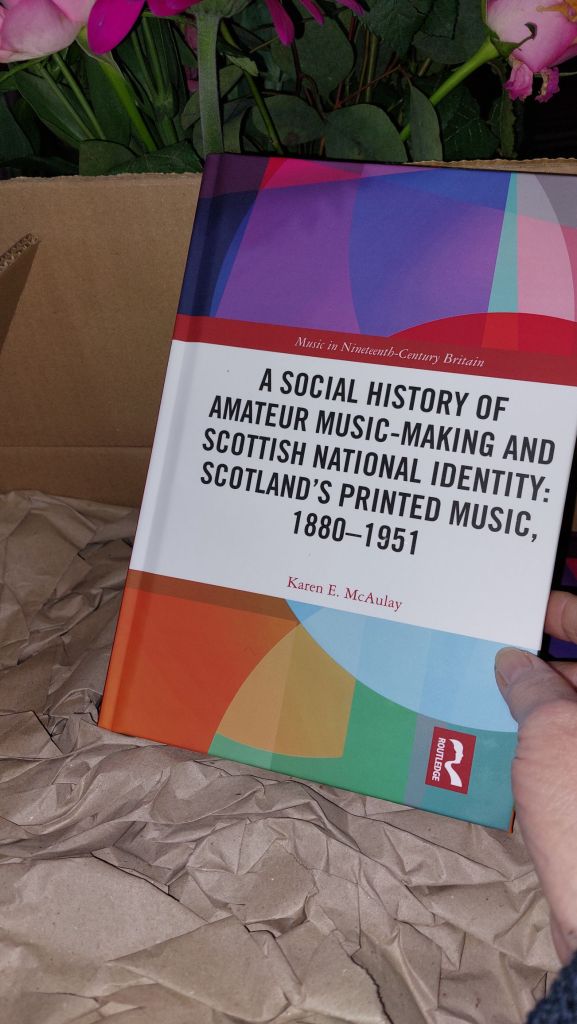
Friends, my forthcoming book, A Social History of Amateur Music-Making and Scottish National Identity: Scotland’s Printed Music, 1880-1951, can now be ordered! 

It’s a proud day – I’m so excited.  (Amazon even recommended it to me the other day, which I found quite amusing!)

Table of Contents

(from the book – and the Routledge website)

  • Introduction
  • 1 An Era of Opportunity for James S. Kerr and Mozart Allan
  • 2 Nights Out Dancing and Evenings with the Children: Enduring Kerr and Mozart Allan Titles
  • 3 The Saleability of Scottish (and Irish) Songs
  • 4 Education, Preservation, Organisation
  • 5 Expanding Horizons
  • 6 Multimedia Technology, from Magic Lanterns to Recordings and Broadcasts
  • 7 Publishing ‘Classical’ Music in Scotland
  • Conclusion

Description

(again, from the Routledge website)

Late Victorian Scotland had a flourishing music publishing trade, evidenced by the survival of a plethora of vocal scores and dance tune books; and whether informing us what people actually sang and played at home, danced to, or enjoyed in choirs, or reminding us of the impact of emigration from Britain for both emigrants and their families left behind, examining this neglected repertoire provides an insight into Scottish musical culture and is a valuable addition to the broader social history of Scotland.

The decline of the music trade by the mid-twentieth century is attributable to various factors, some external, but others due to the conservative and perhaps somewhat parochial nature of the publishers’ output. What survives bears witness to the importance of domestic and amateur music-making in ordinary lives between 1880 and 1950. Much of the music is now little more than a historical artefact. Nonetheless, Karen E. McAulay shows that the nature of the music, the song and fiddle tune books’ contents, the paratext around the collections, its packaging, marketing and dissemination all document the social history of an era whose everyday music has often been dismissed as not significant or, indeed, properly ‘old’ enough to merit consideration.

The book will be valuable for academics as well as folk musicians and those interested in the social and musical history of Scotland and the British Isles.

I got through the Door!

Today was my first wee bit of teaching*, since retiring from the library and becoming solely a part-time research fellow.  Sporting my new ID card (it now says I’m a member of the Research team), I got there in good time and strode up to the classroom door. I have never before been able to get through a classroom door without a student letting me in, so this was the moment of truth! I was in. Hooray! I eyed the digital whiteboard set-up with some suspicion, but I got the powerpoint working with no difficulty. All went well, and we had a good session. Hopefully, I’ve also navigated Moodle successfully – another new venture for me.

It’s not as though I hadn’t given lectures about my research specialism before. I’ve given research papers galore, but this was the first time of teaching, when I wasn’t speaking as a librarian. But, guess what? Despite my best intentions, it was unavoidable to mention the library, the songbooks on the shelves, the library donations … hardly surprising, because I wouldn’t have written my second monograph without being prompted by some of the old music in all those carrier bags and boxes we took in over the years. I even caught myself saying ‘we have ….’ and ‘we did …’. Old habits die hard.

I’ve achieved my ambition – I’m a research fellow – but I can’t pretend I don’t have a library background!

*For clarification, this was a guest lecture. I’ve a few more temporary teaching dates lined up. It’s nice to use my PGCert in this way.

Image by Pexels from Pixabay

Francis George Scott – Would he make it into your Music Case?

This post was originally written for the Whittaker Live library blog in July 2023.

A few weeks ago, I was thinking about the Scottish song settings by Francis George Scott (1880-1958).  Opinions seemed to be divided about his output, but this composer – who for most of his career taught music at Jordanhill Teacher Training College in Glasgow – arranged and composed dozens and dozens of songs.  He worked […]

Francis George Scott – Would he make it into your Music Case?

Distractions!

You know what it’s like, working from home. The Plus: surrounded by all your books and papers, and the kettle just ten feet away from your desk. The Negative: trying so hard not to get distracted by – well – STUFF! No-one has ever suggested I have ADHD. But maybe I have? Take this morning. All set to start on time, I set the washing machine going, and make a cup of tea.

I’ll need more teabags in the caddy, I muse. But I manage not to go and get them. I’m only working this morning, so I want to get on.

Mug in hand, I read my emails and start checking train times for a lecturing gig.

A family member drifts in. My home office is in an alcove off the dining room, on the way to the kitchen. Ah, well. (They’re going out this morning anyway!) I adopt a friendly, interested but BUSY demeanour: (let’s call it FIbB).

Continue what I’m doing. Train times sorted, email written, and on with the lengthy article. To be accurate, on with a wee literature search to back up an assertion in the lengthy article.

The washing machine beeps to say it has stopped. I ignore it, and work on.

Another family member drifts in. Only a couple of minutes … FIbB face again.

Progress is being made. Suddenly it’s time for elevenses, so I think I’ll just hang the laundry out …

The blinking drain outside the kitchen has blocked! I am remarkably good at unblocking drains – it’s a dry day, and I’d better get it done – it barely takes ten minutes – otherwise there’ll be another overflow next time we use the washing machine OR the dishwasher!

As I stand out there, sleeves rolled up, the first family member reappears, seems in the mood for chatting. FIbB face doesn’t work so well out in the garden, apparently. I suppose I don’t look busy in the same way as when I’m at my desk.

In my own defence, I did spend another three extra hours working later, so my conscience is clear, and I’m happy with what I achieved. I remind myself that working on campus isn’t without its interruptions, either – just different ones. And had I been on campus, that drain would still be blocked – but I might not yet know about it …

No Way! Is this Possible?

Remember that I acquired a humorous duet about a young married couple during the suffragette era? (Here’s the link)

Well …

It is just feasible that the lyricist was the mother of one of ‘my’ Scottish woman composers.  More anon.  But wouldn’t it be cool if I’m right?!

I’ve compared poems, thought about anapaestic meter, even learned about a visit of a Shah to Britain…

Historical Women Composers and the Transience of Female Musical Fame (Chapter 1) – The Cambridge Companion to Women Composers

I spent years as a specialist music librarian,  trying to boost our holdings of music by women composers.  This chapter would have been on my list of useful links, had I come across it before retirement from librarianship!  I’ll share it here now; tomorrow I’ll be following up some of the references, for my own research interests.

The Cambridge Companion to Women Composers.  Historical Women Composers and the Transience of Female Musical Fame (from Part I – Themes in Studying Women Composers)

Published online by Cambridge University Press:  23 May 2024

By

Paula Higgins

Sewing as a Reflective Practice

I used to have another blog, which I started when I was doing a Teaching Artist course.  I no longer do postings on it – I can only do justice to one decent blog at a time!

Nonetheless, the stitched lockdown journal was a project I was proud of, so I thought I’d share it again here, now.  As distinct from my dressmaking hobbies, collage is more of a reflective practice which helps me to stay grounded.  Sometimes, I sew about something research-related, but at other times, my collages and embroidery are just snapshots of daily life or things in the news!

For a whole year of the pandemic, I kept a journal – stitched in fabric, using collage and embroidery. You can view the videoclips here:- Lockdown Journal Downstairs Lockdown Journal Becomes a “Book” (no, not the published variety!) I missed doing it once it was finished, so I’ve started a new project. But more about […]

my stitched Lockdown journal