Dr Karen McAulay explores the history of Scottish music collecting, publishing and national identity from the 18th to 20th centuries. Research Fellow at Royal Conservatoire of Scotland, author of two Routledge monographs.
Friday was a great day. Or should I say, Friday afternoon was a great afternoon?
A short research visit to the Mitchell Library was followed by discussion of my forthcoming RCS research contract – to enable me to continue researching part-time after I leave the library – followed by a trip to Glasgow Uni for the launch of the Books and Borrowing Database. It’s a fantastic resource, and I’ve watched the project with interest. (website: https://borrowing.stir.ac.uk/)
A bit of networking over a glass of wine and some cheese straws, then I headed home with a distinct lightness in my step. It wasn’t just the glass of wine! I felt as though I’m finally adjusting myself into who I’m meant to be.
I like to think I’ve been a good librarian. I do believe I have. But if I am honest, I chose librarianship because I couldn’t see myself as an academic. I am an object lesson in not writing oneself off at the age of twenty-four. If you’re like I was, or you know someone like I was, tell yourself/them to have more self-belief.
I’m giving my annual lecture on Scottish song books tomorrow. Just shows that I can lecture. Indeed, I’ve read countless papers over the past two decades.
Just think how many books I needn’t have catalogued, if I’d been braver and more determined at twenty-four. (I’m still cataloguing them – feeling a bit pressured, if I’m honest!)
On the other hand, how many intriguing enquiries I’d have missed, not to mention unexpected surprises amongst the book and music donations … there have been some advantages.
Image: Wikipedia picture of Hereford Cathedral Chained Library
How could I resist this event?! After all my efforts a few years ago, researching the borrowing of legal deposit music at the University of St Andrews in the early 19th century, I simply HAVE to attend this. It’s somewhat ‘meta’ for a scholar librarian to take a research interest in the borrowing habits of readers who ‘checked out’ centuries ago, isn’t it?
I’ve rearranged my research hours accordingly, so I can finish the week on a research rather than a librarianly note:-
A lovely thing happened this afternoon. I am honoured to have been elected, along with two esteemed colleagues, as an Honorary Fellow of our professional association, IAML (UK & Irl).
When I retire from music librarianship soon, I will have been in post 36 years. But I will actually have been a music librarian for 39 years – and a librarian for almost 40. Where did the time go?
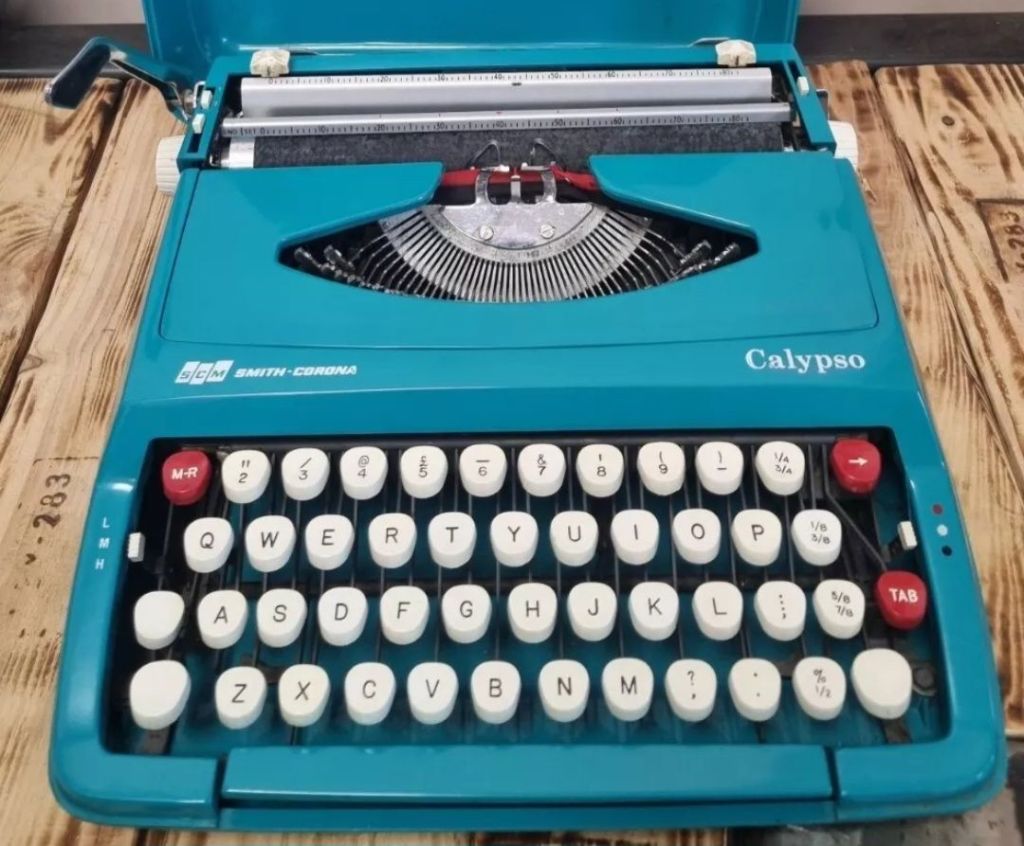
Memories of the Newsletter (Ebay image)
My first ‘role’ in IAML was as Newsletter editor. (Anyone remember Roneo stencils and that pink correction fluid?) And my last has been as Communications Chair. I tell you, blogging is a doddle compared to those stencils!
I’m grateful, and humbled, to have had my efforts recognised. I feel a bit undeserving, but I AM very grateful!
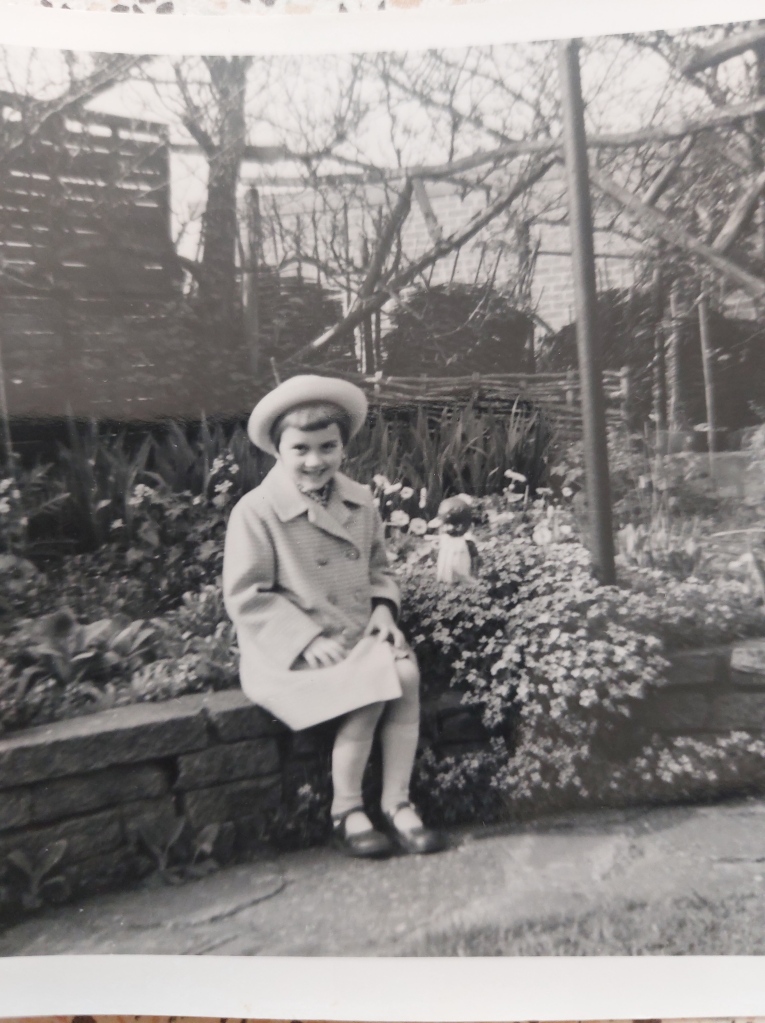
Already a lover of libraries and music!
[The photo? A little girl who wanted to be a librarian like her uncle … because libraries were always her favourite place!]
I’m a rank amateur when it comes to composing, but I quite enjoy the freedom of neither having elevated expectations of myself, nor of being under any pressure to be compared with ‘real’ professional composers!
I wrote a couple of choral pieces about the climate crisis, not long ago. Both have been trialled at workshops run by composer Chris Hutchings in Edinburgh. One was even programmed by a choir putting on a couple of concerts down in England last weekend. That’s beyond exciting.
Songs of Hope for a Planet in Peril, St Mary’s Ivinghoe
(Ivinghoe is near Leighton Buzzard – near Luton, to those of us unfamiliar with the locality!)
Workshops
You can hear both being tried out, here. The most recent was, Not like Noah. Before that, I wrote the Extinction Calypso.
Flushed with success, I thought I’d write another piece this year, and I did make a start at the weekend. However, these things can’t be hurried. It is still a work in progress.
Chris Hutchings has put together a website where choirs can find a wide range of different pieces on the subject of climate change – Choirs for Climate. Do take a look!
It’s also Climate Week in the Whittaker Library (where I work) this week. I can’t take any credit for all that’s happening – my capable colleagues set it all up. But of you’re interested, do visit the library blog, here.
How often are we told this? Starting with school exams, in fact ….
So I’m here to remind you of this basic advice. Even if you think you’ve got it right, read it again, and then re-read it. Sometimes things aren’t what they seem on first reading. (Said she, having carefully copied out the instructions, broken them down into separate sub-instructions, compiled a beautiful submission … only to discover that A included B and C, and my word-count would have to be reduced by 40% as a consequence. Computers can tell when your uploaded document is too long!)
I blame myself. I jumped to the wrong conclusion. However, I was pleasantly surprised to discover how easily I lost those surplus words. Anyone need a ruthless editor …?
I’ve just given a webinar for the National Acquisitions Group, ‘Getting Historically Under-Represented Composers and Contemporary Environmental Concerns into Library Stock’.
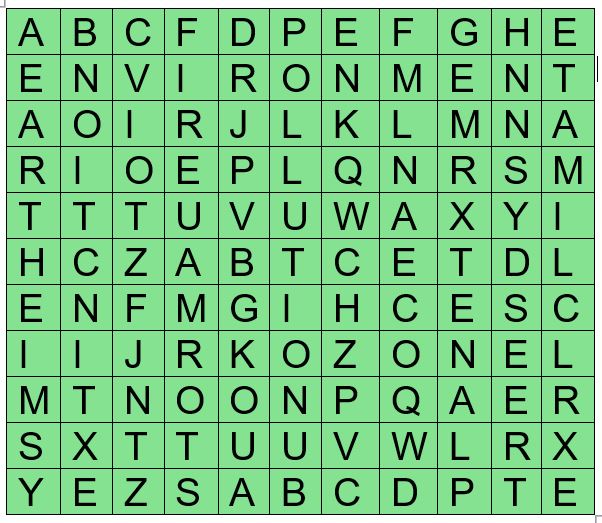
Earlier today, I took a dislike to one of my slides. It was where I was talking about finding musical compositions on the subject of the climate crisis, and it suddenly dawned on me that a wordsearch slide would be far better than what I had intended. So, I made a ‘wordsearch’, on the spot. It was my first, and I made it very quickly – don’t judge me! Stupidly, I didn’t count how many words I’d hidden. I found twelve related to climate change in some way. But later on, my sister found far more, if you include more general words. Have a go …
There was a time long ago, whilst I was doing a postgraduate librarianship diploma in Aberystwyth, when we all had to go on a week’s study tour. I went to Sheffield, staying with friends, and visiting various libraries with my classmates.
A visit to some archives enchanted me. I can’t remember if they were regional archives or university ones, but those heavy bindings, scrolls, and all the modern accoutrements of white tapes, book cushions and weighted ‘snakes’ – not to mention the questions of conservation and restoration – certainly seemed irresistible in that moment. I would love to have known that conservation was in itself a career. I didn’t know.
On the other hand, I was forced to acknowledge that more legal conveyancing and inheritance documents survive than mediaeval music manuscripts. And some materials looked unmistakably grubby when they reached the archive. Besides, I was already on track for librarianship rather than archives.
Dusty Old Deans
I was half-amused, half-annoyed by a pearl of parental wisdom:-
You don’t want to be an archivist, dear. All you’ll meet is Dusty Old Deans.
Admittedly, I had not so long before been researching mediaeval music and visiting cathedral libraries. I hadn’t encountered a Dean, dusty or otherwise, whom I hadn’t found charming.
So many archives, so little time!
Anyway, I had no reason to visit archives for a couple of decades, until I recommenced researching. I’m no longer a mediaevalist. But Victorian and early 20th century archival materials have turned out to hold their own appeal. Archival correspondence is intriguing, even when it’s conveniently in legible typescript. The biggest attraction of retirement from librarianship is the opportunity of far more research, and hopefully many more hours in archives.
I wonder if there’s anywhere I could learn to do conservation …. ?
Well, this has been an interesting weekend. It has encompassed both the sublime (filling in a Fellowship application) and the ridiculous. Completing an application turned out to have been exactly the right thing to have done, in the circumstances, because it put the unrelated storm-in-a-teacup properly into perspective. It even banished a migraine – quite remarkable! The expression, ‘Focus on the positive’ has a lot to be said for it.
Not, I hasten to add, that I have submitted the application yet – but at least I’ve written what needs writing. I am NOT planning on turning to daytime TV in my 66th year – I can’t think of anything worse. So, plainly I need engrossing things to do, once I’ve had the dreaded birthday.
When it comes to filling in online forms, the best thing is to print them out for easy reference, and then to draft answers to the various questions.
Headings
That way, you can write under headings reflecting the different parts of each question; ensure nothing gets omitted; AND keep count of how many words you have used. I’m getting quite good at condensing down sentences and simplifying wording where my first response would have been just too wordy.
So, I’ve made up a title for my proposed project (I did that when I woke at 5.40 am and couldn’t get back to sleep!);
Composed a 50-word summary (that fitted the time between getting ready for church and actually setting off);
and answered all the questions, in between cooking Sunday dinner, eating it, and supper-time.
However, there’s another question I must ask myself: as well as writing under all the headings that the form requires, I also need to ensure I’ve showcased anything that I feel relevant. That’s a task for Monday night!
I feel as though I’ve had a busy day, but I’m happy with what I’ve achieved.
Reaching the end of my recent cataloguing project – the gift of a number of books of old Scottish music – I must confess I left what looked like the most miscellaneous, worn, unbound pieces until last. Late on Friday afternoon, I had observed that one such piece had a pencil note at the head – ‘Music for The Gentle Shepherd, Foulis edition, 1788’. Now, this is a famous ballad opera by Allan Ramsay. It was so popular that my colleague Brianna Robertson-Kirkland writes that there were 86 editions of TheGentle Shepherd, 66 of them the ballad opera. Initially, the songs only indicated the name of the tune to use, and different editions have more or less songs. The 1788 edition contains a full vocal score of the songs, and that’s what we’ve got. My guess is that the last owner bought the 18 pages which someone had previously separated from the back of the larger original volume.
I haven’t made a study of it myself, but I do recognise the opera and its songs as very significant in the history of Scottish music – and this edition has particular importance. So, if this gathering of pages was so important, it would benefit from a decent catalogue entry.
The pages are numbered 1-18. With no title-page, still less a cover, to give me further clues, it wasn’t a task for 4.30 on a Friday afternoon, but it very definitely was one for a Monday morning.
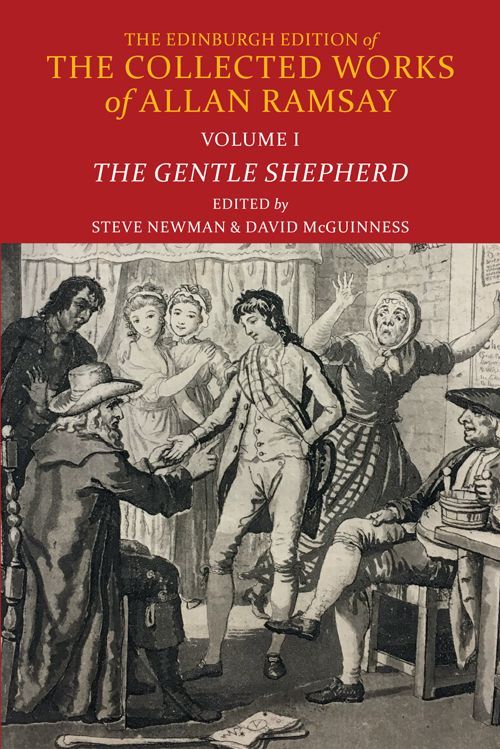
A bit of digging around soon found me another library’s catalogue record of Ramsay’s ballad opera in that very edition – a particularly significant edition, because it’s the most lavish, quite apart from having the complete vocal score section. RCS lecturer Brianna Robertson-Kirkland has researched the work in detail and written an article about it, which is on one of her class reading-lists. Dr David McGuinness, with whom I worked on the HMS.Scot AHRC-funded project a few years ago, has also recently published a book about it, with Steve Newman.
The new Edinburgh Edition of The Gentle Shepherd
But the catalogue record didn’t exactly fit my purpose, because what I had in my hand was the appendix at the end of the book, containing all the songs. We didn’t have the text of the ballad opera at all.
No problem – I downloaded the catalogue record and adapted it to reflect what we did have. I made sure the words ‘Scottish songs’ appeared in the catalogue record, and I indexed every one of those songs. The appendix is only eighteen pages long – it wasn’t that arduous a task. I’m really happy that we’ve been given this, because – even though it’s fragile and will have to be handled with extreme care – it means the students will now be able to see the music that Brianna has written about, and lectures about. (It still needs a nice stout card folder, and a secure storage space – but they’ll be sorted out soon.)
Informed Cataloguing
There’s one strange thing, though. It appears no other cataloguer has catalogued each song in The Gentle Shepherd – not in Jisc Library Hub, at any rate. Well, although we at RCS might not have the whole magnificent text, a title page or a cover, we HAVE now got a catalogue record which indexes all the songs. Hooray!
Contents:-
The wawking of the fauld (1st line: My Peggy is a young thing)
Fy gar rub her o’er wi’ strae (1st line: Dear Roger, if your Jenny geck)
Polwart on the Green (1st line: The dorty will repent)
O dear mother, what shall I do (1st line; O dear Peggy, love’s beguiling)
How can I be sad on my wedding day (1st line: How shall I be sad when a husband I hae?)
Nansy’s to the green-wood gane (1st line: I yield, dear lassie)
Cauld kail in Aberdeen (1st Line : Cauld be the rebels cast)
Mucking o’ Geordie’s byre (1st line: The laird, wha in riches)
Carle, an’ the king come (1st line: Peggy, now the king’s come)
The yellow-hair’d laddie (1st line: When first my dear ladie gade to the green hill)
Kirk wad let me be (1st line: Duty, and part of reason)
Woe’s my heart that we shou’d sunder (1st line: Speak on, speak thus)
Tweed Side (1st line: When hope was quite sunk in despair)
Bush aboon Traquair (1st line: At setting day and rising morn)
The bonny grey-ey’d morn
Corn-Riggs (1st line: My Patie is a lover gay)
I struggled to explain to my family just how gratifying I find this. But I think it’s really important not only that Brianna’s students can see which songs are in Foulis’s edition of The Gentle Shepherd, but also, anyone looking for one of those song titles will be able to see that it was one of the songs used in the famous ballad opera.
The Gentle Shepherd / Allan Ramsay ; edited by Steve Newman, David McGuinness.
As a matter of interest, we do also have some items going back to the era when Cedric Thorpe Davie put on a performance of the opera. Anyone checking our catalogue will spot those too!
The Gentle Shepherd: a pastoral comedy / by Allan Ramsay ; abridged and adapted for performance at Edinburgh International Festival by Robert Kemp [bound photocopy, 47 p.]
I accepted a generous donation of old books to the Library a couple of weeks ago. This presented me, personally, with a bit of a problem because our offices, furniture and contents are being moved around, and I had proudly emptied most of my shelves in readiness. There will be fewer shelves in the other office. And now I had two shelves full of old Scottish music – right up my street – which needed cataloguing.
Most vital priority – get them done before I retire from the Library.
Almost as vital – to get them done before the move on Thursday next week!
Of course, the lovely thing is that they’re books I’ve encountered in various research contexts … the PhD; the Bass Culture project (https://HMS.Scot); the book chapter on subscriptions; and my own forthcoming monograph.
I catalogued like crazy on Thursday and Friday. I’ve catalogued Sammelbande (personal bound volumes) of songs, piano music and fiddle tunes. I’ve shown colleagues books signed by George Thomson. I’ve indexed Gow’s strathspeys and reels. And yesterday I blogged about James Davie and his Caledonian Repository.
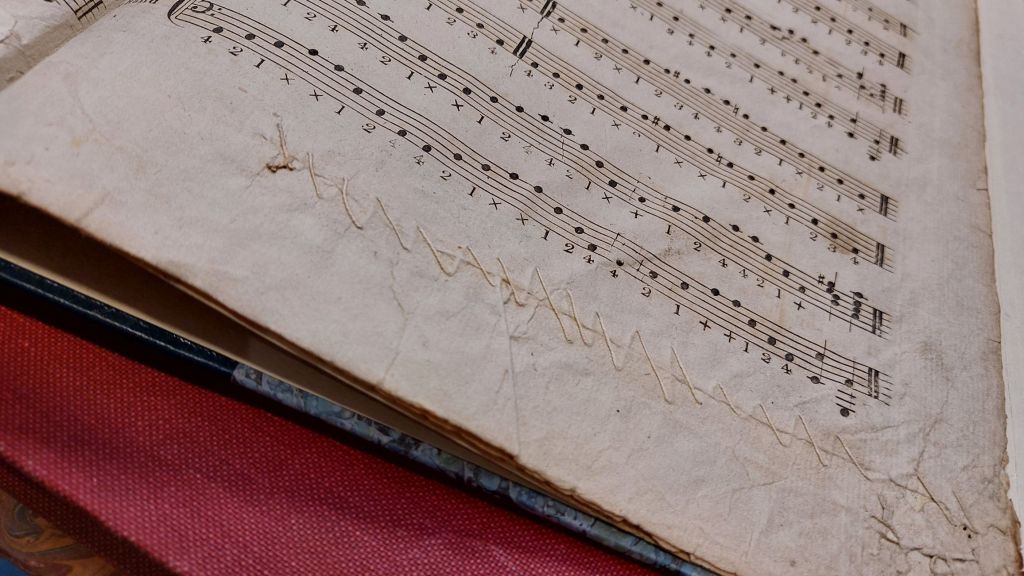
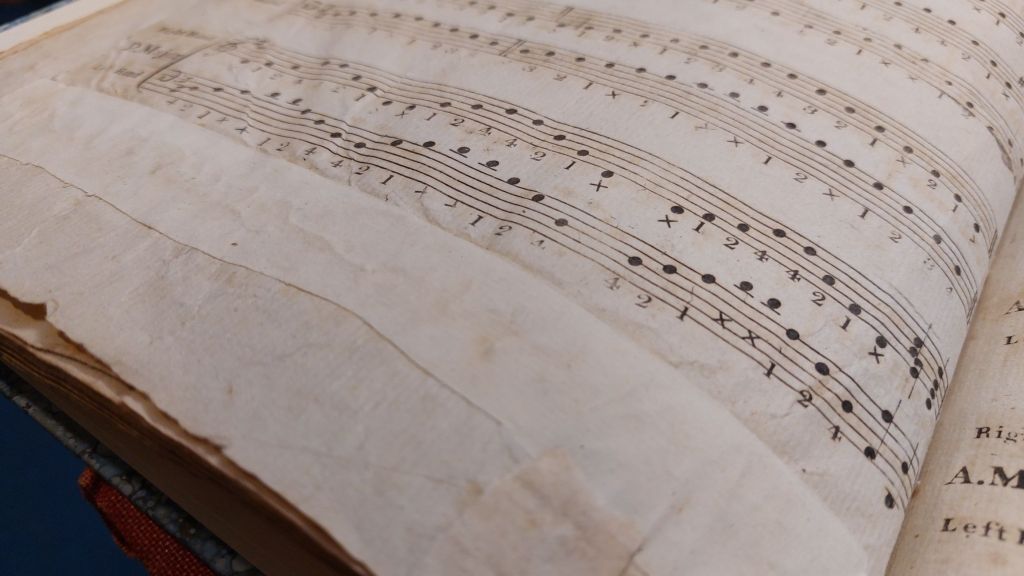
But I’ve also just enjoyed handling the music, because sometimes one finds some endearingly human evidence of the scores being used, even to the point of needing mending. It’s quite touching to ponder how much a piece had been used, before it actually needed stitching – here, along a line where the edge of the printer’s block had originally left a dent in the paper:-
Stitched on one side, pasted on the other!
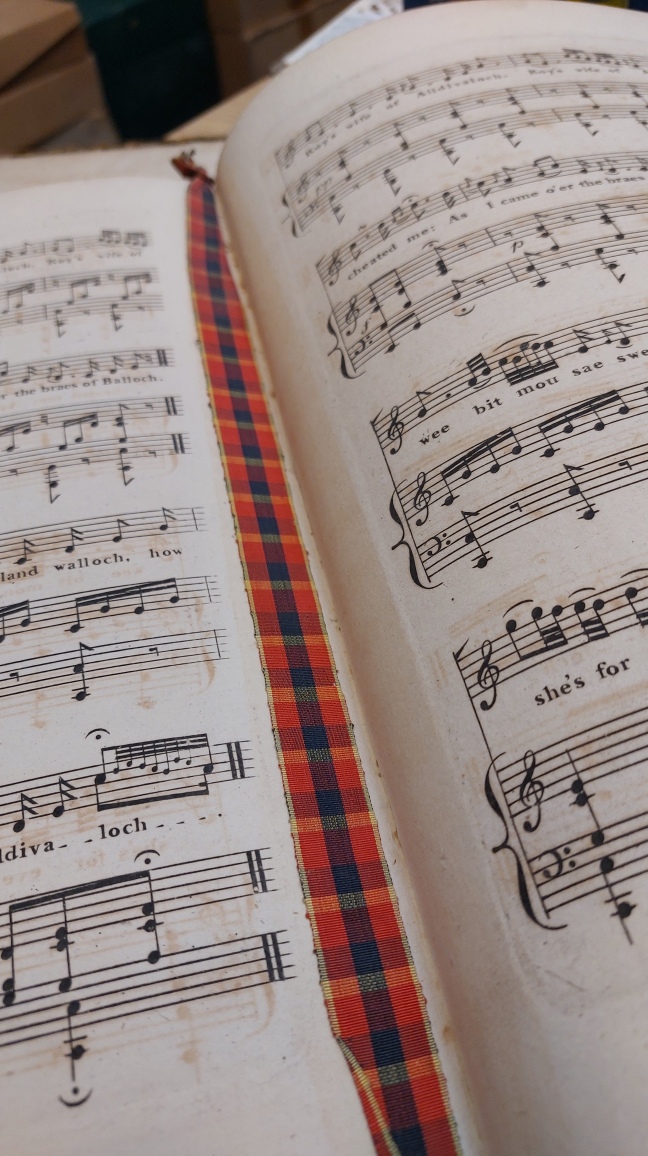
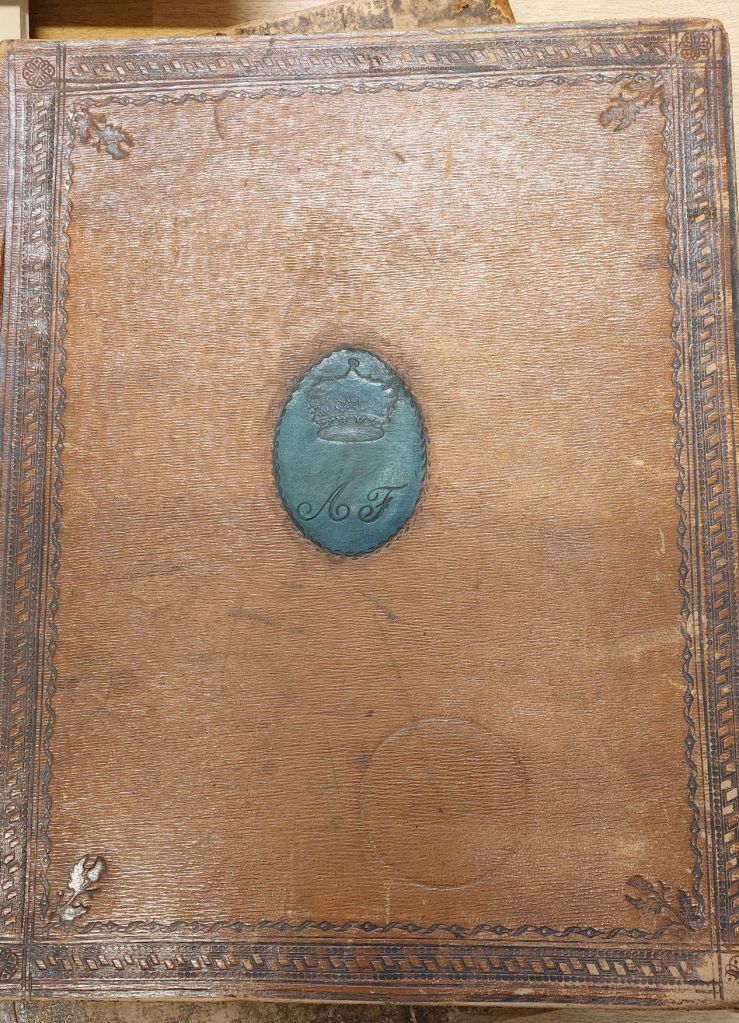
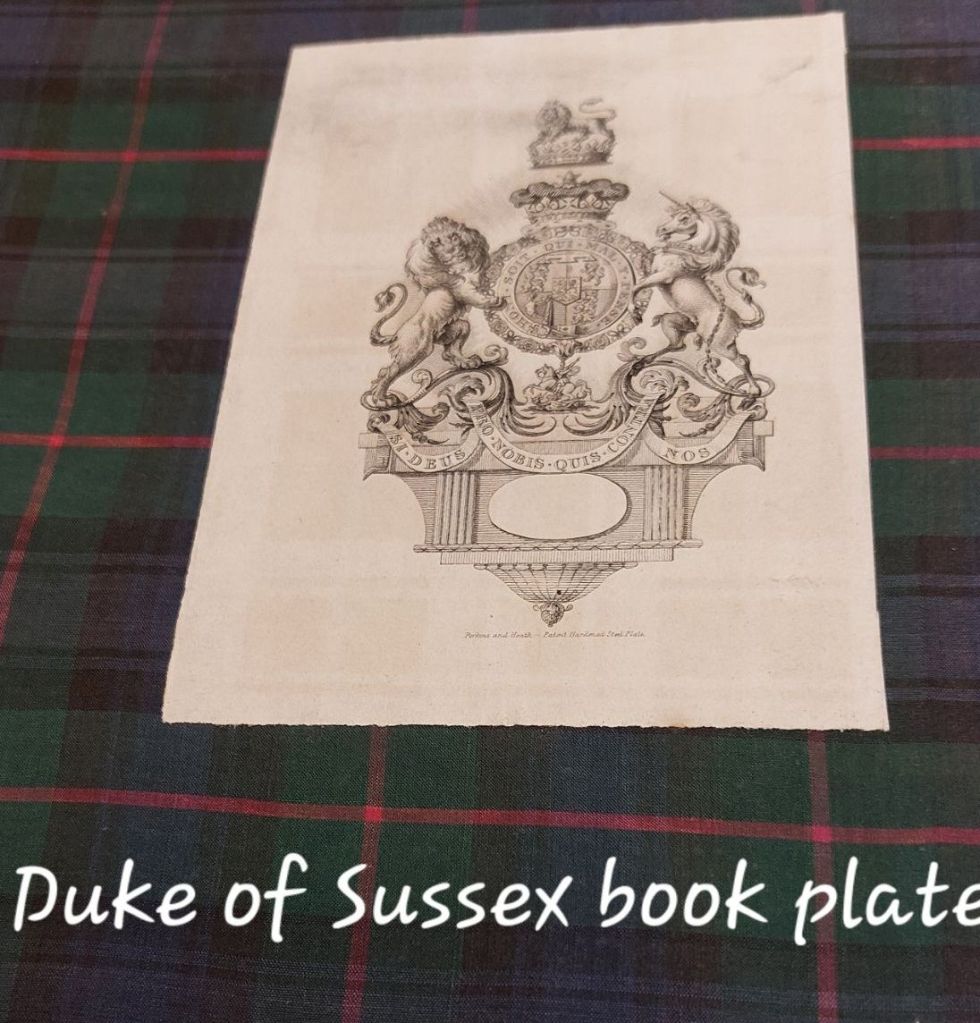
I’ve smiled at Georgian ladies’ stitched repairs to much-loved pieces, noticed with amusement a handful of early Mozart Allan books (yes, including some strathspeys and reels) in a fin-de-siecle Sammelband which had seen better days; spotted piano fingerings pencilled in; and best of all, found a tartan ribbon in a volume dedicated to the Duke of Sussex – his personal copy, which was first sold out of the family’s possession in 1844. His library was dispersed after he died in straitened financial circumstances:-
Nine Scots Songs and three Duetts, newly arranged with a harp or piano forte accompaniment / by P. Anthony Corri
This book has the Duke’s family crest on a label pasted inside, and the outer cover is embossed with ‘A F’ (Augustus Frederick), reflecting the monogram on the title page.
The Duke of Sussex’s mongramAugustus Frederick, Duke of Sussex (1773-1843)
The tartan endpapers and tartan ribbon between pp.30-31 are a perfect illustration of what I have written about in a chapter on tartanry in my forthcoming monograph. Everyone – whether nobility or commoner – liked a bit of tartan on or inside their Scottish song books, and here, someone even found a bit of tartan ribbon to use as a bookmark.
I have just a few of those books left to catalogue now. There’s an intriguing one without a cover or title page, waiting for 9 am on Monday …! Hopefully, I’ll end up with an empty bookcase again.













 Karen McAulay, Musicologist