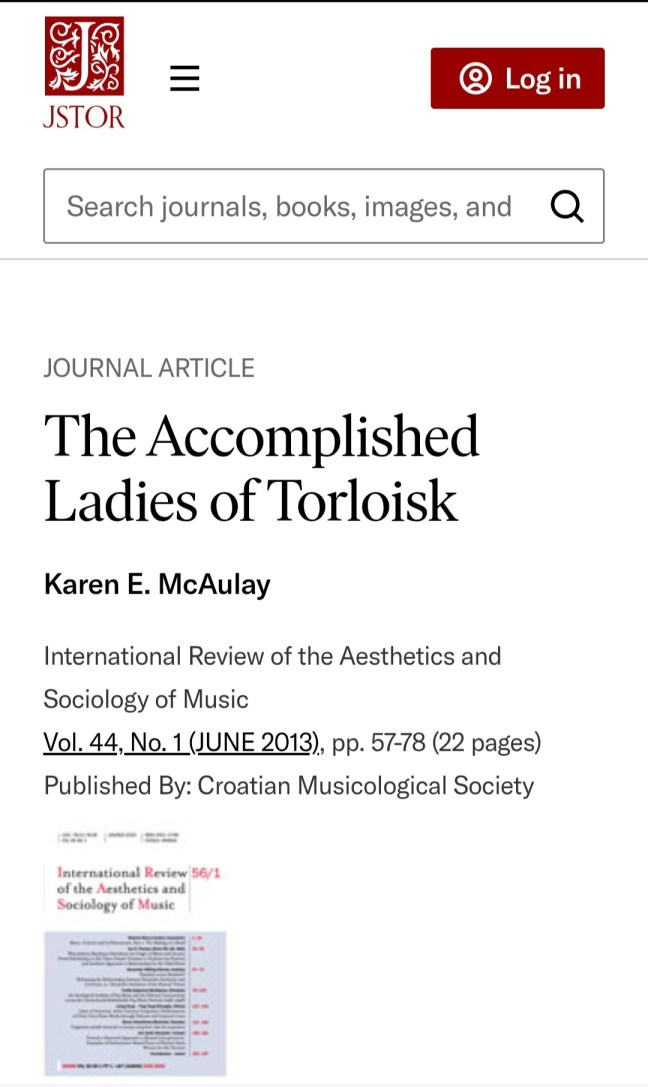
Dr Karen McAulay explores the history of Scottish music collecting, publishing and national identity from the 18th to 20th centuries. Research Fellow at Royal Conservatoire of Scotland, author of two Routledge monographs.
Folks, I’ve just noticed Routledge has a 20% summer sale on at the moment. So, if you or your library could use a copy, this might be a good time to get it! (All books and e-books are 20% off until 1 August 2025.)
The accent is on social history and Scotland – and music-making, obviously. I’m keen to hear what readers think of it. (If you are a reviews editor, do get in touch with Routledge. There’s a link on the website.)
Halfway through the second week of holiday, I’m getting into my stride.
Home Improvements
Business duck!
We sorely, desperately needed a new bathroom. We’ve had a consultation, and it all happens next week. (Crikey! It’s going to be an exciting week.)
The garden is now tidier. We also needed two garden walls painted. Done today – not by us, though. (And NOW I can put a few more plants in the border!)
Health, Hair, Hard Work and Handiwork
So bright & white!
Doctor, optician, hairdresser appointments made. I haven’t booked the dental checkup yet, but give me time.
Five bags of books weeded out of ONE room (the one where I work!), to be distributed to the charity shop, a secondhand bookshop, and a few to give away. I also spent several hours on eBay. The shelves are still full, but tidier, and there’s also no longer a heap in the corner of the lounge. I am gradually tidying odd corners that have been annoying me for ages; have found books that I’d forgotten I even had; and have conceded to myself that I never will read some of the books – that Norwegian darning book is way, way above my capabilities!
Last week I made ‘Himself’ a waistcoat. Yesterday I made myself a shirt – it had been cut out, but hadn’t been started in 1-2 years, so it’s nice that it’s now hanging up awaiting buttons and buttonholes. I do have other sewing projects lined up, but I thought I ought to get into the habit of finishing one thing before starting another. It’s an astonishingly quick pattern, which probably explains why I have a number of shirts in the same design!
Quick make!
Hardly Holiday?
You might ask where the rest and relaxation has gone. I can’t really answer that. However, I can assure you that I haven’t done any research this week!
But I have bought us tickets for a Tchaikovsky concert tomorrow evening. That counts as an outing purely for pleasure, and best of all, it’s not far from home.
There’s much to be said for getting on top of tasks that were long overdue. When I go to town tomorrow afternoon, I’ll hopefully be able to drop off the ‘gift’ books before I go to the hairdresser, and if I’m lucky, reward myself with a coffee afterwards. (If not – well, it’ll be a treat for Friday.)
Relax, dear reader – this is not an incursion into my working research existence. I haven’t broken my resolution to take a well-earned holiday. Well, not exactly!
Going through the Thomas Nelson correspondence a few weeks ago, I came across a post-war letter celebrating the fact that sugar rationing was finally over, in which one editor suggested to another that now would be a good time to reissue Helen Jerome’s sweet-making book.
Now for a bit of history! It had first been published in 1924. In 1931, the author proposed another book, this time about baking cakes. The publishers declined it, since they felt the sweet-making one hadn’t sold very well.
Notwithstanding these observations, they revised the sweet-making book in 1936, and reprinted it in June 1939 (still pre-war). This publisher very much had their finger on the pulse, and books for adults quite often tapped into contemporary issues. So, right now they guessed – probably accurately – that people would enjoy making confectionery again after the years of privation. I obtained a revised edition with a foreword dated Spring 1954:-
FOREWORD TO THE REVISED EDITION. The effect of sweet and sugar rationing appears only to have increased the amount of sweets eaten in Great Britain, establishing us as one of the largest sweet-eating countries in the world. There is now much added interest in the actual making of sweets at home – whether as a skilled hobby … a family venture for special occasions, or as an experiment embarked upon by teenagers …
I’ll be honest – I bought this book intending to make some confectionery which I could photograph and write about. Now I’m on holiday, I imagined myself lovingly creating something delicious to intrigue and delight the family. However, I’ve looked through at the required equipment, the fancy syrups, and high boiling temperatures, and I have taken fright. It’s not going to happen! The first three chapters are terrifying enough: Utensils Required for Sweet-making; Materials Required for Sweet-making and Hints on their Preparation; and Sugar Boiling, Sugar Syrups, Spun Sugar, and Crystallisation.
I have a stove. And a sugar thermometer (unused). I don’t have a slab, be it marble, slate or heavy wood (‘covered with a sheet of enamelled iron’) or a ‘heavy white enamelled tray known as a “butcher’s tray”‘. Nor do I have a nylon or hair sieve, candy bars (not the edible variety – these are ‘a set of four steel bars cut from 1/2 in. cube steel, and 12-18 in. long, which help to obtain and professional finish’ and ‘can be obtained from a builder’s merchant’.) I’m mystified by sweet rings or cream rings, a caramel marker, a sugar scraper, a candy hook or a starch tray … need I continue? There are three more pages of equipment requirements.
As you can see, getting set up could be quite expensive! Not only are some of the above items going to be hard to source, but I had a bit of a problem establishing what, precisely, a gill measurement is. My first Google search did not go well …
The AI answer wasn’t quite what I expected!
If at first you don’t succeed – try, try, try again:-
Ah, that’s more like it!
Anyway, let’s look at the ingredients:- Loaf sugar, granulated sugar, demerara sugar, castor sugar, icing sugar, Raw West Indian or ‘soft’ sugar. Treacle, honey, glucose, cream of tartar, butter … so far, so good. But don’t get complacent. After various nuts and dried fruit, we find we need plain cooking chocolate (yes) and covering chocolate (what?), cocoa butter, various flavourings, gum arabic, gelatine, confectioners’ starch. Maple sugar, maple syrup, molasses, marshmallow cream … and then we get on to various techniques that you use to transform these ingredients into other more complex substances.
After all this, there are ten chapters devoted to different kinds of sweets, followed by advice about packaging them.
Fondants
Marzipan (you make this from scratch – don’t imagine you can buy a packet from Sainsbury’s!)
Toffees
Caramels
Candies and Fudges
Nougats
Chocolates
Jelly Sweets and ‘Delights’
Unboiled Bon-Bons
Miscellaneous Recipes
Now I’m feeling hungry, and my mouth is watering, but I am not equipped to start my confectionery journey. Not only that, but my ceramic hob is my pride and joy (or a ridiculous obsession, to quote my nearest and dearest), and I live in fear of pots boiling over at the best of times. Can I risk spilling boiling syrup on it? I cannot.
I take my hat off to the author, with her First-Class Diplomas, London and Paris (Cordon Bleu), who was a former staff Teacher of Cookery at the Polytechnic, Regent Street, London W1. I envy the skilled hobbyists capable of mastering ‘difficult processes’ (see? she admits they’re hard!). And I’m in awe of ‘teenagers who want to make their own “tuck”‘. I can well imagine their collective excitement at being able to buy all these sweet ingredients to create the treats they had missed out on for so long, and I hope many tasty confections were made by the purchasers of this book.
Next time I’m passing a shop, I’ll get some Fry’s Turkish Delight, and be grateful that I can!
I haven’t had a foreign holiday in years, but I haven’t really been very good at taking a decent break at home, either. As long as I was sharing myself between librarianship and research, my annual leave tended just to support my research habit. But this year, I’ve done substantially more research.
I decided that this year, I would have to do better when it came to taking a deliberate break.
I’ve continued to pursue domestic projects, stayed abreast of family preoccupations, done some more weeding (so much weeding!), and read a great book, BeingMortal, by Atul Gawande. This was lent to me a couple of weeks ago, and it proved well worth devoting the time to. But by Thursday, I was itching to go on another outing. A holiday surely has to involve going places, if only locally.
I fancied tea beside a river. ALL I typed into Google was, ‘tea’, and it came up with the ideal cafe. Does it read minds? We didn’t even know there WAS a small loch at Gartcosh, so this was a pleasant surprise. It turns out there’s also a garden centre, which might be useful to know in future.
I’ve also visited a friend, and when I got home, I found that the book I ordered the other day had arrived.
Well, this was fatal. It’s a song book. I looked right through it, looked up the two lady composers and their illustrator, played the songs over, then decided I’d better write down what I had discovered. An enjoyable use of an evening, but this hardly counts as taking a deliberate holiday from research! Indeed, it merely piques my interest as to how the ladies ended up writing their book. Did the friends reach out to the publisher? Or vice versa? Or did someone put them in touch?
The Thomas Nelson ‘child singing’ motif
Meanwhile, my crowded bookshelves have an extra book, and I need to remember that I’m taking a holiday!
As I mentioned, I feel I can’t actually go away on holiday in case I’m called to go down south. So, peacefully minding my own business in Scotland, I thought I’d just aim to do something enjoyable, useful or both, every day of my break. (My other intention is to sort out my sleeping patterns.)
Monday, we had to wake early, but otherwise I made a good start – we had afternoon tea out.
Tuesday, I aspired to a day beside the sea, but I was thwarted – just one of those things. But I started sewing a waistcoat, and compiled a list of tradesmen for a much-needed project. Enjoyment and productivity, as you see.
And today? I woke at 5.30 am and couldn’t get back to sleep.
Still, I’ve finished the waistcoat – it didn’t take long. Pursued the home project a bit further, and rewarded myself by ordering a book. And then I made a start on the garden. But it doesn’t exactly feel as though I got the enjoyment-productivity ratio quite right. I’ll have to do better.
It’s a whole year since I retired from librarianship, and started my new contract as a part-time postdoctoral fellow at the Royal Conservatoire of Scotland. Do I miss librarianship? No, I’m afraid I don’t! And am I going to give a step-by-step account of my first year not being a librarian, able to focus entirely on research? No! (I’ve blogged so much about my research that you, dear reader, have already read countless highlights.)
Along with my research, I did a little maternity cover supervising some undergraduate dissertations – that was interesting and enjoyable, and I was proud to see ‘my’ students graduate this week. (Humour me – I’ve never been able to talk about ‘my’ students before, even if it was only for one module.)
And I took up my IASH Heritage postdoctoral fellowship at the University of Edinburgh in January. Originally planned to be for six months, it has been extended over the summer, so I’m certainly not done yet with Thomas Nelson’s educational music publishing activities.
Help me Determine my Prospective Audience?
Indeed, I’m contemplating what exactly I shall do with all the information I’ve gathered – do I write a scholarly article? Keep going and consider a book as research output? And for whom would it be written? Educational historians? Social historians? Musicologists? If you’re any of these categories – or indeed, some other category – say, a historian of publishing – it would be immensely helpful if you could respond via this blog and let me know in what way it would interest you. Any feedback will help me determine my prospective audience. I’d be really grateful.
I have two follow-on ideas which I am going to pursue this summer, along with some more archival research.
But first – I need a holiday!
I’ve saved up the bulk of my annual leave so that I could take the next four weeks off this July. Family concerns mean I’m not able to consider ‘a holiday’ abroad, or indeed staying away anywhere that involves significant outlay, just in case I had to come back hastily – but a break is called for. Last summer – partial retiree or not – I had a book to nurse through to completion, and the Christmas break was a disaster, with everyone around me succumbing to flu. (I didn’t. But I’m really no Florence Nightingale, so it was tough.) Yes, I definitely need a break.
Know When to Take a Break
I should put my research hat aside for the next four weeks. Apart from the ongoing concerns, my sleeping patterns are messed up with the early rising needed for my Edinburgh research days, and I am beset with insufficient sleep, broken nights and weird dreams.
Burning the Candle at both Ends?
When I finally wake in the morning and it’s time to get up, almost my first thought is consumed by whatever I’ve been thinking about the previous day.
But who WAS she?
So, this morning’s question was:- ‘But who WAS she?’ Some sneaky Googling turns into a lengthy trawl of deep and darkly forgotten corners of art and music history to track down the composer of some tunes for early years classes. Until it really is time to do something real (the family laundry). And as I get on with daily chores, the little voice says, ‘No, you know some people she was associated with. And that she was a composer. Isn’t that enough? It isn’t. How did Thomas Nelson the publishers know about her, for a start?’ She’s not a major player in my cast list, but I’m still curious about her. Am I capable of forgetting about her until August? I’m not sure that I am!
Meanwhile…
I need to spend some time researching fun things to do that aren’t research-based!
As I’ve indicated, I’m blogging less at the moment, due to preoccupations unrelated to research.
Don’t they say that there’s calm at the very centre of the storm? So, theoretically, if there’s chaos all around, but I sit quietly in the middle of it, it should be peaceful and still?
Rubbish! Either that, or I haven’t precisely located the epicentre of the storm in order to sit in it. I know that many would say, ‘when there’s nothing you can do, you just have to put it to the back of your mind.’ Easier said than done.
My research, of course, is a dependable solace. So I put my phone on ‘do not disturb’ whilst I visited two libraries yesterday, and settled into what should have been a lovely, calming day, as indeed it was – until I encountered my nemesis …
A microfilm reader.
As anyone knows, the linear nature of microfilm storage goes with the territory, as it does with film or audio tape. Whether you’re looking for a page in a weekly journal from the furthest end of the date range, or looking at every single ‘books reviewed/received’ section, it’s going to take time.
Scroll, Scroll, Scroll …
Even with varying speed scroll facility – I was still trying to locate a three-word book title. The journal has no index. I haven’t finished looking yet. I did find two entries, which makes me all the more determined to try to find another two – which may or may not be there.
But the other, additional problem is a visual one. I wear varifocals. Only the bottom of my lenses are the right focal length for reading. But the top of the microfilm reader is at least as tall as me. Moreover, it’s very bright, and the effort of focusing combined with the brightness resulted in a searing pain that meant I had to reach for sunglasses as soon as I stepped outdoors.
Too much light!
I’ve used eye-drops. But it still hurt this morning and turned, predictably, into a migraine. And if I want to complete my search, I have to put myself through it all again on Tuesday. (It’s my research. I may have some light sensitivity after last year’s macular surgery, but I am not visually impaired, so it’s up to me to just get on with it, if I want to trace what I’m looking for.)
Meanwhile, the chaos whirls around me, but perhaps I should find something more easy on the eyes, to take my mind off it!
As regular readers will know, my IASH Fellowship concerns the history of the Nelson’s Scots Song Books.
I’ve seen all four of the teacher’s books in libraries; and possess one teacher’s edition of my own, plus one pupil’s edition – not the same volume number. And I’m going to some lengths to track down the other three of each edition. I want to be able to show them when I talk about them, so I simply must keep looking.
Today, I headed to town, feeling as though I ought to be riding a pony and tootling a hunter’s horn, to the sound of La Chasse or the William Tell Overture. (The heavens opened between subway and second-hand bookshop, somewhat spoiling my fantasy. Urghh!)
But hunting with a pack of hounds would have been no good at all, for you have to creep up on these rare beasts very, very softly. Pretend to be looking at something else, as you slowly extend your arm towards the shelf. And then, whilst it’s relaxed with its defences down, grasp it quickly and hold on tight.
Captured!
I examined it disbelievingly. Yes! I now have the teacher’s edition to go with my pupil’s edition of Vol.2. (Actually, I also found some other useful material that wasn’t published by Thomas Nelson.)
And then I turned round. On a table, if you please, there sat another Nelson music book that I’ve been reading about. Not a song book, but interesting just because it was published around the same time, by the same Nelson editors. It was as though it was waiting for me to find it.
Did I celebrate with a coffee? Now, what do you think!
There are times when scholarship doesn’t so much take a back seat, as slide over into the passenger seat. I’m still working on my research, but I may not blog as frequently for a short while.
Do you want any more Flora Woodman, or have I said enough?! I published an article earlier this year – same subject matter as my paper today, but certainly not the same piece of writing:-
‘The ‘Scottish Soprano’ and the ‘Voice of Scotland’: the Importance of Nationality to Flora Woodman and Robert Wilson’, History Scotland Vol.25 no.1 (Spring 2025), 74-81
Public library e-magazine apps may still provide access to the issue, though History Scotland is no longer published. I believe you can access it via the former publisher, too. Let me share the message I received from History Scotland a few weeks ago:-
“As you may know, the Spring 2025 issue of History Scotland will be the last issue of the magazine. Thank you so much for your support over the years.The good news is, we’ll still be exploring Scotland’s past in our expert webinars and our monthly history newsletter, and there is still a huge range of back issues of the magazine for you to enjoy…
“Visit the pocketmags.com website and you can download back issues going back to 2010. How to buy back issues:
I made a McKinnon tartan sash as a ‘prop’ for my talk. That was Flora’s mum’s family tartan, going back a few generations. Flora said it – I haven’t verified this! It also bears the Scottish Clans Association of London badge – oh, I take these things seriously! (If you are reading this after the event but missed it – I only wore the tartan sash for 15 seconds to show how it would be worn. Minimal cultural appropriation was committed.)
As we answered questions after the first three talks, something occurred to me. Flora had something significant in common with her Scottish Clans Association of London audiences. The vast majority of them were of Scottish descent, and – like Flora – quite a few of them would have been born outwith Scotland. To them, she was quite simply, Scottish, the same as they themselves were. No-one was going to accuse her of not really being Scottish, because that would negate their own sense of Scottishness too. If Scottish blood flows in your veins – you’re Scottish, wherever you are.