Dr Karen McAulay explores the history of Scottish music collecting, publishing and national identity from the 18th to 20th centuries. Research Fellow at Royal Conservatoire of Scotland, author of two Routledge monographs.
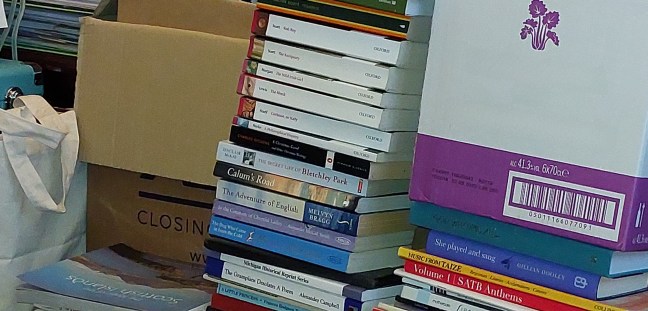
I forgot to add .. the decorating delays are apparently our fault for having so much stuff. It’s my books and music in the dining room that the painter’s alluding to. (He has no idea about Himself’s collection, many of which were originally secretly delivered to his workplace so that I wouldn’t see them, and are now scattered in various parts of the house.)
Last November, one of the electricians also innocently asked why I had so many books. I answered lamely, ‘Well, so I could write these two.’ Which didn’t seem terribly convincing to me, but seemed to satisfy him!
Scholar
Former librarian
Organist
Writes books about music books …
I don’t feel guilty about the books, but I really must reduce the collection before my family have to clear the house once I’m gone! Some are going on eBay, others to the charity shop.
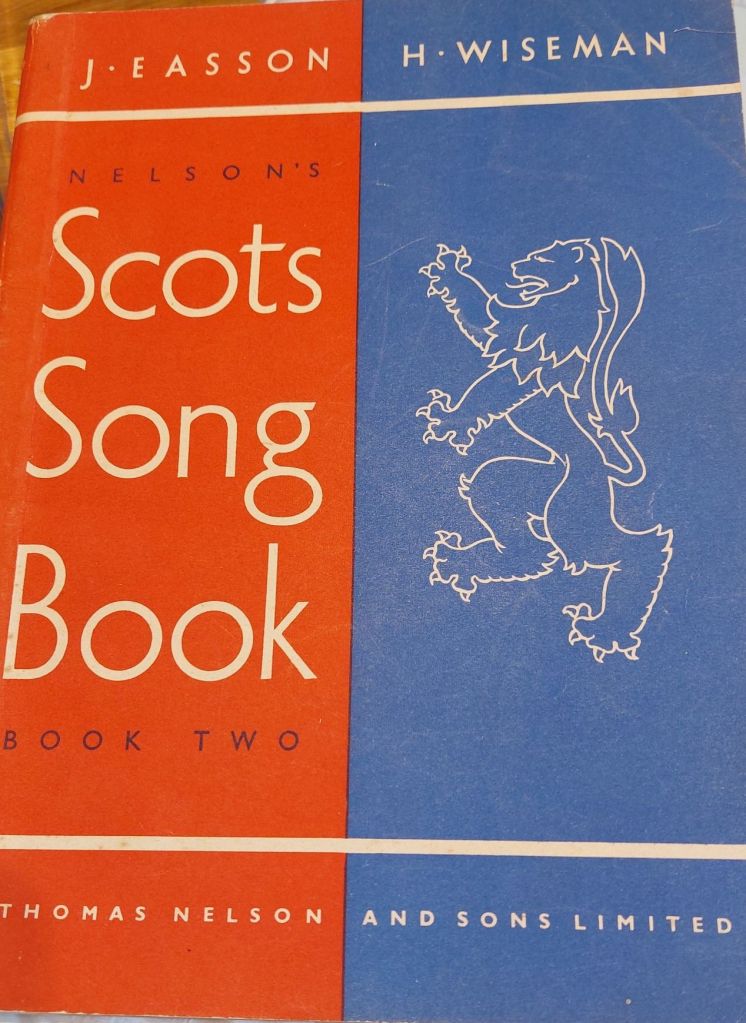
Once used in an Edinburgh school, a wee Scots song book (pupil’s edition) found its way to a shop on the Isle of Arran, then back to the mainland to me in Glasgow.
1, 2 … still looking!
If you ever find any of these in the back of a school cupboard, or bookshop, or car boot sale, or Granny’s attic …
… please do let me know! I’m trying to get complete set! There were four books for the kids, and four for teachers.
As regular readers will know, my IASH Fellowship concerns the history of the Nelson’s Scots Song Books.
I’ve seen all four of the teacher’s books in libraries; and possess one teacher’s edition of my own, plus one pupil’s edition – not the same volume number. And I’m going to some lengths to track down the other three of each edition. I want to be able to show them when I talk about them, so I simply must keep looking.
Today, I headed to town, feeling as though I ought to be riding a pony and tootling a hunter’s horn, to the sound of La Chasse or the William Tell Overture. (The heavens opened between subway and second-hand bookshop, somewhat spoiling my fantasy. Urghh!)
But hunting with a pack of hounds would have been no good at all, for you have to creep up on these rare beasts very, very softly. Pretend to be looking at something else, as you slowly extend your arm towards the shelf. And then, whilst it’s relaxed with its defences down, grasp it quickly and hold on tight.
Captured!
I examined it disbelievingly. Yes! I now have the teacher’s edition to go with my pupil’s edition of Vol.2. (Actually, I also found some other useful material that wasn’t published by Thomas Nelson.)
And then I turned round. On a table, if you please, there sat another Nelson music book that I’ve been reading about. Not a song book, but interesting just because it was published around the same time, by the same Nelson editors. It was as though it was waiting for me to find it.
Did I celebrate with a coffee? Now, what do you think!
Why do collectors collect things? Especially old things. The link with the past? The feeling that in some remote way, there’s a virtual thread linking you and an earlier era, or a particular individual?
As I’ve mentioned, I’m writing a long article about some late Victorian/Edwardian Scottish women musicians. It’s virtually finished. But there’s one more thing to do.
I have a single 78 rpm shellac recording of one of these women, whose reputation was not inconsiderable in her day. She played in London. She and her ‘orchestra ‘ made a handful of recordings. But I have no means of playing this precious artefact. I’ve tried to beg or borrow an old gramophone (or newer technology) to no avail, so eventually I bought a record player on Amazon.
All this because I wanted to know what instruments were in her band, a century ago! My article is incomplete without this detail.
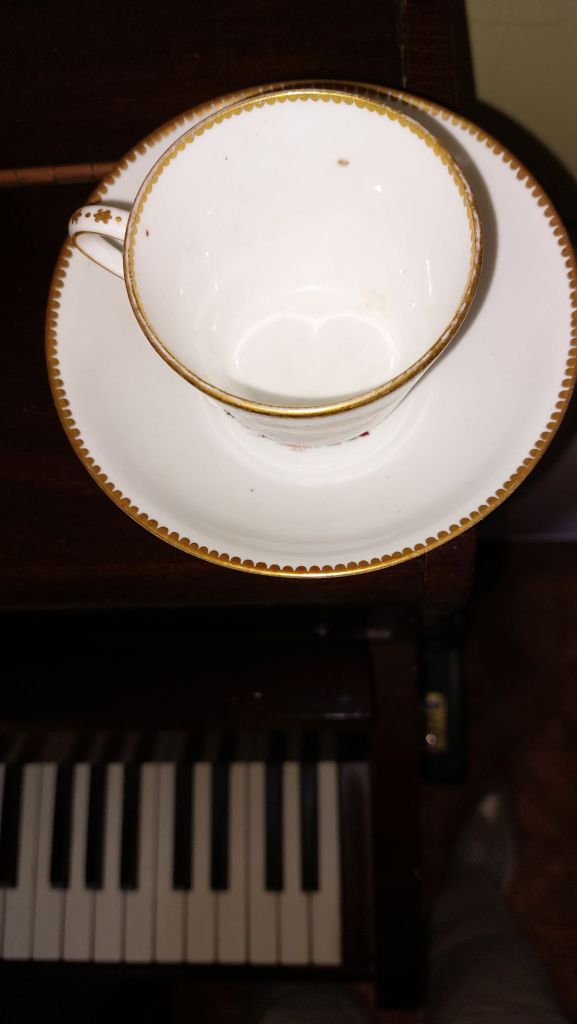
PetronellaThere’s an anecdote about a whisky-filled teacup rattling on a piano edge whilst she played …!
If you know anyone who researches women ART collectors, please do share this CFP from National Galleries Scotland. I’m sorry to say I have no evidence of Miss Lambert collecting art, though she did collect seashells as well as cataloguing the University of St Andrews’ legal deposit music. (Certainly a kind of collecting …?!)
This is turning into a busy week! Here’s another interesting call for essays, this time from the Women’s Study Group. Picture me, if you will, twirling like a top as I decide which of all these opportunities to turn my attention to first!
Quoting, with permission, from the email that was kindly forwarded to me:-
“The Art and Science of Collecting in Eighteenth-Century Europe
Edited by Dr. Arlene Leis and Dr. Kacie Wills
“We are inviting chapter abstracts for a collection of essays designed for academics, specialists and enthusiasts interested in the interrelations between art, science and collecting in Europe during the long 18th century. Our volume will discuss the topic of art, science and collecting in its broadest sense and in diverse theoretical contexts, such as art historical, feminist, social, gendered, colonial, archival, literary and cultural ones. To accompany our existing contributions, we welcome essays that take a global and material approach, and are particularly keen on research that makes use of new archival resources. We encourage interdisciplinary perspectives and are especially interested in essays that reveal the way in which women participated in art, science, and collecting in some capacity.
“The compendium will consist of around 15 essays, 6000 words each (including footnotes), with up to four illustrations. In addition to these more traditional essays, we are looking for shorter (circa 1,000 words) case studies on material objects pertaining to collections/collectors from that period. The subject of art, science and collecting will also be central to these contributions. These smaller pieces will each include one illustration. The following topics/case studies are particularly desired:
Women’s Collecting Interests
Histories and methodologies of collecting, taxonomies, cataloging, arrangement, and modes of display
Cabinets of curiosities
Catalogues
Collections housed in art and/or science institutions
The boundaries between the natural and the artificial
Scientific and artistic tools and instruments
Seriality vs. Rare objects
Transitional Objects
Conservation
Collecting networks
The artist collector
The scientist collector
The overlapping of art, science and collecting in domestic spaces.
“Essay abstracts of 500 words and 300 word abstracts for smaller case studies are due January 30, 2019 and should be sent along with a short bio to: artsciencecollecting@gmail.com
“Finished case studies will be due July 30, 2019, and due date for long essays will be September 30, 2019.






 Karen McAulay, Musicologist