Oral Transmission of Folk Songs

Wavy lines of music and an artistic interpretation of a fiddle

Attribution and Authorship

When I’m talking to students about oral transmission of folk songs, my take is – perhaps a bit controversially – that I believe a lot of songs were actually written by ONE person. Passed on, passed around, changed certainly, but I don’t buy the idea that they somehow ‘grew’ anonymously or collectively out of the soil. Maybe a group of pals did sometimes sit in the pub, stand in the fields or sit at their looms working up words or a tune, but as often as not, someone ‘wrote’ or devised that song. We just don’t always know who did.

Tune Variants

The other problem, of course, is variants. If you pass things round and they get picked up by ear, or someone writes it down – but not exactly how it was performed by the last person – the tunes change slightly. Or, in times-gone-by, gaps between crotchets got filled in by two stepwise quavers, or an ornament got written out in full. And how do you determine what the ‘right’ version is? I don’t think you can, often enough, though you can certainly try to identify the most common form of a tune.  Or if you’re able to, the earliest printed version. (If Hamish McHamish wrote a song in 1825, then the earliest printed version is most likely to be closest to his intentions. But unless he took his tune to the printer, or published it himself, you can’t be sure. )

The Ravages of Time

So we have at least a couple of centuries in which some tunes had the opportunity to change a multitude of times. (And that’s before an accompanist decided that G7 would be better than E minor at a particular point …) Try and compare a song in three different published collections. It won’t necessarily be exactly the same.

The Strong but Wrong Singer

I also use the modern-day example of my own church organist experience. You teach the congregation a new tune. A strong singer gets something wrong, and thereafter, try as you may, everyone sings Jemima’s version of the tune. That, too, could be construed as oral transmission in action!

(And as for Technology)

Today, we had a new song. The choir had studiously learned it, syncopated rhythms and all. We sang it first as an anthem. Later, we sang it with the congregation. Even the syncopations went moderately well, though I can’t say I was listening out for those who, ‘like sheep had gone astray’ (to quote Handel’s Messiah). There was only one problem: the verses appeared on the PowerPoint in the wrong order, and there was not a thing could be done about it once we’d started. When the choir sang it with the congregation, the latter sang what they could, or what they saw on the screen …. ! Maybe that’s why the syncopations went well – not everyone was actually singing.

All I can do is offer a corrected version of the lyrics for the PowerPoint, and we’ll try again another day. Who knows what might have changed in the meantime?

The Man who Turned up Everywhere!

Yesterday was my first day back in the archives. My phone was crawling with messages (an ongoing family situation). Then came a phone-call, which I couldn’t answer without running out to where I could talk. That led to another, and another. And another. Back and forth I went.  I can’t tell you what a day it was!

However, I did get through several folders of Thomas Nelson papers.  I’m in search of the first mention of a particular individual who was very influential in Nelson’s educational music output.  I found him mentioned a couple of times in yesterday’s papers, once quite unexpectedly. I need to see how this sits in my timeline.  Honestly, I didn’t expect to find him urging an organist’s wife to submit a book proposal on … elocution!  It didn’t look like choral speaking (yes, that was a thing, which was quite in vogue a little later on). Indeed, a Nelson editor specifically advised his boss that it was about elocution, so I don’t need to wonder.

Nelson’s rejected the lady’s proposal. She found another publisher.  I briefly wondered how the Englishman who basically ended up acting as music advisor to the Nelson editors, came to know a Scottish organist and his wife, quite early on in his professional career? But I think they probably met at a course or conference.

Ramsay’s ‘The Gentle Shepherd’ Songs

Reaching the end of my recent cataloguing project – the gift of a number of books of old Scottish music – I must confess I left what looked like the most miscellaneous, worn, unbound pieces until last. Late on Friday afternoon, I had observed that one such piece had a pencil note at the head – ‘Music for The Gentle Shepherd, Foulis edition, 1788’. Now, this is a famous ballad opera by Allan Ramsay.  It was so popular that my colleague Brianna Robertson-Kirkland writes that there were 86 editions of  The Gentle Shepherd, 66 of them the ballad opera. Initially, the songs only indicated the name of the tune to use, and different editions have more or less songs. The 1788 edition contains a full vocal score of the songs, and that’s what we’ve got. My guess is that the last owner bought the 18 pages which someone had previously separated from the back of the larger original volume.

I haven’t made a study of it myself, but I do recognise the opera and its songs as very significant in the history of Scottish music – and this edition has particular importance.  So, if this gathering of pages was so important, it would benefit from a  decent catalogue entry.

The pages are numbered 1-18.  With no title-page, still less a cover, to give me further clues, it wasn’t a task for 4.30 on a Friday afternoon, but it very definitely was one for a Monday morning.

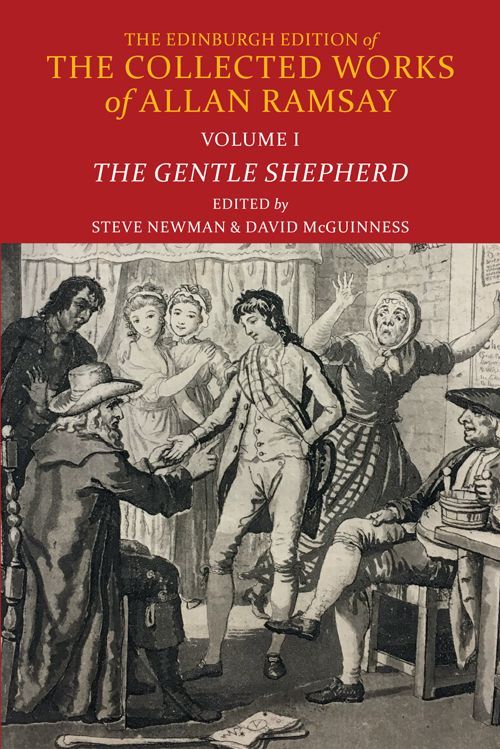
A bit of digging around soon found me another library’s catalogue record of Ramsay’s ballad opera in that very edition – a particularly significant edition, because it’s the most lavish, quite apart from having the complete vocal score section. RCS lecturer Brianna Robertson-Kirkland has researched the work in detail and written an article about it, which is on one of her class reading-lists. Dr David McGuinness, with whom I worked on the HMS.Scot AHRC-funded project a few years ago, has also recently published a book about it,  with Steve Newman.

The new Edinburgh Edition of The Gentle Shepherd

But the catalogue record didn’t exactly fit my purpose, because what I had in my hand was the appendix at the end of the book, containing all the songs. We didn’t have the text of the ballad opera at all.

No problem – I downloaded the catalogue record and adapted it to reflect what we did have. I made sure the words ‘Scottish songs’ appeared in the catalogue record, and I indexed every one of those songs. The appendix is only eighteen pages long – it wasn’t that arduous a task. I’m really happy that we’ve been given this, because – even though it’s fragile and will have to be handled with extreme care – it means the students will now be able to see the music that Brianna has written about, and lectures about.  (It still needs a nice stout card folder, and a secure storage space – but they’ll be sorted out soon.)

Informed Cataloguing

There’s one strange thing, though. It appears no other cataloguer has catalogued each song in The Gentle Shepherd – not in Jisc Library Hub, at any rate.  Well, although we at RCS might not have the whole magnificent text, a title page or a cover, we HAVE now got a catalogue record which indexes all the songs. Hooray!

Contents:-

  • The wawking of the fauld (1st line: My Peggy is a young thing)
  • Fy gar rub her o’er wi’ strae (1st line: Dear Roger, if your Jenny geck)
  • Polwart on the Green (1st line: The dorty will repent)
  • O dear mother, what shall I do (1st line; O dear Peggy, love’s beguiling)
  • How can I be sad on my wedding day (1st line: How shall I be sad when a husband I hae?)
  • Nansy’s to the green-wood gane (1st line: I yield, dear lassie)
  • Cauld kail in Aberdeen (1st Line : Cauld be the rebels cast)
  • Mucking o’ Geordie’s byre (1st line: The laird, wha in riches)
  • Carle, an’ the king come (1st line: Peggy, now the king’s come)
  • The yellow-hair’d laddie (1st line: When first my dear ladie gade to the green hill)
  • By the delicious warmness of thy mouth
  • Happy Clown (1st line: Hid from himself)
  • Leith Wynd (1st line: Were I assur’d)
  • O’er Bogie (1st line: Weel, I agree ye’re sure o’ me)
  • Kirk wad let me be (1st line: Duty, and part of reason)
  • Woe’s my heart that we shou’d sunder (1st line: Speak on, speak thus)
  • Tweed Side (1st line: When hope was quite sunk in despair)
  • Bush aboon Traquair (1st line: At setting day and rising morn)
  • The bonny grey-ey’d morn
  • Corn-Riggs (1st line: My Patie is a lover gay)

I struggled to explain to my family just how gratifying I find this.  But I think it’s really important not only that Brianna’s students can see which songs are in Foulis’s edition of The Gentle Shepherd, but also, anyone looking for one of those song titles will be able to see that it was one of the songs used in the famous ballad opera.

As a matter of interest, we do also have some items going back to the era when Cedric Thorpe Davie put on a performance of the opera. Anyone checking our catalogue will spot those too!

A Grumpy and Irritable Aberdonian

Grey granite bricks

To be fair, David Baptie spoke highly of the Aberdonian James Davie, an early to mid 19th Century Scottish song enthusiast. He was a friend of the Dundonian song collector James Wighton.

However, correspondence between the two men reveals him writing sour objections to other contemporaries’ activities and opinions. I quoted some of his grumblings in my first book, Our Ancient National. Airs. I formed the impression that he was decidedly irritable in his old age! 

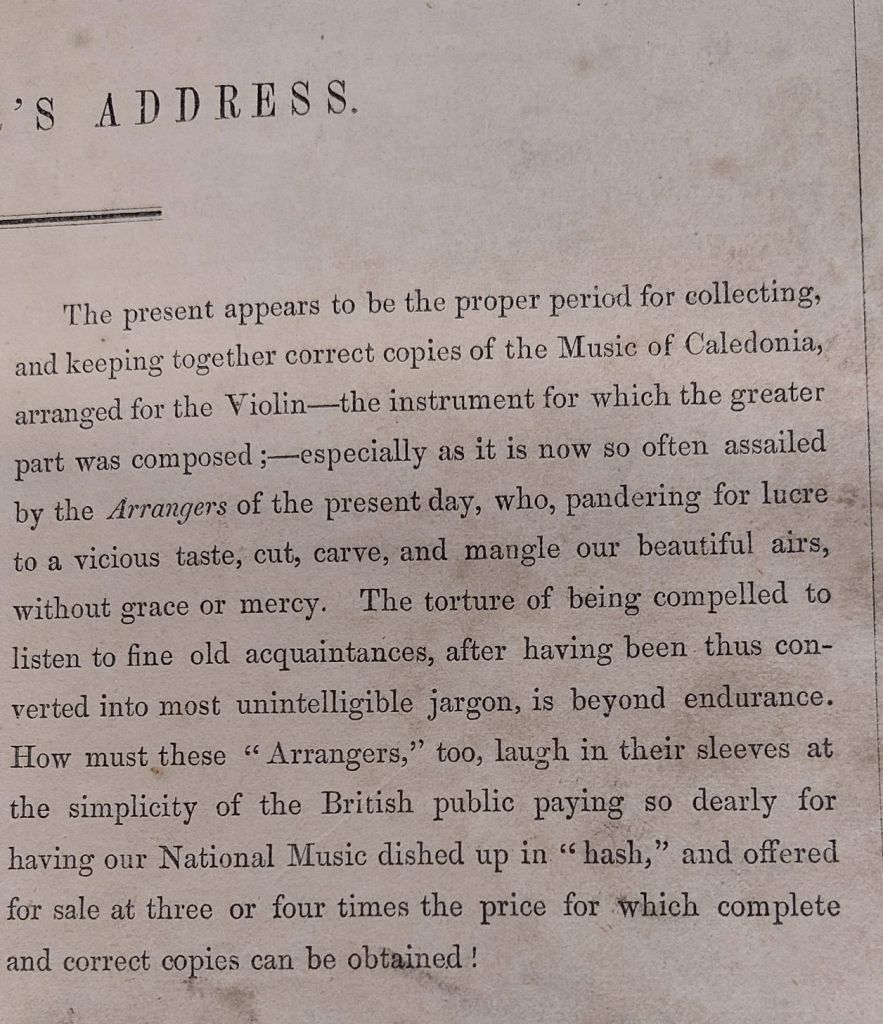
Here he is, in characteristic tone at the start of his Caledonian Repository:-

Arrangers? Pshaw!

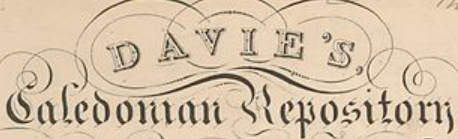
Notwithstanding this, I was excited to accession several books of this Caledonian Repository to the library, since they’re quite rare. The books are tatty and fragile, but a tangible link with the past – they’re about 200 years old.

James Davie’s Caledonian Repository (You can find it in the National Library of Scotland https://digital.nls.uk/special-collections-of-printed-music/archive/102743092)

The Repository is in two series. We have three books from the first  and two from the second. Grateful that the tune contents pages were there, I sorted out which pages belonged where, then catalogued them. Oh, my fingers flew. But the last one that I managed to catalogue before 5 pm yesterday, simply didn’t want to play fair. The catalogue entry was done. But, without going into details, it wasn’t displaying properly.

I went home, had tea, opened the laptop and recatalogued that piece using the info I’d already entered.

No luck.

I removed the identifying sequential number and tried again.

Still no luck.

Maybe ‘something’ magical would happen to it overnight? It was too much to hope! Mr Davie, irascible as ever, did NOT want that book to appear properly in our catalogue.

Finally, my line-manager suggested trying to give it a different barcode. I have absolutely no idea why the system didn’t like the one I’d assigned it, but I did as suggested, and hey presto, we have Davie’s Caledonian Repository, Series 2, Book 2, properly catalogued and accessible.

So that left me with Series 2, Book 1 to do this morning. That book has all its pages, but the page numbering is, shall we say, a little quixotic.  Mr Davie has had the last laugh there.

Nonetheless, we do now have all five items in the Whittaker Library catalogue.  I like to think Davie would be a little bit pleased!

I Wrote a Grant Application …

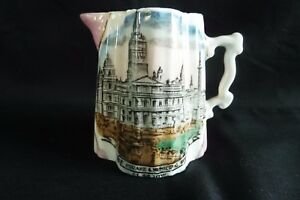
Of course, it’s a highly competitive world out there. I can’t attempt to rate my chances. But I rewarded myself for getting it written and submitted on time, by ordering a wee Victorian Glaswegian souvenir jug. And we’ll see what unfolds!

Where are they now?

Meanwhile, I have amused myself by checking out some old Glasgow music publishers’ addresses. I wasn’t sure where they all were. And although the streets are still on the map, it was a strange feeling to see that places where businesses once thrived, have generally been replaced or kind of left behind by the passing of time. Only three addresses seem generally unchanged. Another – just a green patch of land – is on my morning bus-route, right beside an old public library.   (Physical and cultural landscapes have one big thing in common – they do change as the years go by!)