It’s Getting Closer! The Next Article

Anyone looking at my publication record is soon going to be mightily confused. The article about Sir John Macgregor Murray concerns a Highlander who lived from 1745-1822. I wrote it at a time when I was still researching Scottish music collecting and publishing in the late eighteenth- and early nineteenth-centuries.

Today, I received the final proofs for the next extensive article. This time, it’s about Scotswomen with portfolio music careers in the late nineteenth- and early twentieth-centuries. (Two of them were of English parentage, but let’s not quibble!) A spin-off from my latest book, in the sense that I turned my focus onto a number of individuals who had hung around in the shadows of the book, this article extends over some 22 pages, and luckily there wasn’t a great deal needing changing in the proofs.  But the instructions for using the proofing system extended over 49 pages, and there was also a ten-step quick tour of the process. I nearly had a fit at the sight of the former, but the latter told me nearly all I needed to know. Job done.

There are still more articles in the pipeline; I’ll flag them up as they come along! Meanwhile, there’s the small matter of Christmas requiring my attention during the semi-retired part of my existence, not to mention the continued tidying up of our poor scarred, rewired residence! But first, I need stamps …

Image: Glasgow Athenaeum, forerunner of the Royal Conservatoire of Scotland (Wikimedia Commons) – where two of ‘my’ musical ladies received their advanced musical training.

Archival Truths: the Reality of Archival Research

White puzzle with black gap where the missing piece should be.

I can say this very succinctly!

That which you seek may not be there.

Indeed,

That which you seek may not exist.

You can look as hard as you like, for as long as you like, with as much concentration and determination as you can muster from every inch, every fibre of your body … but not everything you want to find, will have survived to the present day, whether in archives or attics, boxes or basements.

Thus, the Thomas Nelson archive may have a handlist, but even the handlist (a second or third version of a handlist made by unknown hands at some point in the past) may document items that no longer exist. I struck lucky with my searches for correspondence about the four Nelson Scots Song Books (1948-1954). Of course, I still don’t know if there was further correspondence between the song book editors (by which I mean the compilers), as well as that between the compilers and Nelson’s in-house editors. But I found enough to be interesting, and to document the general story of their coming to fruition. It is possibly significant that they were published post-war, by the educational department editors, who had all been in Edinburgh for years by now.

However, for the past few weeks, I’ve been looking for correspondence between the author of a 1935 (ie, pre-war) book aimed at the general reader, and Nelson’s in-house editors. There was correspondence as early as 1932 – I know that much, but I can’t find it. Not only have I completely failed to find it, but we’ve discovered at least half-a-dozen boxes are missing. I bet you anything the missing correspondence is (was) in one or more of those missing boxes! Now, Nelson had offices in Edinburgh and London. The editorial staff for educational materials seemed to have been based in Edinburgh before the Second World War, whilst some – but not all – of the other editorial staff joined them from London’s Pater Noster Row at the start of the war. Thus, my 1935 book – not a school textbook – may have been edited from the London office, not in Edinburgh. Hold onto that knowledge.

Missing in Enemy Action?

When the London offices were bombed, the remaining London editorial staff, including the juvenile literature department, were found temporary office accomodation with another publisher. If my missing correspondence was lost either during a move to Edinburgh, or during the London raids, or in the general upheaval that followed, then they will never be found.

Ironically, when I was researching in the British Museum for my Masters degree, there was a particular Augustinian plainsong manuscript that I desperately needed to see – I’d travelled from Exeter to see it. But I filled in the paper slip (this was 1980 – that’s how you did it) – and got the slip back, marked ‘Missing in Enemy Action’. I rather think I have come up against the same problem again!

And the handlist? The original copy could even have been made by Nelson’s own staff, maybe in Edinburgh, but incorporating letters that had come up from London.

There remain four ‘temporary boxes’ at the end of the sequence, which may contain my prey. And a handful of other boxes that I can’t look at until the next time I’m in Edinburgh. But I’m preparing myself to accept the almost inevitable. In this particular instance,

That for which I search may not exist at all.

Imperial War Museum image (copyright © The Family Estate (Art.IWM ART 16123) – I can only share the link).

Annual Review of 2024

Probably the most eventful year I’ve ever reported, 2024 saw plenty of action. However, I’d like to add a few words of explanation before I go any further. Firstly, everyone’s different and everyone’s circumstances are different. (You know the old saying about how you have to ‘walk a mile in someone’s shoes’ before you understand their experiences and challenges?) I’ve spent far too long on introspection, measuring myself unfavourably against high-achievers. It gets you nowhere, apart from feeling inadequate. You will know what is possible in your own situation; please don’t feel I’ve set myself up as an example. I’ve done it my way.

If you’re on the tenure track hamster wheel elsewhere in the world, you may read this and wonder at how little I’ve achieved. On the other hand, if you’re not employed as an academic, you might be surprised at how much. If you’re fully retired, you may think I’ve lost my marbles, but if you’re semi-retired, you might understand! Similarly, everyone’s personal circumstances at home are different too.

For full disclosure, my research career has been what you’d now call alt-ac (alternative academic); I have had 10½ paid hours a week on research for over a decade, but my main career has been in music librarianship.  (I’ve never been a full-time academic,  and my outputs were achieved in less than one third of my working week.)  As you’ll see, I recently gave a keynote about being ‘alt-ac’, and I’d certainly be open to further bookings of this kind, if your institution or network was interested. (I’m in the UK.)

Highlights

  • I had successful eye surgery in February. 
  • I retired from librarianship at the end of June.
  • I was promoted to part-time postdoctoral research fellow in July (10½ hours a week).
  • I’ve had the opportunity to do some teaching cover.
  • My second monograph was published. (It has a 2025 imprint, but actually came out in autumn 2024.)
  • I was elected a Fellow of IAML (UK & Ireland) in the spring, and of the Royal Conservatoire of Scotland in November.
  • I was keynote speaker for the ECRN Alt-Ac Showcase at the University of Birmingham.
  • I successfully applied for a research fellowship at IASH (the Institute for Advanced Study in the Humanities) at the University of Edinburgh, which I shall be taking up between January and June 2025.
  • I received the Mervyn Heard Award from the Magic Lantern Society in December, for research into Bayley and Ferguson’s service of song  publications.

Four fellowships of various kinds is quite an impressive number, however you look at it, so I must remind myself of this before I start beating myself up about my relatively modest upward progress!

Publications

  • A Social History of Amateur Music-Making and Scottish National Identity: Scotland’s Printed Music, 1880-1951 (Routledge, 2025)
  • Book Review: Gun Sireadh, Gun Irraidh: The Tolmie Collection (Folk Music Journal Vol.12 no.5, pp.127-9; my review of a new edition of the Tolmie Collection, a significant Gaelic song anthology, here re-edited by Kenna Campbell and Ainsley Hamill)
  • [Article withdrawn due to pressures of time, but published on this blog: ‘The Exhilaration and Exasperation of Hybridity: Third-Space Professionalism in the Library’]
  • 2 accepted chapters pending publication.
  • 2 articles recently submitted, pending peer review. [February 2025 update: one got through peer review, has been revised, edited and I’ve approved the proofs. The other got through peer review and now awaits the revisions. Nonetheless, satisfactory progress!]

Speaker

  • Exchange Talk, Royal Conservatoire of Scotland, Jan 2024, ‘From Magic Lantern to Microphone: the Scottish Music Publishers & Pedagogues inspiring Hearts & Minds through Song’
  • NAG (National Acquisitions Group) Talk, April 2024, ‘Redressing the Balance: Getting Historically Under-Represented Composers and Contemporary Environmental Concerns into Library Stock’
  • Print Networks, conference held at University of Newcastle, July 2024, ‘‘Music for All’: the Rise and Fall of Scottish Music Publishing, 1880-1964’
  • Exchange Talk, Royal Conservatoire of Scotland, Nov 2024, ‘The Glory of Scotland’ (it’s the title of a Scottish song book published for the 1951 Festival of Britain)
  • Keynote for ECRN Alt-Ac Showcase at the University of Birmingham, Nov 2024, ‘My Alt-Ac Life’

Other Activities

  • BBC Scotland: ‘Good Morning Scotland’ interview
  • Book launch
  • Fellowships of IAML(UK) and RCS
  • Mervyn Peak Award, Magic Lantern Society
  • New job title: Post Doctoral Research Fellow
  • Peer reviews for AHRC and a scholarly journal
  • Providing teaching cover
  • Successful application: Heritage Collections Research Fellowship, IASH (Institute for Advanced Studies in the Humanities at the University of Edinburgh), for Jan-June 2025.
Edinburgh University Library from The Meadows (Wikipedia image)

Forward Planning

My IASH Fellowship will allow me the opportunity to explore the former Edinburgh publisher, Thomas Nelson’s archives, to find out more about their publishing in the music field. There wasn’t a great amount, but I aim to explore correspondence and find out how it fits into the wider range of their activities. I’ll be spending more of my time on research than I ever have since 1982!

Meanwhile, I’ve been working on an article for a history publication; I want to get that finished in the near future, so that I can turn my attention to another article on a different topic. What I do after that will probably depend on how the IASH Fellowship research goes, and what interesting possibilities reveal themselves to me. There’s bound to be enough for an article. But could I expand it to something book-length? I’ll have to wait and see!

Meddle the Thistle Wha Daur! (Old Poem, New Thistle)

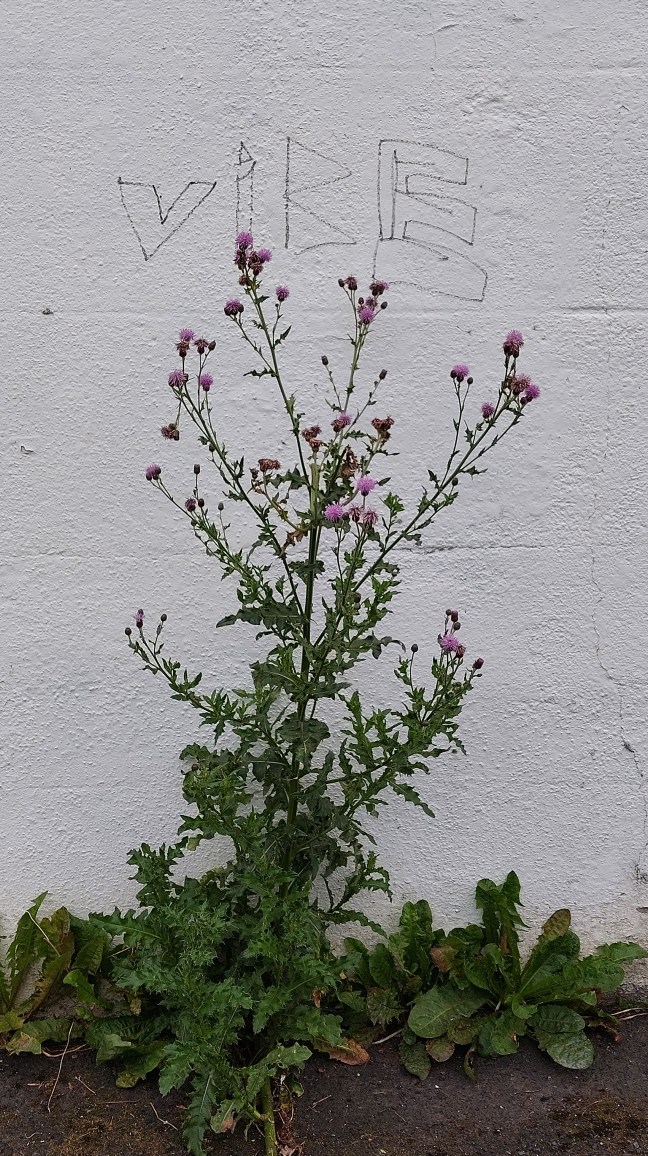
Thistle against a white wall with graffiti reading ;'Vibe'

Our neighbours have a high white wall. There’s a tall thistle growing there, and some young joker has scrawled above it, ‘VIBE’. I don’t know if they were consciously referencing the metaphor of a prickly thistle to represent Scottish, and most particularly, Glaswegian identity, but – hey, they wrote it directly right above that thistle, so who knows? I took a photo anyway – it was too good an opportunity to miss.

Every time I walk down the road or get into my car, there it is, and every time it reminds me of a poem by one of ‘my’ Scottish song-writers. He published his book of poems in 1894, and it’s well out of copyright, so I can share it with you. Just look at that last verse – there’s a proud, very nationalist Scot for you!

“I’m a Scot and I carena’ wha’ kens it, Juist meddle the thistle wha’ daur,

They’ll maybe get mair than they wantit, An Scotia be little the waur …”

To be honest, I’m more interested in the poet for his work as an Edinburgh music teacher, than as a poet or local historian, but it’s all part and parcel of who he was. Two different musicians set this song to music – one was really pretty uninspiring, but the other one’s not too bad! (Well… musically competent, not remotely ‘Scottish’ sounding, nor particularly memorable, but competent.)

The poet-teacher gets a significant mention in my forthcoming book, especially his views about children singing Scottish songs.

I have just sent the manuscript back to the editor with my own amendments to the copy-editing, so watch this space! Now to turn back to the question of the second index … which I drafted a few weeks ago, but which now needs fine-tuning before I get the proofs back to link my index-terms to the publisher’s page numbers!

Image by Ralph from Pixabay

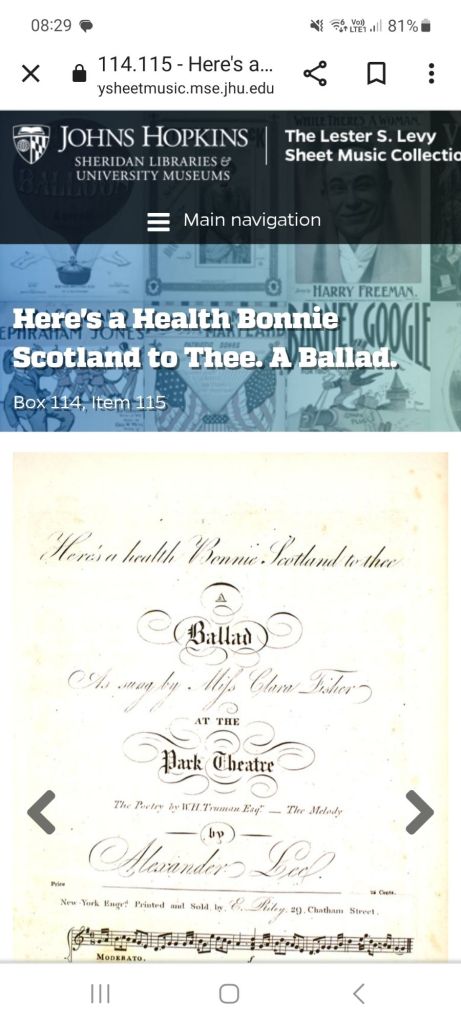
Here’s a Health, Bonnie Scotland, to Thee (an old song by G. A. Lee)

George Alexander Lee published this ‘Scottish song’ in America with A. Fleetwood in New York ca. 1830, whilst this London publication by Alex. Lee & Lee is estimated at 1832 by the National Library of Scotland.

I’ve been wondering how old the expression ‘Bonnie Scotland’ actually is – certainly, this song is sixty years older than the alleged instance in the novel cited on LiveBreatheScotland.com. (I did a search and found ‘bonnie’ but not ‘bonnie Scotland’, so I won’t perpetuate the apparent fallacy by naming the book.)

Has anyone encountered the expression prior to 1830? A friend has suggested the date would be consistent with the years between George IV’s trip to Scotland and before Victoria and Albert’s later acquisition of Balmoral.

National Pride and Expats: Scottish themed songs in the Diaspora

A bit of early morning Googling does suggest that the phrase has been popular with visitors and nostalgic expats. Am I right in reaching this conclusion? The fact that the ostensibly Scottish song was first published in New York and London, not Edinburgh or Glasgow – would appear to bear this out. The song appears in Scottish publications a couple of decades later.

In the Lester S Levy Collection at Johns Hopkins Sheridan Libraries and University Museums

For your enjoyment, here’s a Victor recording of 1912, from the Library of Congress. (My understanding is that it is now in the public domain.)

Cover Image by Frank Winkler from Pixabay

Knowing When to Stop

The mystery teacher – photo from British Newspaper Archive

There are times when our insatiable curiosity leads us ‘up the garden path’, aren’t there? For me, it’s when I decide to pursue the life history of characters that really aren’t central to what I’m researching.

Take this weekend: I’m currently researching the pedagogical output of a Victorian Edinburgh music teacher, and I discovered his daughter collaborated on some of his publications. (This is confirmed by a letter that her sister wrote to a music journal later.) The collaborations appear to have been before she married.

I found a newspaper article about a story she had written for a women’s magazine called The People’s Friend in 1906, and this gave me her married name, but also informed me that she was working as a head teacher in a village quite a way from Edinburgh. It was definitely her – it named her father and his achievements.

Oh, my goodness. I wrote a number of stories for that magazine myself, some decades ago, so that made me sit up and look, straight away!

More interestingly, though – for a married woman still to be working, was a red flag in itself, because it was usual for a woman to stop working when she married. I traced her marriage certificate on Scotland’s People, and only noticed at the last minute that there was an amendment attached. She divorced her husband – whereabouts unknown – in 1912. Perhaps she had found it expedient to continue working, notwithstanding having a young child, if there had already been marital discord for a while. But who knows?!

I found the mother, a nine-year old son and a servant living back in Edinburgh in 1911. The census described her just as a teacher – no mention of headship here.

Really, my only interest at this point – whether or not she continued to collaborate with her father after she married – was my curiosity about a woman working as a teacher after marriage. Not long ago, I researched a late Victorian woman called Clarinda Webster, who was a music teacher, head teacher and ultimately a divorcee, so there was a human interest in finding someone else whose circumstances might have been vaguely similar …

After a few hours delving into Ancestry, Scotland’s People and the British Newspaper Archive, I made myself stop. I don’t know where this woman and her son ended up. Maybe they left Scotland or emigrated, who knows? At the end of the day, it doesn’t make any difference to my research into pedagogical music publications in the late Victorian and Edwardian eras.

On the other hand, stories of working women professionals in that era continue to interest me, whether musicians, teachers or both. It wouldn’t take much to convince me to keep looking…

Am Writing: New Book Contract

Yes, folks, there really is going to be another book. Following on from my first one, date-wise, but with more social history, more about publishers, and more about amateur music making between 1880-1950.

Exciting? You bet!

Provisional Title

A Social History of Amateur Music-Making and Scottish National Identity: Scotland’s Printed Music, 1880-1950