Diversifying Your Repertoire: Music by BIPOC Composers

At the Whittaker Library, we use the Portal (a bit like Moodle, it’s a kind of intranet for material shared within the institution) for useful information to help our students and colleagues.

A while ago, I compiled lists of music by women composers, subdivided into categories, such as music for children, music for tuba, music for mixed chamber ensemble – but until now, I hadn’t done much in the way of subdividing the lists of music by BIPOC composers. So, I have been working on it.  Despite having acquired quite a lot of music, I have discovered that the commonest instruments have by far and away the most music. Poor tuba player, if you want to diversify your programme with music by people of other ethnicities.

Some university libraries have put in a lot of effort helping students find this kind of thing – especially in Canada and the USA – and there are some useful databases to help – but I have still been struggling to find materials for some of the more minority instruments. Not a great deal for piccolo, tuba, accordion – or bagpipes! (Well,  there might not be as much pipe music over there – we started the piping tradition here in Scotland. However,  there are plenty of non-Scottish pipe bands. Some international pipers must also compose!)

If you play tuba, trombone, piccolo, oboe, saxophone – you get the picture – and your repertoire includes a fabulous piece of music by a BIPOC composer, PLEASE do recommend your library to get that piece in stock so that other musicians can also find it! It won’t be up to me to continue ordering music at RCS after the end of June – and that’s a strange feeling – but I can, right now, highlight the fact that libraries need to pay attention to the repertoire they buy.

If you’re a librarian – by all means, keep the standard repertoire up to date. Buy what your patrons need and ask for. But if you have a chance to do stock development, please keep the BIPOC composers in mind. They are, after all, the global majority! And I’m ashamed to say, we don’t know enough about them, though I can, hand on heart, say that I’ve been making a determined effort to find out.

I had hoped to do one last workshop about all the exciting new repertoire in the library, before I retired. Sadly, this isn’t going to happen. Never mind – maybe one day, someone will find this blog post and feel inspired to explore it all for themselves.

Image by congerdesign from Pixabay

Slow Productivity: my Latest Read

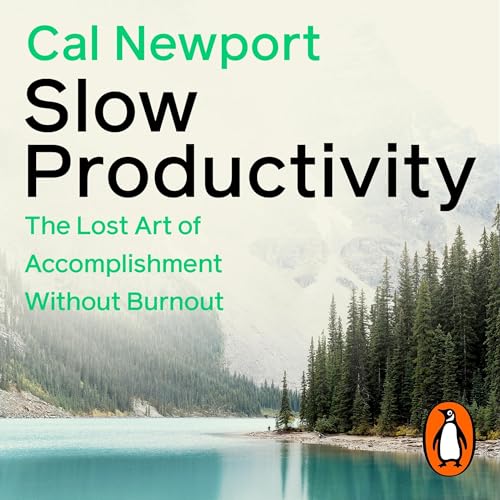
Cover of Cal Newport book, Slow Productivity

Slow Productivity: The Lost Art of Accomplishment Without Burnout
by Cal Newport and Penguin Audio (March 2024)

picture of headphones on a patchwork background.

I’ve been listening to Cal Newport’s book, Slow Productivity: the Lost Art of Accomplishment without Burnout, on Audible. I’ve taken my time over it – appropriately – and I’m approaching the end of it. Because I haven’t finished completely, what I’m writing here today can’t really be described as a review, so much as a first impression.

But why, you might ask, would anyone less than two months away from retirement age, decide to read a book about productivity at all? It’s a good question! I think I was both intrigued by the title, and fascinated by the different paces at which different people work. There are times when I achieve a lot – but not usually at a frenetic pace.   I don’t throw myself into tasks at fever-pitch, unless a deadline is creeping up on me. On the other hand, I do tend to have so many things on the go, that going slow feels impossible. (And I’m worryingly obsessed about accomplishment and achievements! That’s how I was raised.)

The main thrust of the book is that we ‘knowledge-workers’ should be more deliberate, allow ourselves time to do things well, factor in holidays, breaks and slower-moving spells, and not take on too much. That we’re not like factory workers on an assembly line, and aren’t generally required to produce so many units of whatever-it-might-be, per hour, day or week. Newport’s historical examples are inspiring, underlining his message, but some suggestions have no application to any role I’ve ever occupied. Pay someone to do some part of my work? If I was self-employed, possibly. However, the only time I’ve ever done that, was getting my first book indexed professionally. Librarians don’t outsource their work. (Neither do 0.3 of the week researchers!) Similarly, if you own a business or are freelance, you can deliberately decide to make a little less profit in exchange for a longer, more intentional route towards a high-quality product/performance act/whatever. People employed in any kind of academia can choose to seek a promoted position or not (depending on circumstances, of course), but it’s not about profitability directly affecting one’s own pocket.

Obsess over Quality

However, the suggestion to look at your role and focus on the ‘core activities’ that will have the most impact, is certainly sensible. As I’ve mentioned before, cataloguing barely-used jazz CDs is a soul-destroying task, mainly because it has such little impact. I hardly needed an Audible book to endorse that sentiment, but there it was.

Impactful Librarianship

As I did the ironing one night last week, listening to my book, I think that’s what prompted me to make sure my final weeks of librarianship would have a bit more impact than that! I’ve thrown myself back into tracking down music by BIPOC composers, and it certainly passes the time more quickly than other tasks I could mention!

My aim is simply to make it possible for students to find more diverse repertoire, should they feel so inclined.  My efforts won’t result in a massive listing – there are less than a thousand such items tagged in our catalogue, and our budget isn’t huge. It’s not just about getting the materials in – but I won’t be the one devising ways to get it known about and borrowed, after 28 June 2024.

Yesterday, a highlight was discovering one particular new acquisition was already on loan to a second borrower. Result!  That  in library terms, is impact.

And Impactful Research

As for slow productivity? I need to finish reading Newport’s book and then consider how to apply the best suggestions to a semi-retired existence. At the time I’m posting this, it’s a Wednesday, and I have my research hat on. I have a book review to do, and then I’ll look at my list of projects … because I’m not retiring from research! Far from it.

Time to Reflect

My research has been on hold whilst I recover from eye surgery. Firstly, a UK ‘fit note’ says you’re unfit to work (and research is work); and secondly, my good eye soon tells me if I’ve placed too many demands on it. It’s weird to look at a computer screen when one eye  is compensating for the other one (that doesn’t fully focus and has an obstruction in the form of a black gas bubble). 

So, no research reading, though I have bought a couple of books for later.  But that doesn’t stop me thinking. I can’t help doing that.

The other evening, I started a very short list of potential research directions. I can’t proceed with any of them until (a) I am back at work, (b) I can get to various libraries and archives, and (c) I get the go-ahead to drive.

Each potential direction requires me to venture along the path to see what’s round the corner.  Not just, whether there’s enough to research, but whether there might be an interested audience for it. For example, there are two Scottish women musicians I’d like to know more about  – a Victorian and an Edwardian.  One never was a big name, except in her locality.  The other did enjoy fame, but she is virtually forgotten today.

Or, two Scottish music publishers with religious inclinations.  Does anyone care today, apart from me? I’m interested in what exactly they published; and whether they ever interacted in any way.  But is anyone else interested? (I had these hesitations about my mediaeval music research, decades ago. It was possibly one of the reasons it foundered.)

In any of these topics, I have to place the subjects into their social and cultural context, if I am to demonstrate relevance or significance in the grander scheme of things.  My motivation is to examine what these individuals and firms’ music and activities tell us about the era in which they lived and worked.

But then there’s the question of impact. I don’t have to so much as open my laptop, let alone a book, to start worrying that I haven’t yet come up with a mind-blowing angle that will knock the world’s socks off!   Moreover, there is no conceivable way I can make any of my research relate to climate change; saving the earth’s resources; social good or benefit to health.  

And so I sit, blurrily gazing into the middle distance, reflecting! I have the go-ahead to return to work on Monday. Blurrily!

Image by nateen08650 from Pixabay

Pat Thomson Blogs about Research Significance

This is thought-provoking:-

Research key words – Significance

I find myself looking at the various strands of my research that I’m considering pursuing, and asking myself sternly, ‘Does this have significance? Is anyone going to benefit from my finding out more about this, as opposed to that, or maybe the other … ?’ Why do I want to pursue these various aspects? What might the outcomes tell us?

Researchfish – Safely reeled in!

Funded research clearly has to  be documented, and in the UK that involves uploading outputs to a website called Researchfish.  I’m glad I was just about up-to-date on my Researchfish entries, so it didn’t take excessively long to check a few entries and submit the whole thing.

It’s a good thing I checked, though.  The bibliography is on the blog – and the blog was logged literally ages ago.  But today I decided that the bibliography was such a huge output that it deserved its own mention.   And although I logged our Brio special issue over a month ago, elsewhere in my earlier narrative I had noted that it was “pending”.  I hastily updated that, too!  (The Brio issue is all there on Pure, our institutional repository, along with my other research outputs.)

fishing-3441090_960_720 PixabaySo as far as I’m concerned, the “fish” has been netted, weighed, documented and forwarded to the distributor!  I’ve hit SEND, and now all that remains is to apply for the next research grant.


Well, after a deserved coffee, anyway!

Quiet Contemplation: but You can Help!

direction-1033278__340

I’ve reached the point where I need to find more grant-funding! I seem to be at a bit of a cross-roads, needing to decide whether to forge ahead immediately with the Stationers’ Hall research, or take another road which will bring me back to it eventually, having gathered more useful data on the way.

There’s also the question of my own status as a researcher.  Neither “new” enough nor “old” enough for early-career or emeritus awards, nor established enough to say that I’m in a “permanent academic post”.  Permanent, yes.  Academic-related, certainly. But ….!

Meanwhile, please do give me feedback on what the Claimed From Stationers’ Hall network has achieved so far.

  • What have you enjoyed?
  • What have you learned/gained from following it?
  • Has it given you fresh ideas?
  • Have you shared information with other people  or taken new actions yourself?

I posted similar questions on the Facebook page yesterday.  I am more than happy for you to talk to me and share your ideas!


Why have I fallen silent? Well, not totally mute, but the thing is … I’m looking for more grant-funding and trying to…

Posted by Claimed From Stationers Hall: Early Legal Deposit Music on Wednesday, March 20, 2019


Research Impacts: Asking You!


fishmosaic

The other day, I blogged about research outcomes.  Much joy has been experienced in the logging of these – it’s actually quite rewarding to look back and see what has been achieved in one and a half days a week.  (Okay, some was admittedly achieved in evenings and weekends as well.  But an outcome’s an outcome, isn’t it?!)

However, if you’ve had an opportunity to glance at my recent guest-blogpost for IAML (UK and Ireland Branch), you’ll realise that the outcomes are only one side of the story.  So, today I’ve been contemplating research impacts.  This project has made networking connections with loads of people, libraries and organisations, so there’s no denying there has been impact within academia … but what about beyond the ivory towers?!  Some of the organisations have a preponderance of researchers, but others certainly embrace both academia and those in non-academic circles.

So, here’s my appeal to you: if you’ve been enjoying following the project, and you feel we’ve in any way influenced you in your academic OR non-academic existence, I’d positively love to hear from you.  I know I haven’t been blogging into a void, because people do respond to what they see … but I’d hate to think I had overlooked some impact or influence that was worth shouting about!  Similarly, do let me know what you’d like to happen next.

I’ve allowed comments on this post – but any form of communication, social-media or otherwise, would be very warmly welcomed!  Thank you.

2018 Round-Up: the Scholar-Librarian

Annual Review, 2018

St Pauls SilhouetteI am a Performing Arts Librarian 3.5 days a week, and a Postdoctoral Researcher 1.5 days a week.  In this self-imposed annual review, I’m not listing routine activities conducted in either capacity; it goes without saying that I’ve answered queries, catalogued, delivered library research training to a number of different class groups, attended meetings, and pursued research-related activities and fieldwork.

From September 2017 to September 2018, I was the AHRC-funded Principal Investigator for a new research network, the Claimed From Stationers’ Hall music research project.  Since then, I have continued to conduct research and network with the various scholars and libraries involved with this project, and in the new year shall be pursuing further grant-funding in order to extend the reach of the project.

As someone who continually asks themselves, “Am I doing enough?”, I feel that even I can be reasonably content with this year’s outputs!

  • JANUARY
  • Chaired sessions at Traditional Pedagogies, international conference at Royal Conservatoire of Scotland
  • FEBRUARY
  • Blogpost: Copyright Literacy: Legal Deposit (Copyright Behind the Scenes) – and Scores of Musical Scores  https://copyrightliteracy.org/2018/02/21/legal-deposit-copyright-behind-the-scenes-and-scores-of-musical-scores/
  • Initial iteration of Claimed From Stationers Hall Bibliography, (since updated regularly) https://claimedfromstationershall.wordpress.com/bibliography/
  • Book chapter, ‘Wynds, Vennels and Dual Carriageways: the changing Nature of Scottish Music’, in Understanding Scotland musically: folk, tradition and policy. Abingdon, Oxon: Routledge, p. 230-239.
  • MARCH
  • Claimed From Stationers’ Hall Workshop, Royal Conservatoire of Scotland, (26 Mar)
  • Scottish Library & Information Council (SLIC) From PGCert to PG Certainty: Enabling the Distance Learner (invited talk, sectoral organisation) (March 2018)
  • APRIL
  • IAML(UK & Irl) Annual Study Weekend, invited talk, Pathways, outputs and impacts: the ‘Claimed from Stationers Hall’ music project takes wings
  • IAML(UK & Irl) Annual Study Weekend From PGCert to PG Certainty: Enabling the Distance Learner (quick-fire session) (April 2018)
  • MAY
  • Blogpost based on the session I gave at the IAML(UK & Ireland) Annual Study Weekend 2018 for the IAML(UK & Ireland) blog, http://iaml-uk-irl.org/blog/libraries-reaching-out-distance-learners
  • JUNE
  • EAERN (Eighteenth-century Arts Education Research Network), ‘Claimed From Stationers’ Hall: But What Happened Next?’ (University of Glasgow, 6 June)
  • Romantic Song Network steering group seminar at British Library
  • JULY 
  • IAML/AIBM Annual Congress, Leipzig, ‘A Network of Early British Legal Deposit Music: Explored through Modern Networking
  • SEPT
  • RMA Conference, Bristol, ‘Overlapping Patterns: the Extant Late Georgian Copyright Music Explored by Modern Research Networking’
  • NOV
  • Field-trip to King’s Inns and Trinity College Dublin Libraries, and British Library
  • EFDSS Conference, London, ‘National Airs in Georgian British Libraries’
  • ARLGS (Academic and Research Libraries Group Scotland) Teachmeet at Glasgow University Library – speaker
  • Article, Trafalgar Chronicle, New Series 3 (2018), 202-212, jointly authored with Brianna Robertson-Kirkland, ‘My love to war is going’: Women and Song in the Napoleonic Era’.
  • DEC
  • Article, Information Professional, Nov-Dec 2018, ‘Coffee and Collaboration’ [teaching electronic resource strategies]

Additionally, I have authored 79 blogposts and 5 Newsletters in connection with the Claimed From Stationers’ Hall research project.

Bat printed cup and saucer possibly New Hall £2-00Institutional Repository: Pure.  My profile:- https://tinyurl.com/KarenMcAulayPureInstRepository

I’ve blogged elsewhere about my musical and sewing activities – both essential to me in terms of relaxation and balance!  You’ll find it here:-

https://karenmcaulay.wordpress.com/2018/12/22/2018-round-up-in-creative-mode/

Collage map golden triangles legal deposit