Mystifying Timewarp Challenge

It’s not as though I’m unaccustomed to what I’ve been doing in odd moments for the past few days.  Over the years, I’ve opened dozens, indeed hundreds of old song books and other music publications, trying to read their prefaces, annotations and harmonic arrangements as though I were a contemporary musician rather than a 21st century musicologist.  Looking at music educational materials is likewise not new to me.

Enter Dr Walford Davies and his The Pursuit of Music

He was the first music professor at the University of Aberystwyth, but he was also hugely popular in the 1920s-30s through his broadcasting work – fully exploiting the new technology of wireless and gramophone for educational purposes, and to share his love of music with the ordinary layman wishing to know more about all they could now listen to. This book was written after he’d mostly, but not entirely retired.

It wasn’t exactly what I expected! If I thought he would write about what made the Pastoral Symphony pastoral, or Die Moldau describe a river’s journey, I rapidly had to change my expectations. 

His audience was apparently not just the average layperson, but also young people in their late teens, not long out of school. If the reader didn’t play the piano, they were urged to get a friend to play the examples for them.  (Considering the book is over 400 pages, you can imagine how long they’d be – erm – captive!)

Dedication

And this was aesthetics, 90 years ago. I struggled to get into the mindset of a layperson wanting to know what music (classical, in the main) was ‘about’, without knowing what a chord was, or realising that music occupies time more than space. Would I have benefited from that knowledge? Would being told in general terms what the harmonic series was, have helped me appreciate the movements of a string quartet? Or Holst’s The Planets?

It wasn’t about musical styles over the years. I didn’t read it cover to cover, but neither did it appear to explain musical form and structure as I would have expected.

Davies’ biographer, H. C. Colles, did comment that it was a mystifying book, and suffered from the fact that the authorโ€™s strengths were in friendly and persuasive spoken, not written communication.

I’ve only heard snatches of his spoken commentary, so I can’t really say.ย  Apart from which, Colles made an observation about Davies’ written style. Colles was a contemporary authority who knew Davies personally – and he may have been picking his own words carefully, so as not to cause offence. My own disquiet is more a matter of content:ย  was it what his avowed audience needed, to start ‘understanding music’?

I think I have been mystified enough.

I wonder what the Nelson editors made of this book by one of the great names of their age? They published it, and I think regarded him as a catch, but what did they actually think?!

And did the layperson, assuming they got through the 400+ pages, lay it down with a contented sigh, feeling that now they understood music?

Archival Truths: the Reality of Archival Research

White puzzle with black gap where the missing piece should be.

I can say this very succinctly!

That which you seek may not be there.

Indeed,

That which you seek may not exist.

You can look as hard as you like, for as long as you like, with as much concentration and determination as you can muster from every inch, every fibre of your body … but not everything you want to find, will have survived to the present day, whether in archives or attics, boxes or basements.

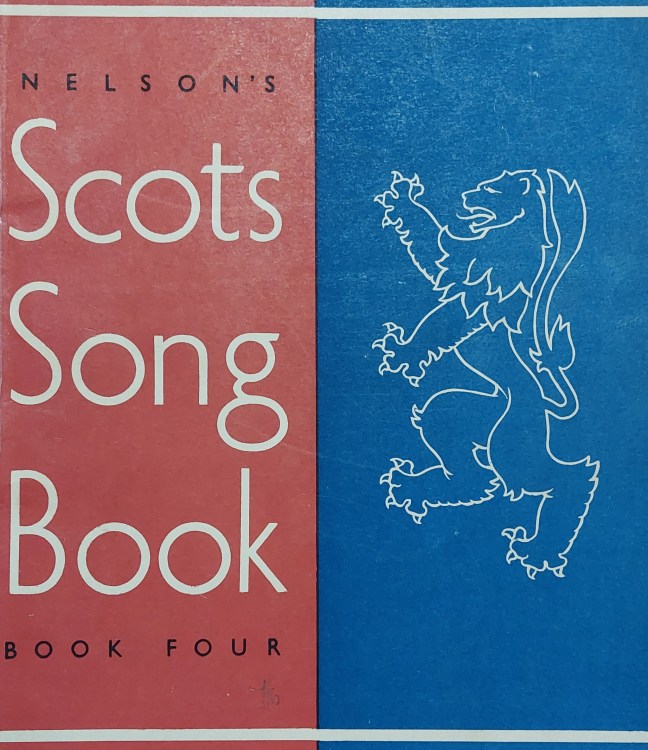
Thus, the Thomas Nelson archive may have a handlist, but even the handlist (a second or third version of a handlist made by unknown hands at some point in the past) may document items that no longer exist. I struck lucky with my searches for correspondence about the four Nelson Scots Song Books (1948-1954). Of course, I still don’t know if there was further correspondence between the song book editors (by which I mean the compilers), as well as that between the compilers and Nelson’s in-house editors. But I found enough to be interesting, and to document the general story of their coming to fruition. It is possibly significant that they were published post-war, by the educational department editors, who had all been in Edinburgh for years by now.

However, for the past few weeks, I’ve been looking for correspondence between the author of a 1935 (ie, pre-war) book aimed at the general reader, and Nelson’s in-house editors. There was correspondence as early as 1932 – I know that much, but I can’t find it. Not only have I completely failed to find it, but we’ve discovered at least half-a-dozen boxes are missing. I bet you anything the missing correspondence is (was) in one or more of those missing boxes! Now, Nelson had offices in Edinburgh and London. The editorial staff for educational materials seemed to have been based in Edinburgh before the Second World War, whilst some – but not all – of the other editorial staff joined them from London’s Pater Noster Row at the start of the war. Thus, my 1935 book – not a school textbook – may have been edited from the London office, not in Edinburgh. Hold onto that knowledge.

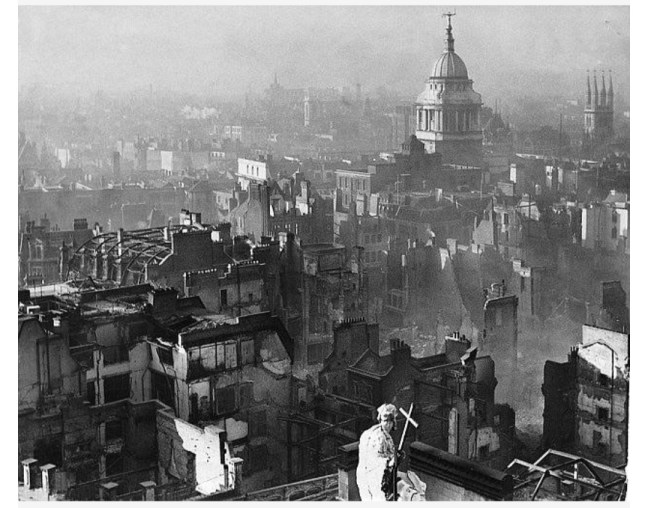
Missing in Enemy Action?

When the London offices were bombed, the remaining London editorial staff, including the juvenile literature department, were found temporary office accomodation with another publisher. If my missing correspondence was lost either during a move to Edinburgh, or during the London raids, or in the general upheaval that followed, then they will never be found.

Ironically, when I was researching in the British Museum for my Masters degree, there was a particular Augustinian plainsong manuscript that I desperately needed to see – I’d travelled from Exeter to see it. But I filled in the paper slip (this was 1980 – that’s how you did it) – and got the slip back, marked ‘Missing in Enemy Action’. I rather think I have come up against the same problem again!

And the handlist? The original copy could even have been made by Nelson’s own staff, maybe in Edinburgh, but incorporating letters that had come up from London.

There remain four ‘temporary boxes’ at the end of the sequence, which may contain my prey. And a handful of other boxes that I can’t look at until the next time I’m in Edinburgh. But I’m preparing myself to accept the almost inevitable. In this particular instance,

That for which I search may not exist at all.

Imperial War Museum image (copyright ยฉ The Family Estate (Art.IWM ART 16123) – I can only share the link).

Identifying ‘The Large Book on Music’: How Large Must a Book be, to be Considered, ‘Large’?

The Music Man

In the late 1920s, Thomas Nelson’s were just starting to work with the music specialist who would turn out to be very helpful to them over the next couple of decades. As I mentioned, I’ve been trying to find the very first letter that passed between them.ย  Moreover, the Nelson’s editor had told his line-manager at the outset (in the mid-1920s) that he hoped this individual would be helping with ‘the large music book’. Now, this is delightfully vague, isn’t it? Nelson’s wouldn’t be publishing anything that I’d call ‘large’ in the way of printed music for several years.

And Another Music Man!

On Friday, I stumbled across editorial correspondence from 1929 about revising an earlier book about music – one useful to individual students, possibly beyond school age – but not a school classroom text-book. When I get my hands on it, I expect to find that it’s a fairly standard Nelson printed book size. If this was ‘the large book’ (Possibility A), then it was only ‘large’ by comparison with slimmer materials intended for the classroom. Moreover, our music man was NOT the person who ended up revising it. His first contribution was something slimmer, and more classroom-based. But this book does perhaps better fit the timescale of a publication being projected in the late 20s.

It’s so easy to imagine up a sequence of events, with what is really insufficient evidence.  After all, there could be another projected ‘large book’ (Possibility B) that never actually happened!

My working theory for Possibility A, is currently that even if they approached the first guy to revise a book, then for whatever reason, he wasn’t ultimately offered or didn’t fancy the commission. The chap who did do it was certainly a good choice, in any event – a knowledgeable scholar rather than a gifted practitioner and pedagogue.

There’s nothing for it – I must continue leafing through early correspondence in search of that initial letter!  But I’ve also ordered a copy of the book that the scholar revised.  After all, it’s another Nelson music publication.   I need to know about it, too, whether it’s the ‘large’ book or otherwise.

The Man who Turned up Everywhere!

Yesterday was my first day back in the archives. My phone was crawling with messages (an ongoing family situation). Then came a phone-call, which I couldn’t answer without running out to where I could talk. That led to another, and another. And another. Back and forth I went.  I can’t tell you what a day it was!

However, I did get through several folders of Thomas Nelson papers.  I’m in search of the first mention of a particular individual who was very influential in Nelson’s educational music output.  I found him mentioned a couple of times in yesterday’s papers, once quite unexpectedly. I need to see how this sits in my timeline.  Honestly, I didn’t expect to find him urging an organist’s wife to submit a book proposal on … elocution!  It didn’t look like choral speaking (yes, that was a thing, which was quite in vogue a little later on). Indeed, a Nelson editor specifically advised his boss that it was about elocution, so I don’t need to wonder.

Nelson’s rejected the lady’s proposal. She found another publisher.ย  I briefly wondered how the Englishman who basically ended up acting as music advisor to the Nelson editors, came to know a Scottish organist and his wife, quite early on in his professional career? But I think they probably met at a course or conference.

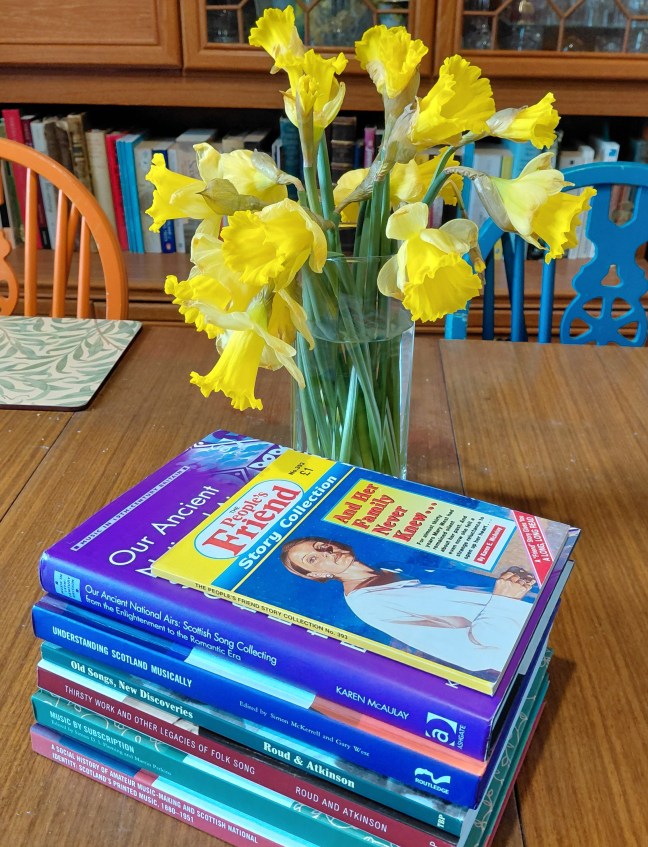
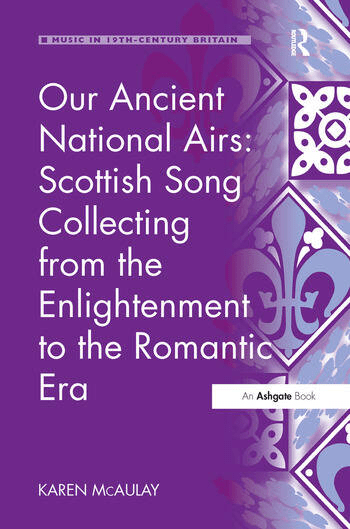
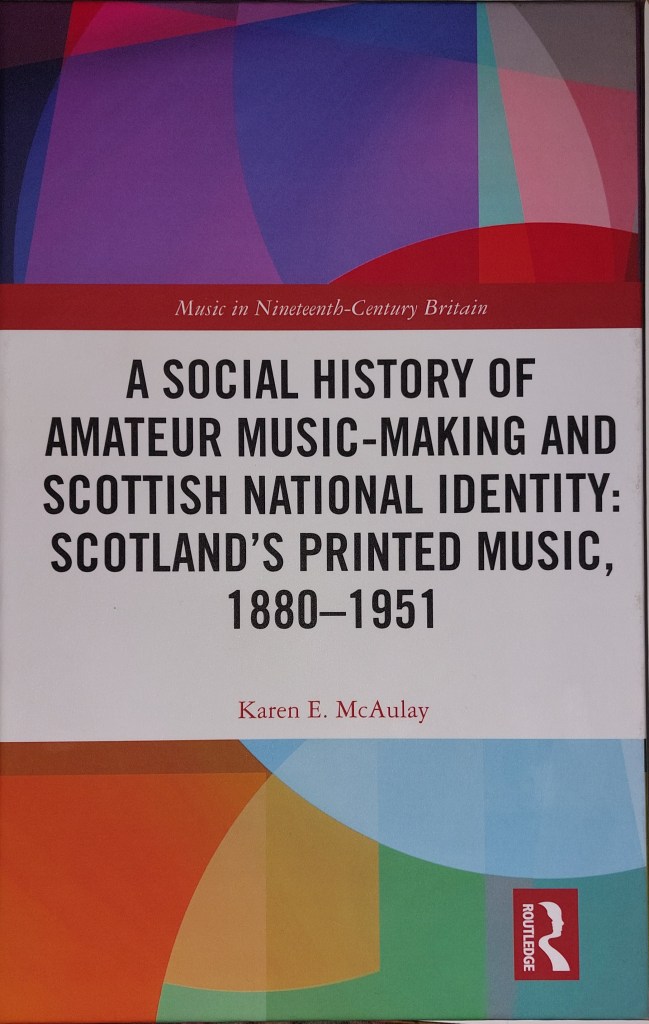
Book: A Social History of Amateur Music-Making and Scottish National Identity

Wavy lines of music and an artistic interpretation of a fiddle

Folks, I’ve just noticed Routledge has a 20% summer sale on at the moment.ย  So, if you or your library could use a copy, this might be a good time to get it!ย  (All books and e-books are 20% off until 1 August 2025.)

The accent is on social history and Scotland – and music-making, obviously. I’m keen to hear what readers think of it.ย (If you are a reviews editor, do get in touch with Routledge. There’s a link on the website.)

  • Amateur music making
  • Scottish music publishing
  • Scottish and Irish songs
  • Fiddle tunes and dance music
  • Preserving the heritage and passing it on
  • Nostalgic Scots abroad
  • Newfangled technology

Routledge link

Karen E McAulay,  A Social History of Amateur Music-Making: Scotland’s Printed Music 1880-1951 (Routledge, 2005) 

ISBN 9781032389202
220 Pages
Published October 30, 2024 by Routledge

Publishing History: a Moment in [Post-War] Time

Front cover of a book entitled 'Sweet-making for all' by Helen Jerome. A tasty assortment of home-made sweets is illustrated.

Relax, dear reader – this is not an incursion into my working research existence. I haven’t broken my resolution to take a well-earned holiday. Well, not exactly!

Going through the Thomas Nelson correspondence a few weeks ago, I came across a post-war letter celebrating the fact that sugar rationing was finally over, in which one editor suggested to another that now would be a good time to reissue Helen Jerome’s sweet-making book.

Now for a bit of history! It had first been published in 1924. In 1931, the author proposed another book, this time about baking cakes. The publishers declined it, since they felt the sweet-making one hadn’t sold very well.

Notwithstanding these observations, they revised the sweet-making book in 1936, and reprinted it in June 1939 (still pre-war). This publisher very much had their finger on the pulse, and books for adults quite often tapped into contemporary issues. So, right now they guessed – probably accurately – that people would enjoy making confectionery again after the years of privation. I obtained a revised edition with a foreword dated Spring 1954:-

FOREWORD TO THE REVISED EDITION. The effect of sweet and sugar rationing appears only to have increased the amount of sweets eaten in Great Britain, establishing us as one of the largest sweet-eating countries in the world. There is now much added interest in the actual making of sweets at home – whether as a skilled hobby … a family venture for special occasions, or as an experiment embarked upon by teenagers …

I’ll be honest – I bought this book intending to make some confectionery which I could photograph and write about. Now I’m on holiday, I imagined myself lovingly creating something delicious to intrigue and delight the family. However, I’ve looked through at the required equipment, the fancy syrups, and high boiling temperatures, and I have taken fright. It’s not going to happen! The first three chapters are terrifying enough: Utensils Required for Sweet-making; Materials Required for Sweet-making and Hints on their Preparation; and Sugar Boiling, Sugar Syrups, Spun Sugar, and Crystallisation.

I have a stove. And a sugar thermometer (unused). I don’t have a slab, be it marble, slate or heavy wood (‘covered with a sheet of enamelled iron’) or a ‘heavy white enamelled tray known as a “butcher’s tray”‘. Nor do I have a nylon or hair sieve, candy bars (not the edible variety – these are ‘a set of four steel bars cut from 1/2 in. cube steel, and 12-18 in. long, which help to obtain and professional finish’ and ‘can be obtained from a builder’s merchant’.) I’m mystified by sweet rings or cream rings, a caramel marker, a sugar scraper, a candy hook or a starch tray … need I continue? There are three more pages of equipment requirements.

As you can see, getting set up could be quite expensive! Not only are some of the above items going to be hard to source, but I had a bit of a problem establishing what, precisely, a gill measurement is. My first Google search did not go well …

The AI answer wasn’t quite what I expected!

If at first you don’t succeed – try, try, try again:-

Ah, that’s more like it!

Anyway, let’s look at the ingredients:- Loaf sugar, granulated sugar, demerara sugar, castor sugar, icing sugar, Raw West Indian or ‘soft’ sugar. Treacle, honey, glucose, cream of tartar, butter … so far, so good. But don’t get complacent. After various nuts and dried fruit, we find we need plain cooking chocolate (yes) and covering chocolate (what?), cocoa butter, various flavourings, gum arabic, gelatine, confectioners’ starch. Maple sugar, maple syrup, molasses, marshmallow cream … and then we get on to various techniques that you use to transform these ingredients into other more complex substances.

After all this, there are ten chapters devoted to different kinds of sweets, followed by advice about packaging them.

  • Fondants
  • Marzipan (you make this from scratch – don’t imagine you can buy a packet from Sainsbury’s!)
  • Toffees
  • Caramels
  • Candies and Fudges
  • Nougats
  • Chocolates
  • Jelly Sweets and ‘Delights’
  • Unboiled Bon-Bons
  • Miscellaneous Recipes

Now I’m feeling hungry, and my mouth is watering, but I am not equipped to start my confectionery journey. Not only that, but my ceramic hob is my pride and joy (or a ridiculous obsession, to quote my nearest and dearest), and I live in fear of pots boiling over at the best of times. Can I risk spilling boiling syrup on it? I cannot.

I take my hat off to the author, with her First-Class Diplomas, London and Paris (Cordon Bleu), who was a former staff Teacher of Cookery at the Polytechnic, Regent Street, London W1. I envy the skilled hobbyists capable of mastering ‘difficult processes’ (see? she admits they’re hard!). And I’m in awe of ‘teenagers who want to make their own “tuck”‘. I can well imagine their collective excitement at being able to buy all these sweet ingredients to create the treats they had missed out on for so long, and I hope many tasty confections were made by the purchasers of this book.

Next time I’m passing a shop, I’ll get some Fry’s Turkish Delight, and be grateful that I can!

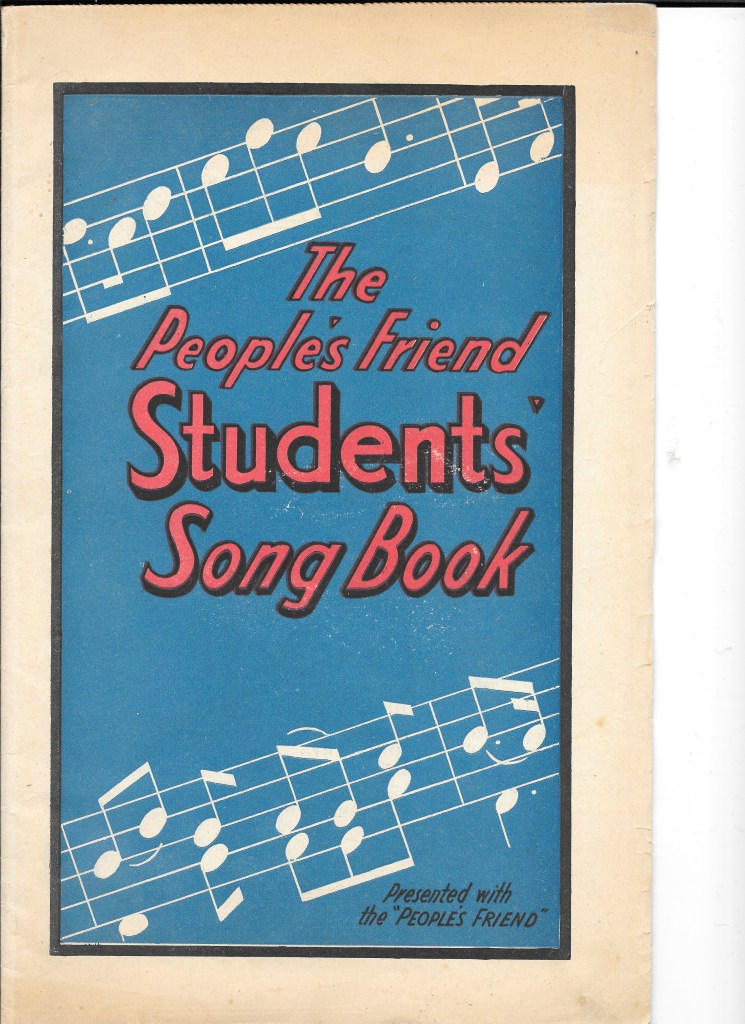
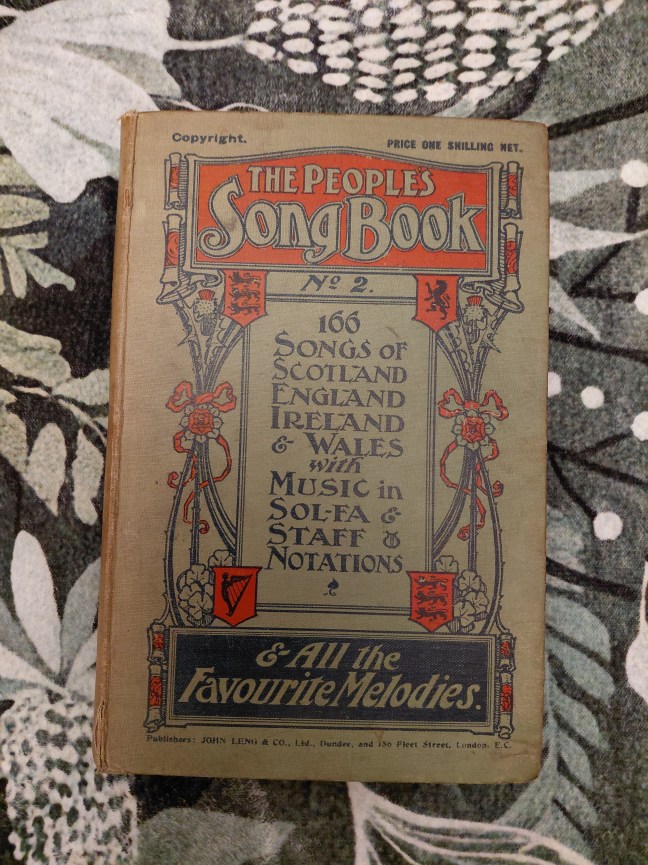
How to Catch a Song Book in the Wild

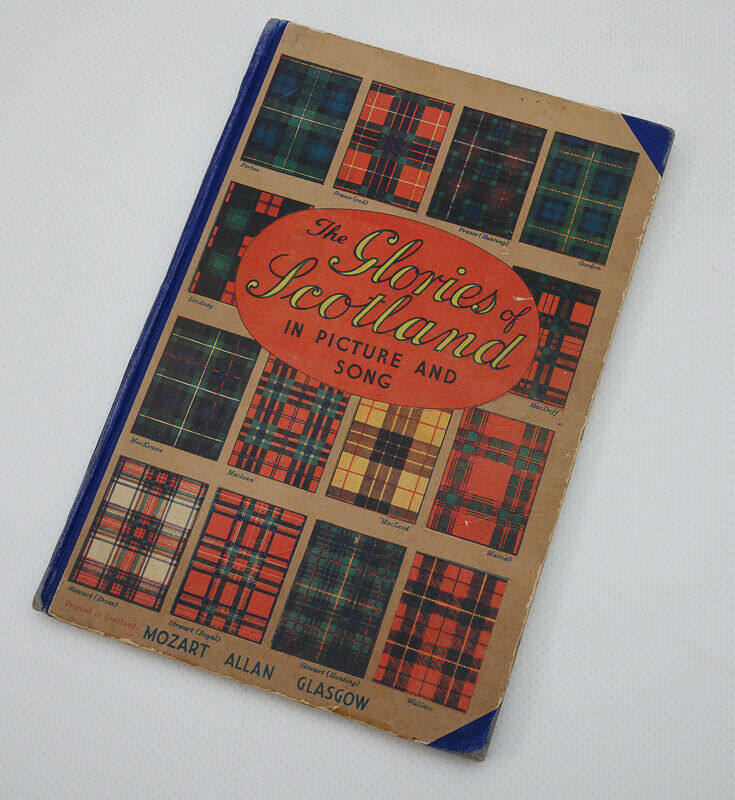
As regular readers will know, my IASH Fellowship concerns the history of the Nelson’s Scots Song Books.

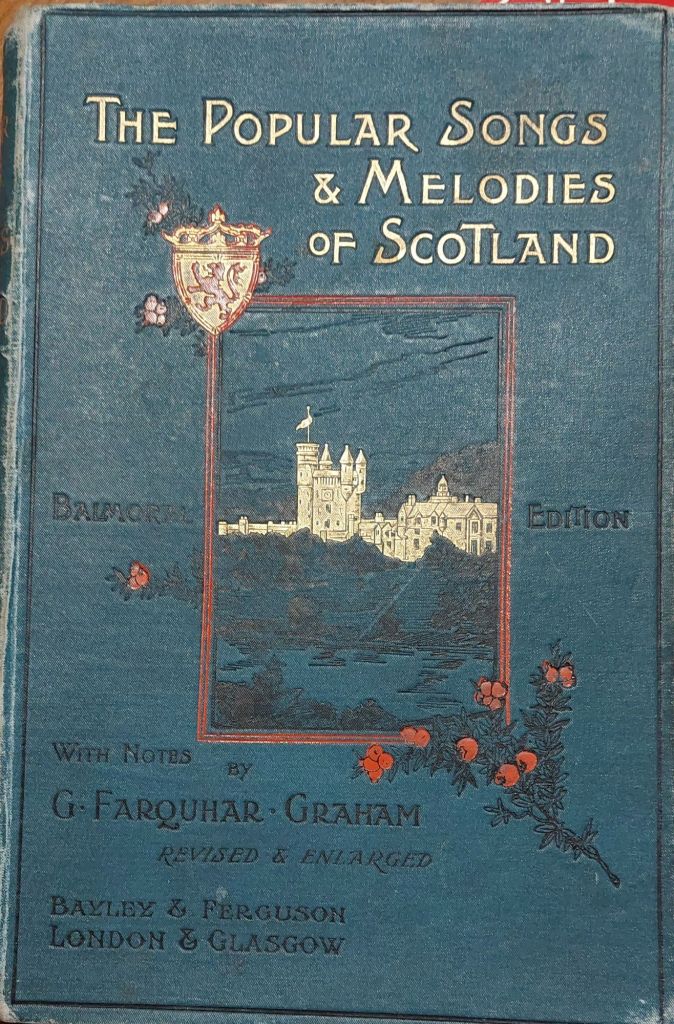
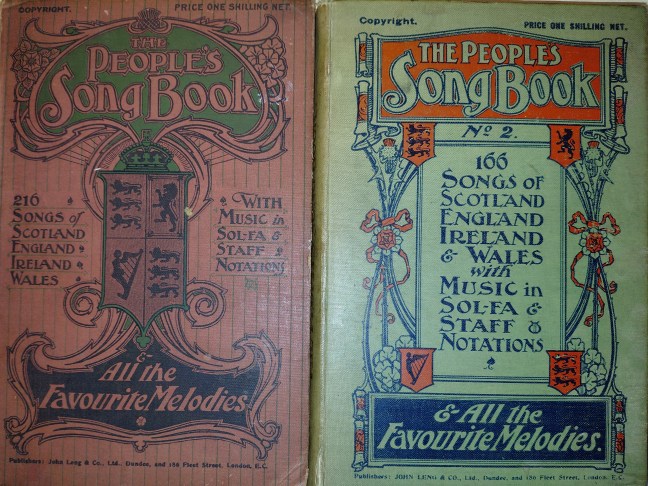
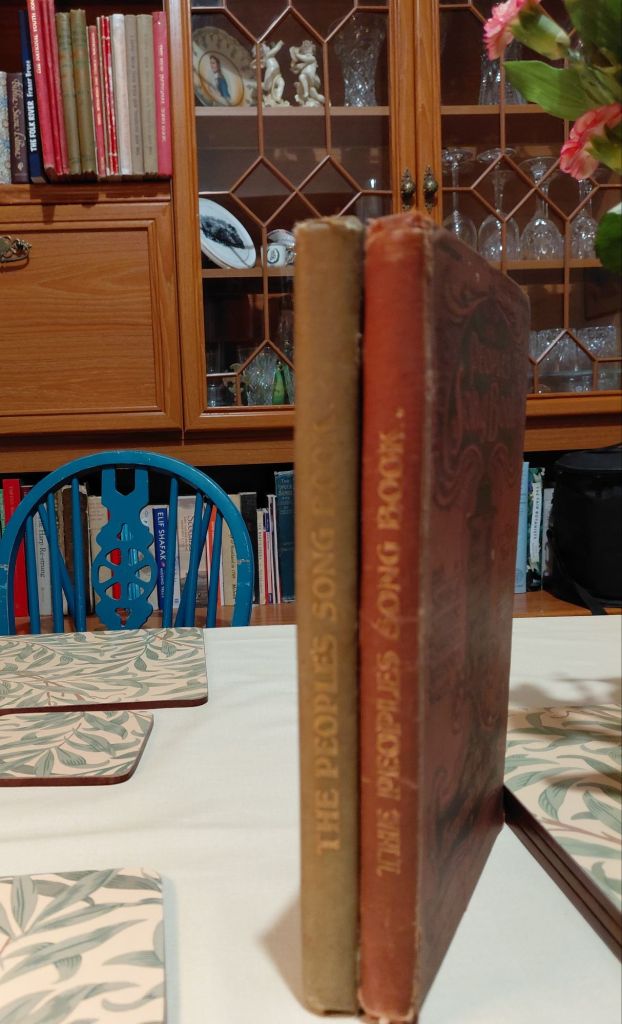
I’ve seen all four of the teacherโ€™s books in libraries; and possess one teacher’s edition of my own, plus one pupilโ€™s edition – not the same volume number.ย  And I’m going to some lengths to track down the other three of each edition.ย  I want to be able to show them when I talk about them, so I simply must keep looking.

Today, I headed to town, feeling as though I ought to be riding a pony and tootling a hunter’s horn, to the sound of La Chasse or the William Tell Overture.  (The heavens opened between subway and second-hand bookshop, somewhat spoiling my fantasy. Urghh!)

But hunting with a pack of hounds would have been no good at all, for you have to creep up on these rare beasts very, very softly. Pretend to be looking at something else, as you slowly extend your arm towards the shelf. And then, whilst it’s relaxed with its defences down, grasp it quickly and hold on tight.

Captured!

I examined it disbelievingly.  Yes! I now have the teacherโ€™s edition to go with my pupilโ€™s edition of Vol.2. (Actually, I also found some other useful material that wasn’t published by Thomas Nelson.)

And then I turned round.  On a table, if you please, there sat another Nelson music book that I’ve been reading about. Not a song book, but interesting just because it was published around the same time, by the same Nelson editors.  It was as though it was waiting for me to find it.

Did I celebrate with a coffee? Now, what do you think!

Sifting through Papers in the Archive

I know what I’m looking for: any mention of music-related publications from the erstwhile Edinburgh publisher, Thomas Nelson.  I found the important things I was hunting down, so now I’m just looking for contextual detail.

These were just a small part of Nelson’s output, of course.  So, my plan of action entails identifying likely boxes (or folders, or binders) and methodically going through them.  As I go, I encounter tantalising threads that I must not be distracted by: John Buchan copyrights, letters from Enid Blyton and Arthur Ransome, and glimpses of the editors’ daily  business.

Sweets that would have been less Sweet

Imagine the author’s distress at realising that glucose had been omitted from their confectionery recipe:-

Wanderlust

Meanwhile, it seems Dr Wilson was the only person who could deal with a ‘peppery’ author, but explaining how a travel anthology had gone missing in transit between Bude and Edinburgh would challenge his diplomacy to the utmost. (You have to appreciate the irony.)

Naming no Names

And I was unimpressed by the managing director who had certain issues with women authors. Admittedly, this was the 1930s, but … really, Sir!

Anyway, I’m heading to the University of Surrey/ RMA conference in Guildford today, so all my editors and their authors can rest in peace until next week!

I’m open to new inspiration!

Actors, Singers and Celebrity Cultures across the Centuries

(I blogged about this a few days ago.)

Concerts, Deportment … and Accessories

A strange coincidence occurred to me last week – I encountered conductor Landon Ronald in two quite different research contexts.

Firstly, I knew that soprano Flora Woodman appeared in at least a couple of concerts with Landon Ronald (1873-1938), Principal of the Guildhall School of Music. (Possibly more – but I was mainly focusing on her repertoire as I went through her logbook and scrapbooks.) However, I did note in her scrapbooks of press-cuttings, en passant, that she wished it to be clarified that she was not his protegee. Interesting – but there’s really nothing more to be said. If she wasn’t, she wasn’t.

Nonetheless, I had also encountered Landon Ronald in a different context last week. In 1936, Thomas Nelson published a book, Let’s Get up a Concert by Rodney Bennett (1890-1948, father of composer Richard Rodney Bennett) and H. S. Gordon, with a preface by Sir Landon Ronald and Illustrations by Joyce Dennys. Landon Ronald again! Nothing to do with Woodman this time. Indeed, it may not have a great deal to do with Landon Ronald either. I’ve found no evidence that he didn’t author the preface, but I do have evidence that someone else paid a ‘big name’ to put their signature to a preface for another book, in full knowledge that the ‘big name’ could be mentioned in book promotions and would undoubtedly add appeal and authority to the book. If Thomas Nelson allowed one author to do this, who’s to say they didn’t with others too?

Now aged 63, Ronald was still Principal of Guildhall, but he says he no longer promotes concerts. He alludes to his experience of ‘hundreds of orchestral concerts in the Summer Season on Sunday evenings at that most democratic of all holiday resorts, Blackpool’ (yes, Flora performed in Blackpool too) – ‘and an unbroken series of four hundred Sunday afternoon orchestral concerts at the Royal Albert Hall.’ (Plenty more about him on the CHARM website, which is the AHRC Research Centre for the History and Analysis of Recorded Music.)

But back to Bennett’s book. Part Two consists of practical advice to performers: dealing with nervousness, platform technique –

However much you desire to pop off like a frightened rabbit, don’t.

‘Walk like a Dancer’

The eager would-be concert performer is advised to ‘learn from professionals’ (p.135) especially from foreign artists, whom Bennett says are more accomplished in this regard – and about ‘pleasing the eye’ (p.136). You must ‘walk like a dancer’, and ‘support [the man in charge*] with unfaltering loyalty’, whilst pianists should appear to be a ‘natural, kind-hearted, happy human being’.

In fact, dated as it seems in some respects, there’s a lot of useful advice in this book. I can only commend the individual who presented it to Penarth County Girls’ School* Library in 1946. It would have been helpful at the time, and a lot of it still is. The illustrations are decidedly tongue-in-cheek, but on the plus side, they don’t patronise the intended audience – advice is always easier taken if the advice giver uses a touch of humour! The artist, Joyce Dennys (1893-1991) was a cartoonist and illustrator. The book perfectly fits into Thomas Nelson’s lists, with their emphasis on providing self-improvement, self-educational material for the intelligent layperson. You might be a teacher needing more guidance on laying on concerts, a nervous and somewhat inexperienced performer, or an organiser of any number of different kinds of musical entertainment, and this title would have plenty of accessible, useful advice.


Of course, platform etiquette would have been second nature to a superstar like Flora Woodman, who would probably have needed little advice after her first few performances.  (Neither, I imagine,  would she have liked the suggestion that foreign artistes had more stage presence! My gut feeling is that she had it by the bucketful.)  She was mixing with professionals of the highest calibre, in Britain’s best concert halls.

I’ve already posted details of some of her fabulous wardrobe, and it would become rather dull if I went on producing lists. But I noticed today how she liked to ring the changes with glamorous accessories. They wouldn’t be wise choices today, but hey, this was a century ago. So – I spotted white fox, ermine, beaver and swansdown, as well as velvet hats, black tulle, hydrangeas, lilacs, pink flowers, a wreath (garland?), and regular adornments of silver (silver what? she doesn’t say). Also, even within a couple of years, she updated her outfits, with ‘second editions’ of her black and white, and pink and pearl ensembles. (Once again, do use your imagination – I’ve given you plenty to work on!)

Meanwhile, excuse me whilst I browse through Rodney Bennett’s book a bit more …


*Yes, Bennett does talk about ‘the man in charge’. It was a different age – don’t shoot me!

*Penarth County Girls’ School is now Stanwell School, Penarth

Bringing Characters to Life

If I remember one comment from my doctoral viva, it was an observation about my writing.

You really bring the characters to life.

And I smiled inwardly, because for several years prior to that, I had published short stories and even a serial in a women’s magazine. I can write about people.

When it comes to research, though, the real people get so under my skin that I feel I almost know them personally.  Yesterday, I found a few letters where an assistant editor was trying to hurry things along before she left for a new job.  She explained this to her authors. Unusually, their replies were also there, so I looked eagerly for their well-wishing messages, or a word of thanks for her efforts – which had been considerable.

Nothing. Nada. Zilch.

I felt indignant on her behalf, but it was the 1950s. Maybe gentlemen didn’t thank lady assistant editors in those days?  I like to think there might have been a tea-party in the office, at least. I know for a fact that the ladies’ tea-breaks were affectionately referred to as ‘the tea-party’, so hopefully someone baked a cake or some scones for her last day!

Maybe?

It is sometimes, however, possible to read too much into a situation. I was surprised to catch an author suddenly writing ‘Dear Madam’ and ‘Yours faithfully’ to someone he’d been writing to for months. And yes, the recipient accordingly responded, ‘Dear Sir’.  I think it was a momentary blip. Maybe Sir’s secretary didn’t remember the recipient’s name.  Anyway, friendly terms resumed after that, so all was well!