Dr Karen McAulay explores the history of Scottish music collecting, publishing and national identity from the 18th to 20th centuries. Research Fellow at Royal Conservatoire of Scotland, author of two Routledge monographs.
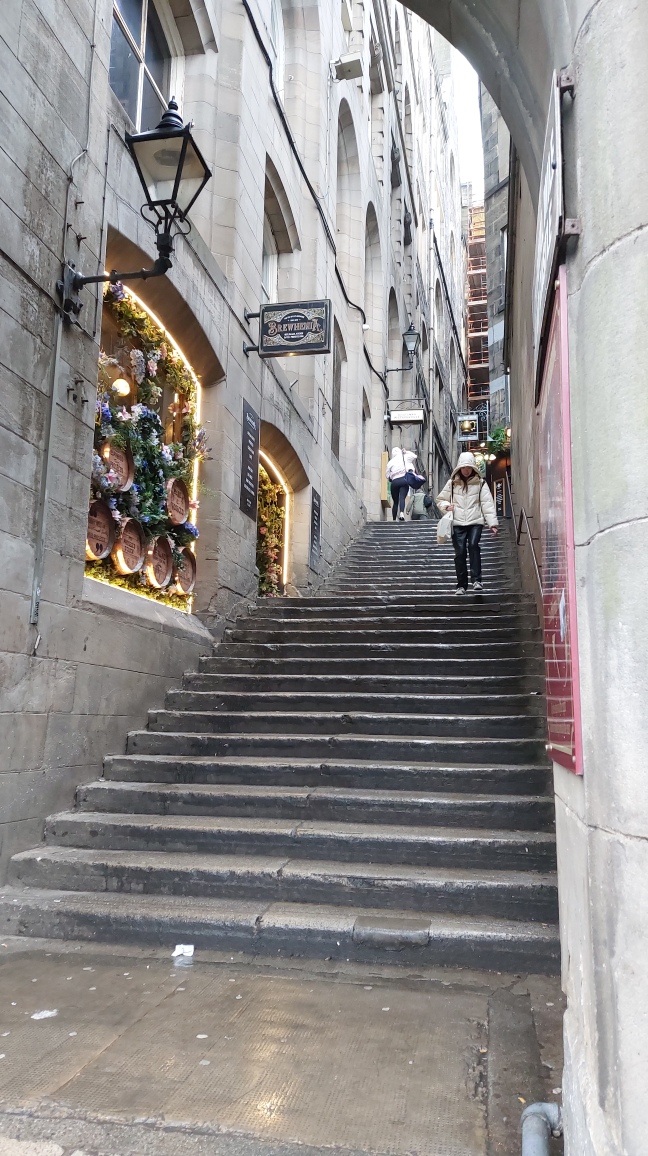
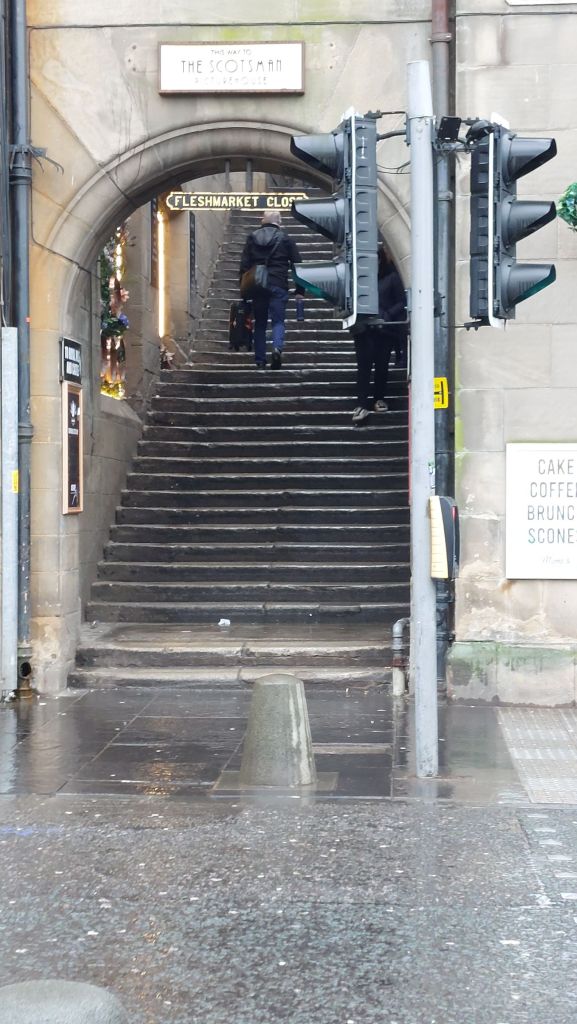
This is Fleshmarket Close in Edinburgh. It’s an absolute killer! I hadn’t ventured up those steps for some years – I swear they’ve got worse – and although my bags weren’t heavy, I was ready for a breather 1/3rd of the way up, and 2/3rd, not to mention at the top! Fitbit says I’ve put in my steps quotient, but annoyingly didn’t count how many flights of stairs I ascended, which is ironic.
But I was on a mission, and I did reward myself with a cuppa when I got to the University Library.
It’s good to go to a different place to study. (The library, I mean, not the cafe …) I think that in itself puts one in a frame of mind to come up with fresh ideas.
It was something of a scoping exercise. Now I need to sit and think about what I found, and its potential as a future research project. Tomorrow will doubtless see me writing away until I get my ideas in order.
I’ll leave you with a couple of publisher’s rejection letters – nothing to do with music or my research. I just stumbled across them, and smiled:-
Publisher to naive would-be authors:-
‘Dear Madam, […] For a book of merely 43 pages, 370 illustrations is excessive …’
Or this one:-
‘Thank you for offering a MSS on Cats and Reptiles. I regret that neither subject would be likely to suit our programme which is chiefly school and expository’.
I wonder if the author ever DID get their MS accepted somewhere?!
My research has been on hold whilst I recover from eye surgery. Firstly, a UK ‘fit note’ says you’re unfit to work (and research is work); and secondly, my good eye soon tells me if I’ve placed too many demands on it. It’s weird to look at a computer screen when one eye is compensating for the other one (that doesn’t fully focus and has an obstruction in the form of a black gas bubble).
So, no research reading, though I have bought a couple of books for later. But that doesn’t stop me thinking. I can’t help doing that.
The other evening, I started a very short list of potential research directions. I can’t proceed with any of them until (a) I am back at work, (b) I can get to various libraries and archives, and (c) I get the go-ahead to drive.
Each potential direction requires me to venture along the path to see what’s round the corner. Not just, whether there’s enough to research, but whether there might be an interested audience for it. For example, there are two Scottish women musicians I’d like to know more about – a Victorian and an Edwardian. One never was a big name, except in her locality. The other did enjoy fame, but she is virtually forgotten today.
Or, two Scottish music publishers with religious inclinations. Does anyone care today, apart from me? I’m interested in what exactly they published; and whether they ever interacted in any way. But is anyone else interested? (I had these hesitations about my mediaeval music research, decades ago. It was possibly one of the reasons it foundered.)
In any of these topics, I have to place the subjects into their social and cultural context, if I am to demonstrate relevance or significance in the grander scheme of things. My motivation is to examine what these individuals and firms’ music and activities tell us about the era in which they lived and worked.
But then there’s the question of impact. I don’t have to so much as open my laptop, let alone a book, to start worrying that I haven’t yet come up with a mind-blowing angle that will knock the world’s socks off! Moreover, there is no conceivable way I can make any of my research relate to climate change; saving the earth’s resources; social good or benefit to health.
And so I sit, blurrily gazing into the middle distance, reflecting! I have the go-ahead to return to work on Monday. Blurrily!
‘Audible’ books are great for someone who is trying to rest their eyes. But the problem starts when the book you want to read isn’t on Audible! Only being able to read a few pages at a time made reading this book a bit more of an endurance test than it needed to be. It wasn’t difficult reading in terms of comprehension – just a bit of an effort for my left eye without the assistance of the right one, which will take a few more weeks to catch up!
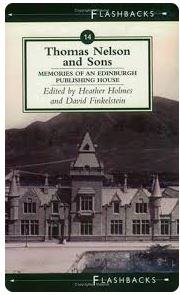
Thomas Nelson & Sons: Memories of an Edinburgh Publishing House, ed. Heather Holmes and David Finkelstein (East Linton: Tuckwell Press, 2001) ; Flashbacks series no.14 (Book cover shown above)
In the final pages of the book I’ve recently submitted to my publisher, I have referred to Thomas Nelson and Sons, the Edinburgh publisher. In connection with the research behind that book, I had acquired a copy of the paperback edited by Heather Holmes and David Finkelstein some months ago, but I didn’t read it at the time – because it was clearly not going to inform me about editorial decisions of the sort I was writing about. Nonetheless, I did want to read it at some stage, and I made a start last weekend.
Image from Wikimedia Commons
I learned a lot more about what it was like working in the print works, as recalled by four different individuals who were time-served printers – but I didn’t learn a huge amount more about publishing decisions in general, and there was nothing at all about publishing music. Nonetheless, it was useful; I’ve got a lot more background, and a few more facts and figures. Moreover, it was helpful to read about the demise of Thomas Nelson and Sons in the 1960s, the same decade that saw the decline of Scotland’s music publishing industry.
The ‘Flashbacks’ series is (or was) published by Tuckwell Press in association with SAPPHIRE (the Scottish Archive of Print and Publishing History Records) and The European Ethnological Research Centre. The latter sponsored the series, c/o the Royal Museums of Scotland. I think the National Museums of Scotland publishing page may be out of date, since it says there are six Flashbacks publications to date, yet the book I’ve just read is no.14, and was published in 2001. So far as I can make out, the series ended around 2004, and I think the SAPPHIRE oral history project ended about five years after that. (There are articles by Finkelstein, Sarah Bromage and Alistair McCleery dating from 2002 and 2009.)
As it happens, this was exactly the kind of book that I needed right now. Whilst I’m temporarily out of action, it’s useful to read around a subject without the pressure of needing to take notes. I can do the detailed scholarly work later!
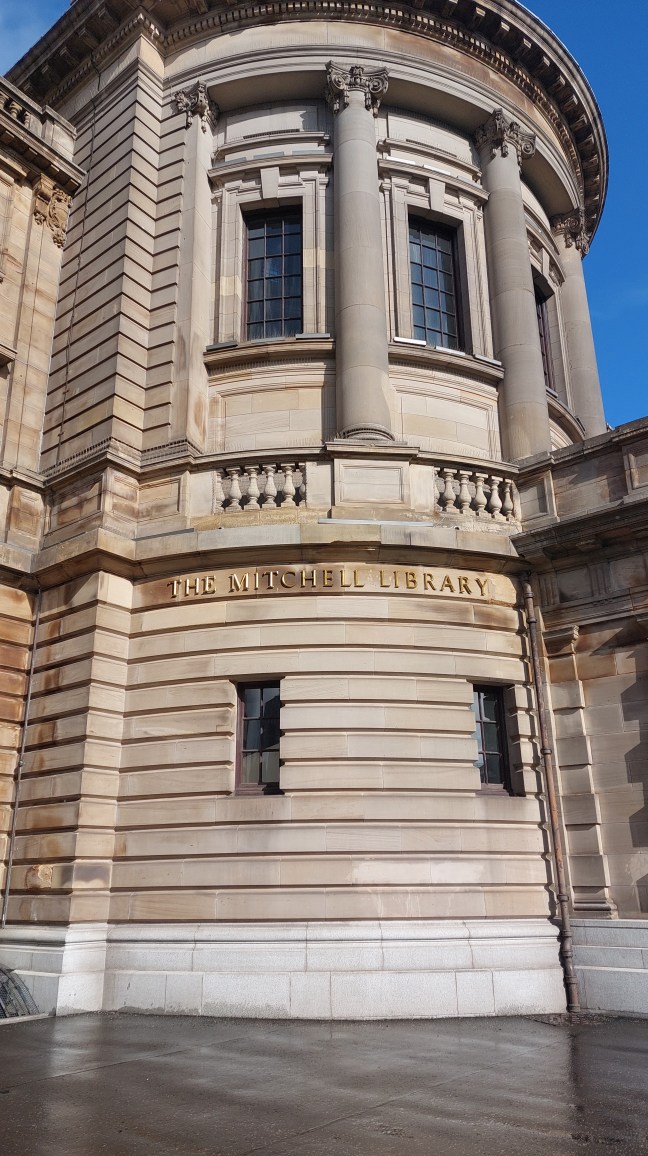
After diligently doing my organ practice this morning, I felt like an outing this afternoon. Only a librarian/musicologist would decide to go library-visiting! However, I knew that Paisley has a new, exciting public library building in the High Street, and I also wanted to find out about an old Paisley publication, so where else would I go? The image above is one I found on Renfrewshire Libraries’ website.
The new Paisley Central Library, wow. Was genuinely emotional to see what can be created when there is will and investment. A beautiful library at the heart of the High Street that will inspire generations to come. Inspiring, well done to the team there and @onerenculture 👏 pic.twitter.com/lAAb8Klwir
Sean McNamara’s enthusiastic tweet about the library, on 23 November 2023.
The library is bright and modern, on three floors. The ground floor has a large children’s section at the back of the floor, with places for parents and children to sit, and steps the children could go up and down – very cheerful and user-friendly.
There are also facilities for making a hot drink. Whatever next?! Very nice, but an unexpected surprise for an old-school librarian who last worked in a public library, erm, 36 years ago!
Plainly there wasn’t going to be anything of the kind I was looking for, on the ground floor. I headed up to the next floor, and the next. Places for computer use, an array of different seating arrangements, non-fiction …..
I asked, but I discovered that if I would find what I wanted anywhere in Paisley, then it was not here. I need to go the Heritage Centre (aka “the archives”), elsewhere in the city. That’s a trip for another day, since it’s not open at the weekend.
Parlane’s former offices in Paisley High Street. Book sculpture right above the top dormer window.
All was not lost. I also wanted to find out where Parlane’s offices had been. I knew that they, too, were in the High Street – and they were two doors away, in fact. They looked a bit sorry for themselves. I took a photo, but a string of twinkly lights (not illuminated by day) obscured a decent photo of the book sculpture at the top of the building.
Maybe I’ll find a better one online somewhere. Messrs Parlane might have been pleased to find a new library as their next-door-but-one neighbour, but I fear they would have been sad to see the High Street today. It wasn’t exactly bustling on a Saturday mid-afternoon.
Home I came, and spent several hours making lists of things I’d like to see at the Heritage Centre. (I hope they’re as welcoming as the website suggests, or they’ll find me a bit of a nuisance with my long list!!)
Soon, very soon, all will be revealed! It’s been quite a quiet year, as far as publications go. Very quiet. But I have had one article and two chapters waiting at their publishers, and this weekend will at least see the article published in History Scotland. Featured on the cover, too.
It occurred to me that many folk with a recently finished PhD or some other significant piece of research, must wonder whether to publish it as a book. Now my second monograph has moved to the revision stage, I thought I’d share a few thoughts on the process.
Everyone will arrive at this point with different prior experiences. In my case, I’ve written in a variety of formats and contexts. All writing experience is useful, even if you have to adopt different styles and protocols.
30+ short stories for The People’s Friend
Serial for The People’s Friend (short stories and serial both great experience in telling a story, building a character, and writing to be understood.)
Countless book reviews
Blogging
Magazine articles
Journal articles
20k word BA dissertation
60k word MA dissertation
100k word PhD dissertation, which became a
First monograph (= scholarly book)
So, here I am, revising the draft of my second monograph. And it’s different. It’s like swimming – eventually you take off your armbands, do a few lengths of the pool, and at some point, head for the sea. I can’t talk about writing a non-academic book, but I can certainly outline what’s likely to happen with a scholarly one.
You pitch your book idea to a suitable publisher. They’re likely to want chapter abstracts, a sample chapter, and an indication of the likely audience. Also some kind of literature review, proving the need for a book like yours to fill the gap.
Your pitch goes to peer reviewers. It may well take a while to get a response. They’re busy academics, after all.
They may suggest changes. Assuming the reviewers’ reports are generally favourable and recommend publication, you finally get a contract – and a deadline to finish writing the book.
Months pass. You get the book written and submitted – and then you wait. The full manuscript now gets reviewed, and eventually you receive the email you’ve been half-dreading. Changes may be suggested.
You respond to their reviews and indicate what you’re going to change. (Or perhaps, you will decide not to change something that you can defend just as it is!) With a second or subsequent book, these folk are the closest you’ll get to the kind of advice your tutors/doctoral supervisor offered – try to receive it gratefully and graciously, unless you really feel misunderstood!
You then wait for the go-ahead to make the agreed revisions, and agree a new deadline. It’s Scheduling Time! My calendar for the rest of 2023 is all mapped out.
I do know what will come next! The copy editor will be let loose on it. I’ll get to see and agree to the suggested edits, usually just small matters of style, or inconsistencies. Meanwhile, I will either have to produce an index, or pay an indexer.
A cover is agreed on. My book is part of a series, so there may not be much choice here.
The exciting part is when it’s just about ready to go to press; you are notified of the publication date, and can start planning that book launch.
And then – if it hasn’t happened already – someone utters the dreaded words,
I’ve just given myself a strict talking-to. On the face of it, I’ve published nothing of significance since January 2023. The shame of it! And me a 0.3 FTE researcher and all! But when I remind myself that by the end of December 2024, I shall hopefully have published another monograph, two book chapters and an article, it doesn’t look quite so bad. I really must stop comparing myself with full-time academics.
Women Composers
My last substantial article was actually written with my librarian hat on – maybe that’s not surprising, given that 0.7 of my role is as a librarian. I wrote about my work getting more music by women composers into RCS Library:-
Watch out for my forthcoming article in History Scotlandin December 2023. It’s about two Scottish women singers, one still famous (albeit not for her singing) and the other now forgotten. I’ve seen the proofs – it looks nice!
Historically Under-Represented Composers
Since writing the ‘Representation of Women Composers in the Whittaker Library’ article, I’ve continued adding music by historically under-represented composers to the library at RCS – it’ll be some kind of legacy to leave when I retire from the library in 38 weeks’ time! I want to know that if students are looking for this kind of repertoire, there will be plenty to choose from.
Climate Change – Vocal Repertoire
I’d also like to see more songs about the climate crisis, a topic that colleagues have already been working on in the wider library collection. If you’re reading this and know of published music suitable for young professional singers, do please get in touch. I’m also looking out for decent publications of songs about environmental issues for classroom use, to benefit our trainee teachers in the Conservatoire. If I can capitalise on the connections I’ve made through social media, to gather more information about this repertoire, then the collection can only benefit. I’m just looking for songs – 38 weeks isn’t long enough to glean more than that, and it’s not as though the library won’t get on capitally without me next year in any case!! No-one’s indispensible.
Like this …
The music has to be commercially published – we’re not trying to build an archive of unpublished material with all the copyright complexities concomitant with such output.
But not this …
My own Extinction Calypso was performed in Edinburgh this March at Chris Hutchings’ Choirs for Climate concert, but it’s precisely NOT the kind of thing to end up in a Conservatoire library – fun, but lightweight, unpublished, and certainly not to be preserved for posterity! It doesn’t make me any the less pleased with it, but I make no pretence of being anything other than a rather third-rate composer. So – please tell me about proper works by serious composers, but not the likes of this:-
When I retire from the library, I shall still go on being a researcher professionally at RCS. (No doubt I’ll also compose and sew pieces of nonsense in my retired-time!) But it’ll be summertime before that happy day. So for now, it’s on with the day-job, and the enjoyment of my Fellowship in St Andrews on Wednesdays and Thursdays! More about that research in due course.
Saturday frivolity, not research. But it does give a bit of insight into the fin-de-siecle publishing trade.
This came in a donation; we have the low voice version, but it was also available for high voice – that’s perfectly normal. Inside, there’s ukulele tab as well as the piano accompaniment, and instruction as to which notes you should tune the strings to. The publisher clearly thought he was onto a winner, and issued it in as many formats as he could think of. Just look! Oh, and he published it both sides of the Atlantic, for maximum exposure.
Just a trivial song, but it must have been a hit – in my family there are still memories of it being sung!
The publisher travelled extensively, actually dying off the coast of South Africa on his final trip. Whether all these trips were for business or pleasure (or both), we’ll never know!
Image by Bob, Pixabay
The library received our second-hand copy of a music book today. It came from the USA, having first been sold in Johannesburg. There is something magical about a book, itself aimed at the Scottish diaspora, having been published in Glasgow and then spending time in TWO of the continents visited by its publisher, before returning to Glasgow today.
I know that, technically, it makes no difference to the contents. Of course it doesn’t. But I’d be lying if I didn’t say I’m over the moon with this particular book’s life-history!