Dr Karen McAulay explores the history of Scottish music collecting, publishing and national identity from the 18th to 20th centuries. Research Fellow at Royal Conservatoire of Scotland, author of two Routledge monographs.
This afternoon, I gave a talk about my archival research, to the Friends of Edinburgh University Library – where I received the strongest indication that people love talking about their memories of school music lessons!
I had great fun introducing the long-forgotten editors at Thomas Nelson – including a lady who went on to work at the University Library after finishing her PhD – and, of course, the people who compiled the Scots Song Books. (They wanted to compile a fifth – I bet you didn’t know that! But Nelson’s didn’t …)
Main picture – tulips outside the University Library
As I’ve mentioned, I’m currently Heritage Collections Research Fellow at IASH, the Institute for Advanced Studies in the Humanities, at the University of Edinburgh. All guest fellows are invited to give a work-in-progress seminar, and it’s my turn on Wednesday 26 March at 1 pm. You can attend in person, or online – more details on the link below. The abstract tells you what my talk is about.
I’ll explain what I’m looking for, and introduce you to some of the individuals I’ve been finding out about. The one thing I can’t predict, is whether I shall by then have found the answer to my prime question!
Probably the most eventful year I’ve ever reported, 2024 saw plenty of action. However, I’d like to add a few words of explanation before I go any further. Firstly, everyone’s different and everyone’s circumstances are different. (You know the old saying about how you have to ‘walk a mile in someone’s shoes’ before you understand their experiences and challenges?) I’ve spent far too long on introspection, measuring myself unfavourably against high-achievers. It gets you nowhere, apart from feeling inadequate. You will know what is possible in your own situation; please don’t feel I’ve set myself up as an example. I’ve done it my way.
If you’re on the tenure track hamster wheel elsewhere in the world, you may read this and wonder at how little I’ve achieved. On the other hand, if you’re not employed as an academic, you might be surprised at how much. If you’re fully retired, you may think I’ve lost my marbles, but if you’re semi-retired, you might understand! Similarly, everyone’s personal circumstances at home are different too.
For full disclosure, my research career has been what you’d now call alt-ac (alternative academic); I have had 10½ paid hours a week on research for over a decade, but my main career has been in music librarianship. (I’ve never been a full-time academic, and my outputs were achieved in less than one third of my working week.) As you’ll see, I recently gave a keynote about being ‘alt-ac’, and I’d certainly be open to further bookings of this kind, if your institution or network was interested. (I’m in the UK.)
Highlights
I had successful eye surgery in February.
I retired from librarianship at the end of June.
I was promoted to part-time postdoctoral research fellow in July (10½ hours a week).
I’ve had the opportunity to do some teaching cover.
My second monograph was published. (It has a 2025 imprint, but actually came out in autumn 2024.)
I was elected a Fellow of IAML (UK & Ireland) in the spring, and of the Royal Conservatoire of Scotland in November.
I was keynote speaker for the ECRN Alt-Ac Showcase at the University of Birmingham.
I successfully applied for a research fellowship at IASH (the Institute for Advanced Study in the Humanities) at the University of Edinburgh, which I shall be taking up between January and June 2025.
I received the Mervyn Heard Award from the Magic Lantern Society in December, for research into Bayley and Ferguson’s service of song publications.
Four fellowships of various kinds is quite an impressive number, however you look at it, so I must remind myself of this before I start beating myself up about my relatively modest upward progress!
Publications
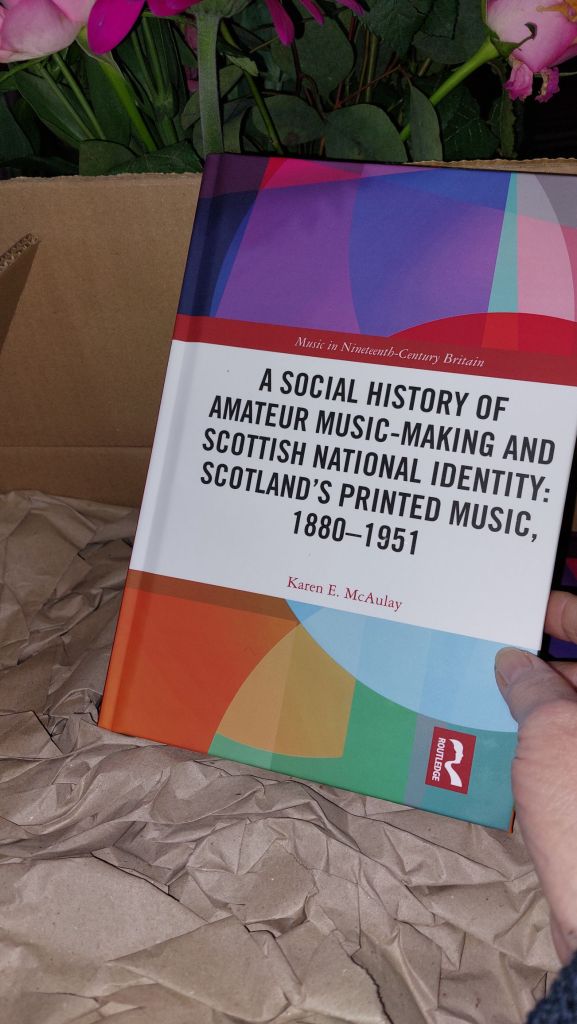
A Social History of Amateur Music-Making and Scottish National Identity: Scotland’s Printed Music, 1880-1951 (Routledge, 2025)
Book Review: Gun Sireadh, Gun Irraidh: The Tolmie Collection (Folk Music Journal Vol.12 no.5, pp.127-9; my review of a new edition of the Tolmie Collection, a significant Gaelic song anthology, here re-edited by Kenna Campbell and Ainsley Hamill)
[Article withdrawn due to pressures of time, but published on this blog: ‘The Exhilaration and Exasperation of Hybridity: Third-Space Professionalism in the Library’]
2 accepted chapters pending publication.
2 articles recently submitted, pending peer review. [February 2025 update: one got through peer review, has been revised, edited and I’ve approved the proofs. The other got through peer review and now awaits the revisions. Nonetheless, satisfactory progress!]
Speaker
Exchange Talk, Royal Conservatoire of Scotland, Jan 2024, ‘From Magic Lantern to Microphone: the Scottish Music Publishers & Pedagogues inspiring Hearts & Minds through Song’
NAG (National Acquisitions Group) Talk, April 2024, ‘Redressing the Balance: Getting Historically Under-Represented Composers and Contemporary Environmental Concerns into Library Stock’
Print Networks, conference held at University of Newcastle, July 2024, ‘‘Music for All’: the Rise and Fall of Scottish Music Publishing, 1880-1964’
Exchange Talk, Royal Conservatoire of Scotland, Nov 2024, ‘The Glory of Scotland’ (it’s the title of a Scottish song book published for the 1951 Festival of Britain)
Keynote for ECRN Alt-Ac Showcase at the University of Birmingham, Nov 2024, ‘My Alt-Ac Life’
Other Activities
BBC Scotland: ‘Good Morning Scotland’ interview
Book launch
Fellowships of IAML(UK) and RCS
Mervyn Peak Award, Magic Lantern Society
New job title: Post Doctoral Research Fellow
Peer reviews for AHRC and a scholarly journal
Providing teaching cover
Successful application: Heritage Collections Research Fellowship, IASH (Institute for Advanced Studies in the Humanities at the University of Edinburgh), for Jan-June 2025.
Edinburgh University Library from The Meadows (Wikipedia image)
Forward Planning
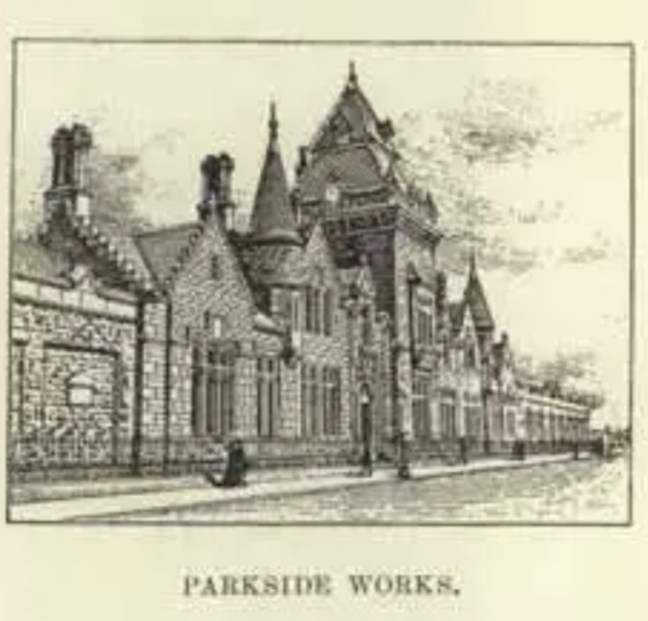
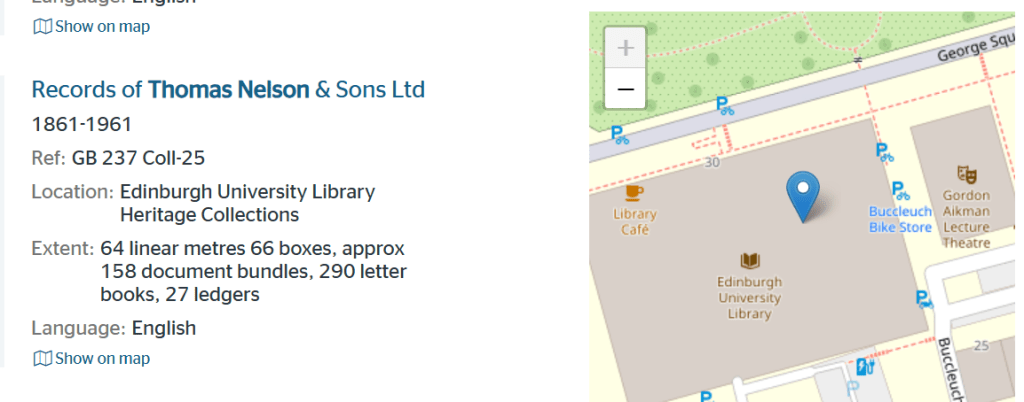
My IASH Fellowship will allow me the opportunity to explore the former Edinburgh publisher, Thomas Nelson’s archives, to find out more about their publishing in the music field. There wasn’t a great amount, but I aim to explore correspondence and find out how it fits into the wider range of their activities. I’ll be spending more of my time on research than I ever have since 1982!
Meanwhile, I’ve been working on an article for a history publication; I want to get that finished in the near future, so that I can turn my attention to another article on a different topic. What I do after that will probably depend on how the IASH Fellowship research goes, and what interesting possibilities reveal themselves to me. There’s bound to be enough for an article. But could I expand it to something book-length? I’ll have to wait and see!
I thought folk might be interested to see a quick summary – NOT the whole talk – of the keynote I gave at the University of Birmingham yesterday. ‘Alt-Ac’ is Alternative Academia, or Alternative Academic. You’ll see what I mean …
A first for me, today: I was the keynote speaker for an Early Career Research Network event jointly organised with CALt-Ac at the University of Birmingham. That’s the College of Arts and Law’s network for people with ‘alternative academic’ roles, rather like mine when I was in the library 3.5 days a week, and seconded to research for 1.5. Not a full-time academic, in other words.
Yes, yes, you’re correct in pointing out that I’m not exactly ‘early-career’ myself! I was invited to share my own ‘Alt-Ac’ story, since it transpires that I have actually been an Alt-Ac since before the term was devised.
Everyone was very kind and appreciative; it’s been a lovely day. I heard interesting and informative contributions, and chatted to a number of people. There was a mix of subject-related presentations, and others which, as I did, shared their own way of making the alt-ac existence work for them.
The ‘Queen of Alt-Ac’ (not my words) declares herself happy (if abashed by the epithet), and is now being conveyed back to Glasgow in her carriage, Avanti West Coast.
My next post will share a summary of my talk. Are you ready …?!
This blog post is an edited excerpt from the research Exchange Talk I gave at the Royal Conservatoire of Scotland on 11 November 2024.
Inside the song-book, The Glories of Scotland, the foreword was followed by a full-page signed photo of a popular Scottish singer and comedian, Alec Finlay. The University of Glasgow’s Scottish Theatre Archive, characterises the latter as, ‘The pocket Harry Lauder’, and ‘Scotland’s gentleman’, describing his comedy as, ‘delightful, couthie and kindly’.
His was an international variety act; significantly, he toured America in late 1950.
If he was known as the ‘pocket Harry Lauder’, it was for a logical reason: a colleague of mine pointed out that Finlay, who clearly modelled his act on the variety superstar, Harry Lauder, even went so far as dressing like him, ‘wiggly stick’ and all.
Harry Lauder, from Wikiwand.com
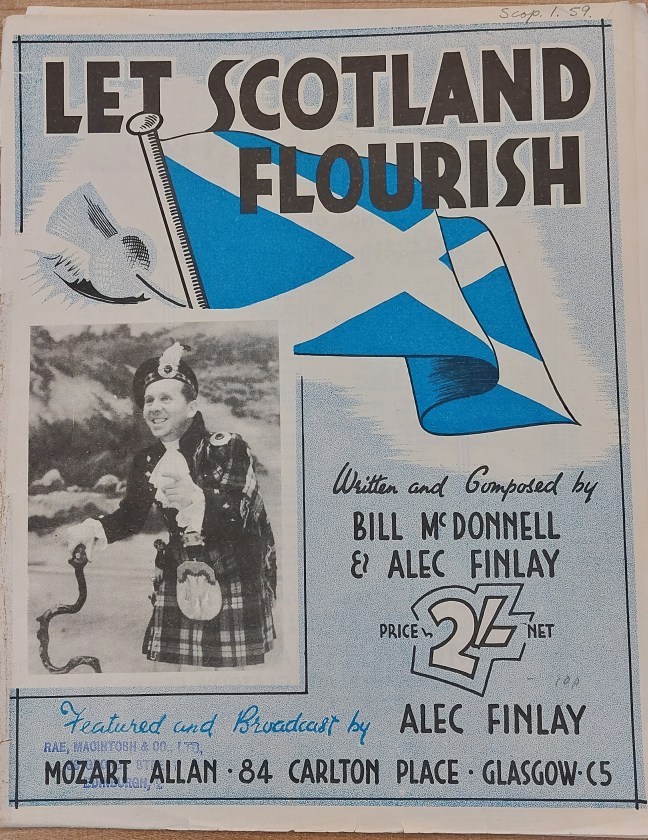
A song is linked to the signed photograph of Alec Finlay at the front of the book. The photo is captioned ‘Scotland’s own comedian’, with Finlay in typical pose, full Highland dress, wiggly stick, and a blurred Scottish vista behind him. Beneath the photo, and alongside his signature, is the name of a song, ‘Let Scotland flourish’, composed and sung by Alec Finlay.
Sure enough, opposite a picture of Edinburgh’s Princes Street supplied by the Scottish Tourist Board, page 71 bears the words of the chorus – not the music, just the lyrics!:-
‘Let Scotland flourish / In all the years to be / The land that I was born in / Will aye be dear to me / Caledonia I adore you / Tho’ I travel the wide world o’er / My home is where my heart lies / Scotland ever more.’
It’s there, ‘by kind permission of Alec Finlay’, and it was written and composed by Bill McDonnell and Alec Finlay. At the foot of the page, we read that the ‘complete words, music and Solfa are available for 2/- from all music-sellers.’ It was published by Mozart Allan – who also published The Glories of Scotland. The British cover appears at the top of this blog post. (There was another for the overseas edition. )
‘Let Scotland flourish’ is a typical Scottish waltz of the era. Finlay was a hit in America in 1950; and selling the song as a single piece of music would make commercial sense.
In the recording of the song, published by Scottish Clan Records in New York, Finlay sings in the broad Scottish brogue that contemporary American listeners would have expected to hear.
A quick post to mark a successful and very enjoyable evening. I gave my research exchange talk tonight at RCS. It was about a book of Scottish songs almost certainly published for the Festival of Britain in 1951. I talked about history, book history, music history, Scottish tourism and that all important catch-phrase for the Festival of Britain – ‘A Tonic for the Nation’. And then there was my book launch afterwards.
RCS wasn’t on Renfrew Street in 1951. We were the Royal Scottish Academy of Music at that point, in the old Athenaeum building (Nelson Mandela Place), but we had established a drama department in 1950 – the Glasgow College of Dramatic Art. (More about our history – click here.)
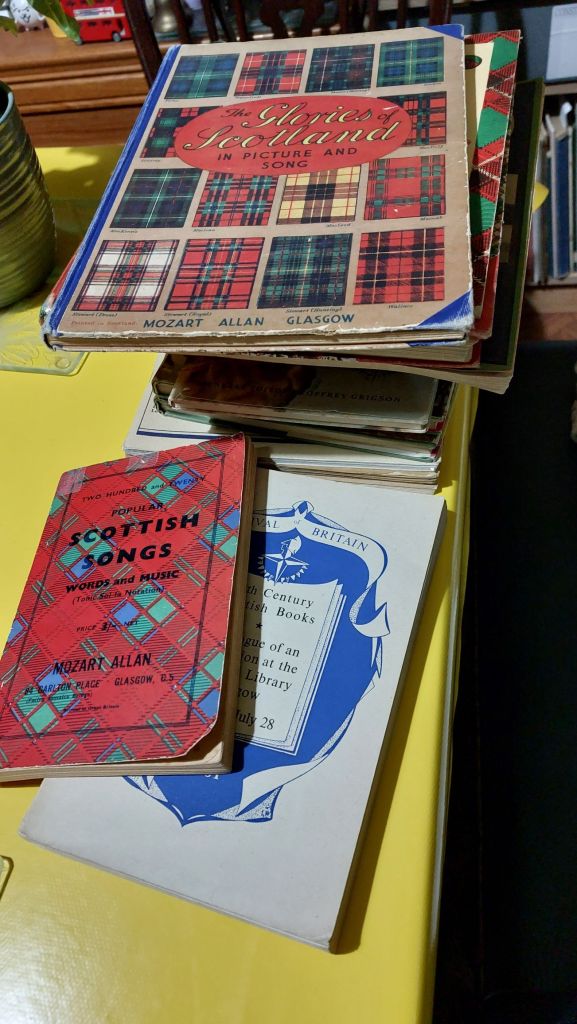
It’s fair to say that the book I talked about tonight – The Glories of Scotland, published by local publisher Mozart Allan – would not have been required repertoire for the talented students passing through our doors in 1951. It wasn’t aimed at high-performing classical artistes. (I doubt the library even had a copy in 1951, but there’s no way of finding out now. Anyway, we have recently acquired it!)
Nonetheless, the songbook does have a place in Glasgow’s history, in its own unique way.
Books relaxing after a night out!
After the exchange talk, we launched my book about amateur music making, Scottish national identity and Scottish music publishing. Professor Stephen Broad introduced it, and said some very kind words about it. There were friends and colleagues there whom I hadn’t seen for a while, so it was very sociable as well as celebratory.
Book launch: my ‘few words’ in response
My thanks go to everyone who contributed to make the evening so successful – Research Exchange colleagues, Library former colleagues, and the box office events team. I’m ‘dead chuffed’, as they say.
On Monday 11th November at 6 pm, I’m giving a talk in the well-established and popular RCS Exchange Talk series, where scholars talk about their latest research. I’ll be talking about a song book compiled for the Festival of Britain:-
The Glories of Scotland in Picture and Song: compiling a book with the 1951 Festival of Britain in mind
At 7 pm we’ll have the launch of my new book, in the library. No online booking for the book launch, but if you’re hoping to attend, please do let me know, so we have an idea of numbers.
You can attend both, or either event.
McAulay, Karen E., A Social History of Amateur Music-Making and Scottish National Identity: Scotland’s Printed Music, 1880-1951 (Routledge, October 2024) 🎶
For a number of years, I’ve given an annual talk to RCS students, about how different generations looked upon, collated and collected and published Scottish songs and tunes. The snappy, official title is ‘Transformations’, but when I was revising it for this year’s presentation, I decided to compile a list of all the people (and a few extra titles) that I would be mentioning. Forty of them! So, I’ve added a new, unofficial subtitle: Speed-Dating 40 Scottish Music Collectors in an Hour. Okay, not exacty forty people, but forty lines in the list. I was quite surprised. I would imagine the individuals themselves might have raised an eyebrow, too.
It was the last time I’d give a lecture as a Performing Arts Librarian. Admittedly, not the last time I hope to give a lecture as a researcher, but certainly the final one with a library hat on! The librarian accordingly played a tiny bit of Beethoven’s Johnnie Cope from memory, along with a few chords from Marjory Kennedy-Fraser’s Sleeps the Noon in the Deep Blue Sky (score open), and blithely announced that she saw no need to inflict her rendition of Debussy’s La Cathedrale Engloutie upon her audience for comparison.
More than anything, the lecture epitomises me as a hybrid. I’m a librarian – I acquire and curate these resources. As a scholar, I contextualise them into cultural history. It wouldn’t be the same talk if I occupied only one of these roles.
The subject of my forthcoming monograph – amateur music making and Scottish national identity – only actually got a brief mention. But it was there. Maybe I’ll need to do a more extensive revision at some point!
I’ve just given a webinar for the National Acquisitions Group, ‘Getting Historically Under-Represented Composers and Contemporary Environmental Concerns into Library Stock’.
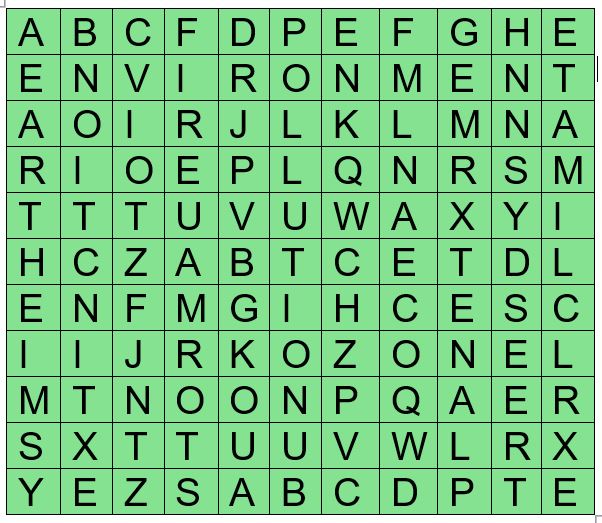
Earlier today, I took a dislike to one of my slides. It was where I was talking about finding musical compositions on the subject of the climate crisis, and it suddenly dawned on me that a wordsearch slide would be far better than what I had intended. So, I made a ‘wordsearch’, on the spot. It was my first, and I made it very quickly – don’t judge me! Stupidly, I didn’t count how many words I’d hidden. I found twelve related to climate change in some way. But later on, my sister found far more, if you include more general words. Have a go …










 Karen McAulay, Musicologist