Dr Karen McAulay explores the history of Scottish music collecting, publishing and national identity from the 18th to 20th centuries. Research Fellow at Royal Conservatoire of Scotland, author of two Routledge monographs.
At Tuesday’s Women who Dared book launch, mention was made of the Wikipedia ‘Women in Red’ project, to which I once attempted to contribute. It’s a valuable project; there’s no denying far too few women are represented in Wikipedia.
I got nowhere with my own attempt, as I was the only person who had researched and written about ‘my’ Elizabeth Lambert (married name Williams), so I couldn’t provide the requisite references by respectable authors. She wasn’t ‘daring’, but she definitely made a worthwhile contribution to St Andrews University Library, in cataloguing their legal deposit music so borrowers knew what was available to borrow. (Her other private interests were interesting, too. She was an acknowledged expert in conchology.) I’m pleased to see she at least has a Wikidata entry now! Anyway, thwarted in my Wikipedia ambitions, I posted a biography on the present blog.
You might also find my article about St Andrews’ Copyright Collection of interest. Again, Miss Lambert gets several honorable mentions. And I found another posting that I’d forgotten all about, this time in 2021 for a University of Stirling research project. I might as well share details of these pieces, to get her a bit more exposure!
‘A Music Library for St Andrews: use of the University’s Copyright Music Collections, 1801-1849’, in Journal of the Edinburgh Bibliographical Society no.15 (2020), 13-33.
I’ve written quite a bit about women in musical history, so I’m adding something to the top of this post every couple of days during Women’s History Month – mostly flashbacks to women musicians I’ve researched, but some other discoveries too. (I’ve been shifting things around to a more chronological order, but I’ve always added the new bit first!) You’ll find more musicians than composers in this posting, just because of my own recent research.
Sometimes I look at the history of women musicians from the point of view of good library provision for our readers, whilst at other times my own research interests are foremost. It just depends on the day of the week, because I currently occupy two roles in the Royal Conservatoire of Scotland. For 3.5 days a week, I’m a librarian. For 1.5, a postdoctoral researcher.
15. The Ketelbey Fellowship
It’s a whole year since I learned that I had been awarded the first Ketelbey postdoctoral research fellowship at the University of St Andrews. Scholar Doris Ketelbey was a significant figure in the history of the department. I felt highly honoured to have been the first Ketelbey Fellow from September to December 2023.
14. Representation of Women Composers in the Library
I couldn’t resist adding the open access article I published about my EDI activity in our own Whittaker Library:-
It’s a privilege to shape a library collection, so I’m pleased to have just ordered and catalogued several relevant books this month.
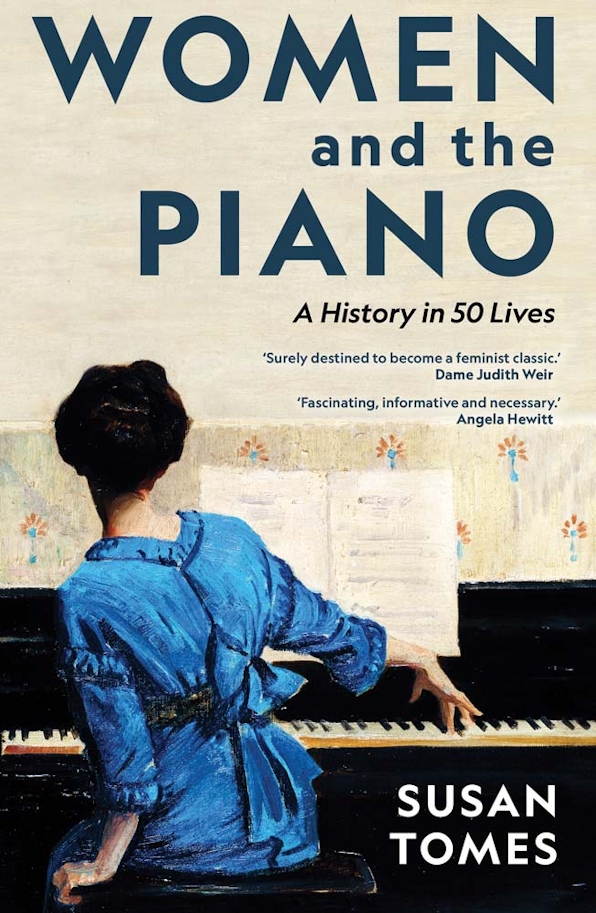
Susan Tomes, Women and the Piano: a History in 50 Lives (Yale University Press, 2024) Read more about it on the publisher’s website, here. In actual fact, it’s the fourth title by this author that we now have in stock. So if readers like this, they might like the earlier three, too!
Margaret C. Watson, Women in Academia : Achieving our Potential. (Market Harborough : Troubadour, 2024). Not a book about women in history, but very much for women in the present day!
Gillian Dooley, She played and sang: Jane Austen and Music (Manchester University Press, 2024). Back to history again.
Women and Music in Ireland / ed. Jennifer O’Connor-Madsen; Laura Watson & Ita Beausang (Boydell Press, 2022)
Moreover, there’s a new Routledge book coming out this summer – I have ordered it for the Whittaker Library. Of course, I may have retired from the Library by the time it arrives. This just means I won’t need to catalogue it! I’ll still be a part-time researcher, so I’ll be able to read it:-
It’s some years now, since a single-minded schoolgirl decided action was necessary. In 2015, Jessy McCabe noticed that Edexel had no women composers in the A-Level Music syllabus, and successfully petitioned to rectify this, via Change.org. I found out about her impressive initiative when I was beginning to start serious work on building up our library collection to include more music – contemporary and historical – by women and people of colour.
Jessy is now a Special Needs teacher. I’m sure she’ll go far.
11. Forgotten Women Composers
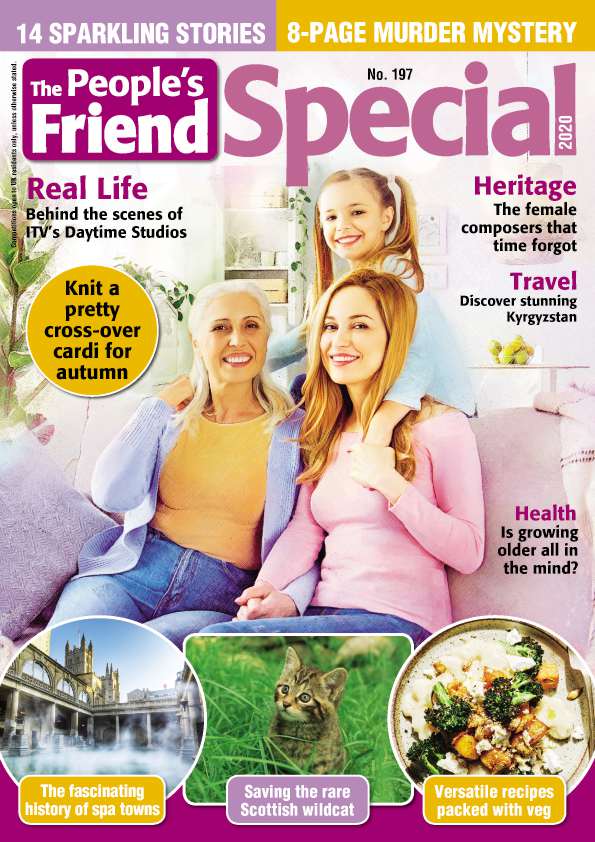
Part of academia entails sharing research outcomes beyond the ‘ivory walls’. It’s called public engagement, and that’s the opportunity I seized when my old friend The People’s Friend magazine commissioned me to write a feature back in 2020.
The sound of forgotten music: Karen McAulay uncovers some of the great female composers who have been lost from history’, in The People’s Friend, Special Edition, 11 Sep 2020, 2 p. (Dundee : D C Thomson). I blogged about it at the time (here).
10. Late Victorian Women Musicians
Since my more recent research has focused on the late Victorian era and the first part of the twentieth century, you’ll not be surprised to find that I found some interesting Scottish women musicians of that era! They are forgotten today – but I’ve done my bit to raise their profiles!
Newsletter article, ‘‘Our Heroine is Dead’: Miss Margaret Wallace Thomson, Paisley Organist (1853-1896)’, The Glasgow Diapason, March 2023, 10-15. (You can find this article in full on this blog)
‘An Extensive Musical Library’: Mrs Clarinda Webster, LRAM, Brio vol.59 no.1 (2022), 29-42 (a late Victorian head teacher who founded a music school in Aberdeen, and later did a national survey of music in public libraries – which she presented to the Library Association!)
In October 2023, I pondered about Mr *and Mrs* J. Spencer Curwen (amongst others) in another blog post, when I remarked upon early twentieth century attitudes to folk song.
9. In Praise of Music Cataloguers! Introducing Miss Elizabeth Lambert
Before I started the Claimed From Stationers’ Hall music copyright network, I had spent some months researching the wonderful late 18th and early 19th century music copyright collection at the University of St Andrews. A key resource was the handwritten catalogue in two notebooks, largely compiled by Miss Elizabeth Lambert (later to become Mrs Williams, when she married and moved to London.)
I just love the fact that this earnest young woman (I’m going out on a limb here, but I’m pretty sure she must have been earnest!) created a useful resource which would help everyone get maximum use out of the music repertoire that other libraries were less than impressed by. So we had Elizabeth cataloguing the collection, and numerous men and women, friends of the professors, making use of it. I blogged about her, and eventually wrote an article for the Edinburgh Bibliographical Society, mentioning her again.
‘A Music Library for St Andrews: use of the University’s Copyright Music Collections, 1801-1849’, in Journal of the Edinburgh Bibliographical Society no.15 (2020), 13-33.
The library’s copyright collection of music was a boon for middling class women like headmistress Mrs Bertram, her teacher daughters and their pupils. It does lead one to wonder if they had a harp at the school. I checked their borrowing records for more evidence. They certainly borrowed several volumes which included harp music.
7. Students but not at University? Educating Young Women
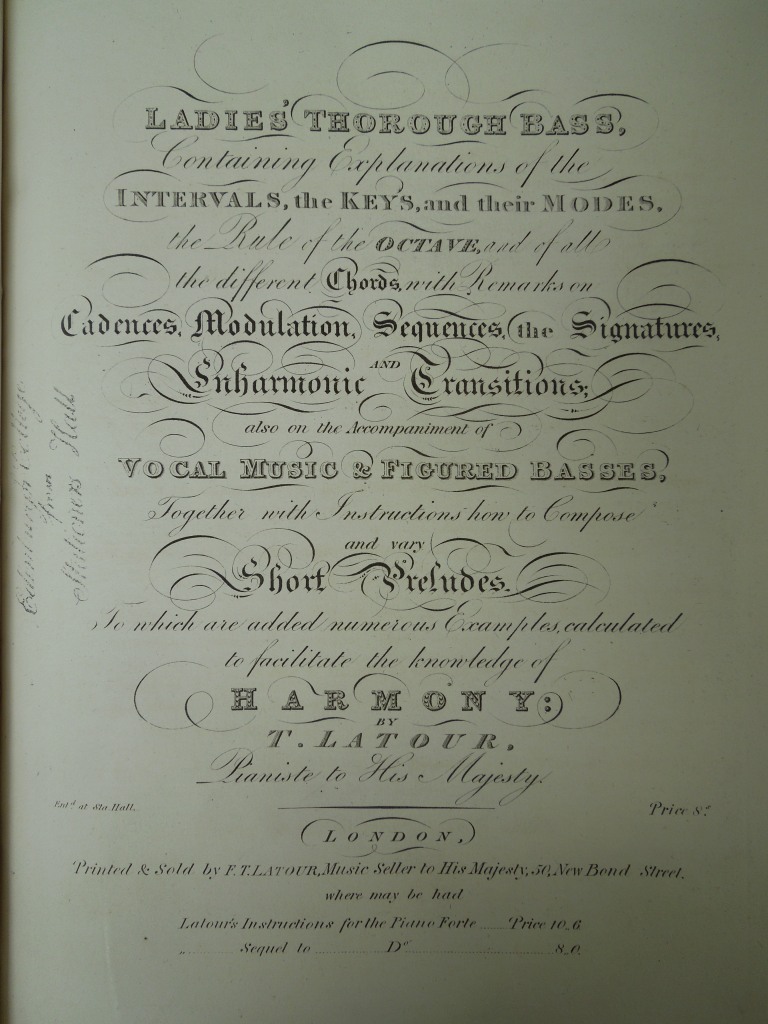
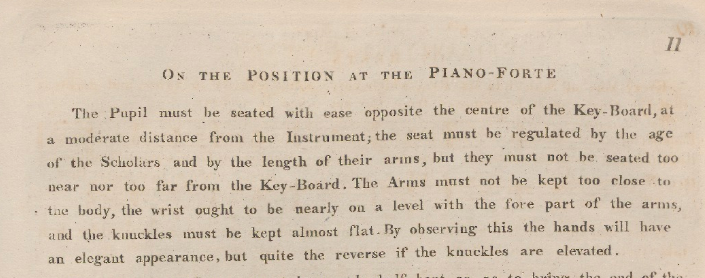
It’s time to turn to piano teacher Mr T. Latour. I’d like to refer you to my June 2018 blog post about women in St Andrews using pedagogical musical material in the early 19th century. Possibly the self-same young ladies attending, or having attended Mrs Bertram’s school?! The illustration features a young woman – probably just approaching or about marriagable age – at an upright piano. The abundant floral arrangement atop the piano (quite apart from sending shivers down the housekeeper’s spine every time the young pianist played too enthusiastically) suggests a well-to-do household. Following Latour’s instructions, the pianist has elegantly flat hands …..
T. Latour – Ladies’ Thorough Bass
Latour advises on the seating position, and how to hold ones hands elegantly
6. Not my work – but very timely for WHM 2024]
I’m not posting anything relating to my work today, but I saw mention of a great new article by Dominic Bridge the other day, so I thought I’d share details here. It’s a fascinating read. The Journal for Eighteenth-Century Studies is part of the Wiley Online Library:-
Back in 2018 when I was awarded the AHRC networking grant for the Claimed from Stationers Hall network, I drew up a list of women composers from the Georgian era. There were more than one might have expected – perhaps they only composed a handful of pieces, in many cases, but nonetheless – they composed. You can find the list on a separate page on this blog, here. And you can read more about it in the blogpost I wrote in July 2018,
This lady ran a girls’ school at St Leonard’s in St Andrews. This was NOT the famous and long-established private school that has long stood there, but an earlier enterprise. And Mrs Bertram and her daughters subsequently moved to Edinburgh, to the disappointment of parents of daughters in St Andrews!
The photo portrays a Mrs Bertram of Edinburgh. Chronologically, she could well be ‘our’ Mrs Bertram, and a scholarly bent is suggested by the pile of books at her hand.
2. The Accomplished Ladies of Torloisk
I almost forgot about the musical Maclean-Clephane ladies of Torloisk, which is a stately home on the island of Mull. But how could I forget about them, considering I published a lengthy article about them some years ago?! Luckily, a book of letters by Sir Walter Scott crossed my library desk, and even though it didn’t contain those particular letters, this did remind me of his musical friends in Torloisk!
Karen E. McAulay, ‘The Accomplished Ladies of Torloisk‘, International Review of the Aesthetics and Sociology of Music, Vol. 44, No. 1 (June 2013), 57-78
Today, I’d like to introduce a woman composer who predates most of the individuals I’ve encountered. Professor James Porter applies his considerable intellect to produce this in-depth article:-
‘An English Composer and Her Opera: Harriet Wainewright’s Comàla (1792)’, Journal of Musicological Research Feb, 2021. Published online: 16 Feb 2021.
I’ve linked to this on my Publications page as a permanent record, but if you’re interested, you can see my talk on YouTube now:-
Engagement activity: RCS Exchange Talk, Monday 29 January 2024: ‘From Magic Lantern to Microphone: the Scottish Music Publishers and Pedagogues inspiring Hearts and Minds through Song’ – YouTube recording
Being a Fellow has been a sheer delight. I’ve met a lot of interesting people; heard interesting research papers; given a public paper (in the Laidlaw Music Centre) and a research paper for the Institute of Scottish Historical Research (ISHR); and availed myself of the invaluable resources of the University Library. As a result, I’ve been able to explore a couple of specific aspects of my research topic – resulting in facts and findings that I’ve incorporated into my book revisions.
Desk cleared …
I said I would get on with monograph revisions, and I have done so – I’ve written a new Preface, and revised the Introduction and first four chapters. There are three more to go, but I’ve broken the back of it, because Chapters 2, 3 and 4 are the longest ones.
Those are tangible outputs. But for me personally, the Fellowship has also been an opportunity to embrace my research scholar identity a bit more, before I retire from the Whittaker Library in July 2024 and become solely a (part-time) researcher. The experience has in that sense given me a powerful sense of endorsement: that another insitution has embraced me as a scholar, and given me a chance to enjoy that status. For that I am very grateful indeed.
Farewell to St Katharine’s Lodge
Here for the final day, I’ve nipped into the Martyr’s Kirk Research Library to look at a couple more old classroom music texts. (I had a little argument with myself about the dates of a few titles advertised on the back of one particular text, but finally concluded that the date of a preface inside a book doesn’t mean that everything advertised on the back outside cover was available at that date. The copy in my hand could, after all, have been printed several years after the text itself came out, and the adverts might well have reflected the later date when the copy was printed, not the date when the text was published.)
I was looking for Scottish song texts, whether ‘folk songs’ or fin-de-siecle songs written for educational purposes. I must confess, I expected to find more than there actually were in these two sources. Still, with glee, I pounced upon ‘My heart’s in the Highlands’.
Too soon. The compiler had set it to … a tune by Mozart! (Very curious, considering the patriotic attitudes of that particular compiler! Why ever did they think that was a good idea?)
I met a colleague and one of their friends for lunch, to discuss a research idea.
And (besides taking my library books back), I started a preliminary check of Chapter 4 of my book, which has grown a little during its revisions.
Wednesday. Glasgow to St Andrews, to do book revisions, and a lecture for the University’s Institute of Scottish Historical Research. (It was about the impact pedagogical and technological innovations had on Scottish music publishers.)
Thursday night. St Andrews to Dundee (expedient – it was the only way to get back in time for work on Friday!)
Sleeperz, where I could not sleep …
Friday morning. Dundee to Glasgow, for a day’s librarianship. One particular query took a couple of hours, but I was told that my reply would make the enquirer very happy … really, that’s all that matters.
New desk lamp – extension cable sorted!
Saturday. Glasgow to Dundee and back for the Friends of Wighton 20th Anniversary celebrations. I attended the speeches and morning concert …
20th Anniversary of the Wighton Centre Sheena Wellington opens Proceedings The Provost of DundeeHarpsichordist Mark Spalding in front of Andrew Wighton’s music booksPurcell’s “Scotch” tune!This is Gaelic singer Wilma MacdougallThis is Sally Garden, the Wighton Musician in Residence a few years ago.
I’m the Honorary Librarian, and my role was to show off Wighton’s books, in the afternoon. Although few visitors required my services, I had some very enjoyable conversations about the books, so it was a pleasant day.
It’s always fun to spot little comments made on the music by Wighton himself, and today I also found one of the books had belonged to an original subscriber. I wonder if she played the tunes when she got the book? In a chapter I wrote a couple of years ago, I found the number of women subscribers compared to men, went up as time went by. There’s a Miss Scrimgeour on the database compiled for that book, but Mrs Scrimgeour doesn’t appear there. Have I somehow found a new subscriber, or was she just mistranscribed at some point?!
Mrs Scrymgeour’s copy, 1796
Googlemaps will again be reporting record travel mileage this month! But I have awarded myself the rest of the weekend off. (Honestly, have I only walked 8466 steps today? I’m surprised!)
Well, the talk seems to have gone well, and again, I found a very responsive audience. After being taken out for a delicious dinner, I headed for Dundee, which was the only way I was going to be at work on time in the morning.
Hotel room obligingly had low lighting and glass topped table, illuminating Wee Davie!
Another time, I need to clarify, for anyone not familiar with Tonic Sol-Fa, that it was devised for singers, not instrumentalists.
If you played an instrument, you learned off standard staff notation or by ear – with or without an instructor. In late Victorian times, after the 1870 and 1872 Education Acts, it stands to reason that more children would have learnt sight-singing by Sol-Fa, than learnt an instrument. Children whose parents could pay, might have had private instrumental lessons. Some might have had opportunities to join a band, learn from someone known to them, or pick up a fiddle (for example), but I still maintain that the majority of children were more likely to have encountered Sol-Fa.
As to social mobility … I’m not entirely sure whether it was easier or harder to fight your way up the ladder in those days. I’d need to ask a social historian of that era. I can only comment on the few instances that I’ve observed: ‘my’ music publishers certainly seemed to do well for themselves.
So, here I sit on a train back to Glasgow. Like Cinderella, my carriage will change back to a pumpkin, and my garb back to rags, if I’m not a librarian behind my desk by nine o’clock!
The bus got delayed in traffic today. (Significantly so. My journey was 4.75 hours from door to door!) This did reduce the time I had for book revisions, but I still managed a productive afternoon. I’ve revised the Introduction and created a Preface.
I had already done more work on my literature review, so I worked through the reviewer’s suggestions until I was pretty sure I’d addressed them all. I start with their suggestions and my responses. Once dealt with, each point is ticked off, and digitally ‘crossed out.’
So far, so good. Just a small matter of giving all the chapters the same treatment. I’ll get there eventually.
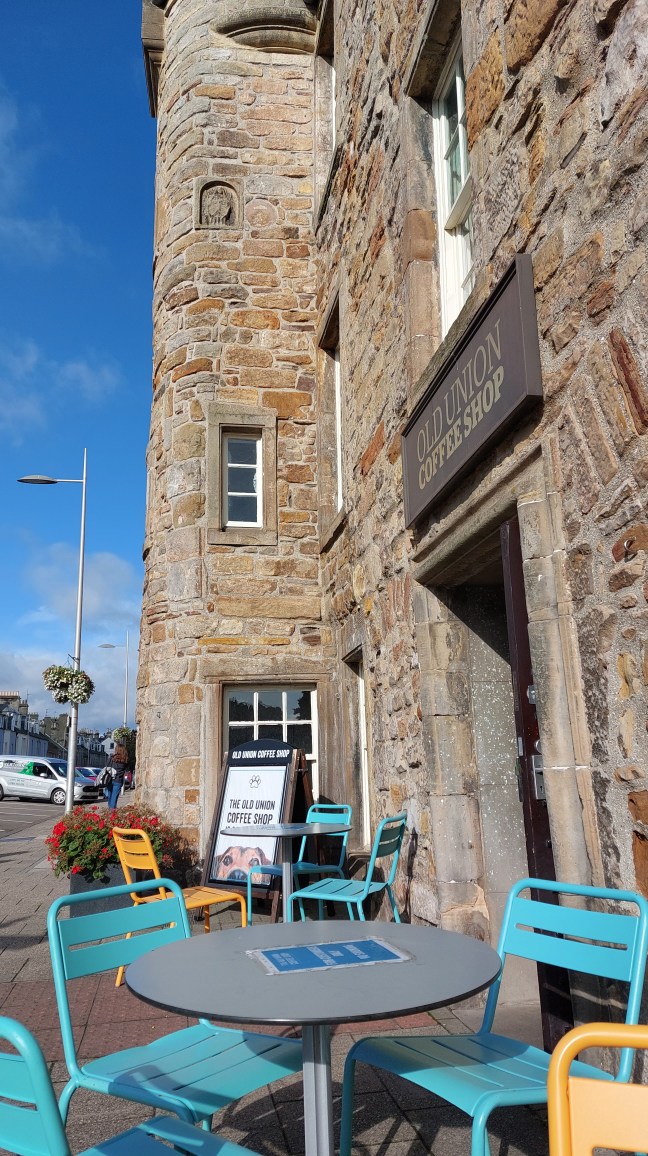
And because a mild, damp morning turned into a mild, dry afternoon, I even managed a walk by the sea. What could be nicer? (I didn’t quite get onto the sand, but next time, if I’m in trainers! …. )
Late lunchtime in St AndrewsUpstairs & downstairs flats with outside stairs
I would still have preferred a couple more hours’ sleep yesterday morning, but I sat down to revise my paper in the afternoon, and found my early morning brain had done me a favour: moving a couple of chunks of text didn’t involve much rewriting, and I think it makes a more interesting narrative.
My weekend working pattern is a bit disjointed – anyone running a household will understand – but that’s just my reality. Revise a bit of writing – start cooking dinner – a bit more revision. And so on. I tell myself that my subconscious mind is still working on it. (So, when I was carving the roast …? No, I don’t believe it was working at all!)
How to Slow Down Speaking Pace?
I also timed my paper. I think I must still read a bit too fast, though, although I do try to pace it. I don’t gabble. Maybe I should try again tonight, as slowly as I can manage. How do other folk get themselves to slow down? Any special strategies, tips or hints?
Here are suggestions from friends and colleagues. I’ve been practising with the first two already:-
Count one for a comma, two for a full stop, and three for a paragraph
Mark the script with where to breathe
Imagine you’re speaking to people for whom the language you’re speaking isn’t their first language.
I woke early again this morning, but thankfully my wakeful brain wasn’t in editorial mode today…
This is the third week of my Ketelbey Fellowship, and I arrived at St Andrews in pouring rain yesterday morning. Fortunately, it had subsided to a drizzle by the time I made my way to Martyrs Kirk, where materials from the Library special collections can be consulted. I didn’t get wet enough to risk dripping onto rare Victorian pamphlets! (I only know they were Victorian by the fact that the earlier numbers included God Save the Queen rather than the King – so they were published before January 1901.)
I had a ball! They each began with an editorial introduction – I love these. They’re so informative about the thinking behind whatever is in the book. Intriguingly, the editor seemed not to be the prime contributor, but all was revealed when I did some Googling later. Good old Baptie (Musical Scotland) informed me that the editor had two middle names, and used them as a nom de plume. No mystery after all! Moreover, one particular collaborator, more involved than most, was …
His daughter.
I didn’t quite get through the pile I’d called up, but I’m making good progress. And I encountered some interesting glimpses into social and political history. What’s more, if ever I needed proof that little girls’ education had a subtle difference to that of little boys, I found it today. It shouldn’t come as a surprise – I know it happened. But I wasn’t expecting to find this in a Sol-Fa song book!
It is such a luxury to have a desk in an office just a couple of minutes from a big university library. This morning, I snatched a quick coffee before I went back for another session with more of these instruction books. What’s more, I feel more a dedicated researcher here, compared to being ‘the librarian that also does research’ in Glasgow. It’s easier to focus, somehow. And tonight, I’m going to a research seminar, so I’ll get to meet some more historians then. Good times.









 Karen McAulay, Musicologist