Countdowns!

You know the story of the shoemaker and the elves? He goes to bed, exhausted, and wakes to find the little elves have done all his outstanding work? Oh, I wish!

Technically, my book is meant to be finished by the end of July. I’ve written quite a bit of the last chapter, but it goes without saying that that’s not the end of the process!

  • Writing the conclusion;
  • Tidying the introduction;
  • Checking the whole thing – for content, and also against the style guide;
  • Converting footnotes to endnotes;
  • Sorting the bibliography…

I’m also handling the comms for an international congress – it begins on 31 July.

Of course, there’s also the day-job to be done! And domesticated things don’t just stop. Garden hedges grow regardless of everything. Aargh!

And I have a whole magazine issue to proofread ASAP. (This task was accepted on my behalf – literally nothing to do with me!)

Daily Countdown

Now, the book deadline has been engraved on my brain for a long time. I’ve also known the congress date quite a long time. But believe it or not, it’s only just dawned on me that both dates coincide, and that therefore 38 days’ countdown for one thing would be 38 days for the other. Strange how the realisation suddenly makes it all the more stressful! All I can do is keep doing what I can. A colleague asked me the other day, what were my plans for this summer … ?

‘Finish a book’, I whispered. One way or another!

Alas, I don’t feel indomitable today. More like, a bit hopeless, faced with the mountain in front of me.
35 years in one post

I omitted to note that this week is my 35 year anniversary of being in the same library post at RCS. Having said that, I have …

  • Had 3 children (minimum maternity leave each time) and seen them grow up.
  • Done a self-funded PhD in my spare time; also gained Fellowship of CILIP and Advance HE. Nearly forgot – I did a PGCert too. My commitment to CPD is, I suggest, exemplary!
  • Published a book;
  • Written a number of articles and papers etc;
  • Nearly finished the second book;
  • Am looking forward to a part-time visiting fellowship in my part-time research secondment.

I just haven’t managed a promotion 😕. Still, apart from that big fail (a single, male former colleague once said that anyone who didn’t move on and up was not a success), at least I have some other successes to my name!

Has anyone said that to you? How did you respond?

GLAM – that’s me

Just an aside. I didn’t finish my first attempt at a PhD. Opting for a career in librarianship (yes, I know, maybe I should have been braver in my scholarly aspirations), I got taken over by professional training, and couldn’t fit in the completion of a thesis simultaneously. As anyone who knows me will already know, I returned to doctoral studies more than two decades later, but continued working in music librarianship. Part of my time has been seconded to postdoctoral research since 2012.

However, librarianship isn’t the trendiest metier in which to work. We get sick of comments about ‘enjoying a quiet life’, or ‘all that time reading books’, or disparaging remarks about library rules and regulations.

Enter “GLAM”. It stands for the Galleries, Libraries, Archives and Museums sector. Suddenly I feel much better about combining librarianship and musicology, because I can officially call myself, the GLAM musicologist.

Saturday dawned, and a research question was bothering me …

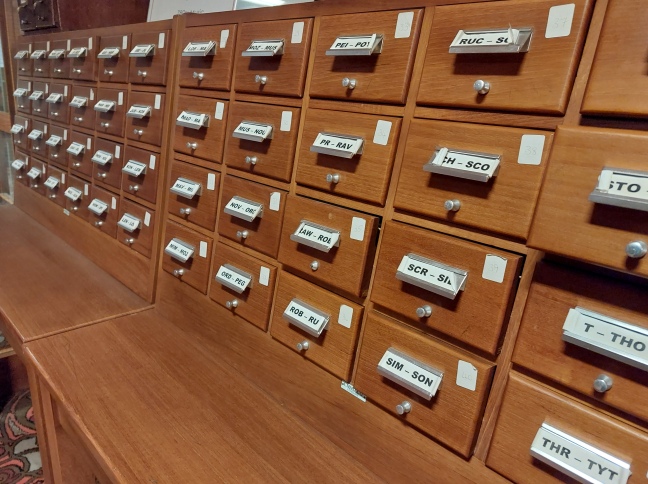
Old music card catalogue at Mitchell Library, Glasgow

So I decided to spend the afternoon at the Mitchell Library. Glasgow is so fortunate to have this wonderful collection!

I saw the two publications I had in mind. I took notes. I even had time to look at the card catalogue. (Catalogues are great research tools, even though I am personally sick of actually cataloguing.)

And then I went home. It was only when I went over my notes that I realised I had missed at least one item in the bibliography of one book, which I thought I had been looking out for. I spent the next 24 hours kicking myself, determined to go back to find that elusive reference if it killed me.

And then my librarian self remembered the advice I often give students. If you have copied out a useful snippet, put it into Google Books, in speech marks. Like this:-

“Reader, I married him”

(Try for yourself – it’s a quote from Charlotte Bronte.)

Often enough, Google Books will retrieve 2-3 lines including the words you copied, telling you the book where it found the text – and the page number.

I searched on the book abbreviation for the missing reference, and found I’d missed three! However, I have now traced them, and all is well. All for research into a publisher who only caught my interest two weeks ago.

Audio at a Future Date

A lot of vinyl records (image from Pixabay)

I’ve taken a couple of days’ leave whilst we’re having work done at home. I’m far too distracted by the banging and crashing around me to be able to sit and write scholarly thoughts. I just can’t!

‘Satan finds work for idle hands to do’ (Proverbs 16:27-29)

However, it appears I can quite easily go shopping on eBay. For some weeks, I’ve covetously watched a handful of old 78-rpm recordings, the sensible voice in one ear drowning out the sentimental voice in the other. The latter is whispering,

‘Look! He conducted that. You can listen to him actually conducting something he arranged! How cool would that be?’

Inner voice

That’s not the voice of a sensible, frugal scholar! Reader, I resisted the sentimental voice. I was being firm, resolute, and admirably sensible until a glorious thought occurred to me: when I’ve finished my book, publication will also entail a book-launch of some kind. And I’m sure to want to give talks about some aspect of the book topic. These records aren’t just artefacts – they’re multimedia soundfiles! Oh yes, indeed. How dreadful it would be, for my future self to remember the records that slipped through my fingers through misguided sensibility?

You also have to understand that my previous research was into an era when there were no sound recordings of any kind. So my present investigations into music between 1880 and 1950 mean stepping into the era when one could listen to recordings (gasp!), view projected slides and even access broadcast media. All very, very exciting at the time.

Broken Record

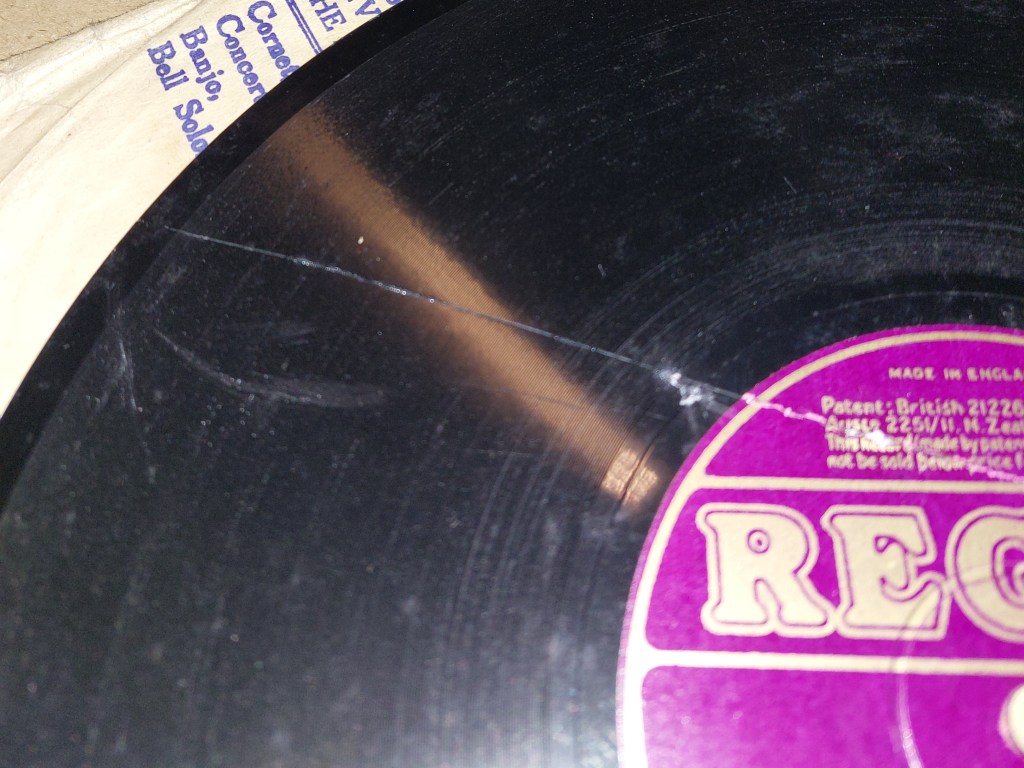
I did do a bit of bargaining, having resolved that I couldn’t have them unless I negotiated the price below a certain figure. The last shellac record I bought arrived in bits, so I hope that if these are travelling as a threesome, they might be a bit more robust – safety in numbers.

And I’m afraid I succumbed to a small music publication, too. (What am I going to do with all these scores when the book is written and they revert to being cheap, forgotten old titles again?!)

Update

Having invested in my own personal domain, I thought I’d better make sure my bio was up-to-date. And then I remembered that my list of publications needed to be there too, so that became another page.

When I was contemplating a mid-career PhD way back in 2003, my then line-manager attended a meeting, and mentioned my intentions. An unnamed academic (luckily, I don’t know who!) thereupon enquired,

“What would a librarian want with a PhD?”

Anon

They didn’t know I was fulfilling an interrupted ambition of some twenty years earlier! (See my bio page.) But if the anonymous scholar saw my list of publications today, I like to think they’d agree I’ve made good use of the PhD …

I went on to get a postgrad Teaching in Higher Education certificate after that!

My Own Domain!

Quick update – you can now find this blog at KarenMcAulayMusicologist.blog. No adverts, and an easier hyperlink to remember. After all this excitement, I’ll go and put the kettle on. (We musicologists know how to enjoy ourselves!)

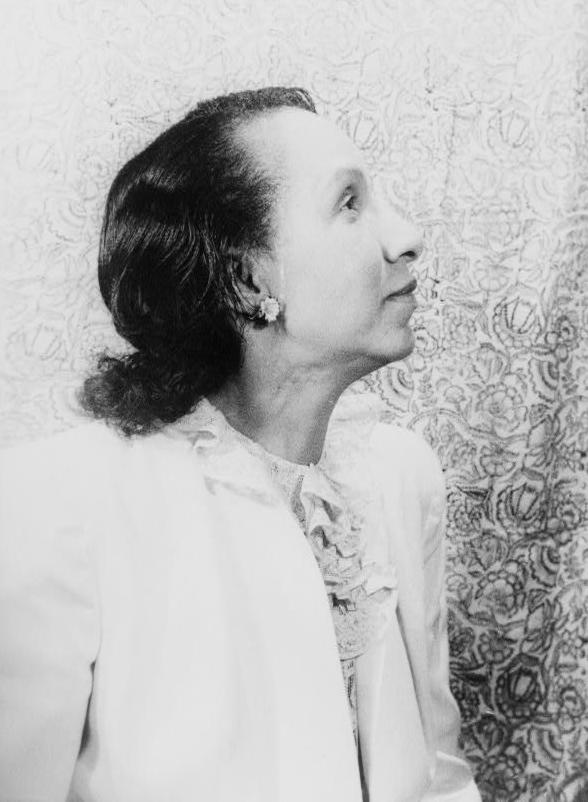
Shirley Graham Du Bois (1896-1977): Undeserved Obscurity

I was reading about Blackface Minstrelsy this morning, and reading about Mr Du Bois brought to mind his less famous but equally talented wife, Shirley. I owed the library blog a blogpost, so I put these various strands together …

Dr Karen E McAulay's avatarWhittaker Live

Image from Wikipedia

Born in Indianapolis into a religious and politically active family (her father was an African Methodist Episcopal Minister), Shirley Graham Du Bois was a writer, playwright, novelist, composer and an activist for black rights.  The Harvard Radcliffe Institute has a page on this remarkable woman – and she features in Nathan Holder’s book for young adults, Where are all the black women composers?, which we have in the Whittaker Library. 

Nathan Holder – Where are all the Black Women Composers?

There’s also an entry in Oxford Music Online:

Wright, J.  Du Bois, Shirley (Lola) GrahamGrove Music Online. 

Shirley studied composition and orchestration in France in her early thirties, and then studied music at Oberlin College in the United States, also beginning a PhD in English and Education at New York University. Nate Holder tells us that she worked for Morgan College…

View original post 562 more words

Writing, Writing! Review Essay published …. Books on Robert Burns

Today saw the publication of my review essay of four new books on Robert Burns, in the Spring 2022 issue of Eighteenth-Century Scotland: The Newsletter of the Eighteenth-Century Scottish Studies Society.

It’s apparently embargoed for sharing until the newsletter goes online publicly in “a few months”, so no link to share just now. But if you subscribe to the newsletter, then keep a look-out for my piece! These are the titles I review:-

  • Ian Brown and Gerard Carruthers, ed., Performing Robert Burns: Enactments and Representations of the “National Bard”. Edinburgh: Edinburgh University Press, 2021. Pp. vi + 210.
  • Katherine Campbell and Emily Lyle, Robert Burns and the Discovery and Re-Creation of Scottish Song. Musica Scotica Historical Studies of Scottish Music Volume 4. Glasgow: Musica Scotica Trust, 2020. Pp. xi + 233.
  • Morag J. Grant, Auld Lang Syne: A Song and Its Culture. Cambridge: Open Book Publishers, 2021. Pp. xvii + E-book: https://books.openbookpublishers.com/10.11647/obp.0231.pdf
  • The Oxford Edition of the Works of Robert Burns, Volume 4: Robert Burns’s Songs for George Thomson. Edited by Kirsteen McCue. Oxford: Oxford University Press, 2021. Pp. xcvi + 692.

(As an aside, it was quite a substantial piece of work – I am astonished that by some wizardry all those words fit 3 pages of pdf!)

Students’ Song Books

Today, I’m working from home wearing my library hat, but I have august company on the desk beside me. My fingers itch to give these new personal acquisitions a closer inspection, but they have to wait until tonight. Meanwhile, I can just look, and gloat.

LATER, MUCH LATER. How helpful! There’s a page at the back actually listing the history of editions of the Scottish Students’ Song Book. That saves me having to unpick the history from newspaper adverts.

Also interesting to note that Janey Drysdale contributed a couple of songs to the British Students’ Song Book, that were arranged by her late brother. Marjory Kennedy Fraser contributed a couple of songs too, the lyrics of which were by Dr Charles Kennedy, whilst she had arranged the musical settings. Neither woman contributed to the earlier Scottish book.

Students were, of course, mostly male. Marjory had been one of the first women to attend music lectures at Edinburgh University, but she didn’t graduate until she was awarded an honorary doctorate much later.

Now, there’s one burning question. Who was the third woman that contributed to the British Students’ Song Book? Yes, I need to know! I have a book to write.