Dr Karen McAulay explores the history of Scottish music collecting, publishing and national identity from the 18th to 20th centuries. Research Fellow at Royal Conservatoire of Scotland, author of two Routledge monographs.
Having virtually finished a major project (the second monograph), I’m exploring future directions.
Unfortunately, this looks – even to me – like going randomly round in somewhat squiggly circles, since it entails seizing intriguing little thoughts that have occurred to me at various points in my research, and (metaphorically) tugging at them to see where they might lead. Right now, none of them have yielded much more, although it’s fair to say that I need to wait for some to have an outcome.
Ladies in the Music Publishing Trade
There’s the thought that a publisher’s wife – who HAD been a piano teacher – might have authored his piano tutor for him. Maybe, but there’s no way to know. Dead end? Well, yesterday, I traced a copy in Australia. I’d love to see it, even if it tells me no more.
Then there’s the sister of another publisher. I do have marginally more to go on – and I’m currently following up some leads – but it’s not exactly a whole new project. After a couple of hours’ searching the British Newspaper Archive delving this evening, I had learnt that she accompanied a church concert in her late 40s – since she, too, was a piano teacher, this is hardly earth-shattering news!
(Come to think of it, I encountered a third lady piano teacher who was a talented songwriter and small-scale self-publisher… see, if only I could amass enough extra information, I would clearly have the makings of an article here!)
So, I also started another line of enquiry. This could be more fruitful, but it’s too soon to know.
As for the tea set? Nothing to do with the ladies, as it happens. The second lady’s brother (the publisher) was a church session clerk – an important role to this day. He therefore had the responsibility of making presentations when called upon. And, on the occasion when his sister played the piano, the church was making the presentation of a tea set and a clock to their minister, who was getting married.
In a very Chaste Design
Doulton, on eBay. Not chaste?
This brings me to the most pressing question (I jest):-
Was it plain? White or cream, maybe? It only had a small, modest embellishment. How else can a tea set be ‘chaste’?
Or this. Surely this! Again, on eBay.
It’s honestly not a problem that would occur to any Kirk session today!
I’ve just given a webinar for the National Acquisitions Group, ‘Getting Historically Under-Represented Composers and Contemporary Environmental Concerns into Library Stock’.
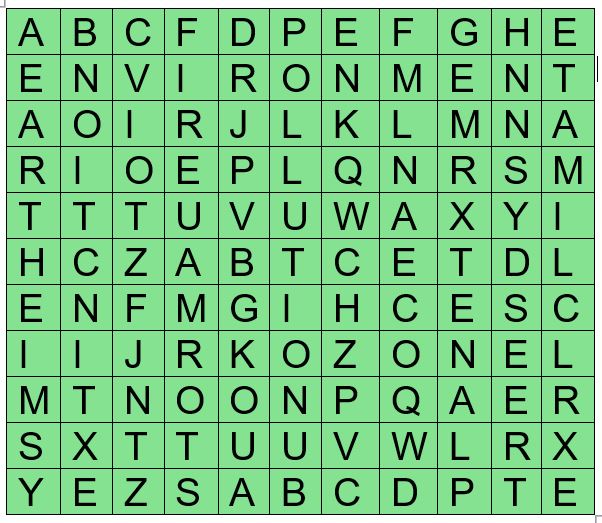
Earlier today, I took a dislike to one of my slides. It was where I was talking about finding musical compositions on the subject of the climate crisis, and it suddenly dawned on me that a wordsearch slide would be far better than what I had intended. So, I made a ‘wordsearch’, on the spot. It was my first, and I made it very quickly – don’t judge me! Stupidly, I didn’t count how many words I’d hidden. I found twelve related to climate change in some way. But later on, my sister found far more, if you include more general words. Have a go …
It’s hard to believe now, just how much more women composers were discriminated against in the past. Today, they’re still struggling for equal recognition, but not as much as when Boosey said he would only publish ‘little songs’ by a woman. It’s not as though there’s a feminine style of composition. We don’t arrange our crotchets and quavers, chords and rhythms in a uniquely feminine way.
I concede that a composer might say their piece was inspired by some aspect of being a woman. Life experiences can inspire any composer. Yet, there are as many experiences as there are people on earth. I don’t think a woman’s music is inherently distinctive, any more than her trumpet playing or any other art-form would be.
Why must we stereotype people? On the face of it, I’m a very conventional, married librarian and mother of three. I look boringly conventional, I freely admit it. Yet I am also the breadwinner, and did a PhD at the second attempt, working full-time throughout. I’ve carved a parallel career as a scholar. Is that conventional? Does it fit the stereotype of a boringly conventional information worker?
Dancing to my own tune
And I’m about to retire from librarianship – but not from research. I’m not going to fit any stereotype of a pensioner, either. (Daytime TV and bingo sessions have absolutely no appeal for me – I might explode if anyone tries to categorise me into those particular boxes!) I have a second monograph and two book chapters to see published before or as I move on with my research plans.
I don’t go on shopping sprees. But let me loose on eBay, and who knows what I’ll buy? I came across a Bayley & Ferguson publication from ca.1894-6. It was published both in Glasgow and in London, and was performed in Bishopbriggs on the outskirts of Glasgow in January 1897. The London address confirms the earliest date. (John A. Parkinson’s Victorian Music Publishers: an Annotated List is invaluable here.*) The cover illustration caught my eye, and I must confess I was intrigued to find it was composed by a woman: Constance M. Yorke. In 1897-8, she also published Twilight Shadows with a London publisher, Larway, who again dealt with light musical fare. I haven’t attempted to get my hands on that one.
Constance M. Yorke: is this Constance Maria Yorke Smith / Scholefield?
I traced a Constance Maria Yorke Smith (1855-1936), who was a vicar’s daughter, originally from Loddon in Norfolk, but whose early adult years were spent in Penally, Pembrokeshire. Her late father was the Revd. J. J. Smith, latterly a tutor at the University of Cambridge. Constance in turn married a clergyman herself – James Henry Scholefield – in a very ‘society’ wedding in Cornwall in 1891. If I’m right, then this ‘humorous musical sketch‘ under her forenames but not her surname, could have been written when she was already married. (Her mother had given the happy couple a grand piano as a wedding gift – Constance would have been making good use of it!)
Rose Smith’s Mother, Mary Ann
This paragraph is newly added (March 2026). In the RMA Research Chronicle, you’ll find my recent article about five Scotswomen involved in and around music publishing in the late Victorian era and early twentieth century. The author of the musical sketch, M. A. Smith, was the mother of composer and self-publisher, Rose Smith. And whilst I can’t be 100% sure of the identity of Constance M. Yorke, I am 101% sure that M. A. Smith was Rose’s mother, and the author of Mr and Mrs Dobbs at Home. I’m still working on this, notwithstanding the fact that my article is now published, because I feel there’s more to be said about M. A. Smith. I’m fascinated by her, her views, and her writing. Bayley & Ferguson didn’t publish the sketch using the lilac-and-green colour scheme commonly associated with women’s suffrage, but the sketch is a somewhat tongue-in-cheek sideways glance at the suffrage movement. Read on, to see what I mean. The rather obnoxious heroine hardly sells the idea of women’s suffrage and equality to the average man – or woman – in the street.
Mr & Mrs Dobbs at Home: humorous Musical Sketch / (words by M. A. Smith; composed by Constance M. Yorke (London, Glasgow: Bayley & Ferguson, n.d.). Franz Pazdírek listed the piece in his Universal Handbook (1904-10), but erroneously attributed it to Caroline M. Yorke, and Twilight Shadows to M. Constance Yorke – rather confusing, Herr Pazdírek!
So, what of ‘Mr and Mrs Dobbs at Home’? Selina is a spoiled young madam. Mr Dobbs is hen-pecked to an insane degree, submissive beyond measure and seemingly incapable of standing up for himself. Selina says he has driven the maids and the nurse away, so it’s only right that he should do all their work. ‘Enter Mr Dobbs in shirt sleeves and kitchen apron, with broom in one hand, duster in the other, as if he had been sweeping.’ (Does he go out to work? No mention of it. And why have they all gone away? The poor man seems to have no spine, let alone any serious vices!) The baby cries. Who goes and fetches her from the nursery? Mr Dobbs. He says the child is teething. Selina instead accuses him of jabbing her with a nappy pin.
Ah, well. Having told him off for having a quick, sneaky puff of his pipe whilst she was getting herself ready, the pair and their baby set off for a day out to meet one of Selina’s friends. At this point, Mr Dobbs mentions that a ‘lady speaker’ has tried for the third time to see Selina, but he forgot to mention this before. (I missed this the first time I flicked through, but sat up straight when I realised that Selina was being courted by the Suffragettes, Suffragists, or similar.) Privately, he seems to think anyone involved in ‘Women’s Rights’ should be kept well away from his wife – it seems a little late in the day for that, considering Selina already has the upper hand! Of course, Selina sees things differently, and the rest of the sketch is basically a dispute as to whether women can, or cannot, ‘rule as well as the men’, with Mr Dobbs muttering that,
Shirts, vests, and ties and knickers, too, are all now female gear; our coats and hats will follow suit, and presently we’ll see the pater in the mater’s skirt, a-toddling out to tea.
Mr Dobbs’ complaint
It’s not a work of high artistic content! Not that it isn’t harmonically sound or averagely tuneful, but it was probably only ever intended for domestic or amateur entertainment. However, I do smile at the thought that whilst Revd. Scholefield was writing his sermons, Constance was sitting at the piano composing a musical sketch about role reversal – and then publishing it. (Or had a lyricist originally written it more as a conservative warning than eager anticipation of a brave new world?!)
You never know what you might find when, on a whim, you order something off eBay.
* John A. Parkinson, Victorian Music Publishers: an Annotated List (Warren, Michigan: Harmonie Park Press, 1990) – it is worth noting that Parkinson worked in the Music Room of the British Museum.
I’ve written quite a bit about women in musical history, so I’m adding something to the top of this post every couple of days during Women’s History Month – mostly flashbacks to women musicians I’ve researched, but some other discoveries too. (I’ve been shifting things around to a more chronological order, but I’ve always added the new bit first!) You’ll find more musicians than composers in this posting, just because of my own recent research.
Sometimes I look at the history of women musicians from the point of view of good library provision for our readers, whilst at other times my own research interests are foremost. It just depends on the day of the week, because I currently occupy two roles in the Royal Conservatoire of Scotland. For 3.5 days a week, I’m a librarian. For 1.5, a postdoctoral researcher.
15. The Ketelbey Fellowship
It’s a whole year since I learned that I had been awarded the first Ketelbey postdoctoral research fellowship at the University of St Andrews. Scholar Doris Ketelbey was a significant figure in the history of the department. I felt highly honoured to have been the first Ketelbey Fellow from September to December 2023.
14. Representation of Women Composers in the Library
I couldn’t resist adding the open access article I published about my EDI activity in our own Whittaker Library:-
It’s a privilege to shape a library collection, so I’m pleased to have just ordered and catalogued several relevant books this month.
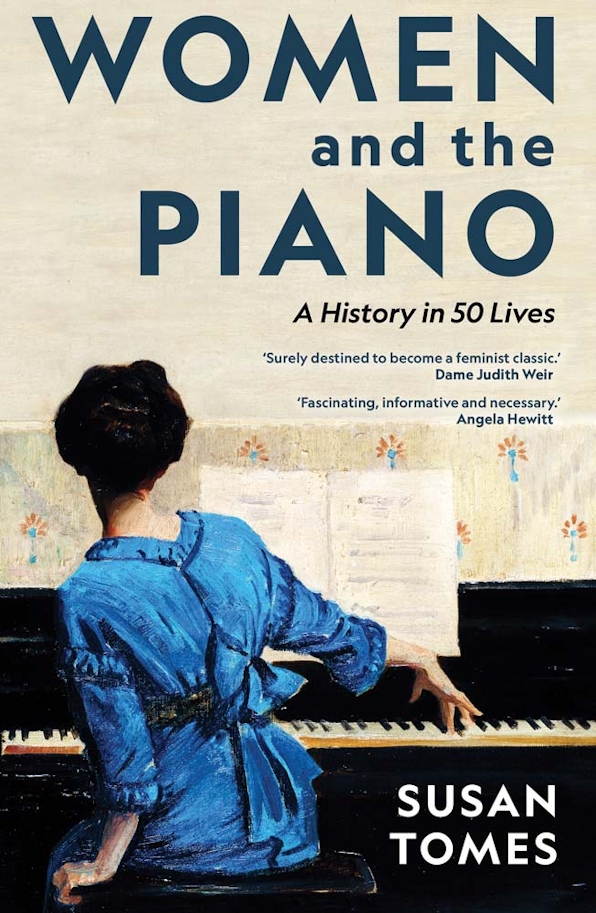
Susan Tomes, Women and the Piano: a History in 50 Lives (Yale University Press, 2024) Read more about it on the publisher’s website, here. In actual fact, it’s the fourth title by this author that we now have in stock. So if readers like this, they might like the earlier three, too!
Margaret C. Watson, Women in Academia : Achieving our Potential. (Market Harborough : Troubadour, 2024). Not a book about women in history, but very much for women in the present day!
Gillian Dooley, She played and sang: Jane Austen and Music (Manchester University Press, 2024). Back to history again.
Women and Music in Ireland / ed. Jennifer O’Connor-Madsen; Laura Watson & Ita Beausang (Boydell Press, 2022)
Moreover, there’s a new Routledge book coming out this summer – I have ordered it for the Whittaker Library. Of course, I may have retired from the Library by the time it arrives. This just means I won’t need to catalogue it! I’ll still be a part-time researcher, so I’ll be able to read it:-
It’s some years now, since a single-minded schoolgirl decided action was necessary. In 2015, Jessy McCabe noticed that Edexel had no women composers in the A-Level Music syllabus, and successfully petitioned to rectify this, via Change.org. I found out about her impressive initiative when I was beginning to start serious work on building up our library collection to include more music – contemporary and historical – by women and people of colour.
Jessy is now a Special Needs teacher. I’m sure she’ll go far.
11. Forgotten Women Composers
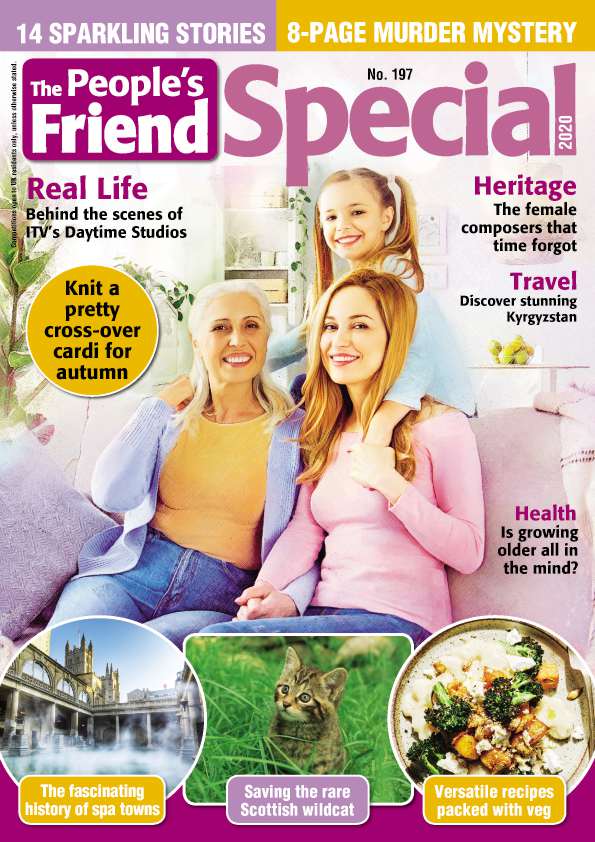
Part of academia entails sharing research outcomes beyond the ‘ivory walls’. It’s called public engagement, and that’s the opportunity I seized when my old friend The People’s Friend magazine commissioned me to write a feature back in 2020.
The sound of forgotten music: Karen McAulay uncovers some of the great female composers who have been lost from history’, in The People’s Friend, Special Edition, 11 Sep 2020, 2 p. (Dundee : D C Thomson). I blogged about it at the time (here).
10. Late Victorian Women Musicians
Since my more recent research has focused on the late Victorian era and the first part of the twentieth century, you’ll not be surprised to find that I found some interesting Scottish women musicians of that era! They are forgotten today – but I’ve done my bit to raise their profiles!
Newsletter article, ‘‘Our Heroine is Dead’: Miss Margaret Wallace Thomson, Paisley Organist (1853-1896)’, The Glasgow Diapason, March 2023, 10-15. (You can find this article in full on this blog)
‘An Extensive Musical Library’: Mrs Clarinda Webster, LRAM, Brio vol.59 no.1 (2022), 29-42 (a late Victorian head teacher who founded a music school in Aberdeen, and later did a national survey of music in public libraries – which she presented to the Library Association!)
In October 2023, I pondered about Mr *and Mrs* J. Spencer Curwen (amongst others) in another blog post, when I remarked upon early twentieth century attitudes to folk song.
9. In Praise of Music Cataloguers! Introducing Miss Elizabeth Lambert
Before I started the Claimed From Stationers’ Hall music copyright network, I had spent some months researching the wonderful late 18th and early 19th century music copyright collection at the University of St Andrews. A key resource was the handwritten catalogue in two notebooks, largely compiled by Miss Elizabeth Lambert (later to become Mrs Williams, when she married and moved to London.)
I just love the fact that this earnest young woman (I’m going out on a limb here, but I’m pretty sure she must have been earnest!) created a useful resource which would help everyone get maximum use out of the music repertoire that other libraries were less than impressed by. So we had Elizabeth cataloguing the collection, and numerous men and women, friends of the professors, making use of it. I blogged about her, and eventually wrote an article for the Edinburgh Bibliographical Society, mentioning her again.
‘A Music Library for St Andrews: use of the University’s Copyright Music Collections, 1801-1849’, in Journal of the Edinburgh Bibliographical Society no.15 (2020), 13-33.
The library’s copyright collection of music was a boon for middling class women like headmistress Mrs Bertram, her teacher daughters and their pupils. It does lead one to wonder if they had a harp at the school. I checked their borrowing records for more evidence. They certainly borrowed several volumes which included harp music.
7. Students but not at University? Educating Young Women
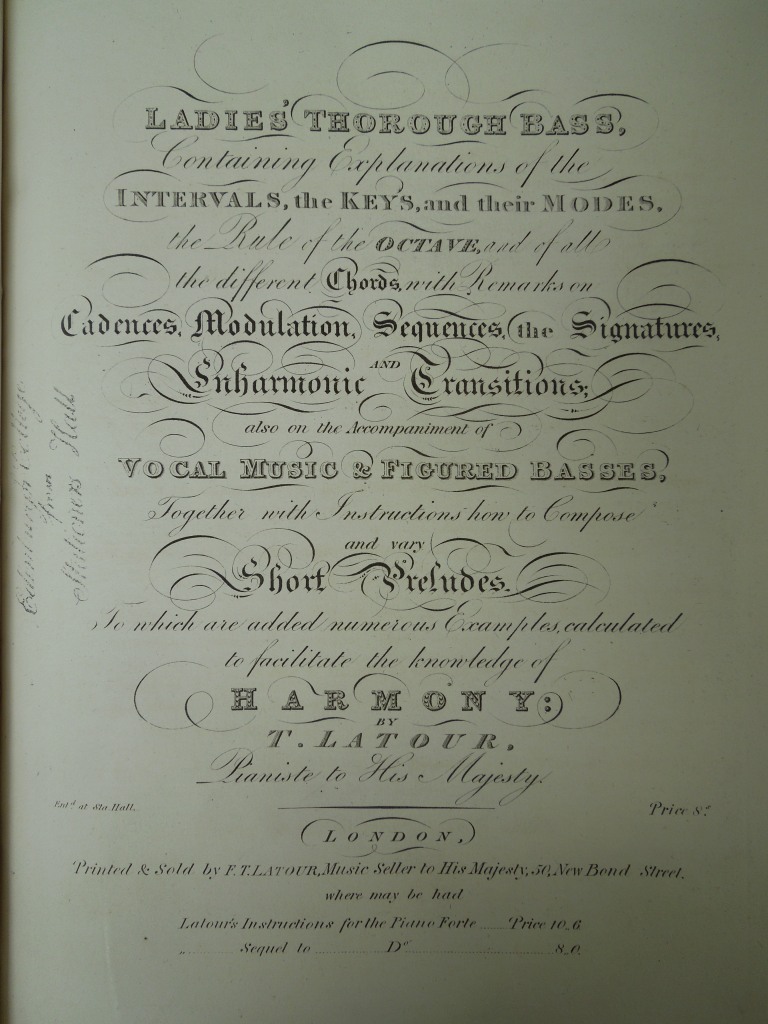
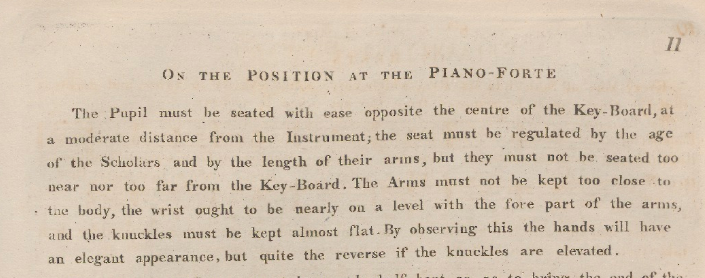
It’s time to turn to piano teacher Mr T. Latour. I’d like to refer you to my June 2018 blog post about women in St Andrews using pedagogical musical material in the early 19th century. Possibly the self-same young ladies attending, or having attended Mrs Bertram’s school?! The illustration features a young woman – probably just approaching or about marriagable age – at an upright piano. The abundant floral arrangement atop the piano (quite apart from sending shivers down the housekeeper’s spine every time the young pianist played too enthusiastically) suggests a well-to-do household. Following Latour’s instructions, the pianist has elegantly flat hands …..
T. Latour – Ladies’ Thorough Bass
Latour advises on the seating position, and how to hold ones hands elegantly
6. Not my work – but very timely for WHM 2024]
I’m not posting anything relating to my work today, but I saw mention of a great new article by Dominic Bridge the other day, so I thought I’d share details here. It’s a fascinating read. The Journal for Eighteenth-Century Studies is part of the Wiley Online Library:-
Back in 2018 when I was awarded the AHRC networking grant for the Claimed from Stationers Hall network, I drew up a list of women composers from the Georgian era. There were more than one might have expected – perhaps they only composed a handful of pieces, in many cases, but nonetheless – they composed. You can find the list on a separate page on this blog, here. And you can read more about it in the blogpost I wrote in July 2018,
This lady ran a girls’ school at St Leonard’s in St Andrews. This was NOT the famous and long-established private school that has long stood there, but an earlier enterprise. And Mrs Bertram and her daughters subsequently moved to Edinburgh, to the disappointment of parents of daughters in St Andrews!
The photo portrays a Mrs Bertram of Edinburgh. Chronologically, she could well be ‘our’ Mrs Bertram, and a scholarly bent is suggested by the pile of books at her hand.
2. The Accomplished Ladies of Torloisk
I almost forgot about the musical Maclean-Clephane ladies of Torloisk, which is a stately home on the island of Mull. But how could I forget about them, considering I published a lengthy article about them some years ago?! Luckily, a book of letters by Sir Walter Scott crossed my library desk, and even though it didn’t contain those particular letters, this did remind me of his musical friends in Torloisk!
Karen E. McAulay, ‘The Accomplished Ladies of Torloisk‘, International Review of the Aesthetics and Sociology of Music, Vol. 44, No. 1 (June 2013), 57-78
Today, I’d like to introduce a woman composer who predates most of the individuals I’ve encountered. Professor James Porter applies his considerable intellect to produce this in-depth article:-
‘An English Composer and Her Opera: Harriet Wainewright’s Comàla (1792)’, Journal of Musicological Research Feb, 2021. Published online: 16 Feb 2021.
Seriously, why do we do year-end reviews? To show the world what we’re most proud of? Quite possibly. To convince ourselves – and the world – that really, we’ve been very busy and deserve a pat on the back? Perhaps so. I took to the internet to find out why businesses do reviews, and why a career-minded individual might do one of their own.
Consulting the Experts
Braze.com said that year-end reviews offer the chance to ‘create distinctive content’; to ‘build loyalty’ and to remind the world what your particular business does best. To that end, obviously you log milestones, achievements and events. You use multimedia formats, and draw upon customer data. This all makes sense, although I don’t know that I, as an individual, can do all these things. (No customers, for a start!)
I tried again, and found a Harvard Business Review posting about, ‘How to create your own “Year in Review“. There’s plenty of sound advice here, suggesting that I should pause and reflect upon successes and failures; lessons learned; proudest achievements; who has helped me most; how my strengths have helped me to succeed; and whether there’s anything I wish I’d done differently. This is much more introspective, and certainly valuable advice. Whether I’d want to blog about all these headings is a moot point, though.
For me, I have an extra conundrum. I shall be retiring from the Whittaker Library at the beginning of July. I hope to continue the research element of my work, though. So – in one sense I’m writing a career-end review, as far as librarianship is concerned, but it’s not a career-end review for me as a researcher.
The Harvard Business Review suggests using your diary to capture key events on which to reflect. I spent a few minutes doing just that, yesterday. Immediately, I realised that there’s one thing I’m proud of over everything else, and that is that although I spend 85% of my time as an academic librarian, my 15% as a postdoctoral researcher is actually highly productive.
What do I do best? I get things done.
‘She’s a Librarian’
I confess, I don’t like hearing this! It makes me feel as though my research activity is dismissed as dilettantism – that I don’t do badly, considering research isn’t my main role. On the other hand, a fly on the wall would point out that yes, I do spend the majority of my time as a librarian.
Jazz CDs – not a Highlight
So, what did my diary exercise reveal? I’ve catalogued a lot of jazz CDs. This causes me to feel quite a bit of resentment, because I know our readers don’t generally listen to CDs as a format, so all my efforts are to very little avail indeed. Maybe that’s one of the things that I wish I’d done differently. It’s not a high-priority task; however, I am conscious that I don’t want to leave the backlog to my successor. And that’s why I do this dreadfully tedious and repetitive activity!
Retrospective Post Script: that jazz CD cataloguing was indeed a waste of time. I did it because the promise had been made that those CDs (thousands of them) would be catalogued. I didn’t make the promise, but I did feel the obligation to fulfil the promise. My resentment was because it used so little brainpower and expertise, provided so very little fulfilment in the moment, and so little benefit in the long-term.
Equality and Diversity: Stock Development
What I’m more proud of is my efforts to get more music by women and composers of colour, into the library, and most particularly, to ensure that our staff and students know just how much of it there now is in our stock. With a colleague from the academic staff, I’m concocting a plan to raise the profile of this material.
I also suggested maybe there might be a prize for diverse programming …
And I just heard – there is going to be such a prize – it really is happening. A red letter day!
For me, a particularly proud moment was being invited to attend a Masters student’s final recital in June, at which one of these new pieces was played. It was a piece requested by a member of staff – I don’t think it was me that actually stumbled across it – but I certainly sourced it, catalogued and listed it. Whilst I’m heartily sick of cataloguing, I do take pleasure in stock development, and in ensuring there are ample means of discovering the music once we have it.
In September, I was gratified that one of our performance departments reached out to me to request more materials by under-represented composers – a sign that the message is getting through, and that staff appreciate that the library really is trying to help.
Since October, I’ve also been broadening the stock of music inspired by climate change and ecology, including songbooks for school-children, since we have a number of music education students. That pleases me, too.
What else? Dealing with donations to the library, some eagerly received and others needing sifting through. Weeding stock to ensure there’s room for new material, and ensuring that tatty material is removed or replaced depending on how much it’s likely to be used.
User Education
Some things are cyclical – most particularly providing initial library introductions, and later talking to different year-groups about good library research practice. In June, I gave a talk about bibliography to the Scottish Graduate School of Arts and Humanities, which attracted far more of an audience than I’d ever dreamt of!
Queries, and Research-Related Activity
I’ve also dealt with queries – such as one from a Polish librarian, or another from an elderly enquirer wanting to trace music remembered from childhood. And I talked about my research activities at a library training session, even though I was rather afraid of wasting colleagues’ time going on about something that might not feel very relevant. (This autumn, I also obtained and catalogued – in detail – a book of Scottish songs that I have written a book chapter about. It would be dreadful, wouldn’t it?, if someone read the chapter but couldn’t find the song-book in the library!)
Professional Activity
Professionally, I managed the comms for the IAML Congress in Cambridge this summer (with a little bit of help from mascots Cam, Bridge and Don and a couple of fellow IAML (UK & Ireland) librarians, and I think it went quite well. The stats for the blog and Twitter (“X”) rose gratifyingly during this period. I went to a couple of days in Cambridge, but I didn’t speak this time.
IAML Congress mascot Don
A Researcher with Determination
Early on in 2023, I was gratified to receive an LIHG (Library and Information History Group) Bursary to attend a conference at the University of Stirling between 17-19 April, which was about Reading and Book Circulation 1650-1850. This was to be the first of two major successes this year, for I was also elected the inaugural Ketelbey Fellow in the Institute of Scottish Historical Research at the University of St Andrews. I’ve written extensively about this experience in other blog-posts, so I won’t duplicate it here. However, I can’t resist reminding myself of highlights!
Researching key documents in Martyrs’ Kirk Reading Room
Attending both fortnightly research lectures, and ISHR pub lunches on alternating weeks
Many enjoyable hours concentrating on my book revisions – with a view of the sea!
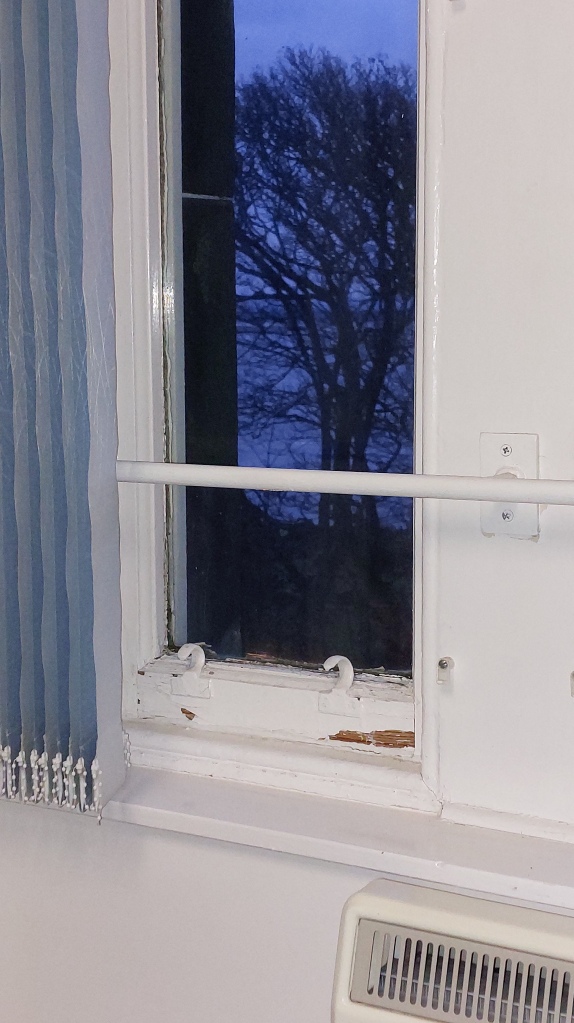
Twilight from my window, St Katharine’s Lodge, St Andrews
We’re not going on a (sniff!) Summer Holiday …
Being a researcher for 15% of the time is not easy – there simply isn’t the time to do all I want to do. Far from ‘dabbling’ in research, I take this side of my work very seriously indeed. I might have been a librarian most of the time, but I have devoted far more than the designated 10.5 hours a week to my research activity! I took annual leave in the summer to get my book draft completed, and took more annual leave to enable me to spend two, rather than 1.5 days researching in St Andrews. I’m doing it again next week; the book revisions must be completed and submitted very soon, and if the only way I can do it is by taking holiday, then that is what I must do.
In January, I wrote an article for the Glasgow Society of Organists, about a Paisley woman organist and accompanist whom I’d discovered during research over Christmas 2022. Even though it wasn’t for a scholarly journal, it was research done to my usual standard, and I’ve drawn upon that research in one of the chapters in my forthcoming monograph.
I’ve peer-reviewed an article, a book manuscript and a grant application. Considering all that I’ve had on my plate this year, I’m quite proud that I did manage to do these things. I don’t attend reading groups, and I’m not always able to attend research-related events that fall in ‘library time’ – I don’t want to give the impression I’m skiving off library work! But I do want to feel part of the research community, and that was precisely what was so magical about my Fellowship in St Andrews. For those two days a week, I was a researcher, pure and simple.
Roll on 2024! What am I going to do differently?
I’m looking forward to the summer. I feel I’ve been a librarian long enough. I’ll miss doing the user education, and rising to the challenges posed by unexpected or unusual queries. I shan’t be sorry to quit cataloguing, particularly jazz CDs!
I don’t actually have any ‘retirement’ plans as such. Apart from having more time to spend on my role as Honorary Librarian of the Friends of Wighton in Dundee. Whilst I live on the other side of Scotland, at least I shall have more opportunities to leap on a bus or train to get to Dundee Central Library to look after the repertoire that I love.
Little old lady? Not me!
Not Entirely Retiring!
I don’t feel remotely like a little old lady! I hope I’ll continue as a postdoctoral researcher in my present institution, but I’m also keeping my eyes open for any other part-time opportunities that I could pursue alongside that. ’Actively looking’, is the phrase, I think.
With a colleague in another institution, we’re cautiously planning a new research idea. And I also have strands of research that I commenced for my book, but hope to pursue in greater depth once this book is safely further along the publication process. Watch this space.
Wednesday. Glasgow to St Andrews, to do book revisions, and a lecture for the University’s Institute of Scottish Historical Research. (It was about the impact pedagogical and technological innovations had on Scottish music publishers.)
Thursday night. St Andrews to Dundee (expedient – it was the only way to get back in time for work on Friday!)
Sleeperz, where I could not sleep …
Friday morning. Dundee to Glasgow, for a day’s librarianship. One particular query took a couple of hours, but I was told that my reply would make the enquirer very happy … really, that’s all that matters.
New desk lamp – extension cable sorted!
Saturday. Glasgow to Dundee and back for the Friends of Wighton 20th Anniversary celebrations. I attended the speeches and morning concert …
20th Anniversary of the Wighton Centre Sheena Wellington opens Proceedings The Provost of DundeeHarpsichordist Mark Spalding in front of Andrew Wighton’s music booksPurcell’s “Scotch” tune!This is Gaelic singer Wilma MacdougallThis is Sally Garden, the Wighton Musician in Residence a few years ago.
I’m the Honorary Librarian, and my role was to show off Wighton’s books, in the afternoon. Although few visitors required my services, I had some very enjoyable conversations about the books, so it was a pleasant day.
It’s always fun to spot little comments made on the music by Wighton himself, and today I also found one of the books had belonged to an original subscriber. I wonder if she played the tunes when she got the book? In a chapter I wrote a couple of years ago, I found the number of women subscribers compared to men, went up as time went by. There’s a Miss Scrimgeour on the database compiled for that book, but Mrs Scrimgeour doesn’t appear there. Have I somehow found a new subscriber, or was she just mistranscribed at some point?!
Mrs Scrymgeour’s copy, 1796
Googlemaps will again be reporting record travel mileage this month! But I have awarded myself the rest of the weekend off. (Honestly, have I only walked 8466 steps today? I’m surprised!)
Choosing more diverse repertoire is challenging for instrumentalists and singers. For four or more years, I’ve been working hard on increasing our stock in this area – music by women, music by BIPOC composers, and, of course, music by women who are BIPOC composers – and I’ve compiled some helpful lists of music in stock at the Royal Conservatoire of Scotland’s Whittaker Library. They’re posted on the library WhittakerLive blog.
I intend this to be my legacy when I retire from the Library in July 2024.
It wasn’t until I needed to draw up a list that I realised just how much I’ve focused on British women in music in my research over the past five or six years! Quite a bit, it appears.
‘My love to war is going’: Women and Song in the Napoleonic Era’, jointly authored with Brianna Robertson-Kirkland, Trafalgar Chronicle, New Series 3 (2018), 202-212.
‘The sound of forgotten music: Karen McAulay uncovers some of the great female composers who have been lost from history’, in The People’s Friend, Special Edition, 11 Sep 2020, 2 p. Dundee : D C Thomson.
‘A Music Library for St Andrews: use of the University’s Copyright Music Collections, 1801-1849’, in Journal of the Edinburgh Bibliographical Society no.15 (2020), 13-33.
Newsletter article, ‘‘Our Heroine is Dead’: Miss Margaret Wallace Thomson, Paisley Organist (1853-1896)’, The Glasgow Diapason, March 2023, 10-15. (You can find this article in full on this blog)
FORTHCOMING: Article in History Today – due Dec 2023 [Marjory Kennedy-Fraser and Annie Gray, fin-de-siecle performers]













 Karen McAulay, Musicologist