What’s That You Said? Too Quiet Over Here?

Apologies! This has turned out to be quite a week.

I’ve twice woken far too early, notwithstanding leaving the house at 6.45 am to go to Edinburgh.  It was still far too early even for that.

I bought a car. I’ve spent hours marking essays (not a normal activity for a former academic librarian-turned-research fellow). I’ve attended live and online seminars, and I’ve  continued in my archival explorations.  It’s only Thursday night, and I’m knackered.

I’ll be back as soon as the marking is completed!

International Women’s Day – a Flashback

As well as my recent article in which I compare Flora Woodman’s career with Robert Wilson’s

It’s time for a flashback to this time last year.  I went all-out to share a lot of research and resources about women musicians, so this year, I think I’ll share it again!  I’ve written quite a bit on the subject, as you’ll see.

Women’s History Month 2024 – Musicians

My Music Guide (1947): a Brave New Future

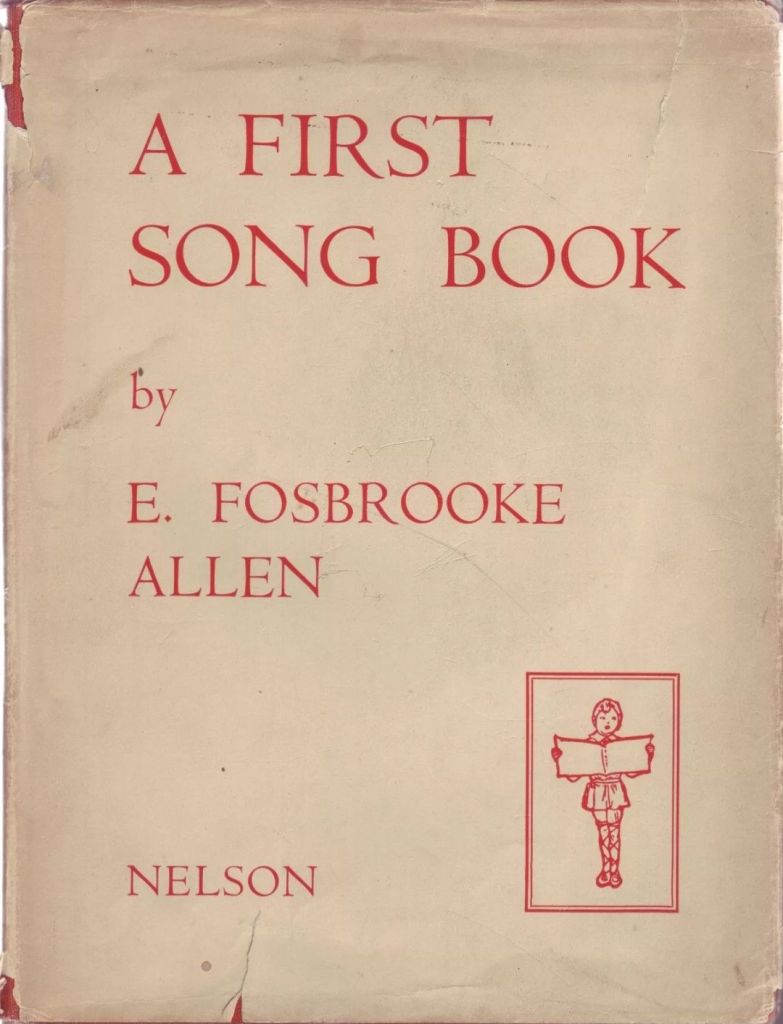
Thomas Nelson’s four-book set was for classroom use. Offering a mixture of history and theory (music-reading and tune-building), it even suggested pupils might plan a folk music concert. 

In this exciting, modern world, children were reminded that their parents’ music lessons consisted only of singing, whereas now they might also learn instruments like the recorder, and perhaps collect interesting clippings from the Radio Times.   (It sounds like another world, doesn’t it?)

Meanwhile, diving straight into the history, children were immediately introduced to the concept of folk music.

This is an English book, but I only recognised two of the three songs from my own school days. ‘The Carrion Crow’ wasn’t one I knew.

I’m delighted to find that kids were also introduced to the role of a song collector.  Although I have to say that the child in the foreground on the right looks bored and unimpressed by the proceedings, in the illustration! Still, Nelson’s editors presumably commissioned the illustration rather than use a stock image, so they’re due some credit.

The song collector

They’re still holding onto the idea that folk music came from country folk. I wonder if pupils ever asked what city folk sang?!

Of course, it wasn’t all folk music.  Kids were also introduced to the likes of Brahms, Handel and Purcell. Today, I imagine only examination classes would have textbooks introducing the classical greats.  On the other hand, more time is probably spent on world music, and efforts are made to consider music by women and people of underrepresented communities.  Times have moved on!

Nonetheless, it’s interesting to see how much knowledge children would have acquired in general classroom music lessons, and to compare it with modern times.

Even the books are brighter and more appealing today, I must admit!

Musicology, and a Nerdy but Meaningful Spreadsheet

Musical notes cut out of old sheet music

How to Assess whether a Song Book was Aligned with Contemporary Tastes

There were once four books of Scottish songs in a mini-series: just under 100 songs, all told. They weren’t much advertised, and few copies are now extant.  If they were intended mainly for school use, then I need to know to what extent their contents were standard Scottish song repertoire for their day. (Each generation has its favourites, noticeably different from the previous ones.)

Now then, I spent a very long time indexing song books as a librarian; that library catalogue is now a reference resource in its own right.  Last night, I listed the contents of those four books, and next, I shall look each song up in our RCS library catalogue.  I’ll end up with two figures for each song:-

  1. How many times the song is listed altogether: a high figure means popularity over a long period.
  2. How many times the song is listed between 1930-1970: this will be a shorter range of numbers. If it’s as high as, say, five hits, then it was popular amongst quite a few compilers over that 40 years.  If it’s not in any other books between 1930-1970, then it’s either old-fashioned, or a more obscure ‘rarity’ from less well-known or very old collections. 

And THEN, I can look up the rare ones in the National Library of Scotland’s Digital Gallery. 

This is the only accurate way of ascertaining whether the contents themselves might have been off-putting to the very audiences that they were meant to attract. I hope that’s not the case, because the compilers were well-placed, indeed ideally-placed to know exactly what went down well with school children. Nonetheless, I want hard evidence, and comparing the repertoire with two significant sets of data – the RCS more standard books, and NLS rare books – seems to me a pretty good way of doing it.

Blogging Helps Clarify the Question

I enjoy writing this blog, because it helps me clarify in my mind what the big issues are that I am addressing. Writing for a wide audience, which may or may not have exactly the same scholarly interest in the topic as I do, is a good way of reminding myself to write accessibly, and hopefully interestingly, about the things which occupy my thoughts as I pursue my research. Do I succeed? You tell me!

‘I was born an American but my Forbears were Scotch’

I have written a lot about diasporic enthusiasm for Scottish culture. Usually, I’m thinking about music, but today’s archival materials embrace almost every topic under the sun. If it can be taught, then educational materials can be published. And thus it is that I encounter an American author’s proposal to Thomas Nelson’s in Edinburgh, which bears out everything I’ve ever said about people’s affinity with the Auld Country.  (Not to mention the annoying ‘Scotch’, a term unused by Scots!)

Thus I have a hankering, just for the romance of it, to have some of my verse published in Edinburgh, especially since I hope to be in that city in the not very far future […]

I can almost hear echoes of Brigadoon in the distance. But, the poet is practical.  Recognising the paper shortages at the time (post-World War 2), the enthusiastic poet offers money to help defray initial costs, because …

Once out, I believe both of us will profit by its […] appearance.

There was only one problem. The editor replied,

We regret very much, however, that we are not publishing poetry at the present time.

Image by Alan Kidd from Pixabay

Now published in History Scotland, Spring 2025: The ‘Scottish Soprano’ and the ‘Voice of Scotland’

The Scottish Clans Association of London badge, on background of Mackinnon tartan

Sadly, this is the last issue of History Scotland, but I’m very pleased to have an article published there. I have really enjoyed writing this, and I think my idea of comparing two very different Scottish singers has actually come together rather well.  I wanted to write about Robert Wilson, but I didn’t want to go over the same ground that has already been covered.  I also wanted to write about Flora Woodman – but would anyone remember her? Then came the inspiration: what if I wrote about them both, two almost contemporary but very different celebrities, and then I could compare them.  This hadn’t been done before! And it worked  – the piece almost wrote itself.

Karen E McAulay, ‘The ‘Scottish Soprano’ and the ‘Voice of Scotland’: the Importance of Nationality to Flora Woodman and Robert Wilson’, History Scotland Vol.25 no.1 (Spring 2025), 74-81

If your public library has e-magazines, you’ll be able to read it online. Glasgow Life certainly has it!

Flora Woodman – photo and compliments, 25th October 1924

Seminar, Weds 26 March, 1pm:- Perusing the Papers from Thomas Nelson and Sons’ Parkside Works (Research into Nelson’s Scots Song Book – Work in Progress)

Through the archway into the courtyard at IASH

As I’ve mentioned, I’m currently Heritage Collections Research Fellow at IASH, the Institute for Advanced Studies in the Humanities, at the University of Edinburgh. All guest fellows are invited to give a work-in-progress seminar, and it’s my turn on Wednesday 26 March at 1 pm. You can attend in person, or online – more details on the link below. The abstract tells you what my talk is about.

Abstract and Zoom link

I’ll explain what I’m looking for, and introduce you to some of the individuals I’ve been finding out about.  The one thing I can’t predict, is whether I shall by then have found the answer to my prime question!

Nelson's Parkside Works - old engraving
Hope Park Square, home of IASH
The ArchivesHub entry for the collection

Autoethnographical? Autobiographical? Reflective?

Well, the ‘Scottish Entertainment’ took place yesterday – attended by sixty to seventy people, if you include our [small] choir. A great time was had by all. There was lots of community singing, along with a couple of choir items, and a smattering of solo items (two spoken, two sung solos, and the concertina.)  And, of course, haggis, neeps and tatties in the middle of the entertainment.  Our pastoral care committee organised the whole event  – I just coordinated the entertainment bit!

It wasn’t a research event, and I can’t exactly call it public engagement – it wasn’t in any sense designed for, or linked with, my research. (Although, as I’ve mentioned, my little introductions were informed by my research!) So, I don’t think I can call this autoethnographical or practice-based research, but I can certainly reflect upon the whole experience.

Timing

I planned two equal ‘halves’ for either side of the meal. It wasn’t a full-scale meal, as such, but I underestimated how much time we’d spend eating. The first half of the entertainment was almost spot-on: we only had to leave one item until after the meal. However, the second ‘half’ had to be significantly cut back (mostly by omitting verses) – so I could really have made it a good bit shorter.

Feedback

The feedback was gratifying. Our repertoire went down well, as did the solos.  I shall respect the soloists’ privacy, so I won’t elaborate further on that point. 

My own debut as a soloist surprised me as much as everyone else, though.  ‘I didn’t know you sang’, someone said. ‘Nor did I – I’ve never sung a solo in public before!’

I chose a song within my range, and the concertina piece was likewise as simple as I could find!  Considering that I took up the concertina during lockdown, with the deliberate aim of having a ‘folk’ instrument for just such an occasion, it was gratifying to be able to play to an appreciative audience.

People were still talking about the event today, which was lovely to hear.

Repertoire

Remember that I did a BBC Scotland radio interview 13 months ago, discussing the top ten Scottish songs of nowadays, the results of a Visit Scotland survey? I didn’t even consult that list for our own afternoon entertainment. There was some, but not a lot of overlap – but I’m happy that the songs chosen by myself and the choir, went down well with our audience.  We had a few Burns songs, a few from the early 20th century, some from the middle and a couple from towards the end of it.

And if we were to  do another event, well, there’s still that Visit Scotland list to draw on!  There is bound to be variation, depending on the sample of people surveyed – whether they are young or old, whether they had children or taught children in schools, and so on.

Sheeps Heads? The Mind Boggles!

One sheep peeps over the backs of the rest of the flock

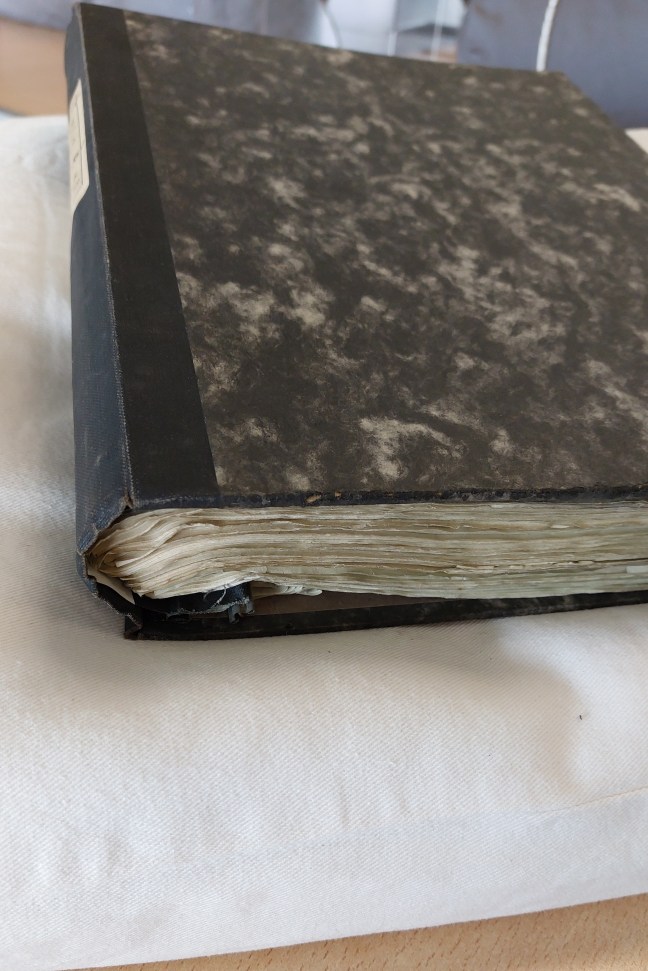
I have literally thousands of typed carbon copies to wade through, in my current research.  I’m looking for gems relating to a handful of music titles that this publisher produced.

Going through archives, it’s not uncommon to find wee gems – like the author who left his swimming trunks behind after a morning swim … (don’t ask!)

Or someone that an editor thinks his colleague might like to meet:-

You will find him uncommonly intelligent and possibly useful […]

Not to mention a rejected manuscript, described as,

The Scots description “cauld kale het again”. [Translation available on request.]

But today we have another conundrum. The publishing editor for the juvenile list decided not to proceed with a book that apparently combined music and art in some way, declaring that,

‘I felt that sheep’s heads are better in broth than served up eight to a bar.’

Or did she mean, eight to a baa-aa?

If only I could see the rejected manuscript to see what she meant! However, this was 1947, and the book went unpublished. I don’t think the author had any more luck elsewhere!