12,914 Steps, mostly in Edinburgh

Phew, what a day! 

Research; then playing for a funeral; dashing home; then over to Edinburgh. A quick stop in the National Library of Scotland, then a social event for new IASH Fellows at Edinburgh University’s Institute for Advanced Studies in the Humanities.

How to dress for such a day? I decided the black suited look was safest, and sallied forth looking one notch cheerier than an undertaker. Ah, well. 

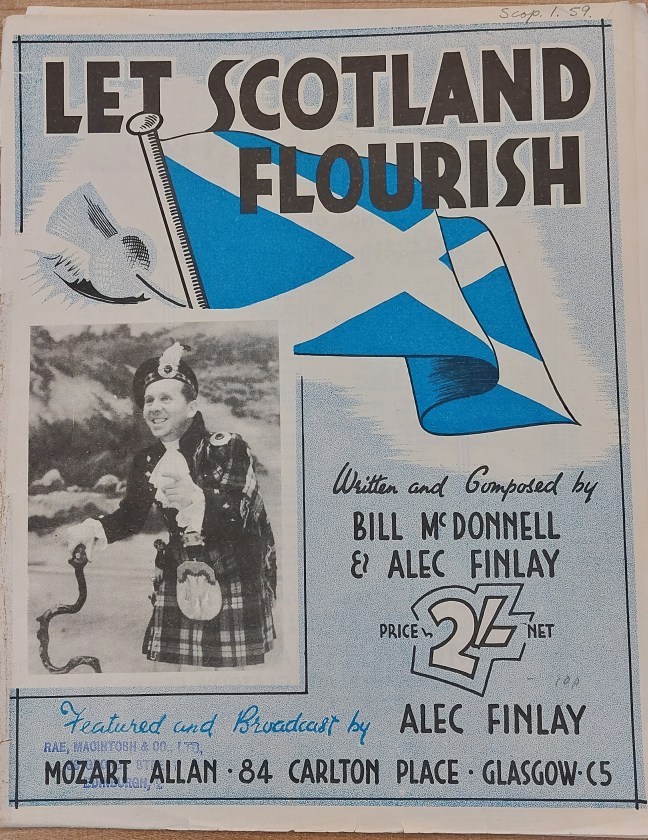
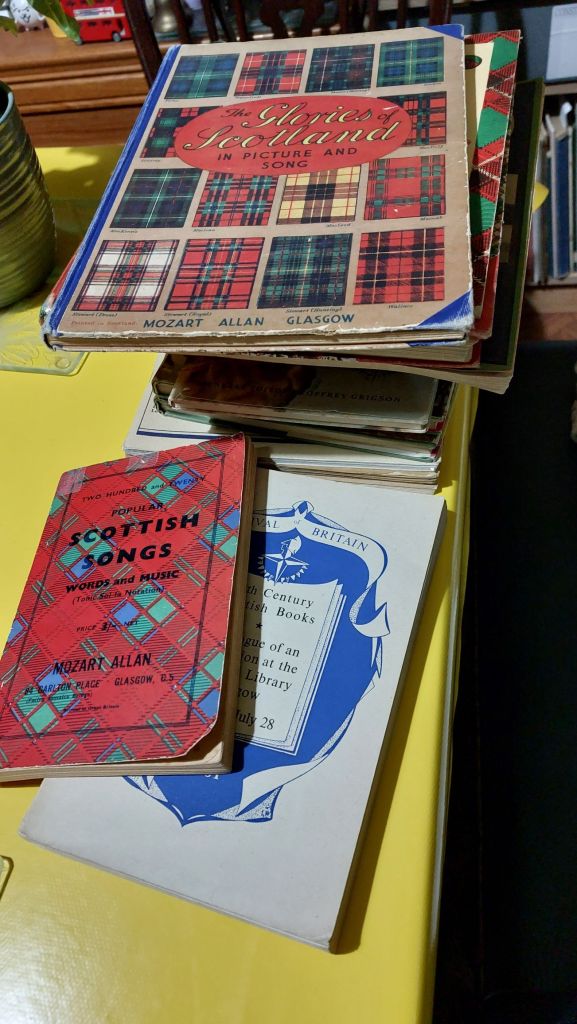
I met a friend, unexpectedly, at NLS.  It’s the kind of place where you do meet people. (I first met my PhD external examiner there, a few days before the viva back in 2009.)  I only had a short while to look at three Glasgow music publications today, but it was long enough.  My main target didn’t actually tell me much, really. It was interesting to see it, but it had no obvious connection with ‘my’ Glasgow Victorian ladies.

And then, I met a lot of Fellows researching a lot of different things – it’s quite exhilarating to hear about so much interesting work.  I’m looking forward to January 2025.

Fitbit tells me I walked just over 5 miles today. I really must research Edinburgh bus routes between now and January!

Digging Beneath the Surface: a Trip to the Archives

Still in search of ‘my’ Victorian ladies, I headed for RCS Archives. Thanks to my British Newspaper Archive subscription, I had already ascertained that two individuals had a connection with the old Athenaeum, but I wanted to dig deeper, to find out exactly which classes the ladies attended, and for how long. 

The Glasgow Athenaeum: Buchanan Street building, opened September 1892

I went through annual reports and prospecti, until I had satisfied myself that I had gleaned all that there was to glean. At different times, the examination results and scholarship awards were listed in different places; fortunately, I needed to search less than a decade, so I know I haven’t missed any mentions.  I can’t claim to have unearthed a wealth of information, but I did flesh out what I already knew.

At this point, even though I’d been advised that the nineteenth-century minutes of meetings really wouldn’t show me anything detailed about individual students, I decided to flick through just a couple of these minutes to see what exactly was there. I was in for a surprise. They had discovered that some of their employees were not receiving a ‘living wage’, and resolved to look into this. I had assumed that a ‘living wage’ was modern terminology, but evidently not!

Image by Andrew Martin from Pixabay

And, I read, ‘the lavatories really need to be sorted out.’ The mind boggles.  ‘My’ ladies had left the Athenaeum by that stage, I think, so hopefully they hadn’t been inconvenienced by the unsatisfactory conveniences!

Stock image of archival stacks free from Pixabay

Positivity and Gratitude

They do say that a good way of nurturing a positive attitude is to focus on the good things that happen each day, whether small or large. In that respect, today has been a very good day.

Garden border with white stone rope edging
  • A surprise gift received.
  • Positive feedback on a choral composition that I finally dared to share.
  • Organ practice – done
  • A couple more pages of my ongoing article written. Not yet finished, but progress, anyway
  • A modern hymn harmonised for the choir
  • Don’t laugh! I’ve sourced, locally, precisely ten feet of white Victorian stone rope edging for a garden border, which has lacked precisely ten feet of white stone rope edging for a considerable number of years. I can’t describe the satisfaction and sense of completion which this will bring once I’ve collected and embedded it!

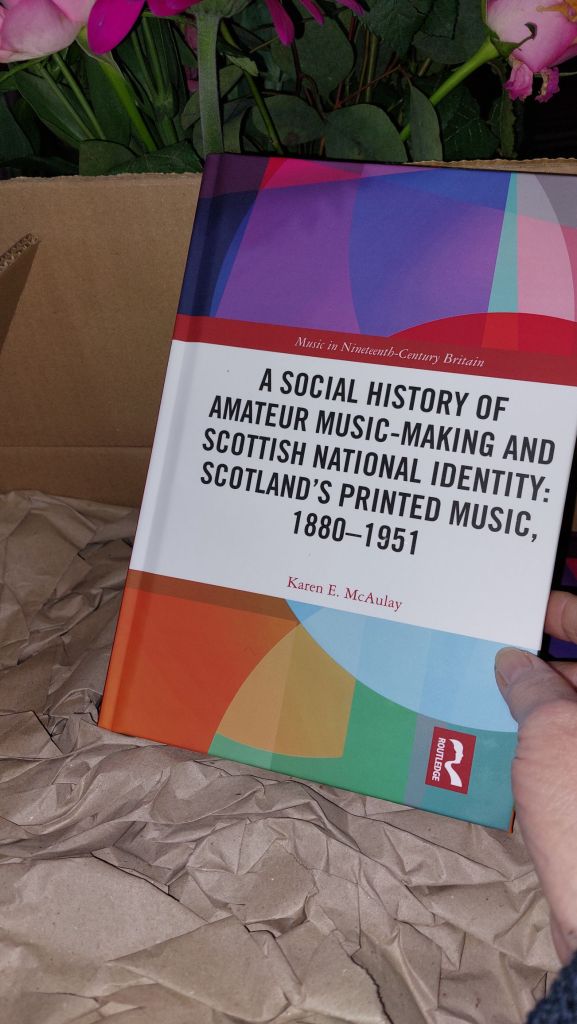
Getting Closer! The Second Monograph

Earlier this week, I got an email from my publisher, asking for an address to send my complimentary copies to. Suddenly, the publication seems very real. It can’t be long now.

A Social History of Amateur Music-Making and Scottish National Identity: Scotland’s Printed Music, 1880-1951.

Incidentally, Amazon seems to think there will be a Kindle edition, too. Good news for individuals who want a more affordable copy!

Image: Pixabay

Reassessing an Impression

You’ll remember that I’m currently writing an article about some Scottish women whom I encountered during the research for my forthcoming book.  (Actually, I have quite a bit more detail, to the extent that it would be a shame not to share it.)

So of course, I can’t share it here, yet. However, I can reveal that one lady in particular worked as an entertainer, in a trio taking Scotland to emigrants in the diaspora.  (I had only traced her on one tour – I didn’t find evidence of her subsequent life – until today. But we’ll come to that in a minute!)

I did NOT expect to find her, as an even younger adult, performing what was then comparatively recent chamber music back home in Scotland.

So I looked for YouTube recordings, just to hear what exactly she had performed.  This was more highbrow, and more ambitious than I had given her credit for!

Anton Rubinstein – Piano Trio no.2, op.15, in G minor (1851)

Henryk Wieniawski – Legende, violin and piano (1860)

Henryk Wieniawski – Scherzo-Tarantelle, op.16, violin and piano (1885)

Today, I also found confirmation that this lady emigrated to Vancouver, got married (over there?) – and was a theatre musician for some years.  Given Vancouver’s penchant for vaudeville, that may have been her work, but this is pure conjecture.

I’m so pleased with these quick glimpses of another side of someone who I had previously imagined just as a purveyor of sentimental Scottish songs.  It doesn’t pay to pigeonhole people!

Knowing Where to Draw the Line

I am capable of searching obsessively for the most minute detail. On and on I go. Former librarians do not like giving up, and I’m afraid to say that by the time I’ve finished, I’m pretty certain that I’ve either found all that’s online to find, or it isn’t there.

So, I started writing an article last week.  I have plenty of data.  Why, I even have a scanned document from the National Library of Australia, and I have a photo of one individual that I never expected to find at all.

Nonetheless, on Saturday night, I thought of another search that I hadn’t tried.  Oh, my!  Immediately,  I found one of my musical Scotswomen exactly where I had wanted to find her. Very satisfying.

I went to bed thinking about my search strategy. I had breakfast and did a bit more before going out. This afternoon? Yup, back at it again.

South of the Border …

I think I persevered a tad too long. I found more adverts for her works.  I explored the names of professionals who performed them.  I even searched for pictures of the now-demolished theatre where one piece was performed.  (Oh yes, I found it.)  She may not even have seen that herself!

Finally, I found her advertising the services of two particular performers for whom she had written music.  Not Scots, either.  But that’s enough.  I suspect she didn’t do a lot more after that, or I’d surely have found it.

Am I drawing the line here, then?  Well, I have a couple of archival queries that I simply must see through to the bitter end, but then?  I’m still a part-time researcher.

Better get on with the writing in the time allocated to research! 

Third Space Professionalism in the Library: the Exhilaration and Exasperation of Hybridity

CONTEXTUAL EXPLANATION
This article was written for a peer-reviewed journal. Owing to personal circumstances and commitments, I was unable to make requested amendments in time for the deadline, and I withdrew my submission. Nonetheless, I’d like to share it, since I don’t foresee myself writing much more on librarianship in future. I present it here in the same shape in which it was originally written, give or take a few tweaks to sentences (and reversion to the first person in a few places).

Abstract

It is fair to note that ‘third space’ has a variety of meanings within librarianship circles, with the liminality of the literal physical library space attracting perhaps more contemporary commentary than the idea of a ‘borderland’ where silos break down and different professions meet.

Nonetheless, although recent writing about third space professionals has focused on individuals with administrative roles in academia, it prompts me to argue that academic librarianship similarly occupies a third space role, and the arguments for valuing and increasing the visibility of third space professionals are equally applicable.

I briefly describe the typical career path of those attaining librarianship qualifications.

There follows a reflective case-study on my own third-space professionalism, having attained librarianship and teaching qualifications, and a mid-career PhD. (I’m posting this article a short while after retiral from the library, as I embark on the next stage of my career.)

Best practice in the context of a third-space career in librarianship is outlined, suggesting that it is arguably just as applicable for achieving success and fulfilment in a third-space role anywhere in higher education.

___________________________________________________________________________

Introduction

Whilst authorities such as Emily McIntosh, Diane Nutt and Celia Whitchurch have researched and published various aspects of third-space roles in higher education, the focus appears largely to have been upon more obviously administrative roles such as student success professionals, or what reviewer Agnete Vabø describes as the ‘new administration class’. (Whitchurch and Society for Research into Higher Education, 2012; Vabø, 2013, p.646; McIntosh and Nutt, 2022, p.1)

In discussions within the library community, ‘third space’ or ‘third place’ has been construed more in terms of a physical space where different communities meet, whether students from a variety of backgrounds; or students alongside librarians; or a ‘third space’ rather like a bookshop or coffee-shop – a space that is neither home nor work, where patrons meet with various expectations, and where librarians occupy roles ranging from curatorial, through pedagogical, to something akin to a guide to the resources within. These and other constructions of the concept were extensively explored by American Associate Professor of Library and Information Science, James K. Elmborg, just over a decade ago.(Elmborg, 2011)

Image by StockSnap from Pixabay

In terms of the status of library staff occupying roles somewhere between administrative, professional and academic, discourse amongst American librarians has tended more to focus on what a recent report has referred to as ‘Academic librarian faculty status’, but this is not exactly applicable in the British context, where librarians are seldom described either as ‘faculty’ or ‘tenure-track’. (Wertheimer, 2023) This makes the concept of a professional ‘third space’ particularly appealing The present opinion piece argues that academic librarians have, in a sense, occupied a third-space position for years. I describe the nature of academic librarianship, outlining some of the pleasures and pitfalls of such a career, and addressing some of the misconceptions that students and academic staff sometimes hold about librarians.

Drawing upon personal experience, I posit that individuals occupying more than one role also find themselves in a yet another uniquely ‘third space’ of their own, and I highlight some of the challenges that this raises.

Lastly, I suggest some best-practice pointers towards making such careers as rewarding as they have the potential to be.  I believe this demonstrates the overlap between all the different kinds of career in these hybrid professional roles.

Becoming an Academic Librarian

Whilst educational administration and student success-related work has in recent decades become a largely graduate profession, there has been a professional framework for librarianship for much longer. It may therefore not be immediately obvious that there are significant similarities between library work in higher education, and other third-space professional roles.

In British librarianship today, graduates from other disciplines often take a postgraduate Master’s in Library and Information Science, in much the same way that a graduate aspiring to teaching might now take a Master’s in Education. (Only a few decades ago, a postgraduate diploma was considered sufficient in both librarianship and teaching.)  Indeed, mirroring our transatlantic cousins, an academic librarian might already have a Master’s in their own discipline before pursuing a Master’s in librarianship. Thereafter, there are various routes to becoming a Chartered Librarian, and optionally, in due course, a Fellow of CILIP. (Chartered Institute of Library and Information Professionals website, no date) 

Those occupying library assistant roles are equally likely to have a first degree, but may not necessarily have completed vocational training, unless their ultimate goal is a more advanced professional role. Conversely, some qualified librarians go on to acquire teaching qualifications as well, particularly when involved in library or research skills instruction. Teaching is a particularly relevant competency for librarians, in terms of assisting patrons.

Whilst librarianship in the UK is still a profession in which professional qualification and/or registration is desirable rather than compulsory, there is nonetheless an emphasis on gaining proficiency in a variety of key skills, with CPD encouraged both by librarianship organisations, and employers. Chartered Librarians or Fellows can choose to submit for revalidation after a while, but this is not essential.  (However, both the Charter and the Fellowship do require continued membership of the awarding body, otherwise one may no longer use the postnominals.) 

Subject librarians in academic libraries depend on subject knowledge as much as their professional skills. In-depth understanding of a discipline makes one better able to acquire the right library stock, whilst subject analysis enables one to create a more helpful catalogue to aid future discovery by readers. There’s little point in creating beautiful catalogue entries, if you don’t understand what a student is actually asking for. Having studied a subject to degree or postgraduate level, one can better understand queries and requests from both students and lecturers, but this also opens up opportunities for collaboration with teaching staff, when both parties appreciate the skills that the other brings to the task in hand.

Librarians are very much hybrids in that third space between professional and academic staff. For a start, we not only help students find resources for their assignments, but also advise on how to discern what is an appropriate or acceptable resource to use. That’s a bit more than being a pen-pusher, and indeed, is as key to a student’s ultimate success as the work done by our professional colleagues in student success roles.

Correcting Misconceptions

There are, however, misconceptions about what it takes to be an effective library worker. At times, patrons seem to regard our professionalism as little more than being an efficient office worker. Indeed, serving at an issue or enquiry desk is to some readers clear evidence that one’s main purpose is to stamp and shelve books.  This is untrue for most library workers!  To be dismissed as ‘just a librarian’ does tend to betray this viewpoint. 

‘You’re actually quite bright, aren’t you?’ an undergraduate observed, after a resource had been located for them. (They didn’t know that I’d walked away from doctoral studies to train as a librarian some years earlier. Ruefully, I reflected that an incomplete PhD – a “Ph” without the “D” – was no use at all.)  But, ‘What does a librarian want with a PhD?’, an academic once asked.

When a Librarian embraces Research

Much midnight oil was burned, before eventually – a quarter century later – I had a PhD on a different topic, self- funded and studied for in my ‘spare time’ alongside full-time work and raising a family. The knowledge I’d gained doing the doctorate was directly related to one of the subjects we teach at my place of work.

I followed the PhD by secondment as a Research Assistant to a major AHRC grant, publishing a monograph, taking a PGCert in Teaching in Higher Arts Education, getting an AHRC networking grant in my own right, and more recently being awarded an honorary research fellowship at another institution. Oh, and writing quite a bit more. Moreover, as a hybrid, third-space professional, it turned out I was very well-suited to helping with academic writing and referencing!

Occupying More than one Role: another Take on Hybridity

Whilst librarians certainly provide academic support, hybridity by its very nature can take different forms. Being a librarian with an element of teaching (we call it ‘user education’) is one thing. Being a librarian with an element of research – for twelve years, I was seconded to be a researcher 1.5 days a week – is another. Or try being a postdoctoral fellow at another institution whilst keeping the home-fires burning as a librarian at the same time. It’s not so much occupying one role in a ‘third space’, as occupying multiple roles and finding oneself a hybrid professional as a consequence.

Academics get research leave. I resorted to taking odd half-days of annual leave.

Carving out a Role in the Third Space

Approaching the end of my librarianship career, I inevitably reflected upon successes and failures. With a ‘year-end’ review, one does a similar exercise, but there is more expectation that certain things will be done differently, or better in future, in an effort to become one’s best, most efficient self.  However, I’ve chosen to focus on research, with a new part-time research role since retiring from the library – I’m leaving the third space for other people to make their own.

Nonetheless, these observations may be helpful to younger colleagues carving their careers as ‘hybrids’, somewhere between academia and the professional office – in whatever professional capacity. Taken in the following order, the mnemonic ‘CARVE’ seems appropriate:-

Collaboration and networking are by far the best way to experience fulfilment in a hybrid role. McIntosh and Nutt underline that, ‘One way to find a place is through participating in knowledge networks.’  (McIntosh and Nutt, 2022, p.5)  Librarians are fortunate to have a variety of librarianship organisations and interest groups with which to engage, and networking became even more important when I acquired other research-based roles:-

  • As an AHRC Research Assistant, I brought research skills, extensive experience in cataloguing music, and my existing engagement with appropriate library networks. Our small team was developing a database of digitised resources, entailing much comparison of sources and amassing critical metadata. (University of Glasgow et al, 2015)
  • With my AHRC Networking grant, I established a network of third-space professionals and scholars, as we explored printed music surviving from the eighteenth and early nineteenth centuries. Librarians and scholars met on a level footing. (‘Brio, Special issue: “Claimed from Stationers” Hall’: papers from an AHRC-funded network project’, 2019)
  • Before, during and since the pandemic, I devised a project of my own, acquiring more music by women composers and composers of colour, to improve equality, diversity and inclusion for our own library. Here, I was undeniably acting as a librarian, but I found myself networking with composers, museum professionals, librarians in other institutions, and educationalists at conferences, as I outlined what I was trying to achieve. (McAulay, 2023)  Indeed, the research I conducted proved useful in a variety of contexts. I’ve shared my findings with interested students, and proudly attended a Master’s student’s final recital, in which one of the newly-acquired works was performed. In future, there is also going to be a prize for diversity in recital programming – the initial idea was mine, even if I wasn’t in the space where the decisions were made.

Achieving a qualification, publishing something, or completing a project (within the department, or inter- departmentally) merits praise. In any role, there is plenty of mundane slogging, but it’s bearable if third-space achievements are noted and greeted with approval.

Recognition is important, and distinct from visibility (see below). Without recognition, success can be lonely. McIntosh and Nutt cite work by J. Hall arguing that ‘one of the challenges for those working “in-between “ is the lack of recognition and validation for this work.’  McIntosh and Nutt, 2022, p.2 citing (Hall, 2022)  Line managers can signal to other members of the department that achievements are a valuable part of the departmental success story. Without reinforcing this message, there’s the risk of causing resentment that one is pushing too hard against the glass ceiling, an upstart with ambitions above one’s station.  

Visibility is similarly crucial. It is entirely appropriate that a noteworthy achievement  should be disseminated – not just internally, but perhaps also sectorally. This boosts confidence and a sense of both autonomy and authority. Blogging and social media are invaluable, and journals are there for disseminating ideas.

Energy is required, to achieve the exhilaration of a successful third-space career. It can be exhausting, particularly in the effort both to maintain visibility and be an effective self-advocate. If, in a library, there is often a perception amongst patrons, whether staff or students, that librarians simply issue materials, send out overdue notices and catalogue things, then it must be very similar in the registry, faculty support office or IT department. Combatting misconceptions with a smile can be very wearing, but is there a choice?  However, backing from line-managers goes a long way to making the task easier and more fulfilling. Indeed, it’s crucial.

Conclusion

Librarians talking about libraries as a ‘third space’ tend more often to mean the physical space in which they operate, but there is also value in discussing the third-space nature of the librarian’s role.

It is important that the concept of the ‘third space’ or ‘hybrid’ professional should be more widely understood by those whose roles are more conventional.  Whether a professional in student success work; the library; or some other academic support role; or indeed, the individual wearing a multiplicity of professional ‘hats’, many workers in higher education support roles are striving to make a difference in a more modern, blended way. With appropriate departmental support, this can only make us more rounded as individuals, confidently offering a wider range of strengths and skills than hithertofore.

_______________________________________________________

Bibliography

‘Brio, Special issue: “Claimed from Stationers” Hall’: papers from an AHRC-funded network project’ (2019) Brio, 56(2).

Chartered Institute of Library and Information Professionals (no date) CILIP accredited qualifications – CILIP: the library and information association, CILIP: the Library and Information Association. Available at: https://www.cilip.org.uk/page/Qualifications (Accessed: 10 January 2024).

Elmborg, J.K. (2011) ‘Libraries as the Spaces Between Us: Recognizing and Valuing the Third Space’, Reference & User Services Quarterly, 50(4), pp. 338–350.

Hall, J. (2022) ‘Understanding and debating the third space: achieving strategy’, in The impact of the Integrated Practitioner in Higher Education: Studies in Third Space Professionalism, ed. E. McIntosh and D. Nutt. Routledge, pp. 26–32.

McAulay, Karen (2023) ‘Representation of Women Composers in the Whittaker Library’, Journal of Perspectives in Applied Academic Practice, 11(1), pp. 21–26. Available at: https://doi.org/10.56433/jpaap.v11i1.533.

McIntosh, E. and Nutt, D. (2022) ‘The Impact of the Integrated Practitioner: Perspectives on Integrated Practice to Enhance Student Success’, Student Success Journal, 13(2). Available at: https://studentsuccessjournal.org/ (Accessed: 18 December 2023).

University of Glasgow, University of Cambridge, Royal Conservatoire of Scotland (2015) HMS.Scot: Historical Music of Scotland. Available at: http://hms.scot/ (Accessed: 3 September 2024).

Vabø, A. (2013) ‘Review of In the space between administration and academia. Reconstructing Identities in Higher Education. The Rise of Third Space Professionals’, Higher Education, 66(5), pp. 645–647.

Wertheimer, A. (2023) ‘Review of Academic librarian faculty status: CLIPP # 47 (2022)’, The International Journal of Information, Diversity, & Inclusion, 7(1/2), pp. 1–3.

Whitchurch, C. and Society for Research into Higher Education. (2012) Reconstructing identities in higher education: the rise of ‘third space’ professionals. 1st ed. New York, NY: Routledge. Available at: http://ebookcentral.proquest.com/lib/aston/detail.action?docID=1075438 (Accessed: 18 December 2023).

Cover Image by Joe from Pixabay

Weird! Discussing an Article Title with Chat GPT

Did I imagine, even 15 years ago, that I’d be discussing a potential article title with an AI function? Sure, I benefited hugely from online resources during the writing of my PhD in 2004-9. However, even social media was only just getting off the ground – I don’t remember engaging with it until after the PhD was completed. Even then, if you asked a question, it was answered by another human being.

Image by Brigitte Werner from Pixabay

However, I came up with the ‘perfect’ article title before I fell asleep last night. So perfect that I could remember it in the morning, when I checked to see if anyone else had already used the opening killer three words before. And, unfortunately, they had. Spelled the American way, the phrase had been used for an American actress’s book that was a combination of ‘lifestyle’ and autobiography. It appears that my beautiful three words described a particular kind of Southern Belle. This was absolutely not what I expected to find. Even with the British spelling, I couldn’t begin my journal article with a recent book title! Particularly when it was on such a very different topic.

I played around with a new title. Should I run it past someone else to see if it sounded appropriate? That felt a bit extreme. It’s just a title, that’s all. I know what I’m going to write about.

And then I remembered Chat GPT. I’ve experimented with it on a microscopically small scale, as you’ll recall. Really, just enough to find out for myself where its strengths and weaknesses might lie, in case anyone asked me what I thought. And then I had stepped back, wary of committing my own words to the big robot in the sky.

Today, I typed tentatively,

‘How about this for an article title:- […] ?’

Chat GPT was impressed!

Your proposed title, ” … ” is compelling and effectively captures the essence of your article. It suggests that the research will challenge preconceived notions or stereotypes […] , making it intriguing for readers.

Well, this was encouraging. But Chat GPT wasn’t done yet!

The phrase “…” is a strong, attention-grabbing lead that sets the tone for a discussion of unexpected findings or reinterpretations of historical narratives. The rest of the title clearly indicates the specific focus of the study, which is both informative and precise.

Overall, it’s a well-crafted title that should resonate with your audience.

Image by Elisa from Pixabay

Am I gullible, and maybe too easily flattered? But it does make me feel that perhaps I’ve got a good enough working title to be going on with. From here on in, though, Chat GPT won’t get a look-in. I never want to end up with something that wasn’t actually written by me. I’ll check how a title sounds. I might even check out a synonym, or ask if I’m using a phrase in the expected way. But basically, I’ve done the research – now I’ll write it up.

Postscript. I also ran the title past a real, respected human being. The title stands!

Main Image by Alana Jordan from Pixabay

Maybe Read this First? Hanley’s ‘Dancing in the Streets’

Picture from Dancing in the Streets book cover

Unless you’re Scottish, you may not have come across Clifford (Cliff) Hanley. He was a Glasgow journalist, writer and sometimes lyricist, born in 1922 and dying in 1999. Dancing in the Streets was first published by Hutchinson in 1958. My own eBay copy is a 1983 reprint by Edinburgh’s now defunct Mainstream Publishing. Amusingly, it came secondhand all the way from a library in Ilford, Essex!

Picture of 1983 Mainstream Publishing edition of Dancing in the Streets book

On the second day of my indisposition with Covid, I picked it up, decided that even Glasgow autobiography and social history was beyond me, and turned to Audible. Don’t judge me! But yesterday and today, feeling closer to my normal self, I picked it up again, and read the whole thing cover to cover. This is a man who knew Glasgow inside out, as a local journalist. (You’d like to read his obituary, maybe? Here it is in The Guardian, 14 August 1999.)

Subject heading: Glasgow (Scotland) Social life and customs

Hanley wrote well, and entertainingly. There’s lots of local colour – not to mention wee reminders that times have changed since then. (Go to a party on the night your wife’s in hospital having your firstborn? I think not! I imagine husbands weren’t allowed in the delivery room in those days, but this is still barely a mitigating factor!)

I bought Dancing in the Streets in the hope of tracking down some elusive information – which I didn’t find, as it happened. (It was, admittedly, a long shot!) However, I did recognise names that I’d already encountered, and I was to discover different gems that filled me with some excitement, because odd little passages foreshadow things that I, as an incomer to Glasgow, had later discovered through diligent research, and these convinced me that what I have written in my forthcoming monograph is certainly born out by someone who was actually there in inter-war and postwar Glasgow. I’m quite glad I hadn’t read it until now. It’s useful background, but it’s not on the subject of Scottish music publishing or amateur music-making, so I don’t feel I was negligent in not considering it earlier. However, in bearing out truths that I had to learn the hard way, there were several ‘Yes! See?  That’s what I found!‘ moments, amongst the laughs that I couldn’t stifle between coughing!

For example –

In my forthcoming book, I’ve written about Emigration and Homesickness

Hanley took a holiday job on a cattle-ship from the Clyde to Montreal, as a very young teenager. On page 95 of his book, he meets some Glaswegian expat women there:-

‘How is Argyle Street, son?’ one of them asked kindly. ‘Fine – still the same, big crowds on a Saturday night an’ buskers playin’ the flute.’ ‘Oh, my God!’ She started weeping, but took a hold of herself. ‘It’s that nice tae hear a good Scotch voice. Could you no’ take me hame on your boat, son?’ ‘I wish I could’, I said in desperate pity. ‘Ah know, ah know, son, ah wish you could tae. Don’t you ever leave your hame, son, it’s the best place in the world. Ah wish tae God ah had never left dear auld Glesga.’

You can see how sentimental old (or more recently manufactured) Scottish songs would go down well with such fond emigrants!

In my new book, I mention Newer Approaches to Folk Song in the 1950s

I have certainly not suggested that the folk revival started, like flicking on a light switch, in a certain year, but I have highlighted new trends, and the influence of Edinburgh University’s new School of Scottish Studies. It’s fair to say that Hanley was not in this new movement. On the contrary, he seems to be poking gentle fun at it, on pages 208-10 of his book. At the abovementioned party, he describes an actor who ‘wanted everyone to sing folk songs, or Hebridean mouth music’, and a girl who was a potter, who wanted to ‘dance some kind of reel in her bare feet’. Later, she was ‘doing something stooping down and stamping, which apparently was meant to represent walking [sic] the tweed’.

WAULKING not Walking

Clifford and the potter were both, I’m afraid, wrong. The word is ‘waulking the tweed’ and Hebridean women used to thump urine-soaked cloth on a table, to soften it. Yes, I know – it sounds gross, put that way! (Feel the same about your genuine old Scottish tweed now?) Anyway, here Clifford has encountered one individual who is more aware of the new trends, and another who has a vague delusion that she understands it! Neither are seen as kindred spirits. Hanley wrote for a living, including the aforementioned song-lyrics, and had occasionally dabbled in performing on stage and radio. Probably a little younger, these partygoers were not part of his usual scene at all.

I’ve written about Teenagers and Gramophones and American Influences

And on page 242, Hanley writes about the decline of variety theatre, about teenagers’ musical tastes, and a new preference to listening to music at home on gramophones rather than go out to a variety show.

Don’t be Shy to read ‘Non-Academic’ Books!

So, unexpectedly, reading this book came as welcome vindication for some of the points I’ve made – a feeling which is always nice, of course. It’s hardly surprising that a book like this actually functions as useful background reading for a study in popular musical culture. But it also came as a welcome reminder that sometimes there’s benefit in stepping back and reading more widely. A book doesn’t have to be a scholarly tome – no index or bibliography here – to contain worthwhile background information. Information, in fact, that I wouldn’t even have recognised as valuable before I embarked on my research, but which came as validation of the most welcome kind.

My own book’s been copy-edited, the proofs have been corrected, and it’s well on its way to being published. I believe orders can be placed at the end of October. But for now, you might just find me heading to the local library to see if I can pick up anything else by Clifford Hanley. You can get Dancing in the Streets very cheaply secondhand, if you’d like to read it for yourself.

Highland Archive Centre – Conan Bridge School, 1880s

Another Covid-ridden short from me today. See if you can see what excited me about these images of Conan Bridge School inventory …

Highland Archive Centre Facebook Posting 31 Aug 2024