Dr Karen McAulay explores the history of Scottish music collecting, publishing and national identity from the 18th to 20th centuries. Research Fellow at Royal Conservatoire of Scotland, author of two Routledge monographs.
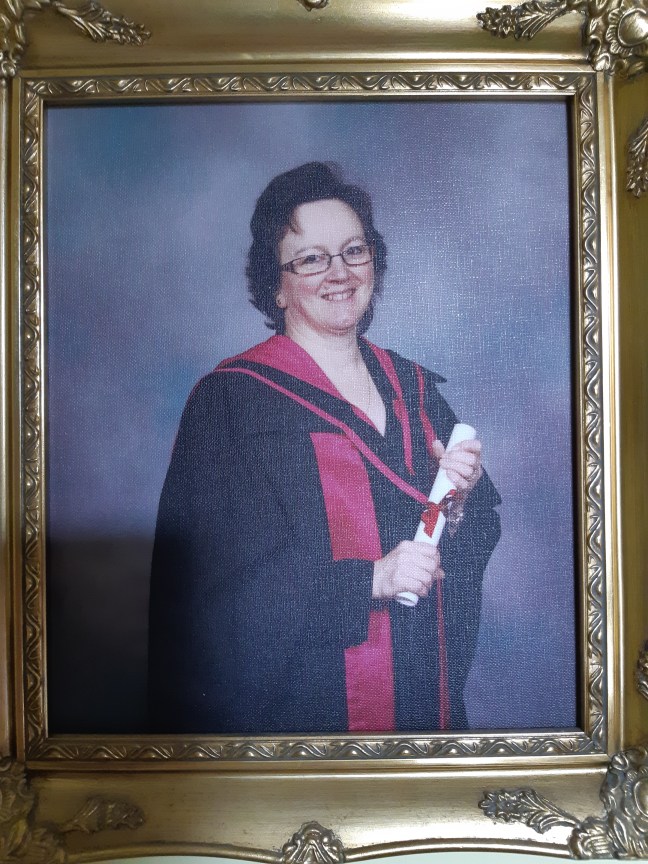
Facebook has just reminded me it’s 15 years since my doctoral graduation. Heavens, where did the time go?
Two Knees and a PhD
Summer 2009 was quite a summer! I submitted my thesis. He had two knee replacements, three months apart. He walked comfortably at my graduation ceremony.
Baking is not really one of my strengths!
Since then? Too much to enumerate. The thesis became a book. I contributed chapters to others’ essay collections. I published another book last month.
Why would a Librarian want a PhD?
Someone asked that, before I even started. I think I’ve demonstrated why.
Why would a Librarian want a PGCert?
Someone asked that, too. It seemed a good move at the time, and I have recently been doing a little teaching cover, proving that this wasn’t such a bad idea, either.
If one thing is certain, I wouldn’t now have a semi-retired existence as a postdoctoral research fellow, if I hadn’t found three old flute manuscripts in a cupboard that was being dismantled, a couple of years before I started the PhD.
I thought folk might be interested to see a quick summary – NOT the whole talk – of the keynote I gave at the University of Birmingham yesterday. ‘Alt-Ac’ is Alternative Academia, or Alternative Academic. You’ll see what I mean …
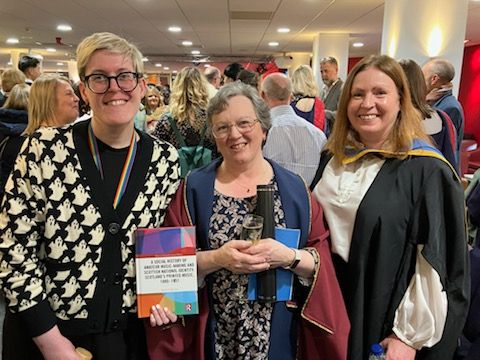
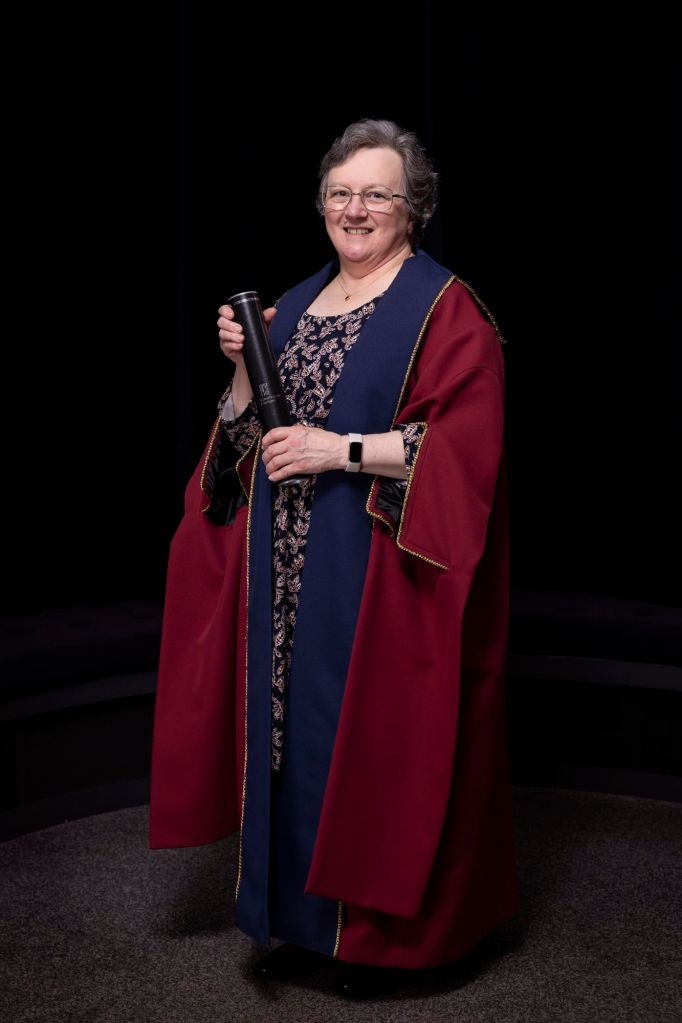
I’m very happy to have been honoured with an honorary Fellowship of the Royal Conservatoire of Scotland, the place where I’ve worked for 36 years. It was a memorable and touching evening.
We tell students that they should not make assertions without providing evidence. I was recently explaining that I had found a great website with a long article about the Shakespeare controversy. It criticised a couple of other authors for blithely ascribing half of Shakespeare’s plays to a woman, Emelia Bassano Lanier, without providing sufficient (any?) evidence.
Now, I’m not a Shakespeare scholar. (I did study some of his plays for A-level, a very long time ago – that doesn’t really count!) In recent years, I have become aware that some experts query whether he did write all the plays ascribed to him. That, in summary, is really all I can say about the controversy, because I simply don’t know enough to make further comment.
I was, however, quite taken with this website’s argument. The authors they were criticising had proposed Emilia Bassano Lanier as the author of a number of ‘Shakespeare’ plays. The justification for this assertion was apparently that Emilia hadn’t written much in her own name before middle-age, due to the fact (?) that she had been busily writing some of the plays that we now consider to be by Shakespeare, before that. It seemed a very shaky assertion!
You need to back up your statements with firm evidence, I insisted in my seminar. Well, I was right in that advice.
However, we also talked a bit about being accurate in our references, and checking where our information came from. Very important, as everyone will agree. And here, I’ve come unstuck. Because, if you wanted to cite the Oxfraud website, the first thing you find is that there’s no date of publication at the bottom of the page, and no obvious sign of who the authors are – or whether they have an institutional affiliation. (Don’t try googling, “Who is responsible for Oxfraud” – it thinks you’re asking about monetary fraud.) Indeed, there is also an Oxfraudfraud website and a ShakespeareAuthorship website, and I’ve no doubt I’ve only scratched the tip of the iceberg. But I shan’t be delving any deeper. I don’t need to cite it.
In the circumstances, it’s probably a good thing that, as a musicologist, I don’t actually need to know about the Shakespeare controversy!
Today was my first wee bit of teaching*, since retiring from the library and becoming solely a part-time research fellow. Sporting my new ID card (it now says I’m a member of the Research team), I got there in good time and strode up to the classroom door. I have never before been able to get through a classroom door without a student letting me in, so this was the moment of truth! I was in. Hooray! I eyed the digital whiteboard set-up with some suspicion, but I got the powerpoint working with no difficulty. All went well, and we had a good session. Hopefully, I’ve also navigated Moodle successfully – another new venture for me.
It’s not as though I hadn’t given lectures about my research specialism before. I’ve given research papers galore, but this was the first time of teaching, when I wasn’t speaking as a librarian. But, guess what? Despite my best intentions, it was unavoidable to mention the library, the songbooks on the shelves, the library donations … hardly surprising, because I wouldn’t have written my second monograph without being prompted by some of the old music in all those carrier bags and boxes we took in over the years. I even caught myself saying ‘we have ….’ and ‘we did …’. Old habits die hard.
I’ve achieved my ambition – I’m a research fellow – but I can’t pretend I don’t have a library background!
*For clarification, this was a guest lecture. I’ve a few more temporary teaching dates lined up. It’s nice to use my PGCert in this way.
To anyone starting out on their research journey, visiting an unfamiliar library can be intimidating. Here are some tips to help you prepare.
Know what you’re looking for. (1) Have you been able to check the catalogue online and get the shelf references?
Know what you’re looking for. (2) Have you got all the bibliographical details to hand? You might need them to look something up once you’re on site, in a card, microfiche or some other retro catalogue format. You also might need to ask someone to fetch items for you – reference libraries don’t have all their stock on open access, and special collections/archives never do – so it’s only reasonable to have as much info as possible to share with the staff who’re going to help you.
Know what you’re looking for. (3) Be clear in your own mind as to why you’re going to see these resources, what you’re intending to look out for, how much you can reasonably get through, and what it will take for you to feel you’ve had a successful day. This is crucial!
Practicalities (1) If you have to order things up in advance, be sure you’ve allowed enough time between your request and your visit.
Practicalities (2) Check travel arrangements and book in advance if necessary.
Practicalities (3) Have a pencil, rubber and ruler. Pens may not be permitted. Take your laptop cable. Find out about wifi access.
Practicalities (4) Ask if you can use your phone to take photos. There could be a form to fill in.
Be prepared for different rules and procedures. Answering your phone with a whisper might be okay in your usual library, but an absolute faux-pas somewhere else! Last week, I answered my phone in a public library, and had just started to explain that I couldn’t speak because I was in a lib …. (you’ve guessed the rest. Shhhhh! My own fault for answering it in the first place.)
Have an open mind. Be prepared for unexpected finds! If it looks useful, note it. AND note the page you found it on! Don’t scribble something so cryptic that you’ll never remember why you wrote it.
Get there early, if possible. Have a leisurely coffee before you start, because there’s always the chance you’ll be so engrossed or busy that you won’t want to waste precious time later on!
On your way home, try to go through your notes. Highlight anything you need to follow up.
I had a great trip to Edinburgh yesterday. The sun shone; I made it up the 122 News Steps to the Royal Mile without ending up completely out of breath; and I was so early that I was able to have a very leisurely coffee indeed in the sunshine, before heading to George IV Bridge. I had only ordered four actual items to look at, but I was looking at them quite intensively, so that was exactly right for the time I had available.
‘Lost Works’, meaning No Known Library Holdings at all
I took notes and photos, found a couple of extra unexpected features (evidence of ‘lost works’, no less – that’s a book history term meaning that we know the title did exist, but no copies are extant in libraries today), and on the way home, I was able to email another library with a question about their own edition of a piece of music I’d just been looking at.
Sadly, I can’t assure you that every research visit will be as sunny or as successful as mine was – but at least you’ll have given yourself the best chance!
Completely unrelated to my research – I just liked it!
Perhaps it’s not surprising to find more librarians and former librarians than usual at a research conference about book and print history and the book trade – but I was certainly in my element amongst the researchers at this week’s Print Networks conference in Newcastle. Indeed, I even found two more musicologists and a music practitioner amongst the kindred spirits, so I didn’t really need to try very hard to make my point that printed music history is indeed a branch of book history. Glasgow printers also got a look-in, so my talk about Glasgow music publishers wasn’t out on a limb geographically, either.
Then there were trade catalogues, book pirates, Stationers’ Hall, slave narratives, radical newspapers in Birmingham … just so many interesting papers!
Having spent the first part of the week in Newcastle, the last couple of days were ‘mine’, an agreeable blend of sociability, along with mundane catching-up at home, and (ahem!) more research.
A Lost Work, aka, a Ghost Publication
An old copy of a classical piece in a Mozart Allan edition raised some interesting questions – could I resist following them up? Indeed I could not. I’ve found another lost work – or as I prefer to call it, a ‘ghost’ publication. It would have been so very nice to have tracked this down. The advertisement absolutely reinforced a point I make in my forthcoming book. But it’s in neither Jisc Library Hub Discover, WorldCat, the British Newspaper Archive, Abe, Alibris, eBay, the Sheet Music Warehouse, Google Books nor Archive.org. There’s no mention of an editor or compiler for this collection, just a title. Oh, bother!
London suburbs
And a London Gent supplying Mozart Allan with Light Music?
It gets worse – another advert at the back of the same classical piano piece appears to suggest that a light-music composer who published almost exclusively with Ascherberg, Hopwood and Crew, also published a few early works with Mozart Allan – but using a different first name. Two of the works published by Mozart Allan also appear later with the first name he was mainly known by. This is interesting. I’ve spent several hours yesterday and today trawling eBay (and treating myself), whilst on the trail of this gent. Yes, I know the book is already in preparation. Anything I find won’t go in the book, but research doesn’t stop when a book is published, does it?!
I’m conscious that my blog posts in recent months have been on several recurring themes. Since they reflect my preoccupations over this period, I don’t regret this focus. However, this week feels a bit like a turning point. (One giant turning point for the country, as it turns out, but also an unrelated turning point for one recently retired small librarian.)
So, following the maxim at the head of this post, now is a time for looking forward rather than back.
My librarianship career was sandwiched between two periods of doctoral study – the one I didn’t complete before proceeding to librarianship training, and the one I worked for part-time in my spare time, a quarter of a century later. That led to the long-term partial secondment to Research and Knowledge Exchange. I have often blogged both about my own expectations of myself; about other people’s expectations and perceptions; and about the perils of making comparisons with other people.
I was an academic librarian throughout my whole career, but since 2012, I combined librarianship with postdoctoral research. Many of my blog posts have mused on the challenges of combining two roles.
I have blogged about looking back over this double-stranded career, my achievements and disappointments.
I’ve blogged about things I’ve discovered during my research.
I’ve blogged about practical processes – like working on a monograph, using Zotero, researching using databases, and instructing students in library-based research methodology.
I’ve blogged about fellowships and other forms of recognition.
I’ve also blogged about library initiatives, such as my work in diversifying the library collection to include more music by women composers and composers of colour.
All Change!
But I’m not a librarian any more. I’m semi-retired. I need to stop defining myself as a ‘librarian who also does research’, and redefine myself as a part-time academic.
I now have a single role: my contract as a part-time post doctoral research fellow. It means I have a lot more ‘spare’ time, so I can spend some of that on research, too, as need requires.
I must get out of the habit of unequal comparisons.
I can also visit Dundee more often, in connection with the Friends of Wighton – where I’m honorary librarian, a completely different role to being an academic librarian in a Higher Education institution.
And I need to spend more time looking forward, and less looking back. The future holds opportunities:-
Temple of Janus, the Greek god of new beginnings
My forthcoming monograph, which I’m currently indexing, and a book launch in connection with that.
the Heritage Collections fellowship at IASH (Institute for Advanced Studies in the Humanities) at the University of Edinburgh, between January and June next year. I’ll be researching a particular archive in the University Library there.
New research ideas.
Outside of my research role, in my ordinary life, I look forward to more organ practice, more composition, and probably more reading and needlework!
It is very, very tempting to look around for ‘things to do’. For groups to join, and possibly opportunities to volunteer for. At the same time, I realise that there’s a risk of taking on too much, too soon. There’s also something very appealing about just waiting for new opportunities to present themselves in their own good time. One might already have done so – time will tell.
People have asked if I’ve got a holiday planned at all. I’m sure this would be a sensible thing to think about, especially considering that last summer’s annual leave was spent finishing the first draft of a book! But I need to know that the finalised book, edited and indexed and all, is on its way to the printers before I can take off on vacation. So – no, nothing planned as yet. August, maybe!
Starting today, that’s my new official title. Prior to my retirement from the Whittaker Library at the Royal Conservatoire of Scotland, I was seconded part-time to Research and Knowledge Exchange. Today, after a brief break, I return as a post doctoral research fellow, since I plainly can’t be seconded from a role I no longer hold.
Reincarnated / ReinKarenated
It’s strange. Today, I sit at my working-from-home desk – same desk, same research work to do, same hours – outwardly, nothing has changed, and yet everything has changed, because I retired from Professional Services and returned to Academic Services. Research is now my sole role, not a small chunk cut out of my 9-5 library existence, and I’m a Research Fellow rather than a Researcher. It’s what I’ve always wanted.
Karen has been reinKarenated, you could say.
What’s in a Name?
‘That’s not how you say my name!’
If I explain the embarrassment of my name, the pun will make more sense. My family pronounces my name ‘Kar’ to rhyme with car, rather than the conventional ‘Kar’ to rhyme with carry. Don’t blame me!
I stopped trying to correct people a very long time ago – it’s not other folks’ fault that my parents decided to pronounce my name distinctively differently. If you’d spent several decades being thought prickly for insisting on an unusual pronunciation, you’d understand why I’ve given up on that!
Call me what you like – I’m a research fellow, and I’d better get on with indexing my monograph ….
Whilst I was going through archival materials today, looking for music-related documentation, I came across all sorts of non-musical correspondence. I wasn’t surprised. Sometimes, it’s rather nice to see what falls out of Pandora’s box, after all. All the ‘extra’ material vastly enriches the ultimate narrative. And other tidbits just raise a smile:-
Parisian pavement cafeRaasay, Western Isles
I found one publisher offering to order whisky from an Inverness wine-dealer for another publisher holidaying in Raasay. Very fraternal!
I found someone looking forward to ‘frizzling in Paris’. (Considering Glasgow’s set to be 4 degrees Celsius tonight -in mid June – I can empathise!)
Then there was a job application letter. No clues as to the manager’s selection rationale – things were very different then – just, pencilled across the top – NO.
I found a terse letter from a professor who was distinctly unimpressed by the unavailability of a book (no, not a music book) that he wanted to purchase:-
Perturbed Professor
‘It’s damnable that such a valuable, well-written & cogent book should be off the market.’
But in 1947-1948, Britain was in economic crisis. There were restrictions on business activities, and if a publisher decided a reprint was non-viable then that, dear Professor, was that. Tough. (I wanted to tell him that eBay and Alibris would have helped alleviate his evident distress.)
I found travelling salesmen being asked if they wanted any books from a particular series. Music-related ones, even? I sat up straight at that, until I realised that the subtext was probably, ‘these books aren’t selling terribly well, old chaps.’
It wasn’t until I got home that I got myself into deep water:-
I looked up what was happening to the British economy in 1947-1948. I knew there WAS a crisis. Britain was in recession. I had never heard of ‘convertibility’ in the economic sense, and I find myself only slightly the wiser after a bit of Googling! World War II had taken its toll, and on top of this, the US had insisted on convertibility, it seems, and we very quickly descended into an almighty mess. However, such a simplistic summary doesn’t sound exactly satisfactory.
I’m undecided whether I need an Oxford Short Introduction, or can I get by with a more basic understanding? Oh well, plenty of time to ponder on that! (But if you’re a modern historian reading this, and you can think of something that would give me an intelligent layperson’s overview of post-war economics, then please do get in touch. Thank you!)















 Karen McAulay, Musicologist