Music by Subscription

Contributed Chapter

Music by subscription : composers and their networks in the British music-publishing trade, 1676-1820 / edited by Simon D.I. Fleming, Martin Perkins. (Routledge, 2022)

I wrote a chapter for this book, which came out in 2022. I wonder if anyone has read RCS’s e-book version? The hardback itself seems to have sat on the shelf unnoticed for a whole year ….

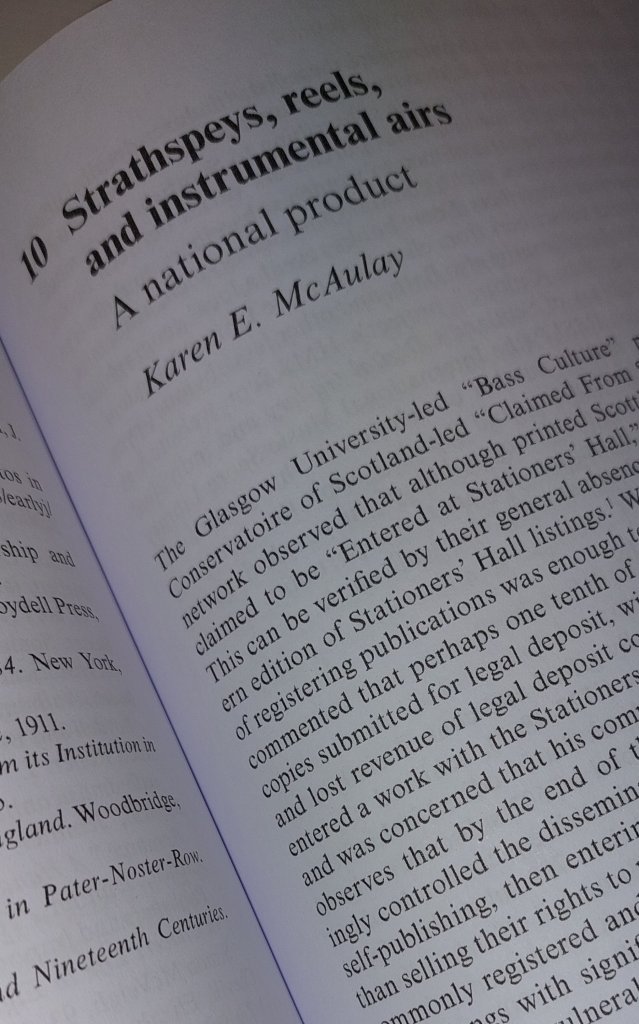
‘Strathspeys, reels, and instrumental airs: a national product’ (pp.177-197)

Meanwhile, back in the Whittaker Library – a Catalogue Entry

One day, when I’ve retired from librarianship, all that will be left to show for my 36 years here will be the books and music on the shelves – and their catalogue records. Naturally, I made sure RCS has a copy of Mozart Allan and Jack Fletcher’s The Glories of Scotland in Picture and Song. Click on the title to see how I’ve catalogued it!

I think you’ll agree I’ve managed to insert enough hints as to why I think it’s significant. There’s a book chapter coming out in an essay collection from the Centre for Printing History and Culture at Birmingham City University, so there will be more to read in due course.

Missing in Caption

So here’s the thing, as we say in Glasgow.  Looking up Doris Ketelbey some weeks ago, I thought I saw an interesting heading in one of her books: it was the title or first line of a Scottish song.  And I did EXACTLY what I warn students not to do.

It made such an impact that I was sure I’d find it again. After all, her book titles weren’t that numerous. Of course I’d remember. Moreover, if I’d found it once …  right? (It’s possible that I found it by accident, with an unlikely set of search words, though.)

I bought a copy of her most popular school textbook, shelved it, and that was me. Sorted!

Until I looked at it more closely. This was European and a bit of world history. Post-Jacobite, I couldn’t see anything where a Scottish song title would have been a suitable caption. And – had there been an illustration above it? – or was I havering? (The caption might have been on a digital image, not searchable as text, maybe …)

Maybe I imagined the illustration, but I remained convinced about that caption. Just a pity that I couldn’t remember the song!

  • I started searching last night. In bed, I lay awake, agitated by my failure to source the mystery book.
  • Today, I searched Hathi Trust and Open Library. No luck. 
  • I looked at Jisc Library Hub and Worldcat, but they weren’t going to show me what I needed.
  • Finally, I made a list of any Ketelbey titles which might possibly have touched on Scottish history (given that she wasn’t first and foremost a historian of Scottish history), and came up with another pair of books possibly also aimed at secondary schools.

There’s only one problem: the nearest copy is in Edinburgh.  I had hoped to find it  in Glasgow’s epic Mitchell Library, but this time I had no luck.

So … Amazon and eBay

However, I’ve ordered the pair for about the cost of a return to Edinburgh. If what I’m looking for isn’t there, then I have to admit defeat. I still don’t understand how something I found before is now so very elusive…

Image by Pexels from Pixabay and by succo from Pixabay

Enchanted!

The publisher travelled extensively, actually dying off the coast of South Africa on his final trip. Whether all these trips were for business or pleasure (or both), we’ll never know!

Image by Bob, Pixabay

The library received our second-hand copy of a music book today. It came from the USA, having first been sold in Johannesburg. There is something magical about a book, itself aimed at the Scottish diaspora, having been published in Glasgow and then spending time in TWO of the continents visited by its publisher, before returning to Glasgow today.

I know that, technically, it makes no difference to the contents. Of course it doesn’t. But I’d be lying if I didn’t say I’m over the moon with this particular book’s life-history!

Print and Tourism

I have contributed a chapter to a forthcoming collection on Print and Tourism, which is being published by Peter Lang.  The completed manuscript will soon be going to the publishers, which is very exciting.  You might ask what a musicologist was doing, writing about print and tourism?  Well, it won’t be long before all is revealed. 

I had enormous fun writing this chapter, and I think folk will enjoy reading it.  It’s different.  Well, that’s hardly surprising, given the subject matter, but I’ve placed it in a wider cultural context than my usual more musicological offerings, and I’m really looking forward to seeing it in print.

A Question for You: What’s significant?

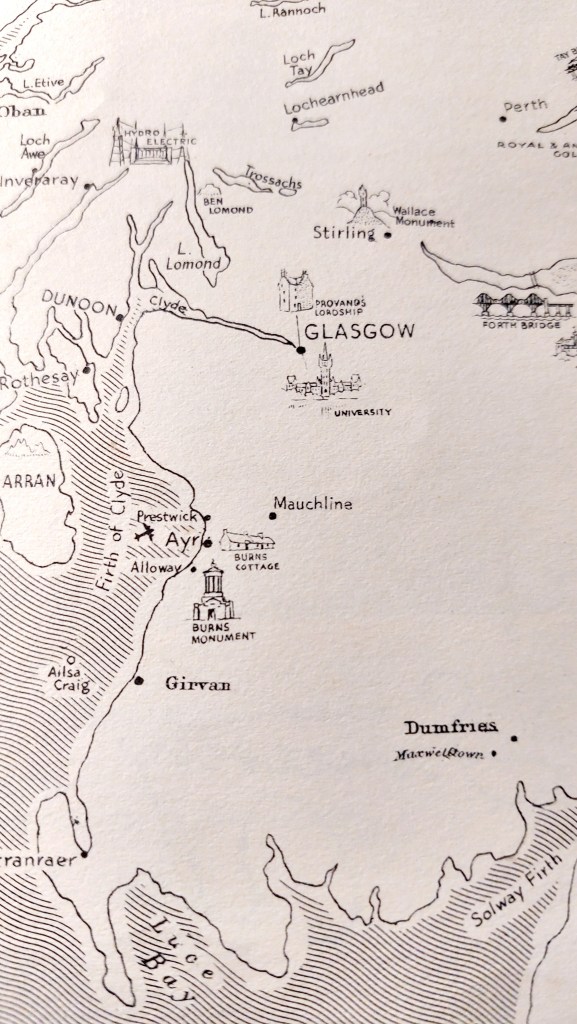
The topic arose from a book I acquired during lockdown.  Ironically, it was only a couple of weeks ago that it dawned on me that not only would we need to buy the essay collection for RCS’s library, but we’d also need a copy of the book which inspired it! I can’t think why that didn’t occur to me sooner, but it is on order and on its way, so I’ll be cataloguing it very soon. We’ll have it well before the essay collection is finally published!

So, your challenge is this: Can you work out what is significant about this map?!

I would never, ever have dreamed, when I went to Exeter to start my first, unfinished doctoral studies on mediaeval English plainsong and polyphony, that I would end up completing a different PhD thirty years on, and writing and being published on such a very different topic!

Reunited! Moffat and Kidson’s Nursery Rhymes

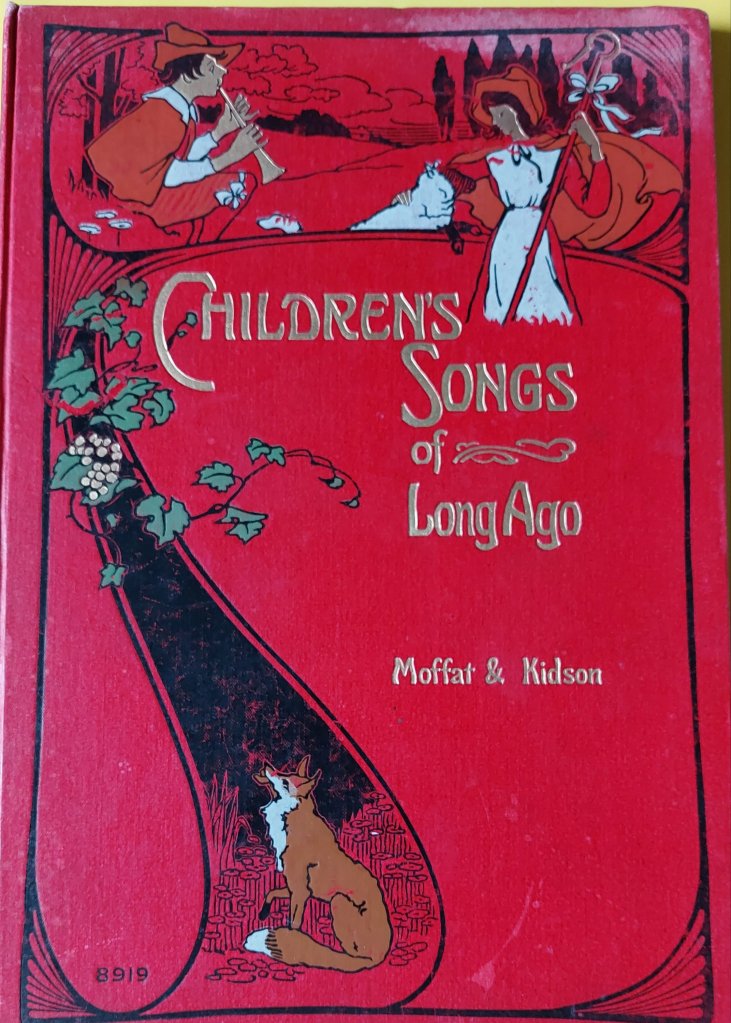
You’ll remember that I recently treated myself to an Edwardian book of children’s songs published by Augener, partly because I’m interested in the compilers, but mostly for the delightful cover? I subsequently discovered it was the sequel to an earlier book, British Nursery Rhymes. Well, I couldn’t have the second without the first, could I?

The sequel: Children’s Songs of Long Ago

Luckily, my interests are generally quite inexpensive! I will take them to the piano at some point – and look more closely at the contents, from the point of view of repertoire.

D’you know, just about every bit of research I’ve done has involved examining repertoire. Starting with 13th century Gregorian chant – not many people know I was initially a mediaevalist! I’ve come a long way.

A Fellow Back in 1901

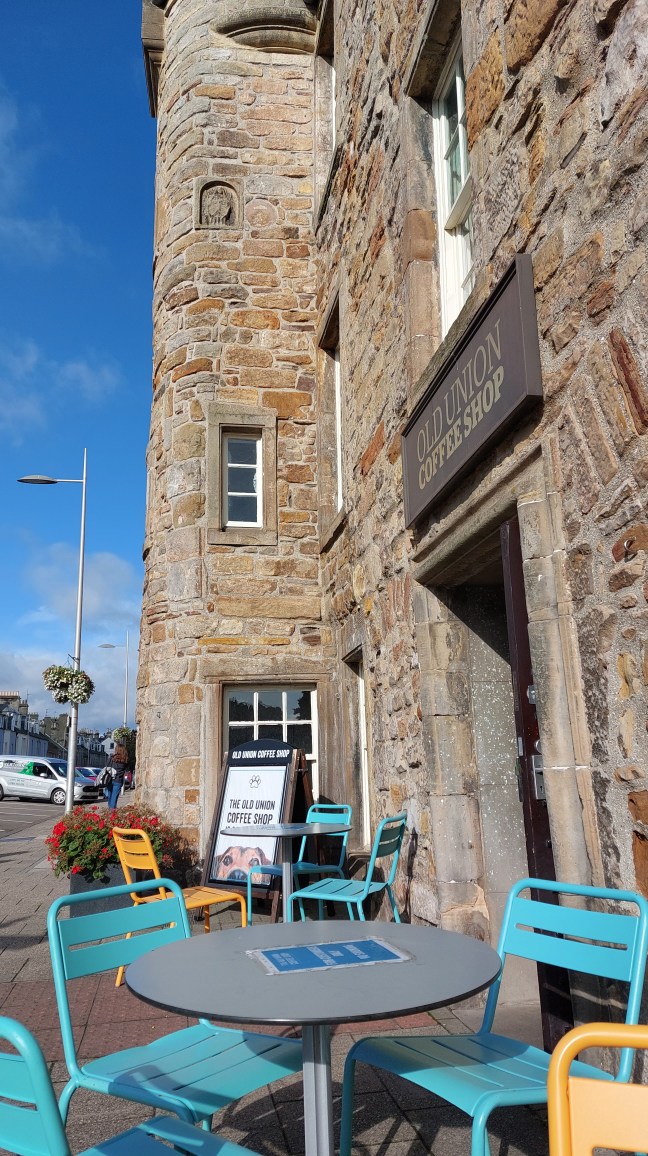
This is the third week of my Ketelbey Fellowship, and I arrived at St Andrews in pouring rain yesterday morning. Fortunately, it had subsided to a drizzle by the time I made my way to Martyrs Kirk, where materials from the Library special collections can be consulted. I didn’t get wet enough to risk dripping onto rare Victorian pamphlets! (I only know they were Victorian by the fact that the earlier numbers included God Save the Queen rather than the King – so they were published before January 1901.)

I had a ball! They each began with an editorial introduction – I love these. They’re so informative about the thinking behind whatever is in the book. Intriguingly, the editor seemed not to be the prime contributor, but all was revealed when I did some Googling later. Good old Baptie (Musical Scotland) informed me that the editor had two middle names, and used them as a nom de plume. No mystery after all! Moreover, one particular collaborator, more involved than most, was …

His daughter.

I didn’t quite get through the pile I’d called up, but I’m making good progress. And I encountered some interesting glimpses into social and political history. What’s more, if ever I needed proof that little girls’ education had a subtle difference to that of little boys, I found it today. It shouldn’t come as a surprise – I know it happened. But I wasn’t expecting to find this in a Sol-Fa song book!

It is such a luxury to have a desk in an office just a couple of minutes from a big university library. This morning, I snatched a quick coffee before I went back for another session with more of these instruction books. What’s more, I feel more a dedicated researcher here, compared to being ‘the librarian that also does research’ in Glasgow. It’s easier to focus, somehow. And tonight, I’m going to a research seminar, so I’ll get to meet some more historians then. Good times.

‘You can’t Judge a Book by its Cover’ (can you not?!)

I know you shouldn’t go on first appearances, but sometimes we do. (Why else do we make an effort with our appearance at interviews?!)

But I won’t spend my Saturday philosophizing. I just want to share my latest gorgeous ‘treat to self’, and a couple I bought earlier…

The above children’s book is a sequel! Yes, of course I have just bought a copy of the first book. Watch this space!

Lovely covers, and in Tonic Sol-Fa for easy reading!

Celebrating Milestones

I’m sure I’m not alone in wanting to buy myself something to mark a significant milestone – admit it, you do it too! Getting my second book submitted on time was certainly an important occasion for me. So, too, was commencing my Fellowship at St Andrews.

My gaze strayed to my eBay ‘Watch List’! I had ‘liked’ a lot of items. Some of them might, arguably, have been even more useful a month or two earlier, but I went through that list carefully. It was all printed matter, whether music or ephemera. I made a couple of offers (one has been accepted already!), then checked I couldn’t easily access the most desirable of the other publications some other way. That still left a handful of items I could definitely justify getting!

They will all be useful in the research I am now embarking upon – an extension of one particular aspect that enthralled me in my book project.

But one particular songbook – which I resolutely did not buy during the book-writing – sneakily snuck into my shopping basket! I had been telling it all along that it couldn’t be included, since it wasn’t published by a Scottish publisher. But although my specialism is Scottish music, there’s nothing to stop me buying something published by a contemporary English firm. And it is very pretty, as well as not being expensive! I’ll show you when it arrives.

Indeed, there are several English-published titles by ‘my’ Scottish educationalists that I now need to examine alongside the things they published in Scotland! But there’s a difference between treating myself and going overboard, so I deferred looking for those until another time. There will be library copies of quite a few of them.

Now, how do I explain the postie paying us more frequent visits for the next week or so?!

Image by Petra Reuter from Pixabay

Report of Conference: Reading and Book Circulation, 1600-1800

(Libraries, Lives and Legacies Festival of Research), University of Stirling, 17-18 April 2023

I wrote a report for the conference that I attended in April this year, thanks to an LIHG Bursary. This report has just been published in the latest LIHG Newsletter for Summer 2023 , Series 3, no. 53 (ISSN 1744-3180), pp.7-10.

I thought I’d share excerpts of the report here, too.

The conference resonated strongly with the research topic of my 2017-18 AHRC Networking Grant, Claimed from Stationers’ Hall, when we were investigating surviving music in the British Legal Deposit libraries of the Georgian era.  Although my network was interested in books rather than music, I had immersed myself in the Georgian borrowing records of St Andrews University Library, and had taken a particular interest in the music borrowing habits of women of that era, so the opportunity to hear more about what people borrowed apart from music was irresistible. 

On the subject of borrowing records, the opening introduction to the ‘Books and Borrowing 1750-1830 project’ and demonstration of the digital resource by Katie Halsey, Matthew Sangster, Kit Baston, and Maxine Branagh-Miscampbell was fascinating, offering so much data for investigation.

The following panel on Reading Practices in Non-Institutional Spaces was just as interesting, with Tim Pye’s ‘Had, Lent; Returned: Borrowing from the Country House Library’, along with Abigail Williams speaking about non-elite book use in rural settings, and Melanie Bigold’s paper about women’s book legacies. Whilst my own interest has been in formal library borrowing, ‘my’ borrowers took music away for their leisure-time enjoyment, and these papers served as a reminder that musicians were probably just as likely to have borrowed music outwith the more regulated library environment. Similarly, the concept of the Sammelband is very familiar to me – that was how libraries kept their legal deposit music. Sam Bailey invented a useful new verb, ‘Sammelbanding’, during the course of their talk on ‘The Reading and Circulation of Erotic Books in Coffee House Libraries’ – a topic far removed from my own research.

Kelsey Jackson Williams’ hands-on session with books from the Leighton Library, in an exhibition curated by Jacqueline Kennard, was the perfect after-lunch session, offering the chance both to stretch one’s legs on the way there, and to inspect some rare selections from the Leighton.

Parallel sessions meant tough choices, but I opted to hear Angela Esterhammer talk about John Galt’s various publishing ventures – an intriguing history – followed by Cleo O’Callaghan Yeoman’s ‘Still my ardent sensibility led me back to novels’.  (I reflected that St Andrews’ first music cataloguer, Miss Elizabeth Lambert, had read a wide variety of books, and whilst her reading included travel accounts, religious books, and books on botany and conchology, she certainly wasn’t averse to reading a good novel, too.)  Next came Amy Solomon talking about Anne Lister’s considerable book collection at Shibden Hall, and how she had made an inherited collection her own, as well as keeping commonplace books, diaries, and reading journals. I regret having missed seeing the films about her diaries, and the two more recent ‘Gentleman Jack’ series on the television.

The first keynote paper was given by Deidre Lynch, on ‘The Social Lives of Scraps: Shearing, Sharing, Scavenging, Gleaning’.  I am sure I was not the only delegate pondering as to whether any of my own ‘scraps’ would survive to intrigue future readers, but more importantly, Deidre’s paper reminded us that proper ‘books’ are only a small proportion of the vast amount of printed material still surviving, often against the odds and far from their original context. 

On the second day, the opening plenary roundtable chaired by Jill Dye addressed borrowers’ records across Scotland, and I heard from several people with whom I was already acquainted, three of them through my own AHRC Networking project. 

We heard about the library of Innerpeffray, the National Library of Scotland, and Edinburgh, Glasgow and St Andrews’ University Libraries. I was interested to hear about the bigger picture, so that I could place my own special interests into the wider context.

For the third panel, I opted for the panel on Readers, Libraries and Loss.  Jessica Purdy gave a fascinating talk on ‘Libraries of Lost Books?’, speaking about chained church libraries, and the fact that their tight security and still pristine condition suggest that the books might as well have been ‘lost’ as far as most of the local residents were concerned.  Elise Watson, too, made us reflect upon just how many publications of Catholic devotional material had been published, even if they were so ephemeral that there are now ‘”Black Holes” of Ephemeral Catholic Print.’

For the fourth panel, I attended the panel on ‘Education’, hearing Maxine Branagh-Miscampbell talking about the Grindlay bequest and ‘Childhood Reading Practices at the Royal High School, Edinburgh’.  The Grindlay bequest was valued sufficiently that it was all added to stock, even though some material was never going to interest young or teenage boys.  Mary Fairclough gave an interesting talk on ‘Barbauld’s An Address to the Deity and Reading Aloud’.  I have recently encountered Victorian publishers appropriating evangelical hymns for magic lantern shows, but had not considered that poetry might also be ‘trimmed down’ and repurposed.

Duncan Frost’s paper did have a musical subject: ‘Bird Books: Advertising, Consumption and Readers of Songbird Training Manuals’.  Who would have thought that so many books were written about catching and training songbirds to sing in captivity?!  The most intriguing aspect of this genre of books was in fact that, despite many pages dedicated to all aspects of caring for and training your bird, there was significantly little information about the kind of tunes that you might want to teach it.

The second and closing keynote lecture was delivered by Andrew Pettegree, on ‘The Universal Short Title Catalogue: Big Data and its Perils’.  Professor Pettegree was at pains to underline not only what the USTC had achieved, but also its shortcomings, or rather, what it was not.  We were also reminded of some aspects that I have encountered in my own work: that books in libraries were not the only copies of these titles; they would have existed plentifully outside libraries, and so might other books which we can now only trace by, for example, publisher’s catalogues and advertisements. Moreover, library catalogues can conceal different editions, or show duplicate entries, depending on minor differences in cataloguing approaches.

Since my own networking grant, I have had to reflect upon the benefits of the work, and the impact the research has had.  One of the outcomes that I identified then, was that library history research created effectively a ‘third space’ where librarians and academic scholars – and those like myself, straddling both library and research worlds – could meet and beneficially share our insights and learning.  I realise that at this recent conference I had experienced exactly the same kind of meeting of minds again. Similarities of approach and a common interest in library and book history meant that I felt I had an underlying understanding enabling me to benefit from their fresh insights.

I am grateful to the Library and Information History Group for enabling me to attend this wonderful and thought-provoking conference.  Besides having such a rich array of papers to listen to, I certainly did benefit from the opportunities to talk to other delegates.  It was a treat to be able to take two days out of normal routine in such a beautiful setting, giving plenty of food for thought for the future.

Image: Image by G.C. from Pixabay