Dr Karen McAulay explores the history of Scottish music collecting, publishing and national identity from the 18th to 20th centuries. Research Fellow at Royal Conservatoire of Scotland, author of two Routledge monographs.
This has become a two-post day? Well, it’s International Women’s Day. How can I not mention it?
I decided I would play music by women this morning. Rose Smith (one of the women I recently wrote about in the RMA Research Chronicle – you’ll be familiar with her name by now!) was a piano teacher, a composer, and an Episcopalian organist. She was born in Lanark, moved to Glasgow whilst still a child, and later lived with her husband and children in Rutherglen. Her composed songs were rather like those by Ivor Novello – I’ve acquired nearly all of what seems to be extant, but I think a lot is missing. She only self-published a few, and the rest – for variety show singers – may not even have been published at all.
There’s no surviving organ music, so there was nothing for it – I played her songs before morning worship today. I bet you she never played them in church! However, since no-one knew they were secular songs, there was no harm in it. They’re well-written pieces, and I do think it’s a shame they’re not known. I did recommend one to an RCS Finalist a few years ago, and it was performed with enjoyment and appreciation.
I have significant performance anxiety about recording my playing, but I did unearth a piano demo of three songs by Rose Smith, that I recorded for a student a few years ago. Be kind! This isn’t a perfect performance or a perfect recording, but does show how the songs go.
Quick piano demo of three songs by Rose Smith
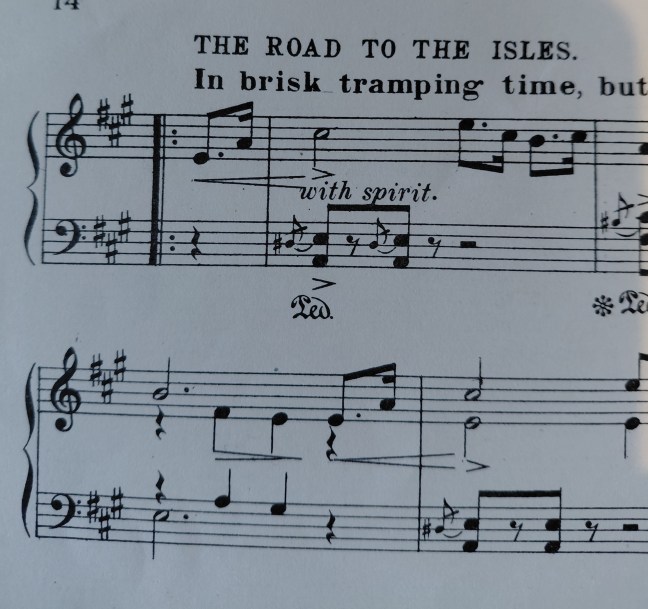
For my outgoing voluntary today, I turned to a more well-known composer. I played Marjory Kennedy-Fraser’s Eriskay Love Song, followed by The Road to the Isles.
Applause
I scored! I don’t usually get a round of applause after a voluntary.
I’ve got a new book of proper organ voluntaries by women composers, so I really must roll up my sleeves and learn some of them, but I suspect The Road to the Isles will prove hard to beat, as far as audience reaction goes …
The first and second Principals of the Glasgow Athenaeum School of Music weren’t actually in post very long. Allan Macbeth managed twelve years (1890-1902); then Edward Emanuel Harper, only two (1902-04). I’ve been researching them recently, and I do believe I’ve found out quite a bit more than has hitherto been known. But this post is not about their biographies and achievements – that’s for another time.
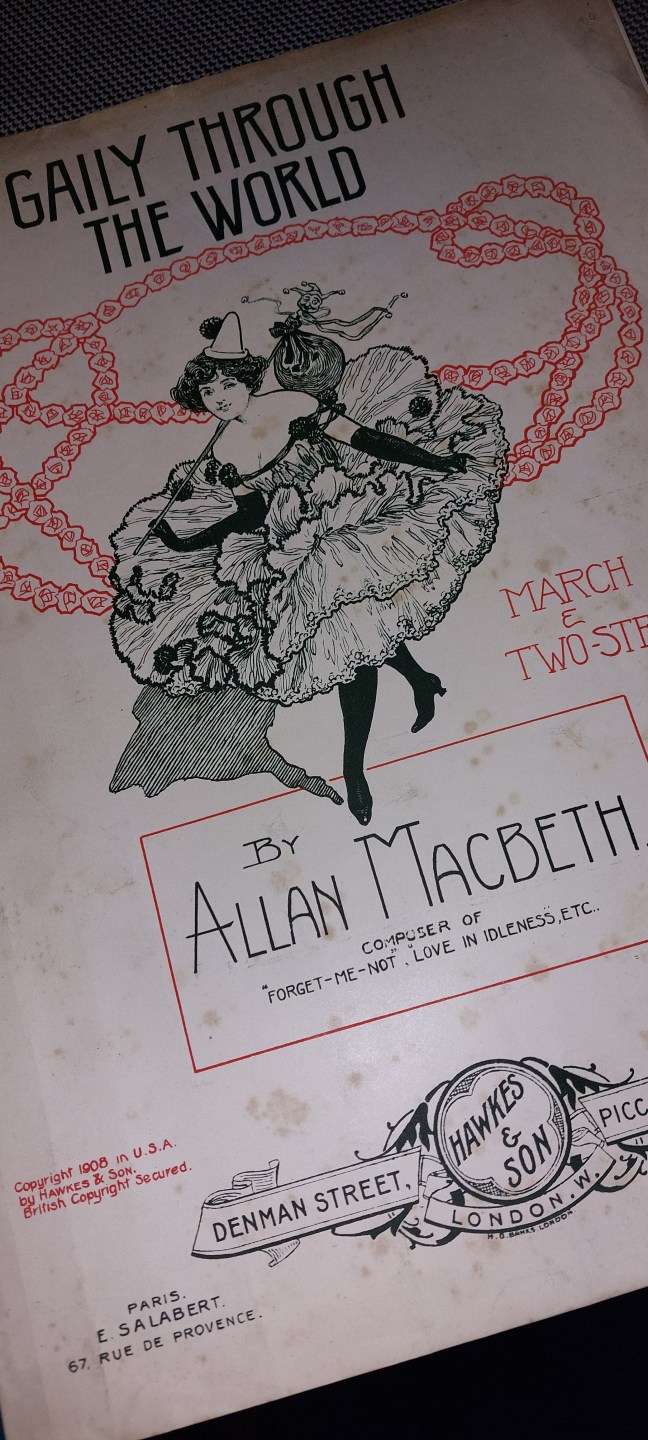
No, today is about practical music-making. Amongst a handful of compositions, Macbeth wrote a march and two-step, Gaily Through the World, which is actually very jaunty, and enjoyed quite a long life as a piece of band music. It’s not high art, but it does stand up as an effective piece of light music. It was published in 1908, two years before he died, by Hawkes. (Yes, the Hawkes that later went into partnership with Boosey in 1930.) That in itself is a mark of its respectability, if nothing else. The author of this YouTube posting says it was premiered at a Boosey Promenade Concert in 1896 – when Macbeth was in the middle of his Principalship.
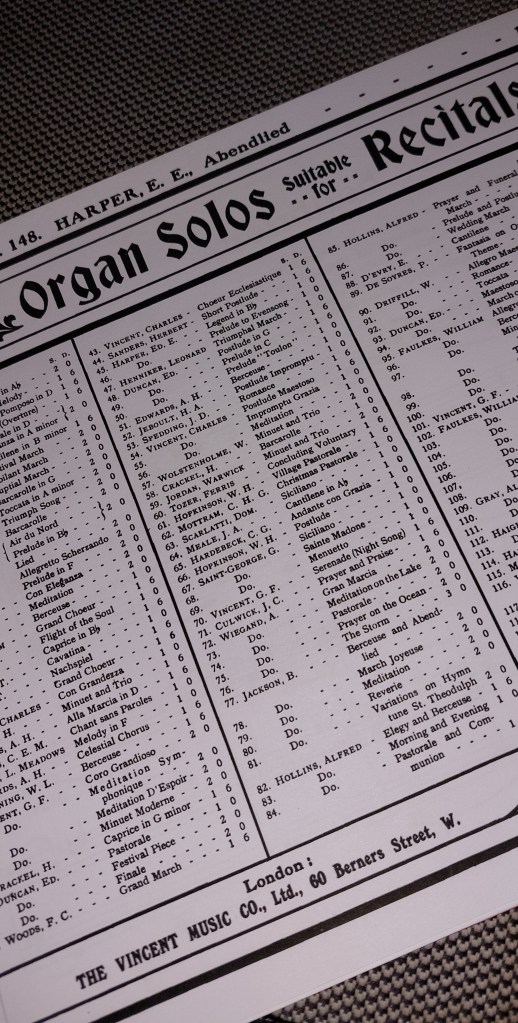
Harper seems to have had a larger output. Again, it was respectable but not remarkable. Nonetheless, I found a piece of organ music on IMSLP, this time published by Vincent Music in 1903, halfway through his own spell at the Athenaeum. (Vincent Music was the firm who would later publish James Woods and Learmont Drysdale’s Song Gems (Scots), which I’ve written about before. They were not as eminent as Boosey or Hawkes.) Abendlied is gentle and reflective, and appeared in an extensive series of ‘Organ Solos Suitable for Recitals’. It’s not hugely memorable, but it’s a nice enough piece for all that. Whilst Macbeth and Harper were both organists, each at several churches, I’ve formed the impression that being an organist occupied perhaps more of Harper’s career than it did of Macbeth’s, but this is really only a guess; moreover, Harper lived much longer than Macbeth and was only Principal of the Athenaeum for a couple of years. He obviously occupied himself in other ways for the rest of his career, and I have quite a list of the churches where he ‘presided’ at the organ.
Anyway, I digress. I played Abendlied before morning worship this morning. (No-one knew it was an ‘Abend Lied’, after all!) It could well have been played by Harper, just a couple of miles up the road, when he was organist at Kilbarchan.
But I saved Macbeth’s Gaily Through the World for my outgoing voluntary – and it did get noticed! It fitted the organ so well that I wondered if he had ever tried it at the organ himself – though maybe he might not have considered it serious enough for late Victorian Presbyterians …
A couple of weeks ago, I mentioned that my RMA Research Chronicle article was now available online as open access. Today, it’s actually in the published issue. Receiving this email is a great start to the day:-
“your article, ‘Women Pursuing Musical Careers: Finding Opportunities in Late Nineteenth- and Early Twentieth-Century Scottish Music Publishing Circles’, has now been published in Royal Musical Association Research Chronicle! You can view your article at https://doi.org/10.1017/rrc.2025.10009 “
This is an Open Access article, distributed under the terms of the Creative Commons Attribution licence (http://creativecommons.org/licenses/by/4.0), which permits unrestricted re-use, distribution and reproduction, provided the original article is properly cited.
Writing about Tourism
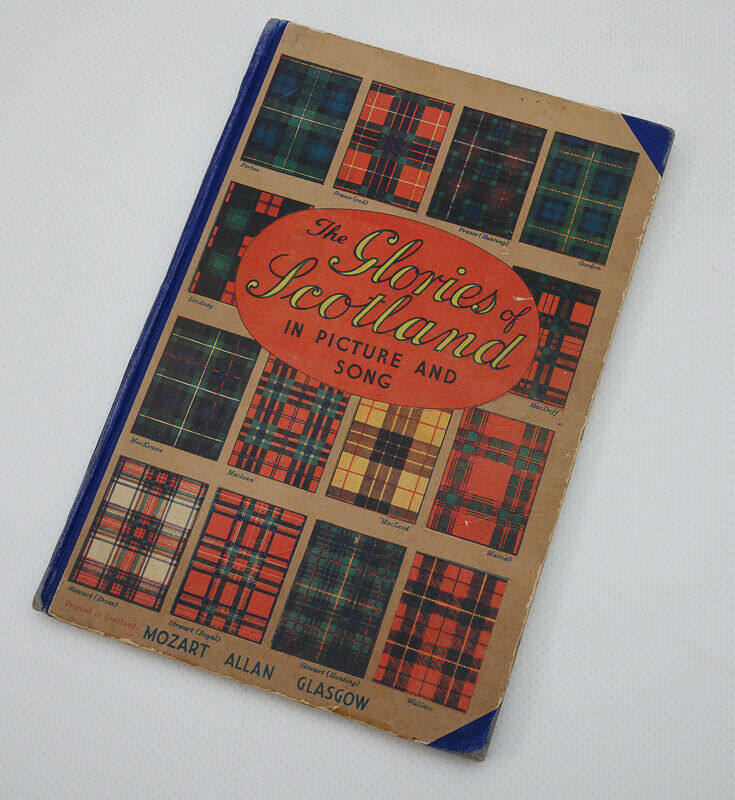
What’s this?, I hear you ask. Why would a musicologist write about tourism? Well, it’s like this: one of the song book titles that I explored in last year’s monograph, The Glories of Scotland, really deserved more space than I could give it in a monograph devoted to a nation’s music publishing. However, the opportunity came up to contribute a chapter to a Peter Lang Publication, Print and Tourism: Travel-Related Publications from the Sixteenth to the Twentieth Century, edited by Catherine Armstrong and Elaine Jackson.
Today, I received the final proofs, which means that the book itself can’t be very far away. I really enjoyed writing this chapter – you could say that it’s decidedly more about publishing history, and tourism, than conventional musicology – and I really look forward to it actually being published.
My chapter (19 pages):-
‘The Glories of Scotland in Picture and Song’: Jumping on the Festival of Britain Bandwagon?’
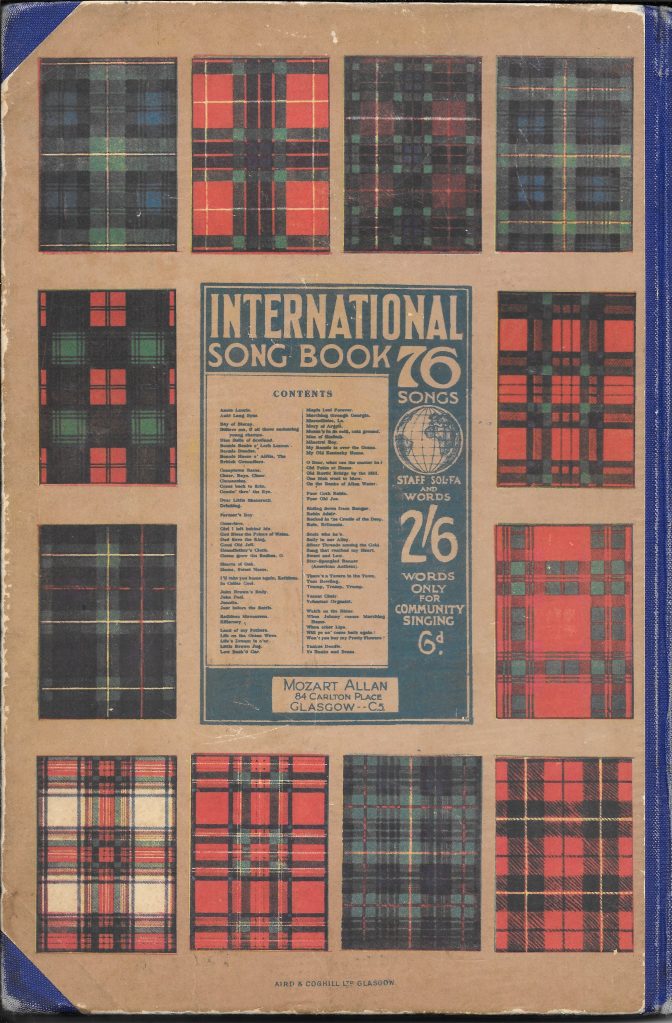
The Glories of Scotland – Mozart Allan’s souvenir songbookBack cover of The Glories of Scotland
There are a few places where my in-laws’ history and my own research findings overlap. Glasgow is one of them, and Greenock is another. I know the stories of three mid-nineteenth century Greenock boys, all with family connections to shipping on the River Clyde: I encountered two of them whilst researching Scottish music publishers, but the other one is indirectly linked to me by marriage.
Allan Macbeth (1856-1910): Athenaeum School of Music Principal
Allan Macbeth was born in Greenock in 1856 to an eminent artist. After the family had moved to Edinburgh, he had two spells studying music in Germany, but he did return to Scotland. He married the daughter of a Greenock builder, ships carpenter, timber-merchant and saw-miller. Between 1880-7, he conducted Glasgow Choral Union.
Between 1890 -1902, he was Principal of Glasgow’s Athenaeum School of Music, building it up to a size barely imagined by the early directors. In 1902, he left to open his own Glasgow College of Music in India Street, taking umbrage after the Athenaeum directors decided they didn’t want a Principal who also taught classes. His own college appears to have died with him when he died in 1910.
Technically capable, in terms of musicianship, he wrote a quantity of lightweight music, eg his Forget me Not intermezzo and Love in Idleness serenata, both of which were subsequently re-arranged for different instrumentations, shortly after his death. Barely any of his music was published in Scotland – It was almost all published in England by a mixture of big and very small names.
Macbeth was one of the arrangers of James Wood and Learmont Drysdale’s Song Gems (Scots) Dunedin Collection, published in 1908 both in London and Boston, Massachusetts. Indeed, my own copy came from Boston, though there had also been an Edinburgh distributor. His Scottish song arrangements were typically late Romantic in style. The collection was aimed at a musically and culturally educated middling class, knowledgeable about Scottish poetry of earlier times. For example, his setting of Walter Scott’s ‘The Maid of Neidpath’ was set to an earlier tune by Natale Corri – hardly of Scottish origin! – with lush harmonies. I wrote about the collection in my A Social History of Amateur Music Making and Scottish National Identity(Routledge, 2025).
Macbeth’s son, Allan Ramsay Macbeth, briefly attended Glasgow School of Art (GSA) as an architectural apprentice before leaving to become an actor, and one of his cousins, Ann Macbeth, became head of embroidery there.
James [Hamish] MacCunn (1868-1916)
Twelve years after Macbeth’s birth, a second musical boy was born in 1868, this time to a wealthy ship-owning family in Greenock. The family firm later went bankrupt, but not before James MacCunn had benefited from a composition scholarship to the newly established Royal College of Music in London at a very young age. Like Macbeth, he left Scotland to further his musical education. He styled himself Hamish to suit his ostentatiously Scottish persona, and spent the rest of his life in England, determined to live in the style to which he had become accustomed. His compositions were on a decidedly larger and more ambitious scale than Macbeth’s, but he perhaps didn’t live up to his early adult promise, and his insistence on flaunting his Celtic origins may ultimately have gone against him. He too gets a mention towards the end of my Social History of Amateur Music Making.
McAulay (McAuley, MacAulay) Hogmanay, 1873
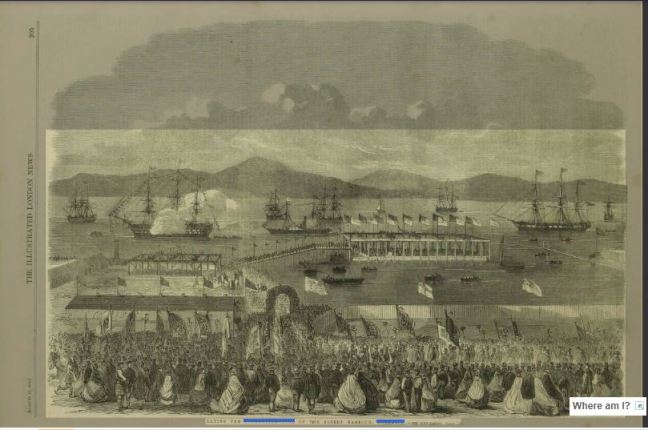
Also in the 1860s, my grandfather-in-law was born in Greenock to a much lowlier family, in 1866. (If you’re trying to calculate how my grandfather-in-law was born 159 years ago, shall we just say that age-gaps account for a lot.) This baby was the second Hugh born in the family, after the first one died of teething. Life wasn’t easy for the illiterate working-class poor; this family had already moved from Ballymoney on the north coast of Ireland, in pursuit of work on the Clyde. His father Alexander worked in the shipyards as a hammerman until his untimely demise one Hogmanay. Last seen on 31 December 1873, Alexander drowned in Albert Harbour and was found a month later. Did he jump, or was he pushed? We’ll never know!
My husband’s grandfather Hugh was later to move his young family to Tyneside in pursuit of work as a ship’s carpenter. Family mythology has various spellings of our name – but since our immigrant Irish McAulays were illiterate, there is no correct spelling. It was spelled however the registrar, or newspaper editor, chose to spell it. There was an embroidered family tale about my Great-Grandfather-in-Law, erasing the embarrassing Hogmanay drowning – and another story about Grandpa-in-Law’s move to Tyneside after a dispute with his foreman (which has every chance of being equally inaccurate).
I can’t help comparing how different were the lives of the two promising young musicians, and the Clydeside then Tyneside shipyard worker who was to thrive on tonic sol-fa, and whose adult family were to make up at least half of their Presbyterian church choir!
Image: Photo of the laying of the foundation stone, Albert Harbour Greenock, from the Illustrated London News 23 August 1862, p. 9 (British Newspaper Archive)
Anyone looking at my publication record is soon going to be mightily confused. The article about Sir John Macgregor Murray concerns a Highlander who lived from 1745-1822. I wrote it at a time when I was still researching Scottish music collecting and publishing in the late eighteenth- and early nineteenth-centuries.
Today, I received the final proofs for the next extensive article. This time, it’s about Scotswomen with portfolio music careers in the late nineteenth- and early twentieth-centuries. (Two of them were of English parentage, but let’s not quibble!) A spin-off from my latest book, in the sense that I turned my focus onto a number of individuals who had hung around in the shadows of the book, this article extends over some 22 pages, and luckily there wasn’t a great deal needing changing in the proofs. But the instructions for using the proofing system extended over 49 pages, and there was also a ten-step quick tour of the process. I nearly had a fit at the sight of the former, but the latter told me nearly all I needed to know. Job done.
There are still more articles in the pipeline; I’ll flag them up as they come along! Meanwhile, there’s the small matter of Christmas requiring my attention during the semi-retired part of my existence, not to mention the continued tidying up of our poor scarred, rewired residence! But first, I need stamps …
Image: Glasgow Athenaeum, forerunner of the Royal Conservatoire of Scotland (Wikimedia Commons) – where two of ‘my’ musical ladies received their advanced musical training.
I have a tiny cutting on my pinboard, which reminds me that,
Many of life’s failures are people who did not realise how close to success they were when they gave up. – Thomas Edison
It’s painfully true in life, but it’s also particularly pertinent in archival research!
Yesterday, I was trawling the most random of files. To be fair, a couple were even labelled ‘Miscellaneous’ in the handlist. However, they date from an era I need to know more about, so I was going to look at them! I entered a rabbit warren of curiosities.
Rejections, marked ‘Refused’, or ‘Returned’
Objections:- ‘You interviewed my son and sent him for a medical before deciding he was too old for an apprenticeship. Why?’ [My precis, not a quote]
Union matters. ‘If you don’t join the union, you put yourself and us in a difficult position because we can’t work alongside you’ [again, my summary]
Sob stories, like the widow whose friends said her story ought to be made into a film, or a book. Apparently, she was robbed and then incarcerated in a lunatic asylum in America, and now she wanted Nelson’s to publish her story of those calamities … (‘Refused‘)
Inks
Plant (machinery)
An Indian paper mill under the mistaken impression that Nelson’s were interested in a collaboration …
By 4 pm, I had a splitting headache, and was quickly flicking through pages as fast as I dared – the paper was fragile, and I still didn’t want to miss something important.
Why not admit defeat and give up on this box file?, I mused. There was nothing relevant in it. Interesting, but irrelevant.
Note from Warlock to a song book compiler
Then I saw it. A beautiful little note from no less than British composer Peter Warlock! In the grand scheme of things, it’s not of huge significance – it’s just an apology for his delayed response, and a request to correct a small detail before publication – but it does confirm the editor’s identity (something I hadn’t yet managed to do, apart from finding a footnote in someone else’s biography), and it reminds me that I should index the Nelson collection that contains Warlock’s unison choral song.
This handwritten note from March 1929 was written less than two years before Warlock died on 17 December 1930, aged only 36. He is thought to have committed suicide over a perceived loss of his creativity. I believe he was something of a tortured soul, though I’m not familiar with his detailed biography.
I so very nearly didn’t find this note! Yet again, that maxim has proved true. Dogged persistence wins every time. The tragedy is that Warlock (Peter Heseltine) was too tormented to be able to keep going at all. What else might he have achieved? How much more might he have written?
I wrote an article for a Scottish organists’ newsletter, a couple of years ago. To ensure the article would continue to be accessible even if the newsletter was not, I also posted it on this blog.
I was thrilled to receive a query about Margaret (aka Maggie) Thomson over the weekend, so I updated the article gently with a couple of scans and a little bit more detail.
Maggie was clearly a modest soul – or, maybe, a typical Victorian woman, eschewing the limelight – even when she was made a presentation, her brother made the acceptance speech. At any rate, I’m not at all surprised that so little survives of her work. It sounds as though she was an amazing, and much loved accompanist, but the two pieces in The National Choir really aren’t remarkable in any way. Parlane was a local, Paisley book publisher with a considerable output, but having a contribution published in The National Choir would not have as much kudos as a composition published by Boosey or even by one of Scotland’s bigger music publishers. (There’s quite a bit more about Parlane and The National Choir in my book, if you’re interested.)
Another piece, referenced in a newspaper review, probably wasn’t even published.
And there’s another piece, held by the British Library, that has some connection with her – although, if she arranged it, then I’m not quite sure what Wallace Waterston’s input was, even though it is catalogued under his name. Maybe he wrote the tune? I haven’t tried to find out.
ADDENDA to my earlier article:-
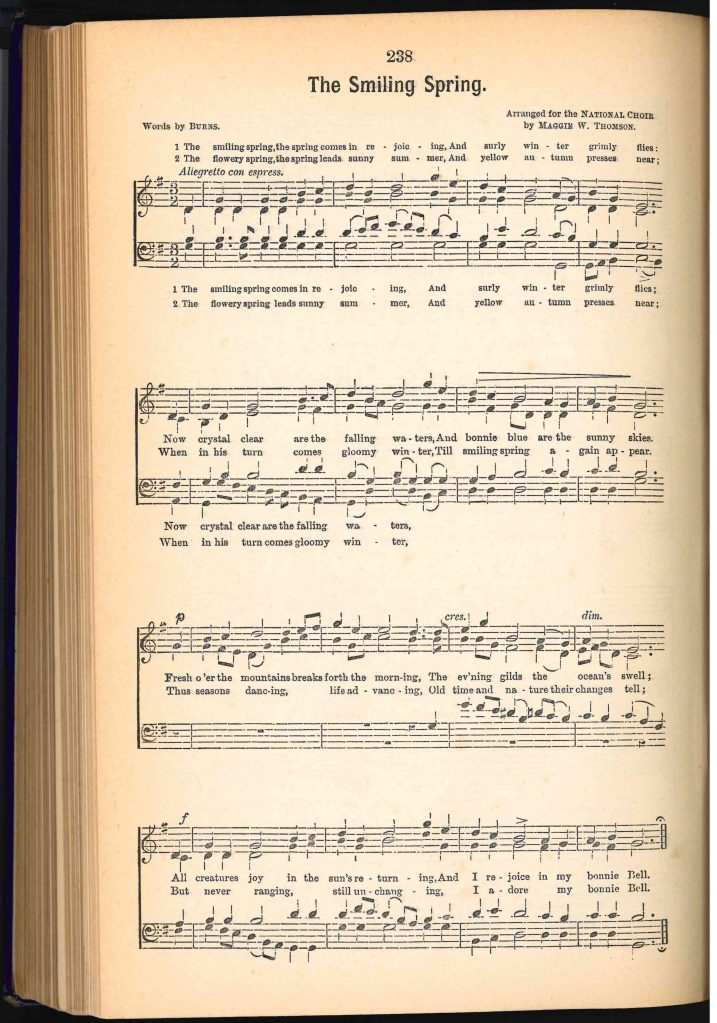
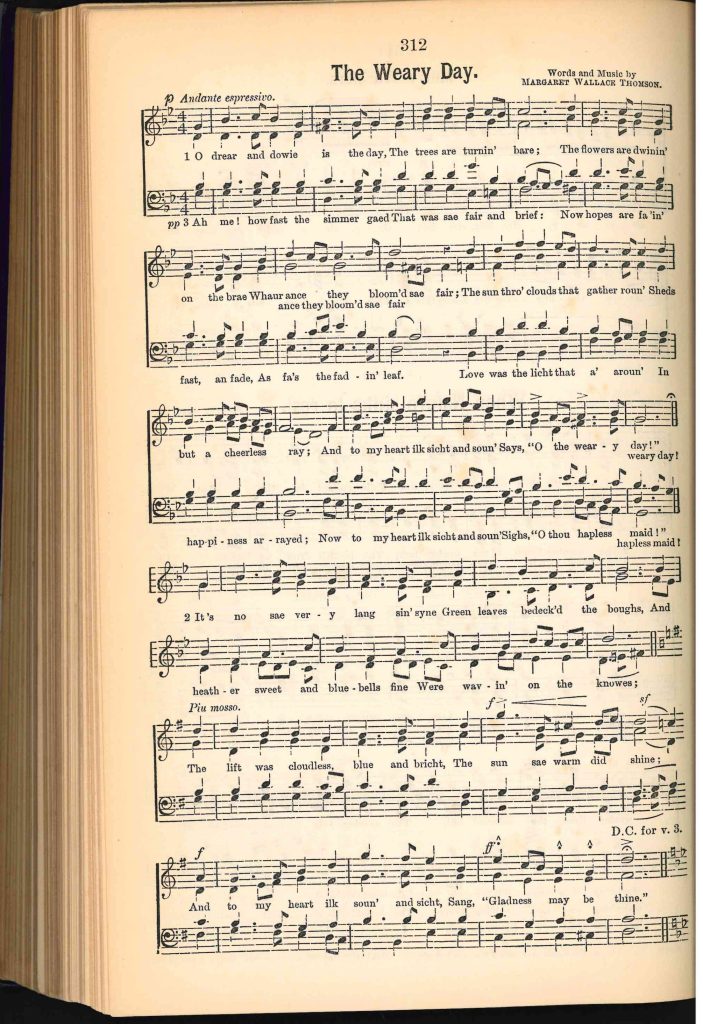
I can share images of the National Choir songs:-
‘The Smiling Spring’‘The Weary Day’
‘The smiling spring’, words by Burns, arr. by MWT for The National Choir [Vol.1 p.238] (Parlane, 1891)
‘The Weary day’, original words and music, by MWT for The National Choir Vol.1 p.312 (Parlane, 1891)
Untraceable:-
‘The voice of the deep’ (1883), bass song, written and composed by MWT [Addendum: referenced in a newspaper report of a concert that took place in St George’s Church, Paisley. A positive review! However, the score might not have been published.]
I can also share the reference to the copy of ‘Break, break, break’ in the British Library:-
‘Break, break, break!’, by Wallace Waterston, piano accompt by MWT (1894, published Paterson’s) – [addendum: copy in British Library – catalogue entry here.]
It’s time for a flashback to this time last year. I went all-out to share a lot of research and resources about women musicians, so this year, I think I’ll share it again! I’ve written quite a bit on the subject, as you’ll see.
This post was originally written for the Whittaker Live library blog in July 2023.
A few weeks ago, I was thinking about the Scottish song settings by Francis George Scott (1880-1958). Opinions seemed to be divided about his output, but this composer – who for most of his career taught music at Jordanhill Teacher Training College in Glasgow – arranged and composed dozens and dozens of songs. He worked […]
I don’t go on shopping sprees. But let me loose on eBay, and who knows what I’ll buy? I came across a Bayley & Ferguson publication from ca.1894-6. It was published both in Glasgow and in London, and was performed in Bishopbriggs on the outskirts of Glasgow in January 1897. The London address confirms the earliest date. (John A. Parkinson’s Victorian Music Publishers: an Annotated List is invaluable here.*) The cover illustration caught my eye, and I must confess I was intrigued to find it was composed by a woman: Constance M. Yorke. In 1897-8, she also published Twilight Shadows with a London publisher, Larway, who again dealt with light musical fare. I haven’t attempted to get my hands on that one.
Constance M. Yorke: is this Constance Maria Yorke Smith / Scholefield?
I traced a Constance Maria Yorke Smith (1855-1936), who was a vicar’s daughter, originally from Loddon in Norfolk, but whose early adult years were spent in Penally, Pembrokeshire. Her late father was the Revd. J. J. Smith, latterly a tutor at the University of Cambridge. Constance in turn married a clergyman herself – James Henry Scholefield – in a very ‘society’ wedding in Cornwall in 1891. If I’m right, then this ‘humorous musical sketch‘ under her forenames but not her surname, could have been written when she was already married. (Her mother had given the happy couple a grand piano as a wedding gift – Constance would have been making good use of it!)
Rose Smith’s Mother, Mary Ann
This paragraph is newly added (March 2026). In the RMA Research Chronicle, you’ll find my recent article about five Scotswomen involved in and around music publishing in the late Victorian era and early twentieth century. The author of the musical sketch, M. A. Smith, was the mother of composer and self-publisher, Rose Smith. And whilst I can’t be 100% sure of the identity of Constance M. Yorke, I am 101% sure that M. A. Smith was Rose’s mother, and the author of Mr and Mrs Dobbs at Home. I’m still working on this, notwithstanding the fact that my article is now published, because I feel there’s more to be said about M. A. Smith. I’m fascinated by her, her views, and her writing. Bayley & Ferguson didn’t publish the sketch using the lilac-and-green colour scheme commonly associated with women’s suffrage, but the sketch is a somewhat tongue-in-cheek sideways glance at the suffrage movement. Read on, to see what I mean. The rather obnoxious heroine hardly sells the idea of women’s suffrage and equality to the average man – or woman – in the street.
Mr & Mrs Dobbs at Home: humorous Musical Sketch / (words by M. A. Smith; composed by Constance M. Yorke (London, Glasgow: Bayley & Ferguson, n.d.). Franz Pazdírek listed the piece in his Universal Handbook (1904-10), but erroneously attributed it to Caroline M. Yorke, and Twilight Shadows to M. Constance Yorke – rather confusing, Herr Pazdírek!
So, what of ‘Mr and Mrs Dobbs at Home’? Selina is a spoiled young madam. Mr Dobbs is hen-pecked to an insane degree, submissive beyond measure and seemingly incapable of standing up for himself. Selina says he has driven the maids and the nurse away, so it’s only right that he should do all their work. ‘Enter Mr Dobbs in shirt sleeves and kitchen apron, with broom in one hand, duster in the other, as if he had been sweeping.’ (Does he go out to work? No mention of it. And why have they all gone away? The poor man seems to have no spine, let alone any serious vices!) The baby cries. Who goes and fetches her from the nursery? Mr Dobbs. He says the child is teething. Selina instead accuses him of jabbing her with a nappy pin.
Ah, well. Having told him off for having a quick, sneaky puff of his pipe whilst she was getting herself ready, the pair and their baby set off for a day out to meet one of Selina’s friends. At this point, Mr Dobbs mentions that a ‘lady speaker’ has tried for the third time to see Selina, but he forgot to mention this before. (I missed this the first time I flicked through, but sat up straight when I realised that Selina was being courted by the Suffragettes, Suffragists, or similar.) Privately, he seems to think anyone involved in ‘Women’s Rights’ should be kept well away from his wife – it seems a little late in the day for that, considering Selina already has the upper hand! Of course, Selina sees things differently, and the rest of the sketch is basically a dispute as to whether women can, or cannot, ‘rule as well as the men’, with Mr Dobbs muttering that,
Shirts, vests, and ties and knickers, too, are all now female gear; our coats and hats will follow suit, and presently we’ll see the pater in the mater’s skirt, a-toddling out to tea.
Mr Dobbs’ complaint
It’s not a work of high artistic content! Not that it isn’t harmonically sound or averagely tuneful, but it was probably only ever intended for domestic or amateur entertainment. However, I do smile at the thought that whilst Revd. Scholefield was writing his sermons, Constance was sitting at the piano composing a musical sketch about role reversal – and then publishing it. (Or had a lyricist originally written it more as a conservative warning than eager anticipation of a brave new world?!)
You never know what you might find when, on a whim, you order something off eBay.
* John A. Parkinson, Victorian Music Publishers: an Annotated List (Warren, Michigan: Harmonie Park Press, 1990) – it is worth noting that Parkinson worked in the Music Room of the British Museum.







 Karen McAulay, Musicologist