Good Days and Bad Days in the Archives

Anyone who has spent any length of time on archival research will agree with me that there are days when nothing of interest really turns up! This week has been a case in point.

On the positive side (and this relates to research time beyond the archives), I used to have ONE spreadsheet listing all the significant names – and relevant dates – of the individuals I’ve encountered over the past year or so, be they Thomas Nelson editors, authors, or connected in some other capacity. I now have a second spreadsheet, charting the weird and wonderful departmental codes appearing on letters and memos to/from the Parkside (Edinburgh) and Pater Noster Row (London) offices; I’ve again listed names associated with those offices. This is likely to be of interest to me, but little interest to anyone else. Still, there’s a quiet satisfaction in having clarified who did what, where and when. Whilst I was working on that, I  discovered that one of the earlier editors had previously been an HMI before joining Nelson’s. That was a gratifying discovery, even if he had been a geographer, and had nothing to do with publishing music education materials.

I’ve also continued reading a book about an individual who published a book with Nelson’s in 1935; I’ve borrowed another; and recommended a useful e-book to my home institution library. It hasn’t been a wasted week.

But, glancing through my archival notes and social media postings, there weren’t any significant discoveries. I had a long list of boxes to trawl, in my hunt for interesting correspondence with one particular author, but on Tuesday I realised I’d already seen all that was worth seeing in two boxes, whilst the third box contained ‘the editor regrets’ letters to would-be authors. (A whole boxful of dashed hopes for dozens of would-be authors, ninety-odd years before my own disappointment in an unproductive, rainy day.)

Dutifully Flicking through Pages (FOMO)

Back I went to Edinburgh yesterday, eagerly anticipating fresh discoveries. Did I find the sought-after correspondence? No. There was plenty to amuse, but I can’t say I learned anything more about music education publishing. For example, my curiosity was piqued by a book proposal for a collection of prayers. The editor wrote to a colleague that he didn’t think they wanted any prayers, but he would decide finally when he saw how the would-be author had prayed. I wish I knew what he decided!

I shook my head sorrowfully at the rather naive author who wrote to Nelson’s asking if they published a particular genre of material. I suppose in the 1930s, it was less easy to find out, but could they not have gone into a library or bookshop and ASKED? Again, there was no copy of a response.

Another book proposal that presumably foundered, was the one  unappealingly entitled, ‘The Unamiable Child’. I don’t think they offered the author a contract. (More recently, wasn’t the Horrid Henry series so beloved by children and their parents, about precisely such a child?  Maybe the earlier hopeful author was just ahead of their time.)

Queen Margaret University / Edinburgh College of Domestic Science

I did, however, come across some correspondence which might be of interest to a historian of domestic science education. It appears to be a long time since anyone seems to have published anything about one of QMU’s earlier forerunners, the Edinburgh College of Domestic Science. (Tom Begg wrote a book, The Excellent Women: The Origins and History of Queen Margaret College, in 1994.) But if you know anyone currently researching it, then I can advise them that 1933 saw a run of correspondence with Thomas Nelson about a book they were producing. I can let them know which folder to consult, if they’d like to follow this up!

Time for Tea

As I approached the end of my second day in the archives, one final memo made me smile. (Again, this had absolutely nothing to do with music – I was just dutifully flicking through pages to ensure I hadn’t missed anything.) A memo was sent to three of Thomas Nelson’s Edinburgh managers in July 1956. They were warned that they might have to entertain a couple of visitors from Melbourne whilst their colleague was away. There were a couple of points that they needed to be aware of. I didn’t read past the first of these!

‘It might be wise to point out that Mr C is a teetotaller’.

Let’s hope they remembered. Reading between the lines, ‘hospitality’ was clearly not always a cup of tea and a scone!

Tray containing tea and scones
Hospitality

Image by Dayoung Seo from Pixabay

She Started Something! Bamboo Pipes – then the Pipers’ Guild

Front of The Pipers' Guild Handbook

Folks, I got distracted again tonight – beguiled by bamboo pipes, in fact. Let me explain!

Have you heard of Margaret James (1891-1978)? I wouldn’t be surprised if not, but believe me, she really started something in the 1920s. Someone gave the Gloucestershire school teacher a bamboo pipe from Sicily, and she realised this was something that kids could make at school.  They weren’t expensive to make, either.  (I read an observation that they were made from materials readily available in many homes.)**  It apparently took off! Kids liked actually making an instrument then learning to play it.  It was certainly another means of practical music-making. Crafting bamboo pipes briefly became the latest thing in classroom music, or so the literature would have us believe.  Although unmentioned in the Board of Education’s Handbook of Suggestions for Teachers in 1927, either in the music or the handcrafts sections, by 1933 the idea was being recommended in Board of Education literature and by HMIs (His Majesty’s Inspectors).  I do tend to wonder how many pipes were actually being made across the country – did the numbers match the rhetoric? Anyway, Margaret organised courses, wrote books and made at least one recording.  Judging by the number of publications, there surely must have been sufficient interest. This is a quick, but not exhaustive, list of works Margaret had a hand in:-

  • The adjusted treble pipe : the rhyme & reason of it, how to make it (Pipers’ Guild, 1933)
  • Directions for making the bass pipe, with diagrams by N. Gibbs (1936)
  • Directions for making the extended treble and alto pipes (Cramer, 1942)
  • Exercises and airs for pipes (Curwen, 1941)
  • Folk dance tunes : for bamboo pipes / transposed by Margaret James (Novello, 1934)
  • How to make a bamboo pipe [Diagram] (Published for the Pipers’ Guild, ca.1933)
  • The Pipers’ Guild handbook / Margaret James; with drawings and a chapter on decoration / by Nora Gibbs. Cramer, [1932]
  • Supplement 1 to the above, [1932-5]

Indeed, Vaughan Williams even wrote a Suite for Pipes (Oxford University Press, 1947), a quartet which was certainly more difficult than the average school pupil could attempt. Here it is, albeit played by a recorder quartet:-

The bamboo pipes do sound sweet, pastoral, traditional – very ‘English’. (I say that in inverted commas, because the question of what sounds ‘English’ is a whole dissertation in itself. I’m not going there.) Which makes it all the more ironic that her original gifted pipe was Sicilian! Anyway, we can agree that their folksy sound is part of their appeal.

Margaret herself started the Pipers’ Guild, which lasts to this day.  I did wonder if her bamboo pipe-making movement made it as far as Scotland  – was it something Scottish teachers were also doing? Judging by newspaper evidence, the Guild did have a small presence up here, but perhaps not quite as enthusiastically as in England. I won’t hunt further. 

Since my research interests are currently in a Scottish publisher producing educational music materials for a widespread market, then I thought maybe I should see if, or how often pipe-making got a passing mention – because their music editor/advisor was nothing if not on the ball. However, by 1939/40, it appears the humble (and ready-made!) recorder had gained supremacy. See this observation by one of Thomas Nelson’s authors:-

[…], who has done a lot of work on pipe playing in schools, composed pieces for them, and might be asked to write a first book on recorder playing, since they’re attracting more interest than pipes now. […] My own opinion is that there is already sufficient pipe music but not sufficient first stage recorder music.’

Similarly, Thomas Nelson’s four classroom books of My Music Guide (1953) mention recorders, but are silent on the question of pipes or pipe-making. Bamboo pipes evidently remained a minority interest, albeit for a long time.

** Glancing at my own garden canes, I doubt they’re wide enough to do anything with.  I don’t know if our toolbox is equipped for such a project, anyway.

Picture of Pipers’ Guild Handbook sourced from eBay. (I didn’t buy it.)

The Big Idea: another Book

I’m contemplating writing another book. It’ll be based on my recent researches as an IASH Fellow, obviously. But I’ve had a brainwave of an idea for the final chapter – which involves a bit more research – so the past few days have been dedicated to exploring possibilities. As I now know, from the historical Thomas Nelson point of view as much as my own present existence as a scholar, publishers like publishing things in series. It helps them sell, if readers can see how a book fits into a larger grouping of books. I’ve been thinking about where my book might fit in.

I’ve also had a wee jaunt to Dundee to talk to a scholar of my acquaintance; and today, I sat down to write an email. Who’d have thought it would take most of an afternoon to write an email?! But when it’s important, it’s worth taking some effort in the crafting of it.

‘Faint heart never won fair lady’

Finally, I thought it was just right. I mused that maybe I should leave it and re-read it tomorrow. But no, I must be resolute. So, I did not prevaricate. More of this thrilling story in due course …

Wonderful! Look! A Gift of a Book

A couple of days ago, I wrote,

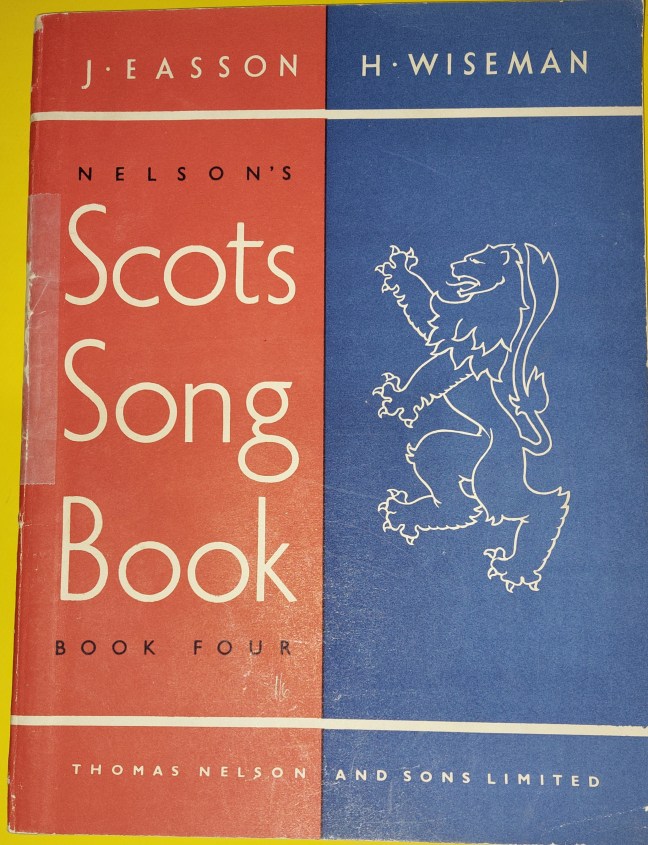
I would dearly love to trace a child, or children, who sang from these books. I think these books were aimed at children probably between eight to twelve years old, so the oldest children were born circa 1936-1946.

Well, I have! Five people have reached out to me already – one of them a prize-winning singer.  However, it appears I underestimated this title’s longevity.  I guessed,

I don’t know how long the books would have remained in use, but my guess is that they’d probably have fallen to bits by the late 1950s. In that case, the youngest users would have been born round about 1950. And that would make them baby-boomers, but several years older than me

I got that wrong! Two (as I predicted) are a bit older than me. Two a little younger. And the very youngest tells me they were at school in the 1980s – still singing from Nelson’s Scots Song Book.

Four are Scots. But the other (one of those a little bit younger than me) was in …

South Wales! (Now I’m curious to know – any more distant sightings, anyone?)

I’ve also, tonight, been gifted a copy of Book 4.  I got home and sat down at the piano straight away! What an exciting present. And I can play away to my heart’s content, since it’s all in the name of research.

Wednesday 26 March, 1 pm

But I won’t pre-empt my Work in Progress talk at IASH next week. Would you like to hear it? It’s online as well as in person. Click here.

Marking Time

Cat sleeping

Who’d have thought marking was such energetic mental exercise?! I might have a Postgraduate Certificate in Learning and Teaching in the Performing Arts – I might even have some experience in doing these activities – but I haven’t usually had to do marking. And now I’m almost all done – just one paper to go, this week, and that has got ‘Tomorrow’ written all over it. My brain has had enough for today.

Back soon.

My Music Guide (1947): a Brave New Future

Thomas Nelson’s four-book set was for classroom use. Offering a mixture of history and theory (music-reading and tune-building), it even suggested pupils might plan a folk music concert. 

In this exciting, modern world, children were reminded that their parents’ music lessons consisted only of singing, whereas now they might also learn instruments like the recorder, and perhaps collect interesting clippings from the Radio Times.   (It sounds like another world, doesn’t it?)

Meanwhile, diving straight into the history, children were immediately introduced to the concept of folk music.

This is an English book, but I only recognised two of the three songs from my own school days. ‘The Carrion Crow’ wasn’t one I knew.

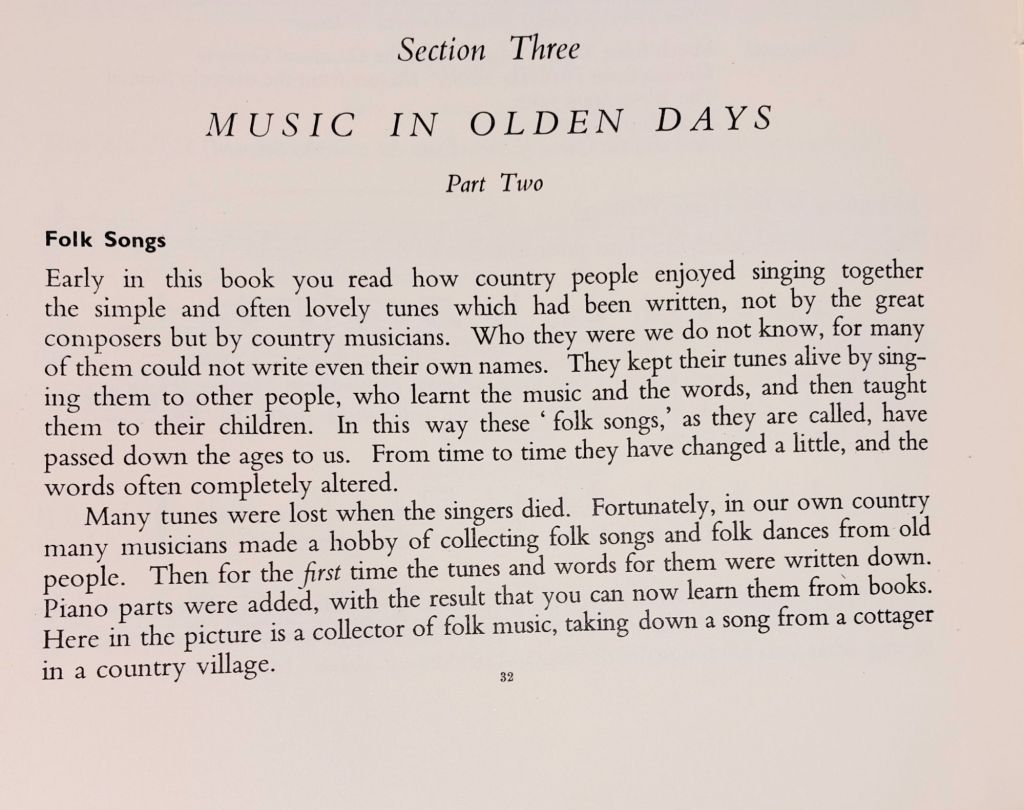
I’m delighted to find that kids were also introduced to the role of a song collector.  Although I have to say that the child in the foreground on the right looks bored and unimpressed by the proceedings, in the illustration! Still, Nelson’s editors presumably commissioned the illustration rather than use a stock image, so they’re due some credit.

The song collector

They’re still holding onto the idea that folk music came from country folk. I wonder if pupils ever asked what city folk sang?!

Of course, it wasn’t all folk music.  Kids were also introduced to the likes of Brahms, Handel and Purcell. Today, I imagine only examination classes would have textbooks introducing the classical greats.  On the other hand, more time is probably spent on world music, and efforts are made to consider music by women and people of underrepresented communities.  Times have moved on!

Nonetheless, it’s interesting to see how much knowledge children would have acquired in general classroom music lessons, and to compare it with modern times.

Even the books are brighter and more appealing today, I must admit!

Highland Archive Centre – Conan Bridge School, 1880s

Another Covid-ridden short from me today. See if you can see what excited me about these images of Conan Bridge School inventory …

Highland Archive Centre Facebook Posting 31 Aug 2024

Meddle the Thistle Wha Daur! (Old Poem, New Thistle)

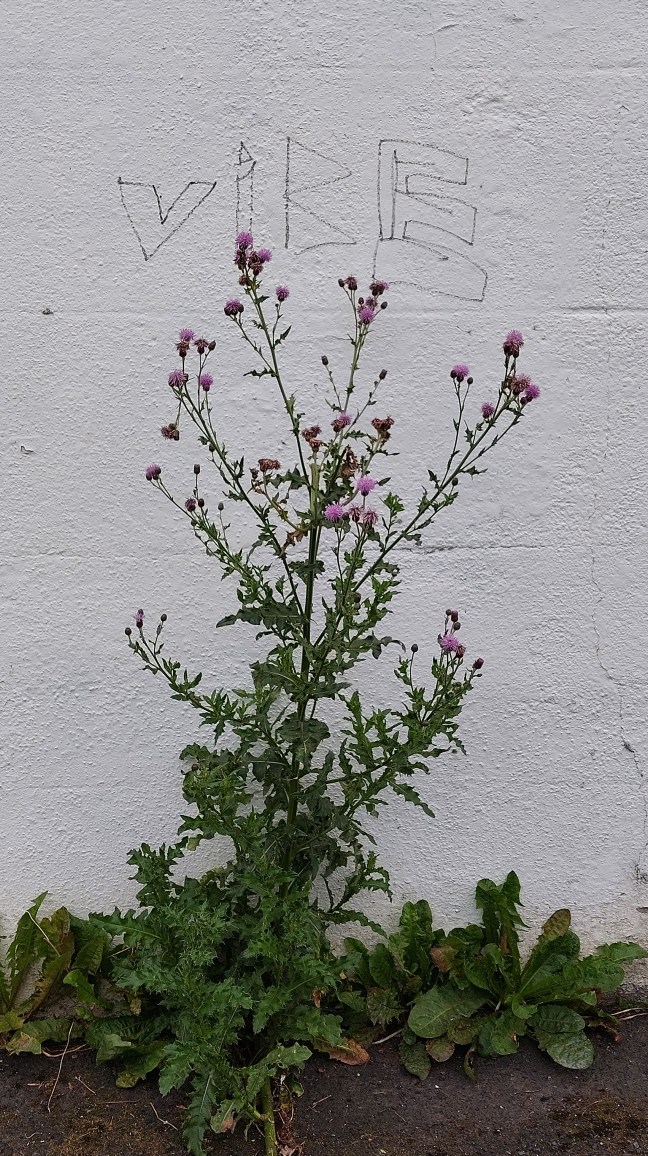
Thistle against a white wall with graffiti reading ;'Vibe'

Our neighbours have a high white wall. There’s a tall thistle growing there, and some young joker has scrawled above it, ‘VIBE’. I don’t know if they were consciously referencing the metaphor of a prickly thistle to represent Scottish, and most particularly, Glaswegian identity, but – hey, they wrote it directly right above that thistle, so who knows? I took a photo anyway – it was too good an opportunity to miss.

Every time I walk down the road or get into my car, there it is, and every time it reminds me of a poem by one of ‘my’ Scottish song-writers. He published his book of poems in 1894, and it’s well out of copyright, so I can share it with you. Just look at that last verse – there’s a proud, very nationalist Scot for you!

“I’m a Scot and I carena’ wha’ kens it, Juist meddle the thistle wha’ daur,

They’ll maybe get mair than they wantit, An Scotia be little the waur …”

To be honest, I’m more interested in the poet for his work as an Edinburgh music teacher, than as a poet or local historian, but it’s all part and parcel of who he was. Two different musicians set this song to music – one was really pretty uninspiring, but the other one’s not too bad! (Well… musically competent, not remotely ‘Scottish’ sounding, nor particularly memorable, but competent.)

The poet-teacher gets a significant mention in my forthcoming book, especially his views about children singing Scottish songs.

I have just sent the manuscript back to the editor with my own amendments to the copy-editing, so watch this space! Now to turn back to the question of the second index … which I drafted a few weeks ago, but which now needs fine-tuning before I get the proofs back to link my index-terms to the publisher’s page numbers!

Image by Ralph from Pixabay

Why all the Fuss about Referencing?

I blogged for the library this morning. It’ll hopefully be of use to our new students 🙂 – you can read the text below.

https://whittakerlive.wordpress.com/2023/10/16/why-all-the-fuss-about-referencing/

You turn up to start a new university course, all ready to elevate your ukulele* performance to the highest possible level … and suddenly, you’re being told about referencing and citation, catalogue searching and note-taking, and you have a written assignment which terrifies the life out of you? How have things got so serious, so soon?

As you’ll have been told, it is very important that whoever marks your essay can see where you drew your information from. When you studied maths at school, your teachers probably told you to ‘show your workings’ (or some similar expression), right? Referencing is pretty much the same idea – they need to know how you arrived at your final argument, and which authorities informed your thinking. Referencing (some people call it citation) is how you show your workings in academia.

AI generated image: Image by qiaominxu 橋茗旭 from Pixabay

You’ll also have been told about the Turnitin software which can determine whether your submission is likely to be all your own work, or cut and pasted from various other sources without acknowledgement. Academic honesty is all-important. Using other folks’ work is not acceptable – and using AI such at Chat GPT is equally frowned upon.

‘Chat GPT can’t do referencing’

(said a colleague from another institution, in discussion)

Is this correct? In the spirit of scientific discovery, we decided to put this to the test. We wrote an ‘essay’ (well, a couple of paragraphs) containing some genuine references, but also some downright lies about pizza and curry! then asked Chat GPT to write a piece of prose with a bibliography.

  • Chat GP entered into the spirit of the thing, and made up some titles in line with the nonsense we’d written!

Well, this wouldn’t be much good in an essay, would it? Made up titles? No publisher details? No, thanks. Perhaps, we thought, we had been wrong to TELL Chat GPT we were only playing with it.

  • Removing the dates, we left incomplete references. Chat GPT completed every reference with ‘(year of publication and the title are not provided).’ That wasn’t much use either.

How could we get Chat GPT to produce a Harvard reference? Indeed, any decent reference?

  • We tried a third time. This time, we left the imaginary essay out of it, and just gave Chat GPT five authors’ names and the years of their genuine publications.

Chat GPT was stumped! However, it was scrupulously polite in admitting it:-

‘I apologize, but I couldn’t find specific references or sources for the provided citations. It’s possible that these references do not exist or that they are not widely known in the academic or literary world. If you have any other questions or need assistance with different topics, please feel free to ask.’

Chat GPT, 16 October 2023

So, it’s true. You can’t get Chat GPT to write a Harvard reference! It might be tempting to try to use technology to help write your essay, but you’re seriously better off doing the work – and the referencing – yourself! You learn, your tutor sees that you’ve done the work, and everyone is happy. (NB The library can help you find resources to get your referencing right. It sounds complicated, but it’s really quite easy to get the hang of it. Look for the Ask a Librarian link on the catalogue home-page.)

*No offence intended to ukulele players!

Guys, Guys! Stop Squabbling! (A Musical Debate)

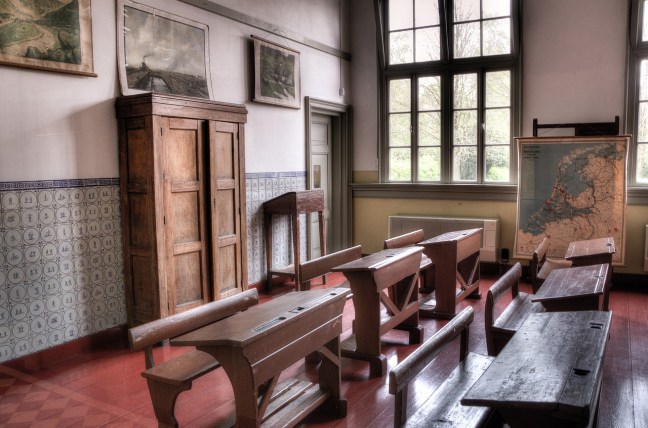
Old school classroom

The year is 1943, and the music teachers are debating.

An editorial in a music journal was followed by a heated discussion. It was all about the best way to get kids reading music – and believe me, they didn’t unanimously approve of the new, fashionable trends! One enlightened individual asked whether anyone had asked the kids what they thought. The editor remarked that we didn’t ask what they thought about learning maths, so why ask them about learning music? There was even some gloomy muttering about Beveridge and the welfare state …

On the whole, it was a gentlemanly conversation – and I can use that word, because the correspondents were, by and large, men. Not entirely – there was a lengthy contribution from a woman teacher training instructor, too.

After publishing a selection of responses over the three months following his editorial article, the editor attempted to sum up the arguments in the following three issues. He named and shamed those he disapproved of, stating quite openly, that someone’s opinion was frankly a load of nonsense! (I’m summarising – these are my words, and not the journal editor’s.)

The second, summarising editorial was supposed to be the end of his [lengthy] summary. But it took yet another editorial before he finally did finish it!

In actual fact, they almost all agreed that things weren’t as good as they had been, forty years earlier; precisely when the rot set in, was open to debate. Moreover, everyone blamed it on the politicians and inadequate time allocations.

Plus ca change …?