Dr Karen McAulay explores the history of Scottish music collecting, publishing and national identity from the 18th to 20th centuries. Research Fellow at Royal Conservatoire of Scotland, author of two Routledge monographs.
Remembering my fruitful walk on 3 January 2023, I looked outside today – yes, the third of January again – saw the sun shining (athough the temperature was literally freezing out there), and decided to go on another research-and-exercise outing. What could possibly go wrong?
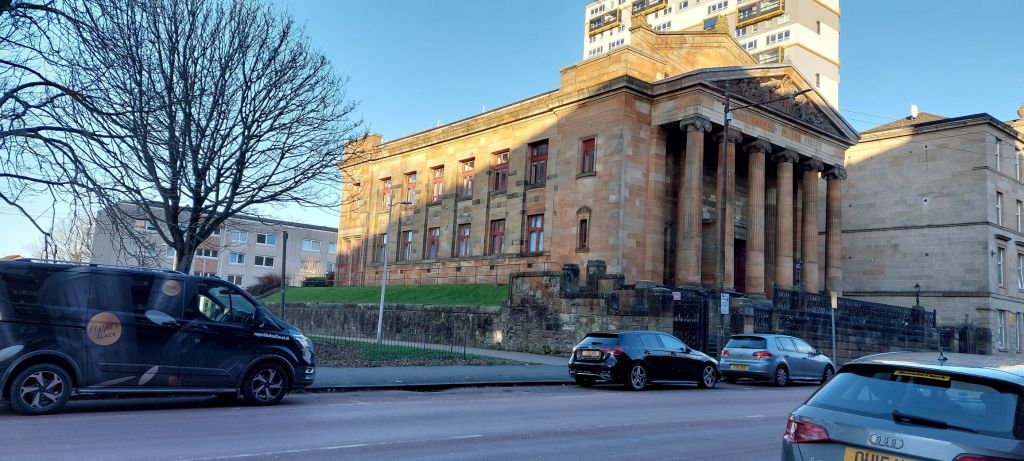
I’ve been exploring the story of a Victorian Glasgow music professor, so I headed for St George’s Cross by subway, to see a former church where he had once been organist. He had started his tenure in an earlier building, which was burned down in a fire, but a new one was built in a mere two years, so he must have resumed duties at that point. I already knew that, as with organist Maggie Thomson’s Paisley church, this Glasgow church had likewise now been converted into rather classy flats.
St George’s-in-the-Fields, Glasgow
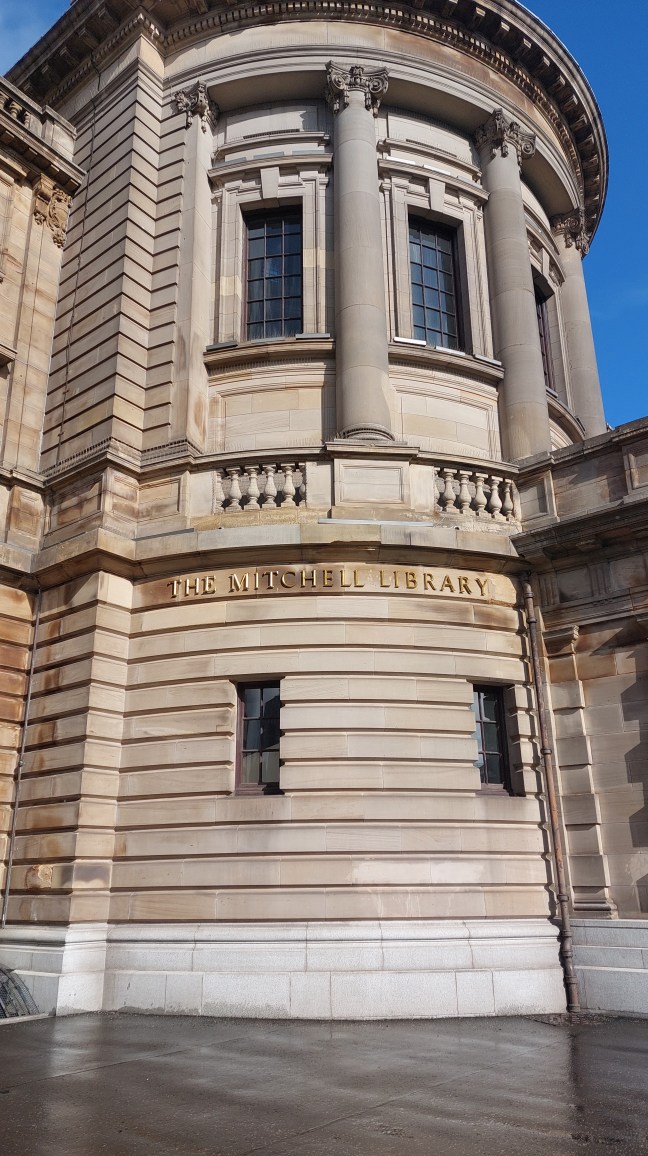
Unperturbed, I headed next to the Mitchell Library, and up to the fourth floor where the old music card catalogue lives; it has never been digitized. This eminent individual certainly composed enough, but mostly in a light-music vein, and not published by any of Glasgow’s bigger music publishers. However, I was still surprised to discover that he is completely unrepresented in the card catalogue.
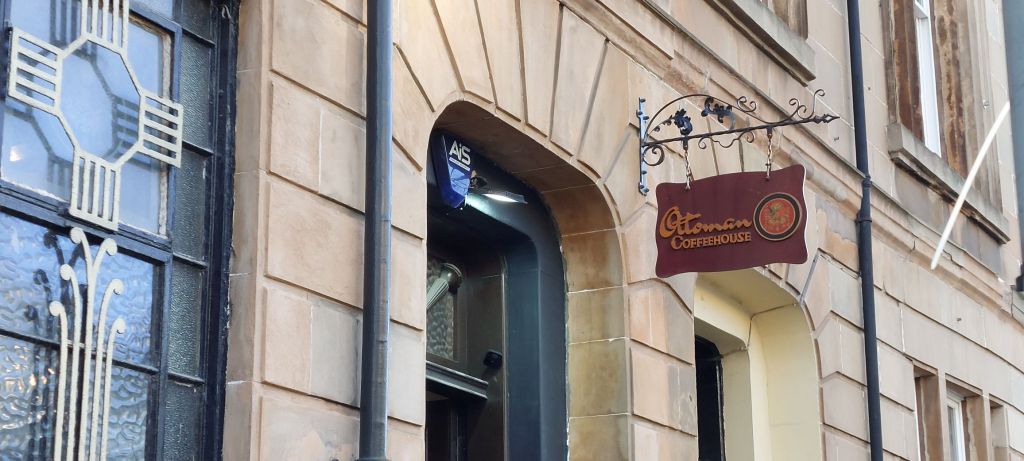
Ottoman Coffeehouse
To drown my sorrows, I headed next to a celebrated Turkish coffee shop in Berkeley Street. (The premises had once been a club for Glasgow musicians, and our hero had been included in a song-book that they sponsored; clearly I needed to have a coffee there in his honour.) Foiled again! There was a queue out to the pavement, just to get inside the cafe. Back I went to the Mitchell Library cafe, to get my coffee more quickly!
It was still bright and sunny outside, so my next port-of-call was India Street (on the opposite side of the M8, near Charing Cross station). This had been both of professional significance and latterly home to our hero, and although I knew modern developments had taken place, I still hoped that I might be able to walk the length of the street. Thwarted! Scottish Power sits squatly and solidly across the line of the road, and pedestrian access is blocked by ongoing building works before you even get to it.
I could have headed into the city centre to gaze at the Athenaeum, but I’ve passed it hundreds of times, and there are plenty of pictures on the web – it wouldn’t have felt like much of a discovery. Sighing – for the mere glimpse of a road sign at the wrong end of India Street had not exactly thrilled me – I headed for the bus home.
But fate had one more twist for me: whilst I was looking on the travel app to find out when the next bus was due …
… the next bus sailed past my stop.
I decided that maybe walking briskly to the Subway would be quicker than waiting for another bus. At least the Subway dates from the era when our hero was in his prime and doing well.
‘How did you get on?’, I was asked, when I got back home. I was forced to admit that, apart from St-George’s-in-the-Fields, I had really seen virtually nothing.
On the plus side, my FitBit is as happy as Larry. Finally, it said, she has realised that Christmas is over, and it’s time for the healthy living to resume!
It was foggy all day, I’ll always remember that. The mist still swirling outside, I went to bed and went over in my mind all the places I’d visited.
We met in a small cafe – always a good idea to start off with coffee! It was a short walk to our first stop, the place where much of the city’s music was printed.
A minibus took us to our next port of call – by the river – and then across the river to see where one of our publishers got married. (This raised a few eyebrows, but in fairness, it might have looked different 150 years ago!) From there – to see where he traded from, and then (wishing it was open) past a museum and on to the premises of another local publisher. Again, faded glories, I’m afraid. But it would have been very handy for the shipping!
Our new businessmen would have used trams to get into the city, until the subway started in the 1890s. We took the subway – no trams nowadays! It was time to visit a couple more publishers’ premises in the city centre, not to mention the former Athenaeum. Time for the minibus – there were a couple of former churches to visit (one still standing, another very definitely not); another educational institution, and the street where three music publishers finally found themselves merged into one single entity.
Where next? The Mitchell Library, with all its historical collections, or a nearby cafe? Or indeed, the library cafe? What would everyone prefer? We talked about what we’d seen, and whether it had changed our opinions of all that cheap music, so popular with earlier generations.
I dozed, until finally my busy mind gave in to sleep.
It’s time to confess – the whole story is simply a figment of my imagination – I was dreaming. It never happened – but I’ve thought about it so much that maybe it might have some mileage after all. Would you be interested in such a tour? There are few places we could could actually go into, but I am convinced that a tour of key places would bring the history alive in a way that books can only hint at. It would certainly tie in brilliantly with my second, recently published book. I’m going to think about it a bit more imaginatively … watch this space!
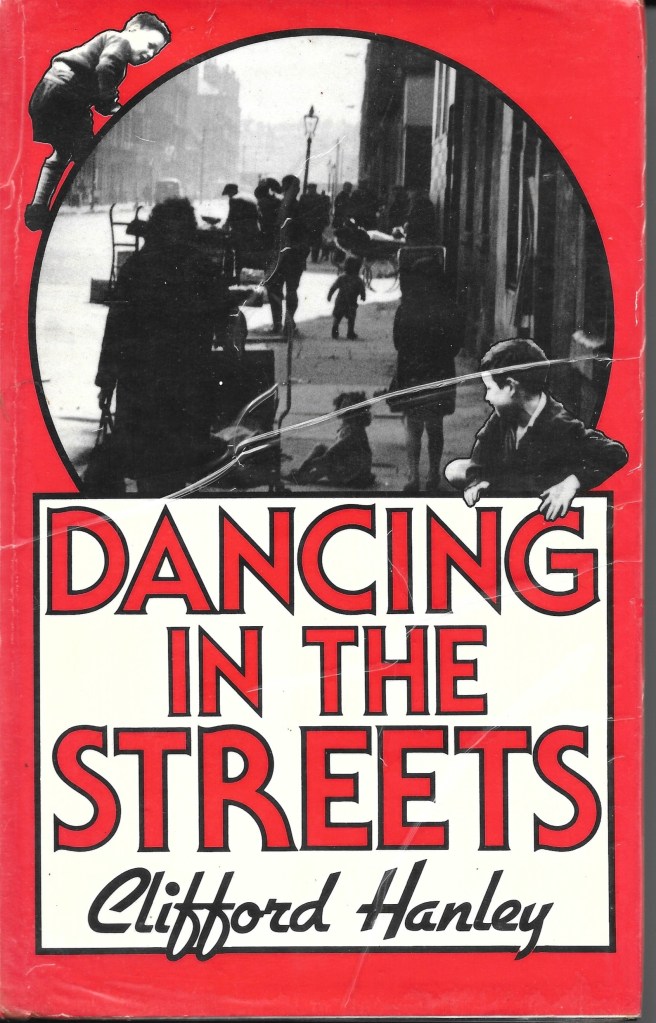
Unless you’re Scottish, you may not have come across Clifford (Cliff) Hanley. He was a Glasgow journalist, writer and sometimes lyricist, born in 1922 and dying in 1999. Dancing in the Streets was first published by Hutchinson in 1958. My own eBay copy is a 1983 reprint by Edinburgh’s now defunct Mainstream Publishing. Amusingly, it came secondhand all the way from a library in Ilford, Essex!
On the second day of my indisposition with Covid, I picked it up, decided that even Glasgow autobiography and social history was beyond me, and turned to Audible. Don’t judge me! But yesterday and today, feeling closer to my normal self, I picked it up again, and read the whole thing cover to cover. This is a man who knew Glasgow inside out, as a local journalist. (You’d like to read his obituary, maybe? Here it is in The Guardian, 14 August 1999.)
Subject heading: Glasgow (Scotland) Social life and customs
Hanley wrote well, and entertainingly. There’s lots of local colour – not to mention wee reminders that times have changed since then. (Go to a party on the night your wife’s in hospital having your firstborn? I think not! I imagine husbands weren’t allowed in the delivery room in those days, but this is still barely a mitigating factor!)
I bought Dancing in the Streets in the hope of tracking down some elusive information – which I didn’t find, as it happened. (It was, admittedly, a long shot!) However, I did recognise names that I’d already encountered, and I was to discover different gems that filled me with some excitement, because odd little passages foreshadow things that I, as an incomer to Glasgow, had later discovered through diligent research, and these convinced me that what I have written in my forthcoming monograph is certainly born out by someone who was actually there in inter-war and postwar Glasgow. I’m quite glad I hadn’t read it until now. It’s useful background, but it’s not on the subject of Scottish music publishing or amateur music-making, so I don’t feel I was negligent in not considering it earlier. However, in bearing out truths that I had to learn the hard way, there were several ‘Yes! See? That’s what I found!‘ moments, amongst the laughs that I couldn’t stifle between coughing!
For example –
In my forthcoming book, I’ve written about Emigration and Homesickness
Hanley took a holiday job on a cattle-ship from the Clyde to Montreal, as a very young teenager. On page 95 of his book, he meets some Glaswegian expat women there:-
‘How is Argyle Street, son?’ one of them asked kindly. ‘Fine – still the same, big crowds on a Saturday night an’ buskers playin’ the flute.’ ‘Oh, my God!’ She started weeping, but took a hold of herself. ‘It’s that nice tae hear a good Scotch voice. Could you no’ take me hame on your boat, son?’ ‘I wish I could’, I said in desperate pity. ‘Ah know, ah know, son, ah wish you could tae. Don’t you ever leave your hame, son, it’s the best place in the world. Ah wish tae God ah had never left dear auld Glesga.’
You can see how sentimental old (or more recently manufactured) Scottish songs would go down well with such fond emigrants!
In my new book, I mention Newer Approaches to Folk Song in the 1950s
I have certainly not suggested that the folk revival started, like flicking on a light switch, in a certain year, but I have highlighted new trends, and the influence of Edinburgh University’s new School of Scottish Studies. It’s fair to say that Hanley was not in this new movement. On the contrary, he seems to be poking gentle fun at it, on pages 208-10 of his book. At the abovementioned party, he describes an actor who ‘wanted everyone to sing folk songs, or Hebridean mouth music’, and a girl who was a potter, who wanted to ‘dance some kind of reel in her bare feet’. Later, she was ‘doing something stooping down and stamping, which apparently was meant to represent walking [sic] the tweed’.
WAULKING not Walking
Clifford and the potter were both, I’m afraid, wrong. The word is ‘waulking the tweed’ and Hebridean women used to thump urine-soaked cloth on a table, to soften it. Yes, I know – it sounds gross, put that way! (Feel the same about your genuine old Scottish tweed now?) Anyway, here Clifford has encountered one individual who is more aware of the new trends, and another who has a vague delusion that she understands it! Neither are seen as kindred spirits. Hanley wrote for a living, including the aforementioned song-lyrics, and had occasionally dabbled in performing on stage and radio. Probably a little younger, these partygoers were not part of his usual scene at all.
I’ve written about Teenagers and Gramophones and American Influences
And on page 242, Hanley writes about the decline of variety theatre, about teenagers’ musical tastes, and a new preference to listening to music at home on gramophones rather than go out to a variety show.
Don’t be Shy to read ‘Non-Academic’ Books!
So, unexpectedly, reading this book came as welcome vindication for some of the points I’ve made – a feeling which is always nice, of course. It’s hardly surprising that a book like this actually functions as useful background reading for a study in popular musical culture. But it also came as a welcome reminder that sometimes there’s benefit in stepping back and reading more widely. A book doesn’t have to be a scholarly tome – no index or bibliography here – to contain worthwhile background information. Information, in fact, that I wouldn’t even have recognised as valuable before I embarked on my research, but which came as validation of the most welcome kind.
My own book’s been copy-edited, the proofs have been corrected, and it’s well on its way to being published. I believe orders can be placed at the end of October. But for now, you might just find me heading to the local library to see if I can pick up anything else by Clifford Hanley. You can get Dancing in the Streets very cheaply secondhand, if you’d like to read it for yourself.
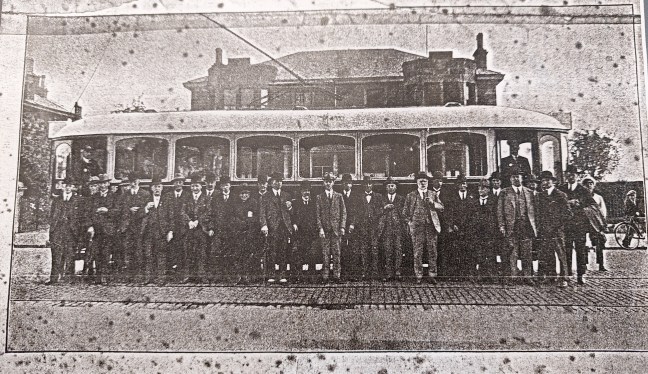
At least a couple of decades ago – long before I was interested in the social history of amateur music-making in Scotland – I came across a curious piece of sheet music. Knowing that my other half is more than a little interested in Glasgow trams, I made a photocopy and kept it safe. Every so often, we would joke that I’d get someone to sing it when it came to ‘final curtains’ time. (It would make a nice change from ‘Abide with me’ and the 23rd Psalm, after all!)
My Insatiable Curiosity
I hadn’t looked at ‘Glasgow’s Tuppenny Tram’ in years, but whilst I was proofreading my forthcoming book, I decided I really should look to see who had published that song. James S. Kerr? Mozart Allan? Galbraith’s in Renfield Street? Certainly not Bayley & Ferguson or Paterson’s. So I looked. The song was self-published in 1926 by the author and composer, an entertainer called R. F. Morrison. The song was actually arranged by Carleton H. Smyth, who was secretary and treasurer of the Glasgow Masonic Burns Club. (You’ll see that Morrison was also the author of ‘Just a wee Deoch-an-Doris’ and ‘Suvla Bay’. Which is interesting, since Harry Lauder’s songsheet of ‘A Wee Deoch-an-Doris’ seems not to mention Morrison at all – but I couldn’t access Morrison’s version without going to the British Library, so I shall have to remain mystified.)
There’s no’ much wrang wi’ Glasgow, auld Glesca on the Clyde; St Mungo’s name is known to fame, ower a’ the world wide. There’s bonnie places roon aboot, that thousands never see, You need no ship to make the trip, so be advised by me. CHORUS. Take a trip on a tuppenny tram, and happy you will be, From daylight till dark, there’s many a park, awaitin’ for you & me, Don’t use your hoard for a Daimler or Ford, Like the workers of Uncle Sam, Since Maister Dalrymple made motorin’ simple, wi’ Glasgow’s Tuppenny Tram.
Glasgow’s Tuppenny Tram / R F Morrison, 1926
‘Since Maister Dalrymple made motorin’ simple, wi’ Glasgow’s Tuppenny Tram’
Whilst we remembered the closing lines of the song (after all, we knew that Mr Dalrymple was a significant name in the history of Glasgow’s tram system, until he disappeared off to Sao Paulo in Brazil as a transport consultant), it’s fair to say we hadn’t looked properly at the whole song.
I’ll spare you the second verse! It lists a number of places you could visit by tram. (As the chorus says – see above – no need to waste money on a car!) Meanwhile, the back page is a large advertisement reminding you that there are 32 parks to visit in Glasgow (and still get home in time for tea), and reminds the reader to take care crossing the road …
It’s rubbish! It does incorporate some bits of Scottish song-tunes, but Carleton H. Smyth’s setting was very humdrum. Only one actual mistake in a chord, to be fair. My book is missing NOTHING AT ALL by not referencing this song.
Oh well, it’s a nice reminder of what Glaswegians would do on a sunny Sunday afternoon, or during Fair Fortnight if they had a bit more time. (Apart, of course, from going to variety concerts to hear the likes of R. F. Morrison! I wonder what the other acts were like?)
Meanwhile, I have now been positively beggednot to have the song performed when it comes to the final curtain! What’s it worth … ?!
I went back to the Mitchell Library in my continuing search for old (historically old) lady music publishers. Floor 5 was temporarily operating from Floor 3, but the books I needed could thankfully still be got out for me.
The Mitchell’s epic carpets. Glasgow logo.
The ladies were nowhere to be seen in the book documenting the Glasgow Society of Musicians. Nor was there any hint of them in another book about live music for Victorian Glaswegians. (Although I did, whilst I was still in the library, get an Ancestry message from one of the ladies’ descendants!)
Floor 4 for the Music 🎶 Catalogue
Undeterred, I headed for Floor 4, to have another look in the old card music catalogue – a really useful resource. Again, I only found two of one composer’s pieces. I already own one of them, but that still means one find. And I also spotted a couple of issues of a journal that interested me. A quick flick through, allowed me to note potentially interesting pages, even if they don’t relate to the present theme. I was in my element.
Closing my laptop, I decided to round off the morning with a coffee downstairs …
Then the fire alarm went off. Everyone filed out, and I looked down the street. Would I find a café?
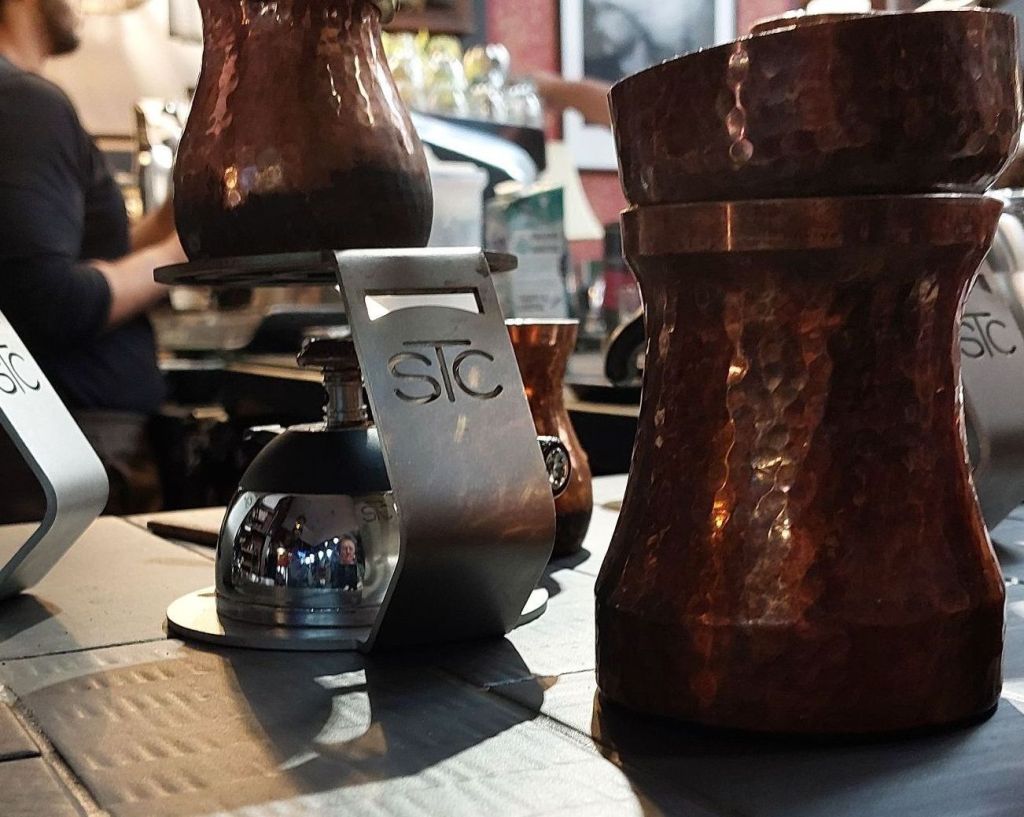
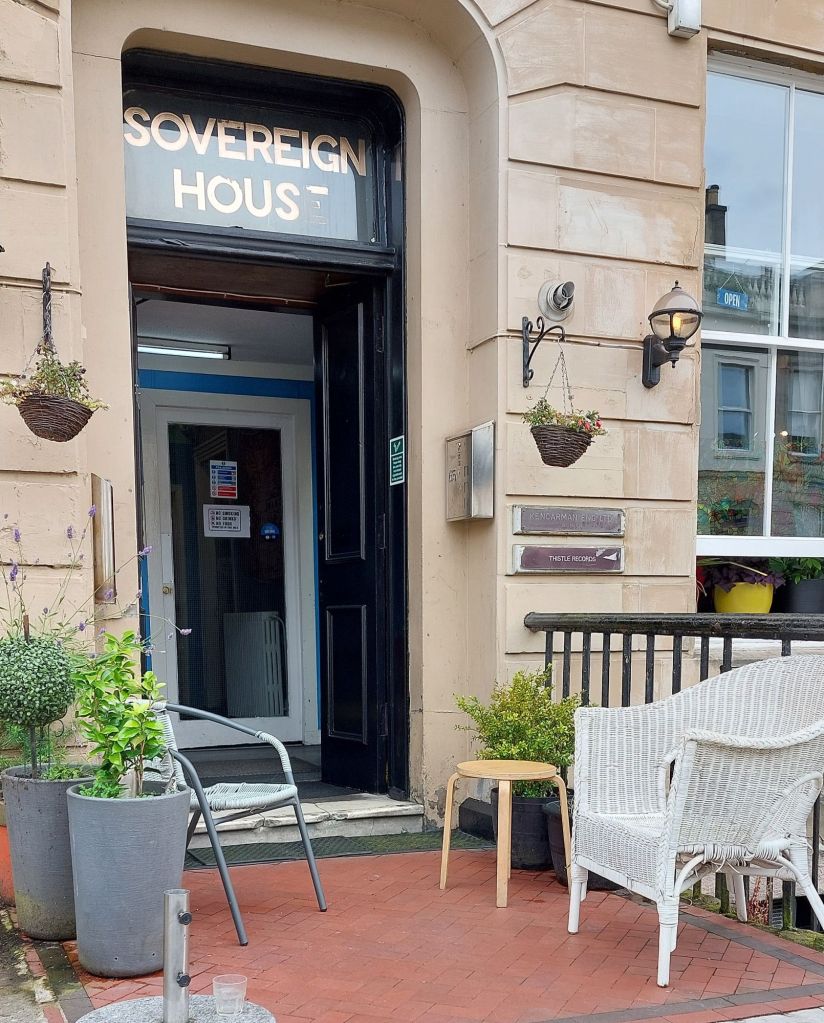
Turkish coffee potsThe erstwhile Thistle Records in Sovereign House. Name plaque still there.
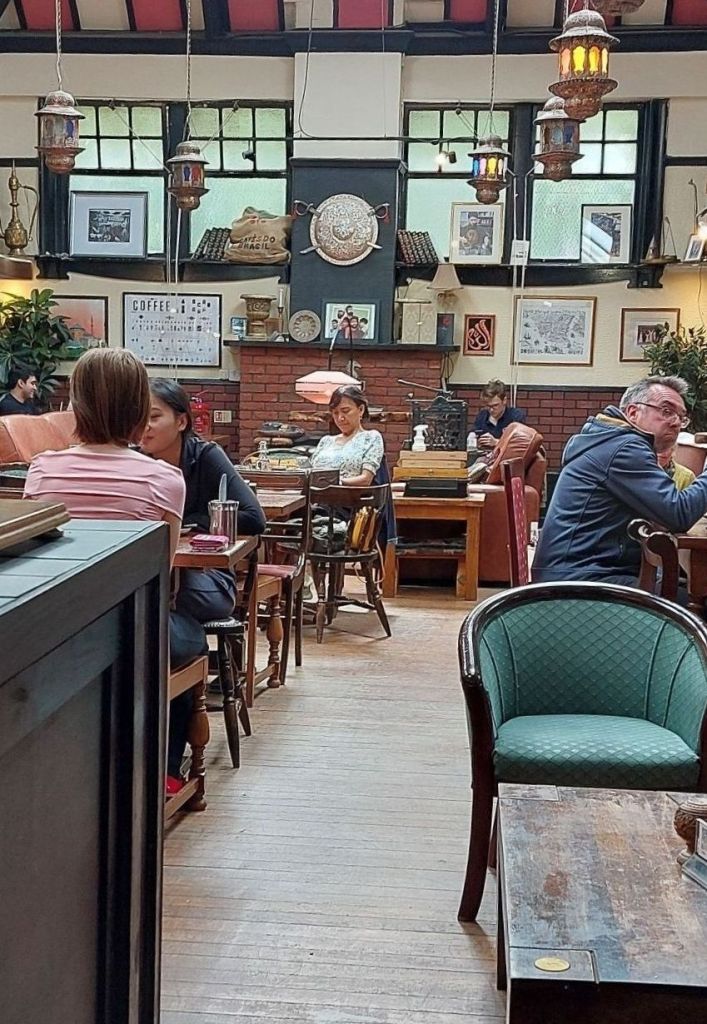
Believe it or not, the Turkish cafe in between what had been Thistle Records, and Kerr’s Music Corporation (Glasgow Music Centre), was in another building with a historical past: no less than the Glasgow Society of Musicians, about which I had just been reading. I got my latte, also snapping a picture of the interior – clearly once the Musicians’ Concert Room – and the art-nouveau front door.
Where once they heard piano trios …You can just see the arched ceiling …Mission accomplished!
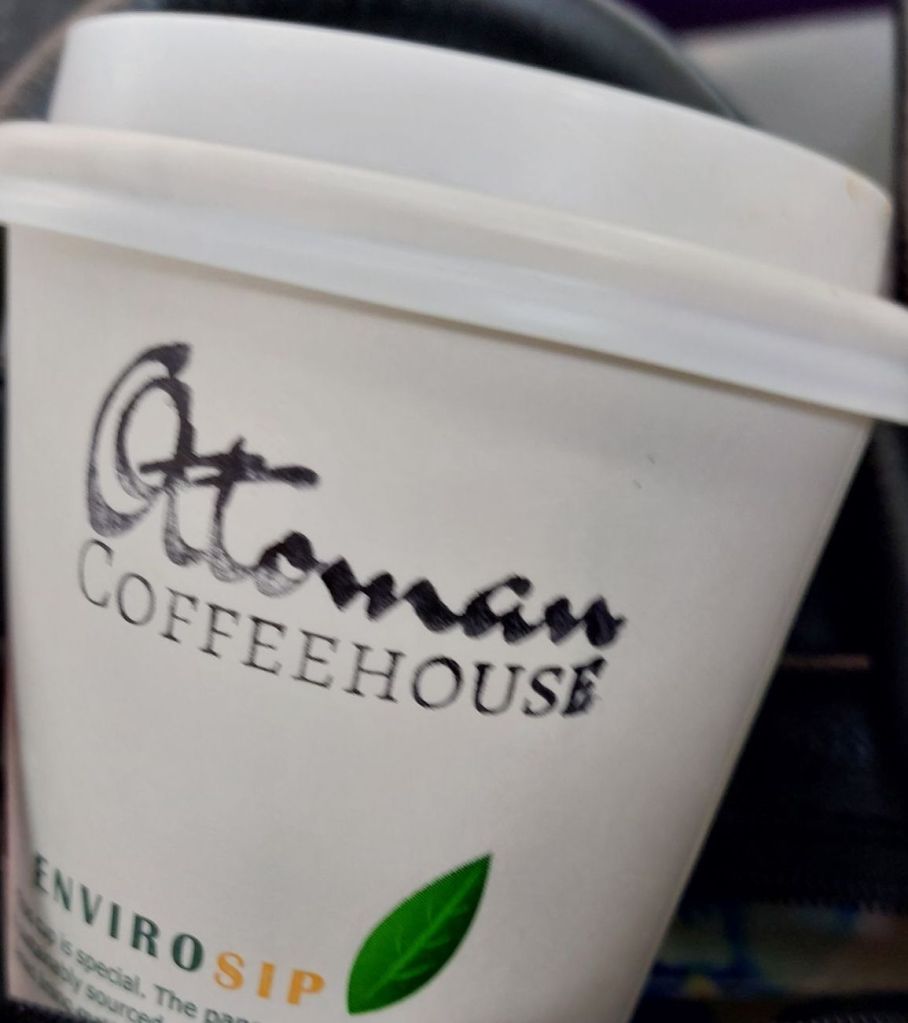
Another time, I’ll make sure I have a coffee ‘to sit in’ rather than takeaway! Glasgow’s most eminent musicians would have enjoyed performances there … whether or not the ladies ever got a look-in!
Yesterday, I set out to track down some music. It’s light music, not great music – almost ephemeral, you could say – but together, it tells a story.
I also wanted to find out more about the life of one of these fin-de-siecle Glasgow woman music publishers.
It’s not that easy. The music is scattered round our legal deposit libraries; the cataloguing isn’t completely consistent; and fin-de-siecle ladies, whether single, married, childless or proud mothers, didn’t leave much record of their daily lives. They’re hidden in the shadows of family members, and, whilst I imagine they knew one another, let me stress that this is NOT a tale of a female publishing cooperative!
I had a nice chat with a local history librarian, making an acquaintance who is now equally keen to find out more; then I headed home – as yet, none the wiser – to devise a complex spreadsheet of music titles. I’m visualising a pinboard with strings criss-crossing between ladies, libraries and work-lists.
So complex, indeed, that I still haven’t planned how best to get to SEE the music.
I’ve done quite a bit of work about diversity in library collections – whether diversity in terms of music composed by women, or music composed by people of colour. I’ve also devoted quite a bit of space in one chapter of my forthcoming book, to the influence of the craze for ‘minstrelsy’ music towards the end of the nineteenth century.
I was very much taken with the exhibition at the Hunterian Museum a couple of years ago, and I’m also very interested in Glasgow’s history as ‘Second City of the Empire’, and finding out more about some of our dubious merchant forebears. So – will I be going to see the Kelvingrove exhibition? You bet I will!
I’m conscious that I haven’t posted with my research hat on this week. Fear not, I’ll be back! But not in today’s posting. The exhibition very much deserves to be showcased in its own right.
If I haven’t been rapturously blogging from St Andrews this week, it’s because I’ve been confined to the West of Scotland and the staff side of a library. My ring-fenced research time found a gap in the fence, and no research has been done. But I’ve conducted a lot of library tours! Discussed historically underrepresented composers, and ordered some more music by women composers (all enjoyable tasks). Weeded some books (rather more mundane). But it has felt like a very long week – the first time I’ve been in the library Monday to Friday, since 2012. Why now?, you might ask. A fair question!
On the plus side, I’ll recoup the missing time in October, and (better still) this situation won’t arise again, because next Autumn I shall have retired from librarianship.
But NOT from research, certainly not. I truly can’t wait to settle into having just one professional role!
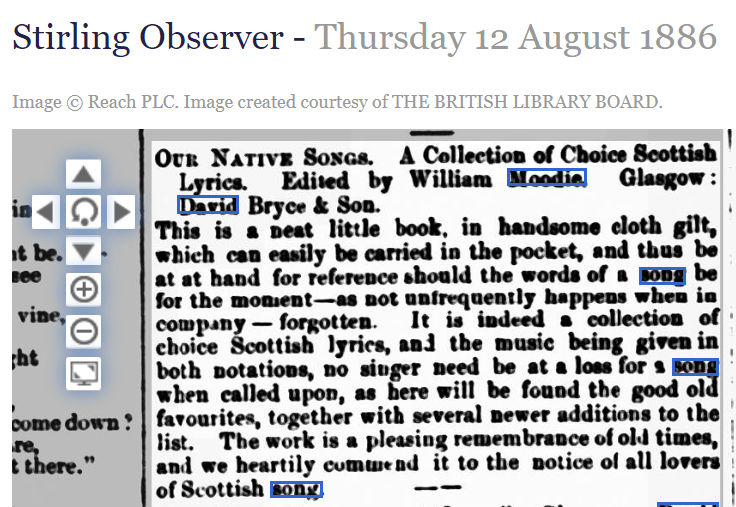
I blogged for the Whittaker Library this morning! It’s about William Moodie’s little book, Our Native Songs. Moodie features in the book that I’ve just finished writing, so I got a bit excited about this little songbook, even though it wasn’t the context in which I had been writing about him before. All the same, it has his words in the Preface, and it has a Glasgow connection, so it was lovely to handle it whilst I catalogued and blogged about it. (And now, I won’t be able to resist investigating the publisher, will I?!)
Since I’m currently working on a book about Scottish music publishers, I suppose it was inevitable that I’d ask myself just one question last night:-
Did 20th century Scottish music publishers publish any music to commemorate the four Coronations of their day?
Well, you’d have thought they might, wouldn’t you? There were militaristic books of marches and national songs in war-time, so why not patriotic books of national favourites when a new monarch acceded to the throne?
A couple of klaxon warnings should be sounded straight away.
It would be easy to say that Kerr and Mozart Allan never published anything related to coronations, but the truth of the matter is that I have plenty of evidence that what survives in libraries is certainly not the same as what was published in the first place. The more ephemeral the music, the slimmer the chance of its surviving. And, without putting too fine a point on it, a library might keep Mozart Allan’s book of songs by Robert Burns, but a flimsy, contemporary song of the music hall or variety performance kind, not designed for longevity, probably won’t have been added to a University Library’s stock at the time it was published, even if there might be scholars today eagerly seizing upon any lucky survivors. Similarly, a ‘Coronation Waltz’ or ‘Coronation March’ wouldn’t have been something studied by music undergraduates studying Palestrina or Mozart in a red-brick British University.
If you’ve been following social media or broadcast news recently, you’ll realise that some Scottish people are decidedly not Royalist in their leanings. However, it would be risky to say this was the reason for Kerr and Mozart Allan’s apparent lack of interest in publishing music on a coronation theme. There is no written evidence about their political views whatsoever.
I searched for pieces with ‘coronation’, ‘King’ or ‘Queen’ in the title. It was a quick and easy search, but certainly not a comprehensive one. (For example, if there was a song called ‘Westminster Pageantry’, without any of my search terms in the catalogue entry, then I would not have retrieved it.)
But the fact remains that music celebrating the coronation of a British monarch appears not to have been of interest to Kerr and Mozart Allan, the two popular music publishers holding sway in Glasgow for the first part of the twentieth century.
Edward VII and Alexandra’s Coronation, 1902
I found just one Scottish publication, the Glasgow and Galloway Diocesan Choral Association’s Book of the Music to be used at the sixth festival service in St. Mary’s Church, Glasgow on Saturday, June 28, 1902 (in connection with the coronation of His Majesty King Edward VII) etc. And that was it!
The English firm Bosworth, on the other hand, published Alexander Campbell Mackenzie’s Coronation March, op.63, in various formats: for piano, a full score, and arranged for piano duet by J B McEwen. Mackenzie (1847-1935) was Edinburgh born, but became Principal of the Royal Academy of Music in 1887. McEwen (1868-1948), another Scot, was professor of harmony and composition at the Royal Academy, and in time became their next Principal. Mackenzie’s Coronation March was dedicated to the King, and first performed at Crystal Palace with anything up to nine military bands. A march was an accessible genre, but the composer was very much part of the English musical establishment.
So, not much to see in 1902, then. But wait!
George V and Mary’s Coronation, 1911
Bayley and Ferguson had offices in Glasgow and London – and had done for some years. On the occasion of George V and Mary’s Coronation, they published Carlo F. Roberti’s The Crowning of our King & Queen; or, The Coronation Song of – Semper fidelis. I know nothing about Roberti, but someone at the Dundee Courier wrote in 1990 that his real name was Charlie Robertson, of Perthshire. (If you have access to the British Newspaper Archive, you can read how the readers responded to this snippet, on 8 February 1990. Robertson was a violin teacher. His song was taught to local schoolchildren at the time.)
The Scottish firm Paterson’s had offices in both Scotland and London, too. They published a Coronation song by a Durham man, Thomas Richardson, who had moved to Edinburgh to become organist at St Peter’s Episcopal Church in 1879, and singing-master at George Watson’s College in 1883. His song, ‘Mary’ had an alternative title, ‘Queen Mary. Coronation Song’, with words by K. Kelly, and was for some two decades popular as what people imagined to be a Scottish song. Which raises the interesting debate as to what makes a song ‘Scottish’!
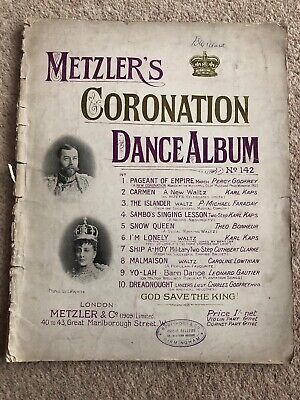
Metzler’s Coronation Dance Album (image from eBay)
Meanwhile in London, light music publisher Metzler published a book of tunes around this time, which included at least one piece composed for Edward’s Coronation: Metzler’s Coronation Dance Album. The precise date is uncertain: Metzler gives 1911 in Roman numerals, and (1909) in Arabic. Very helpful, Mr Metzler!
George VI and Elizabeth’s Coronation, 1937
Paterson’s was essentially a London firm by this time. J Michael Diack, one of the directors, had moved down south some years earlier. And that means that the only Coronation theme publications that I traced were either published in England, or overseas. Perhaps it was the advent of radio broadcasting that made people more enthusiastic about such things, but the outpouring of Coronation-related music was suddenly – well, remarkable! Many people got a wireless in time to listen to the Coronation – the first time such an event could be broadcast.
‘This Most Historic Event’
Which brings me to an advertisement in the Coatbridge Leader on Saturday 27 May 1937. F. Mills & Co sold pianos, organs and radios from his two shops in Coatbridge, a town about a quarter of the way between Glasgow and Edinburgh. (He also had a shop in Motherwell at some point – I haven’t checked dates.) If you bought a piano or organ before the Coronation, he would give you a free stool. If you bought a radio – to listen to the broadcast – then there was a discounted price.
Mr Mills didn’t mention sheet-music, but you’d be surprised how many English music publishers rushed to publish relatively lightweight music for popular consumption, whilst Paterson’s also offered a choral arrangement of a Handel anthem by one of Diack’s favourite composers:-
Let all the people rejoice : coronation anthem S.A.T.B. / Handel; arranged by W.F.R. Gibbs ; edited by J. Michael Diack. (Lyric collection of choral music, sacred. No. 1647) London: Paterson’s 1936
Paterson’s Coronation music book
Royal cavalcade : coronation march / Albert W. Ketelbey, in piano or orchestral score (Bosworth, 1937)
Chappell’s Coronation Album. A Musical Cavalcade, etc. [Marches and Songs.], 1937
The Coronation Waltz / Jimmy Kennedy (Peter Maurice, 1937)
Long live the King (Paxton, 1936)
The Coronation Song / Martin Silver (London: Silver’s, 1936)
Coronation March Album / Granville Bantock (London: Joseph Williams, 1936)
Slightly to my surprise – though it was obvious, when I thought about it, with emigration still high – I found publications from Australia, Canada and America too:-
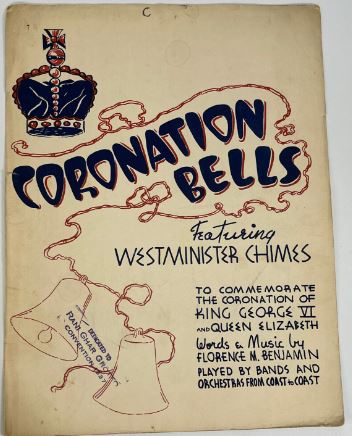
Coronation Bells – image from eBay
Sterling’s Coronation Community Album (1937?) Disappointingly, the contents of this publication from the Antipodes didn’t seem to have anything to do with the – erm, actual Coronation. But I suppose the word ‘Coronation’ would have been eye-catching.
In Toronto, Florence M Benjamin published her Coronation Bells in 1937
And in Chicago, Moissaye Boguslawski’s Coronation March: dedicated to their Majesties King George and Queen Elizabeth of England was published by Calumet Music in 1937
Elizabeth II’s Coronation in 1953
There was a rush to get television sets for Queen Elizabeth II’s Coronation, although comparatively few people in Scotland would have had them this early on. Francis, Day and Hunter published a new dance introduced on television for the Coronation.
However, despite now being basically an English firm, Paterson’s turned to their Scottish roots for their Coronation offerings, which had nothing to do with the television broadcast at all. Indeed, country dancing was very popular across Britain:-
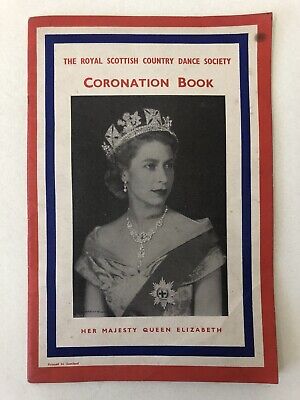
For the Royal Scottish Country Dance Society, Paterson’s published The Scottish country dance book. Book 17 : Coronation book / music arranged by Herbert Wiseman.
Paterson’s also published Pipe-Major William Ross’s The coronation bagpipe march… entitled “The coronation of Queen Elizabeth 1953”
The English Folk Dance and Song Society also published a book of dances: The Coronation Country Dance Book.
Many other publishers produced music in their own preferred genres, but I didn’t see anything from Kerr’s, Mozart Allan or Bayley & Ferguson.
From Bosworth came Coronation march album for piano solo, with music by Ketelbey and a variety of other composers.
Bosworth also published a Coronation Suite for piano by Barbara Kirkby-Mason, who was known for writing educational material.
Francis, Day and Hunter produced Francis & Day’s coronation album in 1952, along with
Archie Alexander’s The Coronation Polka, followed by
Kenneth Wright’s A Waltz For The Queen (Television’s New Coronation Dance), arranged by Sydney Thompson in 1953
The Northern Music Company – a London firm – published Coronation Waltz by Christine Hurst and George Warren, with words by Bill Tomlinson and Stanley Barnes. Reported in The Stage in October 1952, it was written by ‘four northern songwriters’ and received favourable reviews at its introduction in a Butlin’s holiday camp dance contest. If this makes you think of ‘Hi-de-Hi’, then you’re absolutely right – Butlin’s holidays were cheap, accessible, didn’t involve travelling abroad, and as we all know, dance contests have never gone out of favour!
Coronation Waltz- image from eBay
Last night, I was just idly searching to see if ‘my’ Scottish music publishers showed much interest in Coronation-themed publishing. On the face of it, those with an English office did make a token effort. Those based solely in Glasgow may not have done, with the caveat that they might have produced ephemeral material no longer traceable, and there could have been songs that my quick search didn’t reveal.
But I know a lot more about light music publishing in England around those times!
IMAGES: All from eBay!
If you enjoyed this blog post about popular printed music, then you might like to read another post about music with a more serious, ceremonial slant, that I wrote for our library blog, Whittaker Live: Tracing our Musical History through National Events.















 Karen McAulay, Musicologist