Dr Karen McAulay explores the history of Scottish music collecting, publishing and national identity from the 18th to 20th centuries. Research Fellow at Royal Conservatoire of Scotland, author of two Routledge monographs.
Perhaps it’s not surprising to find more librarians and former librarians than usual at a research conference about book and print history and the book trade – but I was certainly in my element amongst the researchers at this week’s Print Networks conference in Newcastle. Indeed, I even found two more musicologists and a music practitioner amongst the kindred spirits, so I didn’t really need to try very hard to make my point that printed music history is indeed a branch of book history. Glasgow printers also got a look-in, so my talk about Glasgow music publishers wasn’t out on a limb geographically, either.
Then there were trade catalogues, book pirates, Stationers’ Hall, slave narratives, radical newspapers in Birmingham … just so many interesting papers!
Having spent the first part of the week in Newcastle, the last couple of days were ‘mine’, an agreeable blend of sociability, along with mundane catching-up at home, and (ahem!) more research.
A Lost Work, aka, a Ghost Publication
An old copy of a classical piece in a Mozart Allan edition raised some interesting questions – could I resist following them up? Indeed I could not. I’ve found another lost work – or as I prefer to call it, a ‘ghost’ publication. It would have been so very nice to have tracked this down. The advertisement absolutely reinforced a point I make in my forthcoming book. But it’s in neither Jisc Library Hub Discover, WorldCat, the British Newspaper Archive, Abe, Alibris, eBay, the Sheet Music Warehouse, Google Books nor Archive.org. There’s no mention of an editor or compiler for this collection, just a title. Oh, bother!
London suburbs
And a London Gent supplying Mozart Allan with Light Music?
It gets worse – another advert at the back of the same classical piano piece appears to suggest that a light-music composer who published almost exclusively with Ascherberg, Hopwood and Crew, also published a few early works with Mozart Allan – but using a different first name. Two of the works published by Mozart Allan also appear later with the first name he was mainly known by. This is interesting. I’ve spent several hours yesterday and today trawling eBay (and treating myself), whilst on the trail of this gent. Yes, I know the book is already in preparation. Anything I find won’t go in the book, but research doesn’t stop when a book is published, does it?!
I accepted a generous donation of old books to the Library a couple of weeks ago. This presented me, personally, with a bit of a problem because our offices, furniture and contents are being moved around, and I had proudly emptied most of my shelves in readiness. There will be fewer shelves in the other office. And now I had two shelves full of old Scottish music – right up my street – which needed cataloguing.
Most vital priority – get them done before I retire from the Library.
Almost as vital – to get them done before the move on Thursday next week!
Of course, the lovely thing is that they’re books I’ve encountered in various research contexts … the PhD; the Bass Culture project (https://HMS.Scot); the book chapter on subscriptions; and my own forthcoming monograph.
I catalogued like crazy on Thursday and Friday. I’ve catalogued Sammelbande (personal bound volumes) of songs, piano music and fiddle tunes. I’ve shown colleagues books signed by George Thomson. I’ve indexed Gow’s strathspeys and reels. And yesterday I blogged about James Davie and his Caledonian Repository.
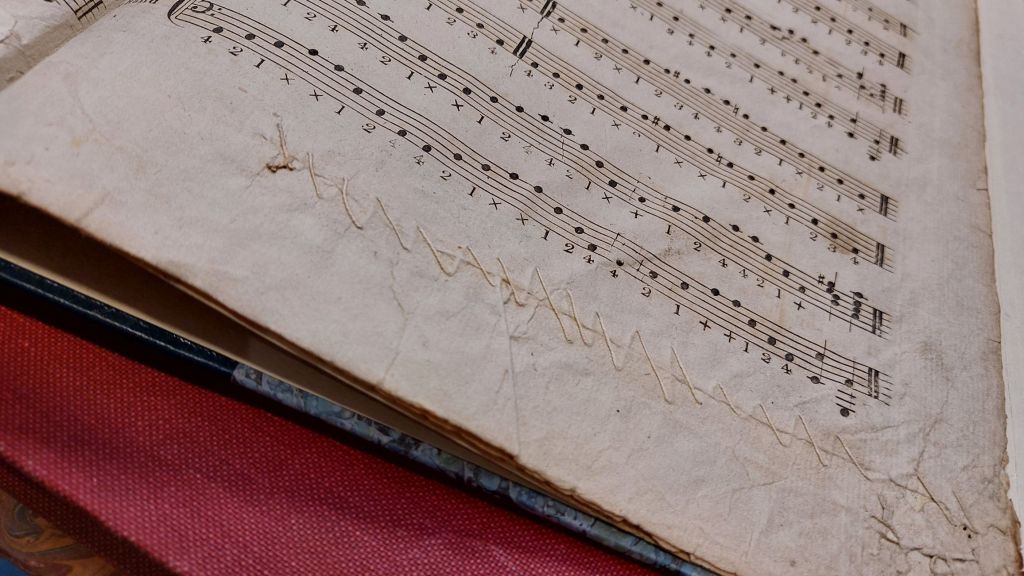
But I’ve also just enjoyed handling the music, because sometimes one finds some endearingly human evidence of the scores being used, even to the point of needing mending. It’s quite touching to ponder how much a piece had been used, before it actually needed stitching – here, along a line where the edge of the printer’s block had originally left a dent in the paper:-
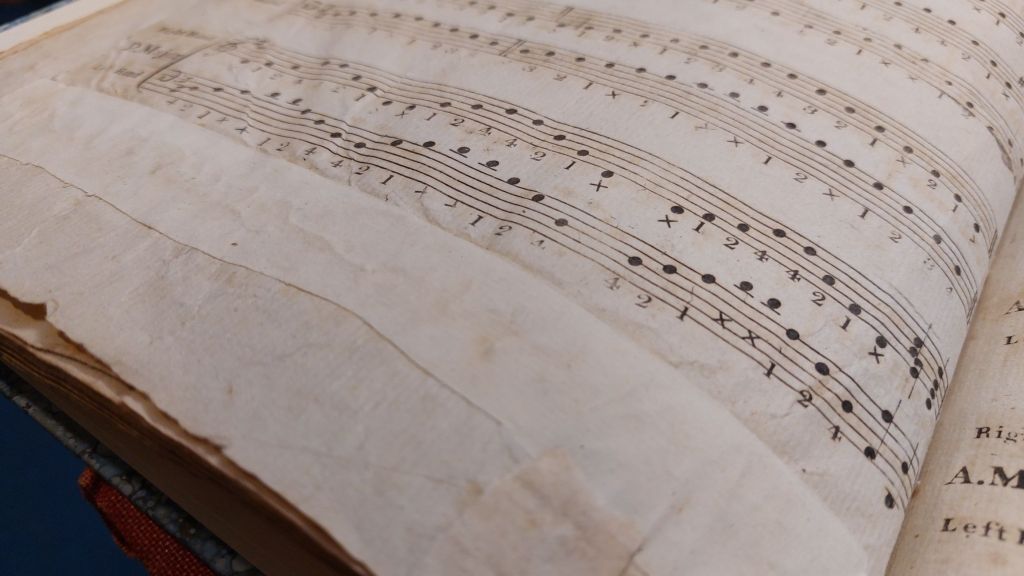
Stitched on one side, pasted on the other!
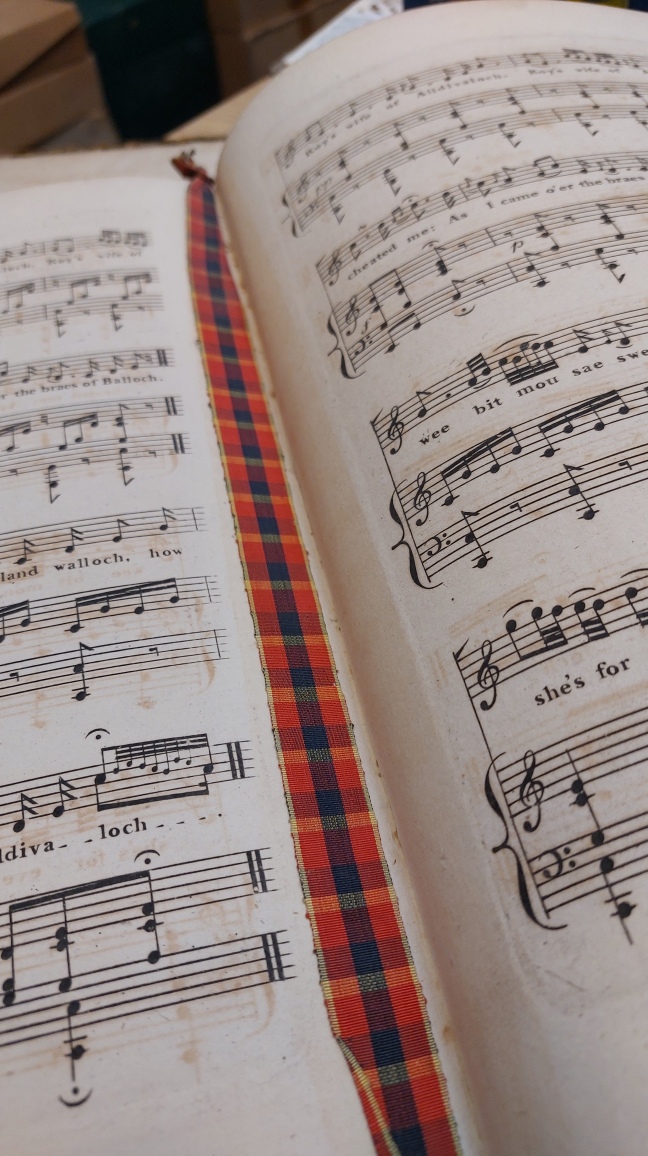
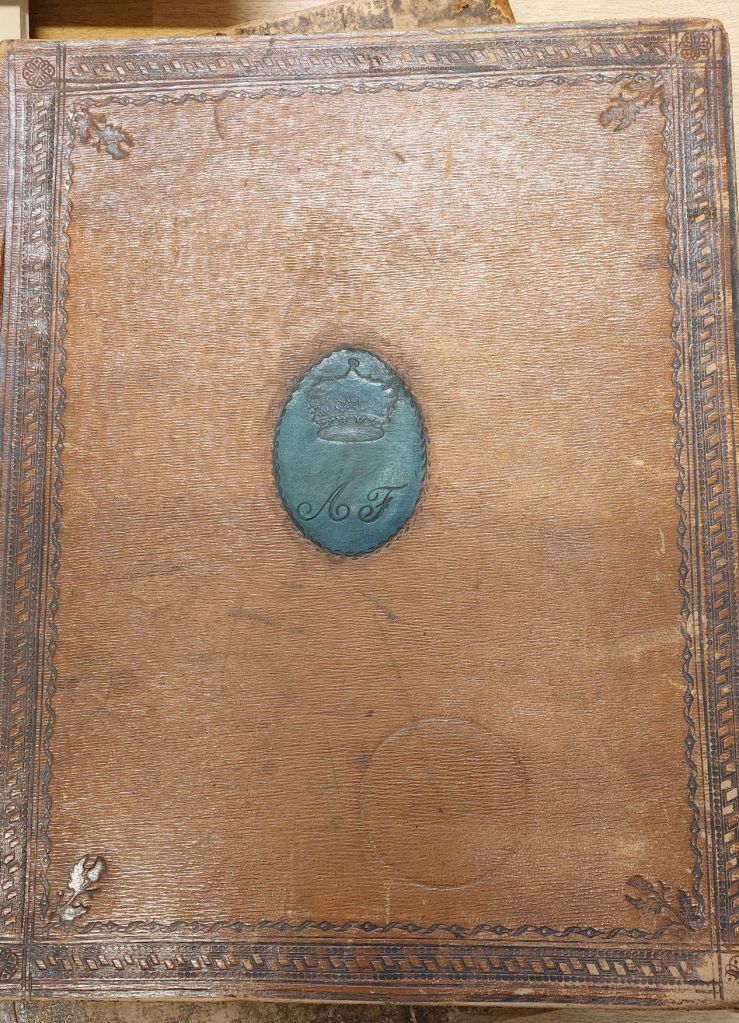
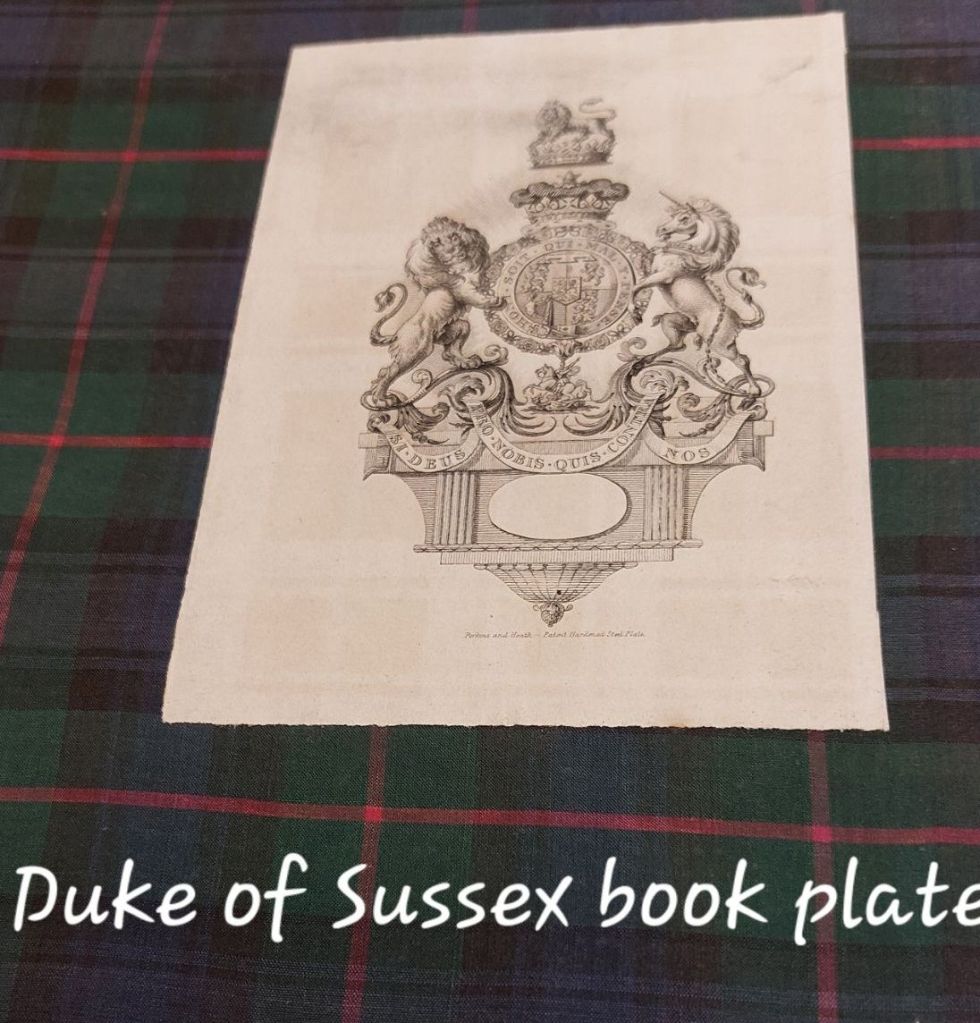
I’ve smiled at Georgian ladies’ stitched repairs to much-loved pieces, noticed with amusement a handful of early Mozart Allan books (yes, including some strathspeys and reels) in a fin-de-siecle Sammelband which had seen better days; spotted piano fingerings pencilled in; and best of all, found a tartan ribbon in a volume dedicated to the Duke of Sussex – his personal copy, which was first sold out of the family’s possession in 1844. His library was dispersed after he died in straitened financial circumstances:-
Nine Scots Songs and three Duetts, newly arranged with a harp or piano forte accompaniment / by P. Anthony Corri
This book has the Duke’s family crest on a label pasted inside, and the outer cover is embossed with ‘A F’ (Augustus Frederick), reflecting the monogram on the title page.
The Duke of Sussex’s mongramAugustus Frederick, Duke of Sussex (1773-1843)
The tartan endpapers and tartan ribbon between pp.30-31 are a perfect illustration of what I have written about in a chapter on tartanry in my forthcoming monograph. Everyone – whether nobility or commoner – liked a bit of tartan on or inside their Scottish song books, and here, someone even found a bit of tartan ribbon to use as a bookmark.
I have just a few of those books left to catalogue now. There’s an intriguing one without a cover or title page, waiting for 9 am on Monday …! Hopefully, I’ll end up with an empty bookcase again.
I don’t go on shopping sprees. But let me loose on eBay, and who knows what I’ll buy? I came across a Bayley & Ferguson publication from ca.1894-6. It was published both in Glasgow and in London, and was performed in Bishopbriggs on the outskirts of Glasgow in January 1897. The London address confirms the earliest date. (John A. Parkinson’s Victorian Music Publishers: an Annotated List is invaluable here.*) The cover illustration caught my eye, and I must confess I was intrigued to find it was composed by a woman: Constance M. Yorke. In 1897-8, she also published Twilight Shadows with a London publisher, Larway, who again dealt with light musical fare. I haven’t attempted to get my hands on that one.
Constance M. Yorke: is this Constance Maria Yorke Smith / Scholefield?
I traced a Constance Maria Yorke Smith (1855-1936), who was a vicar’s daughter, originally from Loddon in Norfolk, but whose early adult years were spent in Penally, Pembrokeshire. Her late father was the Revd. J. J. Smith, latterly a tutor at the University of Cambridge. Constance in turn married a clergyman herself – James Henry Scholefield – in a very ‘society’ wedding in Cornwall in 1891. If I’m right, then this ‘humorous musical sketch‘ under her forenames but not her surname, could have been written when she was already married. (Her mother had given the happy couple a grand piano as a wedding gift – Constance would have been making good use of it!)
Rose Smith’s Mother, Mary Ann
This paragraph is newly added (March 2026). In the RMA Research Chronicle, you’ll find my recent article about five Scotswomen involved in and around music publishing in the late Victorian era and early twentieth century. The author of the musical sketch, M. A. Smith, was the mother of composer and self-publisher, Rose Smith. And whilst I can’t be 100% sure of the identity of Constance M. Yorke, I am 101% sure that M. A. Smith was Rose’s mother, and the author of Mr and Mrs Dobbs at Home. I’m still working on this, notwithstanding the fact that my article is now published, because I feel there’s more to be said about M. A. Smith. I’m fascinated by her, her views, and her writing. Bayley & Ferguson didn’t publish the sketch using the lilac-and-green colour scheme commonly associated with women’s suffrage, but the sketch is a somewhat tongue-in-cheek sideways glance at the suffrage movement. Read on, to see what I mean. The rather obnoxious heroine hardly sells the idea of women’s suffrage and equality to the average man – or woman – in the street.
Mr & Mrs Dobbs at Home: humorous Musical Sketch / (words by M. A. Smith; composed by Constance M. Yorke (London, Glasgow: Bayley & Ferguson, n.d.). Franz Pazdírek listed the piece in his Universal Handbook (1904-10), but erroneously attributed it to Caroline M. Yorke, and Twilight Shadows to M. Constance Yorke – rather confusing, Herr Pazdírek!
So, what of ‘Mr and Mrs Dobbs at Home’? Selina is a spoiled young madam. Mr Dobbs is hen-pecked to an insane degree, submissive beyond measure and seemingly incapable of standing up for himself. Selina says he has driven the maids and the nurse away, so it’s only right that he should do all their work. ‘Enter Mr Dobbs in shirt sleeves and kitchen apron, with broom in one hand, duster in the other, as if he had been sweeping.’ (Does he go out to work? No mention of it. And why have they all gone away? The poor man seems to have no spine, let alone any serious vices!) The baby cries. Who goes and fetches her from the nursery? Mr Dobbs. He says the child is teething. Selina instead accuses him of jabbing her with a nappy pin.
Ah, well. Having told him off for having a quick, sneaky puff of his pipe whilst she was getting herself ready, the pair and their baby set off for a day out to meet one of Selina’s friends. At this point, Mr Dobbs mentions that a ‘lady speaker’ has tried for the third time to see Selina, but he forgot to mention this before. (I missed this the first time I flicked through, but sat up straight when I realised that Selina was being courted by the Suffragettes, Suffragists, or similar.) Privately, he seems to think anyone involved in ‘Women’s Rights’ should be kept well away from his wife – it seems a little late in the day for that, considering Selina already has the upper hand! Of course, Selina sees things differently, and the rest of the sketch is basically a dispute as to whether women can, or cannot, ‘rule as well as the men’, with Mr Dobbs muttering that,
Shirts, vests, and ties and knickers, too, are all now female gear; our coats and hats will follow suit, and presently we’ll see the pater in the mater’s skirt, a-toddling out to tea.
Mr Dobbs’ complaint
It’s not a work of high artistic content! Not that it isn’t harmonically sound or averagely tuneful, but it was probably only ever intended for domestic or amateur entertainment. However, I do smile at the thought that whilst Revd. Scholefield was writing his sermons, Constance was sitting at the piano composing a musical sketch about role reversal – and then publishing it. (Or had a lyricist originally written it more as a conservative warning than eager anticipation of a brave new world?!)
You never know what you might find when, on a whim, you order something off eBay.
* John A. Parkinson, Victorian Music Publishers: an Annotated List (Warren, Michigan: Harmonie Park Press, 1990) – it is worth noting that Parkinson worked in the Music Room of the British Museum.
As I pursued my research for my latest book, I accumulated quite a few postcards and other ephemera which might not, at first sight, appear to have had much to do with the subject in hand. Indeed, when I decided to sort out my box file, I was initially a bit surprised just how much of this stuff I had acquired! However, much of the work was done during the pandemic, when eBay was actually a very sensible way of getting hold of things … and you could argue (hark at me, justifying myself) that I spent less on those postcards than two or three hot drinks at the RCS café-bar each day I’m on site!
Did Mozart Allan use printers Aird & Coghill? They printed a lot of music in Glasgow!
Sifting through my treasure-trove was so enjoyable that I eventually realised I wasn’t in the least bit ashamed of my guilty secret. I have a contemporary postcard of the very respectable-looking Glasgow street where James S. Kerr first lived. (The neighbourhood is less upmarket now, and both his first home AND his shop are now gone.) And there’s a postcard of the shop that Frank Simpson had on the corner of Sauchiehall Street before the shop and adjacent church were knocked down to make room for British Home Stores. I also have a card of the view Mozart Allan would have seen every time he stepped outside his shop. (HIS shop building is still standing, just along from the Courts, beside the River Clyde.)
Pretty much the view from the shop doorstep!
I have pictures of the docks, as they were then, conveniently close for Kerr and Mozart Allan’s trading activities, and a picture of the boat on which Kerr’s successor sailed to America on one occasion. I like to be able to imagine what a place was like when the person I’m writing about, actually lived there.
I’ve also got odd bits of commercial ephemera – an advertising brochure; a business postcard; a couple of letters. The business postcard set me on the track of the individidual who took over Kerr’s business after Mrs Kerr died. It was only last weekend, long after I’d acquired it, that I realised there was a woman’s name written across the top left corner. A colloquial diminutive for the new owner’s wife’s first name, in fact. So – maybe she worked in the shop, too? It’s not musicological research, but I would like to find out. I enjoy finding women working in the music publishing/retail business, in eras when fewer women worked outside the home.
Another bunch of postcards trace the tartan-mania which spilled over from cards to coffee-table song-books and miniature souvenir books. Talking of souvenirs, I have travel guides, maps, an embroidery canvas of a commemorative map of the British Isles – it was unworked, but I’ve since done the stitching and had it framed – and a reproduction of an early PanAm poster. I’ve written quite a bit about Scottish songs in the memory of expats, both overseas and over here.
And there are a few photos of children having music lessons; of women sitting at the piano; a magic lantern slide; a stereoscope of (apparently) happy workers on a cotton plantation – in my book, I’ve written about the racism in plantation songs.
A whole load of sol-fa booklets of various kinds. They have a wee box of their own.
There’s also a photo of an Edinburgh railway bridge. Why? I was hunting down a particular song-book editor, and a musician with the right name lived just beside that bridge. I don’t think it was the right man, but it’s a nice photo, so I’ve kept it anyway!
I have contributed a chapter to a forthcoming collection on Print and Tourism, which is being published by Peter Lang. The completed manuscript will soon be going to the publishers, which is very exciting. You might ask what a musicologist was doing, writing about print and tourism? Well, it won’t be long before all is revealed.
I had enormous fun writing this chapter, and I think folk will enjoy reading it. It’s different. Well, that’s hardly surprising, given the subject matter, but I’ve placed it in a wider cultural context than my usual more musicological offerings, and I’m really looking forward to seeing it in print.
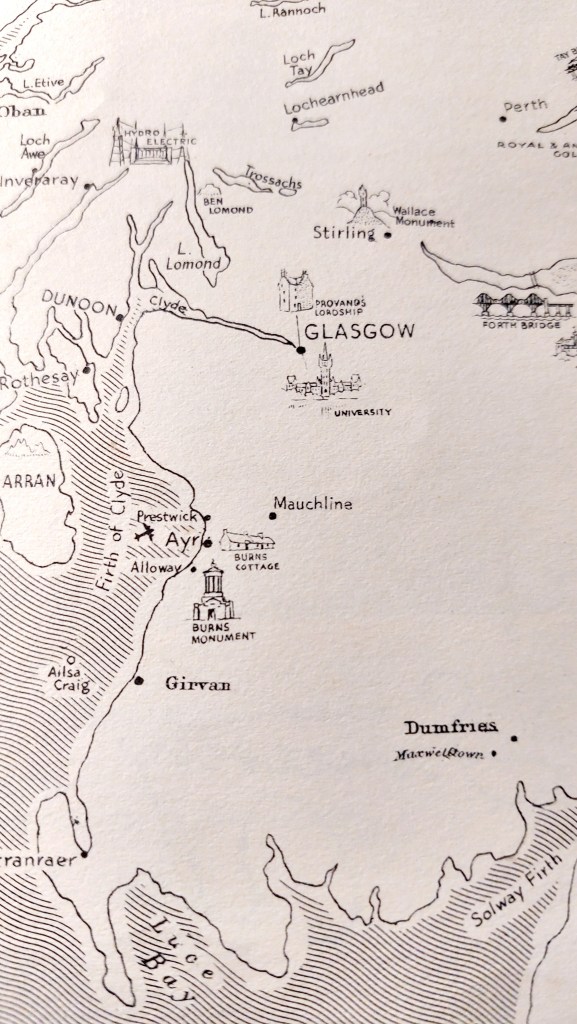
A Question for You: What’s significant?
The topic arose from a book I acquired during lockdown. Ironically, it was only a couple of weeks ago that it dawned on me that not only would we need to buy the essay collection for RCS’s library, but we’d also need a copy of the book which inspired it! I can’t think why that didn’t occur to me sooner, but it is on order and on its way, so I’ll be cataloguing it very soon. We’ll have it well before the essay collection is finally published!
So, your challenge is this: Can you work out what is significant about this map?!
I would never, ever have dreamed, when I went to Exeter to start my first, unfinished doctoral studies on mediaeval English plainsong and polyphony, that I would end up completing a different PhD thirty years on, and writing and being published on such a very different topic!
One of my favourite Mozart Allan songbooks has an intriguing history. I have contributed a chapter discussing it, in a print and tourism collection, and I’ve dealt with it in slightly less depth in my own monograph. (Neither is published yet, but hopefully the essay collection will appear later this year.)
The songbook has a photo of a Glasgow entertainer, and the words (so I thought) of his recent song – but not the music. That, it says, is available from Mozart Allan. I have been itching to see this entertainer’s song, but it entailed a trip to the National Library of Scotland.
Today – at last! – I saw it. Two sides of music, that’s all. The words in the song-sheet are more extensive than what appeared in the songbook. It’s just a typical music-hall waltz, but I’ll tell you something …
They encapsulate much of what I’ve been writing about, so I’m ecstatic to have seen it. I’m not able to share the images (though I think this snippet is probably ok!) – but I’ll certainly be talking about it when I give one of my guest lectures at St Andrews!
Again and again, I sit down to write about music, and end up going into hyperfocus about words. It must just be the way my mind works!
I found this in my drafts from a couple of years ago. Well, this clearly isn’t my holiday postcard. I had just sourced a picture of the boat on which one of ‘my’ Glasgow music publishers sailed home from New York. No idea how long he’d been there, nor what he had been doing! A holiday? Business? Whatever, it’s nice to imagine …
(The card is from eBay, not connected with the Glasgow publisher, I hasten to add.)
Talking of America, after attending the IAML Congress, I had something American I needed to check out. If I had FOUND something interesting in the two new databases I’d learned about, then it would have been galling to have found them after completing my book draft.
I needn’t have worried – I found not a thing. So if ‘my’ cinema pianist did write stock music for silent movies, it didn’t end up in those databases. (I have no evidence that he did – it just would’ve been so cool if he had!) Anyone know of a database of UK stock music for silent movies?!
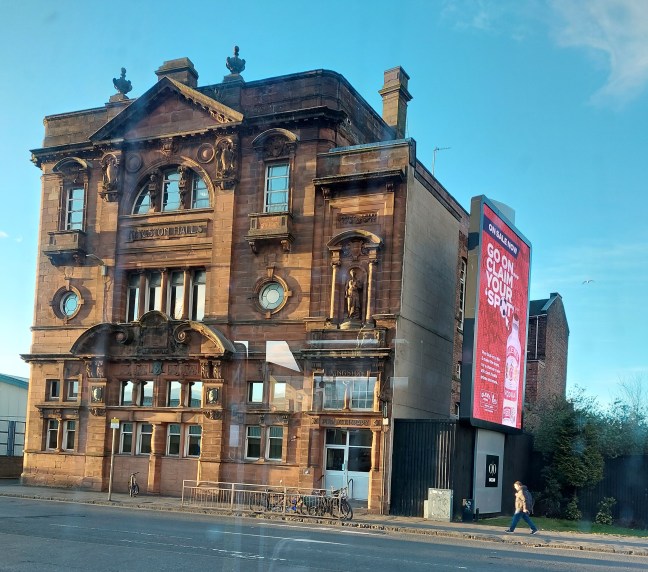
A quick snap from my bus-ride home. This is Glasgow’s former Kingston branch library by the river Clyde, enjoying its retirement in the evening sunshine. Today, the former library still serves the people of Glasgow – it offers homeless accommodation through the Talbot Association.
See the gap to the right of the library? Down a close, you would have found James S. Kerr’s music shop in its first premises, before they moved north of the river. He started off selling pianos, and there was also a dance hall in the block, so there would have been plenty of music around, and probably a good bit of noise from the riverside when you stepped outside.
(My research is into Scottish music 🎶 publishers in the late 19th and early 20th centuries.)
I still don’t know if this kind of post is helpful. To anyone who hasn’t many/any visible outputs, reading someone else’s list of what they achieved is probably the very last thing they need to brighten their day – and I apologise. You’ve probably achieved other, equally or even more important things, which didn’t take the form of words on a page!
From my vantage point, as a researcher who sentenced herself to a career in librarianship, not necessarily as a first choice but what seemed at the time to be a reasonable one, I look at other academics’ lists of achievements and struggle not to compare myself – although realistically I cannot achieve as much research in 1.5 designated days a week as the average full-time academic. My research line-manager is more than content, so maybe I should remind myself of that more often.
So, what have I achieved?
As a librarian, I have spoken at two conferences, a panel discussion and as staff training for another library, about EDI (Equality, Diversity and Inclusion) in our own library. I have a paper being published in an academic journal next year, on the topic of women composers in libraries; but my proudest achievement was actually in sharing a song by a Victorian woman teacher in the junior department of the Athenaeum, that I had discovered in a research capacity, and which a singing student eagerly learned and presented as one of their competition entries in a recent singing competition at RCS. Discovering something, having someone else declare it lovely, and hearing them perform it beautifully, is a very special privilege.
Still hatching
As a researcher, I have another paper forthcoming in an essay collection, though I can hardly list details here before it has even gone through the editorial process. And another magazine article which has been accepted for 2024. Can’t include that either. Nor can I yet include the monograph I’m halfway through writing. I’ve done a ton of work in that respect, but it doesn’t count in a retrospective list of successes!
I’ve also applied for a grant which I didn’t get, and a fellowship for which the deadline is just today, so no news on that front for a little while.
That leaves this little list, the last item of which appeared through my letterbox at the turn of last year, so I’ve cheekily included it here again.
Forthcoming
‘Representation of Women Composers in the Whittaker Library’, Journal of Perspectives in Applied Academic Practice. Arises from a paper given at the International Women’s Day Conference hosted by the University of the Highlands and Islands, 2022. Peer-reviewed and pending publication.
Arrived
‘Alexander Campbell’s Song Collecting Tour: ‘The Classic Ground of our Celtic Homer’, in Thirsty Work and Other Heritages of Folk Song (Ballad Partners, 2022), 180-192
‘Burns and Song: Four New Publications’, Eighteenth Century Scotland, no. 36 (June 2022),12-15.
‘Strathspeys, Reels and Instrumental Airs: a National Product’, in Music by Subscription: Composers and their Networks in the British Music Publishing Trade, 1676–1820, ed. Simon D. I Fleming & Martin Perkins. (Routledge, 2022), 177-197
Meanwhile, as an organist, I’ve completed my first year in Neilston Parish Church, which has been a very healing experience. I love it there! This Christmas has seen three of my own unpublished carols being performed, one in Neilston and two in Barrhead; and earlier in the autumn I contributed a local-history kind of article to the Glasgow Diapason, the newsletter published by the Glasgow Society of Organists. Another publication! Might as well add it to the list:-
‘Trains, Trossachs, Choirs and the Council: Neilston Parish Church’s First Organist’, in The Glasgow Diapason Newsletter
Confession time. Sewing is my relaxation of choice, often influenced by something I’m researching. This year’s project, a Festival of Britain canvas-printed linen piece, relates to the aforementioned chapter that I’ve contributed to someone’s book.
I know I would get more research writing done if I didn’t sew in my leisure time, but I need that for my mental health. Swings and roundabouts…








 Karen McAulay, Musicologist