Rewire, Redecorate … Research?

White paint-pot and brushes on a sheet of newspaper

Rewired

Followers of this blog will recall that our Edwardian home was rewired at the end of November. ‘We’ don’t take kindly to upheaval, of which there was plenty, so I had to unpack and put back a lot of goods (including hundreds of books) afterwards  – notwithstanding the need for remedial decorating  – in order to make the place bearable for Christmas.  Note the ‘We’ and the ‘I’.

Redecorate: Magnolia and White

Today, the remedial redecorating commences (not a DIY effort), so I’ve been repacking goods all over again. I’m the youngish, averagely fit one – and I’m already knackered!  Even my FitBit agrees.  My back has only just recovered from November/December; my fingers are sore; I’ve run out of empty boxes (how, I can’t imagine); and am almost out of floor on which to stack stuff. We have too much stuff. 

I have done my employed research for the week.  Does anyone else working from home recognise this kind of thing?

‘I thought you might have started cooking dinner by now?’

‘But I work until 5 …’

And I did work. Then I cooked. Then I packed and stacked, and continued stacking and packing this morning.  The lounge looks like a library on the move –  and is now so much smaller, in terms of cubic air volume, that it’s actually perceptibly warmer with the same heater settings.

But even women who feel as though they’ve been dragged kicking and screaming back to the 1970s, against their will, have their limits. The kitchen is being decorated first, so it’s fish and chips for tea. There will be no cooking here.

Research?

I’m only contemplating research to the extent of acquiring a decent recording device this weekend! I’m starting an exciting new research project soon, and as soon as the ethical approval process is complete, I’ll be raring to go. Monday will see the Magnolia and White project going on elsewhere in the house – hopefully my own working environment will by then be spick-and-span – with me sitting enjoying remote training to ensure that the new research project goes well.

Now, what colour shall I inject into my magnolia and white dining room to make it a joyful zone in which to work …?

Image by tookapic from Pixabay

The Highs and Lows of 2025

As I’ve mentioned before, I have mixed feelings about this kind of thing. Outwardly, it smacks uncomfortably of, ‘Look at all my Achievements!!!’  Inwardly, I ask myself if I’ve done enough. Could I have tried harder? (I was brought up with, ‘So long as you know you’ve done your best’, but the unspoken suggestion was often that maybe I could and should have tried harder still!)

Sunshine

In a year of highs and lows, this really has been a rollercoaster.  I joyously welcomed the publication of my second Routledge monograph. I was also delighted to accept a visiting Fellowship at IASH (the Institute for Advanced Studies in the Humanities, at the University of Edinburgh), where I explored the Thomas Nelson archives – with more ideas arising out of this.

  • A Social History of Amateur Music-Making and Scottish National Identity: Scotland’s Printed Music, 1880-1951 (Routledge, 2025)

I saw three articles published, gave a paper at a conference in Surrey, and have another two articles and a contributed book chapter in the pipeline.

  • Article, ‘Heart-Moving Stories’ illustrated by Magic Lantern’, The Magic Lantern no.45, December 2025, pp. 11-12 (ISSN 2057-3723)
  • ‘Sir John Macgregor Murray: Preserver of Highland Culture, Music and Song’. Folk Music Journal vol. 13 (2025) no.1, pp.50-63.
  • ‘The ‘Scottish Soprano’ and the ‘Voice of Scotland’: the Importance of Nationality to Flora Woodman and Robert Wilson’, History Scotland Vol.25 no.1 (Spring 2025), 74-81 (accessible online via public library e-magazine apps, or you may be able to order a paper copy online.)
  • Conference paper,  ‘Comparing the Career Trajectories of Two Scottish Singers: Flora Woodman and Robert Wilson’, at the University of Surrey: Actors, Singers and Celebrity Cultures across the Centuries, Thursday 12 to Saturday 14 June 2025,  organised under the aegis of the University’s Theatrical Voice Research Centre.

I also finished supervising and assessing some Honours students’ research projects – an enjoyable new experience.  Having been an ‘Alt-Ac’ since gaining my doctorate in 2009, I had acquired a PGCert and FHEA, but teaching opportunities outside libraryland were infrequent. Being semi-retired certainly opens up new possibilities, and I’m happy to consider other opportunities.

And I have been awarded an Athenaeum Award from my home institution, the Royal Conservatoire of Scotland, for an oral history project in Dundee. That will begin as soon as the  ethical approval process has been completed.

Clouds

However, as well as the professional highs, were the personal lows. In the middle of the year, we lost my mum at the age of 94, and this was far from the only upheaval on the family front. It has not been an easy year.

It would be inaccurate to say that I’m glad to see the back of 2025, because there has been much to celebrate. But, whilst I do hope that 2026 might be less of a bumpy ride, I realise that some things are beyond my control.  ‘Trying hard enough’ isn’t always sufficient guarantee, and some things will be difficult no matter what I do.  Shall we say that I hope the good outweighs the less good?!

Ethical Approval: a Must

Scrabble letters spelling Projects, Jobs, Done

My next research project requires ethical approval – interviewing real live people rather than writing about people long since departed.  And it’s imperative that I get my submission in on time, since the next meeting of our ethics committee is early next year.  

I’ve been working on it for weeks. (Admittedly, I’m a part-time research fellow, so I technically have only 10.5 hours a week to get my research activities done. Yes, we all know that the reality is different!) Anyway, yesterday was my own deadline: it just happened to be the last day we’re open before Christmas, and the morning after my last working day this year.

Efficiency (and Thoroughness)

There’s only one way to fill in a form efficiently, and that’s to make sure every question is answered satisfactorily. To this end, I go through and make myself a list of the information I must provide. Over the past few weeks,  I assembled the info. Attachments were created and labelled. And here’s where Tuesday (not a ‘work’ day) and Thursday came unstuck. I wanted to have a particular collection of old newspaper excerpts to share as an interview prompt.  Finding and listing them was easy enough. Formatting the document in Word, though? With clips of the excerpts? It took hours!

Have I Forgotten Anything?

Finally satisfied, I turned back to the form. And there – I swear they weren’t there when I initially saved it! – were a couple more questions with grey-shaded boxes requiring answers. And attachments.  What a good thing I double-checked. ✔️

It’s done. Phew! Details of whom I hope to interview, what I’ll be asking, and how I’ll save and use the gathered information, are all itemised.

And … breathe!

I submitted it. Ensured everyone involved could access it. At last, I can stop thinking about it until after Christmas!

Now, where’s the domestic to-do list (all the stuff I need to do, because no-one else will think about it) …?

Christmas cheer!

Image by Daniel Schmieder from Pixabay

The Big Idea: another Book

I’m contemplating writing another book. It’ll be based on my recent researches as an IASH Fellow, obviously. But I’ve had a brainwave of an idea for the final chapter – which involves a bit more research – so the past few days have been dedicated to exploring possibilities. As I now know, from the historical Thomas Nelson point of view as much as my own present existence as a scholar, publishers like publishing things in series. It helps them sell, if readers can see how a book fits into a larger grouping of books. I’ve been thinking about where my book might fit in.

I’ve also had a wee jaunt to Dundee to talk to a scholar of my acquaintance; and today, I sat down to write an email. Who’d have thought it would take most of an afternoon to write an email?! But when it’s important, it’s worth taking some effort in the crafting of it.

‘Faint heart never won fair lady’

Finally, I thought it was just right. I mused that maybe I should leave it and re-read it tomorrow. But no, I must be resolute. So, I did not prevaricate. More of this thrilling story in due course …

Mind the Gap! A Hiatus in the Research Process? Don’t Panic

I was going to add another exclamation mark there, but one exclamation mark is enough. Otherwise, it looks panicky, and that’s not what I want.

Over the years, I have come to realise that when you feel you’ve reached a block of some kind, it’s time to take a deep breath, go and do something else, and wait for inspiration to strike.  This profound truth falls into two parts.  The first key thing is to stop thinking about the block. (I’ll come to the second shortly!)  If you’ve just completed a huge project  – or a thesis  – you might need a significant break. In my present project, it wasn’t on that scale.  I just needed to step back for a weekend.

Is That It?

So, here I am, realising that soon I’ll have looked at most of the roughly contemporaneous archives relating to the Nelson’s Scots Song Books, meaning that I won’t be able to extract much more quotable content from these papers.  And oh, I do enjoy the thrill of the chase! I can continue trawling through papers – or databases – for hours, if I’m hunting for particular details. An initial feeling of disappointment – no more discoveries? – left me wondering if I should start writing up what I do know, now?

But There Is More!

This is the second key thing.  Don’t assume that you’ve ground to a halt. And try to avoid doom predictions; don’t fall into the trap of thinking you’ll never manage to get back on track again.  Instead,  regard the hiatus as a time to regroup (if an individual can be said to regroup) and permit new ideas to surface.

I remind myself that I do have a couple of new ideas to pursue, leading on from what I’ve unearthed so far.  This is certainly not the end.

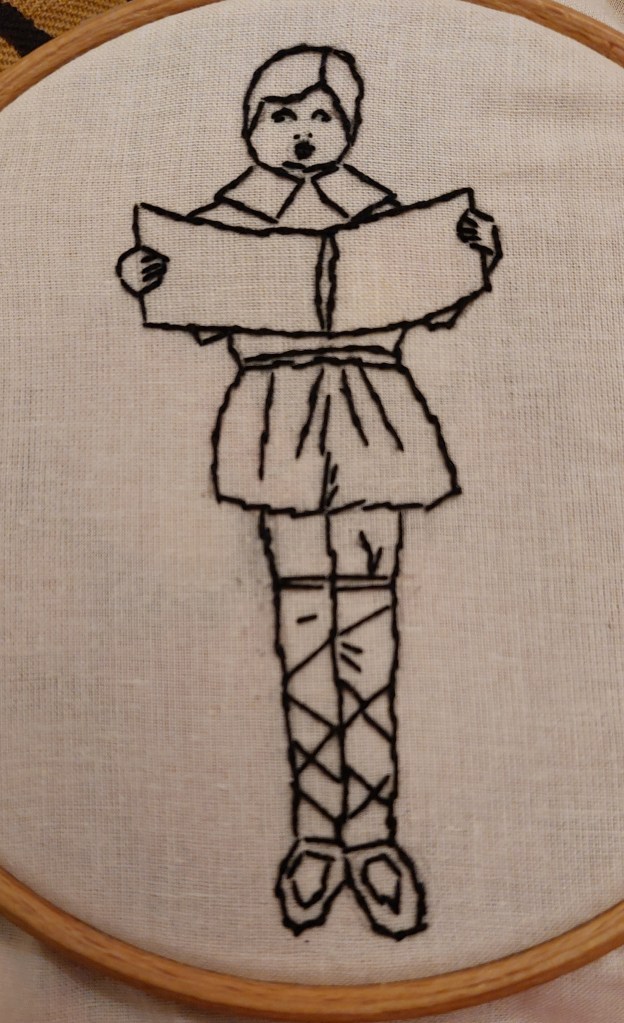
Embroidered copy of child singing from book

Moreover, as I picked up my embroidery needle for some weekend distraction, the sewing project itself reminded me that I haven’t yet explored every angle that I wanted to cover whilst I have access to the archives.

Weekend Pause for Reflection

Remember the little engraving of a child singing from a book? It was used for several of Nelson’s song books, although I think not for the Scots ones. (Only the four Scottish pupils‘ books have illustrations, and they tend to illustrate the songs they accompany – whereas the singing child is just that – a child singing.) I like it, though, and I decided to see if I could reproduce it in stitched form.

And that set me thinking about MacMahon’s New National and Folk Song Books – which include just a few Scots songs. Not to mention the other music books I’ve encountered along the way. 

Actually, that’s another piece of advice.   Take a long, hard look at your initial plan, and ask yourself if you’ve done all you intended to do. There may be other angles that have slipped to the back of your mind.

Looking back at my avowed intentions, at the start of this project, there are several more books I’d like to do a little research into. Not as much as I’ve done into the Scots books, but certainly, to see if I can find any more interesting detail around the times when these other titles were being published. I went back to see what I had written for my Fellowship page on the IASH website. Look:-

Project title: From National Songs to Nursery Rhymes, and Discussion Books to Dance Bands: investigating Thomas Nelson’s Musical Middle Ground

So, how could I NOT devote some thought to nursery rhymes or aspiring amateur dance musicians? Even if it’s only a quick look?

“My recently-published monograph focused mainly on specialist music publishers, but I also made some comparisons with output by contemporary Scottish book publishers, including Thomas Nelson’s.  Exploring the extensive Nelson archive will offer me the opportunity to investigate Nelson’s modest music-related output in depth.  

“The Edinburgh publisher Thomas Nelson’s historical output can be broadly characterised into four categories:- religious; educational; attractive reprints of literary classics; or series for the intelligent layman.  In this project, I shall explore the publishing histories of Nelson’s comparatively limited catalogue of music books and scores, to determine how these titles justified their existence in predominantly non-musical lists.  I’m curious about the publishing histories of all Nelson’s music titles, whether notation or text; and the relative success of different titles.  I’m also interested in the working relationships with compilers and authors.”

Well, I said it there!

  • “The publishing histories of all Nelson’s music titles, whether notation or text.” I can’t compile extensive histories for all of them – there’s more than I thought – but I can certainly explore some that caught my attention. As I have for a couple already, as it happens.
  • As for the relative success of different titles? Well, I can already name a few successful ones, and one a little less successful!
  • And the working relationships? I have plenty of detail, but exploring a few more titles might yield other, unexpected discoveries – all the more reason to keep going!

“I’ll be exploring the background to Nelson’s national song collections, also contemplating their educational music materials in the era ca. 1927-40; books specifically aimed at the layman; and music publications for the Commonwealth.”

  • So – yes, I can justify a bit more time spent looking for the months before MacMahon’s book was published.
  • Maybe I can’t be as thorough as I have been in the 1948-55 era, but I should certainly dip my toes in the water!
  • And – music publications for the Commonwealth? Yes, I can amplify what I know there, too. (Indeed, I’ve just reached out to a college in Nigeria, although it relates to a quest for a picture, rather than anything to do with music.)

So – am I finished? Far from it! I just need to shine a light on different parts of the archive.

(Meanwhile, I’ve finished my wee embroidery – I have no idea what I’ll do with it. But it did get me thinking.)

IASH courtyard, May blossom at its best!

Headline News! Book Progress

A Social History of Amateur Music-Making and Scottish National Identity: Scotland’s Printed Music, 1880-1951

I’ve just heard I should get the proofs of my second monograph by the end of July.

It looks as though the start of semi-retirement is going to be action-packed, doesn’t it? You might almost think I’d planned it that way, but in truth, it’s just how things have worked out.  Any planning was really no more than my thinking, ‘yes, that will probably work out rather nicely’.

I need to start thinking about indexing.  Indeed, I have made a partial start, but so far only focusing on one aspect.

Let me just stop coughing and get this beastly flu-bug out of the way, and then I’ll roll my sleeves up!

Image by Pete Linforth from Pixabay

Funnel or Estuary? Where’s your Research Going?

When I am thinking about research directions, in my mind I have an image of a funnel. Getting further and further into an ever-narrowing topic can be enthralling, but I worry that such a narrow topic might not interest a wide enough audience. 

Admittedly, there are circumstances when narrow specialism is exactly what you need. An eye surgeon who specialises in one particular part of the eye, is exactly what any prospective patient would hope for.

Three cheers for absolute specialists!

However, a broader field in my own kind of subject means I am likely to engage with an interdisciplinary audience. It offers more places to share my findings, and more people to interact with. At this stage in my career, I find this quite appealing. I wouldn’t want to end my career as the woman who was the expert in just one songbook, just one singer, or music in one closely defined location.

Estuary

So, the closest antonym (opposite) that I’ve found to a funnel, is an estuary. I like my research to fan out into different strands over a broader area.  For me, I find I’m more likely to generate impact this way.  But it’s an estuary, not a garden hosepipe spray! That would be altogether too messy. In other words, research might lead in various different directions, but I try to focus my ultimate writing on one particular aspect at a time.  The book currently at the publisher’s has given rise to papers about post-war tourism, Scottish music in the diaspora, and the impact of technology on music publishing for an amateur customer base…

How do you visualise potential research topics? Does consideration of how narrow or  broad something is, form part of your deliberations?

Edinburgh, Glasgow, Paisley?

I have various ideas to pursue, all starting somewhere in Scotland, but my most promising one is the one that extends beyond Scottish music, and beyond Scotland. Possibly even beyond the UK. Another idea isn’t quite as broad, in one sense, but might throw up some new comparisons. I’m still mulling over this one!  The others would be interesting, but don’t offer the same breadth. One in particular is probably too niche to risk giving my full attention to.

Today, my research has been into the first of these ideas.  Delving into unlisted source materials has meant a whole DAY not really finding much with any musical connection. On the other hand, the amount of context I’ve discovered is immense.  I find it very helpful to know about what was going on beyond the publication of a few specific books. It IS relevant to collect data that tells me who the key protagonists were.

However, I’ll have to try to avoid following up intriguing stories that really DON’T concern me. The lovely old man who chased up the progress of his book in an admirably gentle, diplomatic way? It got to the editing stage, but didn’t seem to get published – no trace of it. But it wasn’t music-related, and has no place in my research. I really must not succumb to the temptation to explore the back story of every human interest story I encounter!

Guilty as Charged

The river Kelvin, with the University of Glasgow in the background

It’s about work-life balance, but it’s also about adjusting to a changing situation. I have no problem turning off my 0.7  librarian self when I leave the office, but research has always been something that occupies more than the remaining 0.3 of my working life.  Last year’s summer annual leave was spent finishing writing a book. Last Christmas, revising it.  HOLIDAY? That’s what other folk do!

So, when I find I have more time, what happens? I’ll need to watch this, when I am semi-retired.

I said I was having a day off, a proper day off, didn’t I? So, how did that go? Did I do all I set out to do? Did I keep away from research? No, I did not.

Guilty as Charged.

I finished my audiobook in a leisurely way. (It was Cal Newport’s Slow Productivity – it had to be leisurely!) So far, so good. I even made a note of his three key points:- Do fewer things; Work at a natural pace; and Obsess over quality.

Knowing that I was expecting the postie to collect a parcel this morning, I decided I’d better not laze around in bed reading the book about ultra-processed foods, so instead I went down for breakfast – and there I came unstuck. I opened my phone, headed right for my favourite website (Jisc Library Hub Discover) and started what can only be described as a literature search, for publications by a particular organisation. Oh dear, oh dear. The breakfast disappeared, the piece of paper beside me filled up, and I sent a couple of queries about a publication and an archive. Finally, it was clear that I’d need not only to tweak a paragraph in the paper I’m working on, but also to type up my Jisc Library Hub findings …

Glasgow Tram model at Kelvingrove Art Gallery and Museum

By lunchtime, I was disgusted with myself. I hadn’t even managed half a morning away from research! This afternoon, therefore, I went on an outing. I not only got my favourite red shoes repaired (which was somewhat urgent), but – more importantly – I visited Kelvingrove Art Gallery and Museum, and saw the Glasgow City of Empire exhibition.

Having seen the groundbreaking work at the Hunterian Museum (‘Curating Discomfort‘) a couple of years ago, I had an idea what to expect, and I wasn’t disappointed. It’s thought-provoking. I found myself wondering where the donors of some of the exhibits had got their artefacts from, and whether they’d paid a fair price, or been given them … and under what circumstances?

I sat and watched Aqsa Arif’s film installation, ‘The Trophy Cupboard’ (Anam Ki Almari) in which a woman discovers items ‘collected from the Indian Pavilion at the 1888 Glasgow International Exhibition’. I need to go back and watch it again – I think there are deeper layers that I’d find, if I had seen it more than once. I make no pretence at being highly film-literate, as I’ve never studied the medium as an art-form.

There was also another exhibition about Scottish identity in art, but again, I need to go back another time. There’s just too much to take in on one visit.

On the journey home, thoughts of research returned to my head. There’s another sentence that needs modifying. (Will I do that tonight? Do I dare even open the document at this time of night?!) I cooked tea and started a dressmaking project to distract myself.

But before you ask – no, I didn’t get round to riding the bike today! I’m hopeless. So much for ‘practising for semi-retirement’!

Tomorrow’s another day.

So Now What? The Book Revision is Done …

In the research part of my role (the 1.5 days a week when I am seconded to be a researcher), my path was very clear before Christmas – I was revising my monograph. Having submitted the revisions (on the Twelfth Day of Christmas, no less), what’s next?

Easy, I thought to myself. Whilst I wait for feedback, I’ll just put in a couple of article proposals, then get on with some more research about some interesting elements that I focused on in my book. I have a book to review. And in due course, there’ll be copy-editing and indexing – that’ll keep me occupied! Not to mention looking for grants for which to apply.

Things are Seldom what they Seem!

Four days later, and I now also have two peer-review tasks to do within the next three weeks, and I need to make a recording of my Exchange Talk, just as a back-up in advance of what I hope will be a live Zoom event …

I have 5.5 days in which to do all this. It’s just possible that anything without a deadline might get put to the end of the queue!

Image by Gerd Altmann from Pixabay

The Fellow’s To-Do List

It’s only four weeks until Induction Week at the University of St Andrews!  From knowing I’m going to be the inaugural Ketelbey Fellow ‘in the autumn’ – a vague point in the future – it is suddenly an actual thing happening in a month’s time.  

So, on my first research day back after the vacation then the IAML Congress (leaving aside the fact that I wrote my way through almost my entire vacation), I took a deep breath and started a new To Do list.

And suddenly it wasn’t so much a question of, What am I going to do now I’ve submitted the book?, as, Where do I start on all I’ve got to do now I’ve submitted the book? It feels like there’s quite a bit to do – but I do now know the bus times, and I’ve reached out to a couple of libraries about things I need to know, so I’ve made a start.

I’ve got two guest lectures lined up, and interestingly – but perhaps not surprisingly – the monograph throws up several possible topics. It’s easier to see them, now the whole thing is written.

Indeed, although one lecture title is provisionally settled, I can see several other possibilities to choose from for the other one, which is gratifying. (Although I managed to get Dorothy Ketelbey into my book, I don’t know if I could get her into a lecture. It was only a passing mention. And yet ….)

But before that … one or two other things to catch up on. I’d better get started!