It’s Getting Closer! The Next Article

Anyone looking at my publication record is soon going to be mightily confused. The article about Sir John Macgregor Murray concerns a Highlander who lived from 1745-1822. I wrote it at a time when I was still researching Scottish music collecting and publishing in the late eighteenth- and early nineteenth-centuries.

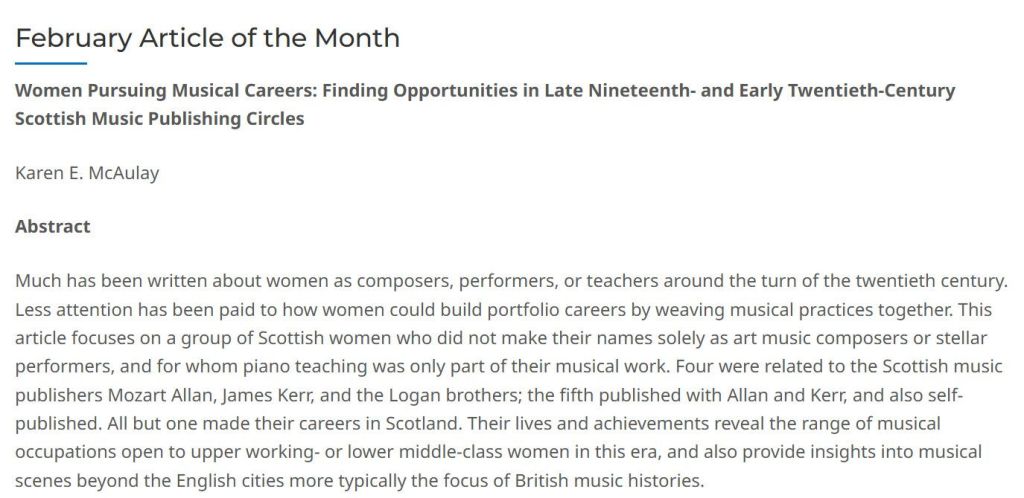
Today, I received the final proofs for the next extensive article. This time, it’s about Scotswomen with portfolio music careers in the late nineteenth- and early twentieth-centuries. (Two of them were of English parentage, but let’s not quibble!) A spin-off from my latest book, in the sense that I turned my focus onto a number of individuals who had hung around in the shadows of the book, this article extends over some 22 pages, and luckily there wasn’t a great deal needing changing in the proofs.  But the instructions for using the proofing system extended over 49 pages, and there was also a ten-step quick tour of the process. I nearly had a fit at the sight of the former, but the latter told me nearly all I needed to know. Job done.

There are still more articles in the pipeline; I’ll flag them up as they come along! Meanwhile, there’s the small matter of Christmas requiring my attention during the semi-retired part of my existence, not to mention the continued tidying up of our poor scarred, rewired residence! But first, I need stamps …

Image: Glasgow Athenaeum, forerunner of the Royal Conservatoire of Scotland (Wikimedia Commons) – where two of ‘my’ musical ladies received their advanced musical training.

A Quiet Contribution to Women’s History: Miss Elizabeth Lambert

Seashells of various sizes

At Tuesday’s Women who Dared book launch, mention was made of the Wikipedia ‘Women in Red’ project, to which I once attempted to contribute.  It’s a valuable project; there’s no denying far too few women are represented in Wikipedia.

I  got nowhere with my own attempt, as I was the only person who had researched and written about ‘my’ Elizabeth Lambert (married name Williams), so I couldn’t provide the requisite references by respectable authors. She wasn’t ‘daring’, but she definitely made a worthwhile contribution to St Andrews University Library, in cataloguing their legal deposit music so borrowers knew what was available to borrow.  (Her other private interests were interesting, too. She was an acknowledged expert in conchology.) I’m pleased to see she at least has a Wikidata entry now! Anyway, thwarted in my Wikipedia ambitions, I posted a biography on the present blog.

You might also find my article about St Andrews’ Copyright Collection of interest. Again, Miss Lambert gets several honorable mentions. And I found another posting that I’d forgotten all about, this time in 2021 for a University of Stirling research project. I might as well share details of these pieces, to get her a bit more exposure!

How to Holiday. Part 2

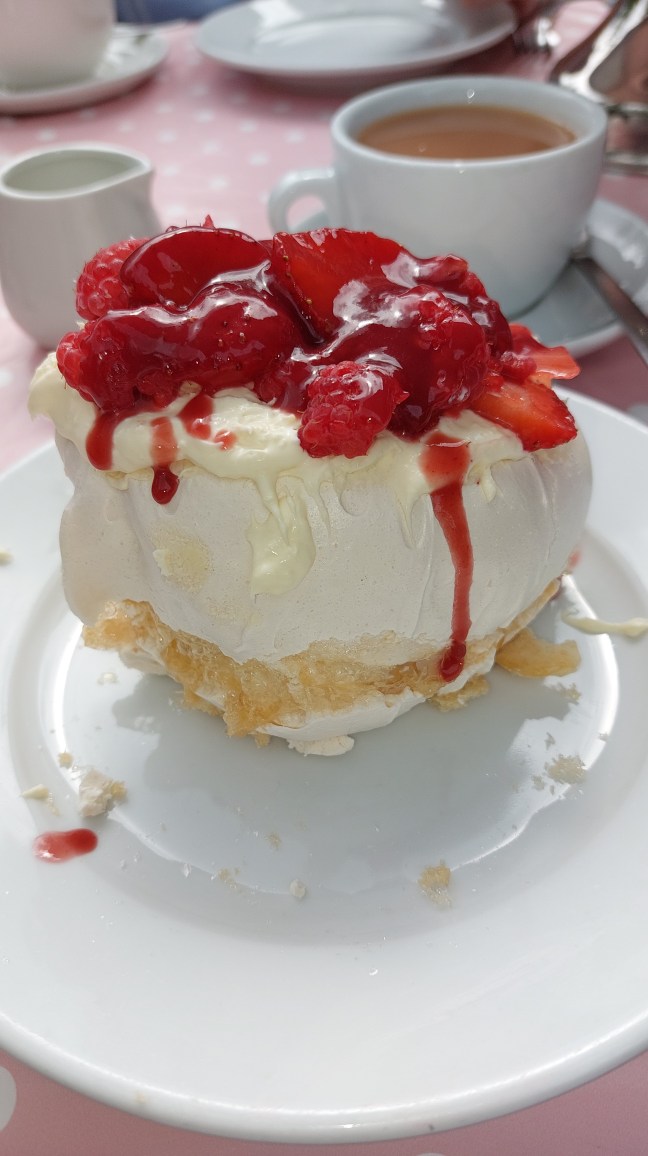
Cream meringue (cake), topped with strawberries

I haven’t had a foreign holiday in years, but I haven’t really been very good at taking a decent break at home,  either.  As long as I was sharing myself between librarianship and research, my annual leave tended just to support my research habit.  But this year, I’ve done substantially more research.

I decided that this year, I would have to do better when it came to taking a deliberate break.

I’ve continued to pursue domestic projects, stayed abreast of family preoccupations, done some more weeding (so much weeding!), and read a great book, Being Mortal, by Atul Gawande.  This was lent to me a couple of weeks ago,  and it proved well worth devoting the time to.   But by Thursday, I was itching to go on another outing.  A holiday surely has to involve going places, if only locally.

Tea House on the Loch

I fancied tea beside a river.  ALL I typed into Google was, ‘tea’, and it came up with the ideal cafe.  Does it read minds? We didn’t even know there WAS a small loch at Gartcosh, so this was a pleasant surprise.  It turns out there’s also a garden centre, which might be useful to know in future.

I’ve also visited a friend, and when I got home, I found that the book I ordered the other day had arrived.

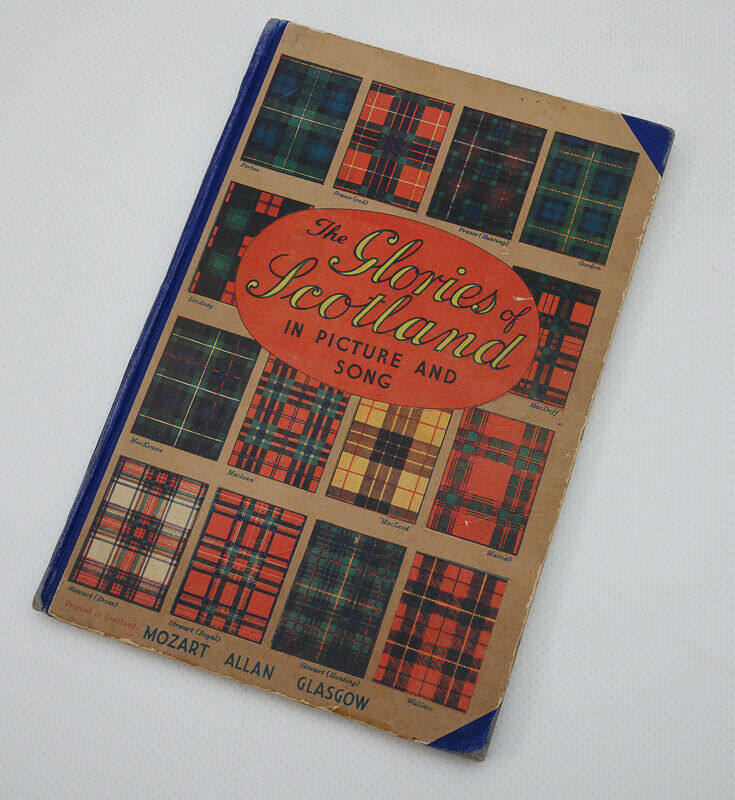
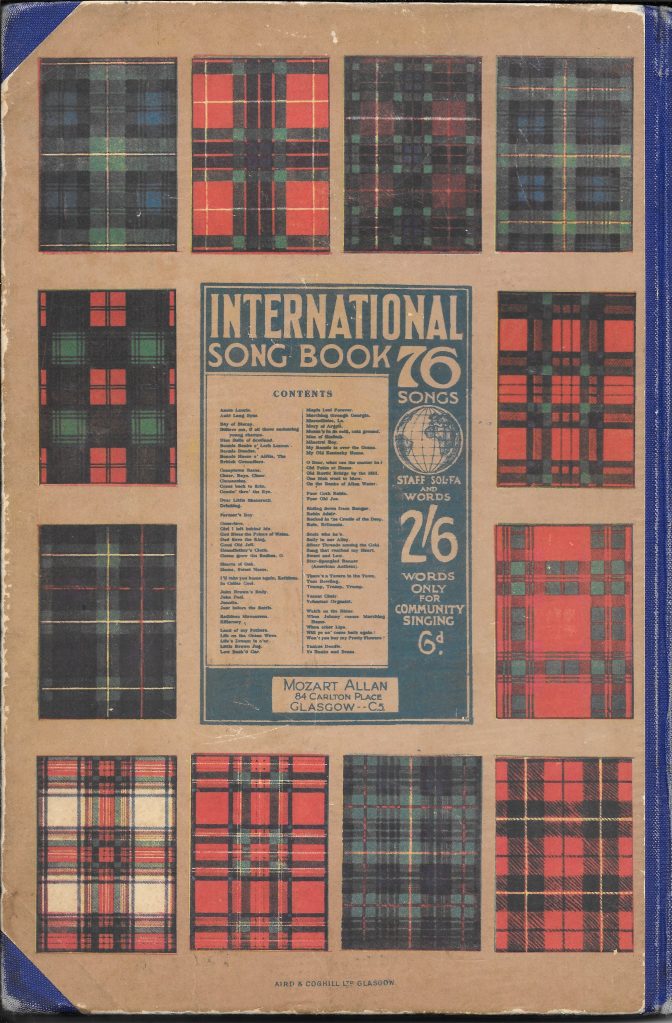
Well, this was fatal. It’s a song book.  I looked right through it, looked up the two lady composers and their illustrator, played the songs over, then decided I’d better write down what I had discovered.  An enjoyable use of an evening, but this hardly counts as taking a deliberate holiday from research! Indeed, it merely piques my interest as to how the ladies ended up writing their book. Did the friends reach out to the publisher? Or vice versa? Or did someone put them in touch?

The Thomas Nelson ‘child singing’ motif

Meanwhile, my crowded bookshelves have an extra book, and I need to remember that I’m taking a holiday!

Research: Distracting Oneself from Distractions

My oldies are giving cause for serious concern, and I’m distracted.  These situations happen to most of us – I won’t elaborate. Suffice to say that research itself can be a distraction from the awfulness, but not entirely!

Young Disrupter

Take yesterday. I thought I’d find solace in our big city public library.  First, I headed for the library café, but although the coffee was good, someone else’s screaming, beaker-flinging toddler didn’t make for a calming experience. I don’t blame the parent – it was just unfortunate.

Horrible old Technology!

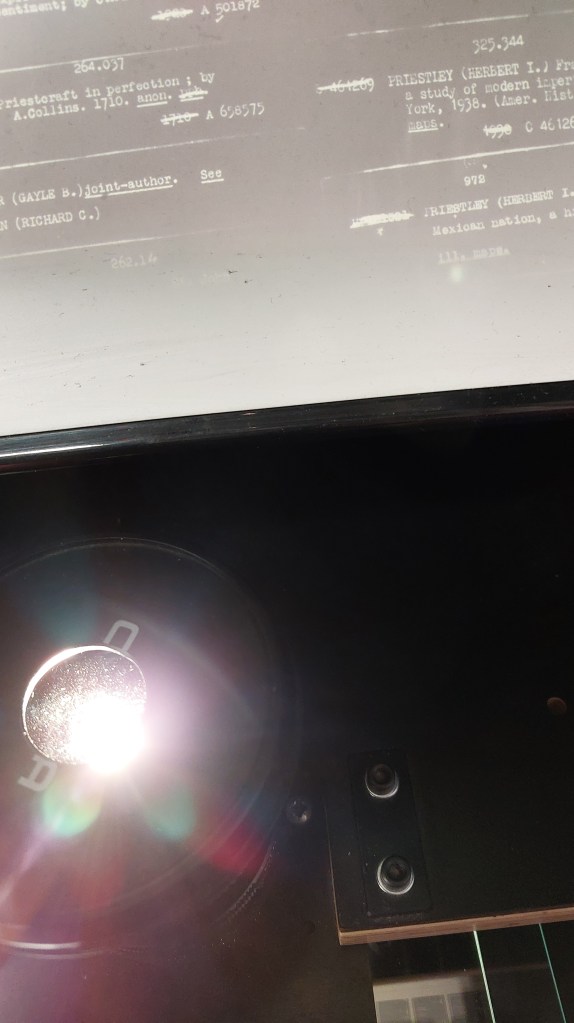
Then the microfiche reader screen was too high for my varifocals, so I had to stand to consult it;  there was only just room and nowhere to plug in the laptop; and not  enough room for my notebook unless I sat back down and balanced it on the edge of the table. I have never liked microfiches anyway! I disliked them in 1988 – nothing has changed.

Although I would like to have stayed longer – I didn’t complete my mission – I wasn’t entirely sorry to have to leave in order not to disappoint expectations that I’d be home to fix lunch.

Back at my own desk, I fiddled with my notes, checked out some details, and quickly checked in with relatives. No news.

Finally, giving in to temptation, I headed back to my happy place.  Fabric.  In this case, examining Flora Woodman’s concert wardrobe through her performance log! I’ve mentioned before that she logged every outfit worn. It’s a shame that the only outfits we can see, are those in publicity photos. Still, the log gives a good impression of the range of outfits, and some of her accessories.  Let me share the concert attire worn by the emerging young star in her first couple of years.  Obviously, there’s no indication of style or design, so you’ll need to visit a few historical costume websites for 1913-1915 and form your own imagined impressions.

(I’ve indicated the source of this blog picture below – it has nothing to do with Flora.)  There’s also a Facebook page called Attire’s Mind, which gives plenty more food for thought.

1913-1914

Cream Lace
Navy Blue
White and Pink
White Coat & skirt
White Silk

1915

Black & White
Blue (Spanish)
Cream Lace
Fur Coat & Pink Hat
Navy Coat & Skirt & White Hat
Pale Green & White
Pink (blue sash)
Pink Rose
Silver, Pink & Mauve
White Silk
White (with Black Tulle, Ermine or Swansdown on different occasions)

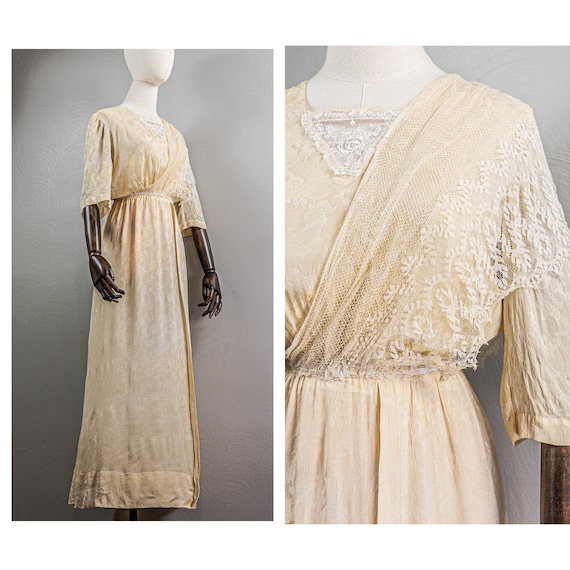
I found the most beautiful dress on The Romantiquary; in my imagination, this might have been one of Flora’s fabulous frocks. Meanwhile, I need to get a grip on myself and get back to the research proper. I’m not a historical costume expert!

PS. I could be persuaded to list more of Flora’s wardrobe later … ?!

Addenda to ‘Our Heroine is Dead: Margaret Wallace Thomson …’

Choral music - A Weary Day, by Margaret (Maggie) Wallace Thomson

I wrote an article for a Scottish organists’ newsletter, a couple of years ago. To ensure the article would continue to be accessible even if the newsletter was not, I also posted it on this blog.

I was thrilled to receive a query about Margaret (aka Maggie) Thomson over the weekend, so I updated the article gently with a couple of scans and a little bit more detail.

Maggie was clearly a modest soul – or, maybe, a typical Victorian woman, eschewing the limelight – even when she was made a presentation, her brother made the acceptance speech. At any rate, I’m not at all surprised that so little survives of her work. It sounds as though she was an amazing, and much loved accompanist, but the two pieces in The National Choir really aren’t remarkable in any way. Parlane was a local, Paisley book publisher with a considerable output, but having a contribution published in The National Choir would not have as much kudos as a composition published by Boosey or even by one of Scotland’s bigger music publishers. (There’s quite a bit more about Parlane and The National Choir in my book, if you’re interested.)

Another piece, referenced in a newspaper review, probably wasn’t even published.

And there’s another piece, held by the British Library, that has some connection with her – although, if she arranged it, then I’m not quite sure what Wallace Waterston’s input was, even though it is catalogued under his name. Maybe he wrote the tune? I haven’t tried to find out.

ADDENDA to my earlier article:-

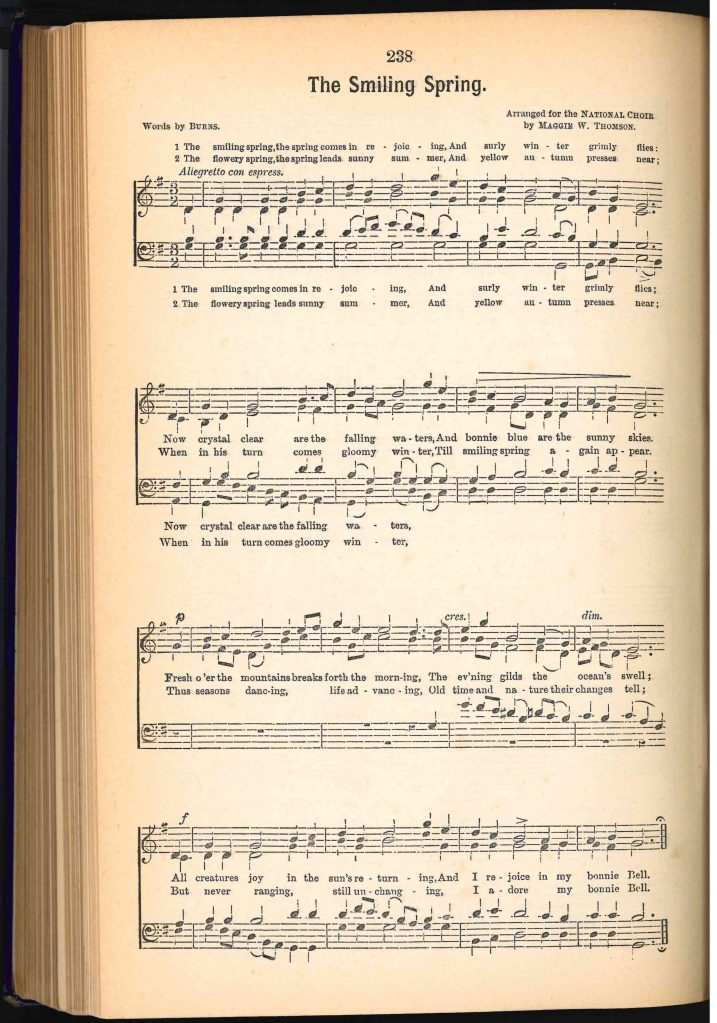
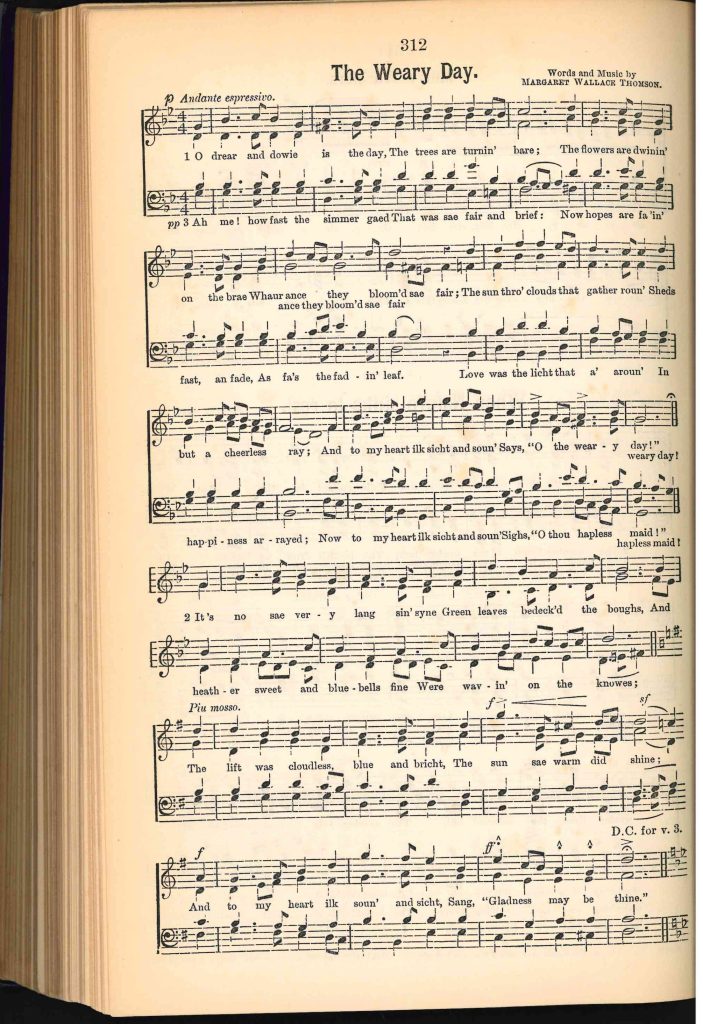
I can share images of the National Choir songs:-

  • ‘The smiling spring’, words by Burns, arr. by MWT for The National Choir [Vol.1 p.238] (Parlane, 1891)
  • ‘The Weary day’, original words and music, by MWT for The National Choir Vol.1 p.312 (Parlane, 1891)

Untraceable:-

  • ‘The voice of the deep’ (1883), bass song, written and composed by MWT [Addendum: referenced in a newspaper report of a concert that took place in St George’s Church, Paisley. A positive review!  However, the score might not have been published.]

I can also share the reference to the copy of ‘Break, break, break’ in the British Library:-

  • ‘Break, break, break!’, by Wallace Waterston, piano accompt by MWT (1894, published Paterson’s) – [addendum: copy in British Library – catalogue entry here.]

International Women’s Day – a Flashback

As well as my recent article in which I compare Flora Woodman’s career with Robert Wilson’s

It’s time for a flashback to this time last year.  I went all-out to share a lot of research and resources about women musicians, so this year, I think I’ll share it again!  I’ve written quite a bit on the subject, as you’ll see.

Women’s History Month 2024 – Musicians

Hearing Her at Last (She Died in 1936)

Why do collectors collect things? Especially old things.  The link with the past? The feeling that in some remote way, there’s a virtual thread linking you and an earlier era, or a particular individual?

As I’ve mentioned, I’m writing a long article about some late Victorian/Edwardian Scottish women musicians.  It’s virtually finished.  But there’s one more thing to do.

I have a single 78 rpm shellac recording of one of these women, whose reputation was not inconsiderable in her day.  She played in London.  She and her ‘orchestra ‘ made a handful of recordings.  But I have no means of playing this precious artefact.  I’ve tried to beg or borrow an old gramophone (or newer technology) to no avail, so eventually I bought a record player on Amazon.

All this because I wanted to know what instruments were in her band, a century ago! My article is incomplete without this detail. 

Petronella
There’s an anecdote about a whisky-filled teacup rattling on a piano edge whilst she played …!

Main image:- Beltona gramophone,  post 1923, from Wikipedia.

No Way! Is this Possible?

Remember that I acquired a humorous duet about a young married couple during the suffragette era? (Here’s the link)

Well …

It is just feasible that the lyricist was the mother of one of ‘my’ Scottish woman composers.  More anon.  But wouldn’t it be cool if I’m right?!

I’ve compared poems, thought about anapaestic meter, even learned about a visit of a Shah to Britain…

Historical Women Composers and the Transience of Female Musical Fame (Chapter 1) – The Cambridge Companion to Women Composers

I spent years as a specialist music librarian,  trying to boost our holdings of music by women composers.  This chapter would have been on my list of useful links, had I come across it before retirement from librarianship!  I’ll share it here now; tomorrow I’ll be following up some of the references, for my own research interests.

The Cambridge Companion to Women Composers.  Historical Women Composers and the Transience of Female Musical Fame (from Part I – Themes in Studying Women Composers)

Published online by Cambridge University Press:  23 May 2024

By

Paula Higgins

Digging Beneath the Surface: a Trip to the Archives

Still in search of ‘my’ Victorian ladies, I headed for RCS Archives. Thanks to my British Newspaper Archive subscription, I had already ascertained that two individuals had a connection with the old Athenaeum, but I wanted to dig deeper, to find out exactly which classes the ladies attended, and for how long. 

The Glasgow Athenaeum: Buchanan Street building, opened September 1892

I went through annual reports and prospecti, until I had satisfied myself that I had gleaned all that there was to glean. At different times, the examination results and scholarship awards were listed in different places; fortunately, I needed to search less than a decade, so I know I haven’t missed any mentions.  I can’t claim to have unearthed a wealth of information, but I did flesh out what I already knew.

At this point, even though I’d been advised that the nineteenth-century minutes of meetings really wouldn’t show me anything detailed about individual students, I decided to flick through just a couple of these minutes to see what exactly was there. I was in for a surprise. They had discovered that some of their employees were not receiving a ‘living wage’, and resolved to look into this. I had assumed that a ‘living wage’ was modern terminology, but evidently not!

Image by Andrew Martin from Pixabay

And, I read, ‘the lavatories really need to be sorted out.’ The mind boggles.  ‘My’ ladies had left the Athenaeum by that stage, I think, so hopefully they hadn’t been inconvenienced by the unsatisfactory conveniences!

Stock image of archival stacks free from Pixabay