What are Weekends for, if not for Applications?

Focus on the Positive

Well, this has been an interesting weekend. It has encompassed both the sublime (filling in a Fellowship application) and the ridiculous. Completing an application turned out to have been exactly the right thing to have done, in the circumstances, because it put the unrelated storm-in-a-teacup properly into perspective.  It even banished a migraine  – quite remarkable! The expression, ‘Focus on the positive’ has a lot to be said for it.

Not, I hasten to add, that I have submitted the application yet – but at least I’ve written what needs writing.  I am NOT planning on turning to daytime TV in my 66th year – I can’t think of anything worse. So, plainly I need engrossing things to do, once I’ve had the dreaded birthday.

When it comes to filling in online forms, the best thing is to print them out for easy reference, and then to draft answers to the various questions.

Headings

That way, you can write under headings reflecting the different parts of each question; ensure nothing gets omitted; AND keep count of how many words you have used. I’m getting quite good at condensing down sentences and simplifying wording where my first response would have been just too wordy.

So, I’ve made up a title for my proposed project (I did that when I woke at 5.40 am and couldn’t get back to sleep!);

Composed a 50-word summary (that fitted the time between getting ready for church and actually setting off);

and answered all the questions, in between cooking Sunday dinner, eating it, and supper-time.

However, there’s another question I must ask myself: as well as writing under all the headings that the form requires, I also need to ensure I’ve showcased anything that I feel relevant.  That’s a task for Monday night!

I feel as though I’ve had a busy day, but I’m happy with what I’ve achieved. 

What will next week bring?!

Revisiting Old Haunts (aka, Revision)

It has been a fortnight of revisions. I had a minor tweak to do to my book manuscript, but that was done pretty much in the twinkling of an eye. So far, so good. I zipped it all up in another zip-file, and off it went.

I’m also revising a paper that I’m giving to a professional organisation at the end of April. Most of it is fine, but I have an extra bit I need to add since I last gave the talk to a different group.

But then, yesterday I decided to do some revision to a lecture that I’m scheduled to give to our own students in a month’s time. I’ve given it annually for several years, and each time it gets a little brush-and-polish to reflect any additional thoughts I’ve had on the topic.

This time – and I don’t know why I thought of it – it underwent a slightly more detailed overhaul. Partly, this is because of the work done on my book since this time last year. In March last year, I was still completing the manuscript for the first draft. Now, it’s with the editors, so my thoughts have had time to settle.  But actually, it’s quite interesting to stand back and look at this particular lecture, since it draws on my research over two decades, albeit in a pretty superficial way. (Well, how much can be said in an hour?!)

Writing Under Headings

As I read the lecture through for the umpteenth time today, I realised that there were bits of rearrangement to do. I remembered my PhD supervisor’s advice: write headings, then ensure you write to those headings. Today, I retrospectively added some headings and – miraculously – any passages that were slightly out of order pretty much jumped out and slapped me in the face. It definitely improves the clarity of one’s writing.

The Hebrides (Image by rachinmanila from Pixabay)

The controversies around Marjory Kennedy-Fraser’s achievements are clearer with some of the life history pruned out, and her friend Professor Blackie is introduced in a more organised way.

Ironically, my listeners won’t even know what’s changed (and they won’t see those  new headings!),  but I’ll know it’s more polished, and that’s the main thing.

Image by Tumisu from Pixabay

In Praise of the Younger Generation (another McAulay author!)

Green picture of earth, superimposed by green arrows and a budding leaf, symbols of recycling

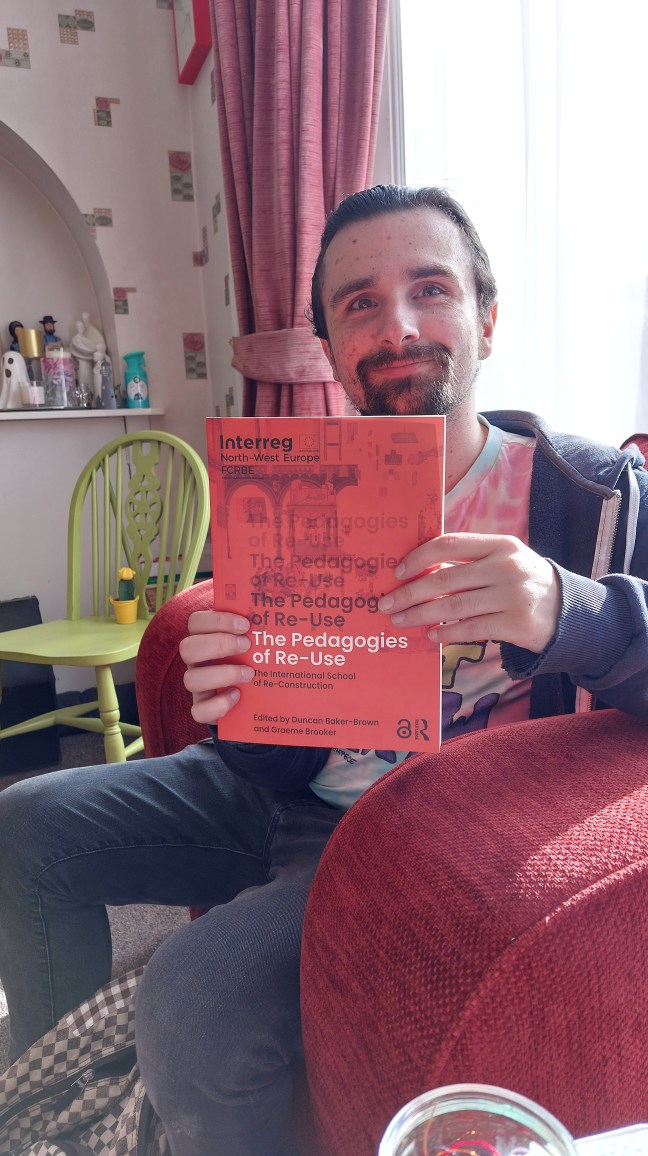
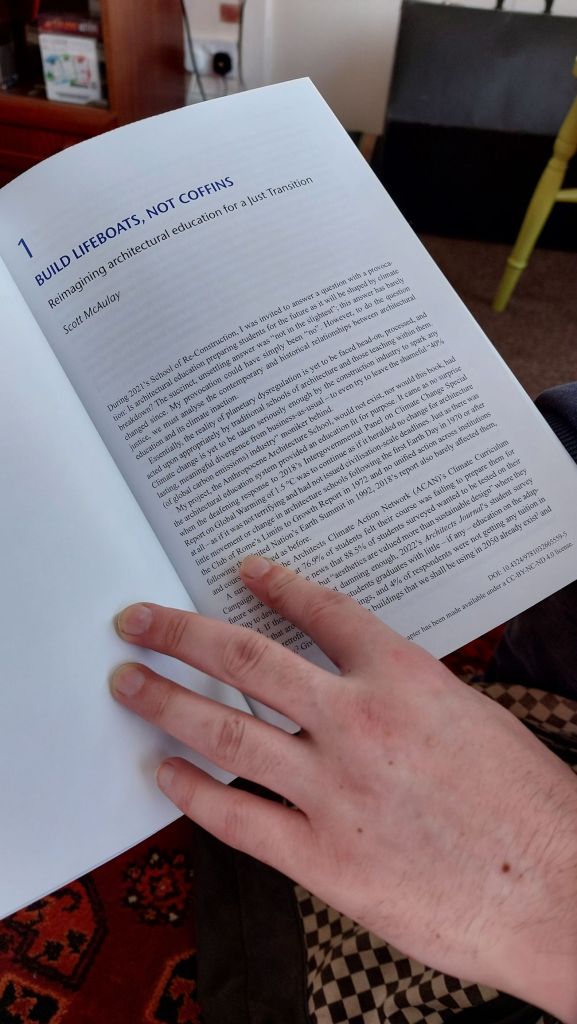
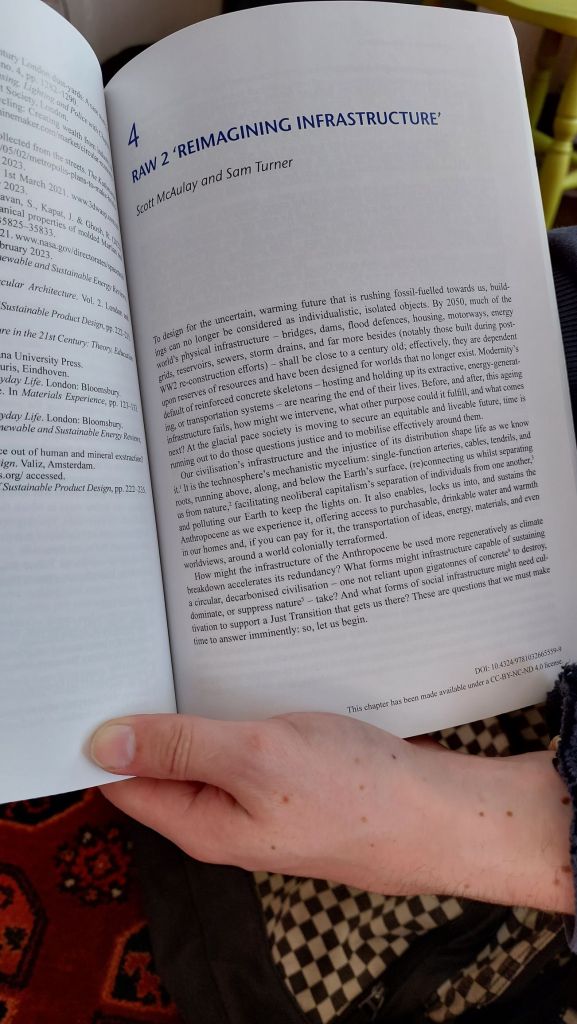
Our middle son, Scott McAulay, has just shared details of a forthcoming Routledge book, The Pedagogies of Re-Use, in which he has one solo- and one jointly-authored chapter. I’m insanely proud! It’s ‘coming soon’ – Amazon says it’s due out on 6 June 2024 – so I look forward to the sight of the book actually in his hand before too long.

The Pedagogies of Re-Use: The International School of Re-Construction
Edited By Duncan Baker-Brown, Graeme Brooker
(Routledge, 2024)

ISBN 1032665513 / 978-1032665511

Competition? It’s not a Competition!

At the end of last year, I wrote a Year-end Review, and told myself firmly that it was not for the purpose either of blowing my own trumpet, or making adverse comparisons of my own output with that of other people. I discovered that the best way was to reflect on successes, failures, and what I would do differently next time.

So, what happens? The first time I read someone’s justifiably proud summary of a few weeks’ outstanding triumphs, I creep into my little hole and bemoan the fact that I haven’t achieved half as much.

I am predominantly a Librarian (0.7 FTE)

That means I catalogue stuff, answer queries, and – at present – engage in discussions with a younger colleague so that the handover goes smoothly this summer. (It also means I’m NOT contracted to do scholarly stuff for 70% of my working hours. If I achieve less as an academic, this is the reason – it’s not disinclination or lack of application.)

  • My library line manager pointed me towards a CFP for an open-access journal, and in January, I researched, wrote, and submitted an article for it. I haven’t yet heard if it’s been accepted – it’s too soon.
  • I shall be co-delivering a workshop about the library’s holdings of music by underrepresented composers, in March. That’s something I need to plan out fully in February.

I’m also a Postdoctoral Researcher (0.3 FTE)

Bearing in mind that I have 10.5 hours a week as an academic, I am pleased with my own efforts in January. Even though I had to take annual leave, to get some more research hours:-

  • Second book revised and resubmitted – too soon to expect a response
  • Abstract submitted for September conference
  • Abstract submitted for July conference
  • BBC Scotland: Good Morning Scotland interview
  • Completed an AHRC Peer-Review
  • Delivered an Exchange Talk at RCS: ‘From Magic Lantern to Microphone: the Scottish Music Publishers and Pedagogues inspiring Hearts and Minds through Song’
HERE – TONIC SOL-FA IS MUCH PRETTIER IN COLOUR!!

And I’m an Organist

No need to summarise what I’ve done. I play, practise, schedule music and rehearse the choir.

NEILSTON PARISH CHURCH

I Compose

  • My Extinction Calypso, performed in Edinburgh last year, is set to be performed twice by a choir in a church down in Buckinghamshire in April this year. I’m ecstatic!
  • I’m just writing the finishing touches to another choral piece with an extinction theme, for an event in Edinburgh towards the end of February – Edinburgh Composers’ Choir Workshop, Sunday 25 February at 14.00

I get on with other aspects of my life

In January, I took steps to clarify my future research existence after I’ve retired from the library this summer. It has been massively stressful, actually, but I have taken steps, and look forward to further progress.

I have commitments in February which means I won’t be posting as often on this blog. However, there will be plenty of thinking time, listening time and perhaps some fiddling about on the piano and squeezeboxes later on in the month.

Postcards from the Past

Old postcards of Jamaica Bridge and Glasgow docks

As I pursued my research for my latest book, I accumulated quite a few postcards and other ephemera which might not, at first sight, appear to have had much to do with the subject in hand.  Indeed, when I decided to sort out my box file, I was initially a bit surprised just how much of this stuff I had acquired!  However, much of the work was done during the pandemic, when eBay was actually a very sensible way of getting hold of things … and you could argue (hark at me, justifying myself) that I spent less on those postcards than two or three hot drinks at the RCS café-bar each day I’m on site!

Did Mozart Allan use printers Aird & Coghill? They printed a lot of music in Glasgow!

Sifting through my treasure-trove was so enjoyable that I eventually realised I wasn’t in the least bit ashamed of my guilty secret.  I have a contemporary postcard of the very respectable-looking Glasgow street where James S. Kerr first lived.  (The neighbourhood is less upmarket now, and both his first home AND his shop are now gone.)  And there’s a postcard of the shop that Frank Simpson had on the corner of Sauchiehall Street before the shop and adjacent church were knocked down to make room for British Home Stores.  I also have a card of the view Mozart Allan would have seen every time he stepped outside his shop.  (HIS shop building is still standing, just along from the Courts, beside the River Clyde.) 

Pretty much the view from the shop doorstep!

I have pictures of the docks, as they were then, conveniently close for Kerr and Mozart Allan’s trading activities, and a picture of the boat on which Kerr’s successor sailed to America on one occasion.  I like to be able to imagine what a place was like when the person I’m writing about, actually lived there.

I’ve also got odd bits of commercial ephemera – an advertising brochure; a business postcard; a couple of letters.  The business postcard set me on the track of the individidual who took over Kerr’s business after Mrs Kerr died.  It was only last weekend, long after I’d acquired it, that I realised there was a woman’s name written across the top left corner.  A colloquial diminutive for the new owner’s wife’s first name, in fact.  So – maybe she worked in the shop, too?  It’s not musicological research, but I would like to find out.  I enjoy finding women working in the music publishing/retail business, in eras when fewer women worked outside the home.

Another bunch of postcards trace the tartan-mania which spilled over from cards to coffee-table song-books and miniature souvenir books.  Talking of souvenirs, I have travel guides, maps, an embroidery canvas of a commemorative map of the British Isles – it was unworked, but I’ve since done the stitching and had it framed – and a reproduction of an early PanAm poster.  I’ve written quite a bit about Scottish songs in the memory of expats, both overseas and over here.

And there are a few photos of children having music lessons; of women sitting at the piano; a magic lantern slide; a stereoscope of (apparently) happy workers on a cotton plantation – in my book, I’ve written about the racism in plantation songs.

A whole load of sol-fa booklets of various kinds.  They have a wee box of their own.

There’s also a photo of an Edinburgh railway bridge.  Why?  I was hunting down a particular song-book editor, and a musician with the right name lived just beside that bridge.  I don’t think it was the right man, but it’s a nice photo, so I’ve kept it anyway!

Why Do a Year-End Review?

Seriously, why do we do year-end reviews? To show the world what we’re most proud of? Quite possibly. To convince ourselves – and the world – that really, we’ve been very busy and deserve a pat on the back? Perhaps so. I took to the internet to find out why businesses do reviews, and why a career-minded individual might do one of their own.

Consulting the Experts

Braze.com said that year-end reviews offer the chance to ‘create distinctive content’; to ‘build loyalty’ and to remind the world what your particular business does best. To that end, obviously you log milestones, achievements and events. You use multimedia formats, and draw upon customer data. This all makes sense, although I don’t know that I, as an individual, can do all these things. (No customers, for a start!)

I tried again, and found a Harvard Business Review posting about, ‘How to create your own “Year in Review“. There’s plenty of sound advice here, suggesting that I should pause and reflect upon successes and failures; lessons learned; proudest achievements; who has helped me most; how my strengths have helped me to succeed; and whether there’s anything I wish I’d done differently. This is much more introspective, and certainly valuable advice. Whether I’d want to blog about all these headings is a moot point, though.

For me, I have an extra conundrum. I shall be retiring from the Whittaker Library at the beginning of July. I hope to continue the research element of my work, though. So – in one sense I’m writing a career-end review, as far as librarianship is concerned, but it’s not a career-end review for me as a researcher. 

The Harvard Business Review suggests using your diary to capture key events on which to reflect. I spent a few minutes doing just that, yesterday. Immediately, I realised that there’s one thing I’m proud of over everything else, and that is that although I spend 85% of my time as an academic librarian, my 15% as a postdoctoral researcher is actually highly productive.

What do I do best? I get things done.

‘She’s a Librarian’

I confess, I don’t like hearing this! It makes me feel as though my research activity is dismissed as dilettantism – that I don’t do badly, considering research isn’t my main role. On the other hand, a fly on the wall would point out that yes, I do spend the majority of my time as a librarian. 

Jazz CDs – not a Highlight

So, what did my diary exercise reveal? I’ve catalogued a lot of jazz CDs. This causes me to feel quite a bit of resentment, because I know our readers don’t generally listen to CDs as a format, so all my efforts are to very little avail indeed. Maybe that’s one of the things that I wish I’d done differently. It’s not a high-priority task; however, I am conscious that I don’t want to leave the backlog to my successor. And that’s why I do this dreadfully tedious and repetitive activity!

Retrospective Post Script: that jazz CD cataloguing was indeed a waste of time. I did it because the promise had been made that those CDs (thousands of them) would be catalogued. I didn’t make the promise, but I did feel the obligation to fulfil the promise. My resentment was because it used so little brainpower and expertise, provided so very little fulfilment in the moment, and so little benefit in the long-term.

Equality and Diversity: Stock Development

What I’m more proud of is my efforts to get more music by women and composers of colour, into the library, and most particularly, to ensure that our staff and students know just how much of it there now is in our stock. With a colleague from the academic staff, I’m concocting a plan to raise the profile of this material. 

I also suggested maybe there might be a prize for diverse programming …

For me, a particularly proud moment was being invited to attend a Masters student’s final recital in June, at which one of these new pieces was played. It was a piece requested by a member of staff – I don’t think it was me that actually stumbled across it – but I certainly sourced it, catalogued and listed it. Whilst I’m heartily sick of cataloguing, I do take pleasure in stock development, and in ensuring there are ample means of discovering the music once we have it.

In September, I was gratified that one of our performance departments reached out to me to request more materials by under-represented composers – a sign that the message is getting through, and that staff appreciate that the library really is trying to help.

Since October, I’ve also been broadening the stock of music inspired by climate change and ecology, including songbooks for school-children, since we have a number of music education students. That pleases me, too.

What else? Dealing with donations to the library, some eagerly received and others needing sifting through. Weeding stock to ensure there’s room for new material, and ensuring that tatty material is removed or replaced depending on how much it’s likely to be used.

User Education

Some things are cyclical – most particularly providing initial library introductions, and later talking to different year-groups about good library research practice. In June, I gave a talk about bibliography to the Scottish Graduate School of Arts and Humanities, which attracted far more of an audience than I’d ever dreamt of!

Queries, and Research-Related Activity

I’ve also dealt with queries – such as one from a Polish librarian, or another from an elderly enquirer wanting to trace music remembered from childhood. And I talked about my research activities at a library training session, even though I was rather afraid of wasting colleagues’ time going on about something that might not feel very relevant. (This autumn, I also obtained and catalogued – in detail – a book of Scottish songs that I have written a book chapter about. It would be dreadful, wouldn’t it?, if someone read the chapter but couldn’t find the song-book in the library!)

Professional Activity

Professionally, I managed the comms for the IAML Congress in Cambridge this summer (with a little bit of help from mascots Cam, Bridge and Don and a couple of fellow IAML (UK & Ireland) librarians, and I think it went quite well. The stats for the blog and Twitter (“X”) rose gratifyingly during this period. I went to a couple of days in Cambridge, but I didn’t speak this time.

Don, one of the Congress mascots, sits with a tea-cup in his hand.
IAML Congress mascot Don

A Researcher with Determination

Early on in 2023, I was gratified to receive an LIHG (Library and Information History Group) Bursary to attend a conference at the University of Stirling between 17-19 April, which was about Reading and Book Circulation 1650-1850. This was to be the first of two major successes this year, for I was also elected the inaugural Ketelbey Fellow in the Institute of Scottish Historical Research at the University of St Andrews. I’ve written extensively about this experience in other blog-posts, so I won’t duplicate it here. However, I can’t resist reminding myself of highlights!

Twilight from my window, St Katharine’s Lodge, St Andrews

We’re not going on a (sniff!) Summer Holiday …

Being a researcher for 15% of the time is not easy – there simply isn’t the time to do all I want to do. Far from ‘dabbling’ in research, I take this side of my work very seriously indeed. I might have been a librarian most of the time, but I have devoted far more than the designated 10.5 hours a week to my research activity! I took annual leave in the summer to get my book draft completed, and took more annual leave to enable me to spend two, rather than 1.5 days researching in St Andrews. I’m doing it again next week; the book revisions must be completed and submitted very soon, and if the only way I can do it is by taking holiday, then that is what I must do. 

Sometimes I feel despondent about how little I’ve achieved, but then I remind myself that I’m not a full-time academic!

Publications

  • In January, I wrote an article for the Glasgow Society of Organists, about a Paisley woman organist and accompanist whom I’d discovered during research over Christmas 2022. Even though it wasn’t for a scholarly journal, it was research done to my usual standard, and I’ve drawn upon that research in one of the chapters in my forthcoming monograph.
  • My article, Representation of Women Composers in the Whittaker Library appeared in the open-access Journal of Perspectives in Applied Academic Practice (pp.21-26).
  • My own book is very, very nearly ready to go back to the my editor, having undergone the recommended revisions.
  • I have two book chapters due out in other scholars’ essay collections, in 2024.
  • I had an article about professional women singers in the late Victorian era, published in History Scotland.

Peer Review

I’ve peer-reviewed an article, a book manuscript and a grant application. Considering all that I’ve had on my plate this year, I’m quite proud that I did manage to do these things. I don’t attend reading groups, and I’m not always able to attend research-related events that fall in ‘library time’ – I don’t want to give the impression I’m skiving off library work! But I do want to feel part of the research community, and that was precisely what was so magical about my Fellowship in St Andrews. For those two days a week, I was a researcher, pure and simple.

Roll on 2024! What am I going to do differently?

I’m looking forward to the summer. I feel I’ve been a librarian long enough. I’ll miss doing the user education, and rising to the challenges posed by unexpected or unusual queries. I shan’t be sorry to quit cataloguing, particularly jazz CDs!

I don’t actually have any ‘retirement’ plans as such. Apart from having more time to spend on my role as Honorary Librarian of the Friends of Wighton in Dundee. Whilst I live on the other side of Scotland, at least I shall have more opportunities to leap on a bus or train to get to Dundee Central Library to look after the repertoire that I love.

Little old lady? Not me!

Not Entirely Retiring!

I don’t feel remotely like a little old lady! I hope I’ll continue as a postdoctoral researcher in my present institution, but I’m also keeping my eyes open for any other part-time opportunities that I could pursue alongside that. ’Actively looking’, is the phrase, I think.

With a colleague in another institution, we’re cautiously planning a new research idea. And I also have strands of research that I commenced for my book, but hope to pursue in greater depth once this book is safely further along the publication process. Watch this space.

A Christmas Detour: The Inn with no Room

Choir, Organ … and Two Salvation Army Cornets

When I’m not occupied as a researcher or a librarian, I’m the organist at Neilston Church of Scotland.  I’m not exactly a serious composer, but I do compose occasional Christmas carols, both lyrics and music. This year, because the church choir is few in numbers, I felt that a bit of instrumental backup would help. The Salvation Army band led Wednesday night’s carol service, so I politely requested two cornets to accompany me on the organ.  Wow! That certainly brightened things up.

Neilston Parish Church

By and large, the carol was well-received.  Although I sensed from one comment that I need to make next year’s effort more upbeat! Someone else thought it sounded Scottish. I suppose there IS a gapped scale in the verse part of the melody, though I didn’t set out to use a Scottish idiom!

Women at the Inn in Bethlehem

My composition was inspired by my thoughts that the traditional story focuses on men – shepherds and wise men – but there must have been women in the Inn. There must! In Biblical times, women didn’t generally have a high profile. Who helped Mary give birth in the stable? Hard to imagine that Joseph manfully rolled his sleeves up to help, if there were women around.

Neilston used to be a weaving village, so my allusions to the warp and weft of fabric are a gentle reference to the past of our locality.

So … here are the lyrics of my Christmas carol:-

Image by Brigitte Moshammer from Pixabay
  1. By the flickering light, they were led to the stable,
    In Bethlehem simply by order of Rome;
    Did the swaddling bands come from the innkeeper’s wife,
    Kindly showing compassion to a girl far from home?
    CHORUS
    Oh, sing for the maidservant fetching the linen,
    Oh, sing for the woman who’d worked at her loom,
    Their linen scraps swaddling the Christ-child so helpless,
    With the Virgin young mother at the inn with no room.
  2. Not the greatest of starts, in a stable so lowly,
    The carpenter’s wife cradling Jesus with care,
    Such a fragile young life, and dependent on strangers,
    With shepherds and kings paying homage right there.
    CHORUS
  3. For that flickering light lit a life so amazing,
    His radiance the whole world could not fail to see,
    And the linen bands foretold the grave-clothes they gave Him,
    Before on the third day, rising triumphantly.
    CHORUS

4.   For the warp and the weft,
Careful hands moving deftly,
Made linen our Saviour to wrap and enfold,
As we pause to reflect how the humblest endeavours
Can be holy in ways that could scarce be foretold.
CHORUS

Link to choir rehearsing first verse and chorus

Image by jharnum from Pixabay

Cover Image by Melissa Manning from Pixabay

The Craziest Christmas

Because I am retiring from the Library next summer, this is the last Christmas I’ll be working full-time in the run-up to the Christmas holiday.  And I have a book deadline. It’s self-inflicted  – I was asked when I thought I could get the revisions done by. And I said …

The start of January.

Am I insane? December has always been the busiest month for us. Our Christmas is low-key, but we’re also church organists, and that brings its own challenges. I’ve had the Ketelbey Fellowship in St Andrews as well.  The experience was fabulous, but I covered approximately 2700 miles in Scotland in 3 months, which all takes time.

There was only one solution: I tried to ignore Christmas for as long as I could.  Did it wait for me? No.  ‘You knew it was coming’, said the critic at my shoulder. ‘You should have been more organised.’  (Don’t get me started! Why should WOMEN be more organised? Particularly those who are working *and* keeping everything in the home afloat!) I bought the Christmas pudding and the Paxo stuffing ages ago, anyway!

My Christmas circular was written at the weekend, and most of my  Christmas cards were sent.  I ordered some presents online, and told myself there was plenty of time.

Mishaps come in Threes

Don’t you just love it when you try so hard to get everything right, and then a different thing goes wrong? I recorded my new carol for the two instrumentalists who had kindly agreed to play with me and the choir … and crashed my Finale software creating cornet parts in Bb.  (It wasn’t the cornets’ fault that I accidentally left a file open when experience should have reminded me to close it properly  – but it took a five hour system-restore to get the audio back …)

I’ve been taking odd bits of annual leave to get writing done (an alternative definition of ‘working at home’), which meant I could justify doing a supermarket shopping order at 9 am yesterday. I felt guilty, even though it was my time, because I knew I should be writing… and yes, I was too late to book a delivery slot. I have to go and collect it tomorrow evening. But the veg box came by van. It was on the doorstep early this morning, neatly draped in plastic to protect it from the rain. Phew!

Chapters 2, 3 and 4 are the biggest chapters, and as I  revised, I found myself adding in stuff that I’d discovered during the Fellowship. Chapter 4, which I most enjoyed (and was pleased with – always fatal) led me a merry dance.  I splurged on more old teaching materials on eBay.  The critic at my shoulder balefully watched small jiffy bags periodically being delivered.  Only yesterday, I received a very expensive scan of a delightful new find. (Thankfully, it wasn’t in yet another jiffy bag.) Anyway, it resulted in a new paragraph. Just one, but it was worth it!

I revised Chapter 5 yesterday. Chapter 6 was just about done today – little has had to be done. It’s just a question of weaving in loose ends …

Second Mishap

But we had a service at church tonight, accompanied by Govan Salvation Army Band. It was time for something else to go wrong. This time, in my anxiety not to be late, I misread the clock and inadvertently fed the family an hour early. I’ll never live it down! However, I did get there in plenty of time, and all went well. My carol (about the women who must have been present at the Nativity) met with almost universal approval – well, from the people who were kind enough to comment, at any rate! 

And a Third

Finally, home again, can I catch a break? Well, no. I missed some items off the Sainsbury’s order. I’m twirling like a top …

Image by InspiredImages from Pixabay

Advance Notice! My latest Article is nigh!

Soon, very soon, all will be revealed! It’s been quite a quiet year, as far as publications go. Very quiet. But I have had one article and two chapters waiting at their publishers, and this weekend will at least see the article published in History Scotland. Featured on the cover, too.

Hooray!

Image by Belinda Cave from Pixabay