Dr Karen McAulay explores the history of Scottish music collecting, publishing and national identity from the 18th to 20th centuries. Research Fellow at Royal Conservatoire of Scotland, author of two Routledge monographs.
This forthcoming Scottish entertainment promises to be so much fun. I had to book more time off for a tradesman’s visit today, so I spent the morning writing song introductions quite different from my usual restrained scholarly style. All the nice little anecdotes suddenly found a home. But let’s see if you can guess the songs requiring my unorthodox props! (How well do you know the west of Scotland?)
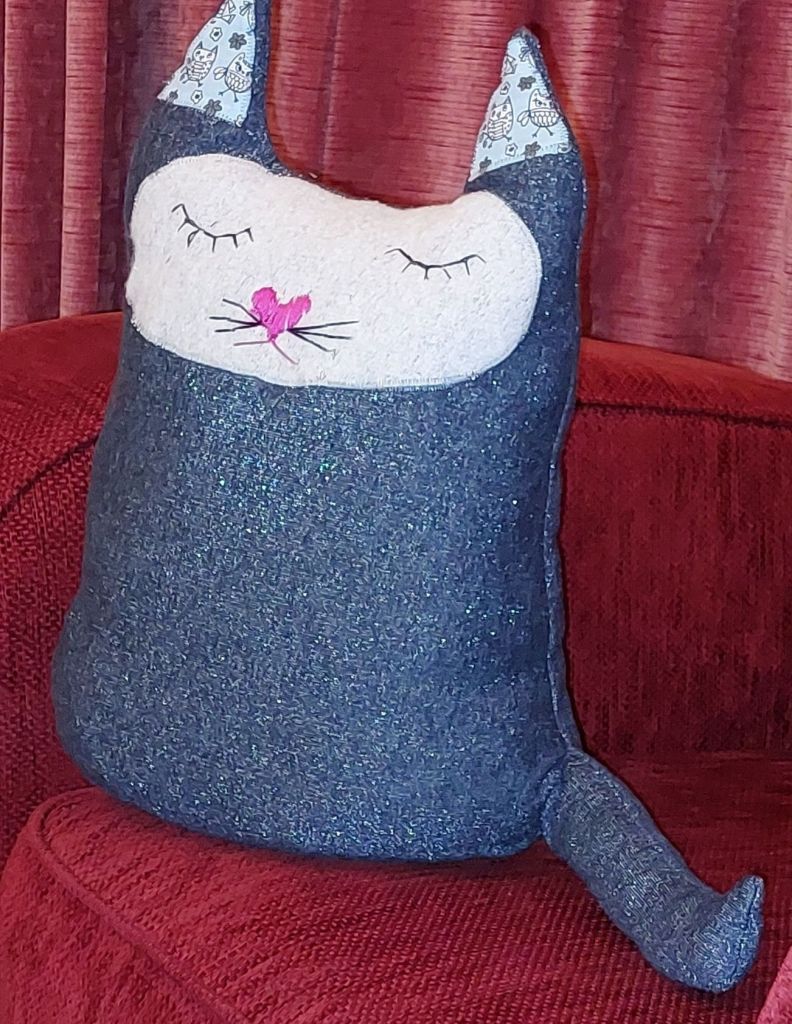
Uncommonly Grey Cat
Grey cat, stuffed (fabric, not taxidermy)?
Jam sandwich?
Tartan shawl?
Yoyo?
I still need to unearth a music stand. (We had one! But where?) And heaven help me if I forget the concertina. I found a couple of tunes that suit it and my own capabilities.
The accordion is staying at home, though. After due consideration, I wouldn’t even have enough hands to carry it …
I wrote this post last year, but for some reason never actually posted. Not to worry – now is the time to share it!
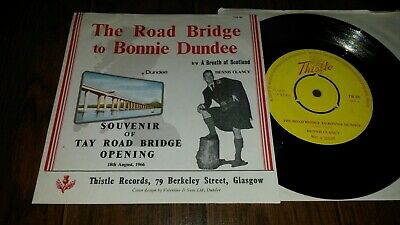
You could say Robert Wilson had Scottish music publishing just about tied up in Glasgow. As his singing career began to wane, he bought up James S. Kerr’s and Frank Simpson’s, also co-founding Thistle Records from his premises in Berkeley Street. Not bad going, eh? Oh, and he also owned a travel company, which is less surprising considering his own worldwide travelling as a singer – he must have gained quite a bit of insight into the travel business. An informed, on-the-ground (or water, or airborne) interest, you could say.
After his death, the remaining shareholders of Kerr’s Corporation later acquired Mozart Allan’s AND Bayley & Ferguson’s backlists, too.
Wilson began a career as an apprentice draftsman, but after redundancy, started out as a singer. He sang with the Rothesay Entertainers, joined the D’Oyly Carte Opera Company Chorus between 1931-7 and then embarked upon his solo career, specialising in middle of the road Scottish song, but not limiting himself exclusively to this repertoire. Here he is, recorded by Pathe Films at the start of his solo career.
Annie Laurie (Maxwellton Braes are Bonnie)
If you’ve got a bit more time, here’s a ‘Voice of Scotland Short’ – a biopic lasting nearly an hour,with musical performances:-
Robert Wilson – Voice of Scotland Short
‘A Tribute to Robert Wilson’, with:-
Kenneth McKellar
Eliot Dobie
Jimmy Shand
Andy Stewart
Will Starr and Accordion
Cliff Hanley
Harry Carmichael
Sydney McEwan
Additional material by Bob Wright of Girvan
Header Image of ‘The Road Bridge to Bonnie Dundee’ from EBay
I have a forthcoming magazine article with more about Robert Wilson, of which I will give full details when it’s published in the near future.
You can read more about Scottish music in bygone days in my recent book:-
On Monday 11th November at 6 pm, I’m giving a talk in the well-established and popular RCS Exchange Talk series, where scholars talk about their latest research. I’ll be talking about a song book compiled for the Festival of Britain:-
The Glories of Scotland in Picture and Song: compiling a book with the 1951 Festival of Britain in mind
At 7 pm we’ll have the launch of my new book, in the library. No online booking for the book launch, but if you’re hoping to attend, please do let me know, so we have an idea of numbers.
You can attend both, or either event.
McAulay, Karen E., A Social History of Amateur Music-Making and Scottish National Identity: Scotland’s Printed Music, 1880-1951 (Routledge, October 2024) 🎶
I’ve been extraordinarily busy. Today (a ‘retirement’ day), I’ve put in a full day’s proofreading and indexing work, topped by an evening stint. I have an imminent deadline!
Not a problem – but things went a bit awry this evening. Sorry, I have no words of wisdom today, just a reflective poem of sorts! You could almost say it’s Kailyard style. (‘Kale yard’ is a homely form of Scottish literature from an earlier era. It’s not high art.)
I checked my proofs (I went through twice), and tweaked what needed tweaking. My husband cooked the dinner (yay!); our son refrained from speaking.
I laboured hard at indexing, with one ear on the gate – the Sainsbury’s van was imminent; I hoped he’d not be late.
A rattled bolt – I shot outside to greet my “daily bread”, but to my horror, there I faced a lanky Glasgow ‘ned’.
The Author yelled – the Ned jumped back, then leapt up on the wall. He AND his mates seemed pure gob-smacked – thank God they didn’t fall.
I used some words not in my book, then fled back safe inside. The ‘Polis’ were awaiting, but no Neds achieved a ride.
The Sainsbury’s man turned up at last – I put the stuff away. Then back to indexing again – oh, what a fun-filled day!
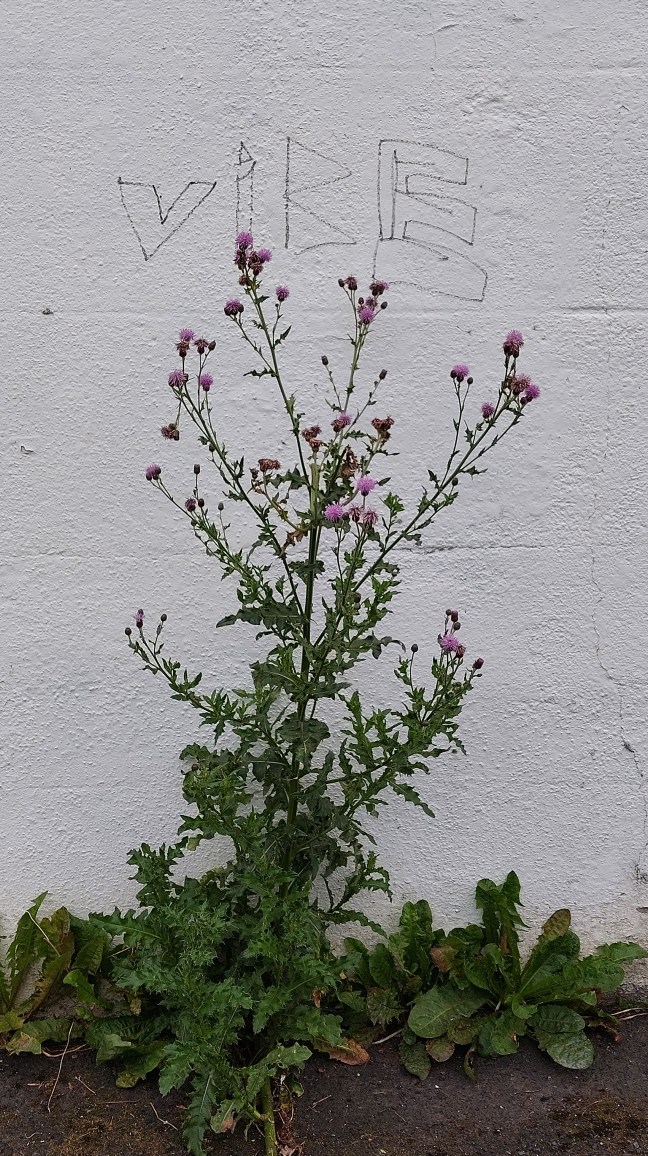
Thistle ‘vibe’ – local.
AI intruder image from Pixabay. My visiting Ned was probably 6 ft, but not nearly soimpressive!
Our neighbours have a high white wall. There’s a tall thistle growing there, and some young joker has scrawled above it, ‘VIBE’. I don’t know if they were consciously referencing the metaphor of a prickly thistle to represent Scottish, and most particularly, Glaswegian identity, but – hey, they wrote it directly right above that thistle, so who knows? I took a photo anyway – it was too good an opportunity to miss.
Every time I walk down the road or get into my car, there it is, and every time it reminds me of a poem by one of ‘my’ Scottish song-writers. He published his book of poems in 1894, and it’s well out of copyright, so I can share it with you. Just look at that last verse – there’s a proud, very nationalist Scot for you!
“I’m a Scot and I carena’ wha’ kens it, Juist meddle the thistle wha’ daur,
They’ll maybe get mair than they wantit, An Scotia be little the waur …”
To be honest, I’m more interested in the poet for his work as an Edinburgh music teacher, than as a poet or local historian, but it’s all part and parcel of who he was. Two different musicians set this song to music – one was really pretty uninspiring, but the other one’s not too bad! (Well… musically competent, not remotely ‘Scottish’ sounding, nor particularly memorable, but competent.)
The poet-teacher gets a significant mention in my forthcoming book, especially his views about children singing Scottish songs.
I have just sent the manuscript back to the editor with my own amendments to the copy-editing, so watch this space! Now to turn back to the question of the second index … which I drafted a few weeks ago, but which now needs fine-tuning before I get the proofs back to link my index-terms to the publisher’s page numbers!
As I pursued my research for my latest book, I accumulated quite a few postcards and other ephemera which might not, at first sight, appear to have had much to do with the subject in hand. Indeed, when I decided to sort out my box file, I was initially a bit surprised just how much of this stuff I had acquired! However, much of the work was done during the pandemic, when eBay was actually a very sensible way of getting hold of things … and you could argue (hark at me, justifying myself) that I spent less on those postcards than two or three hot drinks at the RCS café-bar each day I’m on site!
Did Mozart Allan use printers Aird & Coghill? They printed a lot of music in Glasgow!
Sifting through my treasure-trove was so enjoyable that I eventually realised I wasn’t in the least bit ashamed of my guilty secret. I have a contemporary postcard of the very respectable-looking Glasgow street where James S. Kerr first lived. (The neighbourhood is less upmarket now, and both his first home AND his shop are now gone.) And there’s a postcard of the shop that Frank Simpson had on the corner of Sauchiehall Street before the shop and adjacent church were knocked down to make room for British Home Stores. I also have a card of the view Mozart Allan would have seen every time he stepped outside his shop. (HIS shop building is still standing, just along from the Courts, beside the River Clyde.)
Pretty much the view from the shop doorstep!
I have pictures of the docks, as they were then, conveniently close for Kerr and Mozart Allan’s trading activities, and a picture of the boat on which Kerr’s successor sailed to America on one occasion. I like to be able to imagine what a place was like when the person I’m writing about, actually lived there.
I’ve also got odd bits of commercial ephemera – an advertising brochure; a business postcard; a couple of letters. The business postcard set me on the track of the individidual who took over Kerr’s business after Mrs Kerr died. It was only last weekend, long after I’d acquired it, that I realised there was a woman’s name written across the top left corner. A colloquial diminutive for the new owner’s wife’s first name, in fact. So – maybe she worked in the shop, too? It’s not musicological research, but I would like to find out. I enjoy finding women working in the music publishing/retail business, in eras when fewer women worked outside the home.
Another bunch of postcards trace the tartan-mania which spilled over from cards to coffee-table song-books and miniature souvenir books. Talking of souvenirs, I have travel guides, maps, an embroidery canvas of a commemorative map of the British Isles – it was unworked, but I’ve since done the stitching and had it framed – and a reproduction of an early PanAm poster. I’ve written quite a bit about Scottish songs in the memory of expats, both overseas and over here.
And there are a few photos of children having music lessons; of women sitting at the piano; a magic lantern slide; a stereoscope of (apparently) happy workers on a cotton plantation – in my book, I’ve written about the racism in plantation songs.
A whole load of sol-fa booklets of various kinds. They have a wee box of their own.
There’s also a photo of an Edinburgh railway bridge. Why? I was hunting down a particular song-book editor, and a musician with the right name lived just beside that bridge. I don’t think it was the right man, but it’s a nice photo, so I’ve kept it anyway!
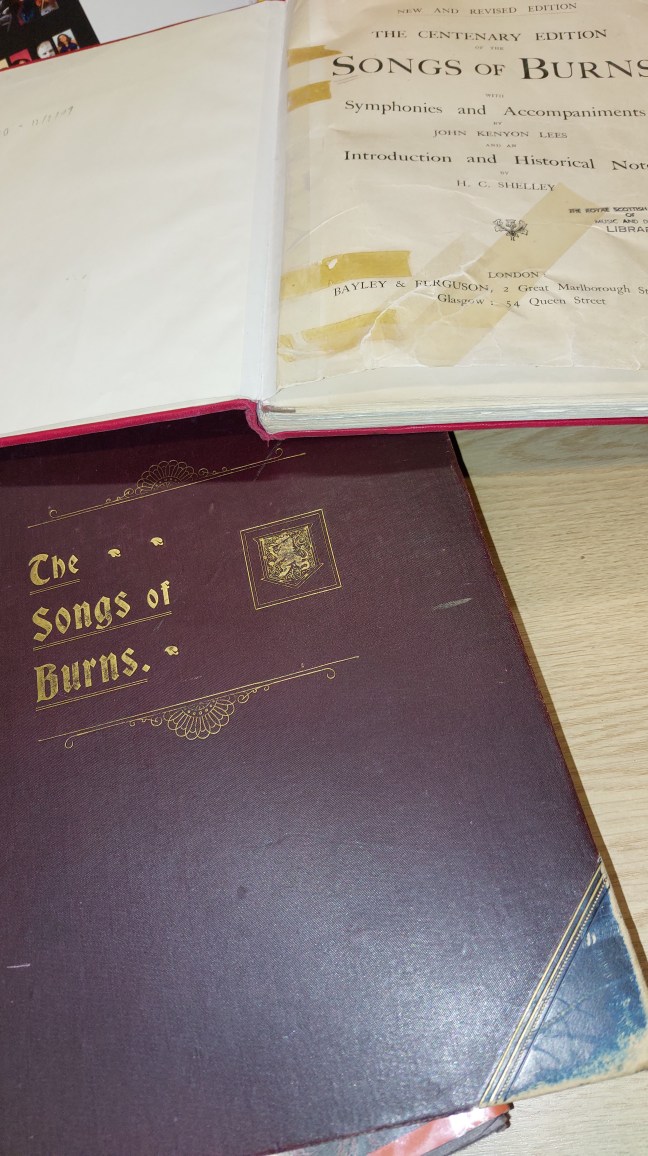
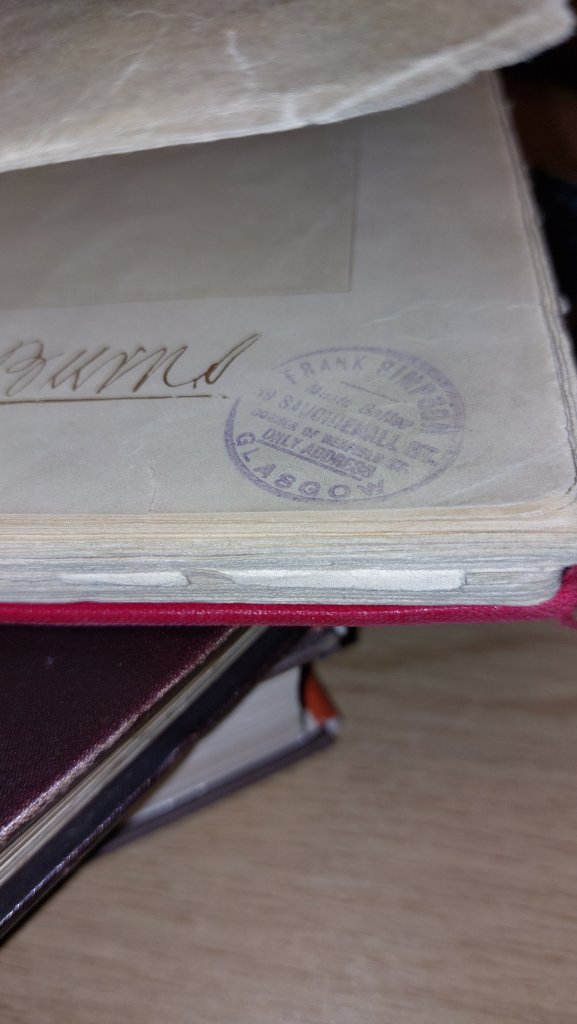
You can imagine the enthusiasm with which publishers rushed to produce centenary editions of Robert Burns’s songs in 1896. We have a Bayley & Ferguson ‘new and revised’ centenary edition in the Royal Conservatoire of Scotland library: well-used over the years, bearing the scars of untold tussles, its paper almost skin-soft through repeated borrowing. This one was published in Glasgow and London. I wasn’t at all surprised to see vendor Frank Simpson’s stamp on it – the Sauchiehall Street shop was there for many years, where the now defunct BHS store later stood. I can’t imagine how many of our old scores came from there!
Today, I needed to compare it with a more lavish bound presentation copy, which we acquired as a donation. The imprint likewise had Bayley and Ferguson’s name, but in larger print above it, it had Hedderwick, of Citizen Buildings in St Vincent Street. Both firms gave Glasgow addresses, and no mention of London. I suspect it was the earlier of the two, since I found 1896 newspaper adverts for this one. Hedderwick was a long established firm. And Bayley and Ferguson did publish music on behalf of other firms, groups or individuals.
It’ll have to go into the special collection – it’s so heavy that I can’t imagine anyone wanting to borrow it.
Plain or fancy, I imagine this title was a bestseller for several decades. I’ll finish cataloguing it tomorrow.
Now – have we got the Mozart Allan centenary Burns edition … ? Of course we have!
One of my favourite Mozart Allan songbooks has an intriguing history. I have contributed a chapter discussing it, in a print and tourism collection, and I’ve dealt with it in slightly less depth in my own monograph. (Neither is published yet, but hopefully the essay collection will appear later this year.)
The songbook has a photo of a Glasgow entertainer, and the words (so I thought) of his recent song – but not the music. That, it says, is available from Mozart Allan. I have been itching to see this entertainer’s song, but it entailed a trip to the National Library of Scotland.
Today – at last! – I saw it. Two sides of music, that’s all. The words in the song-sheet are more extensive than what appeared in the songbook. It’s just a typical music-hall waltz, but I’ll tell you something …
They encapsulate much of what I’ve been writing about, so I’m ecstatic to have seen it. I’m not able to share the images (though I think this snippet is probably ok!) – but I’ll certainly be talking about it when I give one of my guest lectures at St Andrews!
Again and again, I sit down to write about music, and end up going into hyperfocus about words. It must just be the way my mind works!
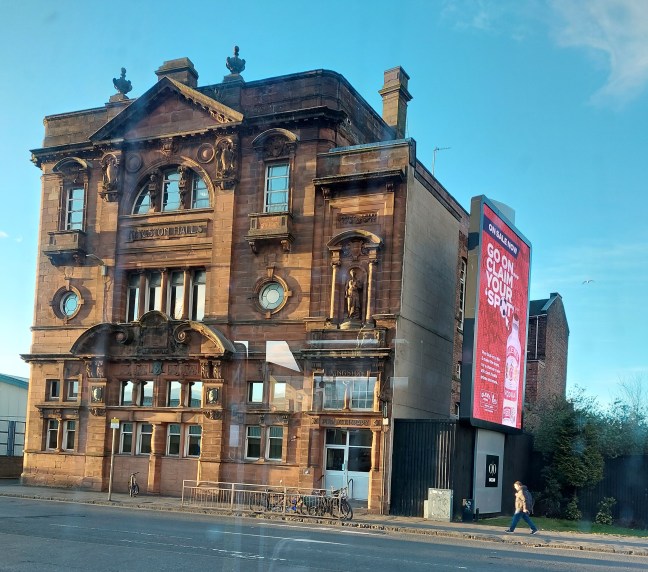
A quick snap from my bus-ride home. This is Glasgow’s former Kingston branch library by the river Clyde, enjoying its retirement in the evening sunshine. Today, the former library still serves the people of Glasgow – it offers homeless accommodation through the Talbot Association.
See the gap to the right of the library? Down a close, you would have found James S. Kerr’s music shop in its first premises, before they moved north of the river. He started off selling pianos, and there was also a dance hall in the block, so there would have been plenty of music around, and probably a good bit of noise from the riverside when you stepped outside.
(My research is into Scottish music 🎶 publishers in the late 19th and early 20th centuries.)











 Karen McAulay, Musicologist