Dr Karen McAulay explores the history of Scottish music collecting, publishing and national identity from the 18th to 20th centuries. Research Fellow at Royal Conservatoire of Scotland, author of two Routledge monographs.
At least a couple of decades ago – long before I was interested in the social history of amateur music-making in Scotland – I came across a curious piece of sheet music. Knowing that my other half is more than a little interested in Glasgow trams, I made a photocopy and kept it safe. Every so often, we would joke that I’d get someone to sing it when it came to ‘final curtains’ time. (It would make a nice change from ‘Abide with me’ and the 23rd Psalm, after all!)
My Insatiable Curiosity
I hadn’t looked at ‘Glasgow’s Tuppenny Tram’ in years, but whilst I was proofreading my forthcoming book, I decided I really should look to see who had published that song. James S. Kerr? Mozart Allan? Galbraith’s in Renfield Street? Certainly not Bayley & Ferguson or Paterson’s. So I looked. The song was self-published in 1926 by the author and composer, an entertainer called R. F. Morrison. The song was actually arranged by Carleton H. Smyth, who was secretary and treasurer of the Glasgow Masonic Burns Club. (You’ll see that Morrison was also the author of ‘Just a wee Deoch-an-Doris’ and ‘Suvla Bay’. Which is interesting, since Harry Lauder’s songsheet of ‘A Wee Deoch-an-Doris’ seems not to mention Morrison at all – but I couldn’t access Morrison’s version without going to the British Library, so I shall have to remain mystified.)
There’s no’ much wrang wi’ Glasgow, auld Glesca on the Clyde; St Mungo’s name is known to fame, ower a’ the world wide. There’s bonnie places roon aboot, that thousands never see, You need no ship to make the trip, so be advised by me. CHORUS. Take a trip on a tuppenny tram, and happy you will be, From daylight till dark, there’s many a park, awaitin’ for you & me, Don’t use your hoard for a Daimler or Ford, Like the workers of Uncle Sam, Since Maister Dalrymple made motorin’ simple, wi’ Glasgow’s Tuppenny Tram.
Glasgow’s Tuppenny Tram / R F Morrison, 1926
‘Since Maister Dalrymple made motorin’ simple, wi’ Glasgow’s Tuppenny Tram’
Whilst we remembered the closing lines of the song (after all, we knew that Mr Dalrymple was a significant name in the history of Glasgow’s tram system, until he disappeared off to Sao Paulo in Brazil as a transport consultant), it’s fair to say we hadn’t looked properly at the whole song.
I’ll spare you the second verse! It lists a number of places you could visit by tram. (As the chorus says – see above – no need to waste money on a car!) Meanwhile, the back page is a large advertisement reminding you that there are 32 parks to visit in Glasgow (and still get home in time for tea), and reminds the reader to take care crossing the road …
It’s rubbish! It does incorporate some bits of Scottish song-tunes, but Carleton H. Smyth’s setting was very humdrum. Only one actual mistake in a chord, to be fair. My book is missing NOTHING AT ALL by not referencing this song.
Oh well, it’s a nice reminder of what Glaswegians would do on a sunny Sunday afternoon, or during Fair Fortnight if they had a bit more time. (Apart, of course, from going to variety concerts to hear the likes of R. F. Morrison! I wonder what the other acts were like?)
Meanwhile, I have now been positively beggednot to have the song performed when it comes to the final curtain! What’s it worth … ?!
Yesterday, I set out to track down some music. It’s light music, not great music – almost ephemeral, you could say – but together, it tells a story.
I also wanted to find out more about the life of one of these fin-de-siecle Glasgow woman music publishers.
It’s not that easy. The music is scattered round our legal deposit libraries; the cataloguing isn’t completely consistent; and fin-de-siecle ladies, whether single, married, childless or proud mothers, didn’t leave much record of their daily lives. They’re hidden in the shadows of family members, and, whilst I imagine they knew one another, let me stress that this is NOT a tale of a female publishing cooperative!
I had a nice chat with a local history librarian, making an acquaintance who is now equally keen to find out more; then I headed home – as yet, none the wiser – to devise a complex spreadsheet of music titles. I’m visualising a pinboard with strings criss-crossing between ladies, libraries and work-lists.
So complex, indeed, that I still haven’t planned how best to get to SEE the music.
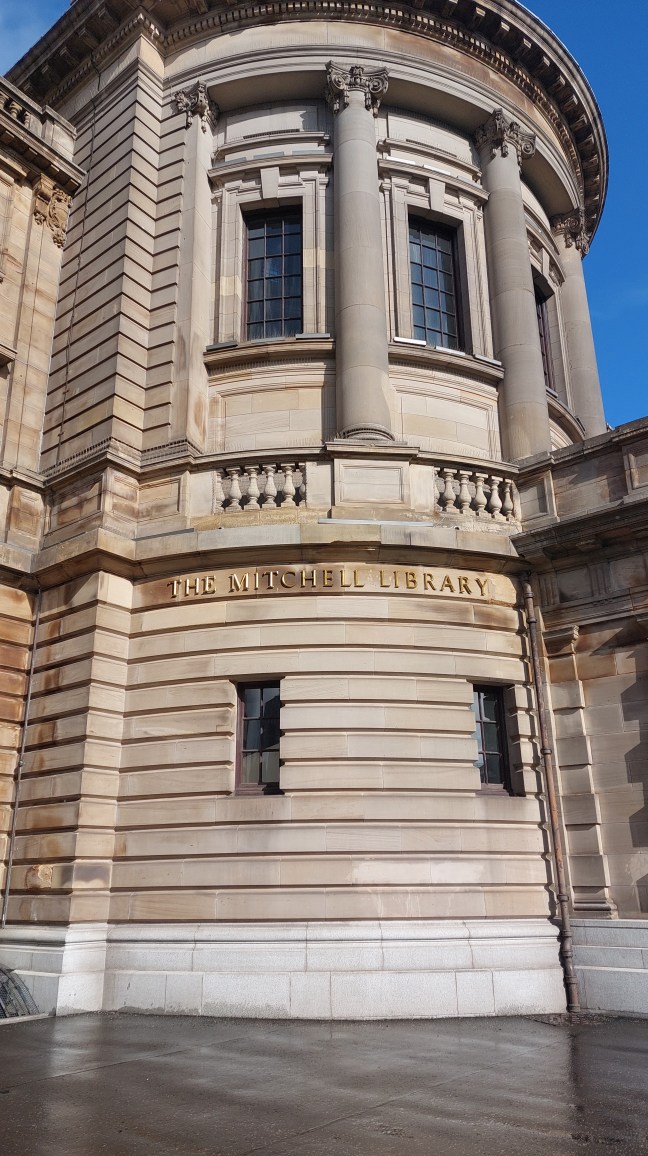
I accepted a generous donation of old books to the Library a couple of weeks ago. This presented me, personally, with a bit of a problem because our offices, furniture and contents are being moved around, and I had proudly emptied most of my shelves in readiness. There will be fewer shelves in the other office. And now I had two shelves full of old Scottish music – right up my street – which needed cataloguing.
Most vital priority – get them done before I retire from the Library.
Almost as vital – to get them done before the move on Thursday next week!
Of course, the lovely thing is that they’re books I’ve encountered in various research contexts … the PhD; the Bass Culture project (https://HMS.Scot); the book chapter on subscriptions; and my own forthcoming monograph.
I catalogued like crazy on Thursday and Friday. I’ve catalogued Sammelbande (personal bound volumes) of songs, piano music and fiddle tunes. I’ve shown colleagues books signed by George Thomson. I’ve indexed Gow’s strathspeys and reels. And yesterday I blogged about James Davie and his Caledonian Repository.
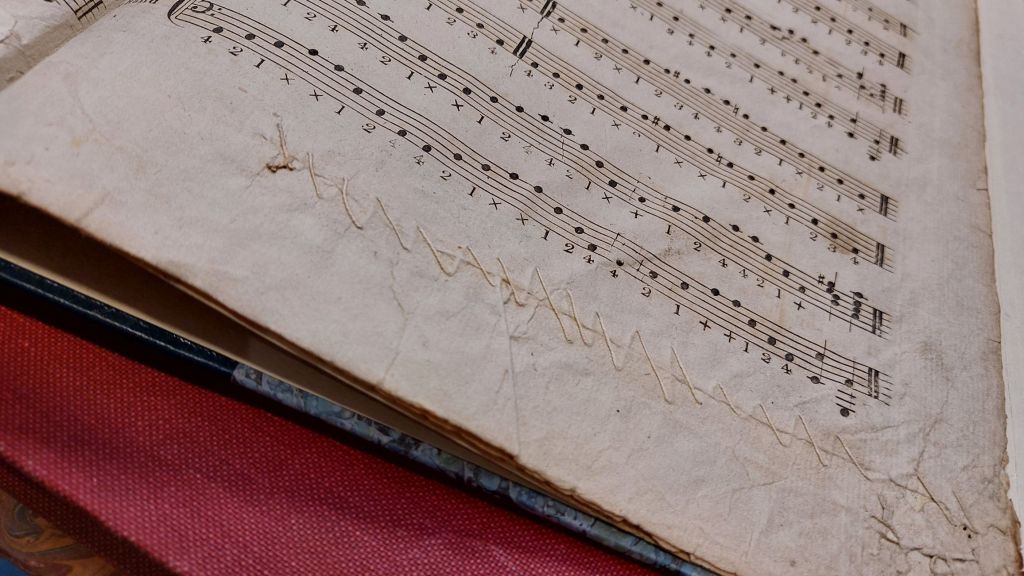
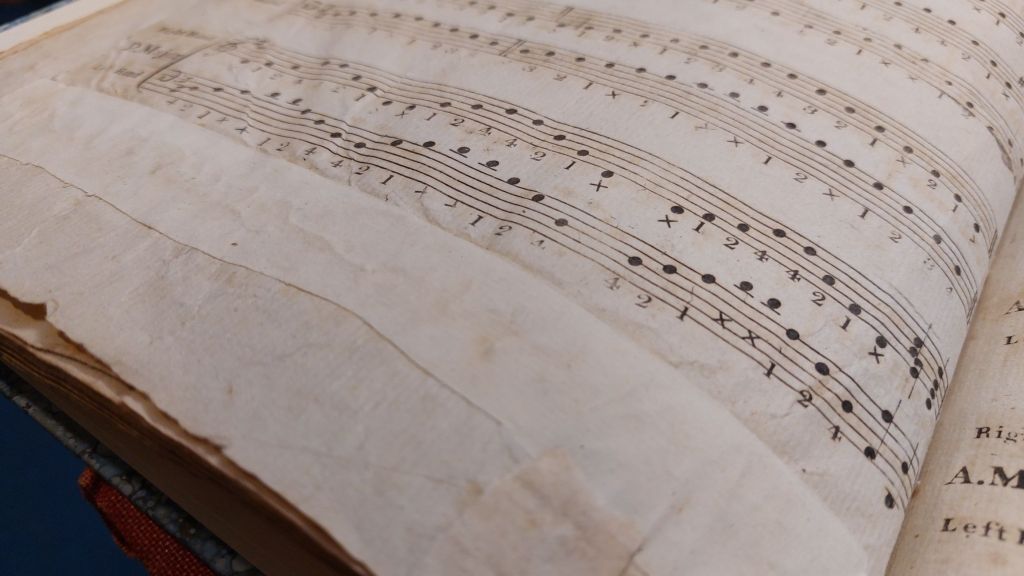
But I’ve also just enjoyed handling the music, because sometimes one finds some endearingly human evidence of the scores being used, even to the point of needing mending. It’s quite touching to ponder how much a piece had been used, before it actually needed stitching – here, along a line where the edge of the printer’s block had originally left a dent in the paper:-
Stitched on one side, pasted on the other!
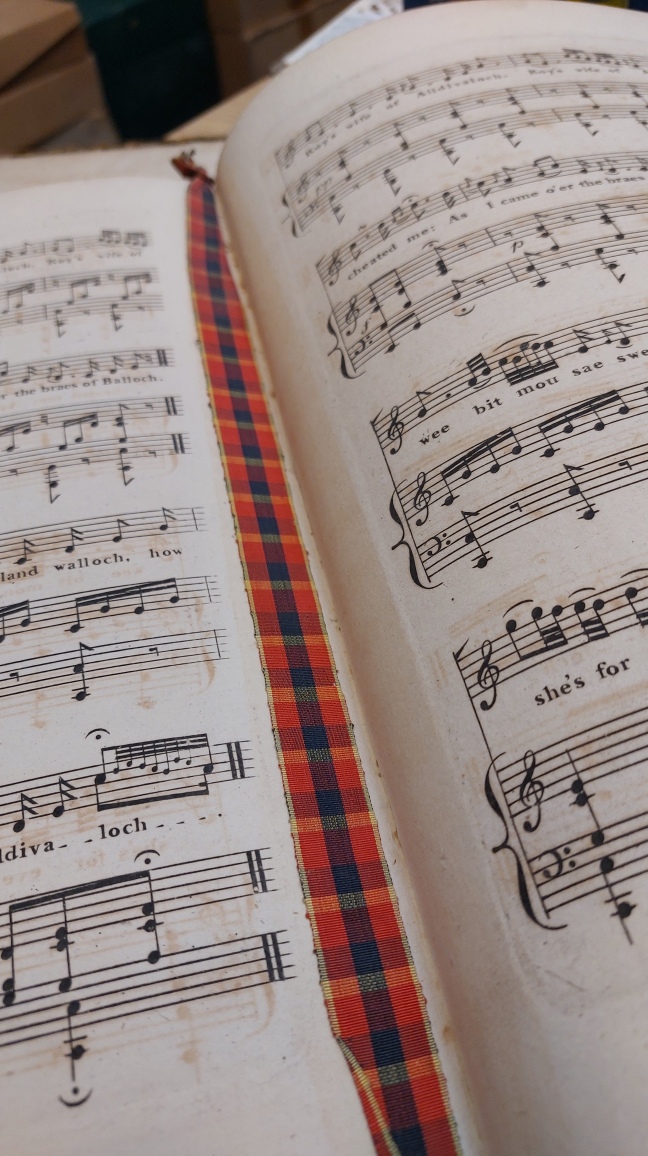
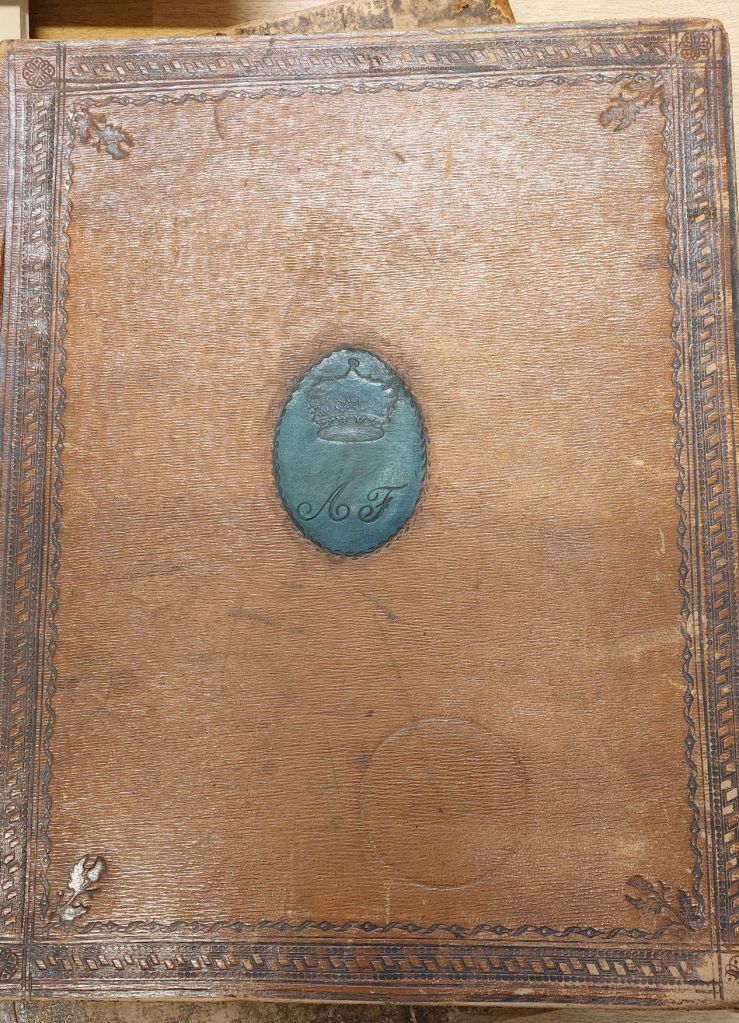
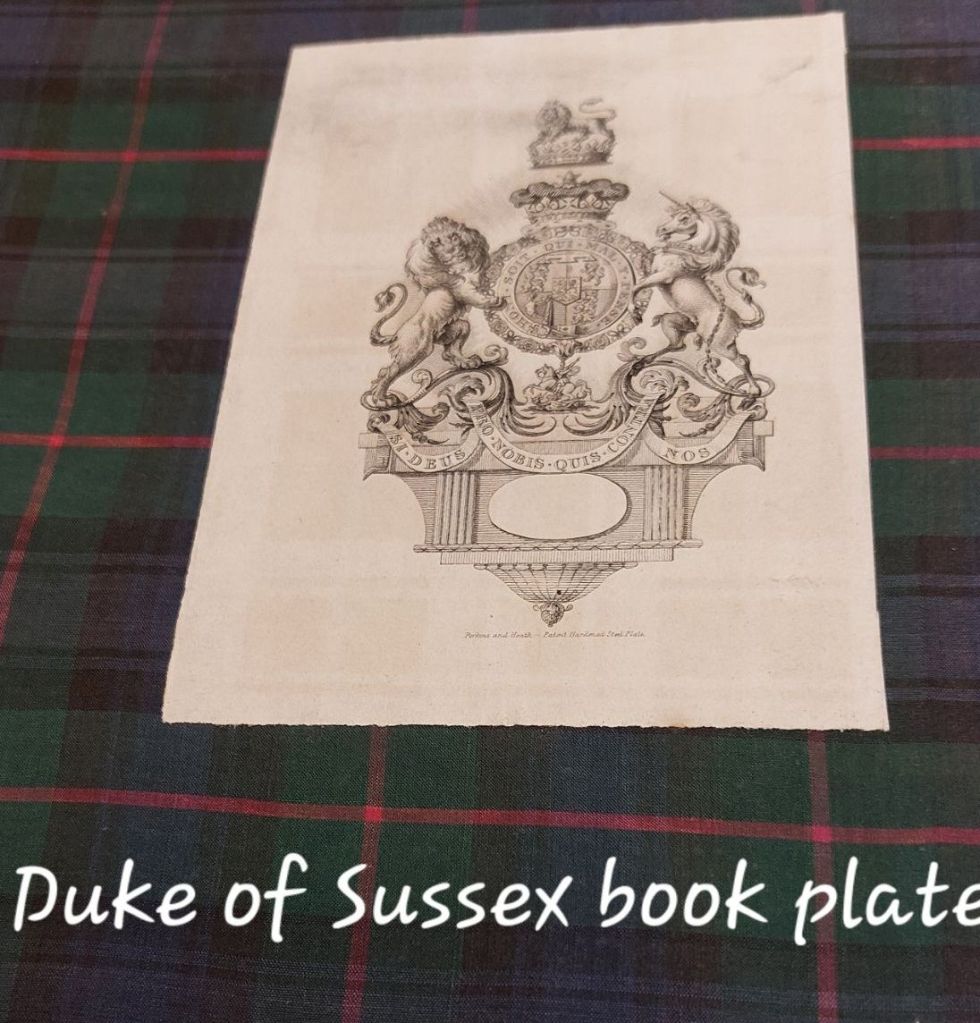
I’ve smiled at Georgian ladies’ stitched repairs to much-loved pieces, noticed with amusement a handful of early Mozart Allan books (yes, including some strathspeys and reels) in a fin-de-siecle Sammelband which had seen better days; spotted piano fingerings pencilled in; and best of all, found a tartan ribbon in a volume dedicated to the Duke of Sussex – his personal copy, which was first sold out of the family’s possession in 1844. His library was dispersed after he died in straitened financial circumstances:-
Nine Scots Songs and three Duetts, newly arranged with a harp or piano forte accompaniment / by P. Anthony Corri
This book has the Duke’s family crest on a label pasted inside, and the outer cover is embossed with ‘A F’ (Augustus Frederick), reflecting the monogram on the title page.
The Duke of Sussex’s mongramAugustus Frederick, Duke of Sussex (1773-1843)
The tartan endpapers and tartan ribbon between pp.30-31 are a perfect illustration of what I have written about in a chapter on tartanry in my forthcoming monograph. Everyone – whether nobility or commoner – liked a bit of tartan on or inside their Scottish song books, and here, someone even found a bit of tartan ribbon to use as a bookmark.
I have just a few of those books left to catalogue now. There’s an intriguing one without a cover or title page, waiting for 9 am on Monday …! Hopefully, I’ll end up with an empty bookcase again.
Few people in Glasgow knew that I had an unfinished first PhD guiltily lurking in my past, when I announced I wanted to do a PhD. It would actually be my second attempt. I’m told that someone (an academic?) asked that memorable and somewhat hurtful question, ‘What does a librarian want with a PhD, anyway?’
Chained to the shelves – Wimborne Minster Chained Library (Wikipedia)
I realised with a jolt, yesterday morning, that I would be retiring from librarianship exactly fifteen years to the day, since I submitted my thesis to the University of Glasgow. I never managed to cease being a librarian in order to become a full-time academic, because I had family responsibilities in Glasgow, and the chances of a full career-change without relocation were limited, to say the least. However, if I entered librarianship with the unfulfilled expectation of soon having a PhD from Exeter, and the aspiration to become a scholar-librarian …. well, I did achieve the latter aspiration. After getting the Glasgow PhD, I became partially seconded to research three years later, and I’ll continue as a part-time researcher when I’m unshackled from the library shelves.
I don’t know who it was that queried whether a librarian actually needed a PhD, more than twenty years ago. It’s probably a good thing I don’t know! However, if I could show that individual how I’ve just spent my afternoon, then maybe they’d begin to understand.
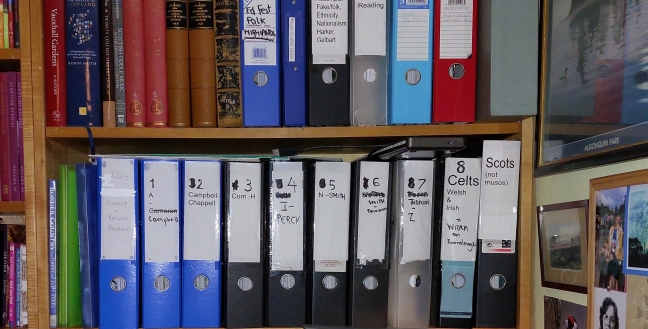
The other day, an academic colleague said they were putting a student in touch with me, to advise them about resources for a project. This afternoon, I was working from home as a librarian, so I decided to spend the time finding suitable resources for my enquirer. I had in mind a lever-arch file from my own research activities, that I knew was in my study-alcove.
Subject Specialist
[Scottish] ResearchFish
The more I thought about the query, the more things I thought of suggesting. I looked at my own monograph, for a start, along with a couple of essay collections that I’ve contributed to. I compiled a list, mostly but not entirely from the library catalogue. (I tweaked a few catalogue entries whilst I was at it. What does an academic want with a library qualification?, one might ask!) I The family balefully eyed the dining-room table that they were hoping to eat off, as I moved aside the ancient and modern books that were gaily strewn across its surface. However, I’m fairly content that I’ve done my preparation to help with the query. I’ve also enjoyed an afternoon in the company of old friends – the compilers, authors and editors of all those books!
A Value-Added Librarian
Listen, I wouldn’t have known any of those resources if I hadn’t done that PhD. I wouldn’t have known what the arguments were. I wouldn’t have known how nineteenth and early twentieth century song-collectors viewed their collections, nor the metaphors they used to describe them, nor which collections might be of particular interest. I wouldn’t subsequently have collaborated on The Historical Music of Scotland database. And if I hadn’t gone on researching, I wouldn’t have known about some of the more recent materials, either.
I kennt his faither! (A Scot knows what that means)
There might have been times when others wondered who I thought I was, but I am absolutely certain that it has come in useful!
I’ve started listening to another Audible book, but it’ll take a while for me to finish it. To take a break from listening, I sidled over to the piano and played a one-eyed rendition of my favourite song.
Lady Anne Bothwell’s Lament (Baloo, my Boy)
My Song Gems (Scots), edited by James Wood and Learmont Drysdale (London: Vincent Music Co., 1908), is a nice big score that sits comfortably on the piano stand. This song is arranged by Finlay Dun, a Victorian arranger. As I squinted at the words, they didn’t look like what I remembered hearing sung from Cedric Thorpe Davie and George McVicar’s The Oxford Scottish Song Book (1969). What was going on? I suspected Davie and McVicar had taken their words from George Farquhar Graham and James Wood’s mid-Victorian Songs of Scotland. ‘You’ll see’, I told my bemused son. ‘The words will have been too smutty for Victorian ears, so Graham and Wood changed them.’
Davie used their words – which were perfectly acceptable for a collection intended both for classroom and adult use – but his musical setting is updated.
A Deserted Mother and Child
Graham and Wood’s collection revealed in the footnotes that it was an old ballad collected by Bishop Percy. However, Graham said that …
The Old Ballad, though poetically meritorious, is so coarse in most of its stanzas as to be repugnant to modern feelings of propriety. We have, therefore, adopted only the first stanza of it, the additional stanzas here given having been written by a friend of the Publisher.
Songs of Scotland (Edinburgh: Wood & Co., 1850), Vol.2, pp.30-31
Percy’s original version is in the National Library of Scotland’s Digital Gallery (Reliques of Ancient Poetry, 1767). Today, the lyrics are inoffensive!
And here’s the Cedric Thorpe Davie setting using Graham and Wood’s sanitized words:-
Kathleen McKellar Ferguson sings the Oxford Scottish Song Book version, divinely, here on YouTube
The Song Gems (Scots) version is in modern English and the text has been partially rewritten again – it falls halfway between the original and the sanitized words! And the musical arrangement? Straight from Graham and Wood’s collection.
Percy, verse 3: Smile not as thy father did, to cozen maids, nay God forbid / Bot yett I feire, thou wilt gae neire Thy fatheris hart, and face to beire.
Wood and Drysdale, verse 2: Smile not as thy father did, to cozen maids, may God forbid / For in thine eye his look I see, The tempting look that ruin’d me …
Olde English or modern, take your pick!
As for Graham and Wood, or Thorpe and McVicar? Not a ruinous smile to be be seen! The lady may have been deserted, but no hint that she had first been seduced!
Remember, I was looking forward to receiving a pile of old Sol-Fa music the other day? Well, it proved as interesting as I expected. And in amongst the copies that I was expecting, were a couple of choir booklets for ‘The Glen’ concerts – which were annual open-air concerts on the Glennifer Braes in Paisley. I’ve written about these concerts, actually. (You’ll see, when my book comes out!)
As predicted, the programmes were mainly of Scottish songs, but the first song in 1915 was an Irish one – ‘Killarney’. I carefully read the score – I have no problem with the Sol-Fa note pitches, but I can’t have learned the rhythmic notation quite so well when we did it at school! And then, I wondered if I could find a recording of the song, to see if I’d got it right!
I found a YouTube recording of 1905 by Marie Narelle. I have not the first idea who this lady was, but it occurred to me that her singing style probably wasn’t a million miles from what the Paisley United Choirs would have considered a good rendition. It was a strange feeling, to be listening to something 118 years old, and the closest I could get to what was sung on the braes that afternoon.
Killarney Lake, sung by Marie Narelle (1905) Edison Gold Moulded Record 9081
But that’s not all. On a completely unrelated note, I remember reading about the fascination people had for echoes in the Georgian era, when I was researching the early 19th century Scottish song collector, Alexander Campbell. Alexander Campbell went to Fingal’s Cave with a bagpiper in his boat, just to hear the echo. And I read somewhere that in Ireland, people did a similar thing at Killarney Lake, where they’d take a few instrumentalists in the boat to listen to the echo – but sometimes the musicians would ask for more cash before they’d play a note!
Maybe it was my destiny to find that YouTube recording!
One of my favourite Mozart Allan songbooks has an intriguing history. I have contributed a chapter discussing it, in a print and tourism collection, and I’ve dealt with it in slightly less depth in my own monograph. (Neither is published yet, but hopefully the essay collection will appear later this year.)
The songbook has a photo of a Glasgow entertainer, and the words (so I thought) of his recent song – but not the music. That, it says, is available from Mozart Allan. I have been itching to see this entertainer’s song, but it entailed a trip to the National Library of Scotland.
Today – at last! – I saw it. Two sides of music, that’s all. The words in the song-sheet are more extensive than what appeared in the songbook. It’s just a typical music-hall waltz, but I’ll tell you something …
They encapsulate much of what I’ve been writing about, so I’m ecstatic to have seen it. I’m not able to share the images (though I think this snippet is probably ok!) – but I’ll certainly be talking about it when I give one of my guest lectures at St Andrews!
Again and again, I sit down to write about music, and end up going into hyperfocus about words. It must just be the way my mind works!
Working on my final chapter, I encountered a composer about whom I knew comparatively little. However, when I discovered he was friendly with one of Scotland’s significant 20th century poets; that the two of them had corresponded extensively; and that the composer set lyrics written by the poet, I thought I ought to know more about both men. I consulted the Oxford Dictionary of Biography. On Amazon, I ordered a poem considered one of the poet’s greatest works. At work, I borrowed a score and a textbook. I also sent out an email, basically asking (in more scholarly terms), ‘is this composer any good?’ (And ‘would you put his songs in your music case, if you were filling it with your favourite repertoire?’)
The outcome was very interesting. I was directed to a singing tutor and a student who had worked on this repertoire. Both sang the composer’s praises – indeed they were enthusiastically generous in their praise.
I also had a response from a traditional music expert: their assessment was quite the reverse. Indeed, it reminded me of what happens when I introduce the songs of Marjory Kennedy Fraser to traditional music students. Looks mingling caution, boredom and blank incomprehension, steal over faces that were only minutes before quite animated and interested.
I’m a musicologist from the classical music tradition, working with supposedly ‘traditional’ folk song collections. Well, commercial collections of ‘traditional’ national songs. I really am stuck in the middle! It’s an interesting place to be.
Since I’m currently working on a book about Scottish music publishers, I suppose it was inevitable that I’d ask myself just one question last night:-
Did 20th century Scottish music publishers publish any music to commemorate the four Coronations of their day?
Well, you’d have thought they might, wouldn’t you? There were militaristic books of marches and national songs in war-time, so why not patriotic books of national favourites when a new monarch acceded to the throne?
A couple of klaxon warnings should be sounded straight away.
It would be easy to say that Kerr and Mozart Allan never published anything related to coronations, but the truth of the matter is that I have plenty of evidence that what survives in libraries is certainly not the same as what was published in the first place. The more ephemeral the music, the slimmer the chance of its surviving. And, without putting too fine a point on it, a library might keep Mozart Allan’s book of songs by Robert Burns, but a flimsy, contemporary song of the music hall or variety performance kind, not designed for longevity, probably won’t have been added to a University Library’s stock at the time it was published, even if there might be scholars today eagerly seizing upon any lucky survivors. Similarly, a ‘Coronation Waltz’ or ‘Coronation March’ wouldn’t have been something studied by music undergraduates studying Palestrina or Mozart in a red-brick British University.
If you’ve been following social media or broadcast news recently, you’ll realise that some Scottish people are decidedly not Royalist in their leanings. However, it would be risky to say this was the reason for Kerr and Mozart Allan’s apparent lack of interest in publishing music on a coronation theme. There is no written evidence about their political views whatsoever.
I searched for pieces with ‘coronation’, ‘King’ or ‘Queen’ in the title. It was a quick and easy search, but certainly not a comprehensive one. (For example, if there was a song called ‘Westminster Pageantry’, without any of my search terms in the catalogue entry, then I would not have retrieved it.)
But the fact remains that music celebrating the coronation of a British monarch appears not to have been of interest to Kerr and Mozart Allan, the two popular music publishers holding sway in Glasgow for the first part of the twentieth century.
Edward VII and Alexandra’s Coronation, 1902
I found just one Scottish publication, the Glasgow and Galloway Diocesan Choral Association’s Book of the Music to be used at the sixth festival service in St. Mary’s Church, Glasgow on Saturday, June 28, 1902 (in connection with the coronation of His Majesty King Edward VII) etc. And that was it!
The English firm Bosworth, on the other hand, published Alexander Campbell Mackenzie’s Coronation March, op.63, in various formats: for piano, a full score, and arranged for piano duet by J B McEwen. Mackenzie (1847-1935) was Edinburgh born, but became Principal of the Royal Academy of Music in 1887. McEwen (1868-1948), another Scot, was professor of harmony and composition at the Royal Academy, and in time became their next Principal. Mackenzie’s Coronation March was dedicated to the King, and first performed at Crystal Palace with anything up to nine military bands. A march was an accessible genre, but the composer was very much part of the English musical establishment.
So, not much to see in 1902, then. But wait!
George V and Mary’s Coronation, 1911
Bayley and Ferguson had offices in Glasgow and London – and had done for some years. On the occasion of George V and Mary’s Coronation, they published Carlo F. Roberti’s The Crowning of our King & Queen; or, The Coronation Song of – Semper fidelis. I know nothing about Roberti, but someone at the Dundee Courier wrote in 1990 that his real name was Charlie Robertson, of Perthshire. (If you have access to the British Newspaper Archive, you can read how the readers responded to this snippet, on 8 February 1990. Robertson was a violin teacher. His song was taught to local schoolchildren at the time.)
The Scottish firm Paterson’s had offices in both Scotland and London, too. They published a Coronation song by a Durham man, Thomas Richardson, who had moved to Edinburgh to become organist at St Peter’s Episcopal Church in 1879, and singing-master at George Watson’s College in 1883. His song, ‘Mary’ had an alternative title, ‘Queen Mary. Coronation Song’, with words by K. Kelly, and was for some two decades popular as what people imagined to be a Scottish song. Which raises the interesting debate as to what makes a song ‘Scottish’!
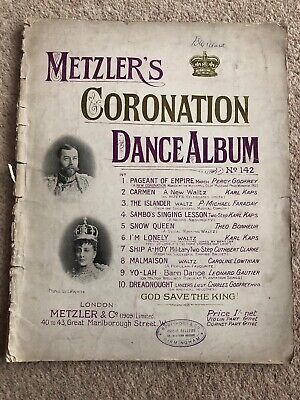
Metzler’s Coronation Dance Album (image from eBay)
Meanwhile in London, light music publisher Metzler published a book of tunes around this time, which included at least one piece composed for Edward’s Coronation: Metzler’s Coronation Dance Album. The precise date is uncertain: Metzler gives 1911 in Roman numerals, and (1909) in Arabic. Very helpful, Mr Metzler!
George VI and Elizabeth’s Coronation, 1937
Paterson’s was essentially a London firm by this time. J Michael Diack, one of the directors, had moved down south some years earlier. And that means that the only Coronation theme publications that I traced were either published in England, or overseas. Perhaps it was the advent of radio broadcasting that made people more enthusiastic about such things, but the outpouring of Coronation-related music was suddenly – well, remarkable! Many people got a wireless in time to listen to the Coronation – the first time such an event could be broadcast.
‘This Most Historic Event’
Which brings me to an advertisement in the Coatbridge Leader on Saturday 27 May 1937. F. Mills & Co sold pianos, organs and radios from his two shops in Coatbridge, a town about a quarter of the way between Glasgow and Edinburgh. (He also had a shop in Motherwell at some point – I haven’t checked dates.) If you bought a piano or organ before the Coronation, he would give you a free stool. If you bought a radio – to listen to the broadcast – then there was a discounted price.
Mr Mills didn’t mention sheet-music, but you’d be surprised how many English music publishers rushed to publish relatively lightweight music for popular consumption, whilst Paterson’s also offered a choral arrangement of a Handel anthem by one of Diack’s favourite composers:-
Let all the people rejoice : coronation anthem S.A.T.B. / Handel; arranged by W.F.R. Gibbs ; edited by J. Michael Diack. (Lyric collection of choral music, sacred. No. 1647) London: Paterson’s 1936
Paterson’s Coronation music book
Royal cavalcade : coronation march / Albert W. Ketelbey, in piano or orchestral score (Bosworth, 1937)
Chappell’s Coronation Album. A Musical Cavalcade, etc. [Marches and Songs.], 1937
The Coronation Waltz / Jimmy Kennedy (Peter Maurice, 1937)
Long live the King (Paxton, 1936)
The Coronation Song / Martin Silver (London: Silver’s, 1936)
Coronation March Album / Granville Bantock (London: Joseph Williams, 1936)
Slightly to my surprise – though it was obvious, when I thought about it, with emigration still high – I found publications from Australia, Canada and America too:-
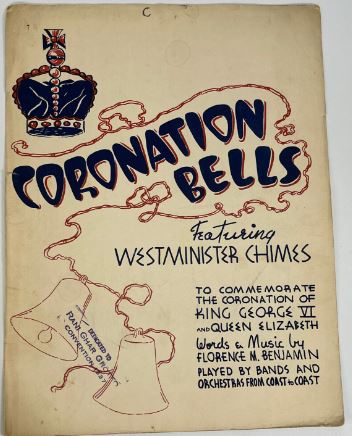
Coronation Bells – image from eBay
Sterling’s Coronation Community Album (1937?) Disappointingly, the contents of this publication from the Antipodes didn’t seem to have anything to do with the – erm, actual Coronation. But I suppose the word ‘Coronation’ would have been eye-catching.
In Toronto, Florence M Benjamin published her Coronation Bells in 1937
And in Chicago, Moissaye Boguslawski’s Coronation March: dedicated to their Majesties King George and Queen Elizabeth of England was published by Calumet Music in 1937
Elizabeth II’s Coronation in 1953
There was a rush to get television sets for Queen Elizabeth II’s Coronation, although comparatively few people in Scotland would have had them this early on. Francis, Day and Hunter published a new dance introduced on television for the Coronation.
However, despite now being basically an English firm, Paterson’s turned to their Scottish roots for their Coronation offerings, which had nothing to do with the television broadcast at all. Indeed, country dancing was very popular across Britain:-
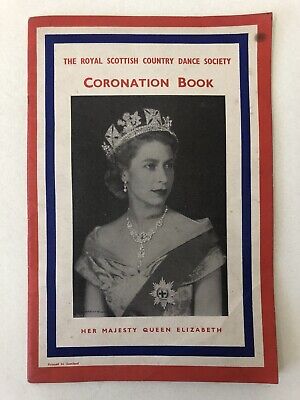
For the Royal Scottish Country Dance Society, Paterson’s published The Scottish country dance book. Book 17 : Coronation book / music arranged by Herbert Wiseman.
Paterson’s also published Pipe-Major William Ross’s The coronation bagpipe march… entitled “The coronation of Queen Elizabeth 1953”
The English Folk Dance and Song Society also published a book of dances: The Coronation Country Dance Book.
Many other publishers produced music in their own preferred genres, but I didn’t see anything from Kerr’s, Mozart Allan or Bayley & Ferguson.
From Bosworth came Coronation march album for piano solo, with music by Ketelbey and a variety of other composers.
Bosworth also published a Coronation Suite for piano by Barbara Kirkby-Mason, who was known for writing educational material.
Francis, Day and Hunter produced Francis & Day’s coronation album in 1952, along with
Archie Alexander’s The Coronation Polka, followed by
Kenneth Wright’s A Waltz For The Queen (Television’s New Coronation Dance), arranged by Sydney Thompson in 1953
The Northern Music Company – a London firm – published Coronation Waltz by Christine Hurst and George Warren, with words by Bill Tomlinson and Stanley Barnes. Reported in The Stage in October 1952, it was written by ‘four northern songwriters’ and received favourable reviews at its introduction in a Butlin’s holiday camp dance contest. If this makes you think of ‘Hi-de-Hi’, then you’re absolutely right – Butlin’s holidays were cheap, accessible, didn’t involve travelling abroad, and as we all know, dance contests have never gone out of favour!
Coronation Waltz- image from eBay
Last night, I was just idly searching to see if ‘my’ Scottish music publishers showed much interest in Coronation-themed publishing. On the face of it, those with an English office did make a token effort. Those based solely in Glasgow may not have done, with the caveat that they might have produced ephemeral material no longer traceable, and there could have been songs that my quick search didn’t reveal.
But I know a lot more about light music publishing in England around those times!
IMAGES: All from eBay!
If you enjoyed this blog post about popular printed music, then you might like to read another post about music with a more serious, ceremonial slant, that I wrote for our library blog, Whittaker Live: Tracing our Musical History through National Events.












 Karen McAulay, Musicologist