Dr Karen McAulay explores the history of Scottish music collecting, publishing and national identity from the 18th to 20th centuries. Research Fellow at Royal Conservatoire of Scotland, author of two Routledge monographs.
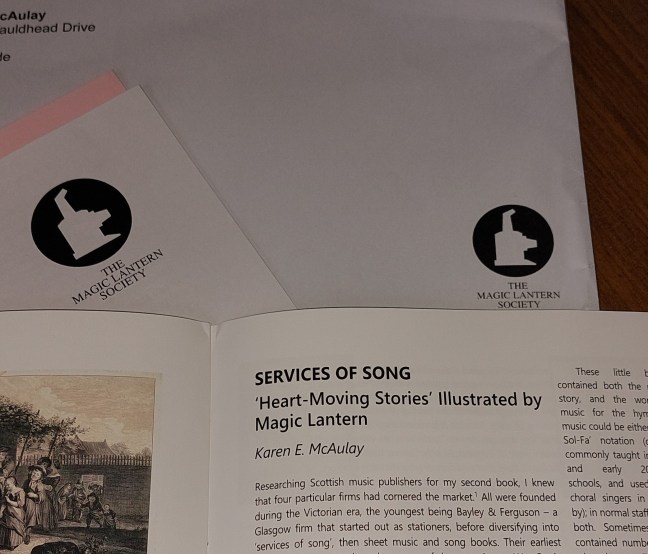
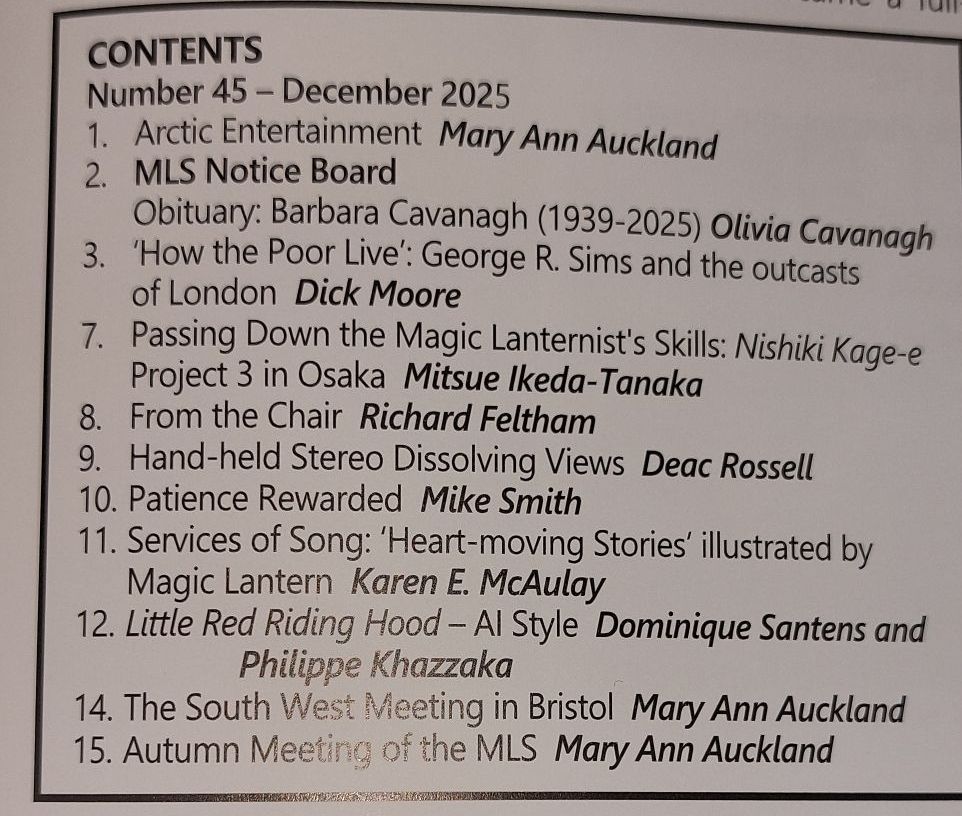
This morning saw the arrival of the latest issue of The Magic Lantern (no.45, December 2025) containing my article, ‘”Heart-Moving Stories” Illustrated by Magic Lantern’. I’m grateful to have had this opportunity to share a favourite bit of research, to which I alluded briefly in my recent monograph.
‘”Heart-Moving Stories” Illustrated by Magic Lantern’, The Magic Lantern no.45 (Dec 2025), pp. 11-12.
If you’ve glanced at my book, you may have encountered the part where I explain about Bayley and Ferguson and the services of song. Services of song are a virtually forgotten genre nowadays, but be assured that they were once a very common form of entertainment/instruction.
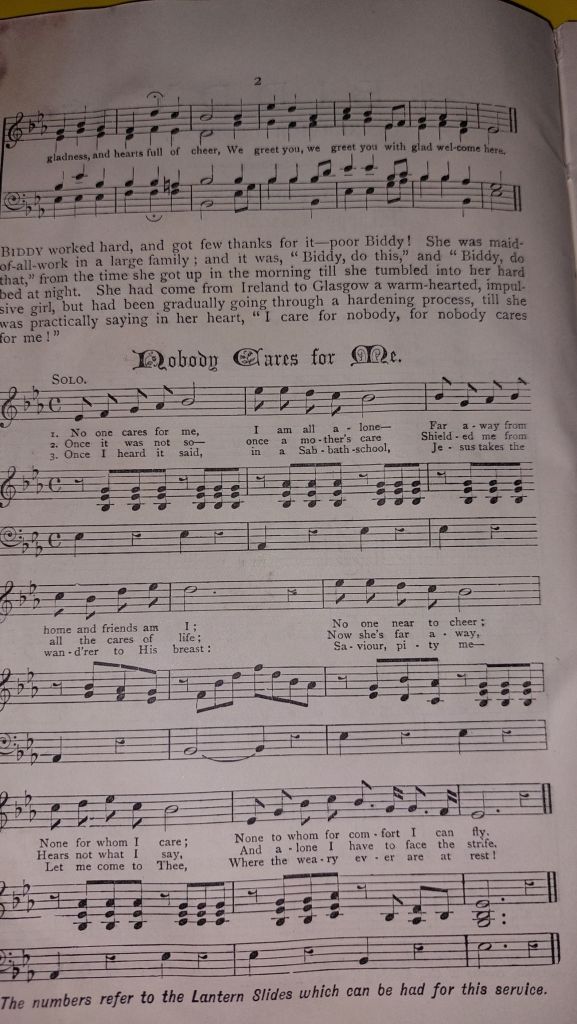
Biddy: opening piece
It’s not an abstract concept – these were a genre of magic lantern show, aimed at adult and/or juvenile audiences. To put on a magic lantern show, you needed a few key ingredients:-
A venue
A magic lantern
Something to project onto
Set of slides
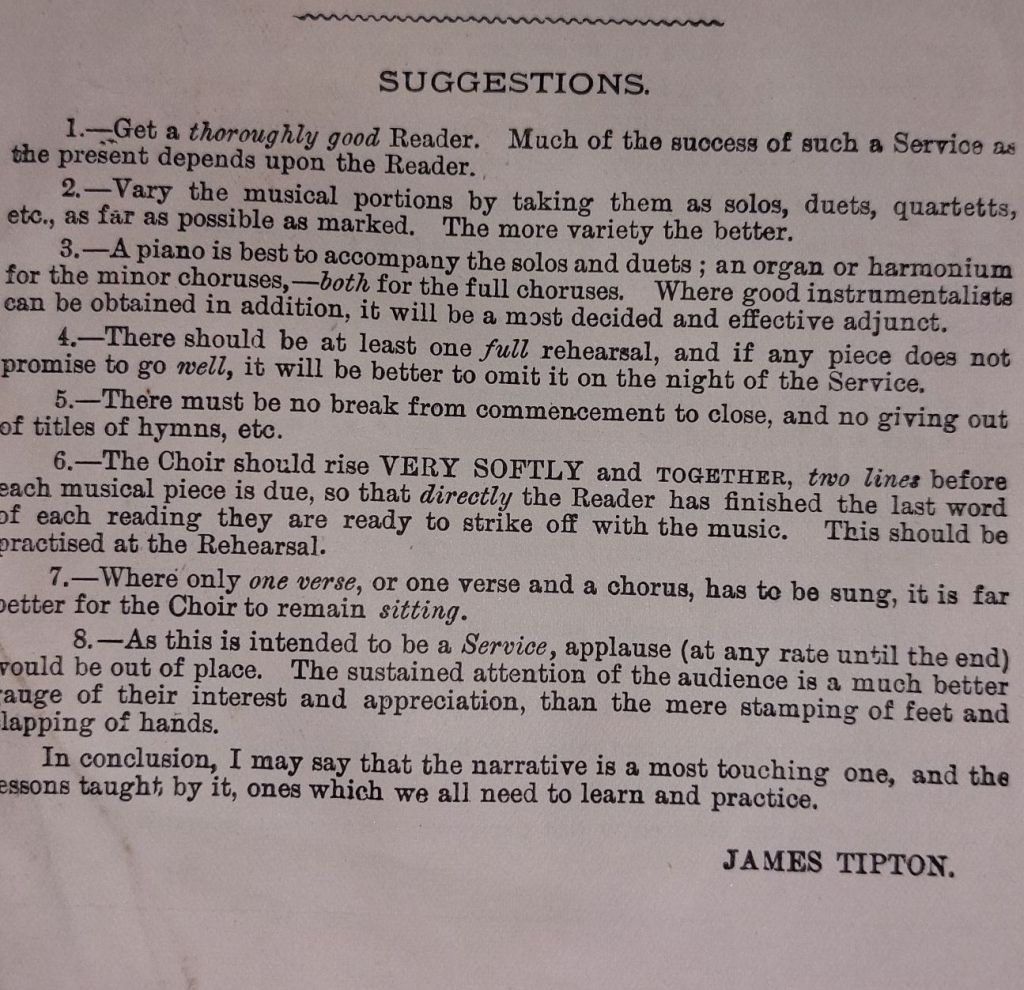
Something containing a narrative (for the narrator), and plenty of songs for the audience. The music could be in Tonic Sol-Fa or staff notation (notes on lines and spaces).
‘Get a thoroughly good Reader’
The narrative could be a biblical story or an adaptation from a moralistic story. Or perhaps something about a poet or a place.
‘Biddy worked hard …’
Whatever, the narrative and the songs were in a wee booklet, and that was your Service of Song. You bought multiple copies – they were cheap! The event itself was advertised as a service of song.
So, as you can see, a Service of Song was an early slideshow providing a variable mix of education, entertainment and religion. They were popular with Sunday Schools as a special treat, and they were often used by the temperance movement. Bayley and Ferguson published loads of them. (Organisers would have to buy or hire the slides – possibly from somewhere else.)
If you would like to know more … read the book!
Karen E McAulay,
A Social History of Amateur Music-Making and Scottish National Identity: Scotland’s Printed Music 1880-1951 🎶
I wrote this post last year, but for some reason never actually posted. Not to worry – now is the time to share it!
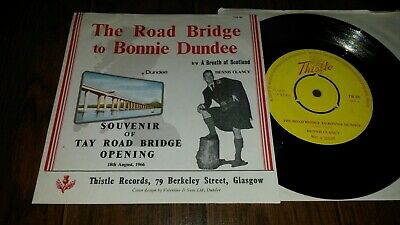
You could say Robert Wilson had Scottish music publishing just about tied up in Glasgow. As his singing career began to wane, he bought up James S. Kerr’s and Frank Simpson’s, also co-founding Thistle Records from his premises in Berkeley Street. Not bad going, eh? Oh, and he also owned a travel company, which is less surprising considering his own worldwide travelling as a singer – he must have gained quite a bit of insight into the travel business. An informed, on-the-ground (or water, or airborne) interest, you could say.
After his death, the remaining shareholders of Kerr’s Corporation later acquired Mozart Allan’s AND Bayley & Ferguson’s backlists, too.
Wilson began a career as an apprentice draftsman, but after redundancy, started out as a singer. He sang with the Rothesay Entertainers, joined the D’Oyly Carte Opera Company Chorus between 1931-7 and then embarked upon his solo career, specialising in middle of the road Scottish song, but not limiting himself exclusively to this repertoire. Here he is, recorded by Pathe Films at the start of his solo career.
Annie Laurie (Maxwellton Braes are Bonnie)
If you’ve got a bit more time, here’s a ‘Voice of Scotland Short’ – a biopic lasting nearly an hour,with musical performances:-
Robert Wilson – Voice of Scotland Short
‘A Tribute to Robert Wilson’, with:-
Kenneth McKellar
Eliot Dobie
Jimmy Shand
Andy Stewart
Will Starr and Accordion
Cliff Hanley
Harry Carmichael
Sydney McEwan
Additional material by Bob Wright of Girvan
Header Image of ‘The Road Bridge to Bonnie Dundee’ from EBay
I have a forthcoming magazine article with more about Robert Wilson, of which I will give full details when it’s published in the near future.
You can read more about Scottish music in bygone days in my recent book:-
Why did Scottish music publishers produce so many songbooks and dance tunes? Who took Scottish music overseas to the diaspora? How did classical composers interact with local publishers?
I’ve discussed all this and more. Full details on the publisher’s page, link above.
I’m honoured to have been awarded the Mervyn Heard Award by the Magic Lantern Society (UK) in recognition of my research into Scottish publishers Bayley and Ferguson’s Services of Song for magic lantern shows in the late-nineteenth and early-twentieth centuries. Their booklet, Wee Davie, containing a script for a reader, and suitably religious songs, was possibly the first thing they published – or certainly one of the first.
The Mervyn Heard Award is awarded for any written work, archival research or smaller-scale digitisation project.
I’ve talked about these service books in research lectures as honorary Ketelbey Research Fellow at the University of St Andrews in 2023, and at the Royal Conservatoire of Scotland’s Exchange Talks series. The discovery of these wee books certainly inspired me to delve deeper into the social history around amateur music-making, other entertainments and educational or religious events, so I owe a debt to the original author Revd. Norman Macleod and his moralistic story, Wee Davie, for starting me off on this particular research strand.
In due course, I’ll be writing more about this topic, most particularly for the Magic Lantern Society itself.
It was foggy all day, I’ll always remember that. The mist still swirling outside, I went to bed and went over in my mind all the places I’d visited.
We met in a small cafe – always a good idea to start off with coffee! It was a short walk to our first stop, the place where much of the city’s music was printed.
A minibus took us to our next port of call – by the river – and then across the river to see where one of our publishers got married. (This raised a few eyebrows, but in fairness, it might have looked different 150 years ago!) From there – to see where he traded from, and then (wishing it was open) past a museum and on to the premises of another local publisher. Again, faded glories, I’m afraid. But it would have been very handy for the shipping!
Our new businessmen would have used trams to get into the city, until the subway started in the 1890s. We took the subway – no trams nowadays! It was time to visit a couple more publishers’ premises in the city centre, not to mention the former Athenaeum. Time for the minibus – there were a couple of former churches to visit (one still standing, another very definitely not); another educational institution, and the street where three music publishers finally found themselves merged into one single entity.
Where next? The Mitchell Library, with all its historical collections, or a nearby cafe? Or indeed, the library cafe? What would everyone prefer? We talked about what we’d seen, and whether it had changed our opinions of all that cheap music, so popular with earlier generations.
I dozed, until finally my busy mind gave in to sleep.
It’s time to confess – the whole story is simply a figment of my imagination – I was dreaming. It never happened – but I’ve thought about it so much that maybe it might have some mileage after all. Would you be interested in such a tour? There are few places we could could actually go into, but I am convinced that a tour of key places would bring the history alive in a way that books can only hint at. It would certainly tie in brilliantly with my second, recently published book. I’m going to think about it a bit more imaginatively … watch this space!
As I planned what to play for tomorrow’s organ voluntaries, my eye fell on an old book of pieces by Cesar Franck. It had been my father’s book, and I remember my nine-year old self playing one of the melodies on the oboe, as he played the rest of the lines. He loved France, French, and French organ music. Today, I realised that this particular volume was published by none other than one of ‘my’ Scottish music publishers – Bayley and Ferguson. What could be more appropriate to celebrate my new book, than to play our ‘duet’ from that particular anthology? (I had, moreover, already encountered the editor, Henderson, in my research. He’s mentioned in passing in Chapter 3.)
I don’t know when Dad got that book. It was published in 1953, and it has an oldish look to the cover design, so I imagine he got it not long after it was published.Wherever he was at the time, it has since spent decades in Norwich before eventually coming up to Glasgow, Bayley & Ferguson’s original home.
I must admit that the focus of my book means I didn’t make much mention of organ music, and definitely no mention of Cesar Franck! Looking at it, the Cesar Franck cover design is staid beyond its years. You wouldn’t think the sixties were just around the corner. Still, it’s the music that matters. I’ll enjoy playing it tomorrow, thinking of Dad as I do so. He would have been so pleased to see my published work – I can only hope he’s smiling from his fleecy cloud now!
I went back to the Mitchell Library in my continuing search for old (historically old) lady music publishers. Floor 5 was temporarily operating from Floor 3, but the books I needed could thankfully still be got out for me.
The Mitchell’s epic carpets. Glasgow logo.
The ladies were nowhere to be seen in the book documenting the Glasgow Society of Musicians. Nor was there any hint of them in another book about live music for Victorian Glaswegians. (Although I did, whilst I was still in the library, get an Ancestry message from one of the ladies’ descendants!)
Floor 4 for the Music 🎶 Catalogue
Undeterred, I headed for Floor 4, to have another look in the old card music catalogue – a really useful resource. Again, I only found two of one composer’s pieces. I already own one of them, but that still means one find. And I also spotted a couple of issues of a journal that interested me. A quick flick through, allowed me to note potentially interesting pages, even if they don’t relate to the present theme. I was in my element.
Closing my laptop, I decided to round off the morning with a coffee downstairs …
Then the fire alarm went off. Everyone filed out, and I looked down the street. Would I find a café?
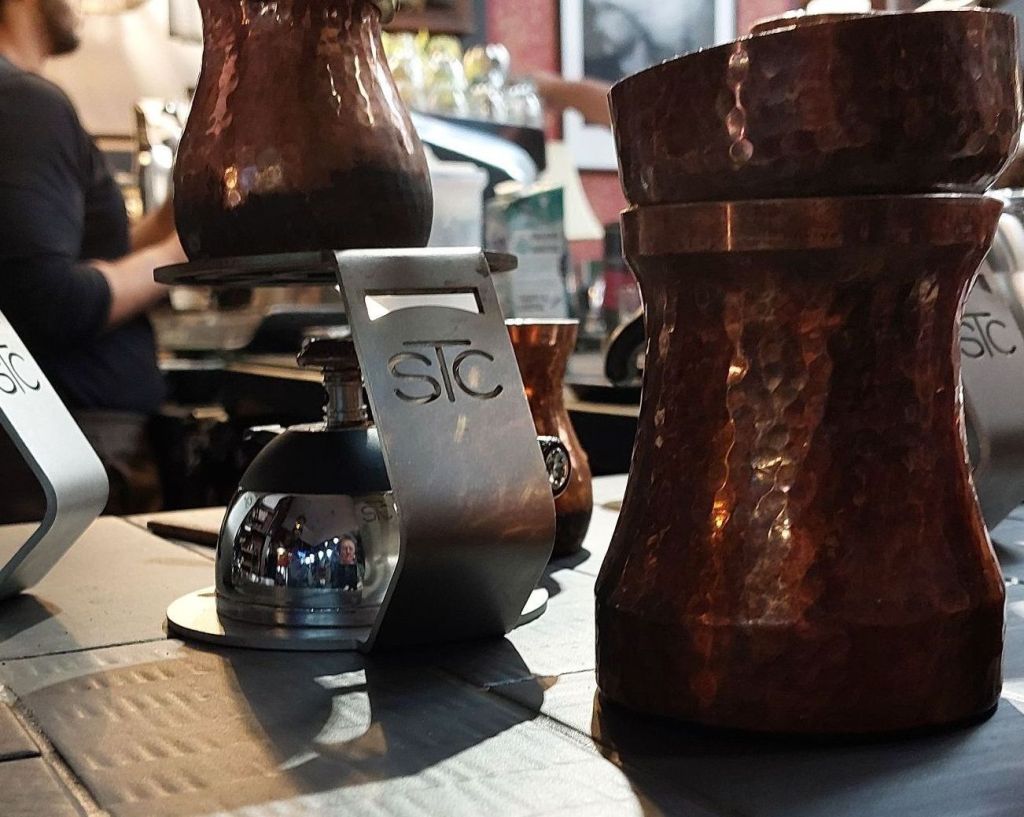
Turkish coffee potsThe erstwhile Thistle Records in Sovereign House. Name plaque still there.
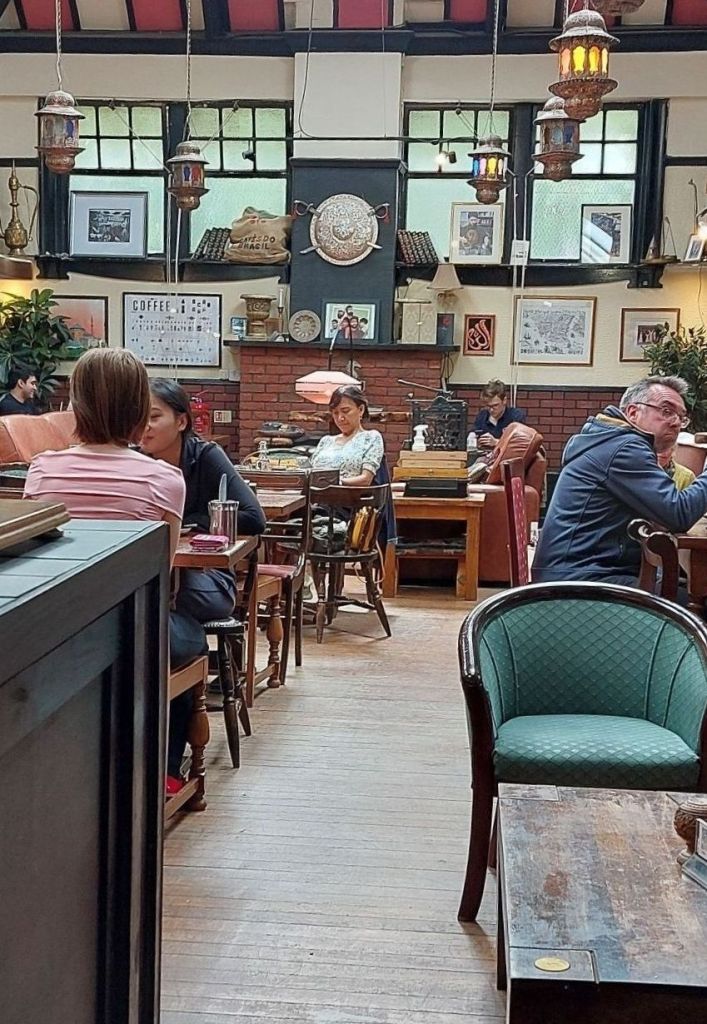
Believe it or not, the Turkish cafe in between what had been Thistle Records, and Kerr’s Music Corporation (Glasgow Music Centre), was in another building with a historical past: no less than the Glasgow Society of Musicians, about which I had just been reading. I got my latte, also snapping a picture of the interior – clearly once the Musicians’ Concert Room – and the art-nouveau front door.
Where once they heard piano trios …You can just see the arched ceiling …Mission accomplished!
Another time, I’ll make sure I have a coffee ‘to sit in’ rather than takeaway! Glasgow’s most eminent musicians would have enjoyed performances there … whether or not the ladies ever got a look-in!
Yesterday, I set out to track down some music. It’s light music, not great music – almost ephemeral, you could say – but together, it tells a story.
I also wanted to find out more about the life of one of these fin-de-siecle Glasgow woman music publishers.
It’s not that easy. The music is scattered round our legal deposit libraries; the cataloguing isn’t completely consistent; and fin-de-siecle ladies, whether single, married, childless or proud mothers, didn’t leave much record of their daily lives. They’re hidden in the shadows of family members, and, whilst I imagine they knew one another, let me stress that this is NOT a tale of a female publishing cooperative!
I had a nice chat with a local history librarian, making an acquaintance who is now equally keen to find out more; then I headed home – as yet, none the wiser – to devise a complex spreadsheet of music titles. I’m visualising a pinboard with strings criss-crossing between ladies, libraries and work-lists.
So complex, indeed, that I still haven’t planned how best to get to SEE the music.
Having virtually finished a major project (the second monograph), I’m exploring future directions.
Unfortunately, this looks – even to me – like going randomly round in somewhat squiggly circles, since it entails seizing intriguing little thoughts that have occurred to me at various points in my research, and (metaphorically) tugging at them to see where they might lead. Right now, none of them have yielded much more, although it’s fair to say that I need to wait for some to have an outcome.
Ladies in the Music Publishing Trade
There’s the thought that a publisher’s wife – who HAD been a piano teacher – might have authored his piano tutor for him. Maybe, but there’s no way to know. Dead end? Well, yesterday, I traced a copy in Australia. I’d love to see it, even if it tells me no more.
Then there’s the sister of another publisher. I do have marginally more to go on – and I’m currently following up some leads – but it’s not exactly a whole new project. After a couple of hours’ searching the British Newspaper Archive delving this evening, I had learnt that she accompanied a church concert in her late 40s – since she, too, was a piano teacher, this is hardly earth-shattering news!
(Come to think of it, I encountered a third lady piano teacher who was a talented songwriter and small-scale self-publisher… see, if only I could amass enough extra information, I would clearly have the makings of an article here!)
So, I also started another line of enquiry. This could be more fruitful, but it’s too soon to know.
As for the tea set? Nothing to do with the ladies, as it happens. The second lady’s brother (the publisher) was a church session clerk – an important role to this day. He therefore had the responsibility of making presentations when called upon. And, on the occasion when his sister played the piano, the church was making the presentation of a tea set and a clock to their minister, who was getting married.
In a very Chaste Design
Doulton, on eBay. Not chaste?
This brings me to the most pressing question (I jest):-
Was it plain? White or cream, maybe? It only had a small, modest embellishment. How else can a tea set be ‘chaste’?
Or this. Surely this! Again, on eBay.
It’s honestly not a problem that would occur to any Kirk session today!














 Karen McAulay, Musicologist