Why Do a Year-End Review?

Seriously, why do we do year-end reviews? To show the world what we’re most proud of? Quite possibly. To convince ourselves – and the world – that really, we’ve been very busy and deserve a pat on the back? Perhaps so. I took to the internet to find out why businesses do reviews, and why a career-minded individual might do one of their own.

Consulting the Experts

Braze.com said that year-end reviews offer the chance to ‘create distinctive content’; to ‘build loyalty’ and to remind the world what your particular business does best. To that end, obviously you log milestones, achievements and events. You use multimedia formats, and draw upon customer data. This all makes sense, although I don’t know that I, as an individual, can do all these things. (No customers, for a start!)

I tried again, and found a Harvard Business Review posting about, ‘How to create your own “Year in Review“. There’s plenty of sound advice here, suggesting that I should pause and reflect upon successes and failures; lessons learned; proudest achievements; who has helped me most; how my strengths have helped me to succeed; and whether there’s anything I wish I’d done differently. This is much more introspective, and certainly valuable advice. Whether I’d want to blog about all these headings is a moot point, though.

For me, I have an extra conundrum. I shall be retiring from the Whittaker Library at the beginning of July. I hope to continue the research element of my work, though. So – in one sense I’m writing a career-end review, as far as librarianship is concerned, but it’s not a career-end review for me as a researcher. 

The Harvard Business Review suggests using your diary to capture key events on which to reflect. I spent a few minutes doing just that, yesterday. Immediately, I realised that there’s one thing I’m proud of over everything else, and that is that although I spend 85% of my time as an academic librarian, my 15% as a postdoctoral researcher is actually highly productive.

What do I do best? I get things done.

‘She’s a Librarian’

I confess, I don’t like hearing this! It makes me feel as though my research activity is dismissed as dilettantism – that I don’t do badly, considering research isn’t my main role. On the other hand, a fly on the wall would point out that yes, I do spend the majority of my time as a librarian. 

Jazz CDs – not a Highlight

So, what did my diary exercise reveal? I’ve catalogued a lot of jazz CDs. This causes me to feel quite a bit of resentment, because I know our readers don’t generally listen to CDs as a format, so all my efforts are to very little avail indeed. Maybe that’s one of the things that I wish I’d done differently. It’s not a high-priority task; however, I am conscious that I don’t want to leave the backlog to my successor. And that’s why I do this dreadfully tedious and repetitive activity!

Retrospective Post Script: that jazz CD cataloguing was indeed a waste of time. I did it because the promise had been made that those CDs (thousands of them) would be catalogued. I didn’t make the promise, but I did feel the obligation to fulfil the promise. My resentment was because it used so little brainpower and expertise, provided so very little fulfilment in the moment, and so little benefit in the long-term.

Equality and Diversity: Stock Development

What I’m more proud of is my efforts to get more music by women and composers of colour, into the library, and most particularly, to ensure that our staff and students know just how much of it there now is in our stock. With a colleague from the academic staff, I’m concocting a plan to raise the profile of this material. 

I also suggested maybe there might be a prize for diverse programming …

For me, a particularly proud moment was being invited to attend a Masters student’s final recital in June, at which one of these new pieces was played. It was a piece requested by a member of staff – I don’t think it was me that actually stumbled across it – but I certainly sourced it, catalogued and listed it. Whilst I’m heartily sick of cataloguing, I do take pleasure in stock development, and in ensuring there are ample means of discovering the music once we have it.

In September, I was gratified that one of our performance departments reached out to me to request more materials by under-represented composers – a sign that the message is getting through, and that staff appreciate that the library really is trying to help.

Since October, I’ve also been broadening the stock of music inspired by climate change and ecology, including songbooks for school-children, since we have a number of music education students. That pleases me, too.

What else? Dealing with donations to the library, some eagerly received and others needing sifting through. Weeding stock to ensure there’s room for new material, and ensuring that tatty material is removed or replaced depending on how much it’s likely to be used.

User Education

Some things are cyclical – most particularly providing initial library introductions, and later talking to different year-groups about good library research practice. In June, I gave a talk about bibliography to the Scottish Graduate School of Arts and Humanities, which attracted far more of an audience than I’d ever dreamt of!

Queries, and Research-Related Activity

I’ve also dealt with queries – such as one from a Polish librarian, or another from an elderly enquirer wanting to trace music remembered from childhood. And I talked about my research activities at a library training session, even though I was rather afraid of wasting colleagues’ time going on about something that might not feel very relevant. (This autumn, I also obtained and catalogued – in detail – a book of Scottish songs that I have written a book chapter about. It would be dreadful, wouldn’t it?, if someone read the chapter but couldn’t find the song-book in the library!)

Professional Activity

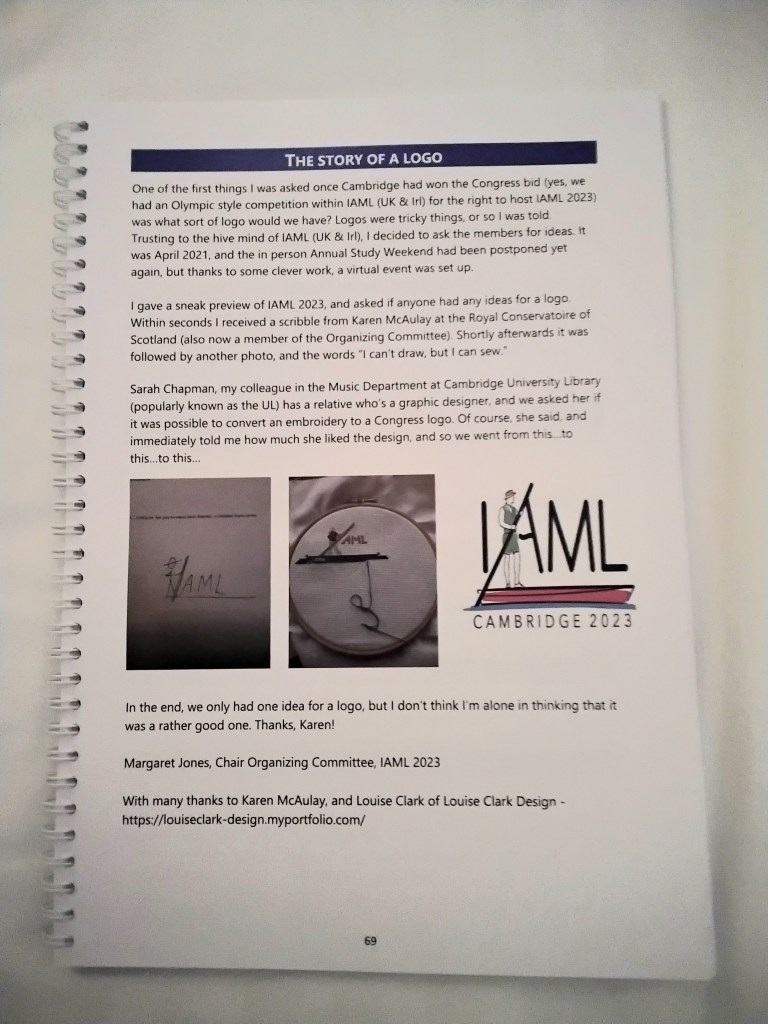
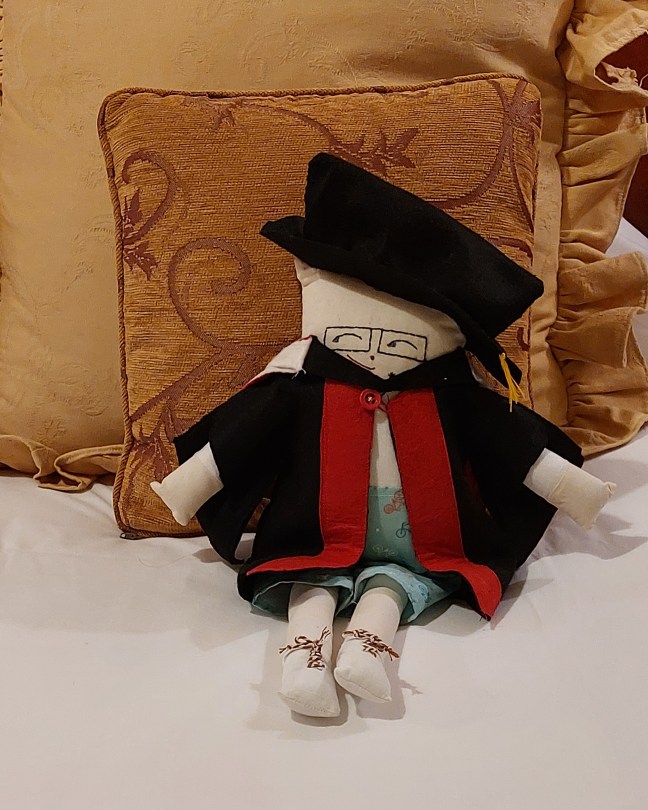
Professionally, I managed the comms for the IAML Congress in Cambridge this summer (with a little bit of help from mascots Cam, Bridge and Don and a couple of fellow IAML (UK & Ireland) librarians, and I think it went quite well. The stats for the blog and Twitter (“X”) rose gratifyingly during this period. I went to a couple of days in Cambridge, but I didn’t speak this time.
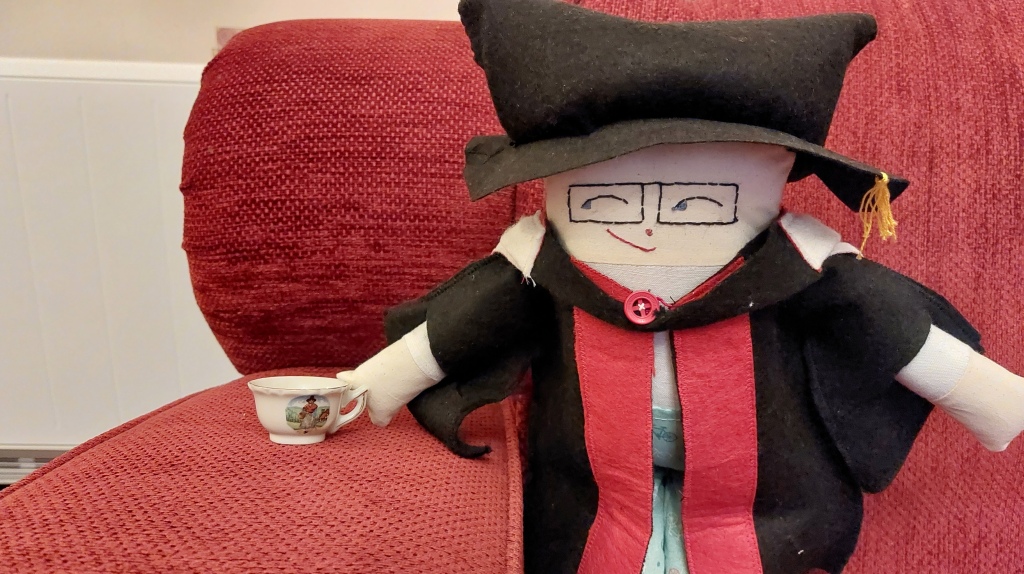
Don, one of the Congress mascots, sits with a tea-cup in his hand.
IAML Congress mascot Don

A Researcher with Determination

Early on in 2023, I was gratified to receive an LIHG (Library and Information History Group) Bursary to attend a conference at the University of Stirling between 17-19 April, which was about Reading and Book Circulation 1650-1850. This was to be the first of two major successes this year, for I was also elected the inaugural Ketelbey Fellow in the Institute of Scottish Historical Research at the University of St Andrews. I’ve written extensively about this experience in other blog-posts, so I won’t duplicate it here. However, I can’t resist reminding myself of highlights!

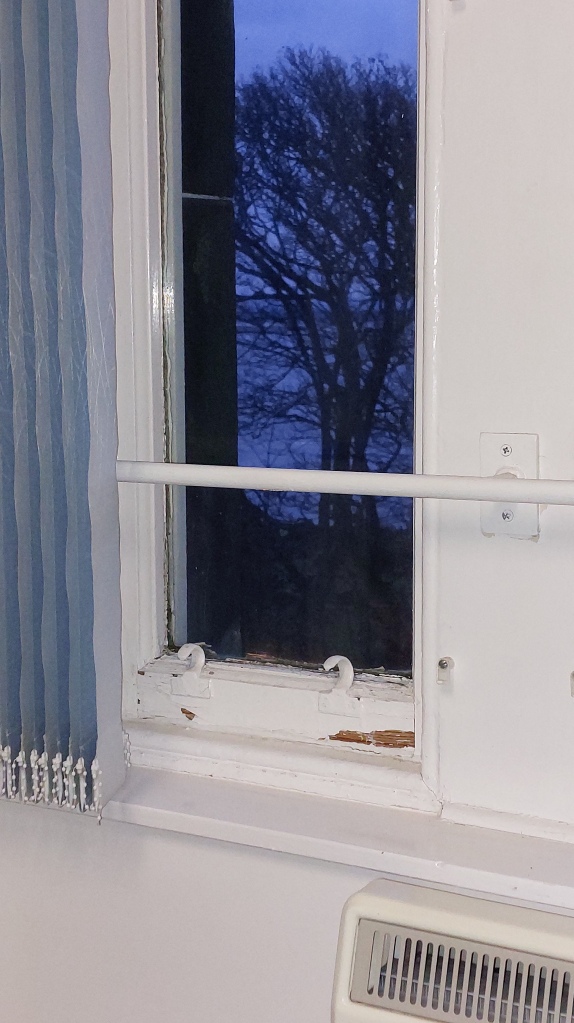
Twilight from my window, St Katharine’s Lodge, St Andrews

We’re not going on a (sniff!) Summer Holiday …

Being a researcher for 15% of the time is not easy – there simply isn’t the time to do all I want to do. Far from ‘dabbling’ in research, I take this side of my work very seriously indeed. I might have been a librarian most of the time, but I have devoted far more than the designated 10.5 hours a week to my research activity! I took annual leave in the summer to get my book draft completed, and took more annual leave to enable me to spend two, rather than 1.5 days researching in St Andrews. I’m doing it again next week; the book revisions must be completed and submitted very soon, and if the only way I can do it is by taking holiday, then that is what I must do. 

Sometimes I feel despondent about how little I’ve achieved, but then I remind myself that I’m not a full-time academic!

Publications

  • In January, I wrote an article for the Glasgow Society of Organists, about a Paisley woman organist and accompanist whom I’d discovered during research over Christmas 2022. Even though it wasn’t for a scholarly journal, it was research done to my usual standard, and I’ve drawn upon that research in one of the chapters in my forthcoming monograph.
  • My article, Representation of Women Composers in the Whittaker Library appeared in the open-access Journal of Perspectives in Applied Academic Practice (pp.21-26).
  • My own book is very, very nearly ready to go back to the my editor, having undergone the recommended revisions.
  • I have two book chapters due out in other scholars’ essay collections, in 2024.
  • I had an article about professional women singers in the late Victorian era, published in History Scotland.

Peer Review

I’ve peer-reviewed an article, a book manuscript and a grant application. Considering all that I’ve had on my plate this year, I’m quite proud that I did manage to do these things. I don’t attend reading groups, and I’m not always able to attend research-related events that fall in ‘library time’ – I don’t want to give the impression I’m skiving off library work! But I do want to feel part of the research community, and that was precisely what was so magical about my Fellowship in St Andrews. For those two days a week, I was a researcher, pure and simple.

Roll on 2024! What am I going to do differently?

I’m looking forward to the summer. I feel I’ve been a librarian long enough. I’ll miss doing the user education, and rising to the challenges posed by unexpected or unusual queries. I shan’t be sorry to quit cataloguing, particularly jazz CDs!

I don’t actually have any ‘retirement’ plans as such. Apart from having more time to spend on my role as Honorary Librarian of the Friends of Wighton in Dundee. Whilst I live on the other side of Scotland, at least I shall have more opportunities to leap on a bus or train to get to Dundee Central Library to look after the repertoire that I love.
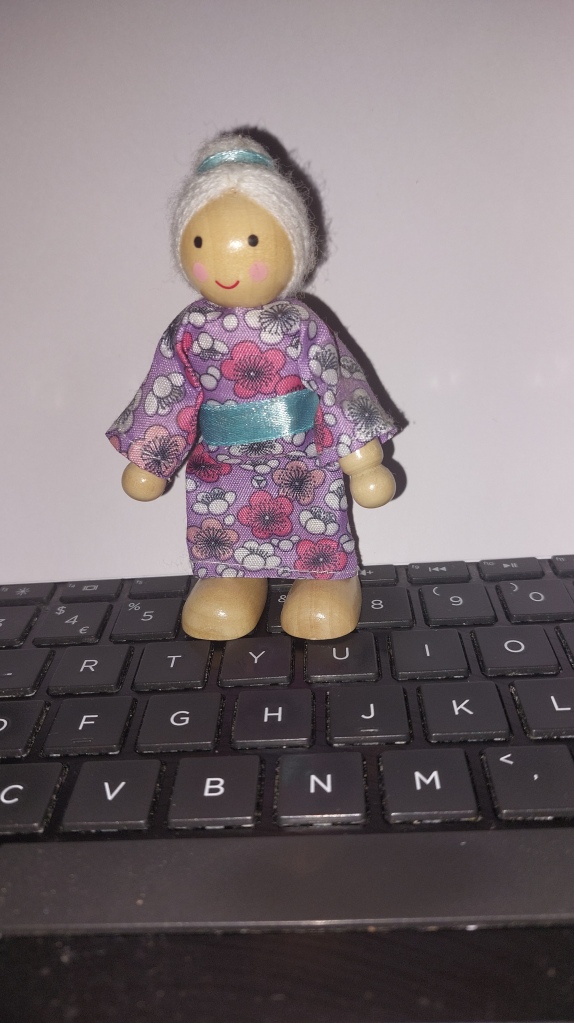
Little old lady? Not me!

Not Entirely Retiring!

I don’t feel remotely like a little old lady! I hope I’ll continue as a postdoctoral researcher in my present institution, but I’m also keeping my eyes open for any other part-time opportunities that I could pursue alongside that. ’Actively looking’, is the phrase, I think.

With a colleague in another institution, we’re cautiously planning a new research idea. And I also have strands of research that I commenced for my book, but hope to pursue in greater depth once this book is safely further along the publication process. Watch this space.

Unexpected Blessings

‘I was talking’, said a colleague, ‘to someone who found a stash of an elderly relative’s music ….’

Now, you’ve possibly picked up on my mixed feelings about donations. Grateful, curious, but also sometimes experiencing a sinking feeling when I realise that a recently donated bagful of music really can’t be added to the library stock. We welcome music if it’s historically important, or a serviceable copy of core repertoire. However, the bottom line is that we want our musicians to use up-to-date or at least respectable standard editions, and a lot of old music is neither historically important nor serviceable core repertoire.

So today, I cautiously asked what kind of music it was?

Sol-Fa.

Postcard from eBay – school and date unidentified!

How often have I sighed at that word? Our students don’t use old Sol-Fa notation. It fell out of use by the mid-1960s, and ‘modern’ or avant-garde classical music never made it into Sol-Fa; the system doesn’t lend itself to harmonically and rhythmically more adventurous music. But today was different, because my own research has meant my spending quite a bit of time finding out more about the use of Sol-Fa in elementary music education. And to cut a long story short, I am very much looking forward to seeing this music. I now know what I should be looking out for, from the perspective of ‘my’ Scottish music publishers. A few tantalising snaps of this donation have really whetted my scholarly appetite. What will I find? How will it augment what I already know?

I can’t wait!

If you find Granny’s old Sol-Fa music in the attic, do give it more than a passing glance. See what the music is. See who published it, and where. (Scotland? England? Somewhere else?) Was it for children? Adults? A male-voice or ladies’ choir? Church? A municipal choir? A school or college? Is there a date on it? (You’ll be lucky! But you never know.) Is it part of a series?

What at first sight looks humdrum, mundane, and unusable can sometimes prove to be a fascinating piece of a musical history jigsaw-puzzle. And strangely enough, you don’t actually have to sing from it, to learn more of that history – a close inspection tells so much.

Generous to a Fault! Referencing Advice

It was necessary! So I took to the library blog and wrote this …

Today’s library blog post!

Thoughts on Sharing and Generosity

I woke at 4 am again today. Could I get back to sleep? No.  As I rode into town on the bus,  I reflected that many of my wakeful thoughts had revolved around scholarly sharing. My mind seemed to bring out a series of issues, examining them one by one.

Tell me Everything

The breathless, ‘Tell me all you know’? Flattering, endearing, and with a piquant irony, considering one of our academic colleagues asked, more than two decades ago, ‘what does a librarian want with a PhD, anyway?’  Indeed, it was around that time that I overheard two graduate librarians opining that librarians don’t actually need degrees at all.  Another academic told a colleague that they were ‘only a librarian.’ (Postscript. That librarian subsequently went on getting postgraduate qualifications too!)

So it’s nice that, as the postdoctoral librarian approaches retirement, she is acknowledged to be possessed of Useful Knowledge. Even if it’s scholarly knowledge, which now sits in books on the library shelves. 

Quote (Unattributed)

Then my thoughts turned to the individuals whom I  would characterise as academic vacuum cleaners, noting your pearls of wisdom and later quoting them, unattributed. I know it’s good to share, but it leaves a bitter taste when your sharing is taken advantage of, whether it’s scholarly research or professional assistance.  On the other hand, if we acknowledge help given, it reflects well on both the sharer and the sharee! 

The problem is that I’m a librarian AND a scholar. And as librarians, we’re accustomed to sharing. I sometimes find it hard to decide where a line has been crossed.

I Can’t. Please Can You …?

Similarly, we librarians share our expertise about referencing, but there’s perhaps a subtle difference between our, ‘this is how you reference’ advice, which I gladly and willingly do all the time – and, ‘can you sort my references?’  As a scholar, I don’t ghost-write articles for publication.  Should I, as a librarian, ghost-format references?  Would I be colluding in giving the impression that the author has done a superb job with all that technical detail?! Or do other librarians do this without a qualm? I just don’t know what’s the norm here.

This is Not a Question, But

There are also times when sharing is not so good, though.  An interrupted talk where anecdotes are shared, uninvited, whilst you’re in mid-flow.  Or ‘Questions’ afterwards, that are not questions so much as demonstrations of knowledge. 

Worth a Try!

And best of all, requests for sharing that simply overstep the mark!  Now you’re wondering what I mean, aren’t you?!  Well, you won’t believe this one.

I was expecting a research question, in one particular email that I received a while ago.  But that wasn’t what was being requested, on this occasion.

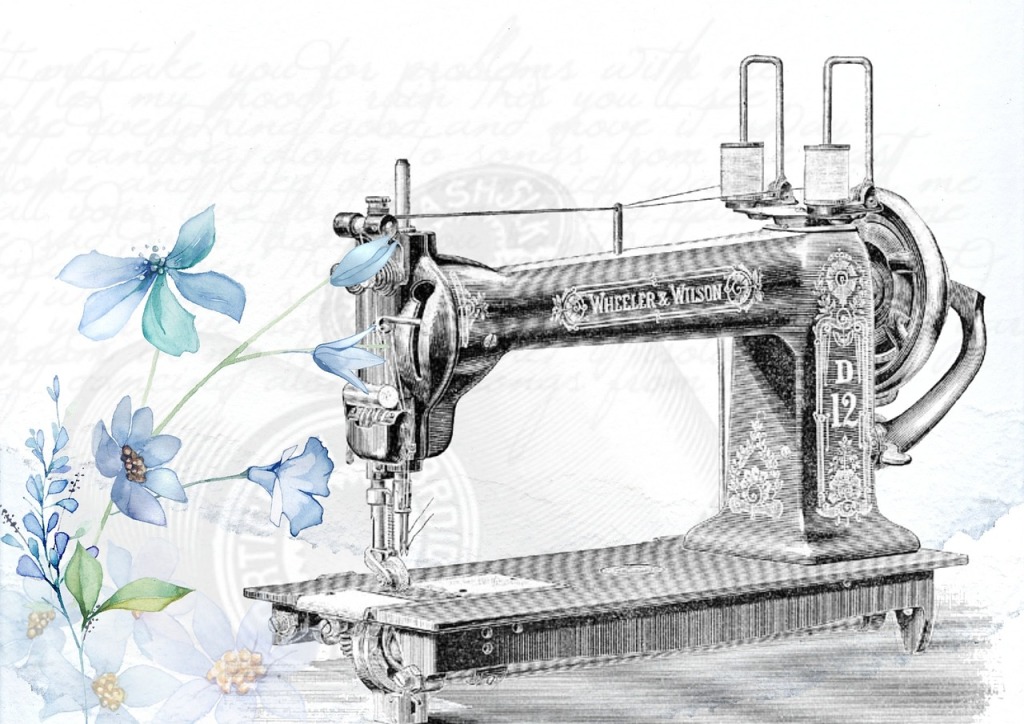
‘You have a sewing machine, don’t you?  Can you show me how to sew curtains?’ 

[Meaning, ‘Can you sew them for me …?’]

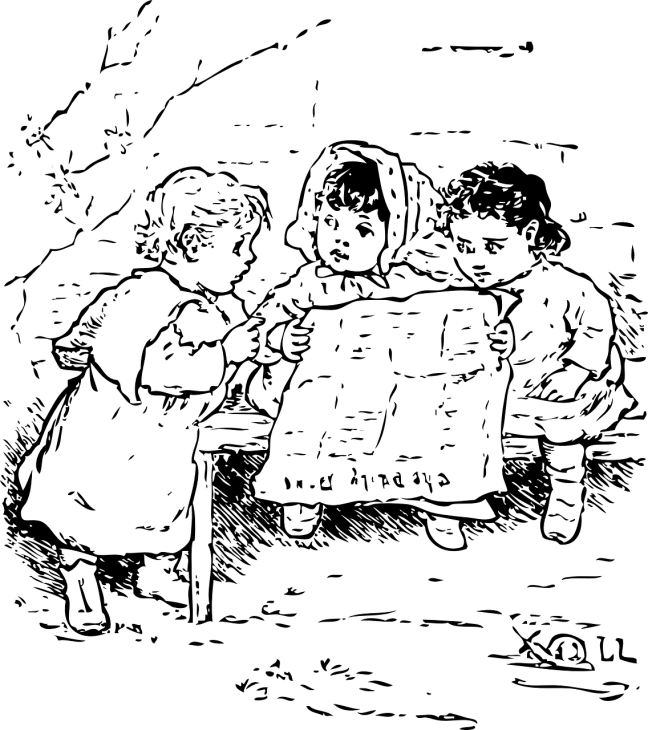
Clker-Free-Vector Images from Pixabay

The Doctor doesn’t have time to sew other scholars’ curtains. Helpful, I am, but not a mug!

Meanwhile, back in the Whittaker Library – a Catalogue Entry

One day, when I’ve retired from librarianship, all that will be left to show for my 36 years here will be the books and music on the shelves – and their catalogue records. Naturally, I made sure RCS has a copy of Mozart Allan and Jack Fletcher’s The Glories of Scotland in Picture and Song. Click on the title to see how I’ve catalogued it!

I think you’ll agree I’ve managed to insert enough hints as to why I think it’s significant. There’s a book chapter coming out in an essay collection from the Centre for Printing History and Culture at Birmingham City University, so there will be more to read in due course.

Why all the Fuss about Referencing?

I blogged for the library this morning. It’ll hopefully be of use to our new students 🙂 – you can read the text below.

https://whittakerlive.wordpress.com/2023/10/16/why-all-the-fuss-about-referencing/

You turn up to start a new university course, all ready to elevate your ukulele* performance to the highest possible level … and suddenly, you’re being told about referencing and citation, catalogue searching and note-taking, and you have a written assignment which terrifies the life out of you? How have things got so serious, so soon?

As you’ll have been told, it is very important that whoever marks your essay can see where you drew your information from. When you studied maths at school, your teachers probably told you to ‘show your workings’ (or some similar expression), right? Referencing is pretty much the same idea – they need to know how you arrived at your final argument, and which authorities informed your thinking. Referencing (some people call it citation) is how you show your workings in academia.

AI generated image: Image by qiaominxu 橋茗旭 from Pixabay

You’ll also have been told about the Turnitin software which can determine whether your submission is likely to be all your own work, or cut and pasted from various other sources without acknowledgement. Academic honesty is all-important. Using other folks’ work is not acceptable – and using AI such at Chat GPT is equally frowned upon.

‘Chat GPT can’t do referencing’

(said a colleague from another institution, in discussion)

Is this correct? In the spirit of scientific discovery, we decided to put this to the test. We wrote an ‘essay’ (well, a couple of paragraphs) containing some genuine references, but also some downright lies about pizza and curry! then asked Chat GPT to write a piece of prose with a bibliography.

  • Chat GP entered into the spirit of the thing, and made up some titles in line with the nonsense we’d written!

Well, this wouldn’t be much good in an essay, would it? Made up titles? No publisher details? No, thanks. Perhaps, we thought, we had been wrong to TELL Chat GPT we were only playing with it.

  • Removing the dates, we left incomplete references. Chat GPT completed every reference with ‘(year of publication and the title are not provided).’ That wasn’t much use either.

How could we get Chat GPT to produce a Harvard reference? Indeed, any decent reference?

  • We tried a third time. This time, we left the imaginary essay out of it, and just gave Chat GPT five authors’ names and the years of their genuine publications.

Chat GPT was stumped! However, it was scrupulously polite in admitting it:-

‘I apologize, but I couldn’t find specific references or sources for the provided citations. It’s possible that these references do not exist or that they are not widely known in the academic or literary world. If you have any other questions or need assistance with different topics, please feel free to ask.’

Chat GPT, 16 October 2023

So, it’s true. You can’t get Chat GPT to write a Harvard reference! It might be tempting to try to use technology to help write your essay, but you’re seriously better off doing the work – and the referencing – yourself! You learn, your tutor sees that you’ve done the work, and everyone is happy. (NB The library can help you find resources to get your referencing right. It sounds complicated, but it’s really quite easy to get the hang of it. Look for the Ask a Librarian link on the catalogue home-page.)

*No offence intended to ukulele players!

All Quiet on the Western [Research] Front

If I haven’t been rapturously blogging from St Andrews this week, it’s because I’ve been confined to the West of Scotland and the staff side of a library. My ring-fenced research time found a gap in the fence, and no research has been done. But I’ve conducted a lot of library tours! Discussed historically underrepresented composers, and ordered some more music by women composers (all enjoyable tasks). Weeded some books (rather more mundane). But it has felt like a very long week – the first time I’ve been in the library Monday to Friday, since 2012. Why now?, you might ask. A fair question!

On the plus side, I’ll recoup the missing time in October, and (better still) this situation won’t arise again, because next Autumn I shall have retired from librarianship.

But NOT from research, certainly not. I truly can’t wait to settle into having just one professional role!

Image by Julia Schwab from Pixabay

Great Expectations (not invariably fulfilled!)

It has been an interesting week in the library.

At the start of the week, I had a query from a colleague. I pointed out some possible books, and then shared the query on a couple of mailing lists. The next three days saw an absolute deluge of emailed replies.

I went to St Andrews, did my research (mine, nothing to do with the query), came back and found some more responses. I have never had so many replies. Well, it was an intriguing query, to be sure. The scholarly community proved itself amazingly generous, suggesting people to contact and resources to consider. I passed them on gratefully!

Today, at the end of the week, came a completely different query, which should have played to my own specialisms. Could I find anything? I’m afraid not! It would have been nice to have pointed to useful resources, but there was really nothing to point to. It seemed ironic that I was asked because of my expertise, but this time the well was dry!

Worse still, I didn’t want to risk being quoted speculating, when I had nothing to offer. It wouldn’t do my reputation any good at all!

I replied thoughtfully, but carefully. I do hope it won’t be disappointing!

I suppose you win some, you lose some …

‘Holiday’?

Today is officially the end of my annual leave. I drove to Cambridge so I can attend IAML Congress tomorrow. It feels as though I have been off work for ages, but a holiday it really was not.

I wake up thinking about unsatisfactory paragraphs. I dream of inconsequential details that will have to be changed. I had a couple of restful days in Norfolk, but even those were disturbed by nocturnal thoughts of untraceable bibliographical details and diurnal anxious thoughts about driving to Cambridge and finding my accommodation – because I have no sense of direction whatsoever!

So, here I am. I, my car and Don the Congress mascot, all safely in the right place, proof that motorway signs marked ‘to London’ can actually be correct in the right circumstances, so long as you get off when Google says so!

And tomorrow I can just be a delegate – no papers to give. I have avoided committing myself to writing anything else that would hinder The Book this year!