Dr Karen McAulay explores the history of Scottish music collecting, publishing and national identity from the 18th to 20th centuries. Research Fellow at Royal Conservatoire of Scotland, author of two Routledge monographs.
A couple of weeks ago, I mentioned that my RMA Research Chronicle article was now available online as open access. Today, it’s actually in the published issue. Receiving this email is a great start to the day:-
“your article, ‘Women Pursuing Musical Careers: Finding Opportunities in Late Nineteenth- and Early Twentieth-Century Scottish Music Publishing Circles’, has now been published in Royal Musical Association Research Chronicle! You can view your article at https://doi.org/10.1017/rrc.2025.10009 “
This is an Open Access article, distributed under the terms of the Creative Commons Attribution licence (http://creativecommons.org/licenses/by/4.0), which permits unrestricted re-use, distribution and reproduction, provided the original article is properly cited.
Writing about Tourism
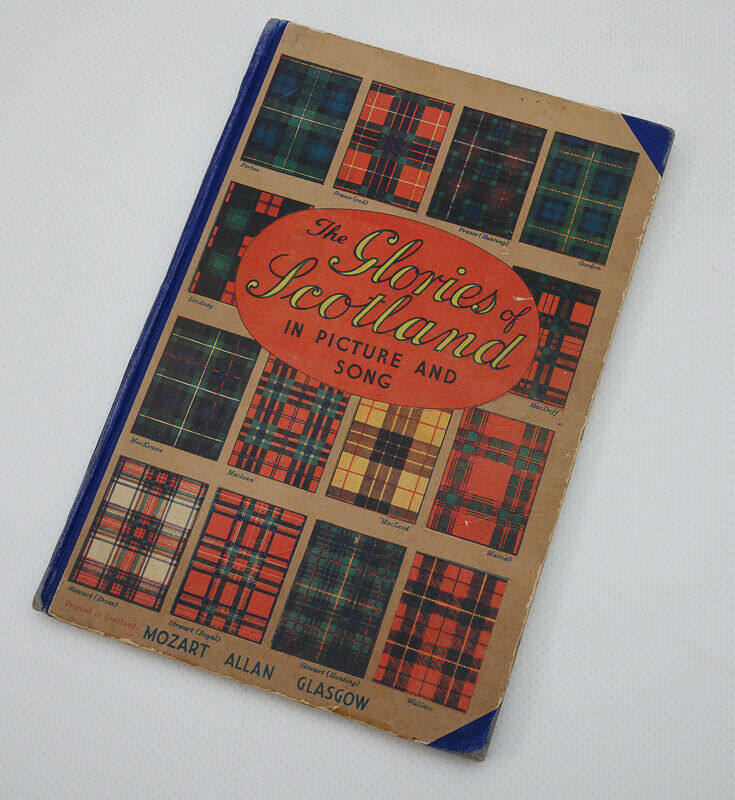
What’s this?, I hear you ask. Why would a musicologist write about tourism? Well, it’s like this: one of the song book titles that I explored in last year’s monograph, The Glories of Scotland, really deserved more space than I could give it in a monograph devoted to a nation’s music publishing. However, the opportunity came up to contribute a chapter to a Peter Lang Publication, Print and Tourism: Travel-Related Publications from the Sixteenth to the Twentieth Century, edited by Catherine Armstrong and Elaine Jackson.
Today, I received the final proofs, which means that the book itself can’t be very far away. I really enjoyed writing this chapter – you could say that it’s decidedly more about publishing history, and tourism, than conventional musicology – and I really look forward to it actually being published.
My chapter (19 pages):-
‘The Glories of Scotland in Picture and Song’: Jumping on the Festival of Britain Bandwagon?’
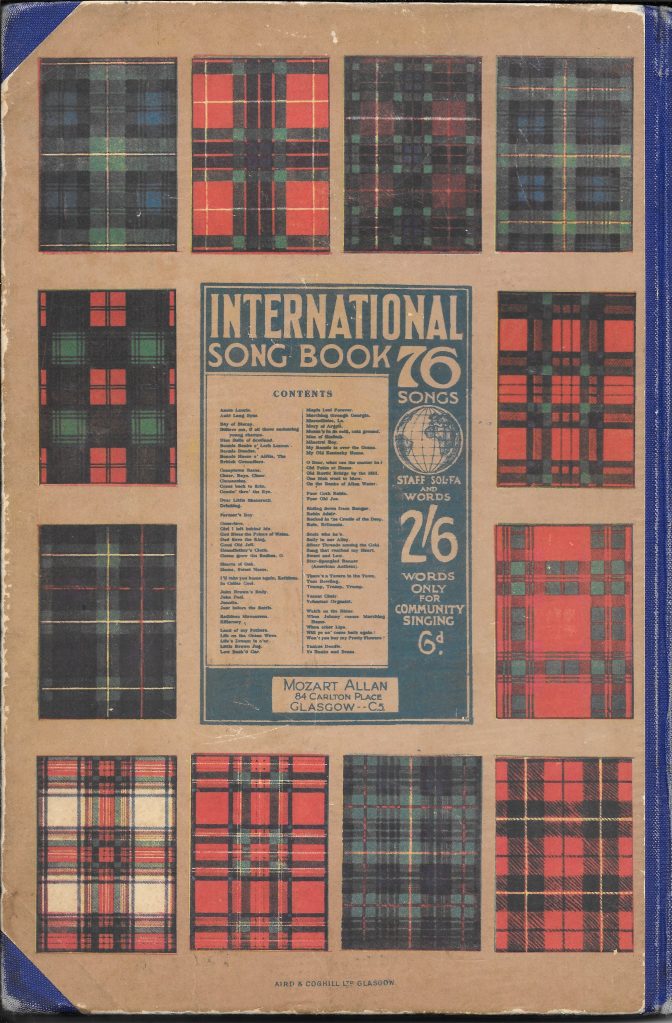
The Glories of Scotland – Mozart Allan’s souvenir songbookBack cover of The Glories of Scotland
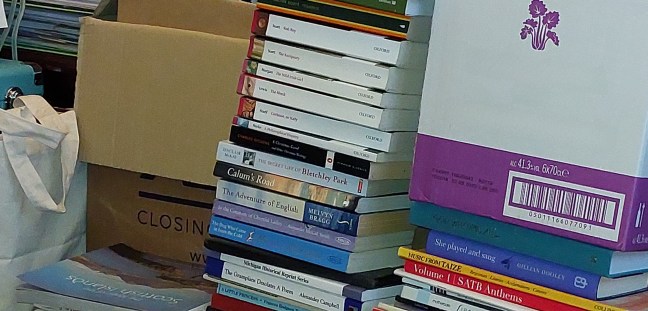
I forgot to add .. the decorating delays are apparently our fault for having so much stuff. It’s my books and music in the dining room that the painter’s alluding to. (He has no idea about Himself’s collection, many of which were originally secretly delivered to his workplace so that I wouldn’t see them, and are now scattered in various parts of the house.)
Last November, one of the electricians also innocently asked why I had so many books. I answered lamely, ‘Well, so I could write these two.’ Which didn’t seem terribly convincing to me, but seemed to satisfy him!
Scholar
Former librarian
Organist
Writes books about music books …
I don’t feel guilty about the books, but I really must reduce the collection before my family have to clear the house once I’m gone! Some are going on eBay, others to the charity shop.
It would be remiss of me not to point out that Routledge’s Black Friday sale makes the e-book version of my book very affordable! (Maybe someone might even buy you it for Christmas?).
Those preferring to read a hard copy might point out to their library that there’s no time like the present…
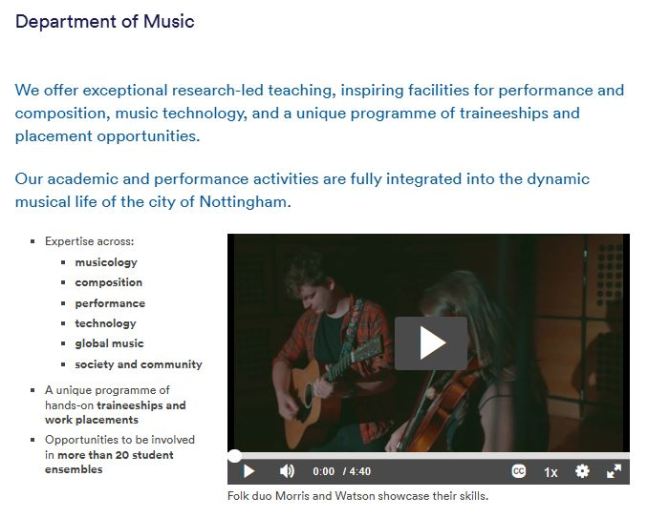
Music graduates and linguists across the UK (and beyond) will have been aghast to learn that the University of Nottingham is suspending its Music and Modern Languages degree courses. Allowing present students to complete their courses, that is, but not taking any new entrants.
Now, I’m not a Nottingham graduate – I’ve no connection with the University at all (apart from having declined a graduate library traineeship back in 1982, for reasons entirely unconnected with Nottingham University Library). Nonetheless, I know, after my own academic music-related career, that the department has an excellent name. I also know – since I have a BA (Hons), MA and PhD in Music – the value of a music degree.
The decision to suspend teaching music seems to me to be a very retrograde step. It is true that students can still be offered the chance to sing in choirs, play in orchestras and so on, but recreational music, at however high a level, is hardly the same as academic study. To suggest that ‘they can still make music’, puts me in mind of 1920s and 1930s pedagogy, where music was often considered a ‘practical’ subject like sewing, art or woodwork, rather than an academic discipline. Don’t get me wrong – I am certainly not denigrating these subjects. Indeed, if I’m not studying or making music, I can usually be found with a needle and thread. I ama creative individual. However, I wish to make the point that even ‘practical’ creative subjects can be studied in a scholarly sense.
So, since I’m now semi-retired, what can I do to help? Arguably, not a lot, but I can use my voice to make a bit more noise. Let me outline what I studied in my own music degrees, decades ago; and then I’ll share how the knowledge I gained has been put to use in my subsequent career. Nottingham’s Music Department homepage offers expertise across: musicology, performance, composition, technology, global music and society and community – a similar, but updated list of what I studied in Durham, Exeter and Glasgow.
My Own Undergraduate Music Experience
Score-reading
Harmony & counterpoint
Aural training
Music history (musicology)
Music analysis
Ethnomusicology (not global; I studied Javanese Gamelan music)
Electronic Music
Composition
Writing about music
Acoustics
My own Masters and PhD Music Journey
Music history (musicology)
Analysis
Cultural and social history
Writing about music
I studied librarianship after my first, unfinished PhD, spending my career as a music librarian, but I returned to research mid-career and thereafter combined librarianship and research. I didn’t become a teacher, which was one of the traditional destinations for music graduates; neither could I find a way into arts administration. So, music librarianship seemed a sensible choice. I worked briefly in the public library sector, and then in academic librarianship. But ask around, and you’ll find music graduates in all sorts of careers.
What did I gain from my music degrees? Well, as a music librarian with appropriate academic music qualifications, I was very much a subject specialist, and was appreciated as such. Simply being in a choir or student orchestra, without the academic study, wouldn’t have made me as knowledgeable.
The Value of Knowing Your Subject: the Evidence
Many thanks for all your efforts in finding all this music!
I showed the class the print-out from this CD record sleeve, which was very relevant
Thanks very much for your enlightening and entertaining contribution yesterday.
A very thorough and impressive piece of research
Thanks! HOW do you do it? I can hardly contain my exuberance. When I’m running the planet, you’ll get the money your worth and 3 extra vacation days. Promise!
Just wanted to thank you so v much for all your help yesterday. It was a great help to come in and find all the music ready
Thanks for your efforts – they are very much appreciated.
[they said] the Library was a great resource: [they had] come in to find four fairly obscure things and we had (and helped find!) all four.
Will mention your wonderful help in the programme notes! 🙂
This very useful, thank you!
And as an organist and choir director? I use my skills on a weekly basis: arranging music; transposing it; writing it; choral training; and planning/developing repertoire.
Lastly, as a music postdoctoral fellow? Enough said. I wouldn’t be researching at a postdoctoral level if I hadn’t studied it at university first. My research has often focused on the region where I live, but also on music in education and society.
It seems to me a crying shame to cut music degrees, denying students future opportunities, and (presumably) cutting staff with immeasurable expertise in their subject. The city of Nottingham, too, will lose out from the expertise that is lost to the region.
Modern languages are every bit as important. How can you have a university that doesn’t teach modern languages? You want translators? Teachers? People who can conduct business, or write books, or manuals, in a language other than English? Or careers where language graduates bring their own aptitudes? (A friend of mine went into computing, because their linguistic skills apparently made them eminently suitable for that path.) So you need modern language graduates!
My late music-teaching, comprehensive school head of modern languages father will be turning in his grave!
At Tuesday’s Women who Dared book launch, mention was made of the Wikipedia ‘Women in Red’ project, to which I once attempted to contribute. It’s a valuable project; there’s no denying far too few women are represented in Wikipedia.
I got nowhere with my own attempt, as I was the only person who had researched and written about ‘my’ Elizabeth Lambert (married name Williams), so I couldn’t provide the requisite references by respectable authors. She wasn’t ‘daring’, but she definitely made a worthwhile contribution to St Andrews University Library, in cataloguing their legal deposit music so borrowers knew what was available to borrow. (Her other private interests were interesting, too. She was an acknowledged expert in conchology.) I’m pleased to see she at least has a Wikidata entry now! Anyway, thwarted in my Wikipedia ambitions, I posted a biography on the present blog.
You might also find my article about St Andrews’ Copyright Collection of interest. Again, Miss Lambert gets several honorable mentions. And I found another posting that I’d forgotten all about, this time in 2021 for a University of Stirling research project. I might as well share details of these pieces, to get her a bit more exposure!
‘A Music Library for St Andrews: use of the University’s Copyright Music Collections, 1801-1849’, in Journal of the Edinburgh Bibliographical Society no.15 (2020), 13-33.
On LinkedIn, public-speaking coach Alex Merry recently posted these tips on making a great presentation. It occurs to me that some of these tips will be equally applicable to the Scottish song entertainment that I’m leading later this month.
Alex Merry’s Presentation Tips
In my case, it’s not a presentation at all – I just need to introduce the songs we’re singing. So it’s categorically not about me. But I do need to be lively and relatable. Start with a short sentence and a pause? I hadn’t thought of that, but it should be easy to factor in.
Fun? Oh, yes. I have a few ideas! 💡 Well, props, really. I’m going to need one of those big, reusable supermarket bags. And I have an abundance of stories, so that’s all right.
My only problem is this: I’m a bit embarrassed about my Englishness. I’ve lived in Scotland more than half my life. Scottish national music is my specialism, and I’m secure in my subject – but this is a fun entertainment, not a demonstration of knowledge, and my accent is all wrong. So … do I bring attention to it jokingly, or put it to the back of my mind? My personal view is that you should never draw attention to your weaknesses. What would you do? Stuart Chater on LinkedIn makes a good argument for NOT being ashamed of your accent.
And the song I’m going to sing? (It wasn’t my idea, someone asked me.) It’s short. It’s within my vocal range. But I can no more sound Scottish than fly!
Remember un-conferences? They were popular a few years ago.
Well, now I’m co-ordinating a Scottish song event, but it’s for entertainment, and not remotely connected with my research. Does that make it an ‘un-research’ event? Anything I might say about these songs will have been learned during my research career. (I grew up in England – it wasn’t my childhood repertoire.)
Community Singing
It’s interesting, all the same. For a start, I am interested in community singing in an early-twentieth-century sense, but my own practical experience of secular community singing is limited. The forthcoming gig may well trigger new trains of thought. (Let’s discount leading congregational singing from the organ, which I’ve done for decades.)
Repertoire
The preparation has been interesting, too. We have collectively chosen the repertoire: some old, some from the 1950s and 60s, and some that our children would have learnt at school. It bears out my findings that the repertoire of favourite Scottish songs does change with every generation.
We’re also channelling Sir Hugh Roberton and his Orpheus Singers for a couple of choral items, but an even earlier choral arrangement felt too dated. You have to know about the west of Scotland’s intimate acquaintance with Roberton’s repertoire to appreciate why those settings go down so well to this day. Somehow, his particular brand of close SATB singing has endured in a nostalgic kind of way, where earlier settings have fallen by the wayside.
Authenticity
It gets better. We’ve debated different versions of the lyrics, and odd discrepancies in tunes. In other words, we re-enacted all the chatter about authenticity and correct versions that has been rolling on for, shall we say, 250 years or more?
And the Squeezeboxes?
Accordion
I debated with myself whether to go all authentic with an accordion accompaniment in appropriate songs, but I don’t think I’m that brave. Singing a solo is brave. A couple of concertina tunes is positively reckless. But the accordion is probably getting left at home. (Although, if you listen carefully between now and then, you might catch me attempting a few strains of ‘The Song of the Clyde’ in private … Jimmy Shand I’m certainly not!)
Despite some depressing occurrences whilst I wasn’t working last week, there was plenty of music to brighten my mood.
I have mentioned before that working at the Conservatoire brings the advantage of lots of concerts to choose from. Lunchtime recitals suit me, from a personal point of view (it saves trying to rush home for a family evening meal and then back out again), but they aren’t ideal from an operational point of view! Anyway, I planned to attend lunchtime recitals on Monday and Friday.
However, I was too late for the Monday recital. The doors closed promptly at 1 pm. I wasn’t inside.
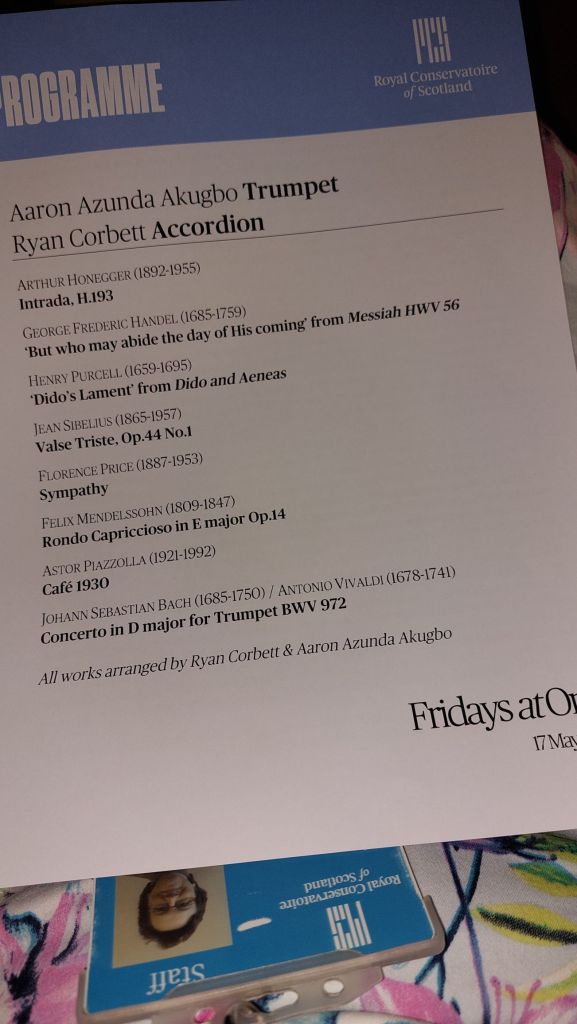
So that left three concerts. I made it to the Friday recital – trumpet and accordion, absolutely fantastic. Feeling a bit like Cinderella rushing to beat the clock, I made it back to my desk for 2 pm, so all was well. (There are aspects of my impending semi-retirement that have considerable appeal!)
Friday – Trumpet and Accordion
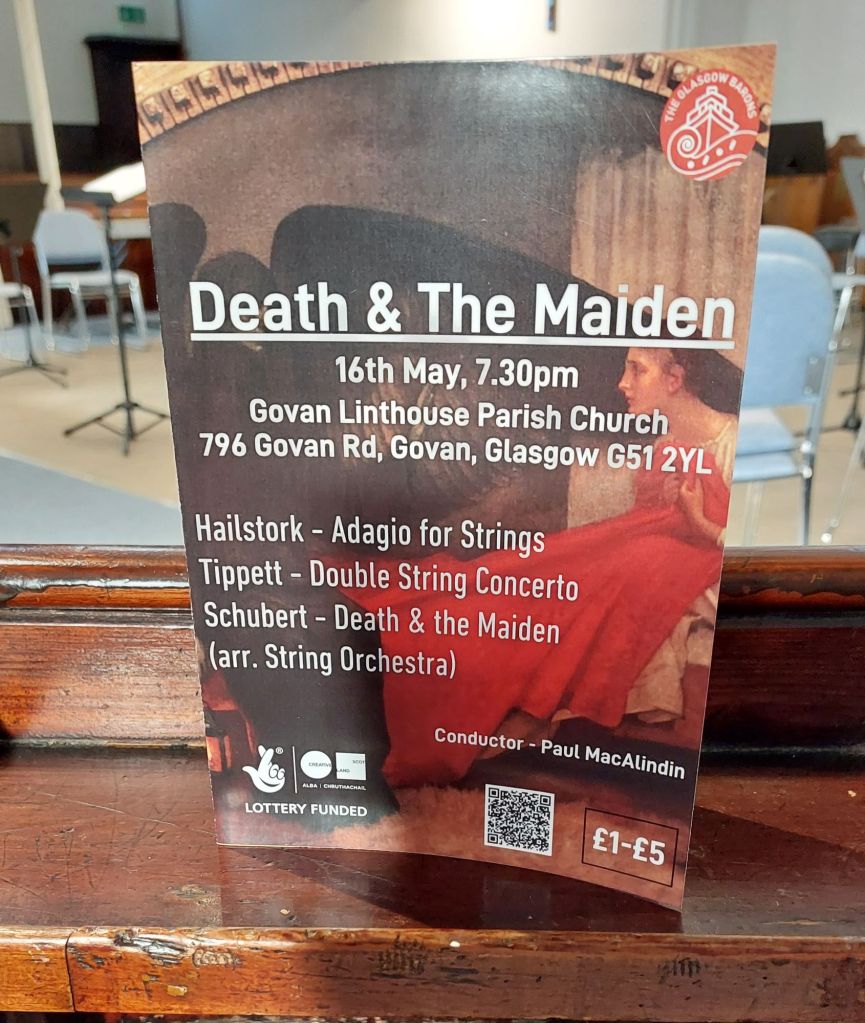
The Thursday evening concert was in my home neighbourhood, on a day when I was working from home. I discovered that the Glasgow Barons were doing an orchestral concert. The first piece was by Hailstork, a BIPOC composer whose name I had literally just encountered that week whilst sourcing music repertoire: how could I resist? And Schubert’s ‘Death and the Maiden’ quartet arranged for string orchestra was sure to be enjoyable. The Tippett, though? I think I need to gain familiarity with it, to appreciate it fully. It probably grows on one.
It was a glorious evening, even before the concert started. I met someone I knew, so I even had company to sit beside me.
And then this afternoon, we went to a Bearsden Choir concert in Glasgow City Halls. Arvo Part’s Salve Regina, a new work by Swann, and Puccini’s operatic Messa di Gloria. I sang that in Exeter University Choir back in 1980-2, and I recognised it instantly. It was a great concert; the choir goes from strength to strength, and the two soloists (an RCS alumnus and a student, both on the opera course) were excellent.
Bearsden Choir concert
And here we are, Monday again. Now, the big question is whether to try to get to today’s lunchtime recital! We’ll see…
I have just contributed a blogpost to a research project blog that is hosted by the University and Stirling. The project is called, Books and Borrowing 1750-1830: an Analysis of Scottish Borrowing Records. There are a large number of participating partners – visit this page to find out more.
I revisited Miss Elizabeth Lambert (later Mrs Williams), Mrs Bertram and her daughters, and Principal Playfair’s daughter, Janet. Here’s the blogpost:-












 Karen McAulay, Musicologist