University of Nottingham, you cannot drop Music and Modern Languages!

Nottingham University view from Pixabay

The screenshot below, is of the University of Nottingham Music Department homepage. A flourishing department, which sadly hit the news for all the wrong reasons a couple of days ago.
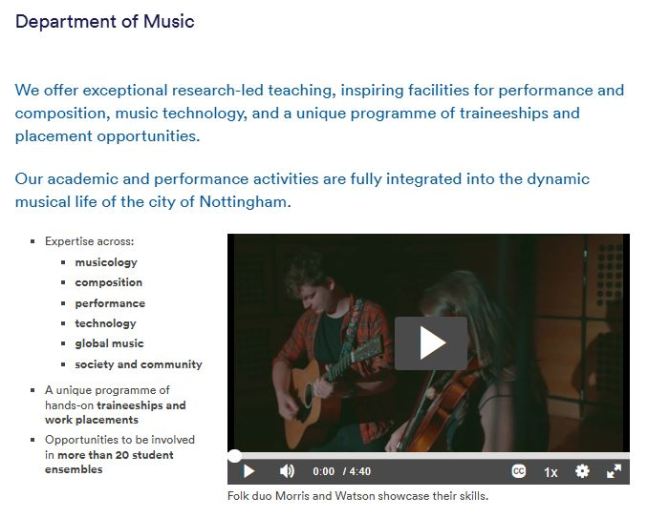
Snip from Nottingham University Music Department homepage

BBC News:- University to suspend music and language courses

Music graduates and linguists across the UK (and beyond) will have been aghast to learn that the University of Nottingham is suspending its Music and Modern Languages degree courses. Allowing present students to complete their courses, that is, but not taking any new entrants.

Now, I’m not a Nottingham graduate – I’ve no connection with the University at all (apart from having declined a graduate library traineeship back in 1982, for reasons entirely unconnected with Nottingham University Library). Nonetheless, I know, after my own academic music-related career, that the department has an excellent name. I also know – since I have a BA (Hons), MA and PhD in Music – the value of a music degree.

The decision to suspend teaching music seems to me to be a very retrograde step. It is true that students can still be offered the chance to sing in choirs, play in orchestras and so on, but recreational music, at however high a level, is hardly the same as academic study. To suggest that ‘they can still make music’, puts me in mind of 1920s and 1930s pedagogy, where music was often considered a ‘practical’ subject like sewing, art or woodwork, rather than an academic discipline. Don’t get me wrong – I am certainly not denigrating these subjects. Indeed, if I’m not studying or making music, I can usually be found with a needle and thread. I am a creative individual. However, I wish to make the point that even ‘practical’ creative subjects can be studied in a scholarly sense.

So, since I’m now semi-retired, what can I do to help? Arguably, not a lot, but I can use my voice to make a bit more noise. Let me outline what I studied in my own music degrees, decades ago; and then I’ll share how the knowledge I gained has been put to use in my subsequent career. Nottingham’s Music Department homepage offers expertise across: musicology, performance, composition, technology, global music and society and community – a similar, but updated list of what I studied in Durham, Exeter and Glasgow.

My Own Undergraduate Music Experience

  • Score-reading
  • Harmony & counterpoint
  • Aural training
  • Music history (musicology)
  • Music analysis
  • Ethnomusicology (not global; I studied Javanese Gamelan music)
  • Electronic Music
  • Composition
  • Writing about music
  • Acoustics

My own Masters and PhD Music Journey

  • Music history (musicology)
  • Analysis
  • Cultural and social history
  • Writing about music

I studied librarianship after my first, unfinished PhD, spending my career as a music librarian, but I returned to research mid-career and thereafter combined librarianship and research. I didn’t become a teacher, which was one of the traditional destinations for music graduates; neither could I find a way into arts administration. So, music librarianship seemed a sensible choice.  I worked briefly in the public library sector,  and then in academic librarianship. But ask around, and you’ll find music graduates in all sorts of careers.

What did I gain from my music degrees? Well, as a music librarian with appropriate academic music qualifications, I was very much a subject specialist, and was appreciated as such. Simply being in a choir or student orchestra, without the academic study, wouldn’t have made me as knowledgeable.

The Value of Knowing Your Subject: the Evidence

  • Many thanks for all your efforts in finding all this music!
  • I showed the class the print-out from this CD record sleeve, which was very relevant
  • Thanks very much for your enlightening and entertaining contribution yesterday.
  • A very thorough and impressive piece of research
  • Thanks! HOW do you do it?  I can hardly contain my exuberance.  When I’m running the planet, you’ll get the money your worth and  3 extra vacation days.  Promise!
  • Just wanted to thank you so v much for all your help yesterday. It was a great help to come in and find all the music ready
  • Thanks for your efforts – they are very much appreciated.
  • [they said] the Library was a great resource: [they had] come in to find four fairly obscure things and we had (and helped find!) all four.
  • Will mention your wonderful help in the programme notes! 🙂
  • This very useful, thank you! 

And as an organist and choir director? I use my skills on a weekly basis: arranging music; transposing it; writing it; choral training; and planning/developing repertoire.

Lastly, as a music postdoctoral fellow? Enough said. I wouldn’t be researching at a postdoctoral level if I hadn’t studied it at university first.  My research has often focused on the region where I live, but also on music in education and society.

It seems to me a crying shame to cut music degrees, denying students future opportunities, and (presumably) cutting staff with immeasurable expertise in their subject. The city of Nottingham, too, will lose out from the expertise that is lost to the region.

Modern languages are every bit as important. How can you have a university that doesn’t teach modern languages?  You want translators? Teachers? People who can conduct business, or write books, or manuals, in a language other than English? Or careers where language graduates bring their own aptitudes? (A friend of mine went into computing, because their linguistic skills apparently made them eminently suitable for that path.) So you need modern language graduates!

My late music-teaching, comprehensive school head of modern languages father will be turning in his grave!

Take Action

Change.org Stop the suspension of undergraduate music courses at The University of Nottingham

Change.org Stop the removal of Modern Languages courses at the University of Nottingham!

Image by David Reed from Pixabay

Hello to All New Visitors! I’m a Research Fellow

I haven’t been posting much this summer, for personal reasons. So – after more than a week of total blog silence, imagine my surprise to find I have had hundreds and hundreds more visitors since yesterday. What’s happened?!

Even if it’s some kind of blip, it gives me the opportunity to introduce myself. I’m a postdoctoral research fellow at the Royal Conservatoire of Scotland and also, for a few weeks more, at IASH at the University of Edinburgh. I research all sorts of cool stuff (well, it’s cool to me) about Scottish music publishers, with a distinct interest in national song collections, and in early 20th century music education in Scotland.

My second book was published at the end of 2024:-

A Social History of Music-Making and Scottish National Identity: Scotland’s Printed Music, 1880-1951.

That might look like a strange date-range, but my previous book covered Scottish song-collecting up to the 1880s, so this kind of continues in a slightly different way from that point onwards. The 1951 cut-off date is because that was the year of the Festival of Britain. And it was also a good place to stop because I touched upon magic lanterns, gramophones and the wireless, but I really didn’t feel I was the right person to write about early television in Scotland! By stopping in 1951, I conveniently sidestepped early television. There are plenty of people more knowledgeable than me on that front.

My current Edinburgh research entails examining archival records of the Thomas Nelson publishing house, an old Edinburgh firm. The British side of this company has ceased trading – it’s an American firm now – but I’ve found plenty to interest me in the documents up the early 1950s. Education became their focus during the era I’m researching.  Whilst my book mostly covers publishers specialising in music, Thomas Nelson really only published music that would be used in schools – though they hoped a few titles would also attract the general public. (The problem being that if you mention ‘school’ or ‘classroom’ in a title, it will turn off the ordinary member of public looking at books in a bookshop!)

Will there be a third book? Possibly! I’m still pondering.  September is earmarked for concentrated thought about that!

If this sounds interesting, please do come back and visit this site again.

Musicology, and a Nerdy but Meaningful Spreadsheet

Musical notes cut out of old sheet music

How to Assess whether a Song Book was Aligned with Contemporary Tastes

There were once four books of Scottish songs in a mini-series: just under 100 songs, all told. They weren’t much advertised, and few copies are now extant.  If they were intended mainly for school use, then I need to know to what extent their contents were standard Scottish song repertoire for their day. (Each generation has its favourites, noticeably different from the previous ones.)

Now then, I spent a very long time indexing song books as a librarian; that library catalogue is now a reference resource in its own right.  Last night, I listed the contents of those four books, and next, I shall look each song up in our RCS library catalogue.  I’ll end up with two figures for each song:-

  1. How many times the song is listed altogether: a high figure means popularity over a long period.
  2. How many times the song is listed between 1930-1970: this will be a shorter range of numbers. If it’s as high as, say, five hits, then it was popular amongst quite a few compilers over that 40 years.  If it’s not in any other books between 1930-1970, then it’s either old-fashioned, or a more obscure ‘rarity’ from less well-known or very old collections. 

And THEN, I can look up the rare ones in the National Library of Scotland’s Digital Gallery. 

This is the only accurate way of ascertaining whether the contents themselves might have been off-putting to the very audiences that they were meant to attract. I hope that’s not the case, because the compilers were well-placed, indeed ideally-placed to know exactly what went down well with school children. Nonetheless, I want hard evidence, and comparing the repertoire with two significant sets of data – the RCS more standard books, and NLS rare books – seems to me a pretty good way of doing it.

Blogging Helps Clarify the Question

I enjoy writing this blog, because it helps me clarify in my mind what the big issues are that I am addressing. Writing for a wide audience, which may or may not have exactly the same scholarly interest in the topic as I do, is a good way of reminding myself to write accessibly, and hopefully interestingly, about the things which occupy my thoughts as I pursue my research. Do I succeed? You tell me!

Bibliographies, Lists

Am I a listophile?  I started the list to end all lists, on Saturday evening. (Yes, I know. Sad, isn’t it? It’s surely better than the Saturday night trips to the laundry in my student days, though.) I’m going through my book manuscript, tracking EVERY sheet music title that I’ve mentioned.

I should already have them in my epic Zotero bibliography, but for this exercise, I’m also checking off which chapters they appear in.  It could be handy when I’m indexing the book in due course. Not only that – if I encounter any date discrepancies, at least I will have the chance to put them right.

But have I created a Monster?

This, dear reader, truly is turning out to be a mega-list. I’m approaching the end of my trawl through Chapter 3 now, and the list is already quite lengthy. On the other hand, since I am likely to be the most knowledgeable authority about publications and publication dates for these particular Scottish publishers, there surely must be some value in this.

And – there are just a few ‘lost books’ amongst them. What could be nicer but more tantalising for a librarian/musicologist/book historian?

Going, Going…
Image by Mike Cuvelier from Pixabay

Image by tookapic from Pixabay

Two Worlds Meet

News of a potentially interesting archival item triggers an attack of insatiable curiosity. I must confess that the musicologist is somewhat more triggered than the custodian!

So, I have a few questions that need answered. Where and when was the original owner born? When did they leave Scotland? What did their Scottish ancestry/identity mean to them?

And most importantly, was ‘Scottish’ music a significant part of their repertoire?

As I mentioned in earlier posts, my librarianship is amply qualified, and embodies four decades of expertise, but musicology and research came first. The musicologist is buried beneath the outer librarian, and can’t help bubbling to the surface when an intriguing possibility presents itself!

If I can answer these initial questions satisfactorily, then I’ll want to explore further. I think you can guess what I need to do this morning!

AND LATER …

Well, the original owner called themselves Scottish. But they were born in England of a Scottish mother. Should I order their birth certificate? It’s not cheap, and could arrive too late to be useful. But … !

Networking is the Name of The Game

Pinterest British Library Spiders Web

The first network steering group meeting took place a couple of weeks ago, and in the past week more networking has taken place.  I’ve already blogged about Monday’s highly satisfactory meeting with retired University of Aberdeen music librarian Richard Turbet, in Norfolk.

Back in Glasgow, on Friday I attended a collaborators’ meeting for another new network, this time at the University of Glasgow: the Royal Society of Edinburgh-funded Romantic National Song Network.  It is spearheaded by Principal Investigator Professor Kirsteen McCue and Postdoctoral Research Assistant Dr Brianna Robertson-Kirkland.  My own doctoral research was about late 18th and 19th century Scottish song-collecting; I had examined collections both with and without accompaniments.  The new network focuses largely on collections with accompaniments, and certainly – like my own research – on collections with music, aka, “songs with their airs”.

Although the focus of my research has changed slightly since my PhD, I can see that the work I did on the borrowing of “national song” collections from St Andrews University library could be pertinent in the context of the RNSN.  I am also enthusiastic about the possibility of revisiting some of my favourite nineteenth century Scottish song collections!

Mrs Bertram’s Music Borrowing: Reading Between the Lines

Moving on to another research network, I recently wrote a blogpost for the EAERN (Eighteenth-century Arts Education Research Network) .  “Mrs Bertram’s Music Borrowing” occupied quite a few evening hours when I stumbled across a reference to her in my perusal of the early nineteenth-century St Andrews University borrowing records, and I was very pleased to have the opportunity to write it up in to a coherent piece for EAERN.  Yes, I’ve stretched a point – we’re talking about the long eighteenth-century here!  Nonetheless, I think it will demonstrate the value of interrogating archival records in minute detail.  After my many years spent cataloguing music materials for the Whittaker Library, my endurance levels for dealing with repetitive detail are exceptionally high!  It’s very rewarding when hours of capturing data can be turned into a human story about someone who lived, breathed and – most importantly – borrowed music from the library!  Do visit the EAERN website.

And lastly – some more networking news about the Claimed From Stationers’ Hall network.  We now have a Facebook page:- https://www.facebook.com/ClaimedStatHall/ – and I’ve also set up a Jiscmail list, so at some stage this week I’ll be sharing details with people whom I think might be interested in joining in the discussion about this fascinating, but often overlooked body of music.

Claiming Copyright in your Music

Music Copyright, the 18th/19th Century Way:

So you’re a composer in Regency Britain, say 1813, and you want to claim copyright inwriting-1043622_640 your music.  What do you do?  Well, if you have a publisher, they might submit it to Stationers’ Hall, where it would be registered.  They might not, though.  (Some publishers thought they’d have the best of both worlds – they’d print a copyright statement to the effect that it had been entered at Stationers’ Hall, but they wouldn’t actually bother doing so.)  In any event, it’s a bit hit or miss.
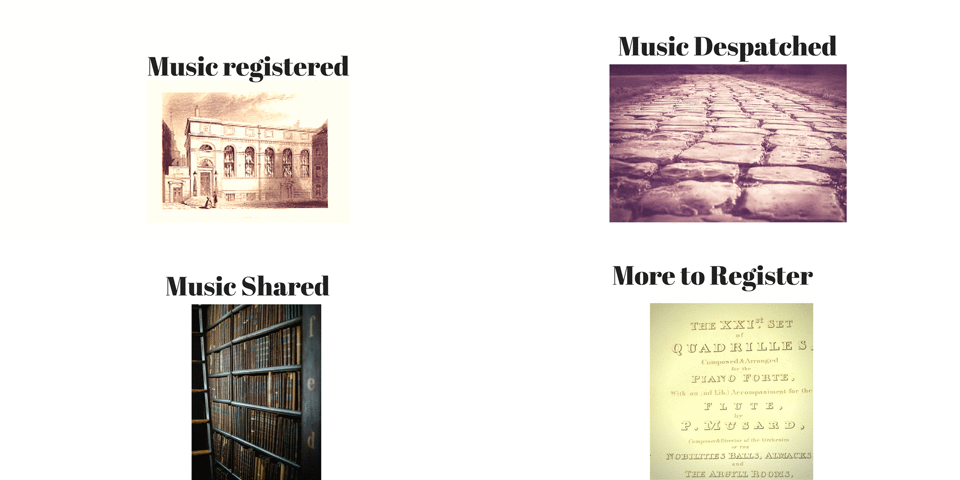
If you’re self-publishing, then you might consider it in your own interest to register your copyright in the work.  After all, by now it’s at least accepted that composers’ work did count as intellectual property and deserved protection.  That wasn’t necessarily the case in the mid-18th century!

Copies of music registered at Stationers’ Hall would then be sent to all the legal deposit libraries – the British Museum (which became the British Library), Sion College in London, the Universities of Oxford, Cambridge, Edinburgh, Glasgow, St Andrews, Aberdeen and Trinity College Dublin, the Advocates’ Library (which became the National Library of Scotland), and Kings’ Inns, also in Dublin.  Whether the music gets to all these places is also a bit hit or miss!  It’s not always sent, not always kept methodically upon arrival, and some libraries don’t want all this music anyway.

Tracing It Today

The Claimed from Stationers Hall project sets out to find out more about what happened to all the Stationers’ Hall music.  This is Week 2 of the network’s existence, so you’ve come in right at the start.  If you’re interested in early music publishing, library history, or the social, cultural side of the music borrowed from these libraries, then this network is right up your street.  Please follow this blog, and the Twitter @ClaimedStatHall, and do let us know if you’re working on anything in any way related to this repertoire!

St Andrews and now Aberdeen

Karen has spent some time exploring the rich archival resources at the University of St Andrews, where the Stationers’ Hall music was sifted through, much was catalogued, and then it was eagerly borrowed by a number of people via the professors’ library memberships.  We can trace what was received, find it in a fascinating handwritten catalogue, and even observe who borrowed what.

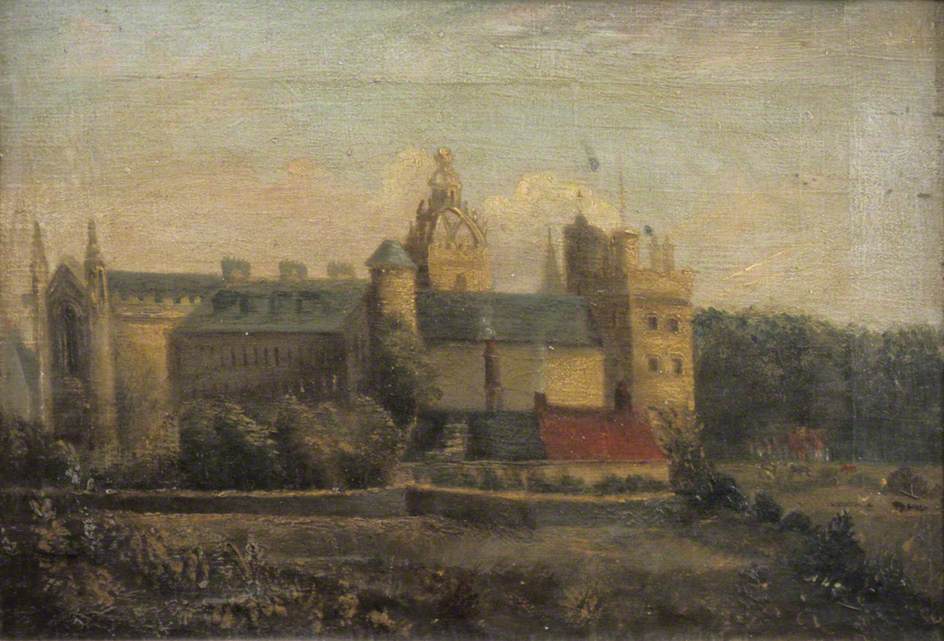
unknown artist; King's College, Aberdeen
King’s College, Aberdeen
unknown artist
University of Aberdeen

But what of the other libraries?  This week, the magnifying glass focused on the parallel collection in Aberdeen.  Work has been done on the documentation of what was received by the library in the 18th century by former librarian and research scholar Richard Turbet, and we can now see what was received in these early years, even if it doesn’t all survive today.  (Turbet, ‘Music Deposited by Stationers’ Hall at the Library of the University and King’s College of Aberdeen, 1753-96′, RMA Research Chronicle 30 (1997) pp.139-162)

Roughly half of the surviving copyright music is now in the online catalogue there: at the time of writing, 2062 of an approximate 4400 items in the entire bound Stationers Hall Music collection.  How was it used by the community in contemporary Aberdeen, though?  The next question is to establish where there are comparable loan records to those in St Andrews.  We do know, through Richard Turbet’s work, that there were concerns as to what had happened to the Stationers’ Hall music, in the Aberdeen Censor of 1826.  Intriguing!

Catalogues and Conundrums

The union catalogue of UK University and national libraries makes it easy to trace most things so long as they have been catalogued online.  However, differences in cataloguing mean that it’s not always as easy as you’d think.  Take Gesualdo Lanza’s Elements of Singing in the Italian and English Styles.

Different cataloguing approaches make it a little difficult to untangle, but if you search Lanza, Elements of Singing, you retrieve 16 entries, one of which is just a print portrait. It was published in 1813 – different catalogues have it self-published, published by Button and Whittaker, or indeed printed and sold by Chappell.  Around 1819-20, an abridged version appeared, again by Chappell (though the catalogue records don’t all state this the same way), and apparently again in 1826.

So there are at least two if not three basic versions, and you’d expect them each to appear in all the copyright libraries?  Think again!  Differently styled catalogue records reveal copies of the 1813 publication in Glasgow, St Andrews, Aberdeen, the British Library and Oxford Bodleian, and a copy in York, which was not a copyright library.  The other legal deposit libraries don’t have it, unless it’s still not catalogued online.  (That’s another interesting question.  Some pre-1801 material is definitely not yet catalogued – grant-funding for retro-conversion theoretically took care of (most of) the post 1801 material, just over a decade ago.)  In total, the two or three versions of 1813, 1820 and perhaps 1826 yield 16 entries in Copac, which equates to slightly more than 16 copies.

This Was Week 2 of the Project

Besides looking at work already done on the Aberdeen collection, this week has also entailed documentation of some of the conferences and other networks that touch upon the subject of Regency music or library history – see our Useful Links page, and do please contact us if there are others we’ve missed!  And of course, we’ve been networking.  We’ve tweeted and we’ve emailed, and we’re loving the responses we’ve received.  Keep in touch!

Today’s the Day! New Network, Claimed From Stationers’ Hall (early copyright music)

This is officially the start of the new AHRC-funded network, Claimed From Stationers Hall.  A fuller blogpost will appear within the next 24 hours.  Have a wander round the website, and please do get in touch if you’d like to be added to the email mailing list.  The topic is the music that was registered at Stationers’ Hall in the eighteenth and early nineteenth centuries up to 1836, so if you have an interest in music publishing of that era, or indeed anything involving British-published sheet music and its performance, or its documentation whether through conventional bibliographic means or in the context of digital humanities … then we’d love to hear from you!

 music history copyright legal deposit GIF

(Never let a musicologist near a gif! I promise to do better ….)