Dr Karen McAulay explores the history of Scottish music collecting, publishing and national identity from the 18th to 20th centuries. Research Fellow at Royal Conservatoire of Scotland, author of two Routledge monographs.
Published online today, 12 January 2026, in the RMA (Royal Musical Association) Research Chronicle, by Cambridge University Press, on Open Access:-click here.
Writing this article was enormously fulfilling. I had encountered these ladies whilst researching my latest monograph, and I became convinced that they deserved profiling in their own right, and not merely as bit-parts in the larger picture occupied by their husbands, fathers and brothers.
The kernel of the abstract states that, ‘This article focuses on a group of Scottish women who did not make their names solely as art music composers or stellar performers, and for whom piano teaching was only part of their musical work. Four were related to the Scottish music publishers Mozart Allan, James Kerr, and the Logan brothers; the fifth published with Allan and Kerr, and also self-published.’
And all had fulfilling portfolio musical careers. Read on, and I’m sure you’ll agree!
Some years ago, I wrote an article about bibliography and paratext – for a librarianship journal, The Library Review. Taking a marketing term, I discussed ways of trying to make bibliographic citation more ‘sexy’, ie, appealing to students.
Oh, how I regretted that article title. Too late, I feared no-one would take it seriously. All the advice says that an article title should say what it means, directly.
After all, if we’re going to be very ‘meta’ about it, what attracted you to this blog post? I said it was about article titles, and here I am, writing about them. It does what it says on the can, to use a colloquial expression. If you were looking for advice about entitling your article, you might conceivably have thought you’d arrived at the right place.
So, why hadn’t I just entitled that earlier article,
‘Getting undergraduates interested in library-based teaching: bibliographic citation and historical paratext’
But I didn’t. Library Review Vol. 64 Iss 1/2 pp. 154 – 161 is there for all to see, with that cringeworthy article title:-
‘Sexy’ bibliography (and revealing paratext)
I learned my lesson. Titles have to be plain and meaningful, so that everyone knows exactly what they’re about. No messing. Otherwise, the danger is that people looking for conventionally sexy and revealing material might stumble across my pedagogical peregrinations and feel cheated. Whilst pedagogues might not even find my article. (Which would be a shame.)
Today, however, my line manager was digging about in Pure, our institutional repository. And – well, I’m a bit stunned to find that my poor little article got far and away the most views. Over 8,700 views, to be precise!
If you’re interested in pedagogy, and specifically, in librarians teaching, then I commend it to you. It’s not a bad article. You can access it here.
However, if you’re expecting a sultry-looking librarian in an off-the shoulder chiffon number, then I’m afraid you are going to be bitterly, bitterly disappointed! I reveal only my experimentation in making bibliographic citation and historical paratext interesting to music undergraduates!
They wondered where I was in the Uni Library this morning – I was off looking at old magazines in the National Library of Scotland!
Queuing for 10 am!
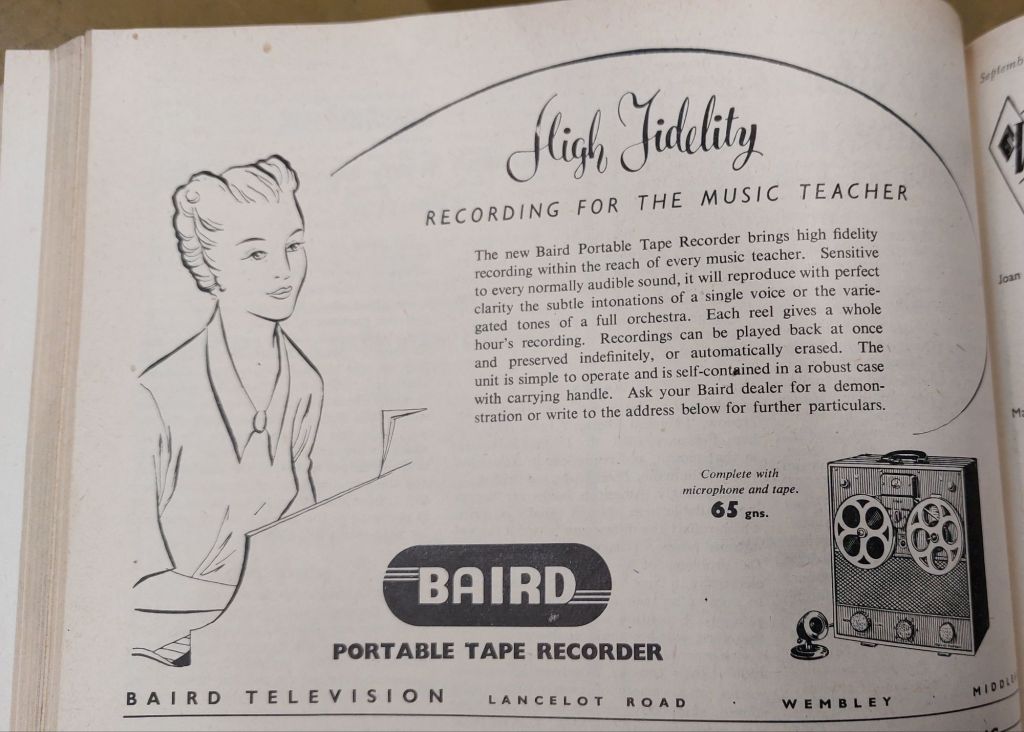
High Fidelity
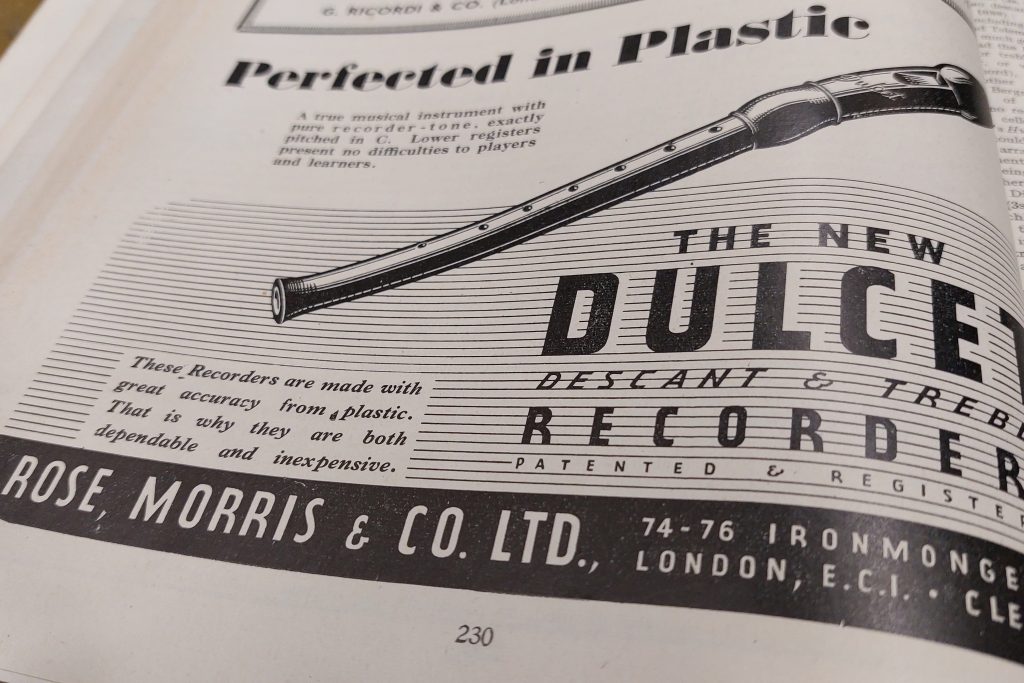
EMI tape recorderPerfected in PlasticBaird’s High Fidelity
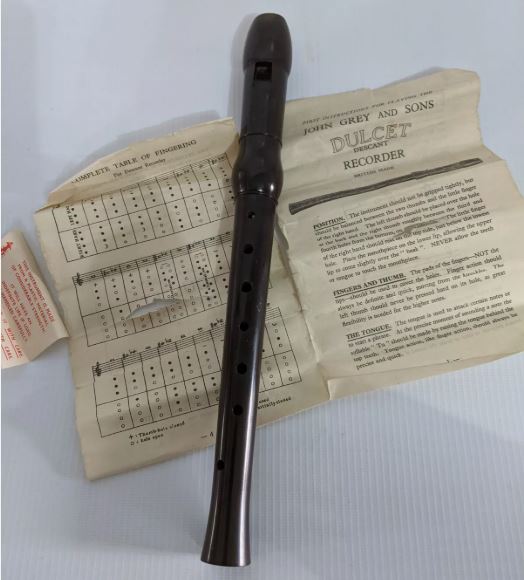
I did find a couple of book reviews and an advert, which is what I was looking for. But I was also drawn to other adverts for long-playing records, tape recorders and plastic recorders! Here we are today, with our phones, mics, streaming services and laptops, whilst a wooden recorder is much more eco-friendly, not to mention authentic. But in post-war Britain, all this shiny new stuff was the last word in modernity!
As for a record that held four times as much music as a 78? Who wouldn’t want such an innovation?!
Oh, and I spotted another ‘innovation’: folk songs with guitar chords. The times they certainly were a-changing. (And this was a decade before Bob Dylan’s song!)
Anyway, I filled in a couple of gaps in my knowledge by ploughing through eightyears‘ worth of bound, unindexed magazines (we forget how amazing digitised journals are!), and answered another question with a microfilmed reel (urgh, old technology!) of another journal. To think that microfilms were comparatively modern when I was a postgrad the first time round. Today, I used a shiny new microfilm reader – very techie – but it’s still a linear way of storing data. Luckily, I found what I was looking for towards the end of the first reel.
And had a thoroughly modern iced latte before heading back to the Uni Library!
Apologies! This has turned out to be quite a week.
I’ve twice woken far too early, notwithstanding leaving the house at 6.45 am to go to Edinburgh. It was still far too early even for that.
I bought a car. I’ve spent hours marking essays (not a normal activity for a former academic librarian-turned-research fellow). I’ve attended live and online seminars, and I’ve continued in my archival explorations. It’s only Thursday night, and I’m knackered.
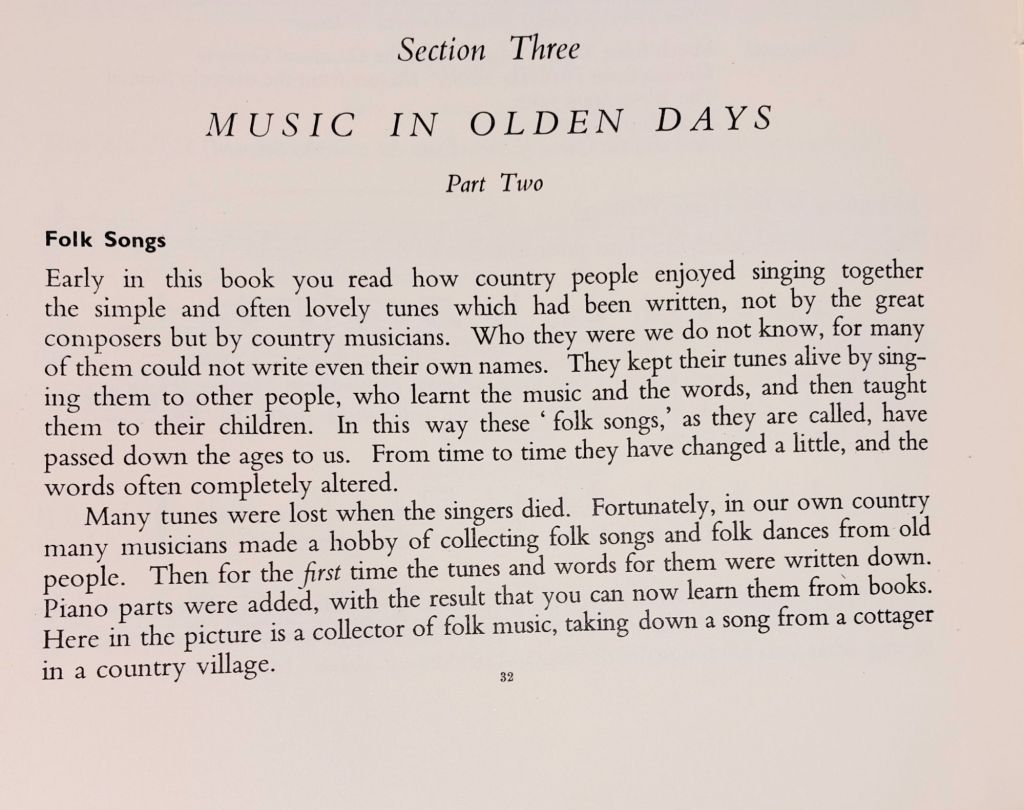
Thomas Nelson’s four-book set was for classroom use. Offering a mixture of history and theory (music-reading and tune-building), it even suggested pupils might plan a folk music concert.
In this exciting, modern world, children were reminded that their parents’ music lessons consisted only of singing, whereas now they might also learn instruments like the recorder, and perhaps collect interesting clippings from the Radio Times. (It sounds like another world, doesn’t it?)
Meanwhile, diving straight into the history, children were immediately introduced to the concept of folk music.
This is an English book, but I only recognised two of the three songs from my own school days. ‘The Carrion Crow’ wasn’t one I knew.
I’m delighted to find that kids were also introduced to the role of a song collector. Although I have to say that the child in the foreground on the right looks bored and unimpressed by the proceedings, in the illustration! Still, Nelson’s editors presumably commissioned the illustration rather than use a stock image, so they’re due some credit.
The song collector
They’re still holding onto the idea that folk music came from country folk. I wonder if pupils ever asked what city folk sang?!
Of course, it wasn’t all folk music. Kids were also introduced to the likes of Brahms, Handel and Purcell. Today, I imagine only examination classes would have textbooks introducing the classical greats. On the other hand, more time is probably spent on world music, and efforts are made to consider music by women and people of underrepresented communities. Times have moved on!
Nonetheless, it’s interesting to see how much knowledge children would have acquired in general classroom music lessons, and to compare it with modern times.
Even the books are brighter and more appealing today, I must admit!
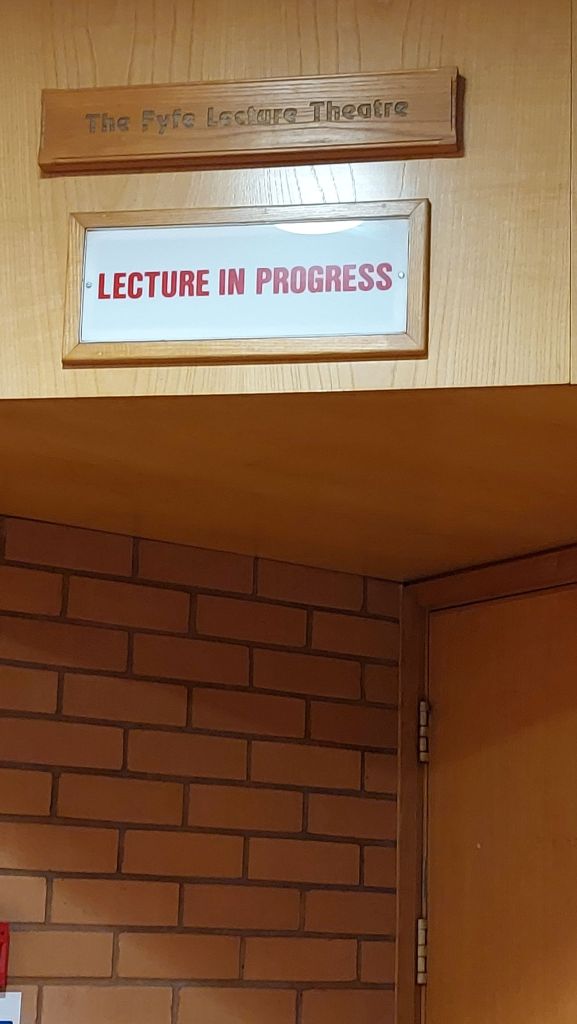
Today was my first wee bit of teaching*, since retiring from the library and becoming solely a part-time research fellow. Sporting my new ID card (it now says I’m a member of the Research team), I got there in good time and strode up to the classroom door. I have never before been able to get through a classroom door without a student letting me in, so this was the moment of truth! I was in. Hooray! I eyed the digital whiteboard set-up with some suspicion, but I got the powerpoint working with no difficulty. All went well, and we had a good session. Hopefully, I’ve also navigated Moodle successfully – another new venture for me.
It’s not as though I hadn’t given lectures about my research specialism before. I’ve given research papers galore, but this was the first time of teaching, when I wasn’t speaking as a librarian. But, guess what? Despite my best intentions, it was unavoidable to mention the library, the songbooks on the shelves, the library donations … hardly surprising, because I wouldn’t have written my second monograph without being prompted by some of the old music in all those carrier bags and boxes we took in over the years. I even caught myself saying ‘we have ….’ and ‘we did …’. Old habits die hard.
I’ve achieved my ambition – I’m a research fellow – but I can’t pretend I don’t have a library background!
*For clarification, this was a guest lecture. I’ve a few more temporary teaching dates lined up. It’s nice to use my PGCert in this way.
We’ve got several things by Nathan Holder, in the Whittaker Library. Indeed, I even helped arrange for Nate to give an Exchange Talk at RCS a couple of years ago. So, when his latest book was published – based on a poem with the same title, that he wrote in June 2020 after George Floyd’s murder in Minneapolis – I knew we had to get a copy! It was ordered immediately.
The book arrived today, and I’ve catalogued it already. I want to read it! However, I’m not the first in the queue. There was nothing for it – I’ve ordered my own personal copy. I’ll write about it once I’ve read it.
For a number of years, I’ve given an annual talk to RCS students, about how different generations looked upon, collated and collected and published Scottish songs and tunes. The snappy, official title is ‘Transformations’, but when I was revising it for this year’s presentation, I decided to compile a list of all the people (and a few extra titles) that I would be mentioning. Forty of them! So, I’ve added a new, unofficial subtitle: Speed-Dating 40 Scottish Music Collectors in an Hour. Okay, not exacty forty people, but forty lines in the list. I was quite surprised. I would imagine the individuals themselves might have raised an eyebrow, too.
It was the last time I’d give a lecture as a Performing Arts Librarian. Admittedly, not the last time I hope to give a lecture as a researcher, but certainly the final one with a library hat on! The librarian accordingly played a tiny bit of Beethoven’s Johnnie Cope from memory, along with a few chords from Marjory Kennedy-Fraser’s Sleeps the Noon in the Deep Blue Sky (score open), and blithely announced that she saw no need to inflict her rendition of Debussy’s La Cathedrale Engloutie upon her audience for comparison.
More than anything, the lecture epitomises me as a hybrid. I’m a librarian – I acquire and curate these resources. As a scholar, I contextualise them into cultural history. It wouldn’t be the same talk if I occupied only one of these roles.
The subject of my forthcoming monograph – amateur music making and Scottish national identity – only actually got a brief mention. But it was there. Maybe I’ll need to do a more extensive revision at some point!
I’ve written quite a bit about women in musical history, so I’m adding something to the top of this post every couple of days during Women’s History Month – mostly flashbacks to women musicians I’ve researched, but some other discoveries too. (I’ve been shifting things around to a more chronological order, but I’ve always added the new bit first!) You’ll find more musicians than composers in this posting, just because of my own recent research.
Sometimes I look at the history of women musicians from the point of view of good library provision for our readers, whilst at other times my own research interests are foremost. It just depends on the day of the week, because I currently occupy two roles in the Royal Conservatoire of Scotland. For 3.5 days a week, I’m a librarian. For 1.5, a postdoctoral researcher.
15. The Ketelbey Fellowship
It’s a whole year since I learned that I had been awarded the first Ketelbey postdoctoral research fellowship at the University of St Andrews. Scholar Doris Ketelbey was a significant figure in the history of the department. I felt highly honoured to have been the first Ketelbey Fellow from September to December 2023.
14. Representation of Women Composers in the Library
I couldn’t resist adding the open access article I published about my EDI activity in our own Whittaker Library:-
It’s a privilege to shape a library collection, so I’m pleased to have just ordered and catalogued several relevant books this month.
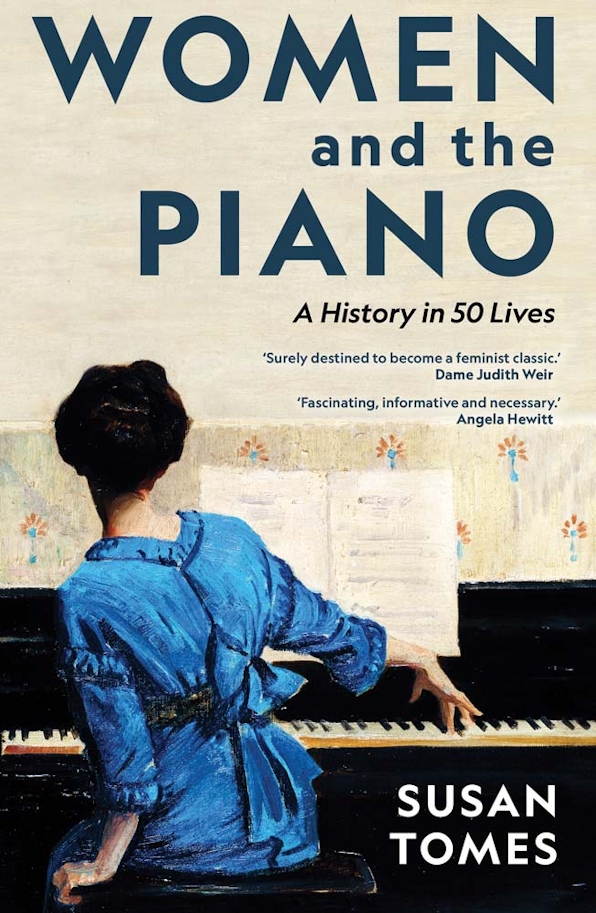
Susan Tomes, Women and the Piano: a History in 50 Lives (Yale University Press, 2024) Read more about it on the publisher’s website, here. In actual fact, it’s the fourth title by this author that we now have in stock. So if readers like this, they might like the earlier three, too!
Margaret C. Watson, Women in Academia : Achieving our Potential. (Market Harborough : Troubadour, 2024). Not a book about women in history, but very much for women in the present day!
Gillian Dooley, She played and sang: Jane Austen and Music (Manchester University Press, 2024). Back to history again.
Women and Music in Ireland / ed. Jennifer O’Connor-Madsen; Laura Watson & Ita Beausang (Boydell Press, 2022)
Moreover, there’s a new Routledge book coming out this summer – I have ordered it for the Whittaker Library. Of course, I may have retired from the Library by the time it arrives. This just means I won’t need to catalogue it! I’ll still be a part-time researcher, so I’ll be able to read it:-
It’s some years now, since a single-minded schoolgirl decided action was necessary. In 2015, Jessy McCabe noticed that Edexel had no women composers in the A-Level Music syllabus, and successfully petitioned to rectify this, via Change.org. I found out about her impressive initiative when I was beginning to start serious work on building up our library collection to include more music – contemporary and historical – by women and people of colour.
Jessy is now a Special Needs teacher. I’m sure she’ll go far.
11. Forgotten Women Composers
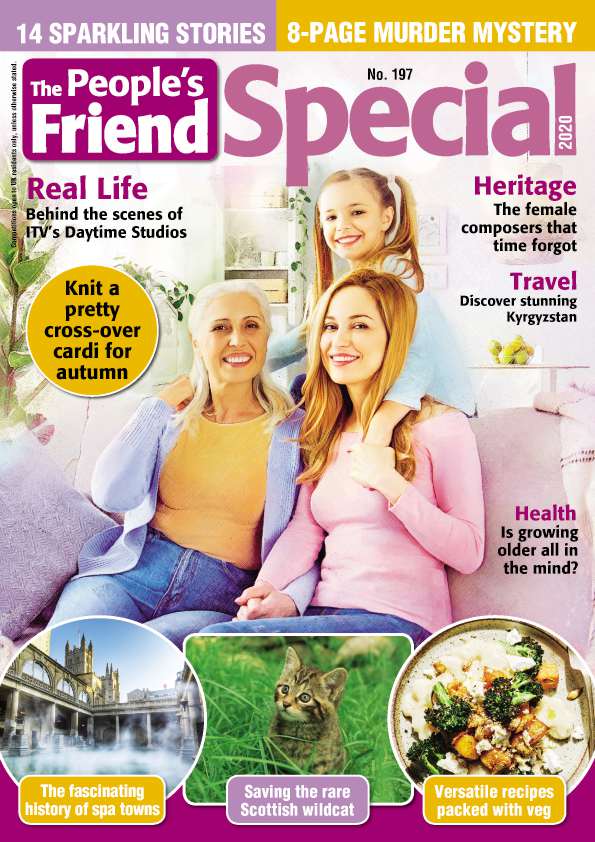
Part of academia entails sharing research outcomes beyond the ‘ivory walls’. It’s called public engagement, and that’s the opportunity I seized when my old friend The People’s Friend magazine commissioned me to write a feature back in 2020.
The sound of forgotten music: Karen McAulay uncovers some of the great female composers who have been lost from history’, in The People’s Friend, Special Edition, 11 Sep 2020, 2 p. (Dundee : D C Thomson). I blogged about it at the time (here).
10. Late Victorian Women Musicians
Since my more recent research has focused on the late Victorian era and the first part of the twentieth century, you’ll not be surprised to find that I found some interesting Scottish women musicians of that era! They are forgotten today – but I’ve done my bit to raise their profiles!
Newsletter article, ‘‘Our Heroine is Dead’: Miss Margaret Wallace Thomson, Paisley Organist (1853-1896)’, The Glasgow Diapason, March 2023, 10-15. (You can find this article in full on this blog)
‘An Extensive Musical Library’: Mrs Clarinda Webster, LRAM, Brio vol.59 no.1 (2022), 29-42 (a late Victorian head teacher who founded a music school in Aberdeen, and later did a national survey of music in public libraries – which she presented to the Library Association!)
In October 2023, I pondered about Mr *and Mrs* J. Spencer Curwen (amongst others) in another blog post, when I remarked upon early twentieth century attitudes to folk song.
9. In Praise of Music Cataloguers! Introducing Miss Elizabeth Lambert
Before I started the Claimed From Stationers’ Hall music copyright network, I had spent some months researching the wonderful late 18th and early 19th century music copyright collection at the University of St Andrews. A key resource was the handwritten catalogue in two notebooks, largely compiled by Miss Elizabeth Lambert (later to become Mrs Williams, when she married and moved to London.)
I just love the fact that this earnest young woman (I’m going out on a limb here, but I’m pretty sure she must have been earnest!) created a useful resource which would help everyone get maximum use out of the music repertoire that other libraries were less than impressed by. So we had Elizabeth cataloguing the collection, and numerous men and women, friends of the professors, making use of it. I blogged about her, and eventually wrote an article for the Edinburgh Bibliographical Society, mentioning her again.
‘A Music Library for St Andrews: use of the University’s Copyright Music Collections, 1801-1849’, in Journal of the Edinburgh Bibliographical Society no.15 (2020), 13-33.
The library’s copyright collection of music was a boon for middling class women like headmistress Mrs Bertram, her teacher daughters and their pupils. It does lead one to wonder if they had a harp at the school. I checked their borrowing records for more evidence. They certainly borrowed several volumes which included harp music.
7. Students but not at University? Educating Young Women
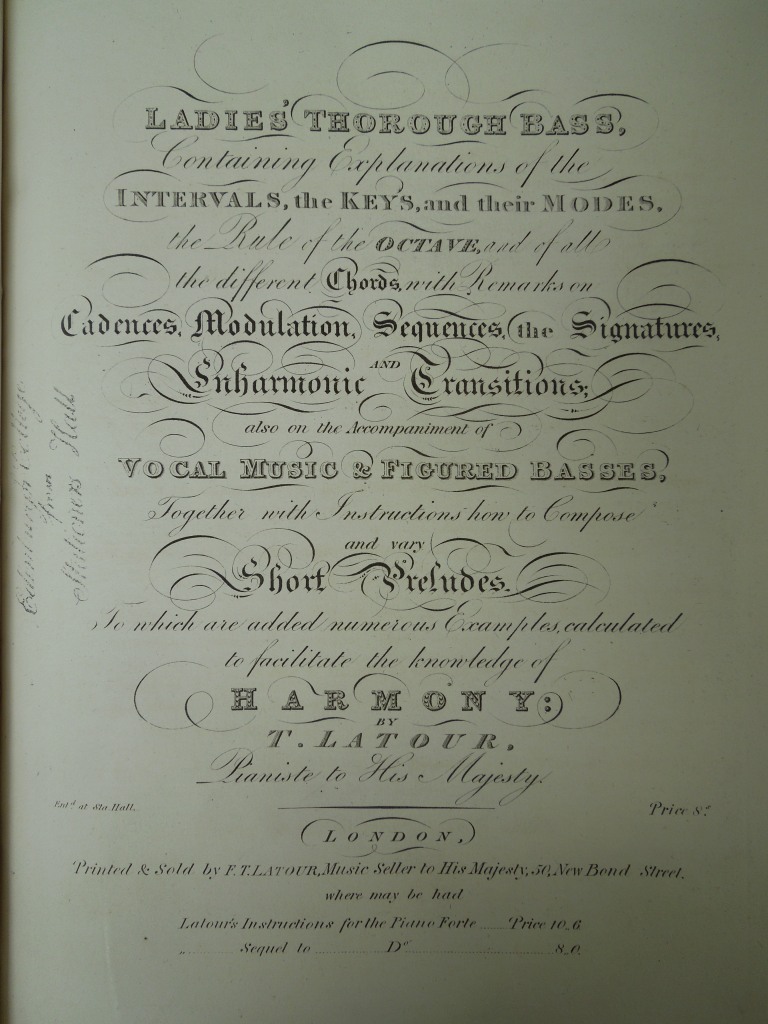
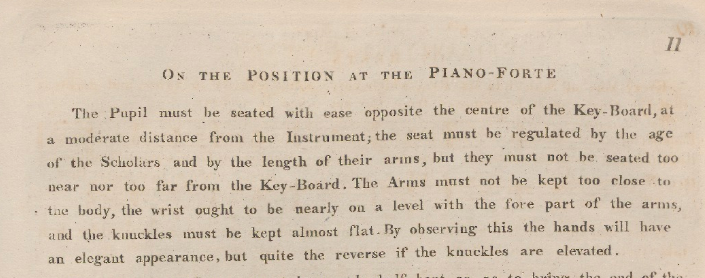
It’s time to turn to piano teacher Mr T. Latour. I’d like to refer you to my June 2018 blog post about women in St Andrews using pedagogical musical material in the early 19th century. Possibly the self-same young ladies attending, or having attended Mrs Bertram’s school?! The illustration features a young woman – probably just approaching or about marriagable age – at an upright piano. The abundant floral arrangement atop the piano (quite apart from sending shivers down the housekeeper’s spine every time the young pianist played too enthusiastically) suggests a well-to-do household. Following Latour’s instructions, the pianist has elegantly flat hands …..
T. Latour – Ladies’ Thorough Bass
Latour advises on the seating position, and how to hold ones hands elegantly
6. Not my work – but very timely for WHM 2024]
I’m not posting anything relating to my work today, but I saw mention of a great new article by Dominic Bridge the other day, so I thought I’d share details here. It’s a fascinating read. The Journal for Eighteenth-Century Studies is part of the Wiley Online Library:-
Back in 2018 when I was awarded the AHRC networking grant for the Claimed from Stationers Hall network, I drew up a list of women composers from the Georgian era. There were more than one might have expected – perhaps they only composed a handful of pieces, in many cases, but nonetheless – they composed. You can find the list on a separate page on this blog, here. And you can read more about it in the blogpost I wrote in July 2018,
This lady ran a girls’ school at St Leonard’s in St Andrews. This was NOT the famous and long-established private school that has long stood there, but an earlier enterprise. And Mrs Bertram and her daughters subsequently moved to Edinburgh, to the disappointment of parents of daughters in St Andrews!
The photo portrays a Mrs Bertram of Edinburgh. Chronologically, she could well be ‘our’ Mrs Bertram, and a scholarly bent is suggested by the pile of books at her hand.
2. The Accomplished Ladies of Torloisk
I almost forgot about the musical Maclean-Clephane ladies of Torloisk, which is a stately home on the island of Mull. But how could I forget about them, considering I published a lengthy article about them some years ago?! Luckily, a book of letters by Sir Walter Scott crossed my library desk, and even though it didn’t contain those particular letters, this did remind me of his musical friends in Torloisk!
Karen E. McAulay, ‘The Accomplished Ladies of Torloisk‘, International Review of the Aesthetics and Sociology of Music, Vol. 44, No. 1 (June 2013), 57-78
Today, I’d like to introduce a woman composer who predates most of the individuals I’ve encountered. Professor James Porter applies his considerable intellect to produce this in-depth article:-
‘An English Composer and Her Opera: Harriet Wainewright’s Comàla (1792)’, Journal of Musicological Research Feb, 2021. Published online: 16 Feb 2021.
I’ve linked to this on my Publications page as a permanent record, but if you’re interested, you can see my talk on YouTube now:-
Engagement activity: RCS Exchange Talk, Monday 29 January 2024: ‘From Magic Lantern to Microphone: the Scottish Music Publishers and Pedagogues inspiring Hearts and Minds through Song’ – YouTube recording














 Karen McAulay, Musicologist