Ethical Approval: a Must

My next research project requires ethical approval – interviewing real live people rather than writing about people long since departed.  And it’s imperative that I get my submission in on time, since the next meeting of our ethics committee is early next year.  

I’ve been working on it for weeks. (Admittedly, I’m a part-time research fellow, so I technically have only 10.5 hours a week to get my research activities done. Yes, we all know that the reality is different!) Anyway, yesterday was my own deadline: it just happened to be the last day we’re open before Christmas, and the morning after my last working day this year.

Efficiency (and Thoroughness)

There’s only one way to fill in a form efficiently, and that’s to make sure every question is answered satisfactorily. To this end, I go through and make myself a list of the information I must provide. Over the past few weeks,  I assembled the info. Attachments were created and labelled. And here’s where Tuesday (not a ‘work’ day) and Thursday came unstuck. I wanted to have a particular collection of old newspaper excerpts to share as an interview prompt.  Finding and listing them was easy enough. Formatting the document in Word, though? With clips of the excerpts? It took hours!

Have I Forgotten Anything?

Finally satisfied, I turned back to the form. And there – I swear they weren’t there when I initially saved it! – were a couple more questions with grey-shaded boxes requiring answers. And attachments.  What a good thing I double-checked. ✔️

It’s done. Phew! Details of whom I hope to interview, what I’ll be asking, and how I’ll save and use the gathered information, are all itemised.

And … breathe!

I submitted it. Ensured everyone involved could access it. At last, I can stop thinking about it until after Christmas!

Now, where’s the domestic to-do list (all the stuff I need to do, because no-one else will think about it) …?

Christmas cheer!

Image by Daniel Schmieder from Pixabay

My IASH Fellowship Ends …

IASH - Institute for Advanced Studies in the Humanities

‘All good things must come to an end’, as the saying goes. And an IASH Postdoctoral Research Fellowship is a thoroughly good thing.  I handed back my keys with sadness today, but I have had a great year. (The Fellowship was technically six months, but I was graciously permitted to hang around, retaining the use of my office for the rest of the year, which was wonderful, and enabled me to continue data-gathering in the Library’s Heritage Collections.)

If you are looking for a next step after your PhD, or if like me, you’re making a change of direction – or need a spell concentrating on a particular research question in the Humanities – do consider applying.

I devoted my time to examining the archives of the Edinburgh publishers, Thomas Nelson.  I initially entitled my project, ‘From National Songs to Nursery Rhymes, and Discussion Books to Dance Bands: investigating Thomas Nelson’s Musical Middle Ground’, but the nursery rhymes turned out to be poems, and weren’t what I had in mind! The rest? Yes, I researched them.

I found quite a bit of correspondence between Thomas Nelson’s editors, authors and compilers, which was gratifying. I was able to trace material in journals that I would not have had access to, had I not been in Edinburgh; there’s the excellent University Library collection of actual and digital resources, and the National Library of Scotland just down the road.

I have deferred commencing any significant written work until I had explored all the potentially relevant materials in the files. I believe I’ve now reached that point.  As a result of conducting this research, I have ideas for extending my research in new directions, and I’m contemplating writing another book, so I need not only to explore potential audiences, but also to start working on a book proposal

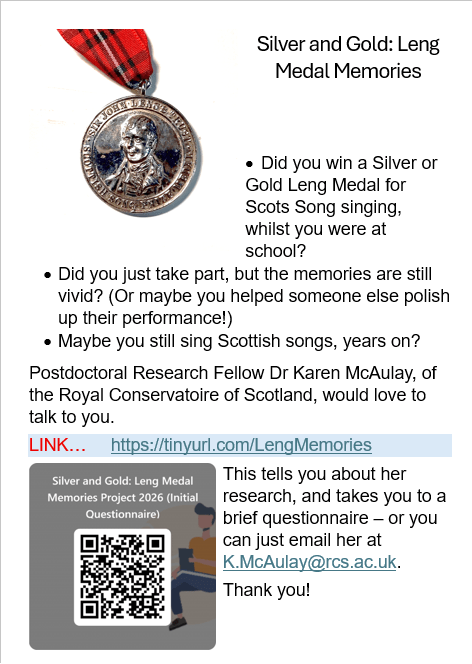
However, I have also applied for and recently won an Athenaeum Award from the Royal Conservatoire of Scotland to enable me to conduct an oral history project. This work, to be conducted in 2026, will hopefully enable me to write a final chapter for my proposed monograph. (I’ll be blogging about this before too long, but there are things I need to do first, before I spill the beans!)

I have benefited from being part of a research community, hearing other scholars’ papers and discussing our research; and attending researcher development sessions. I  was able to focus on my new direction as a researcher – important, after so many years as an ‘alt-ac’ researcher working in professional services. In this regard, I have also been in a position to submit some other unrelated work for publication, and I spoke at a conference at the University of Sussex in June, all of which gives me a sense that my research is gathering momentum.

Today, my last day, I took a cake to the University Library’s Heritage Collections; went to IASH’s Christmas lunch; and mulled over aspects of my ethical approval submission for my next project. (Oh, and drank quite a bit of coffee!)

Thank you so very much for a great year, IASH!

IASH (Institute for Advanced Studies in the Humanities)

Progress! Post-Rewiring, my Desk is cleared for Research again ..

I’ve proof-read an article for The Magic Lantern; navigated Cambridge University Press’s article dashboard for my impending RMA Research Chronicle article; signed an ‘Ironclad’ contract; updated my Pure (institutional repository) account; signed up to a short online course in connection with next year’s research project; and attended a meeting.

It feels as though it’s been a busy morning. One could argue that it has been more administrative than actual research work, but research doesn’t get done without a secure administrative foundation, so that’s good enough for me.

Post-Rewiring?

I’d best describe my mental state as ‘fragile, but functional’! But I’m getting there.

Two Ladies and a Harp: the Maclean-Clephane Sisters of Torloisk on Mull (and Edinburgh)

You know how you buy a new car, and suddenly everyone seems to be driving the same white Fiat 500? It’s the same with research topics.

“Enthusiastic collectors of Gaelic songs and Irish harp tunes”

I researched Gaelic song-collectors Anna and Margaret Maclean-Clephane as part of my PhD (2009).

  • I blogged about the sisters as far back as 2012 in my librarian days, when the Whittaker Library was using Blogspot:- How Far Can a Song Travel? (Author Karen McAulay, Whittaker Live blog, Wednesday, 23 May 2012);
  • and of course they later made it into my book (Our Ancient National Airs, 2013).
  • I followed up with an extended article about them (also in 2013). See this excerpt from the article:-

Naturally, the Maclean Clephane sisters are in my Pure institutional repository at the Royal Conservatoire of Scotland. I coined the above phrase, ‘enthusiastic collectors of Gaelic songs and Irish harp tunes’, using it both in my book (p.92) and my article (p.62), both in 2013.

‘While they were still in their teens’

The sisters had a book ‘printed but not published’ while they were still in their teens – you can read about it in my article, p.58. I have to say, the arrangements in their book were – well, okay, but not artistically stylish!

Margaret had a harp – there is actually a Raeburn portrait of Margaret with her harp – see below.   Alexander Campbell did say the sisters played, but there’s no portrait of Anna with a harp, so we can’t prove it either way. He didn’t meet them. (There was in fact a third sister, though her musical interest didn’t seem to carry through to adulthood. ) Indeed, Anna wasn’t that hot on the piano, as I recall.  They grew up on the Isle of Mull. I’ve driven past the house, Torloisk. It’s massive!

I just love researching and writing about people, particularly musicians! If they’re women musicians, then that’s all the more interesting – so it’s hardly surprising I was drawn to them, and went looking at materials in the National Library of Scotland and the School of Scottish Studies in Edinburgh, and even visiting a manuscript that’s now down in London. (Blog post Women’s History Month 2024. Musicians, this present blog.)

Details of my article

But ever since, these fascinating and talented ladies keep cropping up in my social media feeds. People who’ve read my writings also contact me from time to time. Thanks to the miracles of modern technology, I get notifications that people have consulted my stuff, too … and there’s also a CD whose notes cite me, too:-

Tullochgorum – Haydn – Scottish Songs, by The Poker Club Band and Masako Art (BIS-2471 | SACD

Tullochgorum – Haydn  – Scottish Songs

The harpist, Masako, asked if she could cite my work – I was very appreciative that she went to the trouble of asking me.

Correctly cited 😀
Margaret Clephane … and Masako Art

I spent so long with my early nineteenth-century heroines, but eventually my research took different directions. Not being a Gaelic scholar was just one of the problems I’d encountered! I attended classes in speaking it, at the Conservatoire. I signed up to local authority evening classes at the Gaelic School in Glasgow. But somehow, I never really had time to give it enough attention, despite having been considered good at languages at school and possessing school certificates in – well, several European languages. I understand when someone agrees with me in Gaelic, and can pronounce ‘Torloisk’, for sure, but Gaelic remains beyond me!

But look – now the music is going to be played. That’s exciting!

A Day for Obscure Queries

Sign saying, ASK

I had set myself an assignment today: I would look up articles by scholars in fields related to my own, and see which journals they tended to publish in. (Litmaps is a very useful way of looking up scholarship in related fields to one’s own:- https://www.litmaps.com/ )

Then I would look up the journals and see what their acceptance rate was, and note any other useful metrics. Sometimes it’s a good idea to take a step back from the detail of one’s research, and think about where it might ultimately find a home! I rolled up my sleeves and got started. After a couple of hours of this, one tends to get a bit befuddled. But then …

I unexpectedly received an email from an unknown individual. Someone I did know had recommended me to help with a rather obscure query about Scottish songs. Maybe anyone else would have sensibly thought that they’d deal with it later when they had a minute, but my ex-librarian-brain kicked in before I could stop it, and within an hour or so, I had part-answered that query to the best of my ability. At that point, I remembered that I wasn’t a librarian any more, and wasn’t obliged to persist until I had exhausted every corner of the internet! I’d looked in the places where I’d normally go, so I thought I’d done a reasonable job.

Back I went to my task in hand. I found a useful website for making Venn diagrams, PresentationGo – it’s at www.Presentationgo.com – and came up with a beautiful little Venn diagram to remind myself what I was looking for. I made better progress than I had yesterday; and resumed the task after lunch.

By mid-afternoon, I was getting a bit weary – I didn’t get nearly enough sleep last night. I confess, I was close to nodding off at my laptop when the doorbell rang, bringing me sharply back to a more alert state. Two complete strangers stood outside, one apologetically introducing themselves with, ‘I’m afraid I have probably got the wrong address, but I’m looking for the Scottish Tramway … ‘

I laughed. ‘Oh no, you’ve got exactly the right place. Hold on, I’ll get Himself …’

You see, if my research interests seem obscure, then His all-consuming hobby interest – trams – is equally niche. And he’s heavily involved with an enthusiasts’ society. So I went and told Him he had visitors. He wasn’t expecting any; it turns out this is the first time anyone has actually, physically come to the door with their own unique research query about trams. It made his afternoon: he was quite enchanted, and very happy to oblige with possibly more information than his enquirers had dreamt of. Upstairs and down he went, pulling out useful copies of the society magazine and goodness knows what else. (I’m afraid I went straight back to my desk, wondering whether I’d be cooking tea at the normal time, or waiting for the Tram Advice Surgery to terminate.)

Who would have thought that a terraced house not far from the River Clyde would provide such a useful, if specialised advisory service?

Images by Dean Moriarty and Brigitte Werner from Pixabay

Hello to All New Visitors! I’m a Research Fellow

I haven’t been posting much this summer, for personal reasons. So – after more than a week of total blog silence, imagine my surprise to find I have had hundreds and hundreds more visitors since yesterday. What’s happened?!

Even if it’s some kind of blip, it gives me the opportunity to introduce myself. I’m a postdoctoral research fellow at the Royal Conservatoire of Scotland and also, for a few weeks more, at IASH at the University of Edinburgh. I research all sorts of cool stuff (well, it’s cool to me) about Scottish music publishers, with a distinct interest in national song collections, and in early 20th century music education in Scotland.

My second book was published at the end of 2024:-

A Social History of Music-Making and Scottish National Identity: Scotland’s Printed Music, 1880-1951.

That might look like a strange date-range, but my previous book covered Scottish song-collecting up to the 1880s, so this kind of continues in a slightly different way from that point onwards. The 1951 cut-off date is because that was the year of the Festival of Britain. And it was also a good place to stop because I touched upon magic lanterns, gramophones and the wireless, but I really didn’t feel I was the right person to write about early television in Scotland! By stopping in 1951, I conveniently sidestepped early television. There are plenty of people more knowledgeable than me on that front.

My current Edinburgh research entails examining archival records of the Thomas Nelson publishing house, an old Edinburgh firm. The British side of this company has ceased trading – it’s an American firm now – but I’ve found plenty to interest me in the documents up the early 1950s. Education became their focus during the era I’m researching.  Whilst my book mostly covers publishers specialising in music, Thomas Nelson really only published music that would be used in schools – though they hoped a few titles would also attract the general public. (The problem being that if you mention ‘school’ or ‘classroom’ in a title, it will turn off the ordinary member of public looking at books in a bookshop!)

Will there be a third book? Possibly! I’m still pondering.  September is earmarked for concentrated thought about that!

If this sounds interesting, please do come back and visit this site again.

How Can I be a Fellow? Let me Count the Ways

Elizabeth Barrett Browning would probably kill me for misappropriating her memorable poetical line! However, I’m only now realising the very many different ways in which one can achieve Fellowship.

A Disappointing Start

Many years ago, I tried to achieve a Fellowship of Trinity College London, in oboe performance. I’m afraid I didn’t succeed, remaining a Licentiate to this day – but I no longer call myself an oboist in any case; I haven’t played for years.  To think that at one point, I couldn’t imagine myself not playing it!

An Early Dalliance

Professional

I was more successful in librarianship.  I attained Fellowship of CILIP (the Chartered Institute of Library and Information Professionals) in 2010, only relinquishing it (my decision) when I stopped being a librarian.  I was also made a Fellow of IAML(UK & Irl) as I approached the end of my career in music librarianship.  (My official role was Performing Arts Librarian, but I was, essentially, a music librarian.)

Research

A couple of years ago, I enjoyed a Ketelbey Fellowship semester in the School of History at the University of St Andrews, and I’m currently a Fellow at IASH, University of Edinburgh.

I’m continuing my research activities as a postdoctoral research fellow at the Royal Conservatoire of Scotland  – that’s my permanent part-time role.  Would I cause confusion by mentioning that I was also awarded Fellowship of the Royal Conservatoire of Scotland in Autumn 2024? 

And Today … FRHistS

I was delighted to learn that I’ve just been elected a Fellow of the Royal Historical Society.  This is a worldwide organisation with a long and distinguished history, so Fellowship really is an honour.  I’m one of 78 new Fellows this summer. Since I’ve taken the greatest interest and pleasure in historical research in the latter part of my career – as evidenced by my publications record  –  this news is a source of quiet satisfaction. 

A Year as a Research Fellow

It’s a whole year since I retired from librarianship, and started my new contract as a part-time postdoctoral fellow at the Royal Conservatoire of Scotland. Do I miss librarianship? No, I’m afraid I don’t! And am I going to give a step-by-step account of my first year not being a librarian, able to focus entirely on research? No! (I’ve blogged so much about my research that you, dear reader, have already read countless highlights.)

Along with my research, I did a little maternity cover supervising some undergraduate dissertations – that was interesting and enjoyable, and I was proud to see ‘my’ students graduate this week. (Humour me – I’ve never been able to talk about ‘my’ students before, even if it was only for one module.)

And I took up my IASH Heritage postdoctoral fellowship at the University of Edinburgh in January. Originally planned to be for six months, it has been extended over the summer, so I’m certainly not done yet with Thomas Nelson’s educational music publishing activities.

Help me Determine my Prospective Audience?

Indeed, I’m contemplating what exactly I shall do with all the information I’ve gathered – do I write a scholarly article? Keep going and consider a book as research output? And for whom would it be written? Educational historians? Social historians? Musicologists? If you’re any of these categories – or indeed, some other category – say, a historian of publishing – it would be immensely helpful if you could respond via this blog and let me know in what way it would interest you. Any feedback will help me determine my prospective audience. I’d be really grateful.

I have two follow-on ideas which I am going to pursue this summer, along with some more archival research.

But first – I need a holiday!

I’ve saved up the bulk of my annual leave so that I could take the next four weeks off this July. Family concerns mean I’m not able to consider ‘a holiday’ abroad, or indeed staying away anywhere that involves significant outlay, just in case I had to come back hastily – but a break is called for. Last summer – partial retiree or not – I had a book to nurse through to completion, and the Christmas break was a disaster, with everyone around me succumbing to flu. (I didn’t. But I’m really no Florence Nightingale, so it was tough.) Yes, I definitely need a break.

Know When to Take a Break

I should put my research hat aside for the next four weeks. Apart from the ongoing concerns, my sleeping patterns are messed up with the early rising needed for my Edinburgh research days, and I am beset with insufficient sleep, broken nights and weird dreams.

Burning the Candle at both Ends?

When I finally wake in the morning and it’s time to get up, almost my first thought is consumed by whatever I’ve been thinking about the previous day.

But who WAS she?

So, this morning’s question was:- ‘But who WAS she?’ Some sneaky Googling turns into a lengthy trawl of deep and darkly forgotten corners of art and music history to track down the composer of some tunes for early years classes. Until it really is time to do something real (the family laundry). And as I get on with daily chores, the little voice says, ‘No, you know some people she was associated with. And that she was a composer. Isn’t that enough? It isn’t. How did Thomas Nelson the publishers know about her, for a start?’ She’s not a major player in my cast list, but I’m still curious about her. Am I capable of forgetting about her until August? I’m not sure that I am!

Meanwhile…

I need to spend some time researching fun things to do that aren’t research-based!

‘Mind Your Ps and Qs’, Nana said. (She never mentioned the S)

I have just wasted half a day, and I’m mad at myself. There I was this morning, sitting upstairs in the Heritage Collections reading room, and going through a box of papers labelled ‘Stock’. Not initially of huge interest – until I realised that I had been presented with a snapshot of a year from the stock manager’s viewpoint, enabling me to see which Thomas Nelson titles were out of stock or reprinting at various points in the year. All I had to do was work out the catalogue numbers for the titles I was interested in, and then see which ones came up in the lists, and how often. This was just a little bit more interesting!

Random warehouse (Pixabay)

I had almost worked through the entire box before lunch, and at that point, I was going to attend a seminar. Indeed, I did attend the seminar, and very good it was, too.

But in between the contentedly sifting through papers, and the contentedly attending an excellent seminar, I took it into my head to have one last search for a photo of the editor whose picture I have not yet traced. (It’s the kind of thing that enlivens a PowerPoint presentation.) Reader, I went to the Internet Archive, otherwise known as Archive.org. I’m not going to warn you off going to that website, because I fear that what happened next was all my own fault. I think I typed it in the plural, confusing it with the Archives Hub. Suddenly, I was asked to prove I wasn’t a robot. It did occur to me that they must have tightened up security, because I didn’t remember having to do that before. I obediently ticked the box.

As I said, I think it was my fault, if I mistyped the web address. But what I’m most annoyed about, is a perfectly promising afternoon being wasted by my typing an extra letter – if that’s what I did. I don’t think I’ll be mistyping that particular address ever again!

Mind the Gap! A Hiatus in the Research Process? Don’t Panic

I was going to add another exclamation mark there, but one exclamation mark is enough. Otherwise, it looks panicky, and that’s not what I want.

Over the years, I have come to realise that when you feel you’ve reached a block of some kind, it’s time to take a deep breath, go and do something else, and wait for inspiration to strike.  This profound truth falls into two parts.  The first key thing is to stop thinking about the block. (I’ll come to the second shortly!)  If you’ve just completed a huge project  – or a thesis  – you might need a significant break. In my present project, it wasn’t on that scale.  I just needed to step back for a weekend.

Is That It?

So, here I am, realising that soon I’ll have looked at most of the roughly contemporaneous archives relating to the Nelson’s Scots Song Books, meaning that I won’t be able to extract much more quotable content from these papers.  And oh, I do enjoy the thrill of the chase! I can continue trawling through papers – or databases – for hours, if I’m hunting for particular details. An initial feeling of disappointment – no more discoveries? – left me wondering if I should start writing up what I do know, now?

But There Is More!

This is the second key thing.  Don’t assume that you’ve ground to a halt. And try to avoid doom predictions; don’t fall into the trap of thinking you’ll never manage to get back on track again.  Instead,  regard the hiatus as a time to regroup (if an individual can be said to regroup) and permit new ideas to surface.

I remind myself that I do have a couple of new ideas to pursue, leading on from what I’ve unearthed so far.  This is certainly not the end.

Embroidered copy of child singing from book

Moreover, as I picked up my embroidery needle for some weekend distraction, the sewing project itself reminded me that I haven’t yet explored every angle that I wanted to cover whilst I have access to the archives.

Weekend Pause for Reflection

Remember the little engraving of a child singing from a book? It was used for several of Nelson’s song books, although I think not for the Scots ones. (Only the four Scottish pupils‘ books have illustrations, and they tend to illustrate the songs they accompany – whereas the singing child is just that – a child singing.) I like it, though, and I decided to see if I could reproduce it in stitched form.

And that set me thinking about MacMahon’s New National and Folk Song Books – which include just a few Scots songs. Not to mention the other music books I’ve encountered along the way. 

Actually, that’s another piece of advice.   Take a long, hard look at your initial plan, and ask yourself if you’ve done all you intended to do. There may be other angles that have slipped to the back of your mind.

Looking back at my avowed intentions, at the start of this project, there are several more books I’d like to do a little research into. Not as much as I’ve done into the Scots books, but certainly, to see if I can find any more interesting detail around the times when these other titles were being published. I went back to see what I had written for my Fellowship page on the IASH website. Look:-

Project title: From National Songs to Nursery Rhymes, and Discussion Books to Dance Bands: investigating Thomas Nelson’s Musical Middle Ground

So, how could I NOT devote some thought to nursery rhymes or aspiring amateur dance musicians? Even if it’s only a quick look?

“My recently-published monograph focused mainly on specialist music publishers, but I also made some comparisons with output by contemporary Scottish book publishers, including Thomas Nelson’s.  Exploring the extensive Nelson archive will offer me the opportunity to investigate Nelson’s modest music-related output in depth.  

“The Edinburgh publisher Thomas Nelson’s historical output can be broadly characterised into four categories:- religious; educational; attractive reprints of literary classics; or series for the intelligent layman.  In this project, I shall explore the publishing histories of Nelson’s comparatively limited catalogue of music books and scores, to determine how these titles justified their existence in predominantly non-musical lists.  I’m curious about the publishing histories of all Nelson’s music titles, whether notation or text; and the relative success of different titles.  I’m also interested in the working relationships with compilers and authors.”

Well, I said it there!

  • “The publishing histories of all Nelson’s music titles, whether notation or text.” I can’t compile extensive histories for all of them – there’s more than I thought – but I can certainly explore some that caught my attention. As I have for a couple already, as it happens.
  • As for the relative success of different titles? Well, I can already name a few successful ones, and one a little less successful!
  • And the working relationships? I have plenty of detail, but exploring a few more titles might yield other, unexpected discoveries – all the more reason to keep going!

“I’ll be exploring the background to Nelson’s national song collections, also contemplating their educational music materials in the era ca. 1927-40; books specifically aimed at the layman; and music publications for the Commonwealth.”

  • So – yes, I can justify a bit more time spent looking for the months before MacMahon’s book was published.
  • Maybe I can’t be as thorough as I have been in the 1948-55 era, but I should certainly dip my toes in the water!
  • And – music publications for the Commonwealth? Yes, I can amplify what I know there, too. (Indeed, I’ve just reached out to a college in Nigeria, although it relates to a quest for a picture, rather than anything to do with music.)

So – am I finished? Far from it! I just need to shine a light on different parts of the archive.

(Meanwhile, I’ve finished my wee embroidery – I have no idea what I’ll do with it. But it did get me thinking.)

IASH courtyard, May blossom at its best!