Scots Songs: a Question for your Elderly Scottish Relatives!

Front cover of Nelson's Scots Song Book Pupil's Edition Book 2

I would dearly love to trace a child, or children, who sang from these books. I think these books were aimed at children probably between eight to twelve years old, so the oldest children were born circa 1936-1946.

I don’t know how long the books would have remained in use, but my guess is that they’d probably have fallen to bits by the late 1950s. In that case, the youngest users would have been born round about 1950. And that would make them baby-boomers, but several years older than me.

So, if you have elderly Scottish relatives aged between 74 and 90, please do show them these images. Can they remember singing from these books at school?

And does Granny remember her teacher playing the piano for class singing lessons? There were bigger, more substantial teachers’ books to go with these little booklets. The teachers’ books had the piano accompaniments as well as the words and tune melodies. Only a few libraries still have them. I consider myself lucky to have tracked down my Pupil’s Edition Book 2!

Library copies of teachers’ books on an archival cushion

Musicology, and a Nerdy but Meaningful Spreadsheet

Musical notes cut out of old sheet music

How to Assess whether a Song Book was Aligned with Contemporary Tastes

There were once four books of Scottish songs in a mini-series: just under 100 songs, all told. They weren’t much advertised, and few copies are now extant.  If they were intended mainly for school use, then I need to know to what extent their contents were standard Scottish song repertoire for their day. (Each generation has its favourites, noticeably different from the previous ones.)

Now then, I spent a very long time indexing song books as a librarian; that library catalogue is now a reference resource in its own right.  Last night, I listed the contents of those four books, and next, I shall look each song up in our RCS library catalogue.  I’ll end up with two figures for each song:-

  1. How many times the song is listed altogether: a high figure means popularity over a long period.
  2. How many times the song is listed between 1930-1970: this will be a shorter range of numbers. If it’s as high as, say, five hits, then it was popular amongst quite a few compilers over that 40 years.  If it’s not in any other books between 1930-1970, then it’s either old-fashioned, or a more obscure ‘rarity’ from less well-known or very old collections. 

And THEN, I can look up the rare ones in the National Library of Scotland’s Digital Gallery. 

This is the only accurate way of ascertaining whether the contents themselves might have been off-putting to the very audiences that they were meant to attract. I hope that’s not the case, because the compilers were well-placed, indeed ideally-placed to know exactly what went down well with school children. Nonetheless, I want hard evidence, and comparing the repertoire with two significant sets of data – the RCS more standard books, and NLS rare books – seems to me a pretty good way of doing it.

Blogging Helps Clarify the Question

I enjoy writing this blog, because it helps me clarify in my mind what the big issues are that I am addressing. Writing for a wide audience, which may or may not have exactly the same scholarly interest in the topic as I do, is a good way of reminding myself to write accessibly, and hopefully interestingly, about the things which occupy my thoughts as I pursue my research. Do I succeed? You tell me!

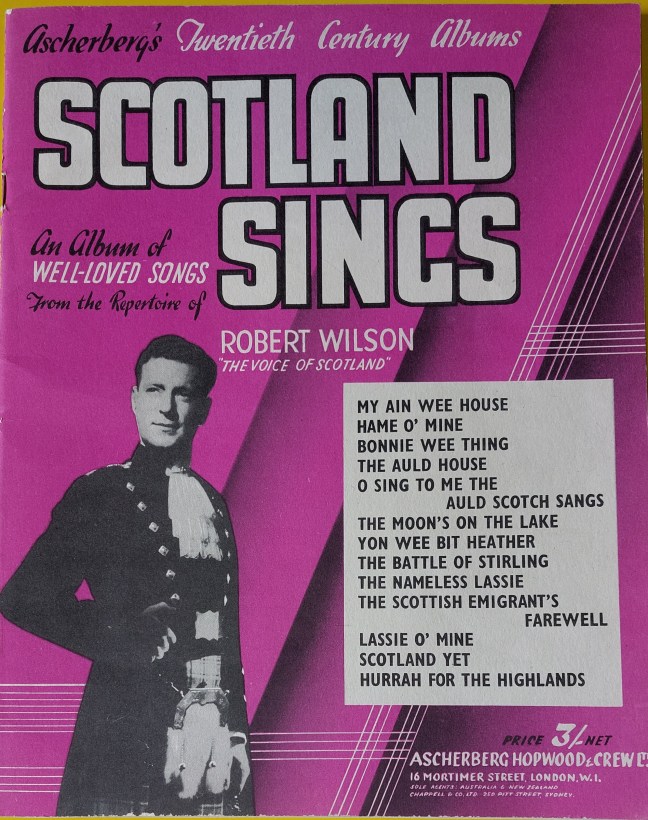
Now published in History Scotland, Spring 2025: The ‘Scottish Soprano’ and the ‘Voice of Scotland’

The Scottish Clans Association of London badge, on background of Mackinnon tartan

Sadly, this is the last issue of History Scotland, but I’m very pleased to have an article published there. I have really enjoyed writing this, and I think my idea of comparing two very different Scottish singers has actually come together rather well.  I wanted to write about Robert Wilson, but I didn’t want to go over the same ground that has already been covered.  I also wanted to write about Flora Woodman – but would anyone remember her? Then came the inspiration: what if I wrote about them both, two almost contemporary but very different celebrities, and then I could compare them.  This hadn’t been done before! And it worked  – the piece almost wrote itself.

Karen E McAulay, ‘The ‘Scottish Soprano’ and the ‘Voice of Scotland’: the Importance of Nationality to Flora Woodman and Robert Wilson’, History Scotland Vol.25 no.1 (Spring 2025), 74-81

If your public library has e-magazines, you’ll be able to read it online. Glasgow Life certainly has it!

Flora Woodman – photo and compliments, 25th October 1924

Seminar, Weds 26 March, 1pm:- Perusing the Papers from Thomas Nelson and Sons’ Parkside Works (Research into Nelson’s Scots Song Book – Work in Progress)

Through the archway into the courtyard at IASH

As I’ve mentioned, I’m currently Heritage Collections Research Fellow at IASH, the Institute for Advanced Studies in the Humanities, at the University of Edinburgh. All guest fellows are invited to give a work-in-progress seminar, and it’s my turn on Wednesday 26 March at 1 pm. You can attend in person, or online – more details on the link below. The abstract tells you what my talk is about.

Abstract and Zoom link

I’ll explain what I’m looking for, and introduce you to some of the individuals I’ve been finding out about.  The one thing I can’t predict, is whether I shall by then have found the answer to my prime question!

Nelson's Parkside Works - old engraving
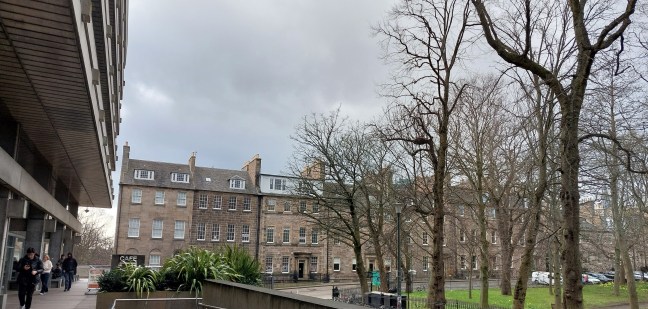
Hope Park Square, home of IASH
The ArchivesHub entry for the collection

Autoethnographical? Autobiographical? Reflective?

Well, the ‘Scottish Entertainment’ took place yesterday – attended by sixty to seventy people, if you include our [small] choir. A great time was had by all. There was lots of community singing, along with a couple of choir items, and a smattering of solo items (two spoken, two sung solos, and the concertina.)  And, of course, haggis, neeps and tatties in the middle of the entertainment.  Our pastoral care committee organised the whole event  – I just coordinated the entertainment bit!

It wasn’t a research event, and I can’t exactly call it public engagement – it wasn’t in any sense designed for, or linked with, my research. (Although, as I’ve mentioned, my little introductions were informed by my research!) So, I don’t think I can call this autoethnographical or practice-based research, but I can certainly reflect upon the whole experience.

Timing

I planned two equal ‘halves’ for either side of the meal. It wasn’t a full-scale meal, as such, but I underestimated how much time we’d spend eating. The first half of the entertainment was almost spot-on: we only had to leave one item until after the meal. However, the second ‘half’ had to be significantly cut back (mostly by omitting verses) – so I could really have made it a good bit shorter.

Feedback

The feedback was gratifying. Our repertoire went down well, as did the solos.  I shall respect the soloists’ privacy, so I won’t elaborate further on that point. 

My own debut as a soloist surprised me as much as everyone else, though.  ‘I didn’t know you sang’, someone said. ‘Nor did I – I’ve never sung a solo in public before!’

I chose a song within my range, and the concertina piece was likewise as simple as I could find!  Considering that I took up the concertina during lockdown, with the deliberate aim of having a ‘folk’ instrument for just such an occasion, it was gratifying to be able to play to an appreciative audience.

People were still talking about the event today, which was lovely to hear.

Repertoire

Remember that I did a BBC Scotland radio interview 13 months ago, discussing the top ten Scottish songs of nowadays, the results of a Visit Scotland survey? I didn’t even consult that list for our own afternoon entertainment. There was some, but not a lot of overlap – but I’m happy that the songs chosen by myself and the choir, went down well with our audience.  We had a few Burns songs, a few from the early 20th century, some from the middle and a couple from towards the end of it.

And if we were to  do another event, well, there’s still that Visit Scotland list to draw on!  There is bound to be variation, depending on the sample of people surveyed – whether they are young or old, whether they had children or taught children in schools, and so on.

Thinking about the Forthcoming Entertainment  …

On LinkedIn, public-speaking coach Alex Merry recently posted these tips on making a great presentation. It occurs to me that some of these tips will be equally applicable to the Scottish song entertainment that I’m leading later this month.

Alex Merry’s Presentation Tips

In my case, it’s not a presentation at all – I just need to introduce the songs we’re singing.  So it’s categorically not about me. But I do need to be lively and relatable.  Start with a short sentence and a pause? I hadn’t thought of that, but it should be easy to factor in.

Fun? Oh, yes. I have a few ideas! 💡 Well, props, really. I’m going to need one of those big, reusable supermarket bags.  And I have an abundance of stories, so that’s all right.

My only problem is this: I’m a bit embarrassed about my Englishness.  I’ve lived in Scotland more than half my life.  Scottish national music is my specialism, and I’m secure in my subject – but this is a fun entertainment, not a demonstration of knowledge, and my accent is all wrong.  So … do I bring attention to it jokingly, or put it to the back of my mind? My personal view is that you should never draw attention to your weaknesses.  What would you do?  Stuart Chater on LinkedIn makes a good argument for NOT being ashamed of your accent.

And the song I’m going to sing? (It wasn’t my idea, someone asked me.)  It’s short. It’s within my vocal range. But I can no more sound Scottish than fly!

Someone please tell me I’m over-thinking this!

A Non-Research Event

Remember un-conferences? They were popular a few years ago.

Well, now I’m co-ordinating a Scottish song event, but it’s for entertainment, and not remotely connected with my research. Does that make it an ‘un-research’ event? Anything I might say about these songs will have been learned during my research career.  (I  grew up in England – it wasn’t my childhood repertoire.) 

Community Singing

It’s interesting, all the same.  For a start, I am interested in community singing in an early-twentieth-century sense, but my own practical experience of secular community singing is limited. The forthcoming gig may well trigger new trains of thought. (Let’s discount leading congregational singing from the organ, which I’ve done for decades.)

Repertoire

The preparation has been interesting, too. We have collectively chosen the repertoire: some old, some from the 1950s and 60s, and some that our children would have learnt at school.  It bears out my findings that the repertoire of favourite Scottish songs does change with every generation. 

We’re also channelling Sir Hugh Roberton and his Orpheus Singers for a couple of choral items, but an even earlier choral arrangement felt too dated.  You have to know about the west of Scotland’s intimate acquaintance with Roberton’s repertoire to appreciate why those settings go down so well to this day.  Somehow, his particular brand of close SATB singing has endured in a nostalgic kind of way, where earlier settings have fallen by the wayside.

Authenticity

It gets better.  We’ve debated different versions of the lyrics, and odd discrepancies in tunes.  In other words, we re-enacted all the chatter about authenticity and correct versions that has been rolling on for, shall we say, 250 years or more?

And the Squeezeboxes?

Accordion

I debated with myself whether to go all authentic with an accordion accompaniment in appropriate songs, but I don’t think I’m that brave.  Singing a solo is brave. A couple of concertina tunes is positively reckless. But the accordion is probably getting left at home. (Although, if you listen carefully between now and then, you might catch me attempting a few strains of ‘The Song of the Clyde’ in private … Jimmy Shand I’m certainly not!)

This is a new adventure for me.  More anon.

Alec Finlay: the ‘Pocket Harry Lauder’

This blog post is an edited excerpt from the research Exchange Talk I gave at the Royal Conservatoire of Scotland on 11 November 2024.

Inside the song-book, The Glories of Scotland, the foreword was followed by a full-page signed photo of a popular Scottish singer and comedian, Alec Finlay. The University of Glasgow’s Scottish Theatre Archive, characterises the latter as, ‘The pocket Harry Lauder’, and ‘Scotland’s gentleman’, describing his comedy as, ‘delightful, couthie and kindly’.

His was an international variety act; significantly, he toured America in late 1950.

If he was known as the ‘pocket Harry Lauder’, it was for a logical reason: a colleague of mine pointed out that Finlay, who clearly modelled his act on the variety superstar, Harry Lauder, even went so far as dressing like him, ‘wiggly stick’ and all.

Harry Lauder, from Wikiwand.com

A song is linked to the signed photograph of Alec Finlay at the front of the book. The photo is captioned ‘Scotland’s own comedian’, with Finlay in typical pose, full Highland dress, wiggly stick, and a blurred Scottish vista behind him. Beneath the photo, and alongside his signature, is the name of a song, ‘Let Scotland flourish’, composed and sung by Alec Finlay.

Sure enough, opposite a picture of Edinburgh’s Princes Street supplied by the Scottish Tourist Board, page 71 bears the words of the chorus – not the music, just the lyrics!:-

‘Let Scotland flourish / In all the years to be / The land that I was born in / Will aye be dear to me / Caledonia I adore you / Tho’ I travel the wide world o’er / My home is where my heart lies / Scotland ever more.’

It’s there, ‘by kind permission of Alec Finlay’, and it was written and composed by Bill McDonnell and Alec Finlay. At the foot of the page, we read that the ‘complete words, music and Solfa are available for 2/- from all music-sellers.’ It was published by Mozart Allan – who also published The Glories of Scotland.  The British cover appears at the top of this blog post.  (There was another for the overseas edition. )

‘Let Scotland flourish’ is a typical Scottish waltz of the era.  Finlay was a hit in America in 1950; and  selling the song as a single piece of music would make commercial sense.

In the recording of the song, published by Scottish Clan Records in New York, Finlay sings in the broad Scottish brogue that contemporary American listeners would have expected to hear.

YouTube audio – enjoy!

Dr Karen McAulay Exchange Talk and Book Launch at RCS, Glasgow 11 Nov 2024

Looking forward to my Exchange Talk and Book Launch next Monday, I made a wee promotional video! Maybe I’ll see you there, if you’re in/around Glasgow.

Click to Book tickets

Click for The book’s details