Interpreting Research through Textile Arts

If you’ve visited this blog before, you’ll know I research various aspects of Scottish music history, not textile arts.  However,  when I take a break from research, I often take up needle and thread – it’s relaxing – and what I sew is quite often a reflection of what I’ve been researching. (I can explain the house at the top of this posting – just read on!)

I applied for an international opportunity to make something really big and research-related, a few months ago. I didn’t succeed, but I went on thinking about it.  I’m not following it though, because I would have nowhere to display it if I did make it.  Instead, I have scaled it down both literally and in terms of subject matter.

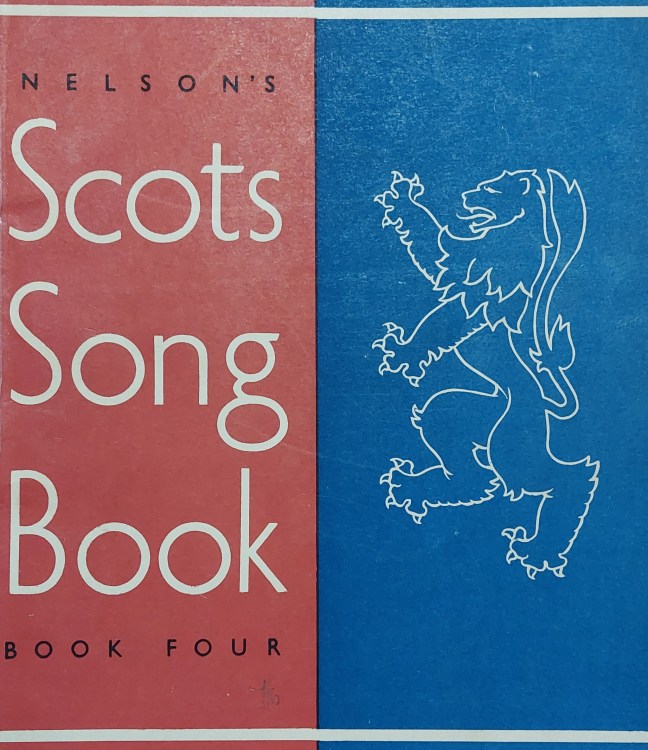
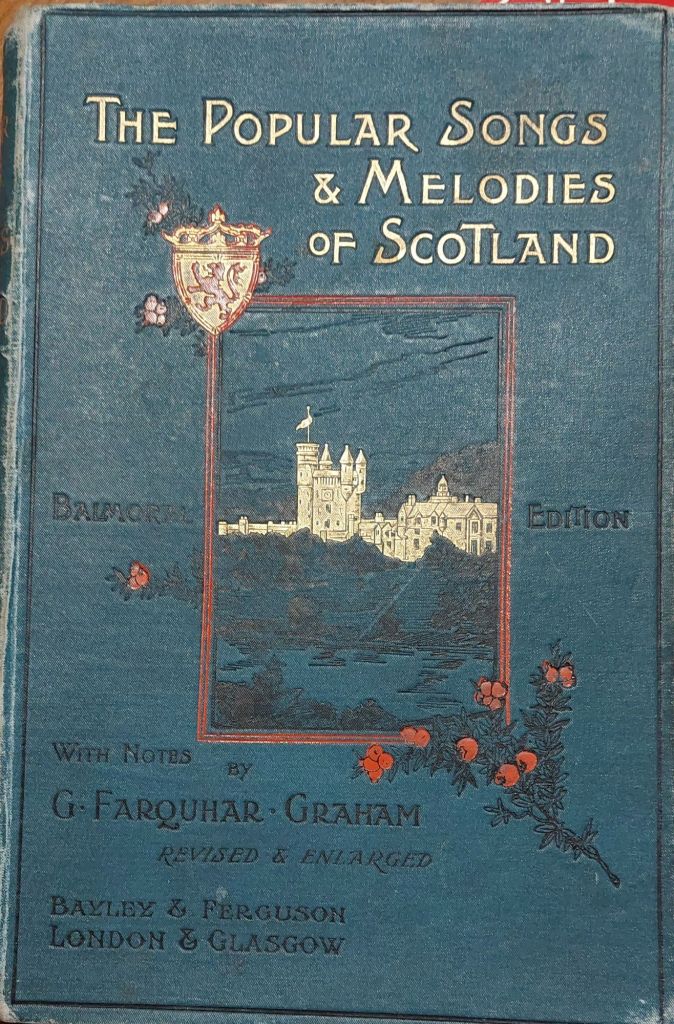
In place of a large wall-hanging representing my latest research in its entirety, I’m trying a new way of making a cloth book, and focusing on a couple of Thomas Nelson books I’ve encountered. I’m still thinking about educational music books published by Nelson in the second quarter of the twentieth century. 

I’m using some iron-on embroidery transfers from my late mother’s collection (the kind where you iron-on a line drawn transfer,  leaving an outline on the background fabric, then work over it), along with a few ideas of my own.

We have only just realised that Mum hoarded things – she was so tidy and methodical that they could be sorted away in that large house, and no-one knew.  Why she kept quite so many embroidery transfers is a mystery.  For needlework teaching purposes? She retired in 1991!  Even I would never get through them, if I live another 30 years.

Anyway, with a bit of ingenuity, I’m finding musical motifs that might have been applicable in the 1930s to 1940s: Percussion bands.  Brass bands. Wind bands. I’ve copied Thomas Nelson’s singing child motif, and the Nelson publisher motif from books I’ve bought on eBay, and no doubt I’ll use the vintage thistle transfers (Scottish symbols) that I acquired from the same source.

Timpani  – second attempt!

There’s a rather fanciful house from Mum’s stash, which I embroidered against a blue background reminiscent of heavy rain, last weekend – Storm Amy was with us, and I had stayed at home last Friday rather than going to Edinburgh. (A wise choice, as it transpired.)  I need to end up with 20 cloth pages, so I might need to go through the stash again to see if I’ve missed anything, or start embroidering quotes that caught my eye. I’ve done one of those  already.

‘Three Stars and a Wish?’ Forget it!

I have to keep reminding myself that this is something I’m doing for fun, as an amateur, whilst Mum was a professional. As an old-school teacher, she hadn’t encountered the ‘three stars and a wish’ principle, and if it wasn’t up to scratch, she told you. Straight. No gentle preamble about what you had done well.  The ‘Spirit of Mum’ has more than once seen me unpick things because it was plainly ‘not my best’.  And whilst my little rainy-day house is now finished (after some unpicking and reworking), I can’t guarantee that I won’t have another go, just to try to improve it. (Maybe representing a sunny day, next time?) It’s strange how one still feels the weight of parental expectations, and hears the criticism, even when they’re no longer around.  This is probably the root of my perfectionism – but I’m working on it, honest!

The next problem, of course, is where to put my creations …?

From That, to This (the Original Idea)

It would have been a much larger art work!

Original Artistic plan for the work

I proposed to create a 2-dimensional hanging collage. Predominantly in black and greys, it would have depicted archival shelves and resources; silhouettes of editors; and in the foreground, children singing from the Nelson Scots Song Book,and a teacher at a piano.  The song-books would reflect the original colours of the Nelson books.  A furled blue and white Saltire flag would have occupied a lower corner of the collage.  Further details, space permitting, might have included popular motifs: a Highland piper, a thistle, or a Highland dancer; a snatch of a song in music notation, and a few significant editorial words from correspondence.

Explanation

The narrative behind this collage would have demonstrated that even a set of small Scots song books had an ultimate audience or user in mind, deriving from decisions by compilers and editors, and created as part of their day-to-day work amongst other projects. The books’ contents show the compilers responding to a contemporary urge to educate and immerse young Scots in their traditional culture.  Illustrations of resources would have hinted at the sheer quantity of paperwork behind the publications, and would have included stitched representations of bundles of paper, a document file and a correspondence book, whilst small, typically Scottish motifs would, if possible, have reflected (but not reproduced) the well-received line-drawn pictures commissioned for the separate pupils’ editions of the song books.

What A Day!

Untitled design from Canva. Silhouetted heads and geometric shapes
Could you hear the cogs turning?!

Right, my two proofs (an article and a contributed chapter), and the final version of another article, have all been returned to their editors. It has actually been quite interesting revisiting recent and not so recent research, after some time away from  it.  Such revisitations help consolidate things in one’s mind, and keep the topics alive and vivid.

The Big Idea

Tomorrow, by contrast, is a day for looking ahead: I need to start a book proposal and apply for some funding. Storm Amy will determine which desk, on which side of the country, I might be using. Waterproofs at the ready, but I don’t think I’ll take an umbrella! Scottish wind can invert the hardiest of specimens.

The Big Idea: another Book

I’m contemplating writing another book. It’ll be based on my recent researches as an IASH Fellow, obviously. But I’ve had a brainwave of an idea for the final chapter – which involves a bit more research – so the past few days have been dedicated to exploring possibilities. As I now know, from the historical Thomas Nelson point of view as much as my own present existence as a scholar, publishers like publishing things in series. It helps them sell, if readers can see how a book fits into a larger grouping of books. I’ve been thinking about where my book might fit in.

I’ve also had a wee jaunt to Dundee to talk to a scholar of my acquaintance; and today, I sat down to write an email. Who’d have thought it would take most of an afternoon to write an email?! But when it’s important, it’s worth taking some effort in the crafting of it.

‘Faint heart never won fair lady’

Finally, I thought it was just right. I mused that maybe I should leave it and re-read it tomorrow. But no, I must be resolute. So, I did not prevaricate. More of this thrilling story in due course …

Like Buses, Pre-Publications seem to come in Threes

Three blue double decker buses, one behind the other

Since Friday, I’ve been sent three exciting emails:-

  • the proofs of one chunky article that’s due to be published next year;
  • the proofs of a contributed chapter with probably a similar timescale,
  • and another even chunkier article that has now been accepted – but needs a couple of final touches before I send it back to the editor.

Not bad, in two working days with a weekend in between!

It’s just the way things turn out, but the first article is a late-in-the day return to a paper that I originally gave in 2019 – I waited to be sure that the original conference organisers wouldn’t be needing it. Not only that, but the paper itself had been a return to, and development of, a topic I researched for my PhD and subsequent first monograph, so it has been a long time brewing! I first ‘encountered’ the ghost of Sir John MacGregor Murray some twenty years ago, and a fascinating ghost he turned out to be. He deserves his article in Folk Music Journal next year. Proofs checked and returned already.

Meanwhile, the book chapter expands on work that I did for my own recent second monograph, A Social History of Amateur Music-Making and Scottish National Identity, focusing on a song collection published in time for the Festival of Britain. And the other article picks up on very different threads from that monograph, but also represents a considerable amount of detailed research since then. I look forward to checking the chapter and dealing with the article.

I do have another article due to be published later this year, too. More of that anon.

When you consider that I’m just beginning to think about a third monograph, it’s all a bit dizzying. Mind you, that won’t be happening immediately. I’m still exploring ideas. (Would it be disloyal to say that this is all so much more fun than cataloguing jazz CDs in my earlier existence …?)

Buses photo: Image by Jm TD from Pixabay

One Book. One Story – about the Book itself

Woman reader looking up thoughtfully

(Do I live in the 1950s these days?!) I’ve been tracing a woman who briefly worked for publisher Thomas Nelson in Edinburgh in the mid-1950s. Yesterday, I found a memo from her to one of the managing directors. Instructed to throw a book away if she couldn’t find a use for it, she promptly did find a use for it, giving it to the library of the Glasgow training college where she had previously worked.

I admired her honesty in telling him, because there was probably no need to report back on what happened to a book that was clearly regarded as inconsequential. It came from the Toronto branch of Nelson’s, and was about important Canadian educationalists; I can see why it might not have been much use in the Edinburgh office. (She had, in fact, travelled back from Montreal at the age of 16 – I have no idea how long she’d been there – so maybe he knew this, and thought she’d be interested in this combination of a country she’d visited, as well as a topic she knew well.)

Nonetheless, she did tell him, and reported that not only did the college librarian thank her, but her former boss at the college had commented that it was a title she’d actually been looking for. My interest was piqued, and I checked Jisc Library Hub Discover. Sure enough, the college has since been absorbed into a university, but the university library still has that book – the only copy in the UK. It has survived 72 years and at least one library relocation. I wondered if it had subsequently been borrowed by that senior training college lecturer – the one who had been looking for it?

Apparently not! The book has no trace of ever having been borrowed. Let’s hope she at least sat and read it in the library!

Image by Bianca Van Dijk from Pixabay

Jobs for Girls and Boys in the 1950s

Yes, I’m afraid I have been distracted in my archival search for the editor of some teaching materials.  I identified a run of box files for the right years, but it turns out not to be from the editorial team. The sales department was obviously crucial, once the books were ready to market and sell, but if my present quarry had only had any evident input into one solitary published title, then frankly those boxes probably don’t concern me in my present research.

Nonetheless, I inspected four boxes fairly closely, before deciding to stop looking at the boxes from 1953. 

In passing, in the ‘Nelson Juniors’ series, I  encountered some careers-related books from the 1950s. The choices – apart from that of journalist – are rather stereotyped! On the other hand, the girls seem to have more choices … curious, that! Maybe they meant to publish more titles, before the series rolled to a halt with the ‘engine driver’ in 1960.

Found on eBay!
Yes, also on eBay

How I became a … (by women authors)

  • Ballet dancer
  • Fashion model
  • Journalist
  • Librarian
  • Nursing Sister
  • Air Stewardess

How I became a … (by male authors)

  • Cricketer
  • Detective
  • Engine Driver
Also on eBay!

The first and last of these seem to have attracted some interest! The ballet book was reviewed in an American dance magazine – Dancing Star, by the editor of a British magazine called Ballet Today. The Ballet Annual wanted to review it. (A lot of announcements were sent to relevant organisations and individuals.) Moreover, The Psychologist Magazine wanted to review both the ballet book and How I became a Nursing Sister. (Nursing, I can understand. But reviewing a children’s book about the career of ballet dancer? Was it to gain insight into a young ballerina’s mind …?)

And even if nowadays, it looks pretty mundane, Meccano Magazine and The Model Engineer both requested review copies of How I became an Engine Driver.  The Stephenson Locomotive Society were also sent a review copy, along with 2750: Legend of a Locomotive, and they promised to publish a review in the Society’s Journal. Indeed, Thomas Nelson sent a presentation copy of the book to the Lord Reay Maharashtra Industrial Museum in Bombay in response to a request for books for the museum library being set up there – just that one book!

Image by Alana Jordan from Pixabay

A Day for Obscure Queries

Sign saying, ASK

I had set myself an assignment today: I would look up articles by scholars in fields related to my own, and see which journals they tended to publish in. (Litmaps is a very useful way of looking up scholarship in related fields to one’s own:- https://www.litmaps.com/ )

Then I would look up the journals and see what their acceptance rate was, and note any other useful metrics. Sometimes it’s a good idea to take a step back from the detail of one’s research, and think about where it might ultimately find a home! I rolled up my sleeves and got started. After a couple of hours of this, one tends to get a bit befuddled. But then …

I unexpectedly received an email from an unknown individual. Someone I did know had recommended me to help with a rather obscure query about Scottish songs. Maybe anyone else would have sensibly thought that they’d deal with it later when they had a minute, but my ex-librarian-brain kicked in before I could stop it, and within an hour or so, I had part-answered that query to the best of my ability. At that point, I remembered that I wasn’t a librarian any more, and wasn’t obliged to persist until I had exhausted every corner of the internet! I’d looked in the places where I’d normally go, so I thought I’d done a reasonable job.

Back I went to my task in hand. I found a useful website for making Venn diagrams, PresentationGo – it’s at www.Presentationgo.com – and came up with a beautiful little Venn diagram to remind myself what I was looking for. I made better progress than I had yesterday; and resumed the task after lunch.

By mid-afternoon, I was getting a bit weary – I didn’t get nearly enough sleep last night. I confess, I was close to nodding off at my laptop when the doorbell rang, bringing me sharply back to a more alert state. Two complete strangers stood outside, one apologetically introducing themselves with, ‘I’m afraid I have probably got the wrong address, but I’m looking for the Scottish Tramway … ‘

I laughed. ‘Oh no, you’ve got exactly the right place. Hold on, I’ll get Himself …’

You see, if my research interests seem obscure, then His all-consuming hobby interest – trams – is equally niche. And he’s heavily involved with an enthusiasts’ society. So I went and told Him he had visitors. He wasn’t expecting any; it turns out this is the first time anyone has actually, physically come to the door with their own unique research query about trams. It made his afternoon: he was quite enchanted, and very happy to oblige with possibly more information than his enquirers had dreamt of. Upstairs and down he went, pulling out useful copies of the society magazine and goodness knows what else. (I’m afraid I went straight back to my desk, wondering whether I’d be cooking tea at the normal time, or waiting for the Tram Advice Surgery to terminate.)

Who would have thought that a terraced house not far from the River Clyde would provide such a useful, if specialised advisory service?

Images by Dean Moriarty and Brigitte Werner from Pixabay

Scholarly Rejection? Get Back in the Saddle!

Brown horse with empty saddle.

Today, after submitting an article to a journal, I suddenly realised that I hadn’t added to my ‘activity log’ for a while. It has been a sombre summer; I went down south twice; did nothing scholarly at all for some five weeks of the summer; and promptly went down with some virus or other when I got back to Glasgow for the second time – so it’s hardly surprising if I took my eye off the ball. Nonetheless, I decided there was no harm in looking out the activity log and updating it. I got quite a surprise. The two rejections earlier this year, coming close after one another, had hurt. I feel a bit sore about the piece I had genuinely thought was accepted one or two years ago, but more recently turned out to be very much not so; and even more sore about the piece that was requested and then kindly but firmly declined. I felt misunderstood!

But it appears that this scholarly year hasn’t been as bad as I thought, notwithstanding those two knocks. I’ve had an article published; and I’ve given a conference paper and two talks. To any ambitious American academic, this probably seems like pathetically small beer, but I’m a British musicologist, I’m 67, and I’m not trying to secure tenure in terms of a full-time academic contract, so it’s all okay. (I could get a dozen articles published in a year, and it would make no difference to my age or status.)

I have a book chapter and a couple more articles accepted and pending publication. Another article accepted subject to revisions, which I’ve submitted – fingers crossed this time! And today’s article just submitted. That doesn’t seem too bad to me. I now have a couple of half-promised articles which I really ought to get on with; another idea for a collaborative article; and the conundrum of a possible third book. (I’m nowhere near writing this illusive thing, but I do have angles to explore, before I can formulate a precise way forward.)

But what I do know, is that the more irons I have in the fire (yes, more cliches – sorry!), the less I mind about the rejections. Maybe I just directed them to a subject area more dissimilar to my own than I realised, so didn’t hit the targets that were expected? In any case, having other things submitted and under consideration at least offers the hope that next time I might be successful.

More irons in the fire …

I wonder what my activity log will look like by the end of the year?!

Image by JamesDeMers from Pixabay

‘You should find that the system is very user-friendly …’

I wrote an article. Revised it. Revised the revisions. I have no problem with this – it’s all intended to make it a better article, and hopefully it is now better. However, I feel less positive about the mechanics of submitting it! You have to use a platform called Manuscript Central. Manuscript Central is a product of the ScholarOne platform.  (It was owned by Thomson Reuters, then Clarivate and is now owned by Silverchair.  Still with me?) I Googled it, and one journal publisher described it as user-friendly.

I’ve used it before. Indeed, I’ve uploaded revisions before.  But today, I couldn’t work out how to do all my re-revisions within the platform. After much huffing and puffing, I did submit a manuscript. I’m less confident as to whether I submitted it correctly! And I dislike feeling thwarted by technology. It doesn’t encourage me!

Confused – but no hair was torn out!

On the positive side – I normally have the greatest difficulty stopping research activity when I stop being a part-time researcher for the day, but today I was more than happy to close the document. Gently, if metaphorically shutting the door behind me!

On Thursday, I’ll turn to the next article for submission.  Hmm, which platform for this one …?

Aha! New Arrival all the Way from Arran

Once used in an Edinburgh school, a wee Scots song book (pupil’s edition) found its way to a shop on the Isle of Arran, then back to the mainland to me in Glasgow.

1, 2 … still looking!

If you ever find any of these in the back of a school cupboard, or bookshop,  or car boot sale, or Granny’s attic …

… please do let me know!  I’m trying to get complete set! There were four books for the kids, and four for teachers.