It’s Getting Closer! The Next Article

Anyone looking at my publication record is soon going to be mightily confused. The article about Sir John Macgregor Murray concerns a Highlander who lived from 1745-1822. I wrote it at a time when I was still researching Scottish music collecting and publishing in the late eighteenth- and early nineteenth-centuries.

Today, I received the final proofs for the next extensive article. This time, it’s about Scotswomen with portfolio music careers in the late nineteenth- and early twentieth-centuries. (Two of them were of English parentage, but let’s not quibble!) A spin-off from my latest book, in the sense that I turned my focus onto a number of individuals who had hung around in the shadows of the book, this article extends over some 22 pages, and luckily there wasn’t a great deal needing changing in the proofs.  But the instructions for using the proofing system extended over 49 pages, and there was also a ten-step quick tour of the process. I nearly had a fit at the sight of the former, but the latter told me nearly all I needed to know. Job done.

There are still more articles in the pipeline; I’ll flag them up as they come along! Meanwhile, there’s the small matter of Christmas requiring my attention during the semi-retired part of my existence, not to mention the continued tidying up of our poor scarred, rewired residence! But first, I need stamps …

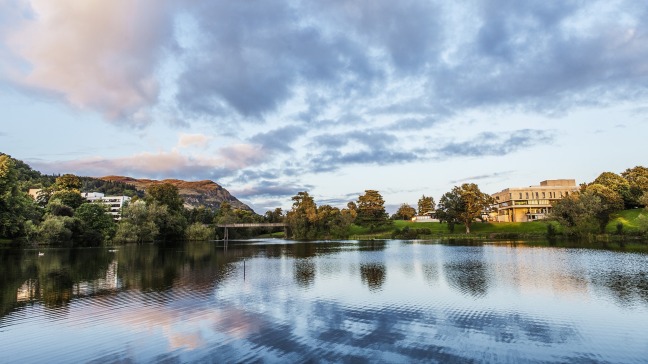
Image: Glasgow Athenaeum, forerunner of the Royal Conservatoire of Scotland (Wikimedia Commons) – where two of ‘my’ musical ladies received their advanced musical training.

New Article about Sir John Macgregor Murray, in the Folk Music Journal

Finally, an article from me after a long spell of apparent silence. ‘Sir John Macgregor Murray: Preserver of Highland Culture, Music and Song’. Folk Music Journal vol. 13 no.1, pp.50-63. 

The article started out as a conference paper, but I felt it deserved a wider audience. Let me share the abstract:-

Abstract

Sir John MacGregor Murray is known by Scottish music historians as the man who retrieved Joseph Macdonald’s Compleat Theory of the Scots Highland Bagpipe. This act of transmitting a work about Highland culture was just one instance of the Highland chieftain’s involvement in facilitating the artistic output of his native country. A founder member of the Highland Society of Scotland, he traversed the Highlands in pursuit of James Macpherson’s Ossian poetry, assisted song collector Alexander Campbell in planning his own itinerary in the Highlands and Western Isles, and helped establish a piping competition in Edinburgh. Sir John was one of a number of individuals who played a mediatory role in the collecting and publication of Scottish music.
This article outlines Sir John’s role in the codifying and promotion of Highland culture, embracing literary as much as musical endeavours. It also introduces some of the other individuals who played a similar role in Scotland during the Georgian and Victorian eras.

EFDSS (English Folk Dance and Song Society) website

Folk Music Journal

Lanrick Castle Gatehouse (Wikipedia)

Check out “Books and Borrowing Database Launch” on Eventbrite!”!

How could I resist this event?! After all my efforts a few years ago, researching the borrowing of legal deposit music at the University of St Andrews in the early 19th century, I simply HAVE to attend this. It’s somewhat ‘meta’ for a scholar librarian to take a research interest in the borrowing habits of readers who ‘checked out’ centuries ago, isn’t it?

I’ve rearranged my research hours accordingly, so I  can finish the week on a research rather than a librarianly note:-

Books and Borrowing Database Launch Date: Fri, Apr 26 • 16:00 BST Location: University Avenue, Glasgow, G12 8QQ https://www.eventbrite.ca/e/books-and-borrowing-database-launch-tickets-879501281007?aff=ebdsshother&utm_share_source=listing_android

Ramsay’s ‘The Gentle Shepherd’ Songs

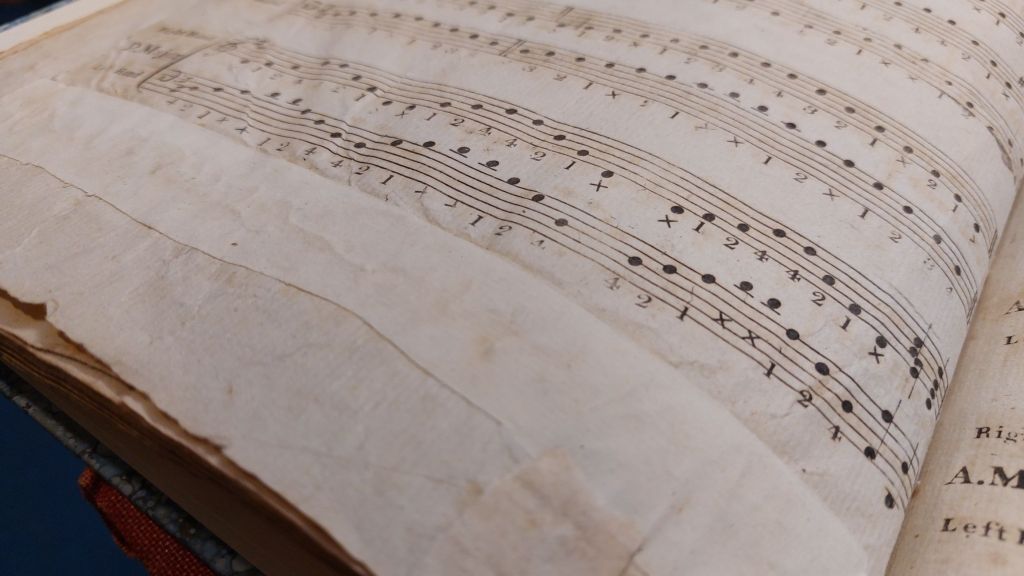
Reaching the end of my recent cataloguing project – the gift of a number of books of old Scottish music – I must confess I left what looked like the most miscellaneous, worn, unbound pieces until last. Late on Friday afternoon, I had observed that one such piece had a pencil note at the head – ‘Music for The Gentle Shepherd, Foulis edition, 1788’. Now, this is a famous ballad opera by Allan Ramsay.  It was so popular that my colleague Brianna Robertson-Kirkland writes that there were 86 editions of  The Gentle Shepherd, 66 of them the ballad opera. Initially, the songs only indicated the name of the tune to use, and different editions have more or less songs. The 1788 edition contains a full vocal score of the songs, and that’s what we’ve got. My guess is that the last owner bought the 18 pages which someone had previously separated from the back of the larger original volume.

I haven’t made a study of it myself, but I do recognise the opera and its songs as very significant in the history of Scottish music – and this edition has particular importance.  So, if this gathering of pages was so important, it would benefit from a  decent catalogue entry.

The pages are numbered 1-18.  With no title-page, still less a cover, to give me further clues, it wasn’t a task for 4.30 on a Friday afternoon, but it very definitely was one for a Monday morning.

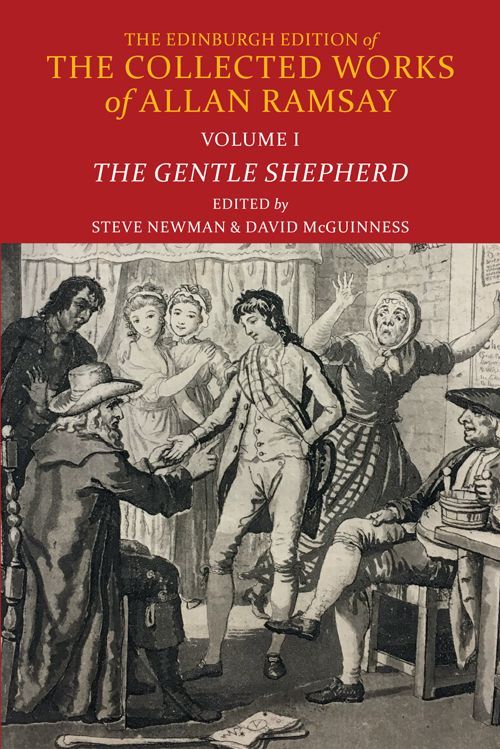
A bit of digging around soon found me another library’s catalogue record of Ramsay’s ballad opera in that very edition – a particularly significant edition, because it’s the most lavish, quite apart from having the complete vocal score section. RCS lecturer Brianna Robertson-Kirkland has researched the work in detail and written an article about it, which is on one of her class reading-lists. Dr David McGuinness, with whom I worked on the HMS.Scot AHRC-funded project a few years ago, has also recently published a book about it,  with Steve Newman.

The new Edinburgh Edition of The Gentle Shepherd

But the catalogue record didn’t exactly fit my purpose, because what I had in my hand was the appendix at the end of the book, containing all the songs. We didn’t have the text of the ballad opera at all.

No problem – I downloaded the catalogue record and adapted it to reflect what we did have. I made sure the words ‘Scottish songs’ appeared in the catalogue record, and I indexed every one of those songs. The appendix is only eighteen pages long – it wasn’t that arduous a task. I’m really happy that we’ve been given this, because – even though it’s fragile and will have to be handled with extreme care – it means the students will now be able to see the music that Brianna has written about, and lectures about.  (It still needs a nice stout card folder, and a secure storage space – but they’ll be sorted out soon.)

Informed Cataloguing

There’s one strange thing, though. It appears no other cataloguer has catalogued each song in The Gentle Shepherd – not in Jisc Library Hub, at any rate.  Well, although we at RCS might not have the whole magnificent text, a title page or a cover, we HAVE now got a catalogue record which indexes all the songs. Hooray!

Contents:-

  • The wawking of the fauld (1st line: My Peggy is a young thing)
  • Fy gar rub her o’er wi’ strae (1st line: Dear Roger, if your Jenny geck)
  • Polwart on the Green (1st line: The dorty will repent)
  • O dear mother, what shall I do (1st line; O dear Peggy, love’s beguiling)
  • How can I be sad on my wedding day (1st line: How shall I be sad when a husband I hae?)
  • Nansy’s to the green-wood gane (1st line: I yield, dear lassie)
  • Cauld kail in Aberdeen (1st Line : Cauld be the rebels cast)
  • Mucking o’ Geordie’s byre (1st line: The laird, wha in riches)
  • Carle, an’ the king come (1st line: Peggy, now the king’s come)
  • The yellow-hair’d laddie (1st line: When first my dear ladie gade to the green hill)
  • By the delicious warmness of thy mouth
  • Happy Clown (1st line: Hid from himself)
  • Leith Wynd (1st line: Were I assur’d)
  • O’er Bogie (1st line: Weel, I agree ye’re sure o’ me)
  • Kirk wad let me be (1st line: Duty, and part of reason)
  • Woe’s my heart that we shou’d sunder (1st line: Speak on, speak thus)
  • Tweed Side (1st line: When hope was quite sunk in despair)
  • Bush aboon Traquair (1st line: At setting day and rising morn)
  • The bonny grey-ey’d morn
  • Corn-Riggs (1st line: My Patie is a lover gay)

I struggled to explain to my family just how gratifying I find this.  But I think it’s really important not only that Brianna’s students can see which songs are in Foulis’s edition of The Gentle Shepherd, but also, anyone looking for one of those song titles will be able to see that it was one of the songs used in the famous ballad opera.

As a matter of interest, we do also have some items going back to the era when Cedric Thorpe Davie put on a performance of the opera. Anyone checking our catalogue will spot those too!

Material Evidence of Use: Music that was Loved

I accepted a generous donation of old books to the Library a couple of weeks ago. This presented me, personally, with a bit of a problem because our offices, furniture and contents are being moved around, and I had proudly emptied most of my shelves in readiness.  There will be fewer shelves in the other office.  And now I had two shelves full of old Scottish music  – right up my street – which needed cataloguing.

  • Most vital priority – get them done before I retire from the Library.
  • Almost as vital – to get them done before the move on Thursday next week!

Of course, the lovely thing is that they’re books I’ve encountered in various research contexts … the PhD; the Bass Culture project (https://HMS.Scot); the book chapter on subscriptions; and my own forthcoming monograph.

I catalogued like crazy on Thursday and Friday. I’ve catalogued Sammelbande (personal bound volumes) of songs, piano music and fiddle tunes. I’ve shown colleagues books signed by George Thomson.  I’ve indexed Gow’s strathspeys and reels. And yesterday I blogged about James Davie and his Caledonian Repository.

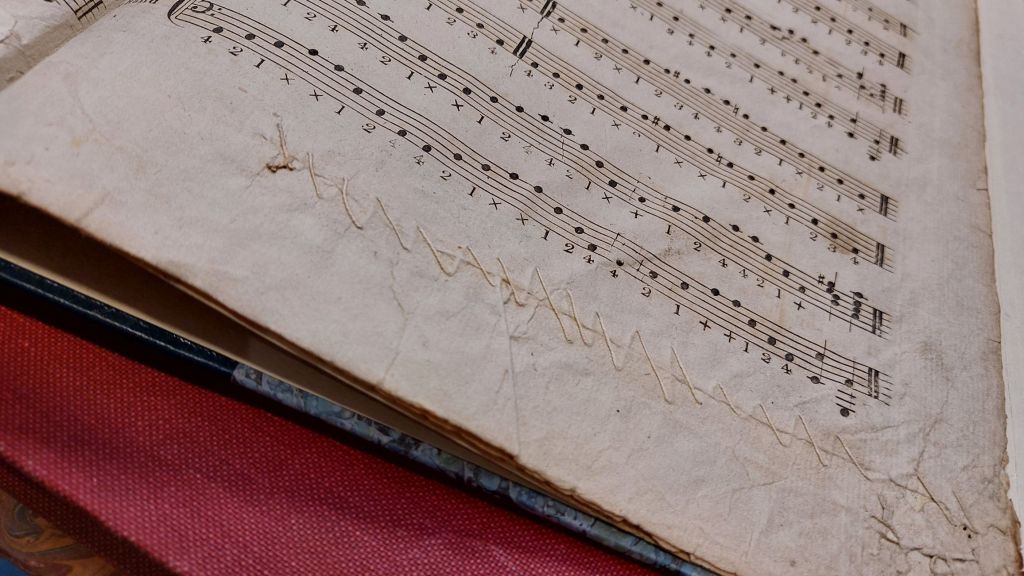
But I’ve also just enjoyed handling the music, because sometimes one finds some endearingly human evidence of the scores being used, even to the point of needing mending.  It’s quite touching to ponder how much a piece had been used, before it actually needed stitching – here, along a line where the edge of the printer’s block had originally left a dent in the paper:-

Stitched on one side, pasted on the other!

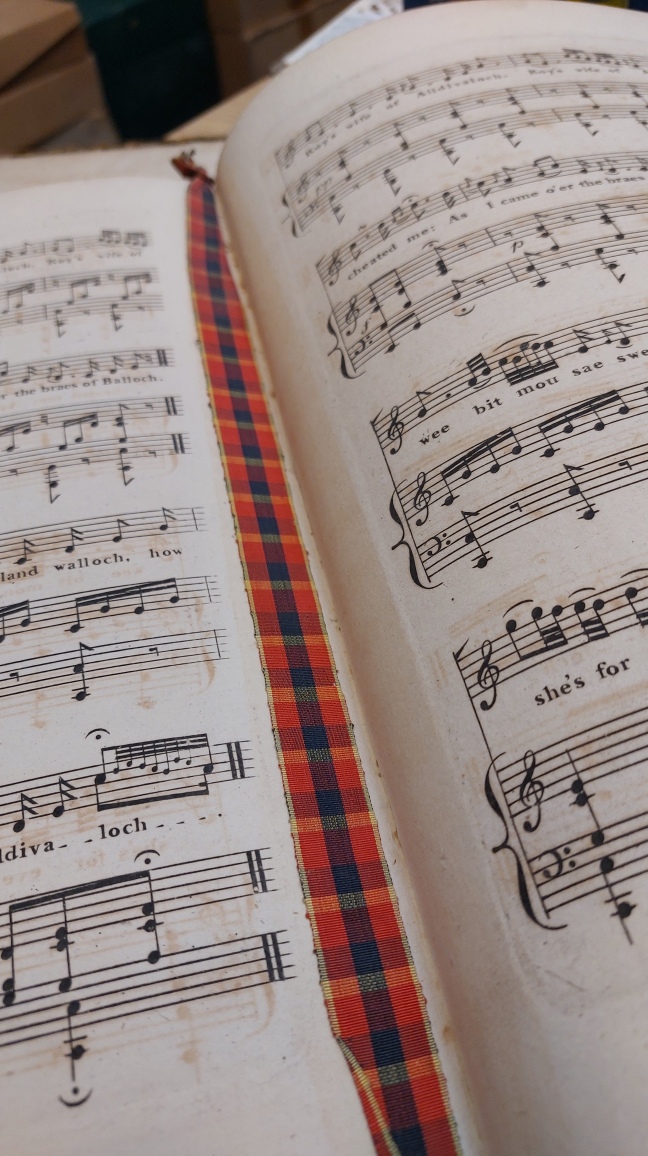
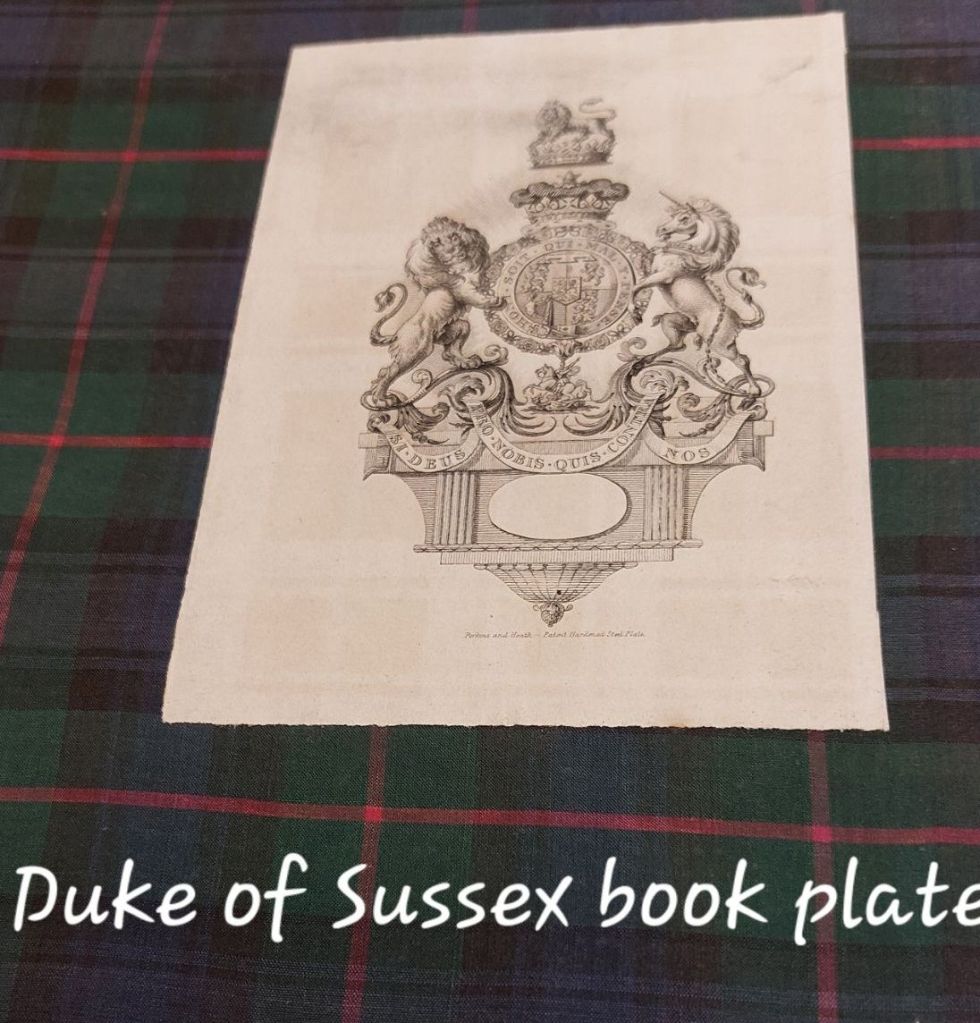
I’ve smiled at Georgian ladies’ stitched repairs to much-loved pieces, noticed with amusement a handful of early Mozart Allan books (yes, including some strathspeys and reels) in a fin-de-siecle Sammelband which had seen better days; spotted piano fingerings pencilled in; and best of all, found a tartan ribbon in a volume dedicated to the Duke of Sussex – his personal copy, which was first sold out of the family’s possession in 1844.  His library was dispersed after he died in straitened financial circumstances:-

Nine Scots Songs and three Duetts, newly arranged with a harp or piano forte accompaniment / by P. Anthony Corri

Whittaker Library catalogue entry

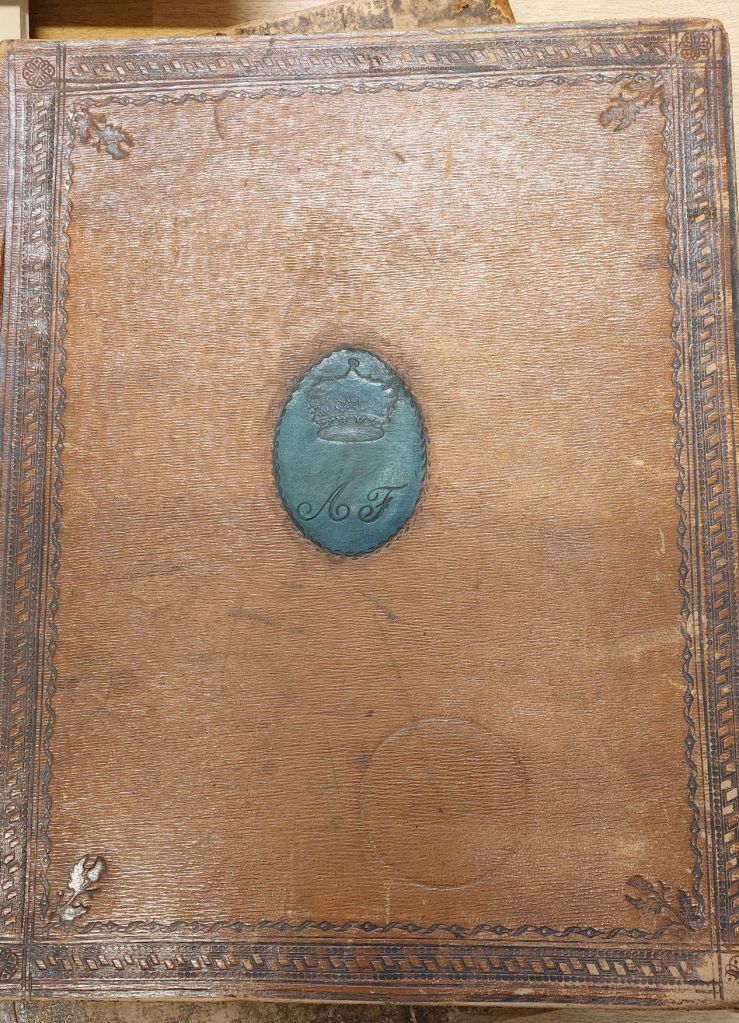
This book has the Duke’s family crest on a label pasted inside, and the outer cover is embossed with  ‘A F’ (Augustus Frederick), reflecting the monogram on the title page.

The Duke of Sussex’s mongram
Augustus Frederick, Duke of Sussex (1773-1843)

The tartan endpapers and tartan ribbon between pp.30-31 are a perfect illustration of what I have written about in a chapter on tartanry in my forthcoming monograph.  Everyone – whether nobility or commoner – liked a bit of tartan on or inside their Scottish song books, and here, someone even found a bit of tartan ribbon to use as a bookmark.

I have just a few of those books left to catalogue now.  There’s an intriguing one without a cover or title page, waiting for 9 am on Monday  …!  Hopefully, I’ll end up with an empty bookcase again.

What does a Librarian want with a PhD, anyway?

Few people in Glasgow knew that I had an unfinished first PhD guiltily lurking in my past, when I announced I wanted to do a PhD. It would actually be my second attempt. I’m told that someone (an academic?) asked that memorable and somewhat hurtful question, ‘What does a librarian want with a PhD, anyway?’

Chained to the shelves – Wimborne Minster Chained Library (Wikipedia)

I realised with a jolt, yesterday morning, that I would be retiring from librarianship exactly fifteen years to the day, since I submitted my thesis to the University of Glasgow. I never managed to cease being a librarian in order to become a full-time academic, because I had family responsibilities in Glasgow, and the chances of a full career-change without relocation were limited, to say the least. However, if I entered librarianship with the unfulfilled expectation of soon having a PhD from Exeter, and the aspiration to become a scholar-librarian …. well, I did achieve the latter aspiration. After getting the Glasgow PhD, I became partially seconded to research three years later, and I’ll continue as a part-time researcher when I’m unshackled from the library shelves.

I don’t know who it was that queried whether a librarian actually needed a PhD, more than twenty years ago. It’s probably a good thing I don’t know! However, if I could show that individual how I’ve just spent my afternoon, then maybe they’d begin to understand.

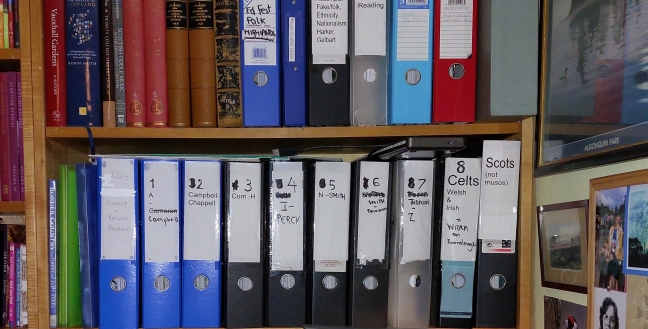
The other day, an academic colleague said they were putting a student in touch with me, to advise them about resources for a project. This afternoon, I was working from home as a librarian, so I decided to spend the time finding suitable resources for my enquirer. I had in mind a lever-arch file from my own research activities, that I knew was in my study-alcove.

Subject Specialist

[Scottish] ResearchFish

The more I thought about the query, the more things I thought of suggesting. I looked at my own monograph, for a start, along with a couple of essay collections that I’ve contributed to. I compiled a list, mostly but not entirely from the library catalogue. (I tweaked a few catalogue entries whilst I was at it. What does an academic want with a library qualification?, one might ask!) I The family balefully eyed the dining-room table that they were hoping to eat off, as I moved aside the ancient and modern books that were gaily strewn across its surface. However, I’m fairly content that I’ve done my preparation to help with the query. I’ve also enjoyed an afternoon in the company of old friends – the compilers, authors and editors of all those books!

A Value-Added Librarian

Listen, I wouldn’t have known any of those resources if I hadn’t done that PhD. I wouldn’t have known what the arguments were. I wouldn’t have known how nineteenth and early twentieth century song-collectors viewed their collections, nor the metaphors they used to describe them, nor which collections might be of particular interest. I wouldn’t subsequently have collaborated on The Historical Music of Scotland database. And if I hadn’t gone on researching, I wouldn’t have known about some of the more recent materials, either.

I kennt his faither! (A Scot knows what that means)

There might have been times when others wondered who I thought I was, but I am absolutely certain that it has come in useful!

‘Repugnant to Modern Feelings of Propriety’? The Most Beautiful Scottish Song

I’ve started listening to another Audible book, but it’ll take a while for me to finish it. To take a break from listening, I sidled over to the piano and played a one-eyed rendition of my favourite song.

Lady Anne Bothwell’s Lament (Baloo, my Boy)

My Song Gems (Scots), edited by James Wood and Learmont Drysdale (London: Vincent Music Co., 1908), is a nice big score that sits comfortably on the piano stand. This song is arranged by Finlay Dun, a Victorian arranger. As I squinted at the words, they didn’t look like what I remembered hearing sung from Cedric Thorpe Davie and George McVicar’s The Oxford Scottish Song Book (1969). What was going on? I suspected Davie and McVicar had taken their words from George Farquhar Graham and James Wood’s mid-Victorian Songs of Scotland. ‘You’ll see’, I told my bemused son. ‘The words will have been too smutty for Victorian ears, so Graham and Wood changed them.’

Davie used their words – which were perfectly acceptable for a collection intended both for classroom and adult use – but his musical setting is updated.

A Deserted Mother and Child

Graham and Wood’s collection revealed in the footnotes that it was an old ballad collected by Bishop Percy. However, Graham said that …

The Old Ballad, though poetically meritorious, is so coarse in most of its stanzas as to be repugnant to modern feelings of propriety. We have, therefore, adopted only the first stanza of it, the additional stanzas here given having been written by a friend of the Publisher.

Songs of Scotland (Edinburgh: Wood & Co., 1850), Vol.2, pp.30-31

Percy’s original version is in the National Library of Scotland’s Digital Gallery (Reliques of Ancient Poetry, 1767). Today, the lyrics are inoffensive!

And here’s the Cedric Thorpe Davie setting using Graham and Wood’s sanitized words:-

Kathleen McKellar Ferguson sings the Oxford Scottish Song Book version, divinely, here on YouTube

The Song Gems (Scots) version is in modern English and the text has been partially rewritten again –  it falls halfway between the original and the sanitized words! And the musical arrangement? Straight from Graham and Wood’s collection.

Percy, verse 3: Smile not as thy father did, to cozen maids, nay God forbid / Bot yett I feire, thou wilt gae neire Thy fatheris hart, and face to beire.

Wood and Drysdale, verse 2: Smile not as thy father did, to cozen maids, may God forbid / For in thine eye his look I see, The tempting look that ruin’d me …

Olde English or modern, take your pick!

As for Graham and Wood, or Thorpe and McVicar? Not a ruinous smile to be be seen! The lady may have been deserted, but no hint that she had first been seduced!

Report of Conference: Reading and Book Circulation, 1600-1800

(Libraries, Lives and Legacies Festival of Research), University of Stirling, 17-18 April 2023

I wrote a report for the conference that I attended in April this year, thanks to an LIHG Bursary. This report has just been published in the latest LIHG Newsletter for Summer 2023 , Series 3, no. 53 (ISSN 1744-3180), pp.7-10.

I thought I’d share excerpts of the report here, too.

The conference resonated strongly with the research topic of my 2017-18 AHRC Networking Grant, Claimed from Stationers’ Hall, when we were investigating surviving music in the British Legal Deposit libraries of the Georgian era.  Although my network was interested in books rather than music, I had immersed myself in the Georgian borrowing records of St Andrews University Library, and had taken a particular interest in the music borrowing habits of women of that era, so the opportunity to hear more about what people borrowed apart from music was irresistible. 

On the subject of borrowing records, the opening introduction to the ‘Books and Borrowing 1750-1830 project’ and demonstration of the digital resource by Katie Halsey, Matthew Sangster, Kit Baston, and Maxine Branagh-Miscampbell was fascinating, offering so much data for investigation.

The following panel on Reading Practices in Non-Institutional Spaces was just as interesting, with Tim Pye’s ‘Had, Lent; Returned: Borrowing from the Country House Library’, along with Abigail Williams speaking about non-elite book use in rural settings, and Melanie Bigold’s paper about women’s book legacies. Whilst my own interest has been in formal library borrowing, ‘my’ borrowers took music away for their leisure-time enjoyment, and these papers served as a reminder that musicians were probably just as likely to have borrowed music outwith the more regulated library environment. Similarly, the concept of the Sammelband is very familiar to me – that was how libraries kept their legal deposit music. Sam Bailey invented a useful new verb, ‘Sammelbanding’, during the course of their talk on ‘The Reading and Circulation of Erotic Books in Coffee House Libraries’ – a topic far removed from my own research.

Kelsey Jackson Williams’ hands-on session with books from the Leighton Library, in an exhibition curated by Jacqueline Kennard, was the perfect after-lunch session, offering the chance both to stretch one’s legs on the way there, and to inspect some rare selections from the Leighton.

Parallel sessions meant tough choices, but I opted to hear Angela Esterhammer talk about John Galt’s various publishing ventures – an intriguing history – followed by Cleo O’Callaghan Yeoman’s ‘Still my ardent sensibility led me back to novels’.  (I reflected that St Andrews’ first music cataloguer, Miss Elizabeth Lambert, had read a wide variety of books, and whilst her reading included travel accounts, religious books, and books on botany and conchology, she certainly wasn’t averse to reading a good novel, too.)  Next came Amy Solomon talking about Anne Lister’s considerable book collection at Shibden Hall, and how she had made an inherited collection her own, as well as keeping commonplace books, diaries, and reading journals. I regret having missed seeing the films about her diaries, and the two more recent ‘Gentleman Jack’ series on the television.

The first keynote paper was given by Deidre Lynch, on ‘The Social Lives of Scraps: Shearing, Sharing, Scavenging, Gleaning’.  I am sure I was not the only delegate pondering as to whether any of my own ‘scraps’ would survive to intrigue future readers, but more importantly, Deidre’s paper reminded us that proper ‘books’ are only a small proportion of the vast amount of printed material still surviving, often against the odds and far from their original context. 

On the second day, the opening plenary roundtable chaired by Jill Dye addressed borrowers’ records across Scotland, and I heard from several people with whom I was already acquainted, three of them through my own AHRC Networking project. 

We heard about the library of Innerpeffray, the National Library of Scotland, and Edinburgh, Glasgow and St Andrews’ University Libraries. I was interested to hear about the bigger picture, so that I could place my own special interests into the wider context.

For the third panel, I opted for the panel on Readers, Libraries and Loss.  Jessica Purdy gave a fascinating talk on ‘Libraries of Lost Books?’, speaking about chained church libraries, and the fact that their tight security and still pristine condition suggest that the books might as well have been ‘lost’ as far as most of the local residents were concerned.  Elise Watson, too, made us reflect upon just how many publications of Catholic devotional material had been published, even if they were so ephemeral that there are now ‘”Black Holes” of Ephemeral Catholic Print.’

For the fourth panel, I attended the panel on ‘Education’, hearing Maxine Branagh-Miscampbell talking about the Grindlay bequest and ‘Childhood Reading Practices at the Royal High School, Edinburgh’.  The Grindlay bequest was valued sufficiently that it was all added to stock, even though some material was never going to interest young or teenage boys.  Mary Fairclough gave an interesting talk on ‘Barbauld’s An Address to the Deity and Reading Aloud’.  I have recently encountered Victorian publishers appropriating evangelical hymns for magic lantern shows, but had not considered that poetry might also be ‘trimmed down’ and repurposed.

Duncan Frost’s paper did have a musical subject: ‘Bird Books: Advertising, Consumption and Readers of Songbird Training Manuals’.  Who would have thought that so many books were written about catching and training songbirds to sing in captivity?!  The most intriguing aspect of this genre of books was in fact that, despite many pages dedicated to all aspects of caring for and training your bird, there was significantly little information about the kind of tunes that you might want to teach it.

The second and closing keynote lecture was delivered by Andrew Pettegree, on ‘The Universal Short Title Catalogue: Big Data and its Perils’.  Professor Pettegree was at pains to underline not only what the USTC had achieved, but also its shortcomings, or rather, what it was not.  We were also reminded of some aspects that I have encountered in my own work: that books in libraries were not the only copies of these titles; they would have existed plentifully outside libraries, and so might other books which we can now only trace by, for example, publisher’s catalogues and advertisements. Moreover, library catalogues can conceal different editions, or show duplicate entries, depending on minor differences in cataloguing approaches.

Since my own networking grant, I have had to reflect upon the benefits of the work, and the impact the research has had.  One of the outcomes that I identified then, was that library history research created effectively a ‘third space’ where librarians and academic scholars – and those like myself, straddling both library and research worlds – could meet and beneficially share our insights and learning.  I realise that at this recent conference I had experienced exactly the same kind of meeting of minds again. Similarities of approach and a common interest in library and book history meant that I felt I had an underlying understanding enabling me to benefit from their fresh insights.

I am grateful to the Library and Information History Group for enabling me to attend this wonderful and thought-provoking conference.  Besides having such a rich array of papers to listen to, I certainly did benefit from the opportunities to talk to other delegates.  It was a treat to be able to take two days out of normal routine in such a beautiful setting, giving plenty of food for thought for the future.

Image: Image by G.C. from Pixabay

Home from Stirling – after the Conference

Stirling University Campus - photo from Pixabay

Conference: Reading and Book Circulation, 1600-1800

I am just back from a fabulous library history conference at the University of Stirling. Even better still, I was the lucky recipient of a generous bursary from the CILIP Library History & Information Group, meaning my attendance was fully funded.

I had many pages of notes to read through and reflect upon before I wrote my report – so many excellent papers to think about. My AHRC networking grant not so long ago was about music in libraries ca.1790-1836, and although I’m currently writing about more recent music publications, it was very interesting to see what else was happening whilst “my” legal deposit library music was being accumulated in libraries in England, Ireland and Scotland.

‘Claimed from Stationers’ Hall’ frock makes a comeback for the conference!

And of course, there was the networking. After the pandemic, lockdown, working from home, hybrid working and so on, it was quite a treat to be able to spend time with kindred spirits for two whole days!

My report will appear in the LIHG Newsletter in June 2023 – it’ll appear online on the LIHG pages hosted by CILIP. This might mean that only members can read it, but maybe I can write a summary of it to share here, once the whole report has gone live.

Image of Stirling University Campus by 昕 沈 from Pixabay

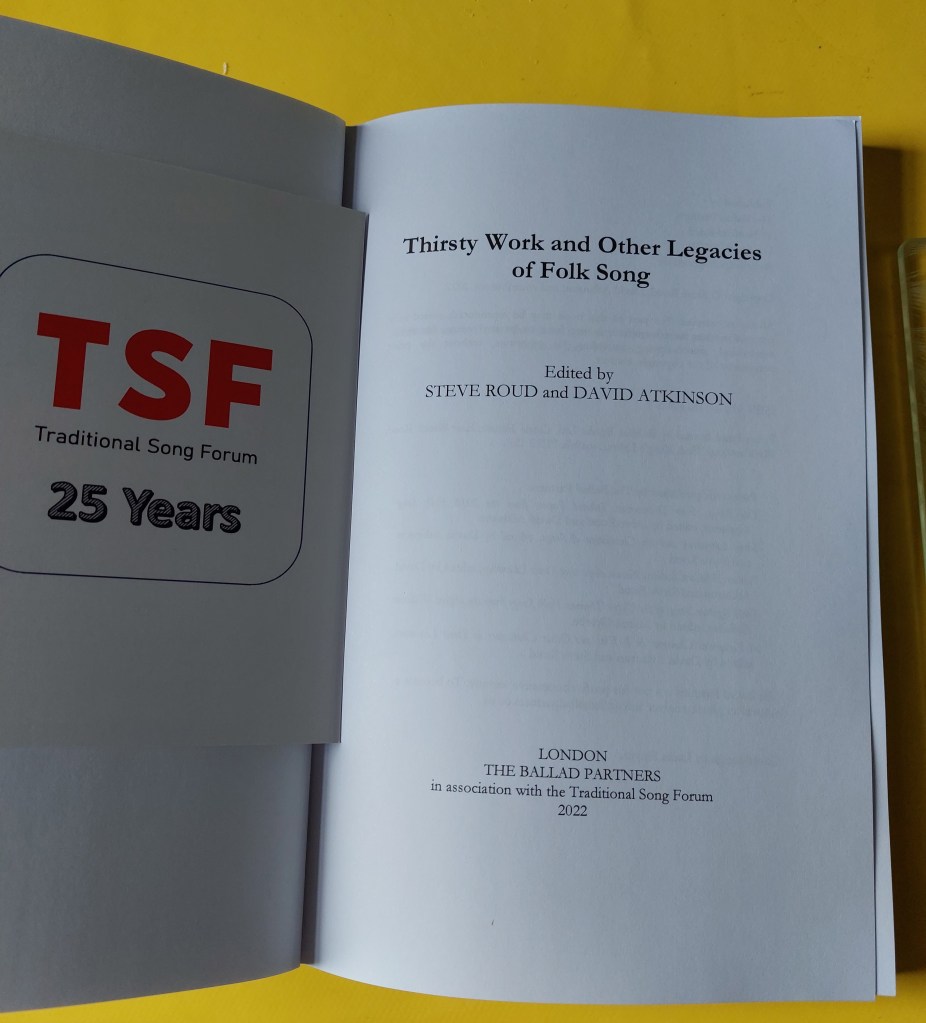
Read about Song-Collector Alexander Campbell, in ‘Thirsty Work and Other Heritages of Folk Song’ Conference Papers

I’ve just received my own copy of a new publication by Ballad Partners, Thirsty Work and Other Heritages of Folk Song, which contains my most recent Alexander Campbell article: ‘Alexander Campbell’s Song Collecting Tour: ‘The Classic Ground of our Celtic Homer’. There’s a section on Campbell and his musicianship – an entirely new angle which I spent some time contemplating during lockdown.

The book is Ballad Partners’ third book of Folk Song Studies.

I have just catalogued a copy for the Royal Conservatoire of Scotland Library – I listed the contents there, so I’ll repeat the list here for your interest. If you would like to purchase a copy of the book, please visit the Ballad Partners’ website. (I’m unconnected with the publishers – I am just one of the contributors!)

CONTENTS

Thirsty work: traditional singing on BBC Radio, 1940-41 / Katie Howson — From Tyneside to Wearside: in search of Sunderland songs / Eileen Richardson — Sam Bennett’s songs / Elaine Bradtke — Newman and Company of Dartmouth and the song tradition of Newfoundland’s South Coast / Anna Kearney Guigne — Railwaymen’s charity concerts, 1888-89 / Colin Bargery — Picturing protest: prints to accompany political songs / Patience Young — ‘That is all the explanation I am at liberty to give in print’: Richard Runciman Terry and Songs from the Sea / Keith Gregson — Drawing from the well : Emma Dusenberry and her old songs of the Ozarks / Eleanor Rodes — Alexander Campbell’s song collecting tour : ‘The Classic Ground of our Celtic Homer’ / Karen McAulay — ‘Don’t let us be strangers’ – William Montgomerie’s fieldwork recordings of Scottish farmworkers, 1952 / Margaret Bennett — ‘No maid in history’s pages’ : the female rebel hero in the Irish ballad tradition / Therese McIntyre — Who is speaking in songs? / David Atkinson