Dr Karen McAulay explores the history of Scottish music collecting, publishing and national identity from the 18th to 20th centuries. Research Fellow at Royal Conservatoire of Scotland, author of two Routledge monographs.
I’m contemplating writing another book. It’ll be based on my recent researches as an IASH Fellow, obviously. But I’ve had a brainwave of an idea for the final chapter – which involves a bit more research – so the past few days have been dedicated to exploring possibilities. As I now know, from the historical Thomas Nelson point of view as much as my own present existence as a scholar, publishers like publishing things in series. It helps them sell, if readers can see how a book fits into a larger grouping of books. I’ve been thinking about where my book might fit in.
I’ve also had a wee jaunt to Dundee to talk to a scholar of my acquaintance; and today, I sat down to write an email. Who’d have thought it would take most of an afternoon to write an email?! But when it’s important, it’s worth taking some effort in the crafting of it.
‘Faint heart never won fair lady’
Finally, I thought it was just right. I mused that maybe I should leave it and re-read it tomorrow. But no, I must be resolute. So, I did not prevaricate. More of this thrilling story in due course …
Folks, I’ve just noticed Routledge has a 20% summer sale on at the moment. So, if you or your library could use a copy, this might be a good time to get it! (All books and e-books are 20% off until 1 August 2025.)
The accent is on social history and Scotland – and music-making, obviously. I’m keen to hear what readers think of it. (If you are a reviews editor, do get in touch with Routledge. There’s a link on the website.)
Probably the most eventful year I’ve ever reported, 2024 saw plenty of action. However, I’d like to add a few words of explanation before I go any further. Firstly, everyone’s different and everyone’s circumstances are different. (You know the old saying about how you have to ‘walk a mile in someone’s shoes’ before you understand their experiences and challenges?) I’ve spent far too long on introspection, measuring myself unfavourably against high-achievers. It gets you nowhere, apart from feeling inadequate. You will know what is possible in your own situation; please don’t feel I’ve set myself up as an example. I’ve done it my way.
If you’re on the tenure track hamster wheel elsewhere in the world, you may read this and wonder at how little I’ve achieved. On the other hand, if you’re not employed as an academic, you might be surprised at how much. If you’re fully retired, you may think I’ve lost my marbles, but if you’re semi-retired, you might understand! Similarly, everyone’s personal circumstances at home are different too.
For full disclosure, my research career has been what you’d now call alt-ac (alternative academic); I have had 10½ paid hours a week on research for over a decade, but my main career has been in music librarianship. (I’ve never been a full-time academic, and my outputs were achieved in less than one third of my working week.) As you’ll see, I recently gave a keynote about being ‘alt-ac’, and I’d certainly be open to further bookings of this kind, if your institution or network was interested. (I’m in the UK.)
Highlights
I had successful eye surgery in February.
I retired from librarianship at the end of June.
I was promoted to part-time postdoctoral research fellow in July (10½ hours a week).
I’ve had the opportunity to do some teaching cover.
My second monograph was published. (It has a 2025 imprint, but actually came out in autumn 2024.)
I was elected a Fellow of IAML (UK & Ireland) in the spring, and of the Royal Conservatoire of Scotland in November.
I was keynote speaker for the ECRN Alt-Ac Showcase at the University of Birmingham.
I successfully applied for a research fellowship at IASH (the Institute for Advanced Study in the Humanities) at the University of Edinburgh, which I shall be taking up between January and June 2025.
I received the Mervyn Heard Award from the Magic Lantern Society in December, for research into Bayley and Ferguson’s service of song publications.
Four fellowships of various kinds is quite an impressive number, however you look at it, so I must remind myself of this before I start beating myself up about my relatively modest upward progress!
Publications
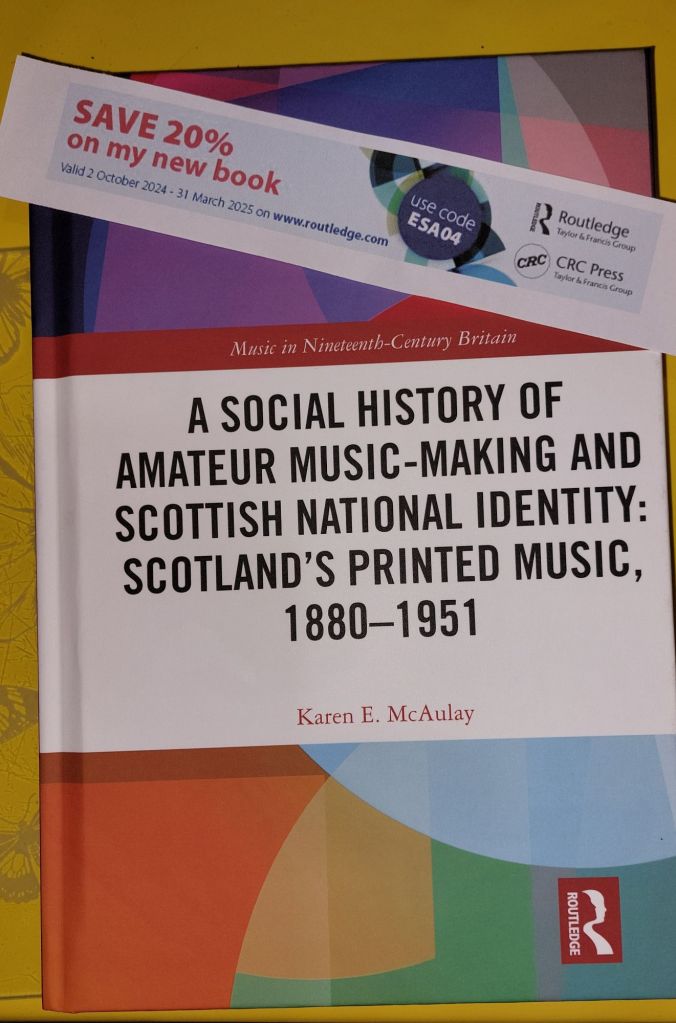
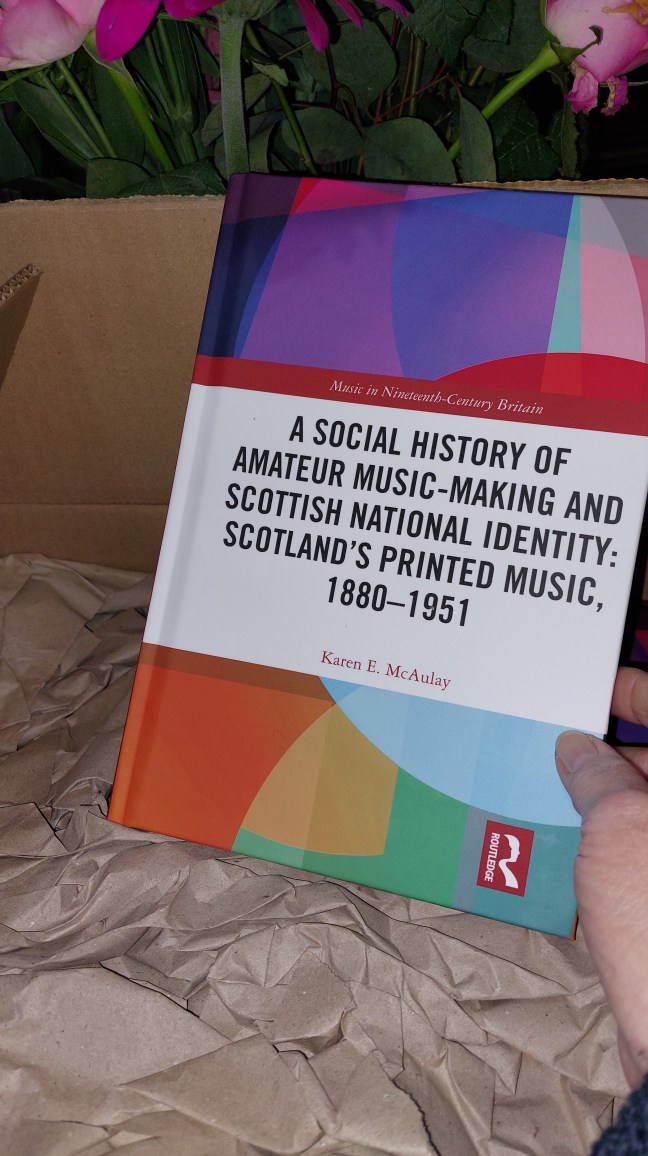
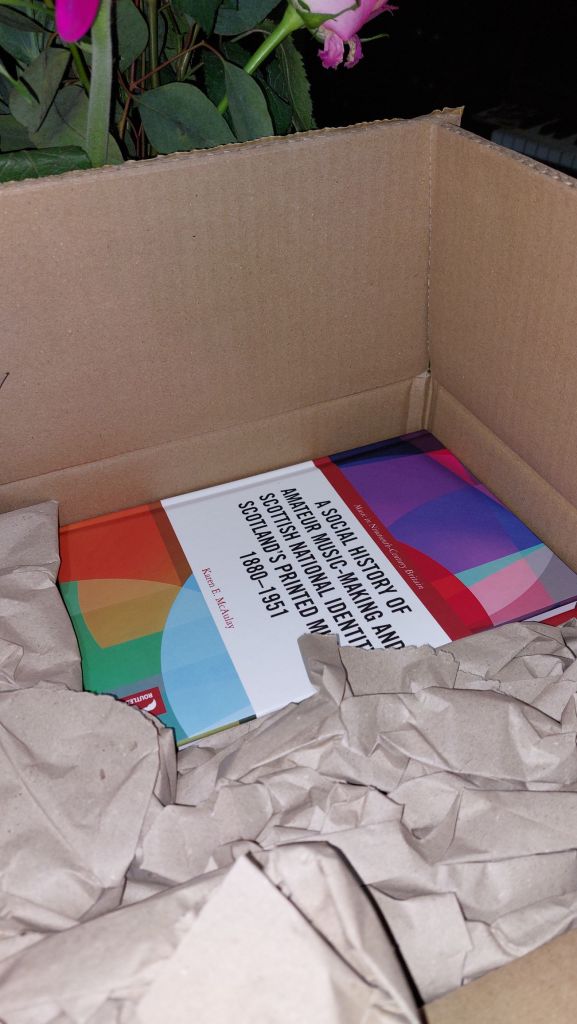
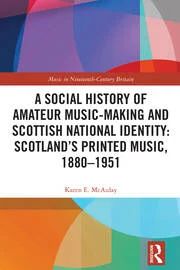
A Social History of Amateur Music-Making and Scottish National Identity: Scotland’s Printed Music, 1880-1951 (Routledge, 2025)
Book Review: Gun Sireadh, Gun Irraidh: The Tolmie Collection (Folk Music Journal Vol.12 no.5, pp.127-9; my review of a new edition of the Tolmie Collection, a significant Gaelic song anthology, here re-edited by Kenna Campbell and Ainsley Hamill)
[Article withdrawn due to pressures of time, but published on this blog: ‘The Exhilaration and Exasperation of Hybridity: Third-Space Professionalism in the Library’]
2 accepted chapters pending publication.
2 articles recently submitted, pending peer review. [February 2025 update: one got through peer review, has been revised, edited and I’ve approved the proofs. The other got through peer review and now awaits the revisions. Nonetheless, satisfactory progress!]
Speaker
Exchange Talk, Royal Conservatoire of Scotland, Jan 2024, ‘From Magic Lantern to Microphone: the Scottish Music Publishers & Pedagogues inspiring Hearts & Minds through Song’
NAG (National Acquisitions Group) Talk, April 2024, ‘Redressing the Balance: Getting Historically Under-Represented Composers and Contemporary Environmental Concerns into Library Stock’
Print Networks, conference held at University of Newcastle, July 2024, ‘‘Music for All’: the Rise and Fall of Scottish Music Publishing, 1880-1964’
Exchange Talk, Royal Conservatoire of Scotland, Nov 2024, ‘The Glory of Scotland’ (it’s the title of a Scottish song book published for the 1951 Festival of Britain)
Keynote for ECRN Alt-Ac Showcase at the University of Birmingham, Nov 2024, ‘My Alt-Ac Life’
Other Activities
BBC Scotland: ‘Good Morning Scotland’ interview
Book launch
Fellowships of IAML(UK) and RCS
Mervyn Peak Award, Magic Lantern Society
New job title: Post Doctoral Research Fellow
Peer reviews for AHRC and a scholarly journal
Providing teaching cover
Successful application: Heritage Collections Research Fellowship, IASH (Institute for Advanced Studies in the Humanities at the University of Edinburgh), for Jan-June 2025.
Edinburgh University Library from The Meadows (Wikipedia image)
Forward Planning
My IASH Fellowship will allow me the opportunity to explore the former Edinburgh publisher, Thomas Nelson’s archives, to find out more about their publishing in the music field. There wasn’t a great amount, but I aim to explore correspondence and find out how it fits into the wider range of their activities. I’ll be spending more of my time on research than I ever have since 1982!
Meanwhile, I’ve been working on an article for a history publication; I want to get that finished in the near future, so that I can turn my attention to another article on a different topic. What I do after that will probably depend on how the IASH Fellowship research goes, and what interesting possibilities reveal themselves to me. There’s bound to be enough for an article. But could I expand it to something book-length? I’ll have to wait and see!
Our talented son, Scott McAulay, has just shared with us an image of his latest triumph – a foreword in another Routledge book. (He’s less than half my age, so who knows how much he’ll have published by the time he reaches my advanced years!)
So, this year, between us we’ve had a hand in three Routledge books, or four if you include the paperback edition of one I contributed to earlier:-
A quick post to mark a successful and very enjoyable evening. I gave my research exchange talk tonight at RCS. It was about a book of Scottish songs almost certainly published for the Festival of Britain in 1951. I talked about history, book history, music history, Scottish tourism and that all important catch-phrase for the Festival of Britain – ‘A Tonic for the Nation’. And then there was my book launch afterwards.
RCS wasn’t on Renfrew Street in 1951. We were the Royal Scottish Academy of Music at that point, in the old Athenaeum building (Nelson Mandela Place), but we had established a drama department in 1950 – the Glasgow College of Dramatic Art. (More about our history – click here.)
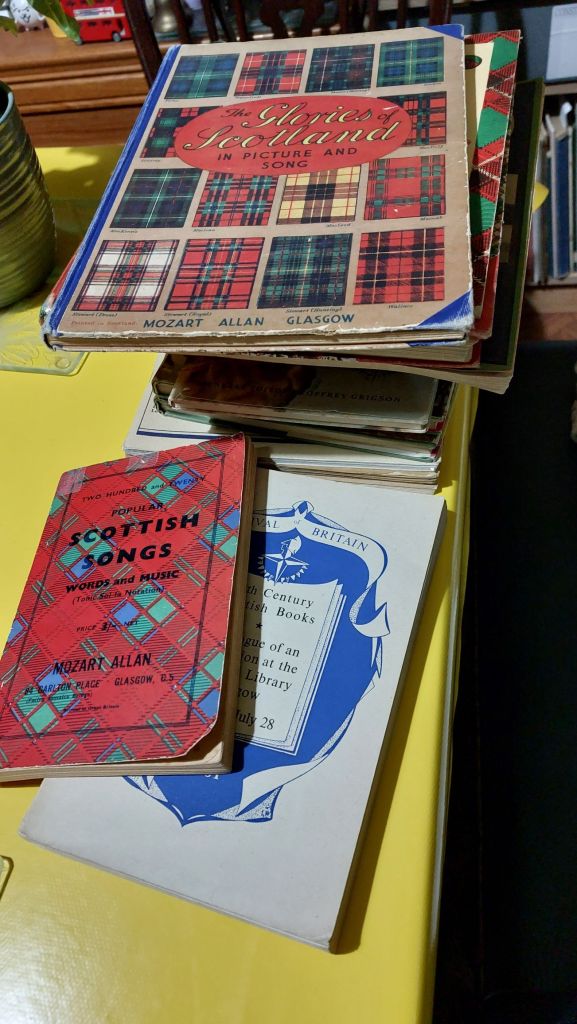
It’s fair to say that the book I talked about tonight – The Glories of Scotland, published by local publisher Mozart Allan – would not have been required repertoire for the talented students passing through our doors in 1951. It wasn’t aimed at high-performing classical artistes. (I doubt the library even had a copy in 1951, but there’s no way of finding out now. Anyway, we have recently acquired it!)
Nonetheless, the songbook does have a place in Glasgow’s history, in its own unique way.
Books relaxing after a night out!
After the exchange talk, we launched my book about amateur music making, Scottish national identity and Scottish music publishing. Professor Stephen Broad introduced it, and said some very kind words about it. There were friends and colleagues there whom I hadn’t seen for a while, so it was very sociable as well as celebratory.
Book launch: my ‘few words’ in response
My thanks go to everyone who contributed to make the evening so successful – Research Exchange colleagues, Library former colleagues, and the box office events team. I’m ‘dead chuffed’, as they say.
On Monday 11th November at 6 pm, I’m giving a talk in the well-established and popular RCS Exchange Talk series, where scholars talk about their latest research. I’ll be talking about a song book compiled for the Festival of Britain:-
The Glories of Scotland in Picture and Song: compiling a book with the 1951 Festival of Britain in mind
At 7 pm we’ll have the launch of my new book, in the library. No online booking for the book launch, but if you’re hoping to attend, please do let me know, so we have an idea of numbers.
You can attend both, or either event.
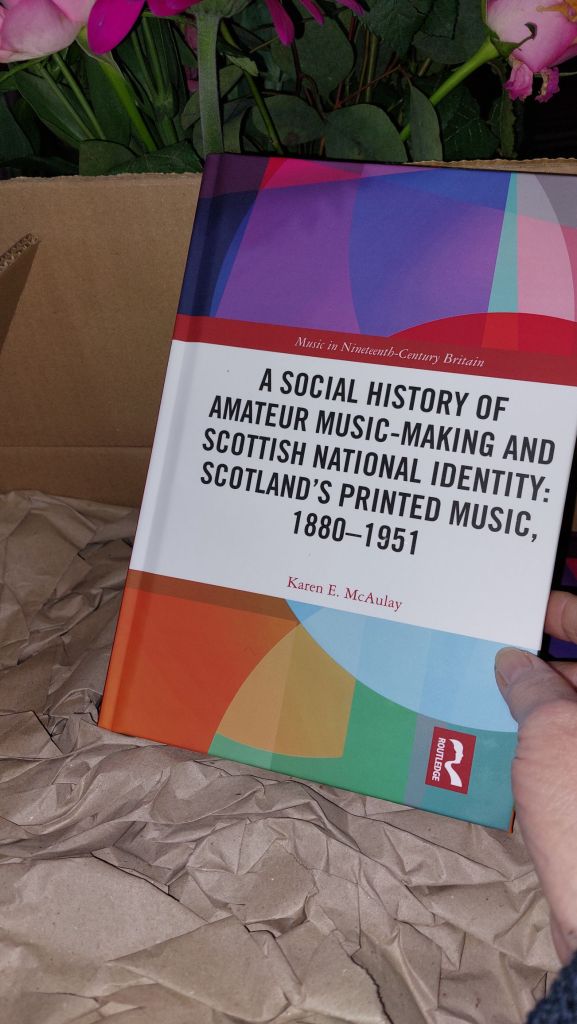
McAulay, Karen E., A Social History of Amateur Music-Making and Scottish National Identity: Scotland’s Printed Music, 1880-1951 (Routledge, October 2024) 🎶
I hope I’ll get better reviews than this from people who are interested! You need to know the context. This is the complete, full and unabridged parental acknowledgement of the book that I spent five years writing. I have not missed a single word.
Writing a second book has felt quite different from the first time round. The first one developed out of my PhD, so I had my supervisor supporting me as I wrote the original thesis.
Going Solo
But this one? All my own, unsupervised work, arising originally from the thought that someone really ought to write a book about the music published by Scottish publishers in the late Victorian era and the early twentieth century. No-one had written one, so I researched and wrote it myself. I was grateful for my peer-reviewers’ feedback on the first draft, and I know that the final product benefited from the subsequent edits that I made during my Ketelbey Fellowship at St Andrews.
This time, I did my own indexing, too. That was a new experience for me.
Now, to start planning a book launch! Watch this space – I have an idea. Provisional date Monday 11th November, but the details have yet to be finalised!
It’s a proud day – I’m so excited. (Amazon even recommended it to me the other day, which I found quite amusing!)
Table of Contents
(from the book – and the Routledge website)
Introduction
1 An Era of Opportunity for James S. Kerr and Mozart Allan
2 Nights Out Dancing and Evenings with the Children: Enduring Kerr and Mozart Allan Titles
3 The Saleability of Scottish (and Irish) Songs
4 Education, Preservation, Organisation
5 Expanding Horizons
6 Multimedia Technology, from Magic Lanterns to Recordings and Broadcasts
7 Publishing ‘Classical’ Music in Scotland
Conclusion
Description
(again, from the Routledge website)
Late Victorian Scotland had a flourishing music publishing trade, evidenced by the survival of a plethora of vocal scores and dance tune books; and whether informing us what people actually sang and played at home, danced to, or enjoyed in choirs, or reminding us of the impact of emigration from Britain for both emigrants and their families left behind, examining this neglected repertoire provides an insight into Scottish musical culture and is a valuable addition to the broader social history of Scotland.
The decline of the music trade by the mid-twentieth century is attributable to various factors, some external, but others due to the conservative and perhaps somewhat parochial nature of the publishers’ output. What survives bears witness to the importance of domestic and amateur music-making in ordinary lives between 1880 and 1950. Much of the music is now little more than a historical artefact. Nonetheless, Karen E. McAulay shows that the nature of the music, the song and fiddle tune books’ contents, the paratext around the collections, its packaging, marketing and dissemination all document the social history of an era whose everyday music has often been dismissed as not significant or, indeed, properly ‘old’ enough to merit consideration.
The book will be valuable for academics as well as folk musicians and those interested in the social and musical history of Scotland and the British Isles.










 Karen McAulay, Musicologist