Dr Karen McAulay explores the history of Scottish music collecting, publishing and national identity from the 18th to 20th centuries. Research Fellow at Royal Conservatoire of Scotland, author of two Routledge monographs.
I made this cloth book after I’d finished the ‘Claimed from Stationers Hall’ research project. Something was missing, though: it lacked explanatory captions. This week, I revised it and corrected my omission!
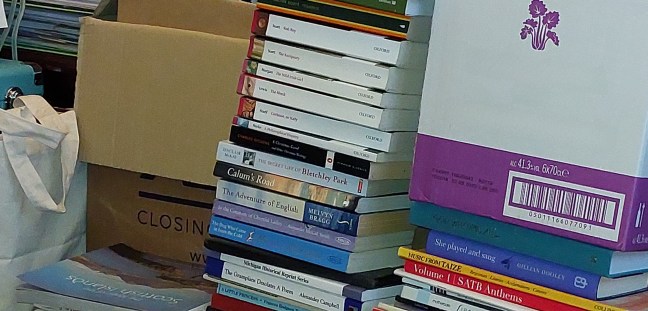
I forgot to add .. the decorating delays are apparently our fault for having so much stuff. It’s my books and music in the dining room that the painter’s alluding to. (He has no idea about Himself’s collection, many of which were originally secretly delivered to his workplace so that I wouldn’t see them, and are now scattered in various parts of the house.)
Last November, one of the electricians also innocently asked why I had so many books. I answered lamely, ‘Well, so I could write these two.’ Which didn’t seem terribly convincing to me, but seemed to satisfy him!
Scholar
Former librarian
Organist
Writes books about music books …
I don’t feel guilty about the books, but I really must reduce the collection before my family have to clear the house once I’m gone! Some are going on eBay, others to the charity shop.
I’m contemplating writing another book. It’ll be based on my recent researches as an IASH Fellow, obviously. But I’ve had a brainwave of an idea for the final chapter – which involves a bit more research – so the past few days have been dedicated to exploring possibilities. As I now know, from the historical Thomas Nelson point of view as much as my own present existence as a scholar, publishers like publishing things in series. It helps them sell, if readers can see how a book fits into a larger grouping of books. I’ve been thinking about where my book might fit in.
I’ve also had a wee jaunt to Dundee to talk to a scholar of my acquaintance; and today, I sat down to write an email. Who’d have thought it would take most of an afternoon to write an email?! But when it’s important, it’s worth taking some effort in the crafting of it.
‘Faint heart never won fair lady’
Finally, I thought it was just right. I mused that maybe I should leave it and re-read it tomorrow. But no, I must be resolute. So, I did not prevaricate. More of this thrilling story in due course …
I haven’t been posting much this summer, for personal reasons. So – after more than a week of total blog silence, imagine my surprise to find I have had hundreds and hundreds more visitors since yesterday. What’s happened?!
Even if it’s some kind of blip, it gives me the opportunity to introduce myself. I’m a postdoctoral research fellow at the Royal Conservatoire of Scotland and also, for a few weeks more, at IASH at the University of Edinburgh. I research all sorts of cool stuff (well, it’s cool to me) about Scottish music publishers, with a distinct interest in national song collections, and in early 20th century music education in Scotland.
My second book was published at the end of 2024:-
A Social History of Music-Making and Scottish National Identity: Scotland’s Printed Music, 1880-1951.
That might look like a strange date-range, but my previous book covered Scottish song-collecting up to the 1880s, so this kind of continues in a slightly different way from that point onwards. The 1951 cut-off date is because that was the year of the Festival of Britain. And it was also a good place to stop because I touched upon magic lanterns, gramophones and the wireless, but I really didn’t feel I was the right person to write about early television in Scotland! By stopping in 1951, I conveniently sidestepped early television. There are plenty of people more knowledgeable than me on that front.
My current Edinburgh research entails examining archival records of the Thomas Nelson publishing house, an old Edinburgh firm. The British side of this company has ceased trading – it’s an American firm now – but I’ve found plenty to interest me in the documents up the early 1950s. Education became their focus during the era I’m researching. Whilst my book mostly covers publishers specialising in music, Thomas Nelson really only published music that would be used in schools – though they hoped a few titles would also attract the general public. (The problem being that if you mention ‘school’ or ‘classroom’ in a title, it will turn off the ordinary member of public looking at books in a bookshop!)
Will there be a third book? Possibly! I’m still pondering. September is earmarked for concentrated thought about that!
If this sounds interesting, please do come back and visit this site again.
Relax, dear reader – this is not an incursion into my working research existence. I haven’t broken my resolution to take a well-earned holiday. Well, not exactly!
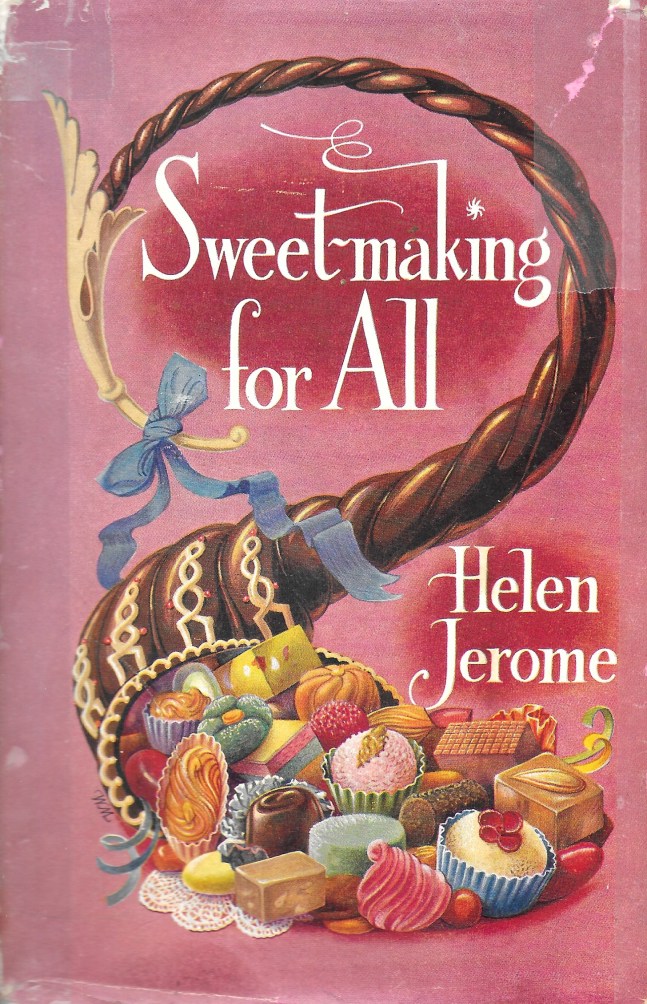
Going through the Thomas Nelson correspondence a few weeks ago, I came across a post-war letter celebrating the fact that sugar rationing was finally over, in which one editor suggested to another that now would be a good time to reissue Helen Jerome’s sweet-making book.
Now for a bit of history! It had first been published in 1924. In 1931, the author proposed another book, this time about baking cakes. The publishers declined it, since they felt the sweet-making one hadn’t sold very well.
Notwithstanding these observations, they revised the sweet-making book in 1936, and reprinted it in June 1939 (still pre-war). This publisher very much had their finger on the pulse, and books for adults quite often tapped into contemporary issues. So, right now they guessed – probably accurately – that people would enjoy making confectionery again after the years of privation. I obtained a revised edition with a foreword dated Spring 1954:-
FOREWORD TO THE REVISED EDITION. The effect of sweet and sugar rationing appears only to have increased the amount of sweets eaten in Great Britain, establishing us as one of the largest sweet-eating countries in the world. There is now much added interest in the actual making of sweets at home – whether as a skilled hobby … a family venture for special occasions, or as an experiment embarked upon by teenagers …
I’ll be honest – I bought this book intending to make some confectionery which I could photograph and write about. Now I’m on holiday, I imagined myself lovingly creating something delicious to intrigue and delight the family. However, I’ve looked through at the required equipment, the fancy syrups, and high boiling temperatures, and I have taken fright. It’s not going to happen! The first three chapters are terrifying enough: Utensils Required for Sweet-making; Materials Required for Sweet-making and Hints on their Preparation; and Sugar Boiling, Sugar Syrups, Spun Sugar, and Crystallisation.
I have a stove. And a sugar thermometer (unused). I don’t have a slab, be it marble, slate or heavy wood (‘covered with a sheet of enamelled iron’) or a ‘heavy white enamelled tray known as a “butcher’s tray”‘. Nor do I have a nylon or hair sieve, candy bars (not the edible variety – these are ‘a set of four steel bars cut from 1/2 in. cube steel, and 12-18 in. long, which help to obtain and professional finish’ and ‘can be obtained from a builder’s merchant’.) I’m mystified by sweet rings or cream rings, a caramel marker, a sugar scraper, a candy hook or a starch tray … need I continue? There are three more pages of equipment requirements.
As you can see, getting set up could be quite expensive! Not only are some of the above items going to be hard to source, but I had a bit of a problem establishing what, precisely, a gill measurement is. My first Google search did not go well …
The AI answer wasn’t quite what I expected!
If at first you don’t succeed – try, try, try again:-
Ah, that’s more like it!
Anyway, let’s look at the ingredients:- Loaf sugar, granulated sugar, demerara sugar, castor sugar, icing sugar, Raw West Indian or ‘soft’ sugar. Treacle, honey, glucose, cream of tartar, butter … so far, so good. But don’t get complacent. After various nuts and dried fruit, we find we need plain cooking chocolate (yes) and covering chocolate (what?), cocoa butter, various flavourings, gum arabic, gelatine, confectioners’ starch. Maple sugar, maple syrup, molasses, marshmallow cream … and then we get on to various techniques that you use to transform these ingredients into other more complex substances.
After all this, there are ten chapters devoted to different kinds of sweets, followed by advice about packaging them.
Fondants
Marzipan (you make this from scratch – don’t imagine you can buy a packet from Sainsbury’s!)
Toffees
Caramels
Candies and Fudges
Nougats
Chocolates
Jelly Sweets and ‘Delights’
Unboiled Bon-Bons
Miscellaneous Recipes
Now I’m feeling hungry, and my mouth is watering, but I am not equipped to start my confectionery journey. Not only that, but my ceramic hob is my pride and joy (or a ridiculous obsession, to quote my nearest and dearest), and I live in fear of pots boiling over at the best of times. Can I risk spilling boiling syrup on it? I cannot.
I take my hat off to the author, with her First-Class Diplomas, London and Paris (Cordon Bleu), who was a former staff Teacher of Cookery at the Polytechnic, Regent Street, London W1. I envy the skilled hobbyists capable of mastering ‘difficult processes’ (see? she admits they’re hard!). And I’m in awe of ‘teenagers who want to make their own “tuck”‘. I can well imagine their collective excitement at being able to buy all these sweet ingredients to create the treats they had missed out on for so long, and I hope many tasty confections were made by the purchasers of this book.
Next time I’m passing a shop, I’ll get some Fry’s Turkish Delight, and be grateful that I can!
I haven’t had a foreign holiday in years, but I haven’t really been very good at taking a decent break at home, either. As long as I was sharing myself between librarianship and research, my annual leave tended just to support my research habit. But this year, I’ve done substantially more research.
I decided that this year, I would have to do better when it came to taking a deliberate break.
I’ve continued to pursue domestic projects, stayed abreast of family preoccupations, done some more weeding (so much weeding!), and read a great book, BeingMortal, by Atul Gawande. This was lent to me a couple of weeks ago, and it proved well worth devoting the time to. But by Thursday, I was itching to go on another outing. A holiday surely has to involve going places, if only locally.
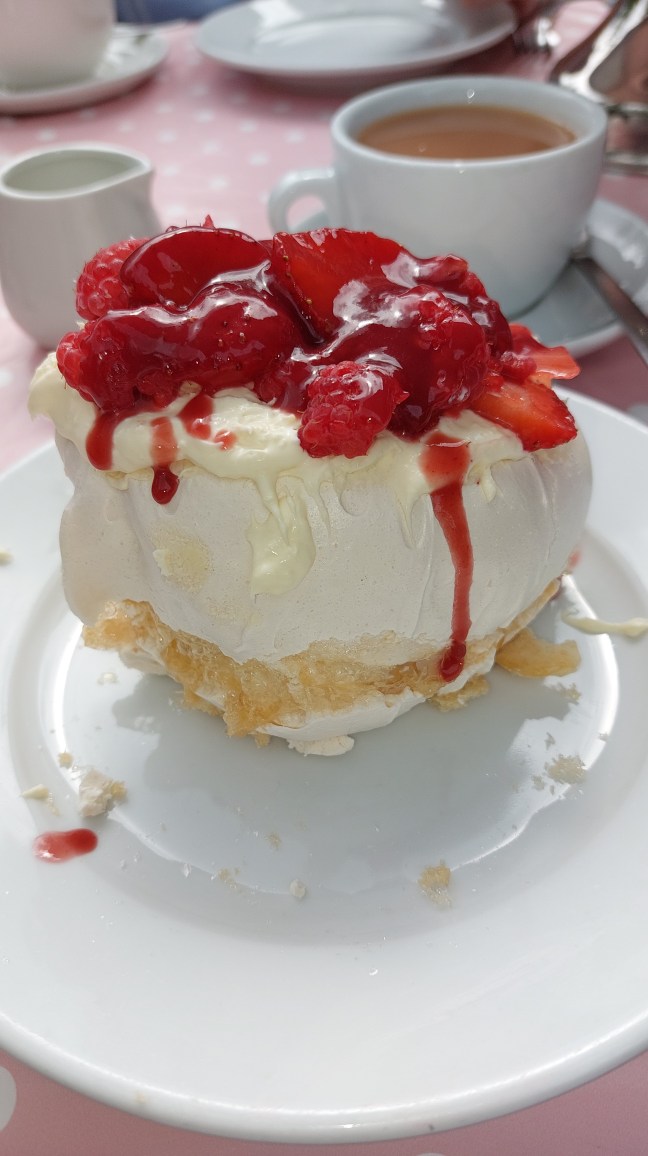
I fancied tea beside a river. ALL I typed into Google was, ‘tea’, and it came up with the ideal cafe. Does it read minds? We didn’t even know there WAS a small loch at Gartcosh, so this was a pleasant surprise. It turns out there’s also a garden centre, which might be useful to know in future.
I’ve also visited a friend, and when I got home, I found that the book I ordered the other day had arrived.
Well, this was fatal. It’s a song book. I looked right through it, looked up the two lady composers and their illustrator, played the songs over, then decided I’d better write down what I had discovered. An enjoyable use of an evening, but this hardly counts as taking a deliberate holiday from research! Indeed, it merely piques my interest as to how the ladies ended up writing their book. Did the friends reach out to the publisher? Or vice versa? Or did someone put them in touch?
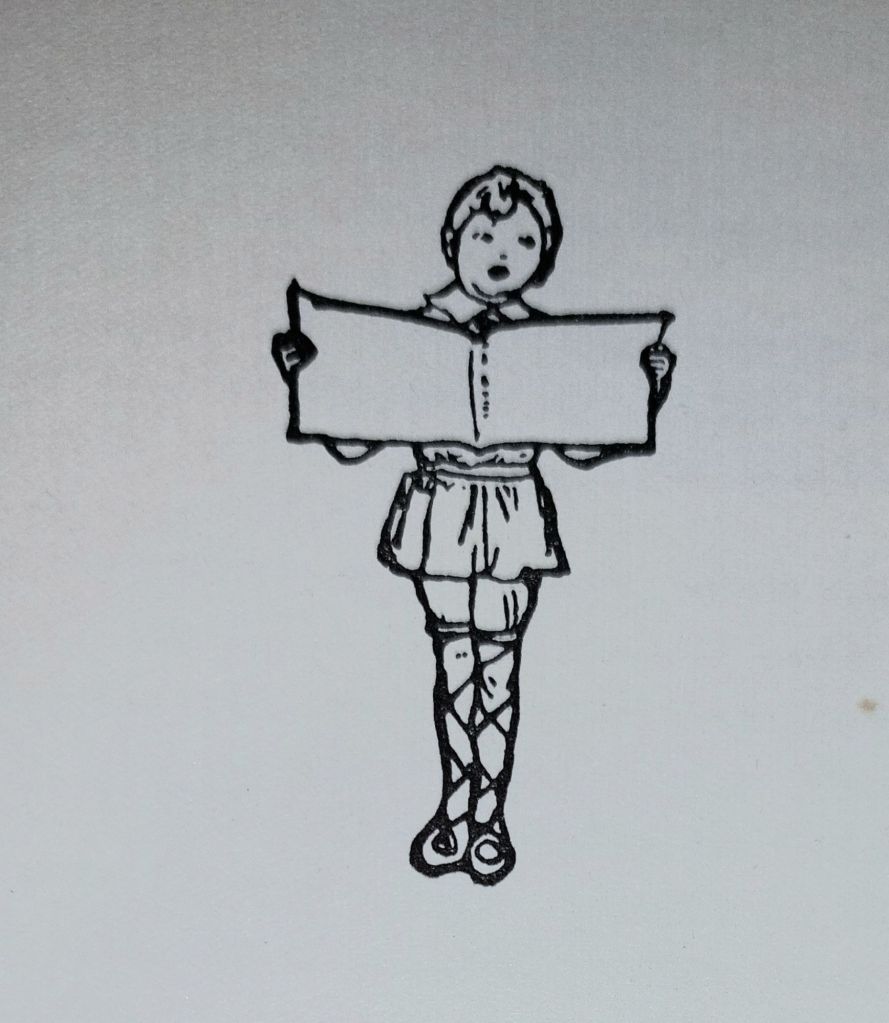
The Thomas Nelson ‘child singing’ motif
Meanwhile, my crowded bookshelves have an extra book, and I need to remember that I’m taking a holiday!
Some months ago, I came across a book that had been given the title of a popular song. I got the book. I understand it was categorised as ‘sensational ‘ at the time. This does not denote ‘stunning’. It was a genre, and not the highest literature.
Later, it had become a silent movie, and I wanted to watch it. Indeed, from a research viewpoint, I needed to see it – though I’ll grant you it does seem counterintuitive that a musicologist would want to watch something without sound.
I couldn’t justify going all the way down to London to watch it, but I managed to find it at NLS. (Sometimes the spelling of a word, or the presence/absence of an apostrophe makes all the difference in something’s retrievability.)
But why did this film matter to me? I wanted to see if the original song might have been played at various places in the movie. There’s no direct link between the film – or the book – and someone I’ve been researching, but they did sing that song. A lot.
It takes a while to get a silent movie converted to a DVD, but finally, today, I went and watched it. The NLS has a Glasgow outpost for digital media. It’s located in the former transport museum at Kelvin Hall, just a bus-ride from home.
Stakeholders in this building are the NLS, Glasgow City Council, the Hunterian Museum and the University of Glasgow, and there’s also a gym facility and a cafe – so you encounter staff in orange polo shirts and shorts before you pass an enormous hall laid out for University exams. Then a museum store. And then, finally, there’s the NLS!
I tried to imagine myself in a cinema with an audience and a cinema pianist or even a small ‘orchestra’. It was a far stretch, sitting in a neat, up-to-date viewing room with modern tech and my notebook in front of me!
The film I’d found was the 1923 re-release of an earlier non-surviving film, but it wasn’t quite the whole movie … that’s partly because the lead actor died before they’d finished shooting the movie. Seems strange that it was still released, doesn’t it? I couldn’t tell if what NLS had, was all that had been shot, or slightly less; it didn’t end neatly.
But as for the song? Yes, I found what I was looking for. So it was worth sitting in silence in a viewing room for 2 hours on a Saturday morning!
As a film adaptation, though, it was interesting to see what was omitted from the narrative, as well as a curious change. Towards the end of the 1875 novel, the heartbroken heroine hints that she’d contemplate impropriety. It’s just a hint – it’s the hero who says the idea is unthinkable. Whereas in the film, she says (the words appear on the screen) that owing to the situation her beloved is in, they have absolutely no hope of a shared future.
I hadn’t anticipated a film watering down something that must have been scandalous when published nearly 50 years earlier. I didn’t notice anything about BBFC classification at the start, but I imagine it would have been considered perfectly suitable for general viewing. I wonder if that has anything to do with it?
Maybe I shouldn’t overthink it. Back to my notebook and my original thoughts!
Whilst I was working on my first PhD – the one I didn’t finish – my mother, concerned that I would never get a job, urged me to do secretarial training. Reader, I was twenty-two, doing doctoral research. You can imagine the conversation that followed.
Nonetheless, having stated categorically that I would never work as a secretary, nor would I learn shorthand, it did seem a good idea to learn to type properly. Getting my Masters dissertation typed had been expensive. (This was before the days of word-processing packages and personal computers, let alone laptops or tablets.) It was an acceptable compromise, so I attended evening classes, took RSA Typing classes and achieved Stage 3, with a certified speed of 55 wpm on a manual typewriter. (Thats ‘words per minute’). Electric typewriters were certainly in use, but not in the technical college where I attended my classes.
Touch-typing at speed has been my secret strength ever since. But today, I was just copying out a quotation about music educational theory in 1947. I wasn’t looking at what I was doing – touch-typing means looking at what you’re copying! But when I did look, I found modern technology had turned it into a laugh! Here’s what the book said:-
‘The Sol-Fa Time Notation ( | : | : | ) is discarded as being unnecessary’
– then I looked at my copy-typing:
‘The Sol-Fa Time Notation (|😐|😐) is discarded as being unnecessary’
I always did think those ta-fe-te-fe syllables were a bit of nonsense, but I never imagined Microsoft would agree with me!
As I’ve already mentioned, I am currently a Heritage Collections Fellow at IASH – the Institute of Advanced Studies in the Humanities, at the University of Edinburgh. I’m halfway through my Fellowship, and (hopefully) halfway through my trawl of the Thomas Nelson publishers’ archives in search of correspondence about their music publications in the 1940s to 1950s. The book I’m primarily interested in has presented me with a few surprises and thoughts of new directions to pursue, but I shall plough on through the archives until I am sure I’ve captured every whisper about these four little school books.
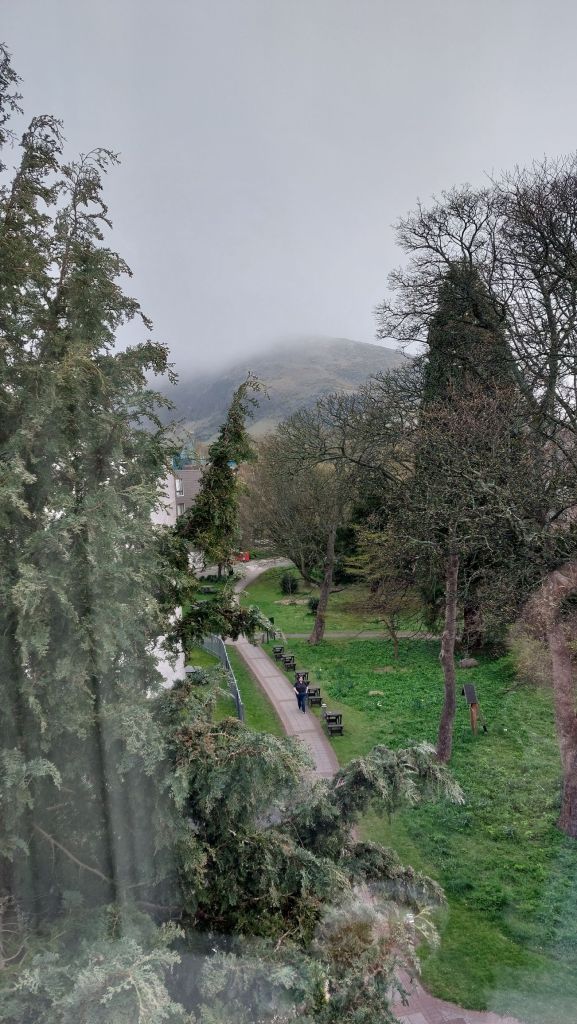
View from the Scholar Hotel
This week, we had the Institute’s 55th Anniversary celebrations, with a focus on Decoloniality. The Institute has just concluded a two-year project on this theme. There was also a session on motherhood and reproductive justice.
Now, you’d think, perhaps correctly, that my Scottish song book and music education focus has little connection with either decoloniality or motherhood. But I did put a lot of effort into broadening the scope of the music collection to include more music by women and composers of colour, whilst I was a Performing Arts librarian at the Royal Conservatoire of Scotland, so I was keen to find out what other scholars in more directly related disciplines have been doing.
I think it’s fair to say I felt a bit overawed! IASH is very interdisciplinary, so there were contributions from all corners of the humanities, and by scholars with far more extensive experience in their fields than I have in mine. But there were contributions from the performing arts, and from heritage collections and archives – I felt more comfortable in these areas, and a bit less out of my depth.
I stayed in Edinburgh overnight to make it less of a rush from Glasgow for the second morning.
In the final session, with contributions from past and present directors, I was impressed by the sheer reach and achievements of this amazing institution, and both proud and humbled to be a Fellow here.
O wad some Power the giftie gie us,
To see oursels as ithers see us!
In the context of Robert Burns’s poem, those lines are exhorting us not to get above ourselves, but taken in a different context, they perhaps offer reassurance that others see something in us that we can’t necessarily see ourselves.
‘They thought I was worthy to be a Fellow – in a very competitive application process?’, I mused. But yes, they did indeed select me, which is a vote of confidence in itself. Sometimes, you need validation by others – it’s hard to be objective about oneself!
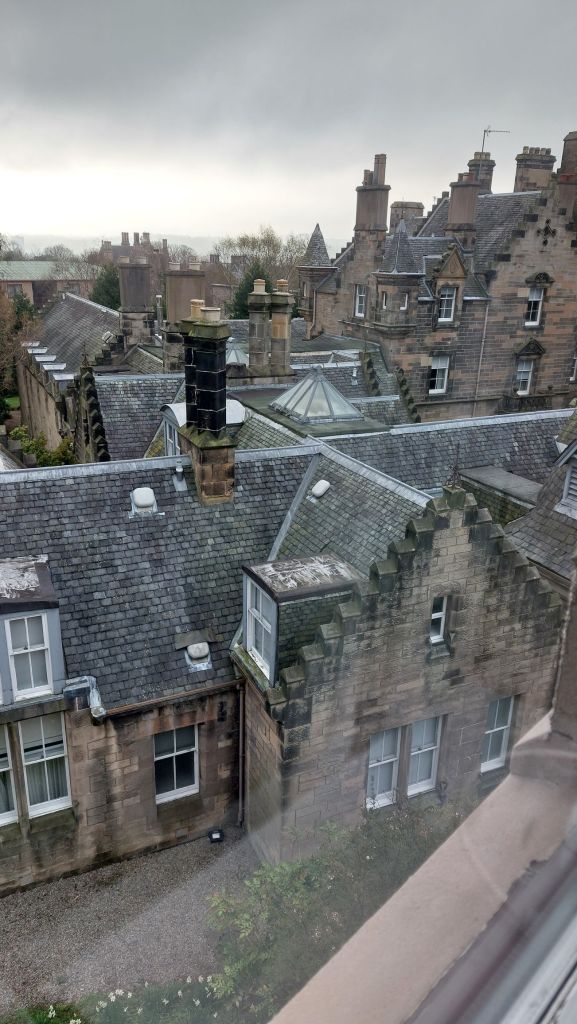
Another view from the Scholar Hotel
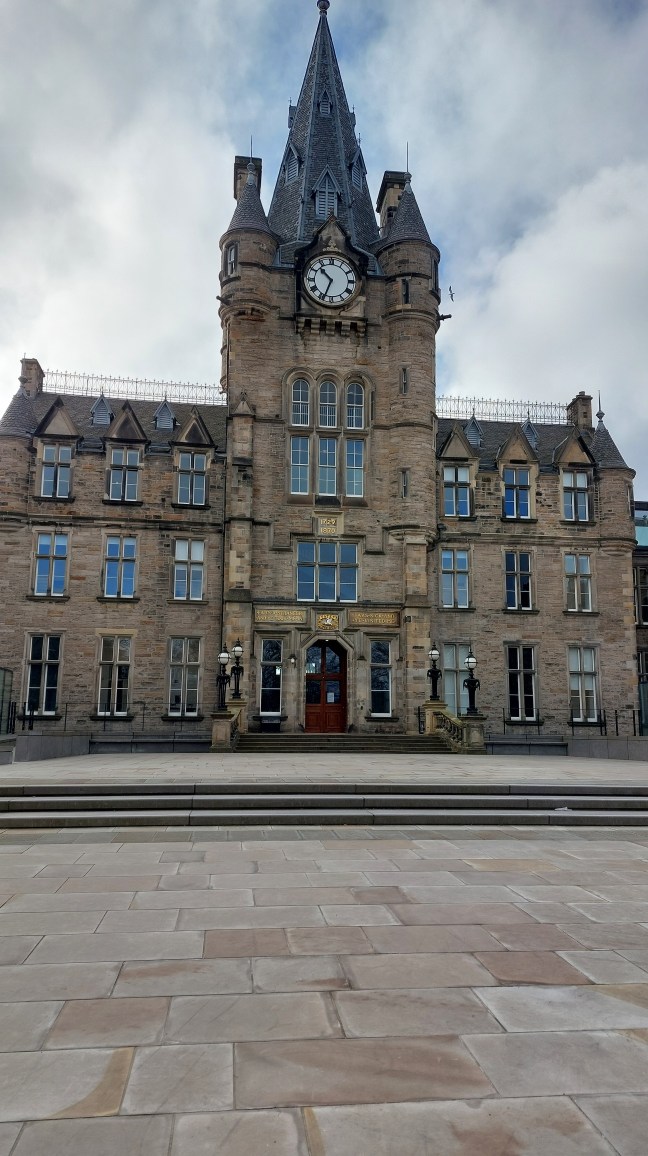
Image at top of post: The Edinburgh Futures Institute
Apologies! This has turned out to be quite a week.
I’ve twice woken far too early, notwithstanding leaving the house at 6.45 am to go to Edinburgh. It was still far too early even for that.
I bought a car. I’ve spent hours marking essays (not a normal activity for a former academic librarian-turned-research fellow). I’ve attended live and online seminars, and I’ve continued in my archival explorations. It’s only Thursday night, and I’m knackered.









 Karen McAulay, Musicologist