Dr Karen McAulay explores the history of Scottish music collecting, publishing and national identity from the 18th to 20th centuries. Research Fellow at Royal Conservatoire of Scotland, author of two Routledge monographs.
MOT cancelled on April Fool’s Day; it really was …
I took myself off on a library visit, looking for a peaceful, fruitful day. (Yes, yes, I know – I’m a librarian, and I already work in a library 3.5 days a week. However, researching in a different library is an entirely different experience.)
It was peaceful, though I could have done without the six miles’ walking in the rain! But –
I found nothing related to my research question!
The trouble was, I had to read a lot of stuff, to eliminate it. Having researched music for so long, however, I was enchanted to read about paper pulp, factories, shipping and personnel in Nairobi, Cape Town, India, Toronto … yes, it was 1946-7, and the links were strong.
Then there were paper and bookbinding cloth shortages. Lots of allusions to both.
But was it a wasted journey? On the face of it, I made no progress, but – as you see – I gathered contextual information. From now on, I won’t be parroting those facts, but alluding to situations I’ve witnessed through perusal of correspondence. That does count for something. And I learned a handful of names that I might one day encounter in a musical context.
Oh, and apart from getting drookit (drenched) and walking six miles (thanks, Fitbit), I did get my peaceful day in a library.
Am I a listophile? I started the list to end all lists, on Saturday evening. (Yes, I know. Sad, isn’t it? It’s surely better than the Saturday night trips to the laundry in my student days, though.) I’m going through my book manuscript, tracking EVERY sheet music title that I’ve mentioned.
I should already have them in my epic Zotero bibliography, but for this exercise, I’m also checking off which chapters they appear in. It could be handy when I’m indexing the book in due course. Not only that – if I encounter any date discrepancies, at least I will have the chance to put them right.
But have I created a Monster?
This, dear reader, truly is turning out to be a mega-list. I’m approaching the end of my trawl through Chapter 3 now, and the list is already quite lengthy. On the other hand, since I am likely to be the most knowledgeable authority about publications and publication dates for these particular Scottish publishers, there surely must be some value in this.
And – there are just a few ‘lost books’ amongst them. What could be nicer but more tantalising for a librarian/musicologist/book historian?
Few people in Glasgow knew that I had an unfinished first PhD guiltily lurking in my past, when I announced I wanted to do a PhD. It would actually be my second attempt. I’m told that someone (an academic?) asked that memorable and somewhat hurtful question, ‘What does a librarian want with a PhD, anyway?’
Chained to the shelves – Wimborne Minster Chained Library (Wikipedia)
I realised with a jolt, yesterday morning, that I would be retiring from librarianship exactly fifteen years to the day, since I submitted my thesis to the University of Glasgow. I never managed to cease being a librarian in order to become a full-time academic, because I had family responsibilities in Glasgow, and the chances of a full career-change without relocation were limited, to say the least. However, if I entered librarianship with the unfulfilled expectation of soon having a PhD from Exeter, and the aspiration to become a scholar-librarian …. well, I did achieve the latter aspiration. After getting the Glasgow PhD, I became partially seconded to research three years later, and I’ll continue as a part-time researcher when I’m unshackled from the library shelves.
I don’t know who it was that queried whether a librarian actually needed a PhD, more than twenty years ago. It’s probably a good thing I don’t know! However, if I could show that individual how I’ve just spent my afternoon, then maybe they’d begin to understand.
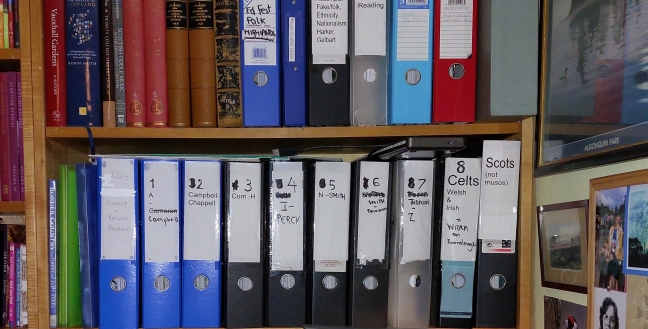
The other day, an academic colleague said they were putting a student in touch with me, to advise them about resources for a project. This afternoon, I was working from home as a librarian, so I decided to spend the time finding suitable resources for my enquirer. I had in mind a lever-arch file from my own research activities, that I knew was in my study-alcove.
Subject Specialist
[Scottish] ResearchFish
The more I thought about the query, the more things I thought of suggesting. I looked at my own monograph, for a start, along with a couple of essay collections that I’ve contributed to. I compiled a list, mostly but not entirely from the library catalogue. (I tweaked a few catalogue entries whilst I was at it. What does an academic want with a library qualification?, one might ask!) I The family balefully eyed the dining-room table that they were hoping to eat off, as I moved aside the ancient and modern books that were gaily strewn across its surface. However, I’m fairly content that I’ve done my preparation to help with the query. I’ve also enjoyed an afternoon in the company of old friends – the compilers, authors and editors of all those books!
A Value-Added Librarian
Listen, I wouldn’t have known any of those resources if I hadn’t done that PhD. I wouldn’t have known what the arguments were. I wouldn’t have known how nineteenth and early twentieth century song-collectors viewed their collections, nor the metaphors they used to describe them, nor which collections might be of particular interest. I wouldn’t subsequently have collaborated on The Historical Music of Scotland database. And if I hadn’t gone on researching, I wouldn’t have known about some of the more recent materials, either.
I kennt his faither! (A Scot knows what that means)
There might have been times when others wondered who I thought I was, but I am absolutely certain that it has come in useful!
As I pursued my research for my latest book, I accumulated quite a few postcards and other ephemera which might not, at first sight, appear to have had much to do with the subject in hand. Indeed, when I decided to sort out my box file, I was initially a bit surprised just how much of this stuff I had acquired! However, much of the work was done during the pandemic, when eBay was actually a very sensible way of getting hold of things … and you could argue (hark at me, justifying myself) that I spent less on those postcards than two or three hot drinks at the RCS café-bar each day I’m on site!
Did Mozart Allan use printers Aird & Coghill? They printed a lot of music in Glasgow!
Sifting through my treasure-trove was so enjoyable that I eventually realised I wasn’t in the least bit ashamed of my guilty secret. I have a contemporary postcard of the very respectable-looking Glasgow street where James S. Kerr first lived. (The neighbourhood is less upmarket now, and both his first home AND his shop are now gone.) And there’s a postcard of the shop that Frank Simpson had on the corner of Sauchiehall Street before the shop and adjacent church were knocked down to make room for British Home Stores. I also have a card of the view Mozart Allan would have seen every time he stepped outside his shop. (HIS shop building is still standing, just along from the Courts, beside the River Clyde.)
Pretty much the view from the shop doorstep!
I have pictures of the docks, as they were then, conveniently close for Kerr and Mozart Allan’s trading activities, and a picture of the boat on which Kerr’s successor sailed to America on one occasion. I like to be able to imagine what a place was like when the person I’m writing about, actually lived there.
I’ve also got odd bits of commercial ephemera – an advertising brochure; a business postcard; a couple of letters. The business postcard set me on the track of the individidual who took over Kerr’s business after Mrs Kerr died. It was only last weekend, long after I’d acquired it, that I realised there was a woman’s name written across the top left corner. A colloquial diminutive for the new owner’s wife’s first name, in fact. So – maybe she worked in the shop, too? It’s not musicological research, but I would like to find out. I enjoy finding women working in the music publishing/retail business, in eras when fewer women worked outside the home.
Another bunch of postcards trace the tartan-mania which spilled over from cards to coffee-table song-books and miniature souvenir books. Talking of souvenirs, I have travel guides, maps, an embroidery canvas of a commemorative map of the British Isles – it was unworked, but I’ve since done the stitching and had it framed – and a reproduction of an early PanAm poster. I’ve written quite a bit about Scottish songs in the memory of expats, both overseas and over here.
And there are a few photos of children having music lessons; of women sitting at the piano; a magic lantern slide; a stereoscope of (apparently) happy workers on a cotton plantation – in my book, I’ve written about the racism in plantation songs.
A whole load of sol-fa booklets of various kinds. They have a wee box of their own.
There’s also a photo of an Edinburgh railway bridge. Why? I was hunting down a particular song-book editor, and a musician with the right name lived just beside that bridge. I don’t think it was the right man, but it’s a nice photo, so I’ve kept it anyway!
Wednesday. Glasgow to St Andrews, to do book revisions, and a lecture for the University’s Institute of Scottish Historical Research. (It was about the impact pedagogical and technological innovations had on Scottish music publishers.)
Thursday night. St Andrews to Dundee (expedient – it was the only way to get back in time for work on Friday!)
Sleeperz, where I could not sleep …
Friday morning. Dundee to Glasgow, for a day’s librarianship. One particular query took a couple of hours, but I was told that my reply would make the enquirer very happy … really, that’s all that matters.
New desk lamp – extension cable sorted!
Saturday. Glasgow to Dundee and back for the Friends of Wighton 20th Anniversary celebrations. I attended the speeches and morning concert …
20th Anniversary of the Wighton Centre Sheena Wellington opens Proceedings The Provost of DundeeHarpsichordist Mark Spalding in front of Andrew Wighton’s music booksPurcell’s “Scotch” tune!This is Gaelic singer Wilma MacdougallThis is Sally Garden, the Wighton Musician in Residence a few years ago.
I’m the Honorary Librarian, and my role was to show off Wighton’s books, in the afternoon. Although few visitors required my services, I had some very enjoyable conversations about the books, so it was a pleasant day.
It’s always fun to spot little comments made on the music by Wighton himself, and today I also found one of the books had belonged to an original subscriber. I wonder if she played the tunes when she got the book? In a chapter I wrote a couple of years ago, I found the number of women subscribers compared to men, went up as time went by. There’s a Miss Scrimgeour on the database compiled for that book, but Mrs Scrimgeour doesn’t appear there. Have I somehow found a new subscriber, or was she just mistranscribed at some point?!
Mrs Scrymgeour’s copy, 1796
Googlemaps will again be reporting record travel mileage this month! But I have awarded myself the rest of the weekend off. (Honestly, have I only walked 8466 steps today? I’m surprised!)
Music by subscription : composers and their networks in the British music-publishing trade, 1676-1820 / edited by Simon D.I. Fleming, Martin Perkins. (Routledge, 2022)
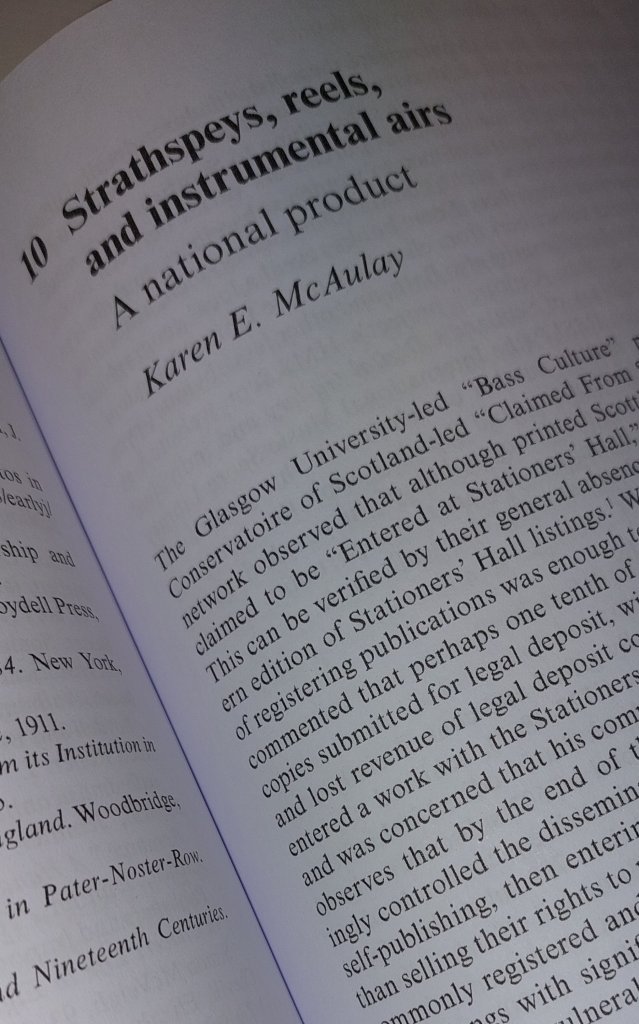
I wrote a chapter for this book, which came out in 2022. I wonder if anyone has read RCS’s e-book version? The hardback itself seems to have sat on the shelf unnoticed for a whole year ….
‘Strathspeys, reels, and instrumental airs: a national product’ (pp.177-197)
One day, when I’ve retired from librarianship, all that will be left to show for my 36 years here will be the books and music on the shelves – and their catalogue records. Naturally, I made sure RCS has a copy of Mozart Allan and Jack Fletcher’s The Glories of Scotland in Picture and Song. Click on the title to see how I’ve catalogued it!
I think you’ll agree I’ve managed to insert enough hints as to why I think it’s significant. There’s a book chapter coming out in an essay collection from the Centre for Printing History and Culture at Birmingham City University, so there will be more to read in due course.
So here’s the thing, as we say in Glasgow. Looking up Doris Ketelbey some weeks ago, I thought I saw an interesting heading in one of her books: it was the title or first line of a Scottish song. And I did EXACTLY what I warn students not to do.
It made such an impact that I was sure I’d find it again. After all, her book titles weren’t that numerous. Of course I’d remember. Moreover, if I’d found it once … right? (It’s possible that I found it by accident, with an unlikely set of search words, though.)
I bought a copy of her most popular school textbook, shelved it, and that was me. Sorted!
Until I looked at it more closely. This was European and a bit of world history. Post-Jacobite, I couldn’t see anything where a Scottish song title would have been a suitable caption. And – had there been an illustration above it? – or was I havering? (The caption might have been on a digital image, not searchable as text, maybe …)
Maybe I imagined the illustration, but I remained convinced about that caption. Just a pity that I couldn’t remember the song!
I started searching last night. In bed, I lay awake, agitated by my failure to source the mystery book.
Today, I searched Hathi Trust and Open Library. No luck.
I looked at Jisc Library Hub and Worldcat, but they weren’t going to show me what I needed.
Finally, I made a list of any Ketelbey titles which might possibly have touched on Scottish history (given that she wasn’t first and foremost a historian of Scottish history), and came up with another pair of books possibly also aimed at secondary schools.
There’s only one problem: the nearest copy is in Edinburgh. I had hoped to find it in Glasgow’s epic Mitchell Library, but this time I had no luck.
So … Amazon and eBay
However, I’ve ordered the pair for about the cost of a return to Edinburgh. If what I’m looking for isn’t there, then I have to admit defeat. I still don’t understand how something I found before is now so very elusive…
The publisher travelled extensively, actually dying off the coast of South Africa on his final trip. Whether all these trips were for business or pleasure (or both), we’ll never know!
Image by Bob, Pixabay
The library received our second-hand copy of a music book today. It came from the USA, having first been sold in Johannesburg. There is something magical about a book, itself aimed at the Scottish diaspora, having been published in Glasgow and then spending time in TWO of the continents visited by its publisher, before returning to Glasgow today.
I know that, technically, it makes no difference to the contents. Of course it doesn’t. But I’d be lying if I didn’t say I’m over the moon with this particular book’s life-history!
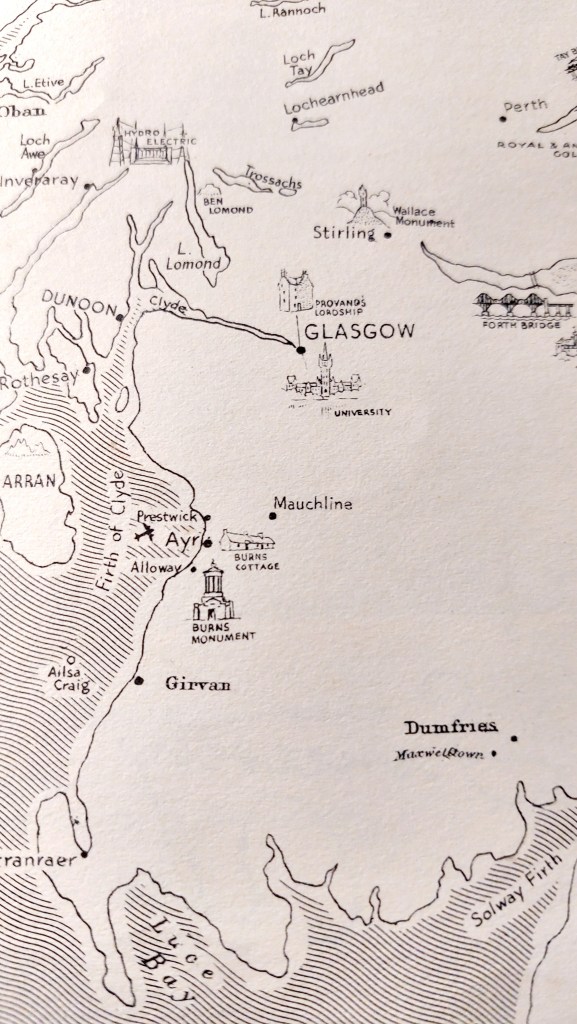
I have contributed a chapter to a forthcoming collection on Print and Tourism, which is being published by Peter Lang. The completed manuscript will soon be going to the publishers, which is very exciting. You might ask what a musicologist was doing, writing about print and tourism? Well, it won’t be long before all is revealed.
I had enormous fun writing this chapter, and I think folk will enjoy reading it. It’s different. Well, that’s hardly surprising, given the subject matter, but I’ve placed it in a wider cultural context than my usual more musicological offerings, and I’m really looking forward to seeing it in print.
A Question for You: What’s significant?
The topic arose from a book I acquired during lockdown. Ironically, it was only a couple of weeks ago that it dawned on me that not only would we need to buy the essay collection for RCS’s library, but we’d also need a copy of the book which inspired it! I can’t think why that didn’t occur to me sooner, but it is on order and on its way, so I’ll be cataloguing it very soon. We’ll have it well before the essay collection is finally published!
So, your challenge is this: Can you work out what is significant about this map?!
I would never, ever have dreamed, when I went to Exeter to start my first, unfinished doctoral studies on mediaeval English plainsong and polyphony, that I would end up completing a different PhD thirty years on, and writing and being published on such a very different topic!












 Karen McAulay, Musicologist