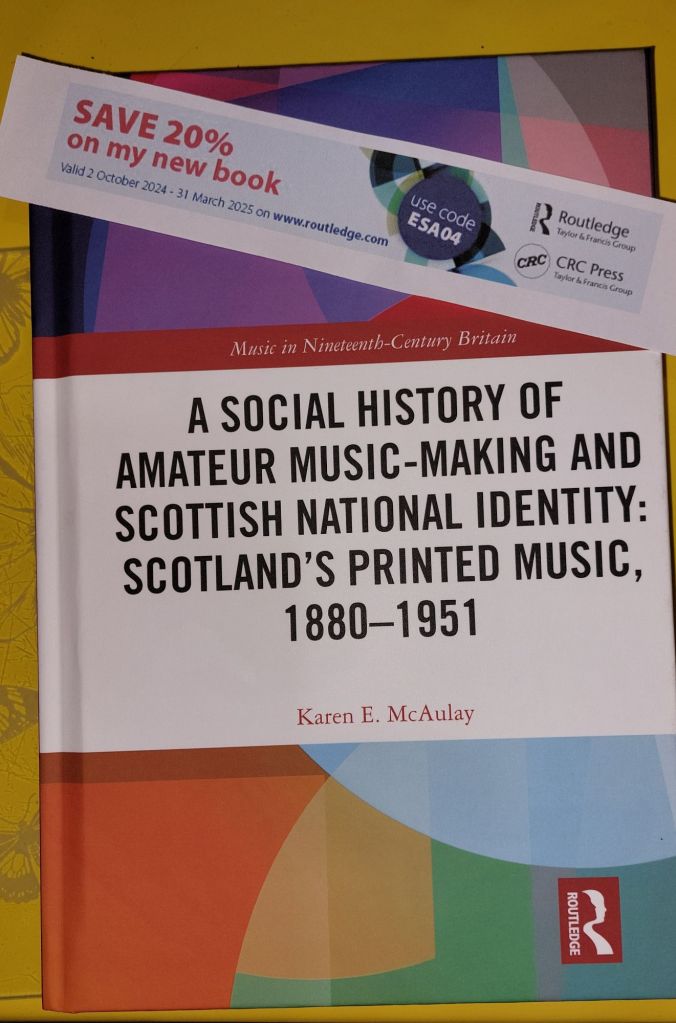
Just a wee reminder – the discount code for my new monograph expires in seven weeks, on 31 March 2025. Don’t miss it!


Dr Karen McAulay explores the history of Scottish music collecting, publishing and national identity from the 18th to 20th centuries. Research Fellow at Royal Conservatoire of Scotland, author of two Routledge monographs.

Just a wee reminder – the discount code for my new monograph expires in seven weeks, on 31 March 2025. Don’t miss it!

Remember un-conferences? They were popular a few years ago.
Well, now I’m co-ordinating a Scottish song event, but it’s for entertainment, and not remotely connected with my research. Does that make it an ‘un-research’ event? Anything I might say about these songs will have been learned during my research career. (I grew up in England – it wasn’t my childhood repertoire.)
It’s interesting, all the same. For a start, I am interested in community singing in an early-twentieth-century sense, but my own practical experience of secular community singing is limited. The forthcoming gig may well trigger new trains of thought. (Let’s discount leading congregational singing from the organ, which I’ve done for decades.)
The preparation has been interesting, too. We have collectively chosen the repertoire: some old, some from the 1950s and 60s, and some that our children would have learnt at school. It bears out my findings that the repertoire of favourite Scottish songs does change with every generation.
We’re also channelling Sir Hugh Roberton and his Orpheus Singers for a couple of choral items, but an even earlier choral arrangement felt too dated. You have to know about the west of Scotland’s intimate acquaintance with Roberton’s repertoire to appreciate why those settings go down so well to this day. Somehow, his particular brand of close SATB singing has endured in a nostalgic kind of way, where earlier settings have fallen by the wayside.
It gets better. We’ve debated different versions of the lyrics, and odd discrepancies in tunes. In other words, we re-enacted all the chatter about authenticity and correct versions that has been rolling on for, shall we say, 250 years or more?

I debated with myself whether to go all authentic with an accordion accompaniment in appropriate songs, but I don’t think I’m that brave. Singing a solo is brave. A couple of concertina tunes is positively reckless. But the accordion is probably getting left at home. (Although, if you listen carefully between now and then, you might catch me attempting a few strains of ‘The Song of the Clyde’ in private … Jimmy Shand I’m certainly not!)
This is a new adventure for me. More anon.


I don’t often sign up to webinars, but something so closely aligned to my own current research was irresistible.
The History Scotland webinar series is promoted by the History Department at the University of Dundee. The guest speaker today was Dr Michelle Moffat of Manchester Metropolitan University.
And what did I learn? Leisure pursuits didn’t stop in wartime, especially going to the cinema. This is worth knowing. (However, I must be careful not to assume things were exactly the same everywhere. It makes me wonder about central London, for example, where people might have felt more threatened. )
There was also interesting detail about rationing and food shortages, and discussion about how much people in Scotland felt the war was ‘their’ war. (I suspect anyone who had relatives fighting overseas would very much have felt indirectly part of it.)
And a reminder about the Mass Observation Archive. I had forgotten about this, but it’s a crucial resource – I’m going to check it out with some questions that I hope it might help with!

Last Friday, I submitted an article. Yesterday, I did the minor edits for an accepted article and dispatched that, too.
And today, I headed to Edinburgh and resumed my archival pursuits. The city was initially bathed in golden sunshine, though this didn’t even last until lunchtime. It is certainly a very beautiful city.


Unless you’ve experienced it, you can’t imagine how many brown folders of thin carbon copies will fit into an archival box. Carbon copies are as thin as airmail writing paper. The bulk of this particular box consists of NINETEEN folders of rejection letters just for one year, 1948.
You might think I didn’t need to concern myself about books they didn’t publish, but you never know what snippets about publishing policy or the economic climate – or anything else! – might turn up. (And you’d be surprised at the number of would-be authors who didn’t take a definite refusal AS a definite refusal, but kept writing to argue their case!)
That was an unexpected postscript, in one of the letters that wasn’t a rejection. The publisher and author had evidently gone to the swimming baths, and the author went home without his trunks! Irrelevant, but it’s undoubtedly evidence they were on friendly terms, isn’t it?
I did discover – unneccessarily, but amusingly – that in the late nineteenth century, the managing director of this publishing house used to go open-air swimming in Leith before work in the summer. Clearly the tradition had either continued, or been revived, with the opening of the Portobello open-air pool in 1936 …
You can tell I’ve spent too long in the late nineteenth century – in the research sense, that is. Dizzy with excitement at the thought of seeing a silent movie – yes, it might actually come to pass, albeit not for a few months – I was almost deliriously pleased to discover that one of my research interests made British Pathe ‘shorts’ during the Second World War. My aim is to contrast two singing careers, started only a decade apart – and here’s the first contrast. One began their career during the First World War and the silent movie era. The other made British Pathe shorts during the Second.
We think we’re so advanced, with our internet and our AI, electric cars and digital sound … but anyone born in the late nineteenth or early twentieth century might have been amazed by their own advances in technology. A fin-de-siecle child treated to a magic lantern show, might have sung along to hymn or Scottish song texts projected on a magic lantern screen, the singing led by whichever grown-up had been co-opted in to help. When silent film came along, any music would be provided by a cinema pianist or a small ‘orchestra’ – possibly no more than a piano trio. What you heard would partly depend on who was playing and the bundle of music they’d brought with them.
But when the children became adults, they would would find themselves listening to the wireless or going out to ‘talking’ movies. Watching, in adulthood, a short film performance by a contemporary star vocalist would have been unimaginable a decade earlier.
However, I must still cool my heels as I wait to see if (and when) the silent movie that I need to see, can be converted into a modern format. Meanwhile, I’m trapped in the nineteenth century with the printed novel that gave rise to the movie. As I read, I wonder how they managed to condense the story into a couple of hours, and then convey the whole plot by wordless gestures.
I can’t wait to see.
‘LUCERNA is an online resource on the magic lantern, an early slide projector invented in the 17th century.
‘For more than 350 years the magic lantern has represented and fed into every aspect of human life and every part of the world. It is still used today, both in its original form and through direct descendants like the modern data projector.
‘LUCERNA includes details of slide sets, slide images, readings and other texts related to slide sets, lantern hardware, people and organisations involved in lantern history, and much more.’
(Introduction to the Lucerna database)
Cover Image from Pixabay

My new schedule entails thinking about an Edinburgh publisher whilst I’m in Edinburgh, and writing about various other aspects of my research on my Glasgow days.
I have an article I’m actively gearing up to write; another requiring tweaking; a couple more requested; and lastly, a new avenue for which I’ve identified a journal, but not yet completed the research. Quite a bit of writing!
But first, in the first article, we have the soprano and her repertoire. And her ‘go-to’ encore. And if you thought I got excited about magic lanterns – new technology for late Victorians – well, you can imagine my excitement at the thought that I may need to watch a silent film soon.
Why? A musicologist watching something in silence? What does silence have to do with music (apart from John Cage’s 4’33”, of course)?
You see, I think this film may have influenced her choice of encore. So, firstly, I’m awaiting an eBay copy of the novel on which the movie was based. And then, I’m waiting to find out if I can watch the movie without leaving Scotland.
She wasn’t a film actress herself, so my whole quest is a bit tangential – I’m not thinking about nipping down to London unless it’s absolutely unavoidable. But I could …
Meanwhile, I reflect that watching silent moving pictures must have been enormously exciting if you had grown up with the occasional magic lantern show. And when, in due course, talkies came in … it’s hard to imagine how amazing that must have been. Small wonder that printed music took a bit of a nosedive in the late 1920s – the options for entertainment outside the house were expanding all the time.
I’m eagerly awaiting news of my chances to watch this intriguing spectacle!

I read some advice the other day (you’ll have seen it often enough):-
If you aren’t happy where you are working, then leave.
There’s another adage, which is similar on the face of it, which goes like this:-
If you keep on doing what you’ve always done, you’ll get what you’ve always got.
I know there’s value in the first suggestion, but it isn’t always possible, is it? You may be well aware that you’ve probably been in the same job too long, but personal circumstances mean you simply can’t leave. Or your role is so specialised that you would have to relocate, which might not be an option.
This is why I prefer the second adage. Sometimes you have to take a long view, and your Plan B might involve changing direction whilst sitting tight. Get ready for a new role, adjust your mindset accordingly, but accept that it’ll be a while before you make the move.
I feel for people at the start of an academic career, with the struggle to get one foot on the ladder. Do you actively want an Alt-Ac career, or do you feel you have no choice?
I wanted to be an academic music librarian. That became my career, but later I regretted not having finished my first PhD and given academia a fair shot.
My Plan B began with getting a PhD. Afterwards, I was very fortunate to get partial secondment as a researcher for more than a decade, whilst remaining in librarianship for the bulk of my week.
It’s not just a question of having the right qualifications. You need to ensure that you believe in yourself as a scholar, and that others see you as a serious academic.
Fast-forward to now. I left Glasgow at 7 am today, in subzero temperatures. Edinburgh is bright, clear and breathtakingly … well, breathtakingly cold as well as beautiful! A freezing cold early start might not sound like a luxury to the average retired librarian. I’ve never wanted to be conventional, though.


This is the first week in my IASH Heritage Collections fellowship. For the first time in my career, I’m NOT juggling librarianship and research. I’m part of a vibrant community of practice, and I have both the University Library and the National Library of Scotland just down the road. Thus, today, I saw a set of four Scottish song books that are remarkably hard to find as a set. (Three cheers for legal deposit!)
And last night, the year got off to an even better start, with an article being accepted. Just a few minor tweaks to do, which won’t be difficult.
It feels to me as though my long-term plan might be working out quite well!

To end the holiday, I started some patchwork, which will end up as a jacket. I had some fabric remnants given to me by my elderly mother, and I picked out colours and designs that went well together. Because it’s inspired by the Victorian crazy patchwork style, my challenge is to ensure that the different fabrics appear random, but are fairly evenly distributed across each piece.
As I went along, I was thinking about my ‘random pattern’, and making connections: ‘See, if I have this HERE, then I need that THERE, but not there … ‘
I feared I needed more fabric, and the hunt online was harder than I expected. Mum’s fabric was tastefully collected, and I couldn’t ruin the thing with cheap, uninspiring ‘ditsy’ prints. I dislike even the word, ditsy! What I was looking for was something the right colour, available almost immediately, and (crucially) that made my heart sing.
I found it! (Eventually.)
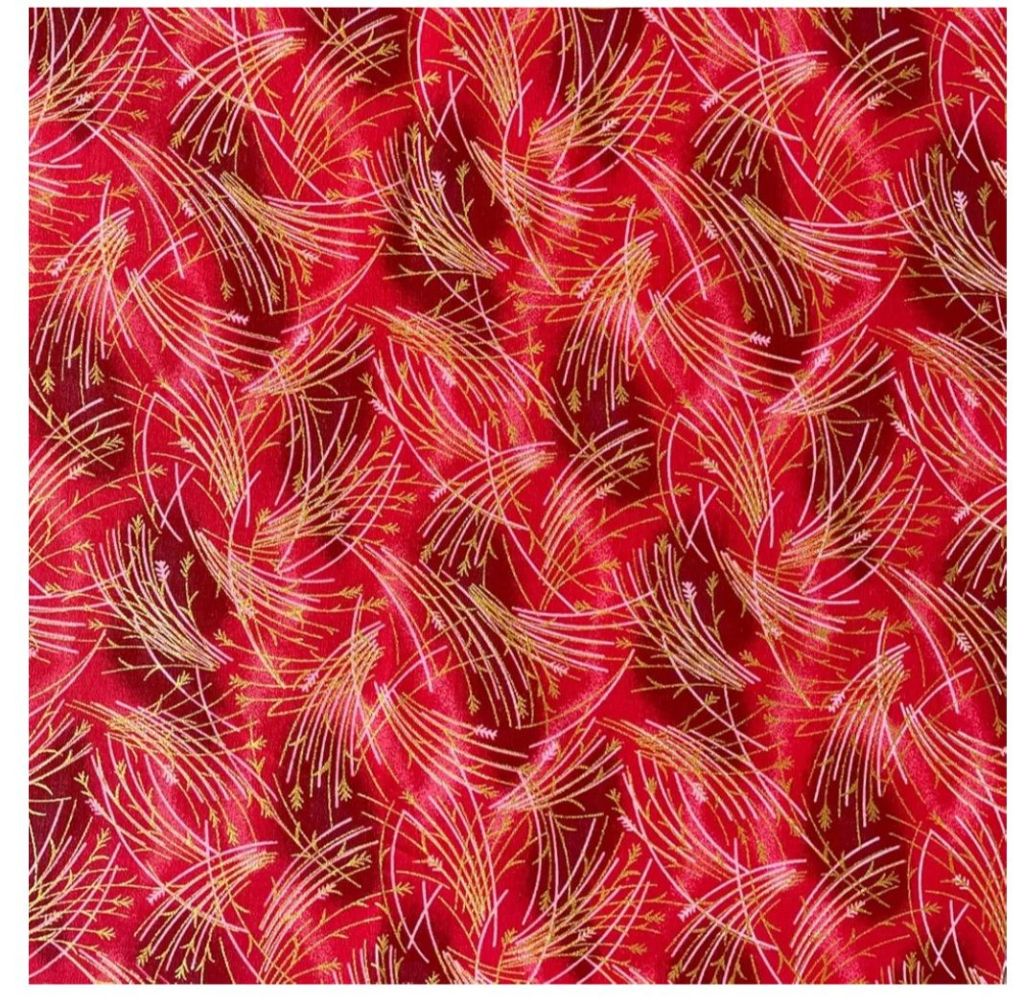
The whole exercise made me think of my research. I look at the information I’ve found, and try to find patterns. When I’m hunting down more detail, again, I’m looking for the ‘aha! That’s it!’ moment, when something fits into what I know, or hopefully augments it.
Here I have this singer and her repertoire. What did she sing? When? How often? Are there times when she sang more of one genre than another?
I’ve been down so many rabbit holes this week. If she sang THIS song, then did she know the lyricist (probably not, though their lives had interesting parallels), or did the lyrics mean more to her because of their subject matter? Did she know the individual for whom it was written? She did, at least by name! (They sang at the same concert.) Some parallels in their lives, too. Did she sing the song that was referenced within the song? Yes! (It’s a bit ‘meta’, I must admit, but I find it interesting.) It’s just one song, not by a composer I’d expected to encounter, but the connections are intriguing.
So far, so good. But there was still the question of another song she sang literally a couple of hundred times. In looking for a pattern, I got myself into a whole new-to-me subject area. Does it make my heart sing? I can’t say, yet. There’s still something I need to know. It might be significant, or it could be a red herring.
Maybe I should do some more patchwork, to calm myself down.
But there’s another parallel. I may not need quite as much extra fabric as I’ve ordered. (Or as much data …?)
Through sheer bad luck, all the men in my house had flu between Christmas and New Year. Call it Casa Influenza, if you will. I’ve been downing zinc, echinacea, and multivitamins with cod-liver oil – providing room service whilst wearing a mask, and cursing my FitBit for suddenly deciding to pass daily comment on my own levels of activity. It’s not counting the stairs, which I consider a very bad show considering how many times I’ve been up and down them. Then, after the first day of my Florence Nightingale gig, it observed I’d been overdoing it and should take a rest. So, I tried to rest the next day (as much as I could), whereupon it observed that I really needed to increase my cardio load. The third day, I walked to the postbox to increase my step-count, but this still wasn’t enough for FitBit. Stupid device!

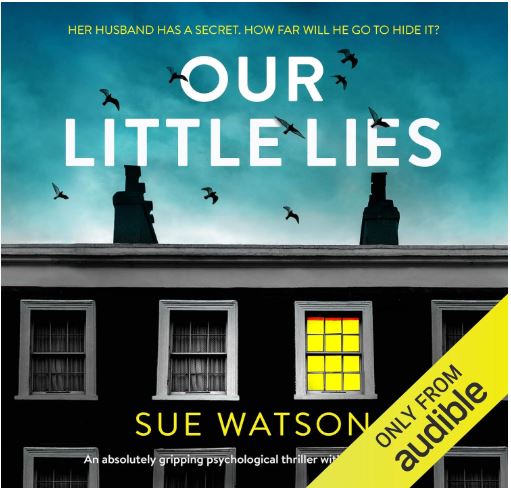
Left to myself downstairs for several days, I couldn’t help myself doing a little bit of research in between fetching and carrying coffee, soup and meals on demand. However, having done absolutely nothing about seeing the new year in last night, I decided that if I was going to make one resolution this year, then it would be to do something more relaxing than searching databases on a public holiday. Moreover, I had woken up early – again – and couldn’t get back to sleep. I reached for my headphones and settled down to an audiobook.
(10 hours and 8 minutes, narrated by Katie Villa.)
An absolutely gripping psychological thriller with a brilliant twist.
I settled down under my duvet, ready to be psychologically thrilled. Although it began pleasantly enough, I must confess that I was too cosy, and I fear I may have been a bit drowsy through a couple of the chapters near the beginning. This didn’t promise to be as exciting as I’d hoped. It seemed like rather a slow, pedestrian start. On the other hand, maybe I’d have got on better if I’d been sitting up in a chair, or doing something else at the same time, rather than nearly falling back to sleep! When I woke up properly again, I didn’t feel as though I’d missed much.
Having said that, I took my phone round the house with me today, and listened to the entire story enjoyably enough, interrupted only when one of my invalids needed sustenance to be supplied! It did get better as it went on. The heroine was believable, and the anti-hero’s determination to gaslight her, accusing her of madness and psychological instability, grew more and more chilling as the tale unfolded. Her husband was a serial adulterer, a manipulative bully, psychologically and sometimes physically abusive.
As you listen (or read), you really do feel the heroine is caught in a trap, where her husband would do anything to make her feel guilty, whether literally finding fault where there was none, or for genuinely pathetic infringements (not folding the throws tidily enough, not tidying up crumbs off the sofa, or allowing the twins to watch TV) – or for serious tragedies for which she was in no sense to blame.
Marianne was certainly obsessive. But her husband Simon, who was a brilliant and ambitious surgeon, convinced her GP to prescribe heavy tranquillisers, and you were left wondering (as Marianne did) whether she was going mad, losing her memory, losing her ability to cope or becoming paranoid – or was the medication causing side-effects?
Admittedly, at one point, I wanted to yell, ‘For pity’s sake, you need to leave him, taking your kids with you!’, but of course, she had no-one to go to; even her so-called new friend turned out to be disloyal in the extreme.
The final chapters were very clever. Marianne arranged a party in which she would reveal her husband (and his lover) in their true colours. There was a murder a couple of days later, and because she couldn’t recall exactly what had happened, she was arrested and held for a number of hours before being released. However, the denouement was not as straightforward as it would have appeared, and – as in the best whodunnits, the culprit eventually turned out to be someone else entirely.
It’s not a detective novel, or even a crime story as such – emotional and domestic abuse underpin the novel, but the murder comes near the end of the book and – as I said – there’s a twist in the last ten minutes.
I closed my Audible book feeling that I had actually chosen just the right book for a lazy New Year’s Day. I’d recommend it.

The aria, ‘Una Voce Poco Fa’ from Rossini’s Il Barbiere di Siviglia (The Barber of Seville) may have been composed in 1816, but it remains popular to the present day – a showpiece for coloratura sopranos. It was certainly an often-performed solo in recitals by the early 20th century star about whom I’m writing at the moment. In the context of the original opera, it’s sung by Rosina, whose overbearing guardian wants to marry her. Of course, Rosina’s sights are set on a handsome young suitor. (Eventually the barber sorts it all out. Of course!)
The Lyric Opera of Chicago gives you the relevant details on a handy page about the work, here.
You can find a translation on the Opera Arias Database.
But what, exactly, draws both singers and audiences to this amazing piece? Jenna Simeonov has written a guide for sopranos learning the aria, on the Schmopera website, and her introduction gives a few clues as to why it would have appealed to a talented young soprano:-
This is a cornerstone aria for many young mezzos, and one of the few chances they have to show off coloratura and play a girl. It’s also an aria full of options.
‘How-to Aria Guides: Una Voce Poco Fa (14 October, 2015)
Sure enough, the woman I’m researching was very young, so the role of Rosina would have felt like one she could empathise with.
Simeonov gives a great deal of useful advice on singing the later coloratura part of the aria, helpfully with a marked-up score to show what she’s talking about. She gives more insight into singing it, from a performer’s point of view, than I could possibly have hoped for, but in her opening words, also advises working with a singing teacher.
The fast part
As we get into the coloratura bits, I can offer some general, if incomplete, advice. Help yourself by always finding the larger tune within the string of sixteenth notes, and stay nice and light. For more specifics, get thee to thy voice teacher.
Looking at the score – my goodness, talk about vocal acrobatics! Swooping scales, trills and other ornamentation, high notes, tricky fast passages that would challenge any soloist – and that’s before the conductor tries to keep an orchestra in synch with ‘Rosina’. Or it’s up to the pianist, in a recital context. No wonder ‘my’ singer was in the habit of noting if her allocated accompanist was good, bad or indifferent!
Here’s Kathleen Battle singing the aria – a beguiling, and impeccable performance:-
(Kathleen Battle – Rossini: ‘Una voce poco fa’, from the opera Il Barbiere di Siviglia by Gioacchino Rossini. Recorded in Antwerpen December 1984. From the TV show: Rene Kollo – Ich lade gern mir Gäste ein.
So, it really is completely understandable why it’s such a well-loved piece of the repertoire, isn’t it?!
Cover image from IMSLP: Editor Castil-Blaze (1784-1857)
Pub. Info. Paris: La Lyre moderne, n.d. Plate 346.
Copyright: Public Domain
Misc. Notes Biblioteca Fondazione Rossini Pesaro
 Karen McAulay, Musicologist