Also on This Day: Hogmanay, Greenock, 1873

Photo of the laying of the foundation stone, Albert Harbour Greenock Illustrated London News 23 August 1862

There are a few places where my in-laws’ history and my own research findings overlap. Glasgow is one of them, and Greenock is another. I know the stories of three mid-nineteenth century Greenock boys, all with family connections to shipping on the River Clyde: I encountered two of them whilst researching Scottish music publishers, but the other one is indirectly linked to me by marriage. 

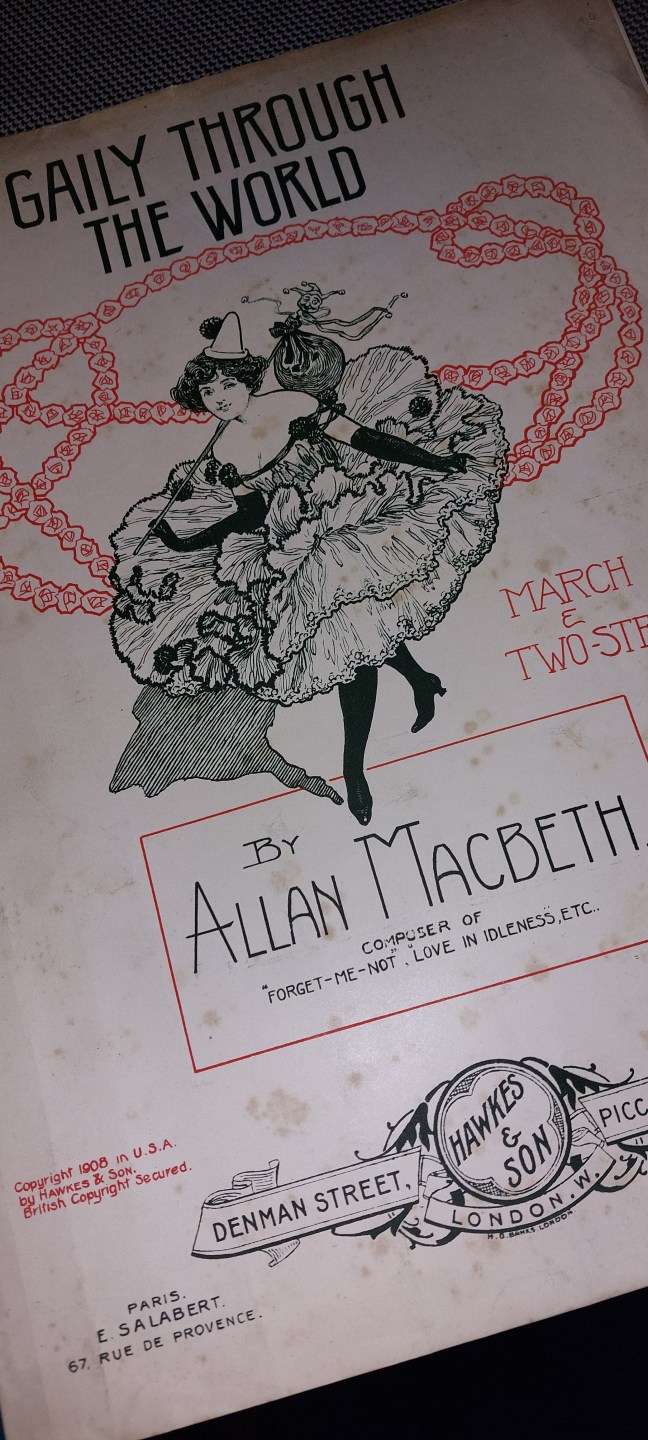
Allan Macbeth (1856-1910): Athenaeum School of Music Principal

Allan Macbeth was born in Greenock in 1856 to an eminent artist.  After the family had moved to Edinburgh, he had two spells studying music in Germany, but he did return to Scotland.  He married the daughter of a Greenock builder, ships carpenter, timber-merchant and saw-miller.  Between 1880-7, he conducted Glasgow Choral Union.

Between 1890 -1902, he was Principal of Glasgow’s Athenaeum School of Music, building it up to a size barely imagined by the early directors.  In 1902, he left to open his own Glasgow College of Music in India Street, taking umbrage after the Athenaeum directors decided they didn’t want a Principal who also taught classes.  His own college appears to have died with him when he died in 1910. 

Technically capable, in terms of musicianship, he wrote a quantity of lightweight music, eg his Forget me Not intermezzo and Love in Idleness serenata, both of which were subsequently re-arranged for different instrumentations, shortly after his death. Barely any of his music was published in Scotland – It was almost all published in England by a mixture of big and very small names. 

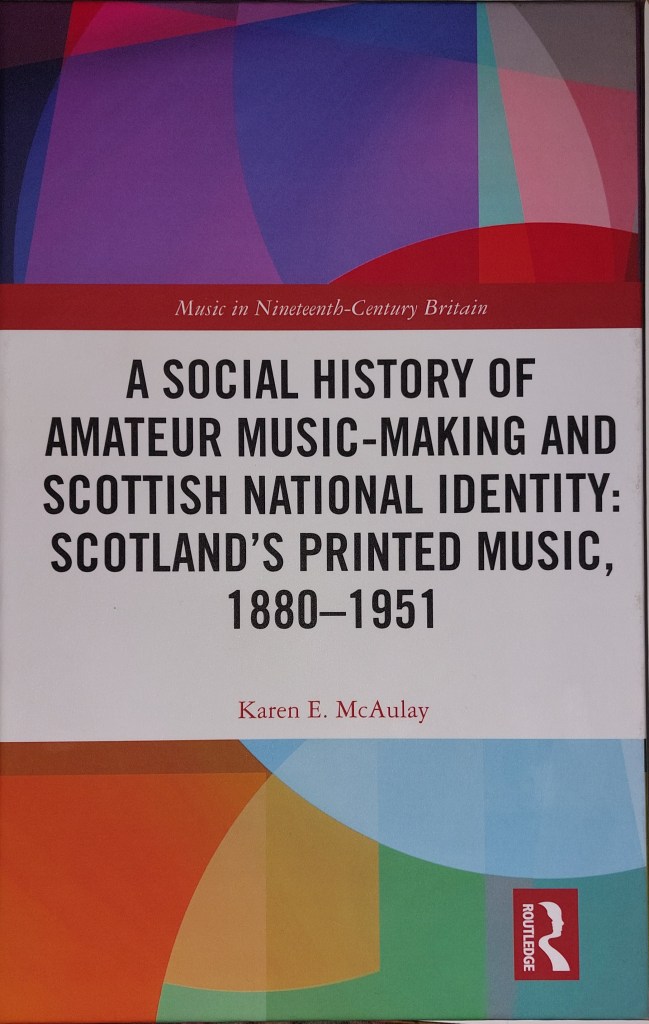
Macbeth was one of the arrangers of James Wood and Learmont Drysdale’s Song Gems (Scots) Dunedin Collection, published in 1908 both in London and Boston, Massachusetts. Indeed, my own copy came from Boston, though there had also been an Edinburgh distributor.  His Scottish song arrangements were typically late Romantic in style.  The collection was aimed at a musically and culturally educated middling class, knowledgeable about Scottish poetry of earlier times.  For example, his setting of Walter Scott’s ‘The Maid of Neidpath’ was set to an earlier tune by Natale Corri – hardly of Scottish origin! – with lush harmonies.  I wrote about the collection in my A Social History of Amateur Music Making and Scottish National Identity (Routledge, 2025).

Macbeth’s son, Allan Ramsay Macbeth, briefly attended Glasgow School of Art (GSA) as an architectural apprentice before leaving to become an actor, and one of his cousins, Ann Macbeth, became head of embroidery there.

James [Hamish] MacCunn (1868-1916)

Twelve years after Macbeth’s birth, a second musical boy was born in 1868, this time to a wealthy ship-owning family in Greenock. The family firm later went bankrupt, but not before James MacCunn had benefited from a composition scholarship to the newly established Royal College of Music in London at a very young age.  Like Macbeth, he left Scotland to further his musical education.  He styled himself Hamish to suit his ostentatiously Scottish persona, and spent the rest of his life in England, determined to live in the style to which he had become accustomed.  His compositions were on a decidedly larger and more ambitious scale than Macbeth’s, but he perhaps didn’t live up to his early adult promise, and his insistence on flaunting his Celtic origins may ultimately have gone against him. He too gets a mention towards the end of my Social History of Amateur Music Making.

McAulay (McAuley, MacAulay) Hogmanay, 1873

Also in the 1860s, my grandfather-in-law was born in Greenock to a much lowlier family, in 1866.  (If you’re trying to calculate how my grandfather-in-law was born 159 years ago, shall we just say that age-gaps account for a lot.) This baby was the second Hugh born in the family, after the first one died of teething.  Life wasn’t easy for the illiterate working-class poor; this family had already moved from Ballymoney on the north coast of Ireland, in pursuit of work on the Clyde.  His father Alexander worked in the shipyards as a hammerman until his untimely demise one Hogmanay.  Last seen on 31 December 1873, Alexander drowned in Albert Harbour and was found a month later. Did he jump, or was he pushed? We’ll never know!

My husband’s grandfather Hugh was later to move his young family to Tyneside in pursuit of work as a ship’s carpenter.  Family mythology has various spellings of our name – but since our immigrant Irish McAulays were illiterate, there is no correct spelling. It was spelled however the registrar, or newspaper editor, chose to spell it. There was an embroidered family tale about my Great-Grandfather-in-Law, erasing the embarrassing Hogmanay drowning – and another story about Grandpa-in-Law’s move to Tyneside after a dispute with his foreman (which has every chance of being equally inaccurate).

I can’t help comparing how different were the lives of the two promising young musicians, and the Clydeside then Tyneside shipyard worker who was to thrive on tonic sol-fa, and whose adult family were to make up at least half of their Presbyterian church choir!

Image: Photo of the laying of the foundation stone, Albert Harbour Greenock, from the Illustrated London News 23 August 1862, p. 9 (British Newspaper Archive)

Now, About a Fifth Book of Scottish Songs?

Nelson's Scots Song Book, Book Four. The last in the series.

Yesterday, I highlighted the 85th anniversary of the Blitz that destroyed Paternoster Row on Sunday 29th December 1940 – and with it, Thomas Nelson’s London premises.

Today, 30th December, we leap forward to 1954. The Second World War had ended nine years earlier. The country was picking itself up again, and James Easson and Herbert Wiseman had published four books of Scottish songs in the series, ‘Nelson’s Scots Song Book, primarily for school use. I’ve done a lot of research into this series, during my Heritage Collections visiting Fellowship at IASH in the University of Edinburgh, so I’m sure you’ll understand that I won’t be saying much about it today – all will be revealed in due course! However, I can reveal that Easson seems to have written a letter to his editor on 30th December 1954, with the expectation of compiling a fifth book. The letter is no longer extant, but the carbon copy of their reply survives.

There was no fifth book.

The Blitz – 85 Years ago, Tonight

This week in Scottish publishing history:-

There ain’t no Paternoster Row

Those were the words of a London Bobby (policeman) the following day, when someone asked about the bombing damage.

Luckily, Thomas Nelson had moved quite a few staff up to their Edinburgh offices at the start of the Second World War,  but some remained in London. But the London offices at 35-36 Paternoster Row were destroyed in the Blitz, on Sunday 29 Dec 1940. 

I find myself wondering how strange – indeed, traumatic – it must have been, to head into work the next morning and find first of all, that public transport was disrupted, and then later, by whatever means, to learn that the firm’s premises were flattened.

Temporary premises were found with another publisher, Duckworth at 3 Henrietta Street.  Not until 1954 were larger premises found for Nelson’s at 36 Park Street, in Mayfair.

Publishing in flames on Paternoster Row

Listen to the first episode of this series on Radio 3, 5th May 2025 (14 mins). Series: Books for Brighter Blackouts:- ‘As the BBC marks the 80th anniversary of VE Day, Professor Emma Smith uncovers five unexpected stories about how World War Two changed books, publishing and reading forever.’ The essay is about that very night of destruction. I was thrilled to find that Professor Smith interviews Professor Andrew Pettegree, an eminent authority in the University of St Andrews; and Liam Sims from the University of Cambridge; amongst other experts.

Q. Name a Scottish Song Collector who Features in Both my Books!

The Songs of Scotland edited by George Farquhar Graham et al. Title page
Songs of Scotland

I couldn’t find a nice anniversary for yesterday, but I certainly have one for today, 28th December.

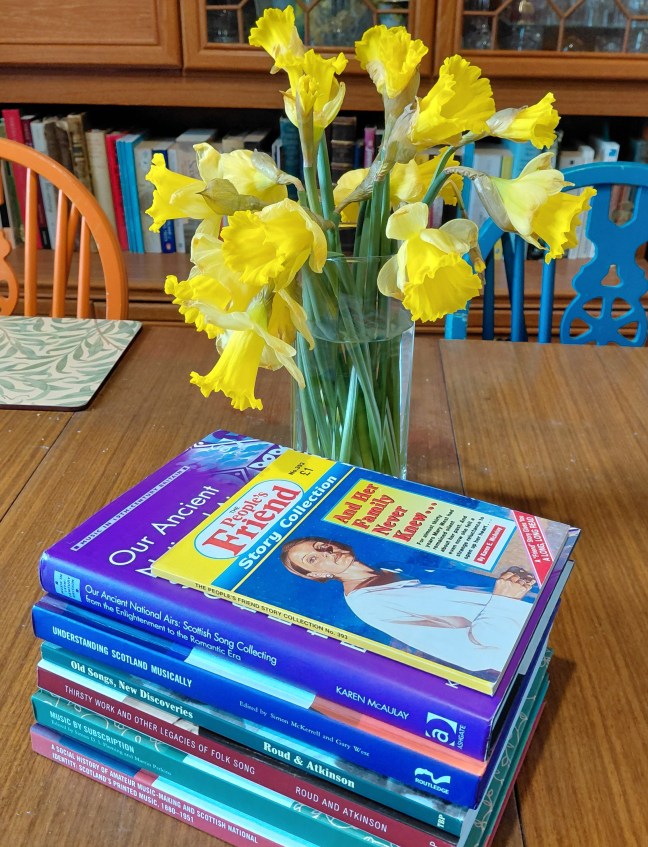
Journo, music critic, and Scottish song compiler George Farquhar Graham (1789-1867) was the editor of John Muir Wood’s long-lived song collection, Songs of Scotland, first published in 1848.  As such, he featured heavily in my Our Ancient National Airs.  But the book enjoyed an afterlife as one of Bayley and Ferguson’s handsome reprints – The Popular Songs and Melodies of Scotland  – thus getting a mention in A Social History of Amateur Music-Making and Scottish National Identity, too.

Where’s all this going? Well, today is Graham’s 236th birthday – ‘Many happy returns,  Sir!’

The Popular Songs and Melodies of Scotland

The Editor’s Boxing Day

Old-fashioned wooden wheelchair

Followers of this blog will already know my penchant for anniversaries. This festive season, I’ve decided to indulge myself – and you, dear reader – with the kind of trivia that doesn’t make it into my research writing.

90 years ago today, Thomas Nelson editor Richard Wilson was languishing in hospital. (On Boxing Day – how miserable!) His daughter had been handling his correspondence whilst he was ill, so he could keep in contact with his boss.  But by Boxing Day, he’d been able to check the page proofs of the Music Guide (a teaching manual) from his hospital bed.

Now, I know he was a dedicated soul – but I also know that the series editor (not his boss) of the teaching series, ‘Music Practice’, was agitating to get these books published as soon as possible. Sooner, if at all feasible!

Let’s hope Wilson’s efforts didn’t delay his recovery …

Christmas was No Big Deal in the Highlands in 1812

Old book with pen, on old wooden desk

I just remembered a tiny detail about Sir John Macgregor Murray that didn’t make it  into my recent Folk Music Journal article!

213 years ago today, we’d have found him at his writing desk, Christmas Day or not.  He was writing to Lewis Gordon about,

‘inspecting the Materials collected by the Society.’

This was in connection with the Gaelic dictionary project.  In fairness, they didn’t make a big splash of Christmas then. At least he was doing something he enjoyed!

***

‘Sir John Macgregor Murray: Preserver of Highland Culture, Music and Song’. Folk Music Journal vol. 13 no.1, pp.50-63. 

A Retrospective, Prompted by the Anniversary of a Letter being Sent

William Chappell, Popular Music of the Olden Time (modern reprint by Elibron)

170 years ago today,  antiquarian ballad and song collector William Chappell sent an unintentionally incendiary letter to Andrew Wighton!

It is difficult to find really good tunes of this early date, because there is so little genuine Scotch music in print – although plenty of Anglo-Scottish.

Sparks flew in Dundee.  How dare Mr Chappell suggest that much of Scotland’s song repertoire wasn’t really Scottish, but some kind of English-worked mishmash? Sparks also flew in Aberdeen, when Chappell’s song-collection was published, on account of his extensive annotations.

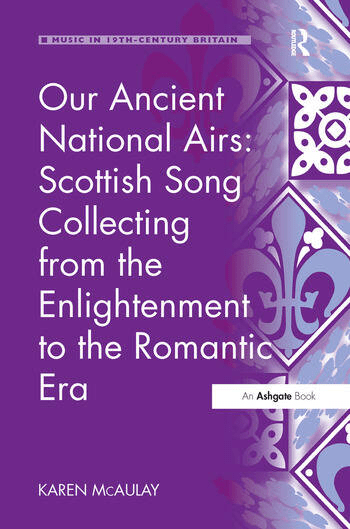
This is actually part of a larger story, which I explored in the final chapter of my first book, Our Ancient National Airs: Scottish Song Collecting from the Enlightenment to the Romantic Era. Chapter 8 is headed,

The Feelings of a Scotsman’ and the Illusion of Origins in the Later Nineteenth Century‘.

CAST LIST:-

  • William Chappell, English antiquarian and song collector; author of Popular Music of the Olden Times;
  • Andrew Wighton, Scottish shopkeeper and song-collector in Dundee (his amazing collection was bequeathed to the city, and The Wighton Collection is now in the Central Library);
  • James Davie, crusty old Aberdonian musician and song-collector, fiercely patriotic and with a strong dislike of Chappell and all that he stood for;
  • David Laing, Edinburgh librarian, authority on Scottish literature and songs, and altogether good chap, generous in sharing his knowledge.

If you’re interested in learning more, my book is available in quite a few libraries or in paperback, e-book or Kindle format. Chappell’s collection is also readily available.

‘”Heart-Moving Stories” Illustrated by Magic Lantern’: freshly published article

This morning saw the arrival of the latest issue  of The Magic Lantern (no.45, December 2025) containing my article, ‘”Heart-Moving Stories” Illustrated by Magic Lantern’.  I’m grateful to have had this opportunity to share a favourite bit of research, to which I alluded briefly in my recent monograph.

‘”Heart-Moving Stories” Illustrated by Magic Lantern’, The Magic Lantern no.45 (Dec 2025), pp. 11-12.

Contents of issue 45, The Magic Lantern

Ethical Approval: a Must

Scrabble letters spelling Projects, Jobs, Done

My next research project requires ethical approval – interviewing real live people rather than writing about people long since departed.  And it’s imperative that I get my submission in on time, since the next meeting of our ethics committee is early next year.  

I’ve been working on it for weeks. (Admittedly, I’m a part-time research fellow, so I technically have only 10.5 hours a week to get my research activities done. Yes, we all know that the reality is different!) Anyway, yesterday was my own deadline: it just happened to be the last day we’re open before Christmas, and the morning after my last working day this year.

Efficiency (and Thoroughness)

There’s only one way to fill in a form efficiently, and that’s to make sure every question is answered satisfactorily. To this end, I go through and make myself a list of the information I must provide. Over the past few weeks,  I assembled the info. Attachments were created and labelled. And here’s where Tuesday (not a ‘work’ day) and Thursday came unstuck. I wanted to have a particular collection of old newspaper excerpts to share as an interview prompt.  Finding and listing them was easy enough. Formatting the document in Word, though? With clips of the excerpts? It took hours!

Have I Forgotten Anything?

Finally satisfied, I turned back to the form. And there – I swear they weren’t there when I initially saved it! – were a couple more questions with grey-shaded boxes requiring answers. And attachments.  What a good thing I double-checked. ✔️

It’s done. Phew! Details of whom I hope to interview, what I’ll be asking, and how I’ll save and use the gathered information, are all itemised.

And … breathe!

I submitted it. Ensured everyone involved could access it. At last, I can stop thinking about it until after Christmas!

Now, where’s the domestic to-do list (all the stuff I need to do, because no-one else will think about it) …?

Christmas cheer!

Image by Daniel Schmieder from Pixabay

My IASH Fellowship Ends …

IASH - Institute for Advanced Studies in the Humanities

‘All good things must come to an end’, as the saying goes. And an IASH Postdoctoral Research Fellowship is a thoroughly good thing.  I handed back my keys with sadness today, but I have had a great year. (The Fellowship was technically six months, but I was graciously permitted to hang around, retaining the use of my office for the rest of the year, which was wonderful, and enabled me to continue data-gathering in the Library’s Heritage Collections.)

If you are looking for a next step after your PhD, or if like me, you’re making a change of direction – or need a spell concentrating on a particular research question in the Humanities – do consider applying.

I devoted my time to examining the archives of the Edinburgh publishers, Thomas Nelson.  I initially entitled my project, ‘From National Songs to Nursery Rhymes, and Discussion Books to Dance Bands: investigating Thomas Nelson’s Musical Middle Ground’, but the nursery rhymes turned out to be poems, and weren’t what I had in mind! The rest? Yes, I researched them.

I found quite a bit of correspondence between Thomas Nelson’s editors, authors and compilers, which was gratifying. I was able to trace material in journals that I would not have had access to, had I not been in Edinburgh; there’s the excellent University Library collection of actual and digital resources, and the National Library of Scotland just down the road.

I have deferred commencing any significant written work until I had explored all the potentially relevant materials in the files. I believe I’ve now reached that point.  As a result of conducting this research, I have ideas for extending my research in new directions, and I’m contemplating writing another book, so I need not only to explore potential audiences, but also to start working on a book proposal

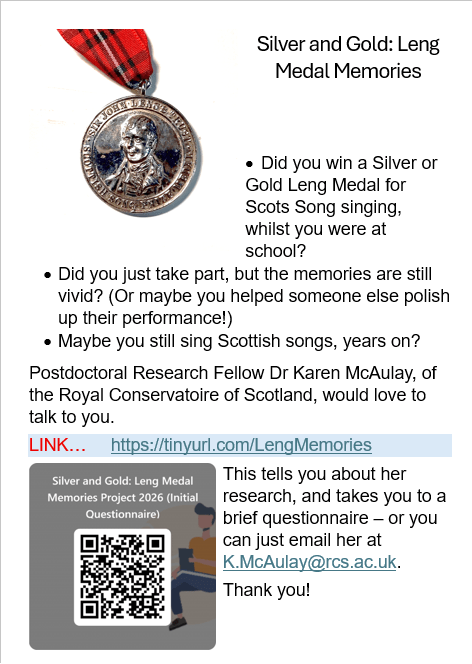
However, I have also applied for and recently won an Athenaeum Award from the Royal Conservatoire of Scotland to enable me to conduct an oral history project. This work, to be conducted in 2026, will hopefully enable me to write a final chapter for my proposed monograph. (I’ll be blogging about this before too long, but there are things I need to do first, before I spill the beans!)

I have benefited from being part of a research community, hearing other scholars’ papers and discussing our research; and attending researcher development sessions. I  was able to focus on my new direction as a researcher – important, after so many years as an ‘alt-ac’ researcher working in professional services. In this regard, I have also been in a position to submit some other unrelated work for publication, and I spoke at a conference at the University of Sussex in June, all of which gives me a sense that my research is gathering momentum.

Today, my last day, I took a cake to the University Library’s Heritage Collections; went to IASH’s Christmas lunch; and mulled over aspects of my ethical approval submission for my next project. (Oh, and drank quite a bit of coffee!)

Thank you so very much for a great year, IASH!

IASH (Institute for Advanced Studies in the Humanities)